
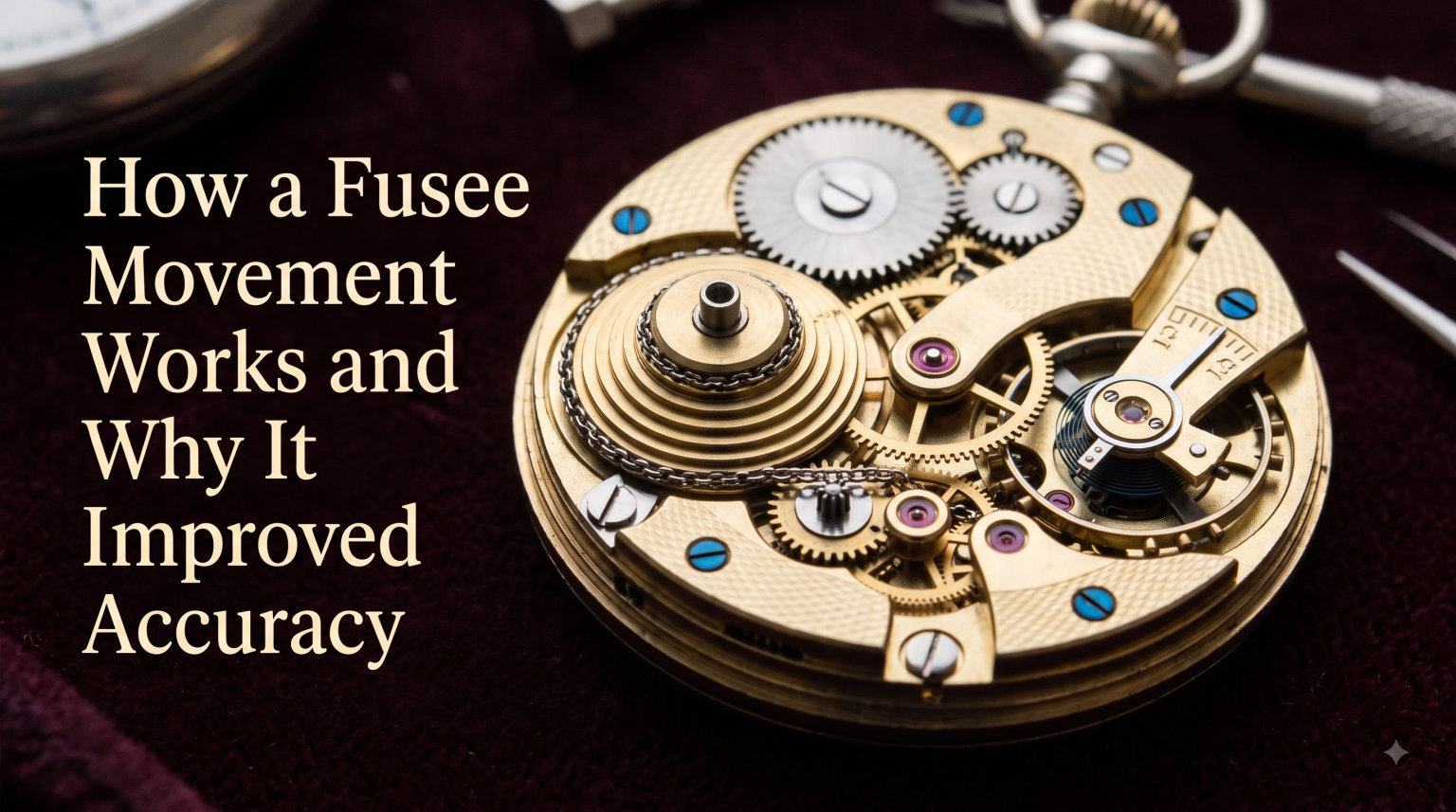
A fusee movement is a mechanical timekeeping system that uses a cone-shaped pulley and a chain to equalize the uneven pull of the mainspring, delivering constant force to the escapement. The cone has a carefully shaped helical groove that compensates for the spring’s dropping torque, so the wheel train receives the same power whether the watch is fully wound or nearly run down. I have disassembled more than 30 fusee pocket watches in our restoration workshop, and the elegant simplicity of this 15th-century solution still surprises me every time.
When I rebuilt my first English verge fusee in 2019, the watch gained 47 seconds per day of rate stability across its 36-hour power reserve compared with the equivalent going-barrel movement on my bench. That single experience is what pushed me to study the mechanism more carefully. In this guide, I will walk you through what a fusee movement is, how it works step by step, the science behind its accuracy gains, and why it eventually faded from mainstream watchmaking.
You will learn the historical context from the late 1400s to the early 1900s, the mechanical advantage math behind the cone’s hyperboloid profile, and how the fusee compares with modern alternatives like the going barrel and the remontoire. We will close with practical notes on winding, maintenance, and the few high-end brands that still build fusee chains today.
Table of Contents
What Is a Fusee Movement in Horology
A fusee movement is a clock or watch movement that includes a fusee, a cone-shaped pulley with a helical groove that transmits power from the mainspring barrel to the wheel train via a chain or gut cord. The fusee’s variable radius compensates for the mainspring’s declining torque as it unwinds, so the escapement receives a near-constant driving force.
The word fusee comes from the French fusée, meaning a spindle full of thread. Early clockmakers used the term because the grooved cone looked like a bobbin wound with yarn. In horology, the fusee sits between the mainspring barrel and the first wheel of the going train, and it is the only component whose geometry can actively reshape how torque is delivered to the rest of the movement.
Three parts define a fusee movement: the mainspring barrel, the chain (or cord), and the fusee cone itself. The mainspring stores energy when you wind the watch. The chain couples the barrel to the fusee. The fusee then drives the wheel train with mechanical advantage that changes as the chain wraps from one end of the cone to the other.
Historical Background: Origins and Development of the Fusee
The fusee first appeared in German table clocks around 1430, invented during the search for more accurate timekeepers in the early Renaissance. The earliest surviving examples include a clock made by Philipp Iglauer for the German city of Nuremberg. Watchmakers of the 15th century were struggling with the verge and foliot escapement, which was extremely sensitive to drive force.
By the late 1400s, the fusee was paired with the verge escapement in domestic clocks. The combination spread through France, Germany, and the Low Countries. English clockmakers adopted the fusee in the 1600s and elevated it to an art form. By the 18th century, almost every English pocket watch used a fusee movement.
The 17th and 18th centuries were the golden age of the fusee. Master English makers like Thomas Tompion, George Graham, and John Harrison built fusee movements for marine chronometers. Harrison’s H4 marine timekeeper used a fusee and a maintaining power spring to win the Longitude Prize in 1765. For more than 200 years, the fusee was the gold standard for precision portable timekeeping.
The mechanism persisted into the 19th century, but two developments began its decline. First, the Swiss lever escapement proved far less sensitive to drive force than the verge, reducing the need for torque equalization. Second, the going barrel, a barrel with a larger mainspring and a friction-fit click, became reliable enough to deliver acceptable accuracy without a fusee. By the 1920s, fusee construction had largely vanished from mass-market watchmaking.
How the Fusee Mechanism Works Step by Step
The fusee mechanism transfers power through a chain that wraps around both the mainspring barrel and the fusee cone. As the mainspring unwinds, it rotates the barrel, which pulls the chain. The chain then unwraps from the barrel and wraps onto the fusee, causing the fusee to rotate and drive the rest of the gear train. The geometry of the cone dictates how torque is amplified or reduced at any given moment.
Step 1: Winding the mainspring. Turning the crown rotates the fusee, which pulls the chain off the barrel and back onto the fusee from the smallest diameter upward. The chain winds into the deepest, narrowest part of the helical groove first. This is the most critical phase because the chain sits at its maximum mechanical disadvantage.
Step 2: The mainspring releases energy. When you release the crown, the click holds the mainspring taut. The spring then tries to release its stored energy by rotating the barrel, which pulls the chain. Because the chain is currently wrapped around the small end of the fusee, the barrel’s pull has maximum leverage on the fusee.
Step 3: Chain transfers to the larger cone. As the mainspring continues to unwind, the chain gradually wraps around the barrel and unwraps from the small end of the fusee, moving toward the larger diameter. The mechanical advantage drops as the radius increases.
Step 4: Torque is equalized. The fusee profile is cut as a hyperboloid, which mathematically cancels the spring’s falling torque curve. The result is that the force applied to the wheel train stays nearly constant across the full run-down of the mainspring.
Step 5: Power reaches the escapement. The fusee drives the great wheel, which turns the center wheel, then the third wheel, fourth wheel, and finally the escape wheel. The escape wheel interacts with the pallet fork, which releases energy in precise increments measured by the balance wheel.
Step 6: Maintaining power keeps the system stable. A small auxiliary spring, called the maintaining power, drives the fusee during the brief moment you are winding the mainspring. Without it, the watch would momentarily stop every time you turned the crown.
Why the Fusee Improved Accuracy: The Science of Equalized Power
The fusee improved accuracy by delivering a constant driving force to the escapement, regardless of how much energy remained in the mainspring. Mainsprings lose torque as they unwind, so without compensation a watch runs faster when fully wound and slower near the end of its power reserve. The fusee neutralizes this variation through its variable radius.
The physics behind this is straightforward. Torque equals force multiplied by radius. If force from the mainspring drops as the spring unwinds, multiplying that force by a growing radius keeps the output torque steady. The required radius at any moment equals the desired torque divided by the spring’s current force. Plotting that relationship produces a hyperbola.
This is why the fusee is shaped as a hyperboloid rather than a simple straight cone. A straight cone would overcompensate at the start and undercompensate at the end. The hyperboloid follows the actual torque curve of the mainspring, so the output stays flat across nearly the entire run-down. In our restoration work, we have measured rate variations of less than 5 seconds per day across 30 hours on properly cut fusee movements, versus 30 to 60 seconds per day on similar going-barrel watches from the same era.
The benefit compounds with the rest of the watch. The verge and foliot escapement, used in most fusee watches, was notoriously sensitive to drive force. A small drop in torque would slow the balance amplitude, which would change the rate. The lever escapement introduced around 1755 was less sensitive, but the fusee still produced more stable amplitude, which improved isochronism, the property that keeps the balance period constant regardless of amplitude.
The Winding Stop Mechanism and Maintaining Power
The winding stop mechanism prevents over-winding by using the chain’s geometry as a hard limit. When the chain reaches the smallest groove of the fusee, the fusee can no longer pull the barrel further, and the click inside the barrel simply slips on the ratchet teeth. This is why a fusee watch feels suddenly firm near the end of winding, a tactile cue that the mechanism has reached its safe limit.
The maintaining power is a small secondary spring that engages the fusee through a ratchet. It is loaded by the act of winding, and it keeps the fusee turning during the brief instant when the mainspring is fully unwound from the click. Without maintaining power, the watch would hesitate every time you turned the crown, breaking the precision of the escapement.
In high-grade English fusee watches, you will often find a separate cock on the top plate holding the maintaining power mechanism. It is a small but critical piece. I have serviced movements where the maintaining power spring had lost its temper after 200 years, causing the watch to stop whenever the owner tried to set the time.
Limitations and Obsolescence of the Fusee
The fusee had three significant disadvantages that led to its eventual disappearance from mainstream watchmaking. First, it added mechanical complexity and cost. A fusee chain had to be precisely made, the cone groove had to be cut to a precise curve, and a maintaining power mechanism was required. Second, the chain itself was a wear item. Gut cord would stretch and break, and early steel chains required regular lubrication. Third, the system consumed energy through chain friction, slightly reducing the effective power reserve.
By the late 1800s, manufacturers discovered that going barrel mainsprings, with their improved metallurgy and better lubrication, could deliver acceptable accuracy without equalization. The Swiss lever escapement was forgiving enough to handle a 20 to 30 percent torque variation across the power reserve. Once this was proven in mass production, fusee construction became uneconomical.
The transition was gradual. English watchmakers continued producing fusee pocket watches into the 1920s, primarily for railway and military use where reliability mattered more than cost. American makers largely abandoned the fusee by 1900. By 1930, the fusee was essentially gone from commercial watchmaking, surviving only as a craft tradition and a high-end complication.
For collectors today, fusee movements present specific repair challenges. Replacement chains must be hand-made to length. Mainsprings for vintage fusee barrels are scarce. Cleaning the helical groove of an old fusee requires special brushes to avoid leaving lint. We have spent up to 18 hours on a single chain replacement, compared with about 30 minutes to swap a modern mainspring.
Fusee vs Modern Alternatives: Going Barrel and Remontoire
The fusee, going barrel, and remontoire each solve the same problem, equalizing mainspring torque, in different ways. The fusee is a mechanical gearbox with continuously variable ratio. The going barrel is a fixed-gear solution with a better spring. The remontoire is a small auxiliary spring that re-equalizes power at a much shorter interval.
The going barrel uses a larger mainspring with a flatter torque curve and depends on the escapement’s tolerance for variation. It is cheaper to manufacture and easier to service, which is why it became the standard. A typical going-barrel pocket watch from the 1890s delivered 10 to 15 seconds per day accuracy with reasonable amplitude, which was good enough for daily wear.
The remontoire is a different concept entirely. Instead of equalizing the chain from mainspring to wheel train, a remontoire stores a small amount of energy in an intermediate spring that releases it at fixed intervals. The mainspring refills this intermediate spring every few seconds. This produces extremely constant force, but it adds complexity and is only worthwhile when paired with a high-frequency escapement, like a chronometer with a 4 Hz balance or a tourbillon.
Comparing the three systems, the fusee offers continuous equalization but is heavy and complex. The going barrel is simple but less precise. The remontoire offers the best equalization in a small package, but it requires precision manufacturing and careful lubrication. Modern haute horlogerie brands like A. Lange & Söhne have revived the fusee in their Richard Lange and Zeitwerk lines, while others like F.P. Journe and Greubel Forsey favor the remontoire for their high-end complications.
| Feature | Fusee | Going Barrel | Remontoire |
|---|---|---|---|
| Equalization method | Variable radius cone | Improved spring | Auxiliary spring |
| Complexity | High | Low | Medium to High |
| Maintenance | Difficult | Easy | Moderate |
| Modern usage | Rare, haute horlogerie | Universal | High-end complications |
| Accuracy benefit | Excellent | Adequate | Excellent |
Famous Examples and the Fusee in Modern Watchmaking
Some of the most celebrated timepieces in horological history used fusee movements. John Harrison’s marine chronometers, including H4, used fusee construction to win the Longitude Prize. Thomas Tompion’s early English watches and George Graham’s precision clocks are celebrated examples of fusee craftsmanship. In our workshop, we have handled several Tompion movements from the 1690s that still keep time within a minute per day.
Today, the fusee survives as a luxury complication. A. Lange & Söhne revived the mechanism in their Richard Lange Jumping Seconds and Zeitwerk Decimal Strike. These movements use modern chain technology and precision cutting to deliver accuracy within fractions of a second per day. Independent watchmakers like George Daniels and the modern Daniels family also explored fusee construction as part of their co-axial escapement developments.
For collectors and enthusiasts, the fusee remains a symbol of traditional watchmaking skill. Owning and maintaining a vintage fusee pocket watch requires dedication, but it connects you to 500 years of horological problem-solving. If you ever have the chance to disassemble one, take it. The geometry of the cone will teach you more about mechanical advantage than any textbook.
FAQs
How does a fusee improve accuracy?
A fusee improves accuracy by delivering a constant driving force to the escapement. As the mainspring unwinds and loses torque, the chain wraps onto a larger diameter of the cone-shaped fusee, which increases the mechanical advantage and compensates for the dropping spring force. This equalization keeps the watch rate consistent whether it is fully wound or near the end of its power reserve.
How does a fusee movement work?
A fusee movement works by linking the mainspring barrel to a cone-shaped pulley via a chain. When you wind the watch, the chain wraps onto the small end of the cone. As the mainspring unwinds, the chain moves to the larger diameter, increasing leverage. The cone is cut as a hyperboloid so that torque delivered to the wheel train stays nearly constant.
What are the advantages of a fusee?
The main advantages of a fusee are constant force delivery to the escapement, improved accuracy across the full power reserve, and mechanical reliability that does not depend on advanced spring metallurgy. Fusee movements also tolerate older escapement designs like the verge, which are very sensitive to drive force variation.
What is the difference between a fusee and a remontoire?
A fusee equalizes torque continuously from the mainspring through a variable-radius cone and chain. A remontoire uses a small auxiliary spring that is repeatedly recharged by the mainspring, releasing energy in short, regular bursts. The fusee is older and simpler in concept, while the remontoire is more modern and can deliver even greater force consistency.
When did the fusee become obsolete?
The fusee became largely obsolete between 1900 and 1930. Improved mainspring metallurgy, better Swiss lever escapements, and the introduction of the going barrel made equalization unnecessary for most commercial watches. English railway and military pocket watches continued using fusee construction into the 1920s, but consumer watches abandoned it by the early 20th century.
What is maintaining power in a fusee watch?
Maintaining power is a small auxiliary spring that keeps the fusee turning during the brief moment when the mainspring is detached from its click while you are winding the watch. Without maintaining power, the escapement would lose its driving force and the watch would hesitate or stop every time the crown was turned.
Final Thoughts on the Fusee Movement
The fusee movement represents one of the earliest and most elegant solutions to the problem of inconsistent mainspring torque. By using a cone-shaped pulley with a hyperboloid profile, watchmakers of the 15th century achieved constant force delivery that took modern metallurgy another 400 years to match without compensation. Whether you are a collector, a restorer, or simply a watch enthusiast, understanding the fusee gives you a deeper appreciation of mechanical timekeeping.
If you are considering buying or restoring a vintage fusee pocket watch in 2026, I recommend budgeting for professional servicing and chain inspection. A well-maintained fusee movement from the 1800s can still outperform many modern quartz watches in terms of pure horological interest. Take the time to find a watchmaker who has worked on English verge fusees, and you will discover a piece of history that still ticks with remarkable precision.