
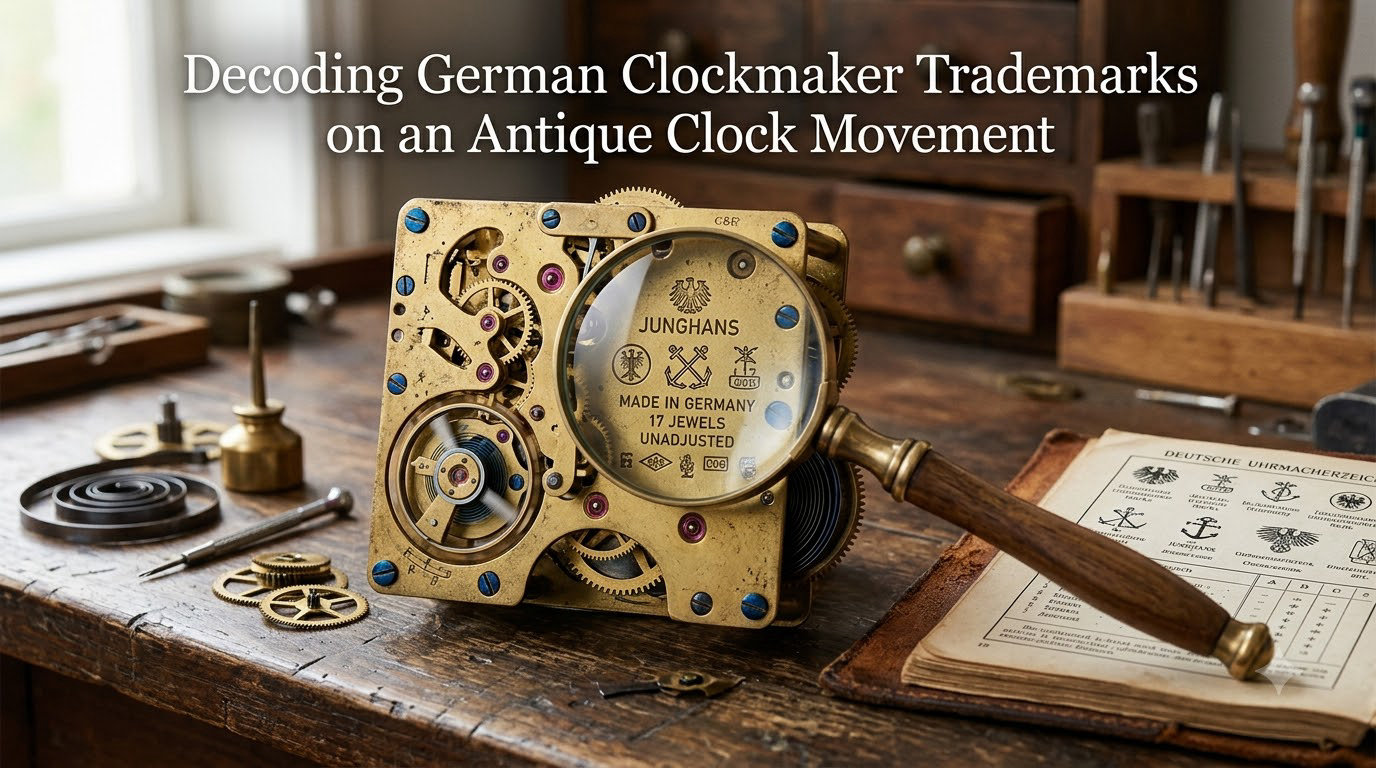
German clockmaker trademarks stamped onto antique movements are the single most important clue for identifying who made your clock, when it was produced, and what it is worth. These marks, pressed into brass backplates and etched onto porcelain dials, tell a story that spans over two centuries of horological craftsmanship. Learning to decode them transforms a mystery heirloom into a documented piece of history.
I have spent years studying antique clock movements, and the thrill of identifying a mark that has gone unrecognized for decades never fades. Our team has examined movements from Black Forest cottages, urban Schramberg factories, and estate sales across the country. Every trademark tells you something specific about the maker, the era, and sometimes even the individual craftsman.
This guide walks you through everything you need to decode German clockmaker trademarks on an antique clock movement. You will learn exactly where to look for marks, how to recognize the most common German makers, how to date a movement from its stampings, and how to avoid the reproduction traps that catch unsuspecting collectors. We will also cover how to photograph your marks so online communities can help you identify the tricky ones.
Whether you inherited a cuckoo clock from your grandmother, found a wall clock at an estate sale, or restore antique timepieces professionally, this information will sharpen your eye. Let us start with the fundamentals of where these marks hide.
Table of Contents
Where to Find German Clockmaker Marks on a Clock Movement
German clockmaker marks appear most frequently on the backplate of the movement, the flat brass plate visible when you remove the clock dial or access the movement from the rear. You should also check the dial near the 6 o’clock position, the pendulum bob, and around the winding arbors where the key inserts. These four locations account for nearly every maker mark you will encounter on an antique German movement.
The backplate is where you should always start your search. Clockmakers stamped their names, logos, and trademark symbols directly onto this brass surface because it was durable and unlikely to wear away. You are looking for deeply impressed letters, decorative emblems, or serial numbers etched into the metal.
The Backplate – Primary Marking Location
The backplate holds roughly 80 percent of all maker marks you will find on a German movement. This is the thick brass plate that forms the rear wall of the movement assembly, opposite the dial side. Manufacturers used steel dies to stamp their trademarks into this surface with enough force to leave a permanent impression.
When you inspect the backplate, look at every square inch of the surface. Marks can appear centered, near the top edge, tucked into a corner, or wrapped around the winding arbors. Some makers used small stamps that are easy to miss, while others covered the entire plate with elaborate decorative borders surrounding their name.
A strong flashlight angled sideways across the brass will reveal shallow marks that are invisible under direct overhead lighting. This raking light technique catches the edges of stamped impressions and makes even faint marks pop into view. I have identified movements this way that had stumped their owners for years.
The Dial – Secondary Marking Area
The dial is the second most common location for German clockmaker trademarks, though marks here are less frequent than on the backplate. Look specifically near the 6 o’clock position, just above the numeral, where many German manufacturers placed their name or logo in small lettering. Some makers also stamped marks along the dial edge or beneath the chapter ring.
Porcelain and enamel dials may carry painted signatures rather than stamped impressions. These painted marks can fade or chip over decades, so examine the dial under magnification if the surface looks worn. A jeweler’s loupe with 5x to 10x magnification works well for this task.
Not every name on a dial indicates the movement maker. Some clocks carry the retailer’s name instead of the manufacturer, since jewelers and shops commissioned movements and sold them under their own labels. This distinction matters when you are tracing provenance.
Pendulum Bobs, Winding Arbors, and Other Hidden Spots
The pendulum bob is an often-overlooked location for maker marks. Some German manufacturers stamped their logo onto the flat face of the brass pendulum disc, usually near the top where the rod attaches. Flip the bob over and check the back as well, since marks sometimes appear only on the reverse.
Winding arbors are another spot worth examining. These are the steel posts where you insert the winding key, and some makers stamped tiny initials or numbers on the arbor collars. The brass plates surrounding the winding holes may also carry stamped patent numbers or date codes.
Finally, check the bottom edge of the movement plates, the strike hammer arms, and any removable brackets. I once found a maker mark stamped on a small bracket inside a movement that had no backplate stamping whatsoever. Persistence pays off when you are hunting for obscure trademarks.
Common German Clockmaker Names and Their Trademarks
The five most common German clockmakers you will encounter are Gustav Becker, Franz Hermle and Sons, Junghans, Kienzle, and Mauthe. Together, these manufacturers produced millions of movements between 1850 and the late twentieth century. Recognizing their specific trademark styles is the fastest way to narrow down an unidentified movement.
Each maker developed distinctive trademarks that evolved over their production history. Learning the visual differences between these marks lets you identify a movement at a glance in many cases.
Gustav Becker – The Anchor and Star
Gustav Becker is one of the most recognized names in German clockmaking. He operated primarily in Freiburg, Silesia (now part of Poland) from 1852 until his death in 1885, and his workshop continued producing under the Becker name into the early twentieth century. His movements are prized by collectors for their quality and distinctive design.
The Becker trademark features a winged anchor symbol combined with his name, often surrounded by a decorative wreath. Early marks from the 1850s through the 1870s tend to be simpler, while later marks incorporate more elaborate scrollwork. The medals he won at international exhibitions, including Vienna in 1873, were sometimes incorporated into the stamp design on later movements.
If you see a backplate with a winged anchor emblem flanked by laurel branches, you are almost certainly looking at a Gustav Becker movement. Cross-reference the serial number with Becker dating charts to pin down the production year.
Franz Hermle and Sons (Hermle)
Hermle is arguably the most prolific German clock movement manufacturer in modern history. Founded in 1922 by Franz Hermle in Wurttemberg, the company produced millions of movements that found their way into clocks made by dozens of brands worldwide. Even today, Hermle movements power many new mechanical clocks.
The Hermle trademark consists of stylized lettering reading “Franz Hermle” or simply “Hermle,” often accompanied by a model number and date code stamped on the backplate. Their marks are typically clean and functional rather than decorative, reflecting the mass-production era of their output.
Hermle used a dating system based on numbers stamped near the movement model number. A two-digit number indicates the year of manufacture, which makes Hermle movements among the easiest to date precisely. This system is invaluable when you need to determine whether a movement is original to its case.
Junghans – The Star Brand
Junghans was founded in 1861 in Schramberg and grew into one of the largest clock manufacturers in the world. The Junghans trademark is a distinctive eight-pointed star, sometimes combined with the company name in Gothic or Roman lettering. This star symbol makes Junghans movements relatively easy to identify.
Early Junghans marks from the 1860s and 1870s used elaborate decorative borders, while later marks became more streamlined and industrial in appearance. The company absorbed several smaller manufacturers over its history, so you may find movements that carry a transitional mark combining the Junghans star with the absorbed maker’s name.
Junghans movements are common in American estate sales because the company exported heavily to the United States. If you find a clock with a Junghans star on the backplate, it could date from anywhere between 1861 and the 1980s.
Kienzle and Mauthe
Kienzle was founded in 1822 in Schwenningen and became known for its reliable, affordable movements. The Kienzle trademark typically features the company name in distinctive script lettering, sometimes accompanied by a winged wheel emblem. Kienzle movements are common in German wall clocks and alarm clocks from the early to mid-twentieth century.
Mauthe, based in Schwenningen alongside Kienzle, used a trademark featuring the company name within a decorative cartouche. Mauthe movements are found in many German bracket clocks and wall clocks from the same era. Both Kienzle and Mauthe marks tend to be less elaborate than Becker or early Junghans stamps.
Other Notable Makers
Beyond the big five, several other German makers left distinctive trademarks. The Hamburg American Clock Company, active from the 1870s, stamped marks referencing both Hamburg and American distribution. Jauch produced movements recognizable by their simpler stamping style, and collectors frequently ask how to identify a Jauch German clock in online forums.
Wintermantel, Lenzkirch, and Werner are additional Black Forest makers whose marks appear on older movements. Lenzkirch marks are particularly prized by collectors because the company produced high-quality movements with ornate backplate engravings. If you encounter a mark you cannot identify, photographing it for expert review is your best next step.
Step-by-Step Process for Decoding German Clockmaker Trademarks
Follow these six steps to decode any German clockmaker trademark systematically. This process works whether you are examining a cuckoo clock, a wall clock, or a grandfather clock movement, and it eliminates the guesswork that leads to misidentification.
Step 1: Gain Access to the Movement
Remove the clock dial or open the rear access panel to expose the backplate. You cannot decode a trademark without seeing the movement itself, so take your time and avoid forcing any components. If the movement is delicate or seized, consider consulting a professional before disassembling anything.
Step 2: Scan Every Surface with Raking Light
Use a flashlight held at a low angle across the backplate, dial, and pendulum bob. Move the light slowly across each surface while watching for shadows cast by stamped impressions. This technique reveals marks that are invisible under normal room lighting.
Step 3: Document Every Mark You Find
Write down or photograph every visible mark, including serial numbers, symbols, names, and any numbers stamped near winding arbors. Do not assume a mark is unimportant, because even small patent numbers can help narrow the production era. Record the exact location of each mark on the movement.
Step 4: Identify the Maker Trademark
Compare the primary symbol or name against known German clockmaker trademarks. Use the maker profiles above as your starting reference. If the mark matches a known maker like Becker, Hermle, or Junghans, you have your manufacturer.
Step 5: Decode Serial Numbers and Date Codes
Look up the serial number in maker-specific databases or dating charts. For Hermle movements, check the two-digit year code near the model number. For Becker movements, compare serial numbers against published dating tables that map serial ranges to production years.
Step 6: Cross-Reference with Databases
Confirm your identification using reference books, online databases, or expert forums. If the mark does not match any known maker, post clear photographs to a community like the NAWCC forums for assistance. Experienced collectors can often identify obscure marks that databases miss.
Region-Specific Marking Styles: Black Forest vs. Urban Manufacturers
German clock movements fall into two broad regional traditions with noticeably different marking styles. Black Forest makers, concentrated in the Schwarzwald region of southwestern Germany, tended to use simpler, more utilitarian stamps. Urban manufacturers in cities like Schramberg, Schwenningen, and Hamburg used more elaborate, formalized trademarks.
Understanding these regional differences helps narrow your search when a mark is partial or worn. A simple stamp of initials on an unadorned backplate points toward a Black Forest cottage industry maker, while an ornate cartouche with a formal logo suggests an urban factory.
Black Forest clockmaking was historically a cottage industry. Families produced movements in home workshops during the winter months, and these small-scale makers often used minimal stamping. You might find nothing more than a set of initials or a simple geometric symbol on a Black Forest movement.
Urban manufacturers operated large factories with standardized production processes. Companies like Junghans, Kienzle, and Becker invested in professional die-cut trademark stamps that produced consistent, recognizable marks across thousands of movements. These formal trademarks are far easier to identify than cottage industry marks.
The city of Schwenningen deserves special mention as a hub of German clock production. Both Kienzle and Mauthe operated there, along with numerous smaller firms. Movements from this region typically carry clean, professional trademarks that reflect the industrial scale of their operations.
When you encounter a movement with no recognizable maker mark but clear regional style clues, use the construction techniques and movement architecture to guide further research. Black Forest movements often use wooden plates in very early examples, while urban makers adopted brass plates earlier and more consistently.
How to Date a German Clock Movement Using Trademark Information
You can date a German clock movement by cross-referencing its trademark style, serial number, and date codes with manufacturer records. Each major German maker used systems that allow relatively precise dating, though the accuracy depends on how complete the maker’s records are and how clearly the mark survives.
Serial numbers are your primary dating tool for most makers. Companies like Gustav Becker kept sequential serial number records, and horological researchers have published charts that map these numbers to production years. If your Becker movement shows a serial number within a documented range, you can date it within a few years.
Hermle movements use a straightforward date code system. Somewhere on the backplate near the model number, you will find a two-digit number representing the year of manufacture. A Hermle movement stamped with a model number followed by “72” was made in 1972. This system makes Hermle movements the easiest of all German makers to date precisely.
Junghans used a combination of serial numbers and trademark variations to indicate production periods. The style of the star emblem changed over the decades, and collectors have documented these evolution stages. Early Junghans stars from the 1860s differ noticeably from post-1900 versions.
Patent marks provide additional dating clues. A patent date stamped on a movement establishes the earliest possible year of manufacture, since the movement cannot predate the patent filing. Cross-reference any patent numbers you find with historical patent databases to confirm the dates.
Movement architecture also helps with dating. The transition from count-wheel striking to rack-and-snail striking in German movements occurred gradually, and earlier movements often lack features that became standard later. A movement with a visible rack-striking mechanism generally dates from the late nineteenth century or later.
For movements without serial numbers or date codes, style analysis becomes your main tool. Dial design, hand styles, and case construction all evolved in ways that complement the trademark evidence. When trademark dating gives you a decade, style analysis can often narrow it further to a specific range of years.
How to Photograph Clockmaker Marks for Online Authentication
Photographing clockmaker marks clearly is essential when you need help identifying a movement from online forums or experts. Forum communities on sites like the NAWCC message boards and Reddit can identify marks quickly, but only if your photographs show enough detail. Poor photos are the number one reason identification requests go unanswered.
Use a camera with macro capability, which includes most modern smartphones in close-up mode. Position the camera parallel to the marked surface to avoid distortion, and fill the frame with the mark. A steady hand or a small tripod prevents blur at the high magnification needed for reading fine stamping.
Lighting matters more than equipment. Use a single light source held at a low angle to the brass surface, which casts shadows inside the stamped impressions and makes them visible. Avoid using your camera flash directly, because it washes out the shallow depth of stamped marks. A small LED flashlight angled from the side works well.
Capture at least three photographs for every identification request. Take one wide shot showing the entire backplate so experts can see the overall movement layout. Take one medium shot focusing on the mark area. Take one extreme close-up filling the frame with the trademark itself.
Include context in your photos by capturing any nearby serial numbers, model numbers, and patent marks. Forum experts often use multiple data points to confirm an identification, and a number that seems irrelevant to you might be exactly what an experienced collector needs to date the movement.
Avoid the common mistakes that ruin mark photographs. Do not photograph through plastic or glass, which causes glare and distortion. Do not rely on ambient room lighting alone. And do not crop your photos too tightly, because surrounding details on the movement often provide critical context.
Warning Signs: Spotting Reproductions and Fakes
Reproduction and fake antique clocks flood the market, and recognizing them requires careful attention to both the trademark and the overall movement construction. The most reliable red flag is a mismatch between the apparent age of the movement and the age of the case. A pristine movement in a heavily aged case often signals a replacement or a deliberate deception.
Examine the trademark stamping quality carefully. Genuine antique marks were pressed with force into brass plates, leaving deep, crisp impressions with slightly rounded edges from decades of patina. Modern reproductions often use shallow, laser-etched, or lightly stamped marks that lack the depth and character of originals.
Forum users frequently report uncertainty about whether marks indicate the maker or just patent information. This confusion is exactly what some fakes exploit. A reproduction might carry a realistic-looking patent mark or decorative emblem without a genuine maker name, leaving buyers to assume it is authentic. Look for the combination of maker name, consistent serial numbering, and correct trademark styling.
The brass itself tells a story. Antique movement brass develops a warm, natural patina over decades that is difficult to replicate convincingly. New brass on a supposedly old movement looks bright and even, while genuine aged brass shows uneven coloration, oxidation in recesses, and a characteristic depth of tone.
Pendulum bobs on reproductions are another tell. Modern fake bobs often use thinner brass, stamped with shallow logos that lack the precision of original maker dies. Compare the bob mark against documented examples from the same maker before accepting it as genuine.
If a deal seems too good to be true on a clock attributed to a famous maker like Gustav Becker or Lenzkirch, approach with caution. These high-value names attract counterfeiters. Always request clear photographs of the backplate marks before purchasing, and verify the serial number against known ranges for that maker.
Trust your instincts and seek second opinions. The NAWCC forums and collector communities are full of experienced members who can spot a reproduction from a photograph. Posting your images before buying is the single most effective way to avoid expensive mistakes.
Resources and Databases for Trademark Research
Several authoritative resources exist for researching German clockmaker trademarks, ranging from comprehensive reference books to active online communities. Using these tools together gives you the best chance of identifying even obscure or worn marks that resist casual research. Building a personal toolkit of these references will serve you across every clock you encounter.
The NAWCC and The Index
The National Association of Watch and Clock Collectors (NAWCC) operates the most comprehensive horological research resources available to collectors. Their website hosts The Index, a curated directory of identification and dating resources that links to maker databases, trademark references, and historical documentation. Membership in the NAWCC also grants access to their extensive library and archives.
The NAWCC message board at mb.nawcc.org is where thousands of collectors and experts share identification help daily. If you post clear photographs of your movement marks, experienced members can often identify them within hours. This community is the closest thing to a real-time identification service that exists in the horological world.
German Makers’ Trademarks by Hans-Heinrich Schmid
This reference book is considered the definitive guide to German clockmaker trademarks. Hans-Heinrich Schmid documented thousands of maker marks with photographs, dates, and historical context. If you are serious about identifying German movements, this book belongs on your shelf.
The Schmid reference organizes trademarks by maker and by region, making it easy to cross-reference marks you find on movements. It covers both the major manufacturers and the smaller cottage industry makers that are harder to identify through online databases alone.
Online Forums and Communities
Beyond the NAWCC forums, several active communities help with clock identification. Reddit’s r/clocks and r/Antiques subreddits have knowledgeable members who regularly identify movements from photographs. These communities are free to access and often respond quickly to identification requests.
Clock repair forums and Facebook groups dedicated to antique clocks also provide identification assistance. When posting, follow the photography guidelines above and include as much context as possible about the clock’s history and where you acquired it.
Professional Appraisal Services
For high-value clocks or cases where definitive identification is critical for insurance or sale purposes, a professional horological appraiser is worth the investment. Appraisers specializing in antique clocks have access to databases and reference materials that go beyond what is publicly available online.
Look for appraisers who are members of recognized professional organizations and who specialize specifically in antique timepieces rather than general antiques. A specialist will understand the nuances of German clockmaker trademarks that a generalist might miss.
Reference Books and Catalogs
Several published references complement the Schmid trademark guide. Tran Duy Ly’s clock identification and price guides cover many German makers with photographs and dating information. Karl Kochmann’s reference works on clock trademarks provide additional coverage of European makers.
Original manufacturer catalogs, when available as reproductions, offer the most authoritative source for matching trademarks to specific production years. These catalogs show exactly how marks appeared when the movements were new, which helps you identify marks that have faded or worn over decades.
Building Your Own Reference Library
Start with the Schmid trademark guide and the NAWCC membership. Add reference books as you encounter makers that interest you, and bookmark online databases for quick access. Photograph every movement you examine, even if you identify it immediately, because building a personal archive of documented marks accelerates your identification skills dramatically.
Over time, pattern recognition becomes second nature. I can now identify many German movements from across a room based on their overall architecture and dial style, because years of examining documented marks have built a mental database. Your own reference library does the same thing for you, one clock at a time.
FAQs
How do you identify German clock maker marks?
German clock maker marks are identified by examining the backplate of the movement, where makers stamped their names, logos, and trademark symbols into the brass. Check the backplate first, then the dial near the 6 o’clock position, the pendulum bob, and around the winding arbors. Use a flashlight angled sideways across the surface to reveal stamped impressions, then compare the marks against known maker trademarks like Gustav Becker, Hermle, Junghans, Kienzle, and Mauthe.
How do I identify my antique clock?
To identify an antique clock, start by locating the movement and examining the backplate for maker marks, serial numbers, and trademark symbols. Document every mark with photographs, compare the trademarks against reference guides, and use serial number databases to date the movement. Cross-reference your findings with books like German Makers Trademarks by Hans-Heinrich Schmid or post photographs to NAWCC forums for expert assistance.
How do you date a clock movement?
You date a clock movement by cross-referencing its serial number, date codes, and trademark style with manufacturer records. Hermle movements use a two-digit year code near the model number, while Gustav Becker movements can be dated using published serial number charts. Patent marks establish the earliest possible production year, and movement architecture features like rack-and-snail striking help narrow the era further.
How to identify a Jauch German clock?
Jauch German clock movements are identified by their simpler, less elaborate stamping style compared to major manufacturers like Junghans or Becker. Look for the Jauch name stamped on the backplate, often with minimal decorative elements. Jauch movements were produced primarily in the mid-twentieth century, so the construction style and materials will reflect that era. If the mark is unclear, photograph it for expert review on horology forums.
How to tell if a clock is an antique?
A clock is generally considered antique if it is over 100 years old, which for 2026 means produced before approximately 1926. To verify age, examine the movement for patent dates, serial numbers, trademark styles, and construction techniques consistent with the claimed era. Check for natural patina on brass components, hand-finished details, and period-appropriate materials. Beware of reproductions with shallow stamping, bright new brass, or mismatched case and movement ages.
What are the different types of clock movements?
Clock movements fall into several categories: mechanical weight-driven movements powered by hanging weights, spring-driven movements wound by key, and battery-operated quartz movements. Within mechanical types, there are time-only movements, time-and-strike movements that sound the hour, and chiming movements that play melodies like Westminster. German antique clocks most commonly use weight-driven or spring-driven mechanical movements identified by their backplate trademarks.
Putting It All Together
Decoding German clockmaker trademarks on an antique clock movement follows a clear path: locate every mark on the backplate, dial, and pendulum bob, identify the maker from their trademark symbol, and use serial numbers or date codes to pin down the production year. This systematic approach works for every German movement you will encounter, from a humble Black Forest cuckoo to an ornate Gustav Becker regulator.
The tools you need are simple: a flashlight, a magnifying loupe, a camera with macro capability, and access to reference databases like the Schmid trademark guide or the NAWCC community. Start with the marks you can identify, and rely on expert forums for the obscure ones that resist initial research.
Every mark you decode adds to your personal knowledge base, and each movement you examine sharpens your eye for the next one. The German clockmaking tradition spans over two centuries of craftsmanship, and the trademarks stamped into those brass plates are your gateway to understanding it. Pick up that flashlight, angle it across the backplate, and start reading the story your clock has been waiting to tell.