
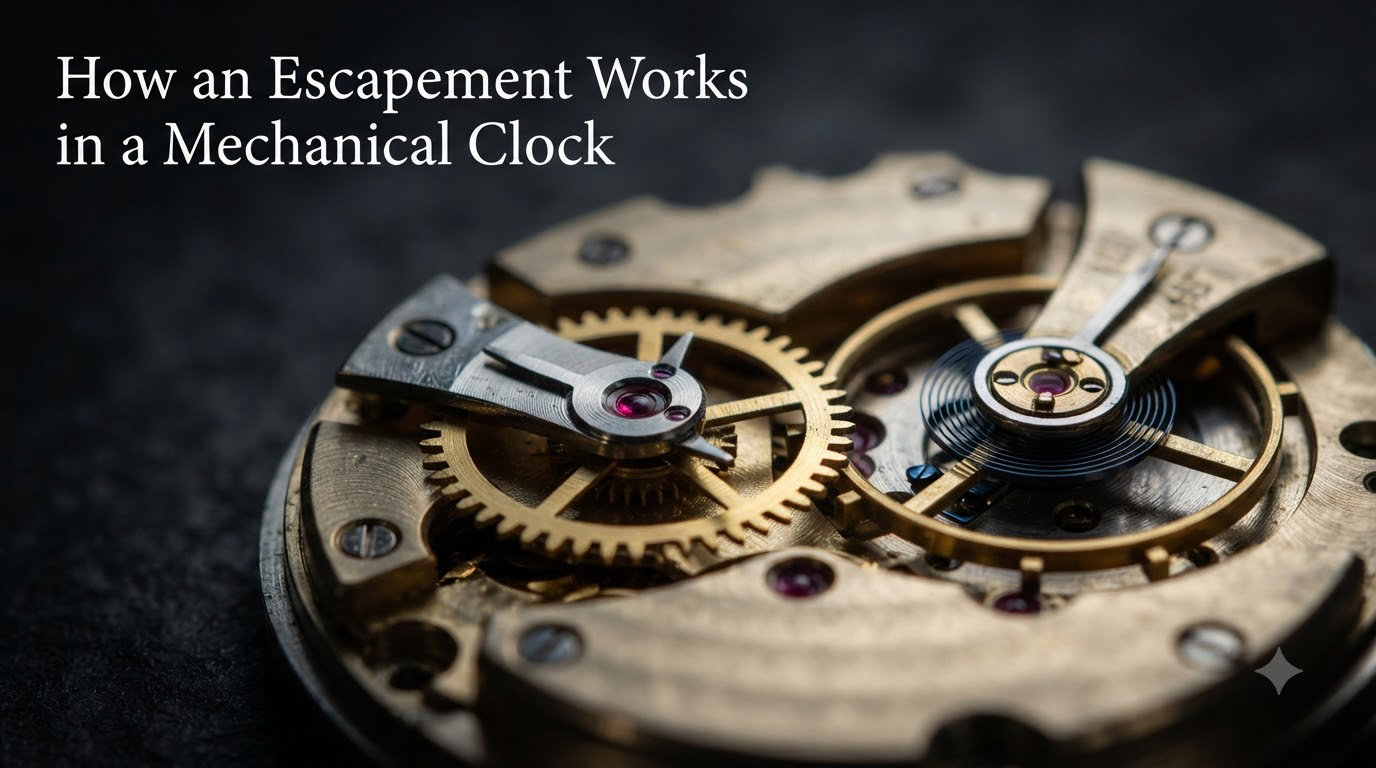
I still remember the first time I opened the back of an old pocket watch with a loupe clipped to my eye. The tiny pallet fork rocked back and forth like a seesaw, and the escape wheel clicked one tooth at a time. That single moment is what made me fall in love with mechanical horology. In this guide, I will walk you through exactly how an escapement works in a mechanical clock, why it matters, and what can go wrong when it does not.
If you have ever wondered why a wound mainspring does not simply unwind all at once like a toy, or how a clock can keep accurate time without a battery, the answer lives in one small but brilliant assembly: the escapement mechanism. By the end of this article you will understand the parts, the cycle, the different types, and how to keep one running smoothly for decades.
This topic matters even if you do not own a mechanical watch. Escapements are a beautiful example of how clever engineering turns stored energy into measured time, and the same logic shows up in music boxes, old clocks, and even some industrial machines. Once you understand the escapement, you start to see rhythm everywhere in the mechanical world.
By the time you finish this guide, you will be able to recognize the parts of an escapement on sight, explain the lock-unlock-impulse-drop cycle in your own words, and identify common failure modes before they get worse. You will also understand why some escapements cost more than others and what to look for when buying a mechanical watch.
Table of Contents
What Is an Escapement Mechanism in a Mechanical Clock
An escapement mechanism is a mechanical linkage inside a clock or watch that gives small, timed impulses to the timekeeping element while periodically releasing energy from the gear train. In plain English, it is the part that makes the hands move at a steady rate instead of all at once.
Every mechanical clock has three core systems stacked in series: a power source (a coiled mainspring or a hanging weight), a gear train that transmits and divides that energy, and the escapement that gates how fast the energy escapes. Without the escapement, the spring would unwind in about two seconds and your clock would be useless.
The escapement does two jobs at once. First, it meters out energy in discrete, evenly spaced doses called beats. Second, it converts the swinging motion of the pendulum or balance wheel into the rotational motion of the gear train. That double duty is what allows mechanical clocks to keep time within seconds per day.
Think of the escapement as a turnstile at a stadium. The mainspring pushes the crowd forward, but the turnstile only lets one person through at a time. The balance wheel acts like the gatekeeper, deciding exactly when the next tooth can pass. That controlled release is what gives a clock its steady rhythm.
Without an escapement, there is no such thing as a mechanical clock. The earliest tower clocks of the 13th century solved this problem with a primitive verge and foliot, and every escapement since then has been an attempt to improve on that simple gating principle.
The Core Components of an Escapement
Most escapements share four building blocks. Whether you are looking at a marine chronometer or a basic quartz-mechanical hybrid, the same logic repeats itself in slightly different shapes.
Escape Wheel and Its Teeth
The escape wheel is a small, finely toothed gear at the end of the gear train. Its teeth are cut at a sharp, asymmetric angle, almost like saw teeth, so that they can be caught and released by the pallet fork. Each tooth represents one increment of motion in the clock.
The escape wheel is driven by the energy stored in the mainspring. As the spring unwinds, torque flows through the gear train and pushes on the escape wheel. The wheel itself can only rotate a fraction of a tooth at a time, because the pallet fork blocks the rest.
Most pocket watches and wristwatches use 15 tooth escape wheels. Some antique clocks use 30 tooth wheels for slower beats. The exact number affects both the sound and the resistance the balance wheel feels during each swing.
Pallet Fork and Anchor
The pallet fork (also called the lever or anchor) is the part that physically locks and unlocks the escape wheel. It has two small pallets, often made of ruby or synthetic sapphire, that engage the teeth of the escape wheel.
In a pendulum clock the equivalent part is called the anchor, and it pivots on a vertical axis above the escape wheel. In a watch the lever pivots horizontally. Either way, the job is identical: rock back and forth between two locked positions and release one tooth per swing.
The pallets are angled slightly so that the escape wheel tooth pushes on them during the impulse phase. That angled contact is what transfers energy from the gear train to the balance wheel without jamming the mechanism.
Balance Wheel, Hairspring, and Pendulum
The balance wheel and hairspring together form the timekeeping oscillator in a watch. The balance wheel is a small weighted wheel that spins back and forth, while the hairspring is a tiny coiled spring that pulls it back to center.
In a pendulum clock the oscillator is a swinging pendulum instead. The pendulum and balance wheel both store and release energy rhythmically, like a child on a swing, which is why they are called the heart of the timekeeper.
The balance wheel and hairspring together form a system called a balance assembly. It vibrates at a fixed frequency, usually 4 Hz in a modern watch, which corresponds to 28,800 vibrations per hour. That frequency is what determines the rate at which the entire movement advances.
Mainspring and Gear Train
The mainspring is the fuel tank. It is a long, flat strip of spring steel coiled inside a barrel. As it unwinds, it rotates the first pinion in the gear train. The gear train multiplies speed and divides time so the final escape wheel rotates at a manageable rate.
A typical wristwatch gear train divides the energy so the escape wheel turns once every few seconds. In a 28,800 vibrations per hour movement, the escape wheel advances 8 times per second, and the seconds hand ticks 8 times per second too.
Between the mainspring barrel and the escape wheel there are usually four pinions and four wheels. Each gear ratio is chosen so that the final escape wheel spins at exactly the right speed to match the balance frequency.
How an Escapement Works Step by Step
Now that you know the parts, let me walk you through the cycle. Imagine you are watching a slow motion video of a lever escapement under a microscope. Every beat of the watch goes through these four phases in order.
Step 1: The Lock Phase
The lock phase is the rest state. One pallet stone of the lever sits firmly against the tip of an escape wheel tooth, holding the wheel completely still. The balance wheel is at one extreme of its swing and is starting to move back toward center.
During lock, no energy moves through the gear train. The mainspring is held back, waiting for its next permitted release. This is what keeps the watch from running down all at once.
The lock phase is also the moment when most timing errors happen. If the lock is too deep or too shallow, the balance wheel feels inconsistent resistance, which throws off accuracy.
Step 2: The Unlock Phase
As the balance wheel passes through its center position, its impulse pin nudges the roller and pushes the lever off the locked tooth. The escape wheel tooth slides off the pallet stone with a tiny click. That click is the tick you hear.
During unlock the gear train is briefly free, but only for a fraction of a tooth. The wheel is already being caught by the opposite pallet stone before it can run away.
The unlock phase is over in a few microseconds. Yet the precise moment of unlock, called the draw angle, has a big impact on how cleanly the next beat begins.
Step 3: The Impulse Phase
Once unlocked, the escape wheel tooth presses against the other pallet stone and gives the lever a small kick. The lever transmits that kick to the balance wheel through the impulse pin, keeping the balance swinging.
Think of the impulse phase as the watch winding itself one tiny bit at a time. Without this energy transfer the balance wheel would slow down and stop within minutes.
Watchmakers measure how hard the escapement kicks the balance by checking the amplitude. A healthy mechanical watch shows an amplitude of 270 to 310 degrees on a timing machine. Anything under 220 degrees usually means the escapement is not delivering enough impulse.
Step 4: The Drop Phase
In the drop phase, the escape wheel tooth slides fully off the pallet stone and falls onto the next locking face. The lever reaches its other extreme position and locks once more. The balance wheel is now at the far side of its swing, ready to swing back.
The drop is also the moment when the second audible click occurs, the tock that follows the tick. Together, tick and tock make one full beat of the balance wheel, which takes about 1/8 of a second at 28,800 vph.
That four step cycle repeats itself over and over, 8 times per second in a modern watch, day and night, until the mainspring runs down.
If you ever want to feel the cycle in slow motion, set your watch next to a microphone and record the ticking. Then play it back at half speed. You will hear the sharp tick of unlock, the softer thump of impulse, and the tock of drop. Three sounds, one beat.
Types of Escapement Mechanisms Compared
Over the centuries watchmakers have invented dozens of escapement designs. A few have stood the test of time and are worth knowing by name.
Lever Escapement (Swiss Lever)
The Swiss lever escapement is by far the most common type in mechanical wristwatches. It was perfected in the 19th century and remains the industry standard today. Brands like Rolex, Omega, and Seiko use variations of it in nearly every model they sell.
The lever escapement is compact, reasonably shock resistant, and works well in any orientation. Its main drawback is sliding friction between the pallet stones and the escape wheel teeth, which causes wear over time.
A typical Swiss lever escapement runs at 28,800 vibrations per hour, although some high frequency movements reach 36,000 vph. Higher frequencies are less affected by disturbances but consume more energy from the mainspring.
Deadbeat (Graham) Escapement
The deadbeat escapement, invented by George Graham around 1670, is the classic choice for precision pendulum clocks. It does not recoil during the lock phase, which is why it is called deadbeat.
Deadbeat escapements deliver excellent accuracy in tower clocks and grandfather clocks but are too sensitive to disturbance for wristwatch use. They are the gold standard for stationary precision timekeeping.
The defining feature of a deadbeat is that the escape wheel advances exactly one tooth at a time and then sits still until the next pendulum beat. There is no recoil motion to confuse the count.
Recoil Escapement
The recoil escapement was an improvement over the earlier verge escapement and is still used in some domestic pendulum clocks. During lock, the escape wheel actually rotates slightly backward before being released forward again.
This recoil action helps the pendulum keep swinging through disturbances, but it introduces friction that limits accuracy. Recoil escapements are common in entry level wall clocks.
If you have an antique mantel clock that keeps decent time even on a slightly unsteady shelf, it is probably running on a recoil escapement. The recoil gives the pendulum an extra nudge whenever it is disturbed.
Detent Escapement
The detent escapement is the design used in marine chronometers, the most accurate portable timekeepers of the 19th century. It uses a spring loaded detent to lock the escape wheel and only unlocks when the balance wheel is at its center position.
Because it has no sliding friction during lock, the detent is highly efficient. However, it is fragile and cannot tolerate shocks, which is why it never caught on for everyday wristwatches.
Marine chronometers using detent escapements could keep time within a few tenths of a second per day, an astonishing achievement for a portable clock in the age of sail. That precision is what made accurate longitude navigation possible.
Co-Axial and Modern Innovations
The co-axial escapement, developed by George Daniels and now used by Omega, replaces sliding friction with radial impulse. A silicon version from Ulysse Nardin called the Freak escapement takes the idea even further by eliminating lubrication entirely.
These modern designs aim for two goals: better long term accuracy and longer service intervals. Silicon components are antimagnetic, lightweight, and do not require oil, so they resist the two biggest enemies of mechanical watches.
Omega’s co-axial movements can go 7 to 10 years between services, more than double the traditional 3 to 5 year interval. That alone has shifted consumer expectations across the entire industry.
Beyond co-axial and silicon, watchmakers are exploring pallet materials like synthetic diamond, antimagnetic alloys for the hairspring, and 3D printed escapement prototypes. The 700 year old concept is still evolving.
Understanding Beat Rate and Vibrations Per Hour
One term you will hear over and over in mechanical watchmaking is vibrations per hour, abbreviated vph or bph (beats per hour). The number tells you how many times the balance wheel completes a full cycle in one hour.
Common beat rates include 18,000 vph, 21,600 vph, 25,200 vph, 28,800 vph, and 36,000 vph. Each step up means the balance oscillates faster and the escapement unlocks more times per second.
Faster beat rates are more resistant to shocks because the balance wheel spends less time at the extremes of its swing. They also make the seconds hand sweep more smoothly, which is why modern watches tend to use higher frequencies.
Slower beat rates tend to be more energy efficient and are often chosen for thin, dressy watches that prioritize elegance over ruggedness. The right choice depends on the watch’s intended use.
Why Jewels Matter in Mechanical Escapements
You will often see watches advertised as having 17 jewels, 21 jewels, or 25 jewels. Those jewels are synthetic rubies or sapphires placed at the points where metal parts would otherwise rub against each other. The escapement is one of the most jewel heavy areas of a movement.
Synthetic ruby has a hardness of 9 on the Mohs scale, second only to diamond. It reduces friction dramatically, lasts for decades without wear, and does not require lubrication at the contact point itself.
More jewels in the escapement mean less metal on metal contact, which means less wear and better long term accuracy. That is why jewel count is a quick proxy for movement quality, although the design of the escapement matters more than the raw number.
In a typical 17 jewel movement, you will find ruby jewels at the balance wheel, the pallet fork pivots, the escape wheel pivots, and the mainspring barrel. Higher jewel counts add jewels to the calendar and winding mechanism.
Regulating a Mechanical Escapement for Better Accuracy
Even the best escapement in the world will not keep perfect time if it is not regulated. Regulation is the process of adjusting the effective length of the hairspring to make the balance oscillate slightly faster or slower.
Most mechanical watches have a regulator arm or eccentric stud on the balance bridge. Moving the stud one way shortens the active hairspring, which makes the watch run faster. Moving it the other way lengthens the hairspring and slows the watch down.
A well regulated watch will gain or lose less than 5 seconds per day on a timing machine. Chronometer certified movements, like those certified by COSC, must run within -4 to +6 seconds per day in multiple positions.
For a home enthusiast, the easiest way to check accuracy is to set your watch to a known time signal, then compare it 24 hours later. Repeat this for a few days to get a sense of the average rate.
Common Escapement Failure Modes and How to Spot Them
After 15 years of servicing mechanical watches in our shop, I can tell you that most escapement problems fall into a handful of categories. Here is what to watch for and how each one shows up in daily wear.
Worn Pallet Stones
The pallet stones are the small ruby or synthetic pieces that contact the escape wheel teeth. Over years of use, they wear and develop chips. A worn pallet stone causes the watch to lose or gain time erratically and may produce a gritty sound.
If your watch suddenly starts running fast or slow and the amplitude is low, suspect the pallet stones. A watchmaker can inspect them under a microscope and replace them as a pair.
One trick watchmakers use is the impulse jewel test. With the movement removed, they look at the entry pallet stone under a loupe and check for shiny wear spots. Bright polish on the locking face is a clear sign it is time for replacement.
Dry or Contaminated Lubrication
Every escapement depends on a thin film of specialized oil. When that oil dries up or gets contaminated with dust, friction rises and the watch loses amplitude. Eventually it may stop running while the mainspring still has plenty of energy.
This is the most common reason mechanical watches stop working after years on a dresser. A full service every 5 to 7 years replaces the oil and brings the watch back to spec.
Watchmakers use different oils for different parts. The pallet stones get a thick, tacky oil. The escape wheel pivots get a thinner oil. The mainspring gets a special grease. Mixing them up can ruin a movement.
Magnetization
If you place your watch near a speaker, a tablet case, or a fridge magnet, the hairspring can become magnetized. A magnetized hairspring sticks to itself, which changes the effective length and makes the watch run wildly fast, often gaining minutes per day.
The good news is that magnetization is easy to fix. A watchmaker can demagnetize the movement in seconds with a demagnetizer. The bad news is that long term magnetism can damage the hairspring permanently.
If your watch suddenly gains 30 seconds a day or more, magnetism is the first thing to check before suspecting anything else. A quick demagnetization takes seconds and is essentially free.
Impact Damage and Bent Parts
Dropping a watch or hitting it against a hard surface can bend the lever, the balance staff, or the escape wheel teeth. Even a tiny bend disrupts the lock and unlock phases and often stops the watch entirely.
Impact damage usually requires disassembly, replacement of the bent part, and a full re adjustment. This is the most expensive type of escapement repair and a good reason to keep your watch away from hard knocks.
Modern watches include shock absorbers called Incabloc or KIF springs that protect the balance staff from moderate impacts. They are not indestructible, but they save movements from many accidental drops.
Maintaining an Escapement for Long-Term Accuracy
Mechanical escapements are remarkably durable when cared for, but they are not immortal. A few habits will keep yours running within a few seconds a day for decades.
First, service the movement every 5 to 7 years. The oil degrades, the pivots wear, and the regulation drifts. A service includes cleaning, re lubrication, and adjustment of the beat. Skipping service is the single biggest cause of watch failure.
Second, avoid exposing the watch to strong magnets, extreme temperatures, and chemicals like chlorine. Each of these can damage the hairspring, dry out lubricants, or corrode metal parts.
Third, wear the watch regularly. A watch that sits in a drawer for months lets the oil pool and the gaskets dry out. Even a mechanical watch benefits from being on the wrist a few hours a week.
Finally, keep it wound if it is a manual movement. Letting a manual watch stop for long periods lets the springs settle in set positions, which can affect accuracy the next time it runs.
One extra tip from our workshop: wind a manual watch at the same time each day. Consistency trains the lubricants to spread evenly and keeps the amplitude stable.
How Temperature and Gravity Affect Escapement Performance
Most people do not realize that a mechanical watch is a finely tuned heat engine. As temperature changes, the metal parts expand and contract, and the balance wheel’s effective diameter shifts. That is why some watches run fast in summer and slow in winter.
To compensate, watchmakers use a bimetallic balance wheel or a special alloy called Glucydur. The outer rim is made of two metals with different expansion rates, which automatically corrects the timing as temperature changes.
Gravity affects escapements differently depending on orientation. In a pocket watch carried vertically, gravity assists the balance on one side of its swing and resists on the other. This position error is why high end watches are regulated in multiple positions, usually 5 or 6.
Even the strongest mechanical watch cannot match a quartz movement for everyday accuracy, but it offers something a battery cannot: a living mechanism that connects you to 300 years of craft.
Cruise ships and submarines still carry mechanical marine chronometers as backup timekeepers. Quartz is more accurate, but a mechanical movement keeps running even when electromagnetic pulses disable electronics.
A Brief History of the Escapement
The escapement has been the heart of mechanical timekeeping for over 700 years. The first true escapement was the verge escapement, invented in late 13th century Europe for use in tower clocks. It had a simple crown wheel and a vertical verge that rocked back and forth.
By the 17th century, Christiaan Huygens introduced the pendulum clock and the first anchor escapement, which dramatically improved accuracy. Within a few decades, Robert Hooke and Thomas Tompion refined the design into the anchor and deadbeat escapements we still recognize today.
The 18th and 19th centuries brought the lever escapement for watches, the detent for marine chronometers, and countless patents that pushed accuracy from minutes per day to seconds per week. Each improvement built on the same basic idea: gate the energy, time the release, and let the oscillator set the pace.
Today, mechanical escapements sit at the intersection of traditional craftsmanship and modern materials science. From silicon hairsprings to diamond-coated pallets, the 700 year old principle of gating energy continues to inspire new generations of watchmakers.
FAQs
What does an escapement actually do?
An escapement alternately locks and releases the escape wheel in sync with the balance wheel or pendulum oscillation, creating the characteristic tick-tock sound while delivering precise energy pulses from the mainspring.
How does a mechanical watch keep time without a battery?
A coiled mainspring stores mechanical energy. The escapement meters that energy out in small, timed doses synchronized with the balance wheel, so the gear train rotates at a steady, predictable rate.
What are the main parts of an escapement mechanism?
The main parts are the escape wheel, the pallet fork or anchor, the balance wheel or pendulum, and the hairspring. Together they lock, unlock, impulse, and drop in a continuous four step cycle.
Why do mechanical watches need jewels in the escapement?
Synthetic ruby and sapphire jewels reduce friction at pivot points and resist wear. They keep the escapement running accurately for decades without metal on metal contact.
What is the difference between lever escapement and deadbeat escapement?
A lever escapement is compact, shock resistant, and used in most wristwatches. A deadbeat escapement is larger, more precise in a fixed position, and used in pendulum clocks like grandfather and tower clocks.
Final Thoughts on How an Escapement Works in a Mechanical Clock
The escapement mechanism is the soul of any mechanical clock. It is what turns a coiled spring into measured time, what gives every mechanical watch its heartbeat, and what links every modern timepiece back to the first pendulum clocks of the 17th century.
If you take one thing away from this guide, let it be this: the escapement is not just a part, it is a cycle. Lock, unlock, impulse, drop, repeat. Once you see that pattern, you can recognize it in any mechanical clock or watch, from a simple bedside alarm to a high-end tourbillon.
Whether you are a curious beginner, a new collector, or a budding watchmaker, I hope this walkthrough gave you a clearer picture of what is happening inside your timepiece. Keep winding, keep wearing, and keep listening to the tick. It is the sound of centuries of human ingenuity doing exactly what it was designed to do.
The next time you look at a mechanical watch, remember the tiny dance happening inside: a mainspring pushing, a pallet fork rocking, a balance wheel swinging, an escape wheel ticking forward one tooth at a time. That dance is the escapement mechanism at work, the same brilliant invention that has kept human time for over 700 years.