
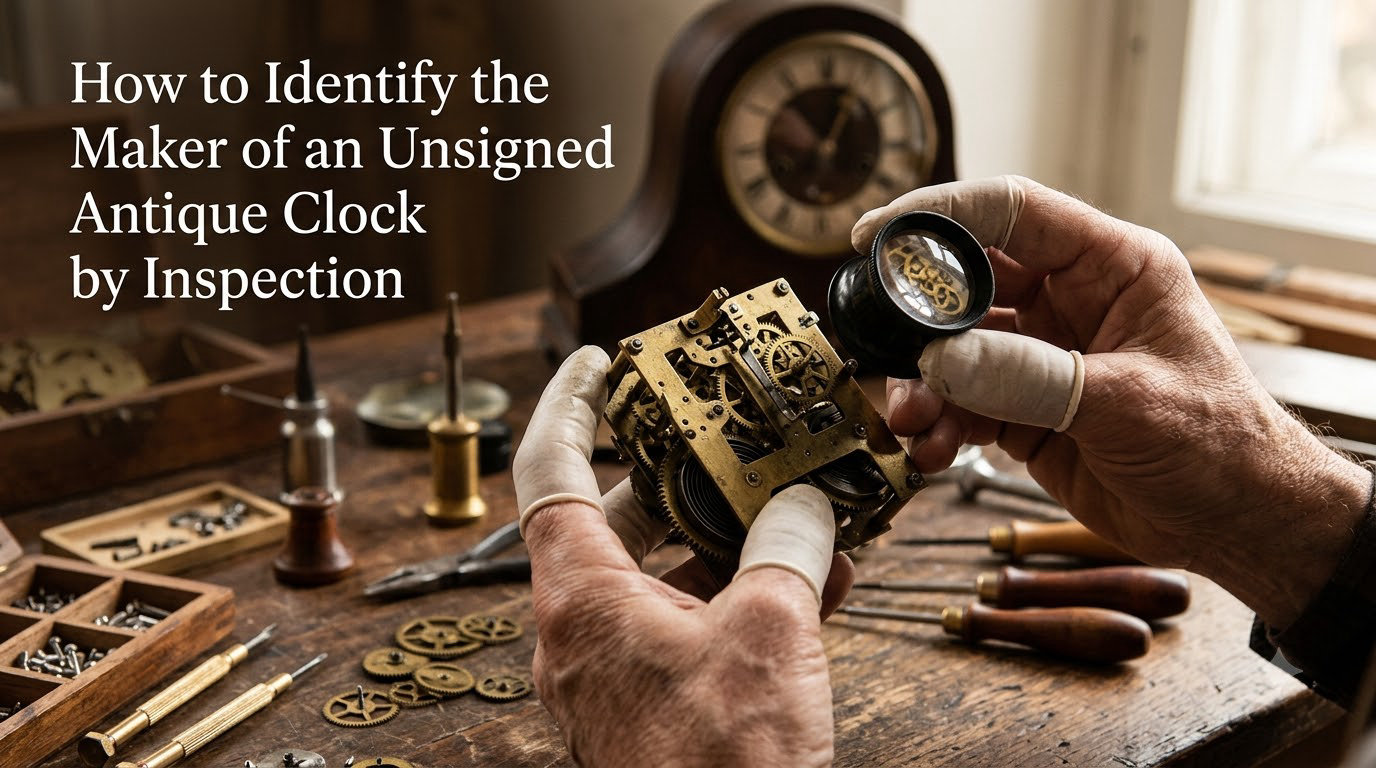
I have spent over fifteen years studying antique clocks, and the question I get asked more than any other is this: how do you figure out who made a clock when there is no signature on it? It is a fair question. Many of the finest antique clocks in existence carry no visible maker’s name, and yet their craftsmanship screams the identity of the artisan if you know where to look.
Learning to identify unsigned antique clock makers by inspection is part science, part detective work. You are reading physical evidence left behind by hands that worked two or three centuries ago. Every filing mark, every gear tooth shape, every choice of brass alloy tells a story about where and when a clock was built, and often by whom.
In this guide, I will walk you through the exact inspection process I use to attribute unsigned antique clocks. We will cover movement markings, dial analysis, case construction, hands examination, and regional style identification. I will also share the tools you need, the authentication red flags to watch for, and when it makes sense to call in a professional appraiser.
Whether you inherited a mystery longcase clock, spotted an unmarked mantel clock at an estate sale, or simply want to understand the timepiece sitting in your hallway, this guide will give you a systematic approach. The goal is not just to put a name on a clock. It is to understand its history, assess its authenticity, and determine its true place in the horological record.
By the end, you will know how to identify the maker of an unsigned antique clock by inspection using the same methods employed by museum curators and serious collectors. Let us begin.
Table of Contents
Tools You Need for Proper Clock Inspection
Proper clock identification starts with the right tools. You cannot perform a thorough inspection with bare hands and a smartphone flashlight, and attempting to disassemble a movement without the correct implements risks damaging irreplaceable components.
Here is the toolkit I carry to every inspection, whether I am examining a clock at an auction preview or in a collector’s home:
Jeweler’s loupe (10x to 20x magnification): Essential for reading faint stamps, engraved initials, and serial numbers on movement plates. A loupe with built-in LED illumination is ideal.
Digital caliper: For measuring movement plate dimensions, pendulum length, and dial diameter. Precise measurements help narrow down maker and period.
Bright LED flashlight or headlamp: Movement interiors are dark by design. A directional light source reveals markings invisible under ambient room lighting.
Dental mirror or small inspection mirror: Angled mirrors let you see the back of movement plates and hidden case surfaces without removing components.
Brass or plastic clockmaker’s tweezers: Non-magnetic tweezers for gently lifting components or clearing debris from engraved areas. Never use steel tools on movement parts.
Soft-bristle brush: A clean, soft brush removes dust from engraved recesses without scratching. This alone can reveal previously hidden maker marks.
Camera with macro capability: Document every marking and detail. Photos taken under raking light (light held at a low angle) reveal engravings that disappear under direct light.
Notebook and measuring tape: Record every dimension, marking, and observation. Identification is a process of elimination, and organized notes are invaluable.
None of these tools are expensive, and together they cost less than a single professional appraisal. The investment pays for itself the first time you discover a hidden stamp that identifies a clock worth thousands more than anyone realized.
One important safety note: never use magnetic tools near a movement. Magnetized components interfere with timekeeping and can be difficult to demagnetize. Stick with brass, plastic, or demagnetized stainless steel implements.
How to Identify the Maker of an Unsigned Antique Clock by Inspection: Step-by-Step Overview
When you set out to identify the maker of an unsigned antique clock by inspection, follow a consistent sequence. This prevents overlooked clues and builds a case through converging evidence rather than relying on a single feature.
Here is the six-step process I use every time:
Inspect the movement first. Remove the movement from the case if safe to do so. Examine both plates, the pillars, the barrel, and the pendulum for stamps, serial numbers, and architectural fingerprints.
Analyze the dial. Look for faint signatures, examine the spandrel design, note the dial material (painted iron, engraved brass, porcelain), and check for chapter ring styles.
Examine the case. Identify the wood species, examine joinery methods, document all hardware, and assess case proportions against known regional patterns.
Study the hands. Hand shapes are remarkably period-specific. Compare hand profiles against documented examples from specific decades and regions.
Determine the period. Use convergent evidence from all the above to establish a date range. Style elements rarely change in isolation.
Compare against known maker patterns. Match your documented features against reference databases, auction records, and published maker studies to narrow the attribution.
This process works because clockmakers worked within established traditions. An English maker in 1790 used specific plate shapes, dial painting styles, hand designs, and case woods that differ from a German maker working the same decade. By documenting each feature systematically, you build an evidence profile that often points to a single workshop or maker.
Let us now examine each inspection area in detail.
Movement Inspection: Your Most Reliable Source
The movement is the single most reliable place to find identifying information on any antique clock. Even when a dial carries no signature, the movement plates often hold stamps, scratch marks, or serial numbers that reveal the maker. I always begin here.
To access the movement, you typically need to remove it from the case. For longcase clocks, this means lifting the movement and dial assembly off the seat board after disconnecting the pendulum, weights, and hands. For bracket and mantel clocks, the movement is usually accessed through a back door or by removing a back plate.
If you are not comfortable removing a movement, document what you can see in place and photograph everything. A professional horologist can handle the removal safely.
Back Plate Markings and Stamps
The back plate is where most maker marks live. Turn the movement so the back plate faces you under bright light, and sweep the entire surface with a loupe. Look in every corner and along every edge. Makers stamped their names, initials, or trademarks in specific locations, and these are often small enough to miss without magnification.
Common markings you may find include the maker’s full name stamped in a cartouche, initials inside a rectangle or shield, a trademark symbol, patent dates, or assembly numbers scratched into the surface. Scratch marks differ from stamps. They are hand-engraved with a scriber and often appear as rough numbers used to match components during assembly.
A key trick: hold your light at a very low angle across the plate surface. This raking light technique casts shadows in even the faintest engravings. I have identified clocks by marks that were completely invisible under overhead lighting but jumped out under raking light from a phone flashlight.
Also check the front plate, the pillar bases, and the underside of the barrel bridge. Some makers marked only the underside of bridges, which requires careful disassembly to reveal.
Serial Numbers and Their Meanings
Serial numbers on clock movements can be powerful identification tools. Many major manufacturers maintained sequential numbering systems that allow you to date a movement to within a year or two. The challenge is that smaller workshops and individual makers did not always keep documented records.
For American clocks, companies like Seth Thomas, New Haven, and Waterbury used serial numbers that can be cross-referenced against published dating charts. For English longcase clocks, serial numbers on the movement or on a small disc attached to the pendulum can sometimes be traced through NAWCC databases.
French clock makers often stamped serial numbers on both the back plate and inside the case. If the numbers match, you have confirmation that the movement and case are original to each other, which strengthens your identification.
When you find a serial number, document it precisely. Even partial numbers can narrow down a date range when combined with style analysis. Record whether it is stamped (mechanical impression), engraved (hand-cut), or hand-scratched (rough marks).
Movement Architecture and Plate Shapes
Even when no marks exist, the physical architecture of the movement speaks volumes. Plate shape alone can tell you the country of origin and narrow the date range by decades.
English longcase movements typically used rectangular brass plates with substantial thickness, often 4 to 6 millimeters, supported by five or six pillars. The plates were secured with pinned joints, not screws. If you see thick rectangular plates with tapered pins, you are almost certainly looking at English work from the eighteenth or early nineteenth century.
French movements often feature round or architectural plate shapes with finely finished edges and decorative shaping. The French favored spring-driven movements with delicate detent or crown wheel escapements in their precision pieces, and their plates show a level of hand-finishing that is distinctive.
German Black Forest movements tend to use simpler plate shapes with more functional finishing. Plate corners are often square rather than rounded, and the brass has a slightly different color due to regional alloy differences.
American mass-produced movements from the mid-nineteenth century onward used stamped brass plates with consistent, machine-cut gear trains. The presence of interchangeable, machine-made components immediately tells you the clock postdates roughly 1840.
Pendulum and Escapement Identification
The pendulum bob and rod carry identification clues that many inspectors overlook. Check the pendulum bob for stamped marks, cast initials, or distinctive shapes. Some makers used uniquely shaped bobs that serve as fingerprints.
The rod itself may carry a rating nut with a specific thread pattern. Thread pitch and direction varied by region and maker. An experienced horologist can sometimes identify a maker from thread measurements alone.
The escapement type is equally informative. A deadbeat escapement suggests a higher-quality English or American movement from the eighteenth century or later. A crown wheel (verge) escapement indicates an earlier piece, typically pre-1750 in English work. The Graham deadbeat, invented around 1715, appears on precision clocks and signals quality workmanship.
Document the escapement type, the pendulum suspension method (silk thread, spring suspension, knife-edge), and any adjustments or modifications. Modifications can indicate later servicing, which is worth noting for authentication purposes.
Dial Analysis: Reading the Clock’s Face
The dial is the clock’s most visible surface and often carries more stylistic information than any other component. Even without a painted or engraved signature, the dial’s design, materials, and decorative elements provide strong identification evidence.
Dial Signatures and Spandrels
Always examine the dial surface above the numeral six and below the numeral twelve. These are the most common locations for maker signatures on painted dials. Even when a clock appears unsigned, a careful look with a loupe may reveal the ghost of a signature that has faded or been partially over-painted during a restoration.
Faded signatures sometimes reappear under ultraviolet light. If you have access to a small UV flashlight, examine the dial in a darkened room. Old paint and new paint fluoresce differently, and a signature covered by a later repaint may become visible.
The spandrels, those decorative corner ornaments on painted dials, changed in style over time and are excellent dating tools. Early painted dials from the 1770s and 1780s featured simple floral or geometric spandrels. By the 1790s, spandrels became more elaborate with scrolling designs. After 1800, gilded angel and floral motifs dominated. By the 1830s, spandrels grew larger and more theatrical.
Matching spandrel styles to documented periods is one of the fastest ways to date an unsigned painted dial clock. I keep a reference chart of spandrel styles by decade for exactly this purpose.
Dial Materials and Manufacturing Techniques
The dial material itself is a strong identification indicator. Brass dials with engraved and silvered chapter rings are characteristic of English clocks from before roughly 1770. Painted iron dials became dominant in England from the 1770s onward and remained standard through the nineteenth century.
Engraved brass dials with matted centers were an English specialty. The center area was textured with a punch to create a matte finish that contrasted with the polished silvered chapter ring. If you see a matted center, you are looking at English work, typically pre-1772.
French clocks frequently used porcelain or enamel dials, often with finely painted numerals and decorative borders. The quality of French enamel work is distinctive. Chips in old enamel show layered construction, while modern reproductions tend to have a single-layer surface.
American shelf clocks used painted wooden dials in the early nineteenth century, transitioning to painted tin or paper-on-wood dials as mass production took hold. A paper dial on a wooden backing immediately signals American mass production from roughly 1820 onward.
Dial Glass and Bezel Clues
The glass protecting the dial can reveal age and origin. Early clocks used hand-blown glass, which has slight imperfections, bubbles, and uneven thickness. Hold the glass up to light and look for these characteristics. Perfectly flat, flawless glass indicates a modern replacement.
The bezel, the ring that holds the glass, also provides clues. Brass bezels with hand-cut threads suggest earlier production. Machine-threaded bezels indicate post-1840 manufacturing. Check the hinge style as well. Early hinges were handmade with visible pivot pins, while later hinges were factory-produced with concealed pins.
Case Examination: Materials, Construction, and Hardware
The clock case is the third pillar of identification. While cases were sometimes made by different craftsmen than the movements, regional case-making traditions were strong enough to provide reliable attribution evidence. The case also helps confirm that the movement and case are original companions.
Wood Types and Construction Methods
Identifying the primary wood species is your first task. English longcase clocks from the eighteenth century typically used oak as a primary wood with walnut or mahogany veneers. By the late eighteenth century, solid mahogany became standard for higher-quality cases.
American clock cases varied widely by region. New England makers favored cherry, birch, and maple. Pennsylvania makers often used walnut. Southern makers sometimes used local woods like yellow pine for secondary components.
French mantel clocks frequently used marble cases, particularly white marble with gilded bronze mounts. The combination of white marble and ormolu (gilded bronze) is a signature French style from the Empire period, roughly 1804 to 1815.
German Black Forest clocks used locally available softwoods, typically pine or linden, often stained dark to simulate more expensive woods. The wood grain pattern and staining method help distinguish German work from English or American cases.
Examine the joinery. Hand-cut dovetails with slight irregularities indicate pre-machine-age construction, typically before 1860. Machine-cut dovetails with perfect symmetry indicate later production. Hand-cut mortise and tenon joints with wooden pegs are characteristic of eighteenth-century case work.
Hardware and Fittings as Fingerprints
Hinges, locks, escutcheons, and handles are often overlooked but provide excellent identification evidence. These fittings were typically sourced from local foundries, and their designs varied by region and period.
English brass furniture from the eighteenth century often features cast brass with hand-finished surfaces. Look for file marks and slight asymmetries that confirm hand manufacture. The bat-shaped hinge was common on English longcase hood doors from the mid-eighteenth century.
American hardware from the early nineteenth century shows increasing standardization. Stamped brass hinges and machine-cut screws replaced hand-forged iron hardware around 1840. The transition from hand-forged to machine-cut screws is one of the most reliable dating indicators you can find.
Check screw slots. Hand-cut screws have off-center slots with irregular widths. Machine-cut screws have centered, uniform slots. This single observation can date a case to within a decade.
Case Proportions and Regional Styles
Case proportions follow regional patterns that are remarkably consistent. English longcase clocks from the eighteenth century have narrow hoods and slim waists. The overall height typically ranges from 7 to 8 feet. The bonnet, or hood top, usually features a pagoda or breakarch design.
American tall-case clocks tend to be shorter and wider than their English counterparts, reflecting different room proportions and aesthetic preferences. Pennsylvania tall-case clocks often feature distinctive decorative inlay and crotch mahogany veneers.
French bracket clocks have compact, architectural case designs with steep angles and minimal ornamentation on lesser pieces. Higher-quality French cases show elaborate gilded bronze mounts that are themselves signed and dated.
Hands Examination: A Window to the Maker
Clock hands are among the most date-specific features on any antique timepiece. Because hand styles changed frequently and followed clear chronological patterns, they serve as excellent identification tools. This is especially valuable when you cannot access the movement for a detailed inspection.
Hand Styles by Period
English clock hands followed a clear evolutionary path. The period before 1700 featured wide, heavy hands often described as star-burst or tulip patterns. Between 1700 and 1750, hands became more refined with intricate pierced designs featuring fleur-de-lis and scrollwork.
From 1750 to 1800, English hands grew slenderer with elegant serpentine curves. The minute hand often featured a counter-balanced tail. After 1800, hands became simpler and more functional, reflecting the rise of industrial production.
American hands followed their own trajectory. Early American tall-case clocks used hands closely modeled on English patterns, since many early American clockmakers trained in England. By the 1820s, American hands developed distinct regional variations, with Connecticut makers favoring simpler, more angular designs.
French hands are characteristically delicate and ornate. Breguet hands, named after the famous French maker Abraham-Louis Breguet, feature a distinctive crescent or apple-shaped tip. These appeared around 1790 and became one of the most widely copied hand styles in horological history.
Hands-Only Identification Techniques
You can sometimes identify a clock’s maker or at least its origin and period using hands alone. This technique is useful when examining a clock through a glass door or in an auction catalog photo where movement access is impossible.
Start by comparing the hand profile against documented examples. Pay attention to the tip shape, the counterpoise (the portion extending behind the center), and the piercing pattern. These three features together often narrow the date to within two decades.
Check whether both hands are made from the same material with the same finishing technique. Matching hands made of blued steel with identical filing patterns suggest originality. Mismatched materials or finishing indicate replacement hands, which reduces the identification value.
Document the hand length relative to the chapter ring. Original hands typically extend to specific positions relative to the numerals. Replacement hands that are too long or too short are a red flag for later modification.
Warning Signs of Replacement Hands
Replacement hands are common and can mislead identification efforts. Watch for hands that appear too crisp and unworn compared to the rest of the clock. Genuine antique hands show the same patina and wear as surrounding components.
Look for tool marks around the hand collet, the brass bushing that fits over the arbor. Fresh tool marks indicate recent hand removal and possible replacement. The collet should show the same aging as the hand itself.
If the minute and hour hands are clearly from different periods or styles, at least one is a replacement. This does not invalidate identification of the clock itself, but it means you cannot use the hands as reliable dating evidence.
Regional Style Identification: German, French, English, and American Clocks
Regional identification is often the fastest path to narrowing an unsigned clock’s origin. Each major clock-making tradition developed distinctive characteristics that remained consistent across decades. Recognizing these patterns allows you to focus your research on specific makers and reference databases.
German Clocks (Black Forest Tradition)
German Black Forest clocks have a distinct character rooted in centuries of regional craft tradition. The Schwarzwald region produced clocks from the seventeenth century onward, and their style evolved along a different path from English or French horology.
Black Forest movements typically use wooden gear trains in early examples, transitioning to brass by the nineteenth century. The plate shape is usually rectangular with functional rather than decorative finishing. Look for the distinctive posts and pillars used in German movement construction, which differ slightly from English patterns.
Cuckoo clocks are the most recognizable Black Forest product, but the region also produced fine bracket clocks, wall clocks (including the so-called Dutch clocks that are actually German), and later regulator-style clocks. The Junghans and Kienzle factories dominated German production from the late nineteenth century onward and used systematic serial numbering that makes identification straightforward.
German clock cases often use pine or linden wood stained dark. The joinery is functional rather than decorative, reflecting the craft traditions of the region. Brass hardware on German clocks tends to be simpler and less ornate than English or French equivalents.
French Clocks
French clock making reached extraordinary levels of artistry and precision, particularly in Paris during the eighteenth and nineteenth centuries. French clocks are identifiable by their movement architecture, case design, and dial work.
The Paris pendule, or mantel clock, typically features a round movement with architectural plate shaping. The movement is often housed in an elaborate case combining marble, gilded bronze, and porcelain. The presence of ormolu mounts (finely cast and gilded bronze decorative elements) is a hallmark of quality French work.
French movements frequently use a suspension spring for the pendulum rather than a silk thread or knife-edge suspension. The pendulum itself often has a distinctive bob shape, frequently round with a rating indicator visible through the back of the case.
The dial on a French clock is usually white enamel rather than painted iron. The numerals are typically Roman or Arabic, finely painted. Look for the word Paris or a city name in small letters on the dial edge, which identifies the retailer rather than the maker.
English Clocks
English clock making represents one of the great horological traditions, and English clocks are among the most studied and documented in the world. The identification process benefits from extensive published research and museum collections.
English longcase clocks are the archetypal English form. They feature brass movements with deadbeat or recoil escapements, rectangular plates, and five-pillar construction. The dial progresses from brass with engraved chapter rings (pre-1770) to painted iron dials with decorated centers and spandrels (post-1770).
English bracket clocks are spring-driven timepieces in wooden cases, typically mahogany or walnut. They feature fusee movements (a cone-shaped pulley that equalizes spring tension), which is a distinctly English approach. If your movement has a fusee, it is almost certainly English in origin.
English lantern clocks, produced from the seventeenth century onward, are wall-mounted clocks with brass frames and exposed movements. Their distinctive shape, with four corner pillars and a bell on top, makes them immediately recognizable. Many lantern clocks were later converted from balance wheel to pendulum regulation, and identifying these conversions is part of the authentication process.
American Clocks
American clock making developed its own identity, particularly after the Industrial Revolution transformed production methods. The Connecticut Valley became the center of American clock production from the early nineteenth century onward.
American tall-case clocks from the late eighteenth century closely resemble English work, reflecting the English training of early American clockmakers like Thomas Harland and Daniel Burnap. By the early nineteenth century, American makers developed distinct styles, particularly in case design and dial painting.
The defining American innovation was mass production. Eli Terry’s wooden-gear shelf clock, introduced around 1816, transformed the industry. Wooden-gear movements in simple cases became the dominant American form for decades. Seth Thomas, who worked with Terry before founding his own company, became one of the most prolific American clock makers.
American clocks from the mid-nineteenth century onward are usually easier to identify than earlier pieces because of systematic stamping and labeling. Look for paper labels inside the case, stamped names on the movement, and patented features like the Terry wooden-gear design.
Authentication Red Flags to Watch For
Not every unsigned antique clock is what it appears to be. During your inspection, watch for signs that a clock has been altered, assembled from parts, or outright faked. These red flags do not necessarily mean a clock is worthless, but they affect identification and value.
Mismatched movement and case: If the movement mounting holes in the case do not align with the movement feet, or if the dial does not fit the case aperture properly, the movement may be a replacement. This breaks the identification chain.
Overly fresh components: A two-hundred-year-old clock should show consistent wear and patina across all components. Freshly polished brass that stands out from the surrounding aging suggests recent replacement parts.
Modern screws and hardware: Phillips-head screws, wire nails, or modern stamped brass fittings inside an otherwise antique clock indicate later repairs or modifications. Document these carefully.
Suspicious signatures: A newly painted or engraved signature that shows no aging compared to the surrounding surface may be a later addition. Forged signatures are a known problem in the antique clock market, and some forgeries are quite skillful.
Reproduction dials: Reproduction painted dials are common on restored longcase clocks. Look for uniform paint texture, modern pigment colors, and the absence of age-appropriate crazing (fine cracking in the painted surface). A genuine eighteenth-century painted dial shows distinct craquelure.
When to Seek Expert Help
Some clocks exceed the scope of amateur identification and require professional expertise. Knowing when to seek help protects both the clock and your investment of time.
Consult a professional horologist or certified appraiser when dealing with clocks that may have significant financial value. A misidentified clock can sell for a fraction of its true worth, or an over-identified clock can lead to embarrassing and costly mistakes.
The National Association of Watch and Clock Collectors (NAWCC) maintains a message board where expert volunteers help identify clocks from submitted photographs. Their members have decades of accumulated knowledge and access to reference databases that are not publicly available.
For particularly valuable or rare pieces, a formal appraisal from a qualified horological appraiser is worth the cost. Appraisers document their methodology, provide written attribution with supporting evidence, and carry professional liability for their assessments.
Museum curators can sometimes help with identification for historically significant pieces. The British Museum, the American Clock and Watch Museum, and the Deutsches Uhrenmuseum in Germany all maintain research collections accessible to serious inquiries.
Professional identification costs typically range from modest fees for photograph-based consultation to several hundred dollars for a written, insured appraisal. Consider this an investment, particularly if you plan to sell or insure the clock.
FAQs
How do I identify my clock maker?
Start by inspecting the movement, specifically the back plate, for stamped names, initials, serial numbers, or trademarks. Then examine the dial for signatures or spandrel styles, study the case wood and hardware, and compare hand styles against documented period examples. Combining evidence from all four areas gives the most reliable maker identification.
How do you identify vintage clock makers marks?
Clock makers marks appear on movement back plates, dials, case interiors, and pendulum bobs. Use a 10x to 20x jeweler’s loupe under raking light (light held at a low angle) to reveal faint stamps and engravings. Look for stamped names in cartouches, initials inside shields, patent numbers, trademark symbols, and assembly scratch marks. Cross-reference any marks you find against published databases and NAWCC resources.
Who is the most famous clock maker?
The most famous clock makers include Thomas Tompion (England, known as the father of English clockmaking), Abraham-Louis Breguet (France, inventor of the tourbillon and Breguet hands), John Harrison (England, who solved the longitude problem), and Seth Thomas (America, pioneer of mass-produced clocks). Thomas Tompion’s pieces are among the most sought-after antique clocks in existence.
How do I identify my antique clock?
Follow a six-step process: inspect the movement for stamps and serial numbers, analyze the dial material and decorative style, examine the case wood and construction methods, study the hand shapes for period markers, determine the date range from convergent evidence, and compare all features against known maker patterns. Regional style identification helps narrow whether the clock is German, French, English, or American in origin.
Can a clock be valuable without a maker’s signature?
Yes. Many valuable antique clocks carry no visible maker signature. Value depends on age, condition, craftsmanship quality, historical significance, and provenance rather than signature alone. A well-made unsigned eighteenth-century longcase clock in original condition can be worth thousands. Identification through inspection methods can increase value by establishing provenance and maker attribution.
Conclusion
Identifying the maker of an unsigned antique clock by inspection is a skill built on systematic observation and pattern recognition. The movement reveals stamps and serial numbers. The dial provides style and material evidence. The case speaks through its wood, joinery, and hardware. And the hands offer remarkably precise dating through their evolving designs.
No single feature gives you a definitive answer in most cases. The power lies in combining evidence from all inspection areas and matching it against documented patterns. A movement architecture consistent with English manufacture, a dial painted with spandrels typical of the 1790s, a case built from solid mahogany with hand-cut dovetails, and hands in the slender serpentine style of the period together form a compelling identification profile.
I encourage you to practice these techniques on clocks you encounter. Start with clocks in antique shops where you can handle the cases and examine dials up close. Work toward movement inspection as your confidence grows. Join the NAWCC or online horological communities where experienced collectors share their knowledge generously.
Every unsigned clock has a story. The inspection techniques in this guide give you the tools to read it. The maker may not have signed their work, but they left their fingerprints everywhere if you know how to look.