
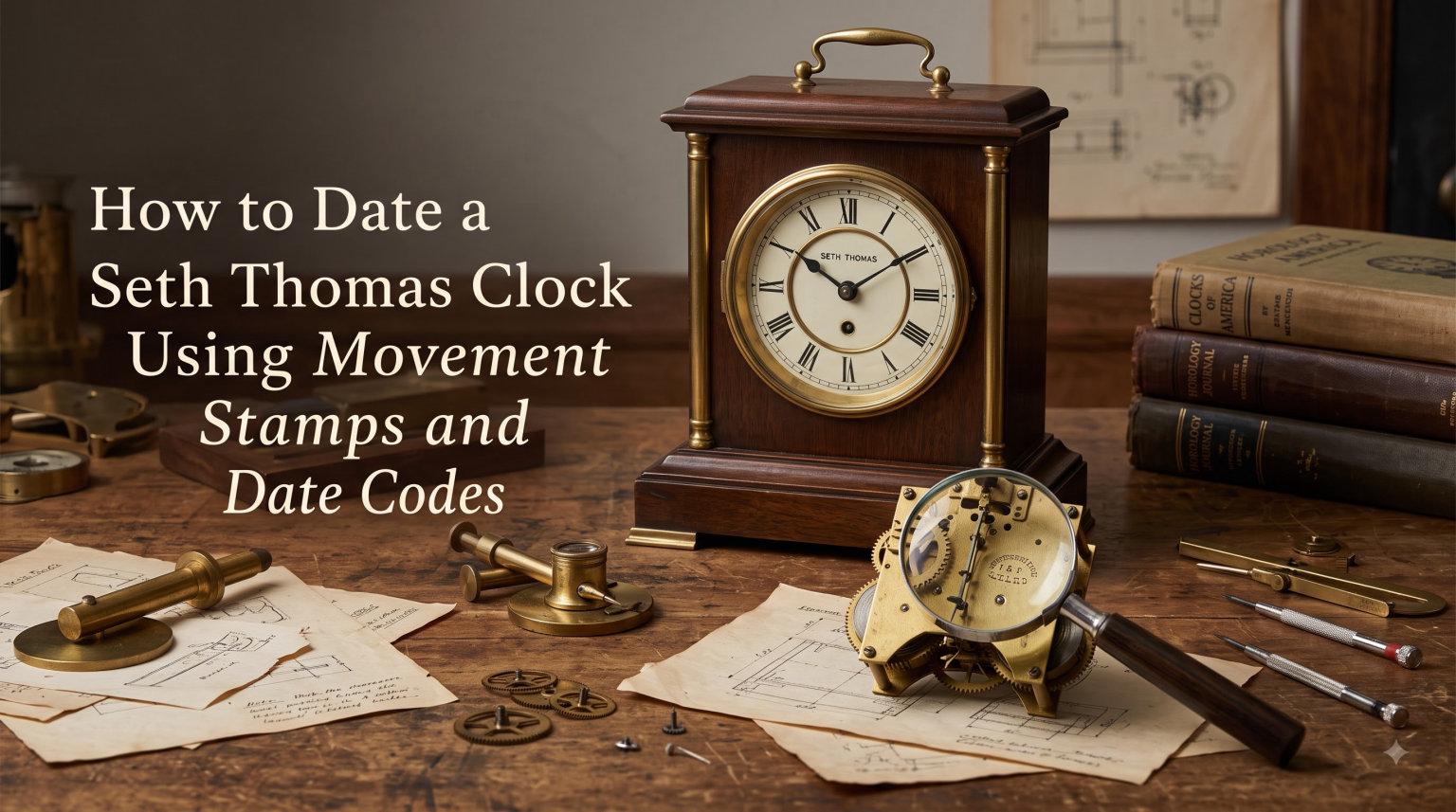
Seth Thomas clock date codes hold the key to figuring out exactly when your antique timepiece rolled off the production line. Whether you inherited a mantel clock from your grandparents or spotted one at an estate sale, knowing its age changes everything about how you value, restore, and care for it.
Our team has spent years studying Seth Thomas movements, stamps, and factory markings to build a reliable dating system anyone can follow. You do not need to be a horologist or a certified appraiser to get this right.
In this guide, we walk you through every method used to date a Seth Thomas clock using movement stamps and date codes. You will learn how to decode the backward-year system, identify movement stamps by era, read paper labels, and spot authenticity red flags before you buy or sell.
By the end, you will be able to pick up almost any Seth Thomas clock and narrow its manufacture date to within a few years using the techniques collectors and NAWCC members rely on every day.
Table of Contents
A Brief History of Seth Thomas Clocks
Seth Thomas founded his clock company in 1813 in the small Connecticut town of Plymouth Hollow. He started by producing wooden-movement tall case clocks before expanding into brass movements, shelf clocks, and mantel clocks over the following decades.
The company grew into one of the most recognized clock manufacturers in America. Seth Thomas clocks became known for solid brass movements, dependable 8-day running times, and cases made from oak, walnut, and mahogany.
When Seth Thomas died in 1859, the town of Plymouth Hollow renamed itself Thomaston in his honor. This detail matters enormously for dating, because the location printed on a clock label changed over time and gives you a reliable era marker.
The company operated independently through most of the 19th and early 20th centuries. It produced millions of clocks ranging from simple alarm clocks to elaborate sonora chime mantel pieces and calendar wall clocks.
By the mid-20th century, the company began transitioning some production to German-made Hermle movements. The Seth Thomas brand eventually passed through several corporate owners before production effectively ceased. Understanding this timeline helps you place any clock into the right era before you even look at the movement.
For dating purposes, the most important historical markers are the town name on labels (Plymouth Hollow versus Thomaston), the introduction of date codes around the late 1800s, and the shift to imported German movements after roughly 1950.
The Seth Thomas Date Code System Explained
Seth Thomas date codes use a clever system that encodes the manufacturing year and month directly onto the clock movement. Once you understand the pattern, you can decode most codes in under a minute.
The most common format found on early 20th-century Seth Thomas movements uses four digits representing the year spelled backward, followed by a letter from A through L representing the month. The letter skips no characters, so A is January and L is December.
For example, the code 9881B means February 1889. You reverse the digits 9-8-8-1 to get 1889, and B corresponds to the second month of the year, February.
Here is the complete month-letter reference that Seth Thomas used:
A = January
B = February
C = March
D = April
E = May
F = June
G = July
H = August
I = September
J = October
K = November
L = December
Keep this list handy when examining a movement. The letter always appears after the four-digit number, and it always uses this same A-through-L mapping.
Not every Seth Thomas clock uses the backward-year format, however. Some movements from the early 1900s use a simpler letter-month plus two-digit year code. The stamp A-09, for instance, means January 1909. In this format, A is January and 09 is the year within the known century.
Later clocks, particularly from the 1950s and 1960s, sometimes use a four-digit number without a letter. These codes typically follow a YYMM pattern. The code 5610 translates to October 1956, where 56 is the year and 10 is the month number. Similarly, 5805 means May 1958.
This means you need to identify which format your clock uses before attempting to decode it. The three formats are the backward-year-plus-letter system, the letter-month-plus-two-digit-year system, and the later YYMM numeric system.
The backward-year format appears most frequently on brass movements from the 1880s through the 1930s. If you are looking at a movement from that era and see four digits followed by a single letter, you are almost certainly dealing with this system.
How to Decode a Seth Thomas Date Code Step by Step
Learning how to date a Seth Thomas clock comes down to a repeatable process. Follow these steps in order and you will arrive at an accurate manufacture date.
Step 1: Locate the Date Code
Open the clock case and examine the back plate of the movement. The date code is usually stamped or engraved directly onto the brass. Look near the edges of the back plate, close to where the movement attaches to the seat board.
If you cannot find it on the movement, check the dial plate (the metal piece behind the clock hands held by three screws). Some clocks have the date stamped on the upper or lower area of this plate.
Step 2: Identify the Code Format
Determine whether you are looking at the backward-year format (four digits plus a letter), the letter-month format (a letter, a dash, and two digits), or the YYMM numeric format (four digits with no letter).
The backward-year format looks like 9881B or 3881G. The letter-month format looks like A-09 or E-11. The numeric format looks like 5610 or 5805.
Step 3: Decode the Year
For the backward-year format, write the four digits in reverse order. The code 9881 becomes 1889 when reversed. The code 3881 becomes 1883. The code 5991 becomes 1995.
For the letter-month format, the two digits after the dash represent the year directly. A-09 means 1909, C-12 means 1912, and E-23 means 1923.
For the YYMM format, the first two digits are the year and the last two are the month. In 5610, the year is 56 (1956) and the month is 10 (October).
Step 4: Decode the Month
For the backward-year format, match the trailing letter to the A-through-L month list. B is February, G is July, J is October, and so on.
For the YYMM format, the last two digits are the month number directly. The number 05 means May, 10 means October, and 12 means December.
Step 5: Cross-Check With Other Markings
Always verify your decoded date against other clues on the clock. Check the label location name, the movement type, the case style, and any model numbers. If your date code says 1889 but the label says Thomaston (which became standard after 1875), your date makes sense.
If the label says Plymouth Hollow (pre-1875) but your decoded date is 1900, something is wrong. Either you misread the code or the label and movement do not originally belong together.
Here are several fully decoded examples to practice with:
9881B = February 1889 (9881 reversed is 1889, B = February)
3881G = July 1883 (3881 reversed is 1883, G = July)
A-09 = January 1909 (A = January, 09 = 1909)
E-05 = May 1905 (E = May, 05 = 1905)
5610 = October 1956 (56 = year, 10 = month)
5805 = May 1958 (58 = year, 05 = month)
Practice on these examples until the pattern clicks. Once it does, you will be able to decode any Seth Thomas date code on sight.
Seth Thomas Movement Stamp Identification
Movement stamps go beyond date codes. They tell you who made the movement, what model it is, and sometimes where it was produced. Learning to read these stamps is essential for accurate Seth Thomas movement identification.
The ST logo is the most recognizable stamp on Seth Thomas movements. The letters ST appear cast or stamped into the brass back plate, often inside a diamond, circle, or shield shape. The style of this logo evolved over decades and provides another dating clue.
Early movements from the mid-1800s may simply read Seth Thomas or S. Thomas without a stylized logo. These movements typically carry the Plymouth Hollow, Conn location stamp as well.
By the late 1800s and early 1900s, the ST monogram inside a decorative border became standard. The border shape and lettering style shifted subtly over the years, with earlier versions featuring more ornate engraving and later versions using simpler, cleaner stamps.
Model numbers are also stamped on the movement. These numbers, such as 89, 77A, 48N, or 120, identify the specific movement type. The model number helps you research production dates and find replacement parts if needed.
The MADE IN USA stamp appears on movements produced after the McKinley Tariff Act of 1891, which required country-of-origin marking on goods. If your movement says MADE IN USA or MADE IN U.S.A., it was almost certainly produced after 1891.
Movements that read only Thomaston, Conn without a MADE IN USA marking likely predate the tariff enforcement period. This gives you a narrower window for clocks produced in the 1880s and very early 1890s.
Post-1950 movements may carry German manufacturer stamps instead of Seth Thomas markings. These movements were made by Hermle and imported for use in Seth Thomas-branded cases. If you see a Hermle stamp, the movement dates from the mid-20th century or later.
The presence of an engraved 8-day marking tells you the movement runs for eight days on a single winding. This was a popular feature across many Seth Thomas models and does not by itself narrow the date significantly, but it confirms you are looking at a quality spring-driven movement rather than a low-cost 30-hour version.
Understanding the Type 89 Movement
The Seth Thomas Type 89 movement deserves its own section because it is one of the most common movements you will encounter. Produced from approximately 1900 through the late 1930s, it powered a huge range of mantel clocks, shelf clocks, and wall clocks.
The Type 89 is an 8-day, spring-driven movement with a pendulum. It typically strikes the hour on a coiled gong and may also strike the half-hour. The movement plates are brass, and the back plate carries the model number 89 stamped near the date code.
If you find a movement stamped 89, you can immediately narrow the clock’s manufacture date to between 1900 and roughly 1938. This is a powerful dating tool on its own, even before you decode the date code.
The Type 89 was used in many popular Seth Thomas models, including various mantel clocks with adamantine cases, oak kitchen clocks, and office calendars. Its ubiquity means replacement parts are still relatively available today.
Several variations of the Type 89 exist, including versions with different strike configurations and plate sizes. The core identifying feature remains the number 89 stamped on the back plate, usually alongside the date code and the ST logo.
Collectors often encounter Type 89 movements that have been serviced or repaired over the decades. Look for evidence of replacement mainsprings, bushings, or repair marks scratched into the plate. These do not affect the date code but tell you the movement has been maintained.
If you are trying to date a clock and find a Type 89 movement with a backward-year date code, you have excellent corroborating evidence. The movement type confirms the era, and the date code gives you the specific month and year.
One important caution: some Type 89 movements have been swapped into non-original cases over the years. Always check whether the movement style, mounting method, and case dimensions appear consistent with an original factory pairing.
Label and Trademark Dating
Paper labels glued inside the clock case are among the most reliable dating tools available. Seth Thomas applied printed labels to the inside back panel or inside the case door of most clocks, and these labels evolved in predictable ways.
The town name on the label is your first and most powerful marker. Clocks labeled Plymouth Hollow, Conn were produced before 1875, when the town changed its name to Thomaston. If you see Plymouth Hollow, your clock predates 1875.
Labels reading Plymouth, Conn typically date from the transition period in the 1860s through the early 1880s. The broader Plymouth township reference appears on some labels even after Thomaston became the official town name.
Labels reading Thomaston, Conn became standard after roughly 1881 and continued through the company’s main production years. If your label says Thomaston, your clock was made in 1881 or later.
The trademark logo on the label also evolved. Early labels feature simple text with the company name and location. Later labels incorporate the ST monogram, decorative borders, and eventually the MADE IN U.S.A. designation.
A clock with an original, intact paper label in readable condition is significantly easier to date and authenticate than one without. Collectors prize clocks with original labels because they provide factory-level provenance.
Some labels also carry hand-stamped date codes. A stenciled or stamped number on the bottom edge of the label, such as 5805, follows the YYMM format and gives you the exact manufacture month and year.
Metal labels appear on some models, particularly office clocks and calendar clocks. These engraved or embossed metal plates follow similar naming and dating conventions to paper labels but are more durable.
Always examine the label carefully for signs of reproduction. Original labels show age-appropriate foxing, discoloration, and adhesive patterns consistent with decades of display. A pristine, bright-white label on a supposedly antique clock is a red flag.
Where to Find Date Codes on Your Clock
Knowing where to look is half the battle when dating Seth Thomas clocks. Date codes appear in several specific locations depending on the clock type and era.
The most common location is the back plate of the movement itself. Remove the clock from its case or open the rear access panel and examine the brass back plate. Look for stamped numbers and letters near the edges, corners, or center of the plate.
The dial plate is the next place to check. This is the metal disc behind the clock hands, typically held in place by three screws. Date codes sometimes appear stamped on the upper or lower portion of this plate.
On mantel clocks, check the bottom of the case. Seth Thomas frequently stenciled date codes on the underside of the case base. Turn the clock carefully (removing the pendulum first) and inspect the bottom panel for stamped numbers.
Inside the case door or on the inside back panel, you will find the paper label. This label may carry a hand-stamped date code on its bottom edge in the YYMM format.
For wall clocks, open the lower door or remove the access panel at the bottom. The movement back plate and the inside back panel are both potential code locations. Some wall clocks also have markings on the inside of the top door or on the dial pan behind the face.
On shelf and kitchen clocks, the movement is often accessible through a rear door. Open it and examine both the movement back plate and the surrounding case interior for stamps.
Grandfather or tall case clocks by Seth Thomas have the movement accessible through the trunk door or the hood. Check the back plate thoroughly, as these movements tend to carry detailed stamps including date codes, model numbers, and the ST logo.
Adamantine mantel clocks deserve special attention. The date code may be stamped on the bottom of the case, on the movement back plate, or on a paper label inside the rear opening. Check all three locations systematically.
If you have checked every location and cannot find a date code, do not panic. Some Seth Thomas clocks simply were not stamped with one. In that case, rely on the label location name, movement type, case style, and trademark design to estimate the era.
Adamantine Case Clocks and Dating
Adamantine clocks represent a distinctive chapter in Seth Thomas production. Adamantine is a celluloid veneer applied over a wooden case to simulate expensive materials like mahogany, rosewood, or onyx. The result is a durable, attractive finish that resists the wear and fading common to natural wood.
Seth Thomas produced adamantine clocks from approximately 1882 through the late 1910s. This relatively narrow window means that identifying an adamantine case immediately narrows your dating range to roughly 35 years.
Adamantine cases come in several finishes, including dark mahogany, rosewood, and black with decorative inlays. Some feature applied ornamentation, including brass or metal trim, clock hands, and numeral rings.
To date an adamantine clock, look for date codes on the movement back plate and on the case bottom. The paper label inside the case should read Thomaston, Conn, consistent with the post-1881 production period.
Many adamantine clocks contain Type 89 movements or similar 8-day spring-driven mechanisms. The combination of adamantine case and Type 89 movement firmly places the clock in the 1900 to 1918 era.
Be aware that adamantine veneer can crack, lift, or develop a cloudy patina over time. The condition of the veneer does not affect dating accuracy but does factor into the clock’s overall value.
Post-1950 German Movements
After approximately 1950, Seth Thomas began using movements manufactured by the German company Hermle in many of its clocks. This transition is important for dating because a Hermle movement in a Seth Thomas case tells you the clock was made in the mid-20th century or later.
Hermle movements are identified by the Hermle name or logo stamped on the back plate. They may also carry two-letter date codes of their own, using a format where the first letter represents the year and the second represents the month within Hermle’s own coding system.
If you open a Seth Thomas case and find a Hermle movement where you expected an original ST-marked brass movement, the movement may be either a factory-original German unit or a later replacement installed during servicing.
Factory-original German movements from the 1950s and 1960s are legitimate Seth Thomas components. They represent the company’s production methods during that era and are authentic to the clock.
Replacement Hermle movements installed during repair work are not original to the clock. You can often distinguish them by mismatched mounting holes, different plate sizes, or evidence of adaptation to fit the original case.
The presence of a Hermle movement does not make a clock worthless or inauthentic. It simply means you need to adjust your dating approach and recognize that the movement and case may not share the same manufacture date.
Authenticity and Counterfeit Warning Signs
One of the biggest concerns among collectors is how to tell a genuine Seth Thomas clock from a reproduction or a cobbled-together piece. Several warning signs can help you avoid costly mistakes.
The single most important authenticity check is whether the movement matches the case. An original Seth Thomas clock has a factory-matched movement and case. If the movement appears too new for the case, has mounting adaptations, or carries a different manufacturer stamp, it may be a replacement.
Original paper labels are a strong authenticity indicator. Reproductions often have photocopied or laser-printed labels with modern paper stock and adhesive. Original labels show appropriate aging, are glued with period-appropriate adhesive, and carry printing consistent with the era.
Be cautious of clocks described as antique Seth Thomas but carrying no ST logo, no model number, and no date code. While some genuine clocks lack codes, a complete absence of markings combined with a too-good-to-be-true asking price warrants extra scrutiny.
Common forgery markers include modern screws in old-looking cases, reproduction dials with vinyl or laser-printed numerals, and movements that show no age-appropriate wear. An antique movement should have tarnish, oil residue, and wear patterns consistent with decades of use.
Reproduction clocks are not the same as counterfeits. Many companies legitimately produced Seth Thomas-style clocks or used the brand name under license. These are not fakes, but they are also not original 19th-century factory pieces. Always ask the seller for documentation and provenance.
NAWCC membership among sellers is a positive trust signal. Members of the National Association of Watch and Clock Collectors adhere to ethical standards and have access to extensive reference materials for verifying authenticity.
If you are uncertain about a clock’s authenticity, post clear photos of the movement back plate, the label, the dial, and the case on collector forums. The Reddit clock community and NAWCC forums are excellent free resources for getting expert opinions.
Value Factors Based on Age
Dating a Seth Thomas clock is the first step toward understanding its value, but age alone does not determine worth. Several factors work together to establish what a clock is truly worth.
Condition is king in the antique clock market. A clock from 1890 in pristine, running condition with original finish and a clean movement will always command more than a rare model that is damaged, non-functional, or heavily restored.
Rarity plays a major role. Common models like standard oak kitchen clocks or basic adamantine mantel clocks were produced in large numbers and are relatively affordable. Unusual models with sonora chimes, calendar mechanisms, or moon phase complications are significantly scarcer and more valuable.
Provenance, or the documented history of ownership, adds value. A clock with original purchase receipts, repair records, or a chain of ownership going back to the original buyer is worth more than an identical clock with no history.
Originality matters more than perfection. Collectors generally prefer a clock with an honest, aged patina and original components over one that has been aggressively restored with replacement parts. A clock with its original movement, dial, hands, and label is always more desirable.
The match between movement and case is a value factor as well. Clocks with their original factory-installed movements are worth more than those with replacement movements, even if the replacement is high quality.
Market demand fluctuates over time. Currently, sonora chime clocks, early Plymouth Hollow pieces, and clocks with unusual complications tend to attract the strongest interest from collectors and command the highest prices.
FAQs
How do I tell how old my Seth Thomas clock is?
Look for a date code stamped on the back plate of the movement. The most common format uses four digits representing the year spelled backward plus a letter for the month (A=January through L=December). Reverse the four digits to get the year, then match the letter to the month. For example, 9881B means February 1889. Also check the paper label for the town name: Plymouth Hollow means pre-1875, Thomaston means 1881 or later.
Are old Seth Thomas clocks valuable?
Yes, many old Seth Thomas clocks hold meaningful value, typically ranging from $100 for common models to several thousand dollars for rare pieces with sonora chimes, calendar mechanisms, or unusual complications. Value depends heavily on condition, originality, rarity, and provenance. Clocks with original movements, intact labels, and minimal restoration command the highest prices in the collector market.
How old is the Seth Thomas 89 movement?
The Seth Thomas Type 89 movement was produced from approximately 1900 through the late 1930s. It is an 8-day, spring-driven brass movement identified by the number 89 stamped on the back plate alongside the ST logo and date code. Because it was used in many popular mantel and shelf clocks, it is one of the most commonly encountered Seth Thomas movements today.
How do you date a clock movement?
To date a Seth Thomas clock movement, locate the stamped date code on the back plate. Identify the format (backward-year plus letter, letter-month plus two-digit year, or YYMM numeric). Reverse the year digits if needed, convert the letter to a month using the A through L system, and cross-check the result against the movement model number, label location name, and case style for consistency.
What happened to the Seth Thomas Clock Company?
The Seth Thomas Clock Company was founded in 1813 and operated independently in Thomaston, Connecticut for over a century. In the mid-20th century, the company began using German-made Hermle movements and eventually passed through several corporate owners. Production of clocks under the Seth Thomas name effectively ceased, though the brand and its historical significance remain highly regarded among collectors and horology enthusiasts.
Conclusion
Dating a Seth Thomas clock using movement stamps and date codes is a skill anyone can develop with practice. The backward-year-plus-letter system, the label location names, the movement model numbers, and the trademark evolution all work together to give you a reliable picture of when your clock was made.
Start with the date code on the movement back plate, confirm your decoded date against the paper label and case style, and always verify that the movement and case are an original factory pairing. If no date code exists, the town name on the label and the movement type will still narrow your date significantly.
Keep the A-through-L month reference and the worked examples from this guide nearby the next time you examine a Seth Thomas clock. With these tools, you can confidently date almost any Seth Thomas timepiece and make informed decisions about its value, authenticity, and care for 2026 and beyond.