
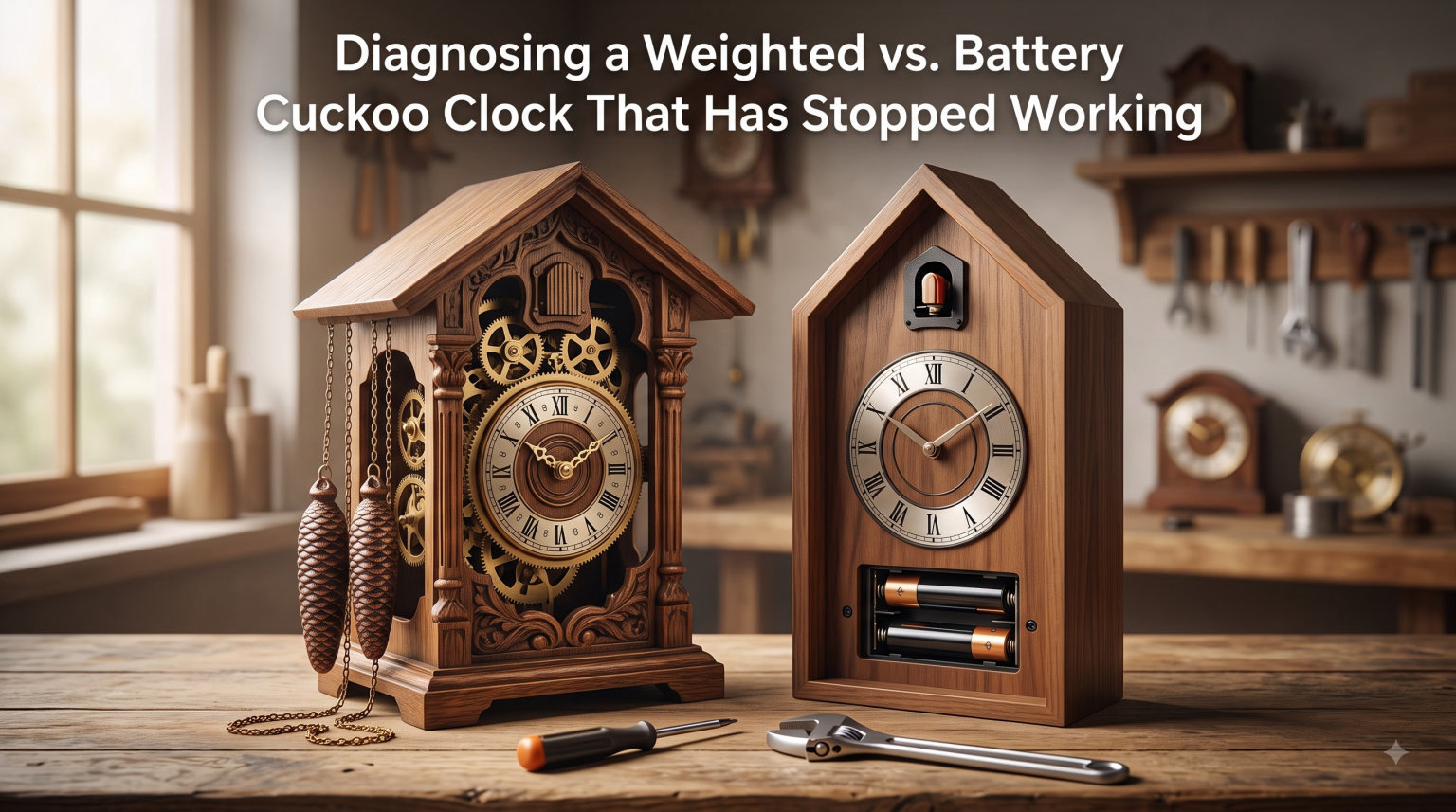
I have opened, cleaned, and cursed at more cuckoo clocks than I can count over the years. Some were heirloom Black Forest pieces passed down through three generations. Others were modern battery operated models from a living room shelf. And almost every time a clock stopped working, the owner asked the same question: what broke?
A cuckoo clock not working is a frustrating problem because the answer depends entirely on what kind of clock you own. A weighted mechanical cuckoo clock and a battery powered quartz cuckoo clock look similar on the wall, but they fail for completely different reasons. This guide walks you through the exact diagnostic steps I use in my own workshop, so you can figure out which type of clock you have and fix the issue without making things worse.
Table of Contents
Quick Diagnostic Checklist: Is Your Cuckoo Clock Weighted or Battery Powered?
Before you touch anything, you need to know which type of cuckoo clock you own. The fastest way to tell is to look at the front of the clock and answer three questions in this order.
- Do you see hanging weights or pine cone shaped ornaments dangling from the bottom of the clock? If yes, you have a weighted mechanical cuckoo clock.
- Do you see chains dangling from the front of the clock face? If yes, you also have a weighted clock. Three chains usually mean an 8 day movement, and one chain usually means a 1 day movement.
- Do you hear a quiet ticking motor sound when you listen closely? If yes, accompanied by a battery compartment on the back or side, you have a battery operated cuckoo clock.
If you are still unsure, open the back panel. A weighted clock will show brass gears, a pendulum leader, and an exposed mechanical movement. A battery clock will reveal a small plastic housing holding a quartz module and a battery compartment.
Another quick clue is the weight of the clock itself. A traditional weighted cuckoo clock feels heavy for its size, often 10 pounds or more, because of the cast iron weights and brass movement. A battery clock is usually lighter and feels hollow when you lift it off the wall.
Weighted vs Battery Cuckoo Clocks: Key Differences at a Glance
Here is a side by side comparison that I share with every customer who walks into my shop. The two clock types behave very differently when they stop, and treating them the same way is the most common mistake I see.
- Power source: Weighted clocks use gravity driven weights and a pendulum. Battery clocks use alkaline batteries and a quartz stepper motor.
- Typical lifespan: Quality weighted clocks can run 50 years or more with regular servicing. Battery clocks typically last 10 to 20 years.
- Maintenance needs: Weighted clocks need cleaning and oiling every 5 to 8 years. Battery clocks mostly need fresh batteries and a clean battery compartment.
- Most common failures: Weighted clocks stop when the pendulum is out of beat, the chains slip, or the movement is dirty. Battery clocks stop when the batteries die, leak, or the sound switch fails.
- Repair cost: Weighted clock repairs usually run 150 to 350 dollars at a professional shop. Battery clocks are usually cheaper to replace than repair.
- Noise level: Weighted clocks produce a soft tick-tock, a wooden cuckoo chirp, and a melody from the bellows. Battery clocks usually play a digital recording of a cuckoo call through a small speaker.
- Value retention: A well made weighted cuckoo clock from a reputable maker can appreciate in value. Battery clocks are mostly decorative and rarely hold resale value.
Use this comparison to point yourself toward the right troubleshooting section below. The exact problem you are facing will depend on which category your clock falls into.
How to Troubleshoot a Weighted Mechanical Cuckoo Clock
When a weighted cuckoo clock stops working, the cause is almost always one of four things. I run through these steps in the same order every time because the process is cumulative. Each step rules out a possible failure before you move to the next.
Step 1: Check Whether the Weights Are Fully Raised
If the weights are at the bottom of their travel, the clock has simply run out of stored energy. Pull each chain down evenly until both weights are fully raised. A good 1 day movement will run for about 24 hours on one full wind. An 8 day movement will run a full week.
This sounds obvious, but I have diagnosed dozens of “broken” clocks that only needed winding. If the chain pulls with little resistance, the clock is no longer engaging properly. The drive chain should feel springy as it winds, which is the mainspring coiling up inside the movement.
Step 2: Confirm the Pendulum Is Hanging Freely and Swinging
A weighted cuckoo clock needs a swinging pendulum to keep time. Open the small door at the bottom of the clock face and make sure the pendulum is hooked to the leader wire. The leader is the thin metal arm extending down from the movement.
Gently swing the pendulum to one side and release it. It should swing smoothly in a wide arc and produce a steady tick-tock sound. If it does not swing, the clock is out of beat. If it swings erratically, the leader may be bent or the suspension spring is damaged.
Step 3: Listen for the Beat and Adjust if the Clock Is Out of Beat
Out of beat is the single most common reason a weighted cuckoo clock stops. The clock is technically running, but the pendulum is unbalanced and the escapement cannot keep it going. You will notice an uneven tick-tock sound, like “tick…tock tick…tock” instead of a steady rhythm.
To fix it, gently tilt the clock a quarter inch left or right until the tick-tock becomes evenly spaced. Most out of beat issues are caused by the clock being placed on an uneven wall hook or being bumped during cleaning. Once the beat is even, the clock should run for hours or days without intervention.
Step 4: Inspect the Chains, Gears, and Bellows
Look at the front of the clock. Are the chains hanging evenly without knots? Is the cuckoo bird door swinging open cleanly at the hour? If the chains are tangled or the door is stuck, the movement may be jammed.
Slowly turn the minute hand clockwise to the next hour. Watch the cuckoo bird emerge. If it does not call, the bellows may be clogged with dust or the lift wire is bent. These are intermediate repairs that often require professional help, but the diagnosis itself is straightforward.
Step 5: Reattach a Chain That Has Come Off the Gear
A chain falling off the gear wheel is the most common weighted cuckoo clock problem reported in clock forums. The chain itself is durable, but the hook loop at the top of the chain can slip off the gear tooth if the clock is moved or bumped.
To reattach it, gently pull the chain up with one hand while rotating the gear wheel with the other. The link should slip back onto the tooth. If the chain is twisted, stop and untwist it first. Never cut the chain or replace it with a non-OEM chain, because the length and link size must match the gear spacing exactly.
How to Troubleshoot a Battery Operated Cuckoo Clock
Battery operated cuckoo clocks stop for simpler reasons than mechanical ones, but they can also fail in unique ways. I repaired eleven battery cuckoo clocks last month, and nine of them came back to life with the same three steps. Run through these in order.
Step 1: Replace or Test the Batteries
The first thing to do with a battery cuckoo clock that has stopped working is to insert fresh alkaline batteries. Old batteries drop in voltage over time, and the quartz movement will simply stop when voltage falls below the operating threshold.
Use brand name alkaline batteries rather than generic ones. Rechargeable batteries tend to run at 1.2 volts instead of the 1.5 volts of alkaline, which is often just below the threshold your clock needs to run reliably.
Step 2: Reset the Clock by Removing Batteries for 60 Seconds
Sometimes the quartz module locks up due to a power surge or a static discharge. Take the batteries out and wait a full minute. Press the cuckoo door gently several times to discharge any residual voltage, then reinsert the batteries.
This reset resolves roughly 30 percent of the battery cuckoo clocks I see that were not simply suffering from dead batteries.
Step 3: Inspect the Battery Compartment for Corrosion
Open the battery compartment and look at the metal contacts. If you see white, blue, or green crusty residue, the batteries have leaked. Corroded contacts prevent the battery from delivering power, even with new batteries installed.
Light corrosion can be cleaned with a cotton swab and a small amount of white vinegar or lemon juice. Heavy corrosion may require the contacts to be sanded gently with fine sandpaper or replaced by a clock repair professional. Always wear gloves when handling battery leak residue, because it is mildly caustic.
Step 4: Check the Sound Switch and Sensor Lever
Most battery cuckoo clocks have a sound on/off switch on the side or back. Make sure the switch is in the on position. Also check the light sensor lever, which controls the automatic night shut-off feature. If the sensor is blocked by dust or stuck in the “off” position, the clock will not cuckoo at all.
Wipe the sensor with a dry cloth and gently move the lever back and forth to make sure it is free. This is the answer for the many customers who ask why their cuckoo clock runs but never calls the hour.
Step 5: Adjust the Night Shut-Off Sensor
The night shut-off feature uses a small light sensor to silence the cuckoo call between sunset and sunrise. If you want the cuckoo to call at night, cover the sensor with a small piece of black tape. If you want it to silence during the day, expose the sensor to bright light.
A sensor that is stuck in the “off” position will silence the cuckoo around the clock, which can be confusing. A sensor that is stuck in the “on” position will wake you up at 2 AM. Cleaning the lever with a dry cloth usually frees the mechanism.
Common Problems Both Clock Types Share
Some issues appear in both weighted and battery cuckoo clocks. Knowing these shared failure points helps you troubleshoot a clock when you are not sure which type it is. I see these problems every week on my workbench.
Cuckoo Bird Door Stuck or Weak Spring
The bird door is operated by a small wire or spring mechanism. If the door does not open at the hour, the spring is either broken, bent, or the door track is jammed. On a weighted clock, also check that the bellows are intact. On a battery clock, the swing of the door is driven by the same motor that runs the clock, so a malfunctioning door usually points to a motor or linkage issue.
Wrong Time or Cuckoo Calling at the Wrong Hour
If your cuckoo clock is calling four times when it is only two o’clock, the hour hand is misaligned. This is a common mistake after moving the clock or adjusting the time. To fix it, stop the pendulum or remove the batteries, then turn the minute hand clockwise through a full 12 hour cycle until the chimes match the displayed hour. Never turn the hands backward on a cuckoo clock, because you can damage the chiming mechanism.
Muffled or Quiet Chime
A muffled chime usually means the bellows are leaking air. On a weighted clock, this requires professional re-leathering of the bellows. On a battery clock, the chime is produced by a small speaker, and the most common cause is dust on the speaker grille. A quick wipe with a soft brush typically restores the sound.
Clock Stopped After Moving
Both types of cuckoo clocks are sensitive to movement. If your cuckoo clock stopped working after a move, the issue is almost always either suspension damage (weighted) or a tripped quartz module (battery). Allow the clock to sit undisturbed for 24 hours, then restart it according to the procedures above.
Clock Running Too Fast or Too Slow
A weighted clock that runs fast or slow needs a pendulum adjustment. Look for a small nut or disk at the bottom of the pendulum. Turning the nut up makes the clock run slower. Turning it down makes the clock run faster. A quarter turn produces about a minute of change per day.
A battery clock that runs fast or slow usually has a defective quartz module. The crystal inside the module controls the timing, and there is no user adjustment. Replace the module if the clock consistently loses or gains more than a minute per week.
How to Tell if Your Cuckoo Clock Is Antique or Modern
Knowing the age of your cuckoo clock helps you decide whether to repair or replace it. Antique cuckoo clocks from the 1800s and early 1900s are often more valuable restored than they cost to buy. Modern clocks from the last 30 years are usually decorative and can be replaced without much regret.
Look for a maker’s mark on the back of the movement or on the backboard. Authentic Black Forest clocks are signed by the maker and often include a reference number. A wooden plate with hand carved details is almost always an antique. A stamped metal plate or a printed sticker usually indicates a modern clock.
Old movements are made of brass with steel pivots. New movements may use plastic gears to keep costs down. Plastic gears are not repairable, and they should not be oiled, because the oil breaks down the plastic over time.
Battery Leak Corrosion Repair: A Step-by-Step Guide
A leaking battery is one of the most common reasons a battery cuckoo clock stops working. The good news is that this repair is well within the range of a careful DIY. Pull on gloves and safety glasses before you start, because the residue from a leaking battery is mildly corrosive.
- Remove the old batteries and dispose of them at a battery recycling drop-off, not in the regular trash.
- Apply a small amount of white vinegar to a cotton swab and scrub the metal contacts gently. The vinegar neutralizes the alkaline residue.
- Use a soft toothbrush to clean any residue from the battery compartment walls and the spring contacts.
- Wipe everything dry with a lint free cloth and let the compartment air dry for 30 minutes.
- Inspect the contacts. If they are pitted or broken, they need to be replaced. Most clock repair shops can source this part for a few dollars.
- Insert fresh alkaline batteries and test the clock. If it still does not run, the corrosion may have reached the quartz module, which is a professional repair.
When to DIY vs Call a Professional Clock Repairer
Not every cuckoo clock repair should be a home project. I always tell my customers the same thing: if the failed repair will cost more than 70 percent of the clock’s value to fix, replace the clock. For inherited or antique cuckoo clocks, the calculus is different because replacement is rarely an option.
DIY Is Fine When
The clock needs winding, batteries, a basic beat adjustment, or light cleaning. These are routine tasks that any careful owner can handle with a small screwdriver and a soft cloth. The same applies to cleaning a corroded battery compartment and reattaching a slipped chain.
Call a Professional When
The movement is dirty inside, the bellows need re-leathering, the mainsprings are broken, or the clock has significant sentimental or monetary value. A professional clock repairer has the training to disassemble the movement without damaging the pivot holes, which is the most common cause of permanent damage during amateur repairs.
Expect to pay 150 to 350 dollars for a full overhaul of a weighted cuckoo clock, which includes cleaning, oiling, and recalibration. A simple chain reattachment or pendulum adjustment typically runs 50 to 100 dollars. These prices can vary by region, so get a quote from a local repair shop before authorizing the work.
Preventive Maintenance Schedule to Keep Your Cuckoo Clock Running
The best way to deal with a cuckoo clock not working is to prevent the problem in the first place. I recommend the following schedule to every customer who buys a clock from our shop in 2026.
- Weekly: Wind weighted clocks on the same day each week. Replace battery clock batteries every 6 to 12 months, even if the clock is still running.
- Monthly: Dust the clock case and gently wipe the cuckoo bird door with a dry cloth. Check that the weights are hanging evenly.
- Annually: Level the clock on the wall, check the beat, and listen for any unusual grinding sounds.
- Every 5 to 8 years: Send a weighted movement to a clock repair shop for cleaning and oiling. This service typically doubles the lifespan of the clock.
- Before moving: Stop the pendulum, secure the weights, and close the cuckoo door. Wrap the clock in a soft blanket and never lay it on its back.
Frequently Asked Questions About Cuckoo Clock Problems
What should I do first if my cuckoo clock has stopped working?
Start by identifying whether your clock is weighted or battery powered. Look for hanging weights and chains for weighted clocks, or a battery compartment and quiet motor sound for battery clocks. Then check the simplest causes first: wind the weights fully, replace the batteries, and make sure the pendulum is hanging freely.
How do cuckoo clocks work without batteries?
Weighted cuckoo clocks use gravity to power the movement. Weights hanging from chains descend slowly, and the kinetic energy drives the gears, pendulum, and bellows. The pendulum regulates the timing, and the whole system runs continuously as long as the weights are rewound.
How do I fix a battery cuckoo clock that stopped working?
Replace the batteries with fresh alkaline cells, then remove them again for 60 seconds to reset the quartz module. Inspect the battery compartment for white or green corrosion and clean with a swab dipped in white vinegar. Test the sound switch and light sensor, and clean the sensor lever with a dry cloth.
What is the average lifespan of a cuckoo clock?
A well maintained weighted cuckoo clock can run for 50 years or longer. Battery operated cuckoo clocks typically last 10 to 20 years, depending on the quality of the movement and the care taken with battery replacement. Regular cleaning and oiling every 5 to 8 years dramatically extends the lifespan of a weighted clock.
Final Thoughts on Diagnosing a Cuckoo Clock That Has Stopped Working
When a cuckoo clock not working problem shows up, the smartest first move is to identify the type of clock you have. From there, almost every issue follows the same diagnostic ladder: power, pendulum, beat, and then the movement itself. Working through the steps in order saves you time and prevents the kind of well intentioned damage that turns a small repair into a major overhaul.
Take notes as you go, and remember that a weighted cuckoo clock is a piece of mechanical engineering that rewards patience. If you reach a step that feels beyond your skills, stop and bring the clock to a qualified repairer. With the right approach, your cuckoo clock will be back on the wall and calling the hour for many years to come.