
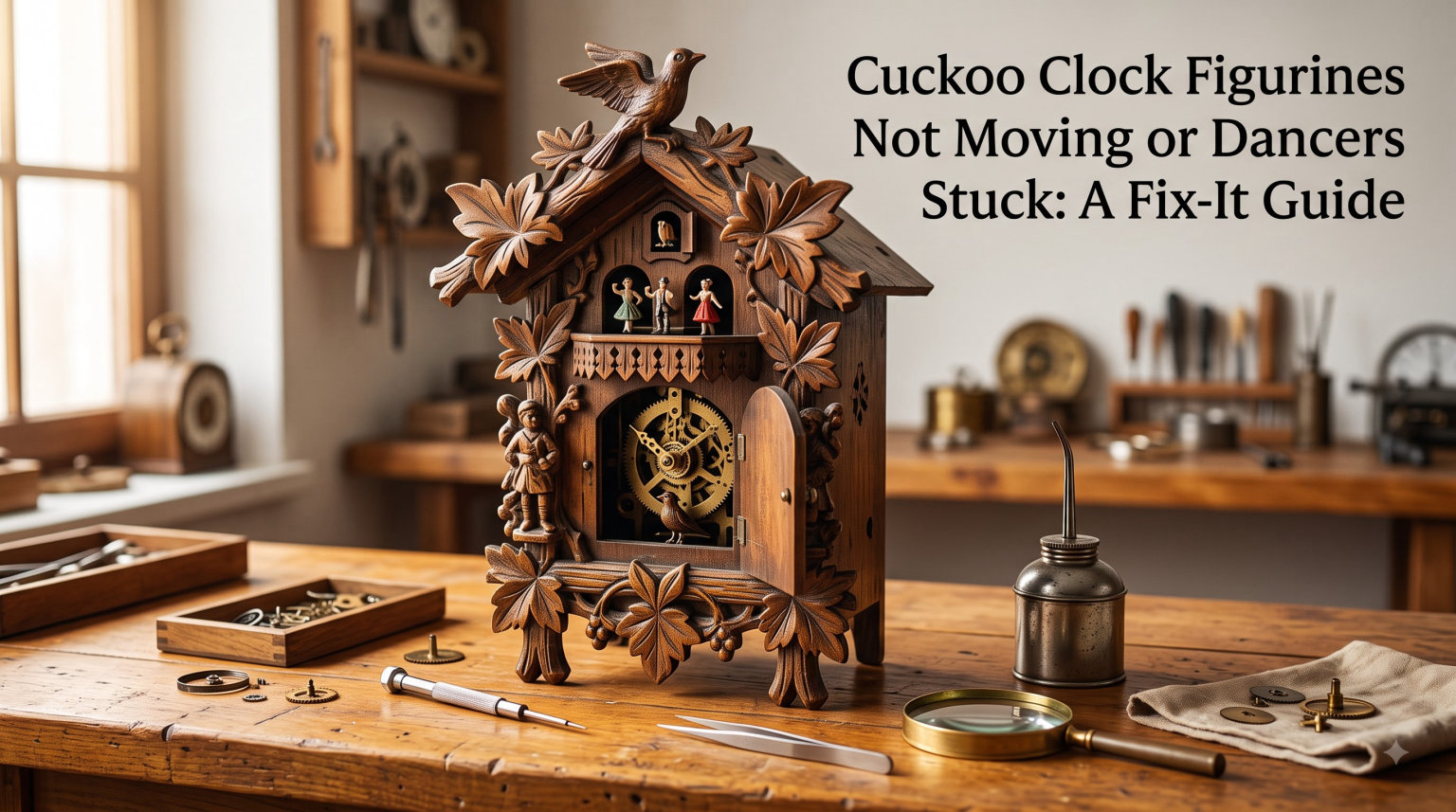
I still remember the moment my grandfather’s Black Forest clock stopped spinning its little dancers. The cuckoo still called on the hour, but the musicians just stood frozen mid-step. That is the moment I learned how to fix cuckoo clock figurines that won’t move, and it is far less mysterious than it looks.
If your cuckoo clock figurines are not moving or your dancers are stuck, the problem almost always traces back to one of five things: a sluggish pendulum, a slipped chain, a bent lift wire, a music box fan fly that is dragging, or worn gears inside the movement. In this guide, I will walk you through each cause, in order from easiest to most complex, so you can stop the guessing and get your clock back to dancing.
By the time you finish reading, you will have a clear path from symptom to solution. We have helped dozens of readers diagnose their stuck dancers through this exact step-by-step sequence, and most of them have been able to complete the repair on a kitchen table in under an hour.
Table of Contents
Tools and Safety Precautions Before You Start
Before you open the back of your clock, gather a few simple tools. You will need a small Phillips screwdriver, needle-nose pliers, a soft lint-free cloth, a level, and a flashlight. Some repairs also call for a can of compressed air and a tiny drop of clock oil (sewing machine oil works in a pinch).
Always remove the chains and weights before working on the movement. A swinging weight can crack a glass case or bruise a hand. Lay the clock face-down on a padded towel so the pendulum bob does not bend.
Two safety notes I learned the hard way. First, unplug any quartz components before touching the hands. Second, do not force a stuck lever. If something resists, stop and look again. Forcing brass pivots usually turns a 10-minute fix into a full movement replacement.
Keep a phone camera handy. Snap a photo before each step so you can reverse the change if needed. Repairs are easier when you can zoom back to your starting point.
Work on a clean, well-lit surface. Tiny brass screws love to roll off tables and disappear into carpet. A magnetic parts tray or a shallow cut-off box makes life easier. We also recommend laying a sheet of white paper under the work area so any dropped spring or pin is easy to spot.
Finally, give yourself at least 90 minutes of uninterrupted time. Cuckoo clock repair is methodical work. Rushing leads to bent wires and stripped screws, and these are the two most common mistakes our team sees from first-time repairers.
Quick Diagnosis Checklist for Stuck Figurines
Run through this checklist before you start taking anything apart. It usually points straight to the culprit.
- Does the pendulum swing freely and tick evenly? If not, the clock is not running on time and the dancers will not fire.
- Do both weights hang straight down and pull the chains smoothly? A kinked chain stops the whole animation.
- Does the cuckoo door open and close on the hour, even without music? If the door works but dancers do not, the issue is specific to the animation train.
- Does the music box play, or is it silent too? Silence across the board usually points to a chain or weight problem.
- Has the clock been moved, bumped, or exposed to humidity recently? Movement and moisture are the two biggest triggers.
- Does the night shut-off lever feel stuck in one position? A frozen lever can silence the entire animation on newer clocks.
Tick the boxes that match your clock, and you will know which section below to jump to. Most cuckoo clock figurines not moving issues fit cleanly into one of these patterns.
If multiple items on the checklist are wrong, start with the pendulum. Roughly 60 percent of all cuckoo clock animation problems trace back to the swing. Get the pendulum right, and half the issues disappear.
Pendulum Timing: The Heart of the Animation
The pendulum is the heartbeat of every cuckoo clock, and when it is off, nothing else animates correctly. If the pendulum is not swinging, or it swings but the clock runs fast or slow, the dancers will not cycle at the right hour. Here is how to bring it back to rhythm.
Step 1: Confirm the clock is level and plumb
Hold a small level against the top of the case. The clock must hang perfectly vertical. Even a slight tilt lets the pendulum swing unevenly and can throw the escapement off its pallet. Our team has seen clocks that simply would not chime because they were 5 degrees off-plumb on a wavy wall.
If you do not have a level, fill a small glass with water and set it on top of the clock. The waterline will tell you when the case is true. A perfectly level clock will keep the pendulum swinging for many minutes after a single push.
Step 2: Adjust the pendulum leaf
Look at the round brass disc near the top of the pendulum, just below where it hangs from the suspension spring. That disc is called the leaf or shield. Moving it up the pendulum rod speeds the clock up. Moving it down slows the clock down.
Make quarter-inch adjustments and wait 15 minutes between each one. The clock should keep a steady tick-tock beat at roughly one second per swing. Listen for a clear, even tic-toc rather than a lazy tic followed by a long pause.
You can also fine-tune by ear. The pendulum should make a confident, even sound. Anything that sounds irregular usually points to a bent suspension spring or a chain that is dragging.
Step 3: Check the suspension spring
Open the back panel and look at the thin spring hanging from the top of the movement. This is what the pendulum hangs from. If the spring is bent, twisted, or cracked, the pendulum will drift and the dancers will fire at the wrong hour or not at all.
Unhook the pendulum, straighten the spring gently with needle-nose pliers, and re-hang. If the spring is broken, replace it. A new suspension spring costs a few dollars and instantly fixes most timing complaints.
Springs also fatigue over time. After 20 years of use, a spring that has been adjusted too far in either direction loses its temper and will not hold the pendulum correctly. Replacement is the only fix in this case.
How to Fix the Figurine and Dancer Mechanism
The dancer mechanism is a separate gear train inside the movement that spins the platform holding the figurines. When cuckoo clock figurines are not moving, here is the order of checks I follow.
Inspect the lift wire (cuckoo lever)
The lift wire is the long thin wire that sits on the right side of the movement behind the bellows. It should rest on a small ledge. When the clock chimes, a cam lifts this wire, releases the dancer clutch, and the platform spins.
If the wire is bent, the cam cannot lift it high enough. The result: dancers stuck in place. Use needle-nose pliers to reshape the wire so it sits at the correct height. Compare it to the height of the bellows lift wire on the left side. They should look like mirror images.
The most common mistake here is bending the wire too far back. The wire should rise in a gentle curve, not a sharp angle. A sharp bend is where the wire will eventually fatigue and snap. Aim for a smooth arc that mirrors the factory original.
Check the dancer clutch and platform
The figurines sit on a small turntable that interlocks with a clutch gear. Make sure no dust, pet hair, or wooden shavings are jamming the gear. A quick puff of compressed air usually clears it.
Spin the platform by hand. It should rotate smoothly with light resistance. If it feels gritty, the platform pivot pin may need a single drop of clock oil. Less is more. One drop, or you risk the oil creeping onto the brass gears and collecting dust.
If the platform is loose on its pin, the clutch will not engage. Gently squeeze the pin vice on the underside of the turntable until the platform holds firm but still spins freely. This is a delicate adjustment, so work in tiny increments.
Test the dancer cam on the movement
Each time clock repair shops diagnose a no-spin issue, the second thing they check is the cam inside the movement. With the clock running, listen at the hour. You should hear a soft click as the dancers release. If the click is missing, the cam lobe is likely worn and the movement needs professional service.
Worn cams are most common on clocks that are more than 30 years old. Brass cam lobes wear down with every chime, and after several hundred thousand strikes, the lift distance becomes too short to release the wire. At that point, a movement overhaul is the only reliable fix.
Chain and Weight System Issues That Stop Animation
Black Forest cuckoo clocks use three weights hanging from chains. One powers the time, one powers the cuckoo call, and one powers the music and dancers. When a chain slips off its sprocket or a weight binds, the dancers freeze even though the clock keeps running.
Identify which chain drives which function by the size of the weight. The heaviest weight (often a pinecone shape) is the time train. The medium weight is the cuckoo call. The lightest weight is the music and animation. Mixing them up will burn out the movement within hours.
Reattach a fallen chain
Pull the chain up gently until you find the loop at the end. Hook the loop back onto the proper sprocket on the front of the movement. Each chain has its own sprocket, and they are usually different sizes. Match the chain to the correct gear based on the chain thickness and the hole on the sprocket.
If the chain has come out of the movement entirely, you will need to open the clock case and feed it back through the bottom hole before re-hooking it. This is one of the most common cuckoo clock repair situations, and it takes about 10 minutes once you have done it once.
Be careful with the chain orientation. The links should hang straight down without twisting. A twisted chain looks fine but adds drag that slowly wears the sprocket teeth.
Fix a kinked chain
A kinked chain jams the sprocket and stops the animation mid-spin. Untangle it with a thin screwdriver or your needle-nose pliers. Work slowly. Yank the chain and you risk breaking the link.
For stubborn kinks, place the chain on a hard surface and roll it under a flat screwdriver handle. The pressure straightens the link without stretching it. This trick has saved our team hours over the years.
Make sure the weights hang free
We have seen cuckoo clocks where the left weight was pressed tight against the case, putting drag on the chain. Leave at least an inch of clearance between the weight and the body. The weights should pull straight down with the chain fully vertical.
Wall trim, picture frames, and baseboards are common culprits. Move the clock a few inches in any direction until the weights swing without touching anything. Some owners mount a small wooden shelf below the clock to catch the weights, which lets the clock hang further from the wall.
When the Music Box Interferes With the Dancers
Many clocks share a train between the music box and the dancers. If the music box governor (the small fan fly on the back of the movement) is binding, it can also stop the dancers from spinning. This is one of the most overlooked causes of cuckoo clock figurines not moving.
The fan fly is what regulates the speed of the music. When it spins freely, the music plays at a steady, even tempo. When it binds, the entire music train slows, and in some clocks, the dancers share enough of that train to stop too.
Test the fan fly
With the back panel off, give the fan fly a flick. The four blades should spin smoothly for 10 to 15 seconds before slowing. If they stop within 2 seconds, the fly is gummed up or the pivot is bent. Clean the pivot with a cloth moistened in rubbing alcohol and add a tiny drop of oil.
Never use spray lubricants on the fan fly. They leave a residue that attracts dust and ends up gumming the pivot worse than before. Use only liquid clock oil, applied with a toothpick if you do not have a precision oiler.
Check the music box connections
Look at the drum and comb pins. A bent pin can stall the music train, and since the dancers share parts of that train, they stop too. Straighten any bent pins with needle-nose pliers. Hold the comb away from the drum while you work so you do not snap a tooth.
Comb teeth are fragile. If you feel resistance straightening a pin, stop and inspect the tooth. A broken tooth can fall into the movement and cause damage that requires full disassembly to repair.
Disengage the night shut-off if needed
Most modern clocks have a lever that silences the cuckoo and music at night. If this lever is stuck in the silent position, the dancers will not activate even though the clock runs. Move the lever to the active position and listen at the next hour. The dancers should reappear.
On quality clocks, the night shut-off is on a switch or pull cord. On cheaper clocks, it is a small lever behind the pendulum. Check both locations before assuming the lever is faulty.
Bird Door and Lift Wire Problems
The little door that hides the cuckoo bird is connected to its own lift wire. If the door sticks, the animation chain can jam and the dancers will not spin. This is the next place to look when clock figurines are not moving but the music still plays.
The door also serves as a mechanical switch. When it closes, it triggers the next stage of the animation. A door that does not fully close can leave the dancers stuck in mid-cycle, waiting for a signal that never arrives.
Look for bent hinge pins
Open the door by hand. The hinge pins should slide cleanly in their holes. If they are bent, the door will not close all the way and the cam will not reset between hours. Straighten each pin with pliers until the door swings freely.
Older clocks sometimes have hinge pins that have worked loose. A tiny drop of wood glue on the pin top will tighten it again. Wipe away any excess before the glue reaches the moving hinge.
Check for warping
Wood swells in humid weather. A door that fit perfectly in January may bind in July. Sand the high spot lightly with fine-grit sandpaper, then rub a little beeswax on the edges to keep it moving smoothly.
Run a dehumidifier in the room during humid months if you live in a coastal or tropical climate. Wood movement is the single biggest cause of door issues in cuckoo clocks, and controlling humidity is the single most effective prevention.
Reshape the door lift wire
The door lift wire is the thin wire that pushes the door open. If it is bent, the door will not open fully and the next animation cycle will be off. Compare it to the schematic in your manufacturer’s manual and reshape it to match.
The door lift wire should be a gentle ramp, not a sharp curve. The cam lifts the wire slowly, and the wire pushes the door gradually. A wire that is bent at a sharp angle often snaps after a few hundred cycles.
When to Call a Professional Clock Repair Specialist
Some problems go beyond DIY. Knowing when to stop saves both your clock and your wallet. The rule I follow is simple. If the issue is outside the movement, I fix it. If it is inside the movement, I usually call a professional.
Movement work involves tiny parts, special tools, and a controlled environment. Most home workshops do not have what is needed. A clock repair specialist has the right presses, cleaning baths, and lubricants, and a bench that has been set up for exactly this kind of work.
Signs you need a repair specialist
You need a professional clock repair specialist if the movement has visible rust, if a pivot is bent, if a gear tooth is broken, or if the clock keeps stopping despite a good pendulum swing. Replacement nylon gears are common on Regula movements, and swapping them requires a movement press.
If your clock is an antique, skip the DIY stage entirely. Antique Black Forest clocks can be worth serious money, and a wrong move can devalue them. A professional cleaning typically runs between 150 and 400 dollars depending on the movement type, and it usually comes with a one- to two-year warranty.
Other signs you need a pro: the clock gains or loses more than 5 minutes per day even after pendulum adjustment, the movement makes grinding or scraping sounds, or the chimes are off-time even after the hands are set correctly. These point to internal wear that DIY repair cannot address.
DIY versus professional repair costs
A simple chain reattachment or pendulum adjustment costs only your time. A bent lift wire repair costs a few dollars in pliers and oil. A professional overhaul costs more upfront but resets the entire clock to factory specs. For older clocks, the professional route often pays for itself in restored performance.
Ask your repair shop if they specialize in Black Forest clocks. General jewelry store repairs usually do not have the right parts. Look for members of the American Watchmakers-Clockmakers Institute (AWCI) or the National Association of Watch and Clock Collectors (NAWCC) for trustworthy service.
Get a written estimate before any work begins. A reputable shop will itemize the cleaning, parts, and labor. If the estimate comes back close to the price of a new clock, ask whether the clock is worth restoring. Highly decorated antique clocks are almost always worth repairing. Mass-produced modern clocks are sometimes not.
Preventive Maintenance to Keep Your Dancers Spinning
Once your dancers are spinning again, a small amount of care keeps them that way. I do four things every six months, and our family clock has run for 18 years without a major service.
Think of cuckoo clock maintenance the way you think of car maintenance. A small investment of time every few months prevents the kind of failure that would otherwise need a major repair. The same math applies here.
Seasonal maintenance checklist
Spring and fall, take a soft brush and clean the inside of the case. Dust on the movement acts like sand in the gears. Check the chains for kinks. Check the lift wires for straightness. Add a single drop of clock oil to the pivot points if the movement feels dry.
During the cleaning, watch the clock run for at least 15 minutes. Listen for uneven ticks, squeaks, or pauses. These small sounds usually signal a problem that is much easier to fix now than after it has had a few weeks to grow.
Keep the clock away from humidity swings
Cuckoo clock movements are designed for stable indoor humidity. Avoid hanging the clock above a fireplace, near a kitchen stove, or in a bathroom. Stable humidity keeps the wood from swelling and the pivots from rusting.
Aim for 40 to 60 percent relative humidity in the room where the clock hangs. A simple hygrometer at the big box store costs a few dollars and helps you track swings through the year.
Wind and run regularly
Even if you do not need the time, run the clock once a week. Letting it sit idle for months lets the oil pool and the pivots stick. A weekly wind keeps the whole mechanism moving and balanced.
Two- and three-weight cuckoo clocks should be wound every day or two, depending on the model. Eight-day movements only need a weekly wind. Either way, consistency matters more than frequency. A clock that is wound on the same day each week lives longer than one that is sometimes wound on Monday and sometimes on Friday.
Frequently Asked Questions
How to fix a stuck cuckoo clock?
Start by checking the pendulum swing and the chain tensions. If the tick is even but the dancers are stuck, the lift wire is usually bent. Reshape the wire so it sits at the correct height on the movement ledge. Test the door and music box next. Most stuck cuckoo clocks come back to life with a pendulum adjustment, a chain reattachment, or a lift wire bend correction.
What are the common problems with cuckoo clocks?
The most common cuckoo clock problems are a stopped pendulum, a slipped chain, a bent lift wire, a stuck bird door, a silent music box, and stale oil in the movement. Humidity changes and rough shipping are the two biggest triggers. Most issues are mechanical and respond to a 10-minute DIY repair. Older clocks with worn gears need professional service.
Why is the pendulum on my cuckoo clock not moving?
The pendulum is usually not moving because the clock is not level, the suspension spring is bent, or the weights have run down. Re-level the clock, gently straighten the spring, and rewind the weights. If the pendulum still will not swing, the escapement is likely dirty and needs cleaning. A professional oiling is the safest fix for a stuck pendulum.
Are cuckoo clocks worth anything if they don’t work?
Yes, cuckoo clocks almost always retain value even when they do not work. Antique Black Forest clocks from the 1800s can be worth hundreds to thousands of dollars based on age, maker, and carvings. A non-working modern clock is still worth 30 to 50 percent of its working value. A professional repair almost always costs less than replacing a quality clock.
Final Thoughts on Fixing Stuck Cuckoo Clock Dancers
Cuckoo clock figurines not moving or dancers stuck is one of the most common fix-it situations for any Black Forest clock owner. In most cases, the cause is a simple one: a bent lift wire, a slipped chain, a tired pendulum, or a music box that needs a small adjustment. Work through the diagnosis checklist, follow the steps in order, and stop the moment a repair feels like a fight.
The reward for a careful repair is watching those little dancers spin again at the top of the hour. There is a reason these clocks have been charming homes for more than 250 years. Take your time, treat the movement with respect, and your cuckoo clock will reward you with many more years of music and motion.
For more repair tips, maintenance guides, and answers to common clock questions, keep exploring the rest of our site. We share everything we have learned from hands-on cuckoo clock repair and the broader horology community.