
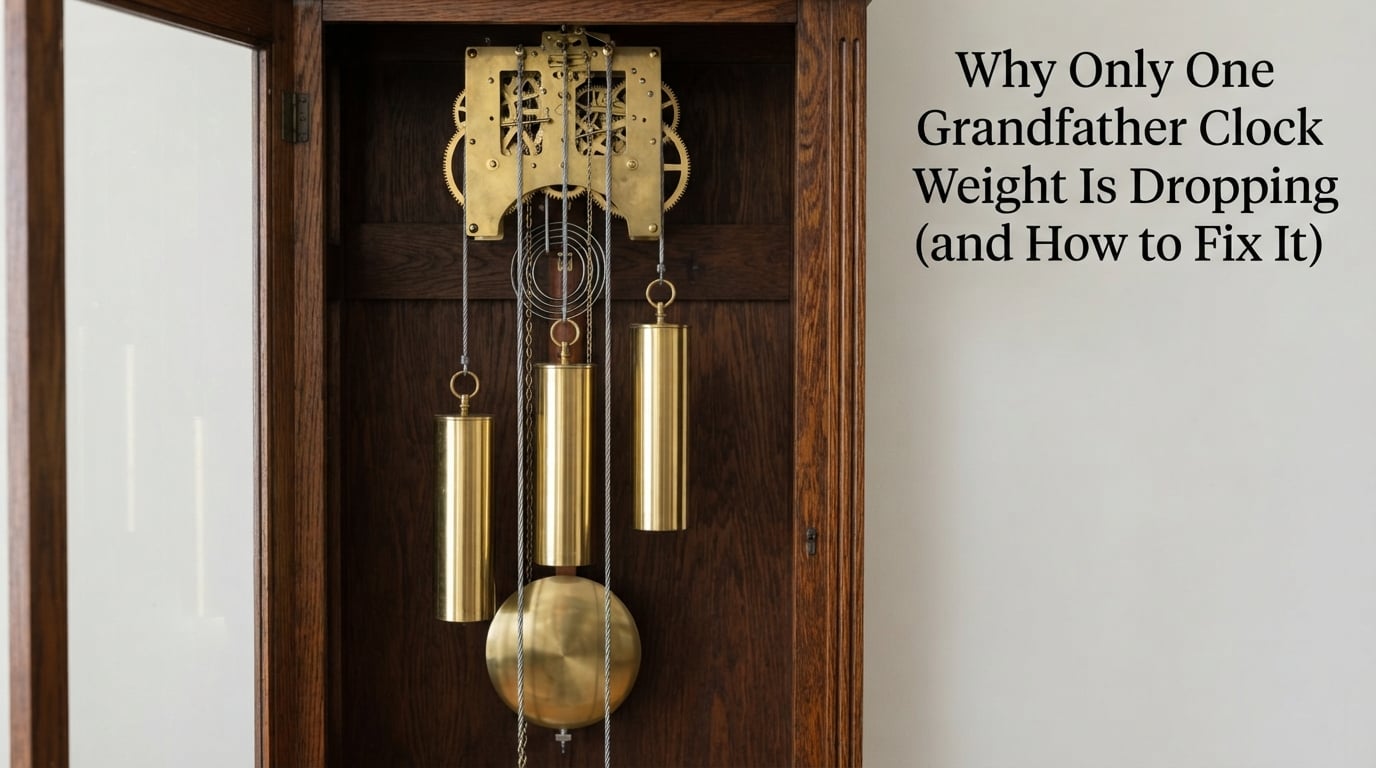
You wind your grandfather clock, step back, and notice something odd. Only one of the three weights is dropping while the other two sit frozen near the top. Before you panic or call a repair technician, take a breath. This is one of the most common grandfather clock weight dropping issues owners encounter, and in most cases, the fix is surprisingly simple.
The most frequent reason only one weight drops is that the chime or strike function has been turned off, either by you or by an automatic nighttime silence mode. When the chime is disengaged, the weights that power the chime and strike mechanisms stop descending because the clock no longer needs that power. Only the center weight, which keeps the pendulum swinging and the clock ticking, continues to drop normally.
In this guide, I will walk you through exactly why this happens, how to tell whether you have a simple settings issue or a real mechanical problem, and step-by-step instructions to get all three weights moving again. I have spent years around mechanical clocks, and the information here covers everything from quick no-tool fixes to knowing when professional help makes sense.
Table of Contents
Understanding Your Clock’s Three Weights and What Each One Does
Every traditional grandfather clock uses three weights hanging from either cables or chains. Each weight powers a different part of the clock’s operation, and understanding which weight does what is the first step to diagnosing any weight problem.
The center weight powers the timekeeping function. This is the weight that keeps the pendulum swinging and the hands moving. If this weight stops dropping, your clock stops entirely. No tick, no time. This is why the center weight dropping while the other two stay up is actually the most common scenario, and often the least alarming.
The right weight powers the chime function. On most clocks, this is the weight that drives the melody you hear every fifteen minutes. If the chime is turned off, this weight has nothing to power, so it stays put. Many clock owners discover this when they flip a silent switch and then wonder why the right weight stopped moving.
The left weight powers the strike function, which produces the hourly count. When the clock strikes the hour, this weight provides the energy for each hammer blow. Like the chime weight, if striking is disabled, the left weight will remain in its raised position.
Which Weight Is the Heaviest?
The heaviest weight always goes on the right side and powers the chime mechanism. The chime requires the most energy because it plays a full melody every quarter hour. If you have ever wondered which side does the heaviest weight go on a grandfather clock, the answer is the right side.
The center weight is typically the lightest because the timekeeping gear train requires the least amount of power. The left strike weight falls somewhere in between. Mixing up these weights during reinstallation after a move is one of the top reasons clocks develop running problems.
Most quality clocks mark each weight with a letter: L for left, C for center, and R for right. Always check these markings before hanging weights, especially if your clock was recently moved or serviced.
Why Only One Grandfather Clock Weight Is Dropping
If you see only one weight descending while the others stay frozen, the answer almost always comes down to one of two scenarios: either the chime and strike are intentionally or accidentally turned off, or there is a mechanical issue with the specific weight train that is stuck.
The single most common cause is nighttime silence mode or a manually set silent switch. Many modern grandfather clocks, especially Howard Miller and similar brands, include an automatic nighttime shutoff that silences the chime between roughly 10 PM and 7 AM. Some owners leave the silent mode engaged permanently because they find the chimes disruptive. When this happens, only the center weight drops because only the timekeeping train is active.
I have talked with dozens of clock owners on forums like the NAWCC message board who were convinced their clock was broken, only to discover the silent mode lever was flipped. One Reddit user shared that their clock ran perfectly for weeks with just the center weight moving, and it turned out the chime selection lever had been bumped during a dusting session.
If your clock is chiming normally but one specific weight is not dropping, then you are likely dealing with a mechanical issue rather than a settings problem. In that case, the cause is usually overwinding, a jammed cable or chain, or a problem within the movement itself.
Common Causes of Stuck Weights Beyond Silent Mode
Silent mode explains why only the center weight drops in many cases. But when you have confirmed the chime is switched on and weights are still stuck, several other culprits could be at play. Let me walk through each one.
Cause 1: Overwinding
Overwinding is a widely misunderstood term. You cannot actually wind a clock weight too tightly and break the spring, because grandfather clocks do not use mainsprings in the traditional sense. What people call overwinding is really a situation where the weight has been pulled up too high and something is preventing it from coming back down.
When you wind the clock and pull the weight to the very top of its travel, the cable or chain can overlap on the winding barrel or catch on a pulley. This creates a bind that holds the weight in place. The clock may still tick from the center weight, but the jammed chime or strike weight will not descend.
Some larger clocks include overwind protection, a mechanical feature designed to prevent the weight from being pulled too high. If your clock has this feature and weights still get stuck in the high position, the protection mechanism itself may need attention.
Cause 2: Jammed Cables or Chains
Cable-driven grandfather clocks use braided steel cables that run over pulleys and wind onto barrels inside the movement. Over time, these cables can fray, develop kinks, or slip off their intended routing path. A frayed cable may catch inside the movement and prevent the weight from descending smoothly.
Chain-driven clocks face similar issues. The chains that support the weights can twist, jump off sprockets, or develop tight spots where links bind together. Chain suspension problems are especially common in clocks that have been moved without properly securing the chains first.
Inspect the cable or chain from the weight up to the movement. Look for fraying, rust spots, kinks, or sections where the cable appears to be pinched. A visual inspection often reveals the problem immediately.
Cause 3: Weights Placed Incorrectly
Incorrect weight placement causes a surprising number of problems. If the weights are swapped after a move or cleaning, the clock may behave erratically. The chime weight placed in the center position will not provide enough power for timekeeping, and the lighter center weight on the chime side may drop too fast or fail to power the melody properly.
Always verify weight placement using the L, C, and R markings stamped or labeled on each weight bottom. The heaviest weight belongs on the right for the chime train. Getting this wrong can make it look like a weight problem when the real issue is simply that the weights are in the wrong spots.
Cause 4: The Clock Has Stopped Ticking
If the clock movement has stopped entirely, none of the weights will drop because there is no power being drawn from any of them. A stopped clock is different from a clock where one weight drops and two stay stuck. If all three weights are frozen, the problem is with the movement or pendulum, not the individual weight trains.
Check whether the pendulum is swinging. If it has stopped, the clock may simply be out of beat. A clock that is in beat produces an even tick-tock rhythm. If the tick sounds uneven, like tick-tick-tock with a hesitation, the clock needs to be put back in beat before the weights will function normally.
Cause 5: Wear and Tear in the Movement
After 15 to 25 years of continuous operation, the pivots and bushings inside a clock movement wear down. This wear increases friction in the gear train, and the weight may no longer have enough pulling power to overcome the resistance. A worn chime train will cause the chime weight to stick, even though the center weight drops fine.
Movement wear is the most common cause of weight problems in older clocks. Forum users on r/clocks frequently report that cables and pulleys function fine, but the internal movement needs service after decades of use. This is a job for a professional clock repair technician.
Step-by-Step Troubleshooting Guide
Follow these steps in order to diagnose and fix your grandfather clock weight dropping issue. Start with the simplest checks and work toward the more complex ones. Most issues are resolved within the first three steps.
Step 1: Check the Silent Mode and Nighttime Shutoff
Locate the chime silence lever or switch on your clock dial. This is usually on the face near the 3 o’clock position or on the side of the movement accessible through a side panel. Make sure it is set to the chime-on position, not silent.
If your clock has automatic nighttime silence, wait until daytime hours (after 7 AM) to see if the chime resumes on its own. Some owners accidentally leave the lever in the silent position and forget about it. Flip the switch and manually advance the minute hand to the next quarter hour to test whether the chime engages.
Step 2: Verify Weight Placement
Remove each weight and check for the L, C, and R markings. If the markings are unclear or missing, you can identify them by weight. Use a bathroom scale to weigh each one. The heaviest weight goes on the right (chime side), the lightest in the center (time side), and the remaining one on the left (strike side).
Hang each weight in its correct position. Make sure the cable or chain is properly seated in the pulley groove and that the weight hangs straight without touching the sides of the clock case.
Step 3: Manually Advance the Minute Hand While Pulling Down
This is the technique recommended by experienced NAWCC forum members and it works remarkably well for stuck chime or strike weights. Here is how to do it safely.
While turning the minute hand slowly forward, pull down gently on the stuck weight. Continue moving the hand past the 12 o’clock position while maintaining gentle downward pressure on the weight. The chime or strike mechanism should engage, and the weight should begin to drop normally as the gear train starts moving.
Do not force the minute hand. If you feel resistance, stop. Forcing the hand can bend it or damage the movement. If the hand will not advance past a certain point, you likely have a mechanical jam that requires professional attention.
Step 4: Inspect the Cable or Chain
Use a flashlight to examine the full length of each cable or chain from the weight up to the movement. Look for fraying, kinks, rust, or sections where the cable has slipped off the pulley. If you see the cable has jumped off a pulley wheel, you may be able to reseat it by hand, but be very careful not to pinch your fingers.
For chain-driven clocks, check that the chain is properly engaged on the sprocket inside the movement. A chain that has jumped off the sprocket will not pull the weight down. You may need to open the clock case to access the movement and reseat the chain.
Step 5: Check If the Clock Is In Beat
Listen to the tick-tock rhythm. A properly adjusted clock produces an evenly spaced tick-tock, tick-tock. If the rhythm is uneven, the clock is out of beat and the pendulum may eventually stop, which stops all weight movement.
To correct the beat, you can slightly tilt the clock to one side until the tick sounds even. For a permanent fix, the crutch that connects the pendulum to the movement needs to be adjusted. This requires removing the pendulum and gently bending the crutch leader, a delicate operation best left to someone comfortable with the procedure.
Step 6: Rewind and Test
Once you have addressed the likely cause, rewind all three weights to their full height and let the clock run. Observe the weights over the next hour. If the chime or strike was the problem, you should now see all three weights descending at their normal rates.
The center weight drops fastest because the timekeeping function runs continuously. The chime weight drops more slowly since it only activates on quarter-hour intervals. The strike weight drops slowest of all, engaging only at the top of each hour. These different drop rates are completely normal.
Quick Diagnosis Checklist
Use this checklist to quickly narrow down your problem. Work through each item and stop when you find the match.
Only the center weight drops: Check if silent mode or nighttime shutoff is engaged. This is the answer in most cases.
All three weights are stuck: The clock has stopped ticking. Check the pendulum and beat adjustment first.
Weights are stuck at the very top: Likely an overwinding bind. Try the manual advance technique from Step 3.
One weight drops much faster than the others: Verify weight placement. The weights may be swapped.
Weights worked fine until recently moved: Check cable routing, chain engagement, and weight position labels.
The clock chimes but a weight still will not drop: Inspect the cable or chain for fraying or jams.
Problem persists after all checks: The movement likely needs professional service due to wear.
When to Call a Professional Clock Repair Technician
Many grandfather clock weight issues can be resolved at home, especially when the cause is silent mode, weight placement, or a simple cable jump. However, some problems require the expertise and tools of a trained horologist.
Call a professional if the cable is visibly frayed or broken. Replacing a cable requires proper tensioning and routing that is difficult to achieve without experience. A frayed cable can also snap under load, which would send a heavy weight crashing down inside the case.
If the movement is worn after 15 or more years of use, a professional overhaul or replacement is the right path. Movement wear causes excessive friction that no amount of weight adjustment will fix. A technician can clean, re-bush, and lubricate the movement, or install a brand-new replacement movement if the original is beyond repair.
Brand-specific repair centers are available for major manufacturers like Howard Miller, Ridgeway, and Hermle. These centers stock the correct replacement parts and have experience with your specific movement type. Expect a professional service call to address movement issues, not just simple adjustments.
Prevention Tips to Keep Weights Dropping Smoothly
A few simple habits will keep your grandfather clock running smoothly and prevent most weight problems from developing in the first place.
Wind the clock at the same time each week. Do not let the weights drop so low that they nearly touch the bottom of the case, as this can cause the chain or cable to develop slack and jump off the sprocket or pulley. Stop winding as soon as the weight reaches the top rather than forcing extra turns.
Have the clock professionally cleaned and lubricated every 3 to 5 years. Fresh oil reduces friction on the pivots and extends the life of the movement significantly. A well-maintained movement can run for 25 to 30 years before needing a full overhaul.
When moving the clock, always remove the pendulum and weights first. Secure the chains or cables to prevent them from jumping off their tracks. Never move a grandfather clock with the weights attached, as the swinging weights will damage the case interior and can tangle the cables.
If you use the nighttime silence feature regularly, be aware that the chime and strike weights will not drop during silent hours. This is normal behavior, not a malfunction. The weights will resume dropping when the silence period ends.
FAQs
Should all weights on a grandfather clock drop evenly?
No, the three weights drop at different rates and that is completely normal. The center weight drops fastest because it powers continuous timekeeping. The right chime weight drops more slowly since it only activates every fifteen minutes. The left strike weight drops slowest because it only runs at the top of each hour. If one weight is not dropping at all rather than just dropping slowly, that indicates a problem.
Why are the weights on my grandfather clock not dropping?
The most common reasons weights stop dropping are: the chime silent mode or nighttime shutoff is engaged, the weights are placed in the wrong positions, a cable or chain is jammed or frayed, the clock has stopped ticking due to being out of beat, or the movement has worn down from years of use. Check the silent switch first, as it is the answer in most cases where only the center weight drops.
How do you put a weight back on a grandfather clock?
First identify each weight by its L, C, or R marking. The heaviest weight goes on the right side for the chime train, the lightest in the center for timekeeping, and the remaining weight on the left for the strike. Hook the weight onto the loop at the bottom of the cable or chain, making sure it hangs straight without touching the case sides. Never attach weights while the clock is running, and always verify placement using the markings on the weight bottoms.
Which side does the heaviest weight go on a grandfather clock?
The heaviest weight always goes on the right side. This weight powers the chime mechanism, which requires the most energy because it plays a full melody every fifteen minutes. The center position holds the lightest weight for timekeeping, and the left position holds the middle weight for the strike function.
What is the average cost to fix a grandfather clock?
A professional service call for basic adjustments and lubrication typically runs between $150 and $350. A full movement overhaul involving cleaning, re-bushing, and reassembly can cost $500 to $1,000 or more depending on the movement complexity. Complete movement replacement ranges from $400 to $800 plus installation. Simple fixes like correcting silent mode or weight placement cost nothing and can be done at home.
How do you unwind the weights on a grandfather clock?
To manually release stuck weights, turn the minute hand slowly forward while pulling down gently on the stuck weight. Continue past the 12 o’clock position while maintaining steady downward pressure. The gear train should engage and allow the weight to descend. Never force the minute hand if you feel strong resistance, as this can damage the movement. If manual advance does not work, the issue may be a jammed cable or worn movement.
Conclusion
When only one grandfather clock weight is dropping, the answer is usually simple: your chime or strike function has been turned off, either manually or by nighttime silence mode. Check that switch first before assuming anything is broken. Understanding why only one grandfather clock weight is dropping saves most owners an unnecessary repair bill and gets the clock back to full operation in minutes.
If the silent mode check does not solve it, work through the troubleshooting steps in order. Verify weight placement, inspect cables and chains, try the manual advance technique, and check the beat. These steps resolve the vast majority of weight issues without professional help. When the problem traces to a worn movement or damaged cable, a qualified clock repair technician is your best next step.
Your grandfather clock is a mechanical marvel designed to run for decades with proper care. A little knowledge about how those three weights work together goes a long way toward keeping it ticking, chiming, and striking beautifully for years to come.