
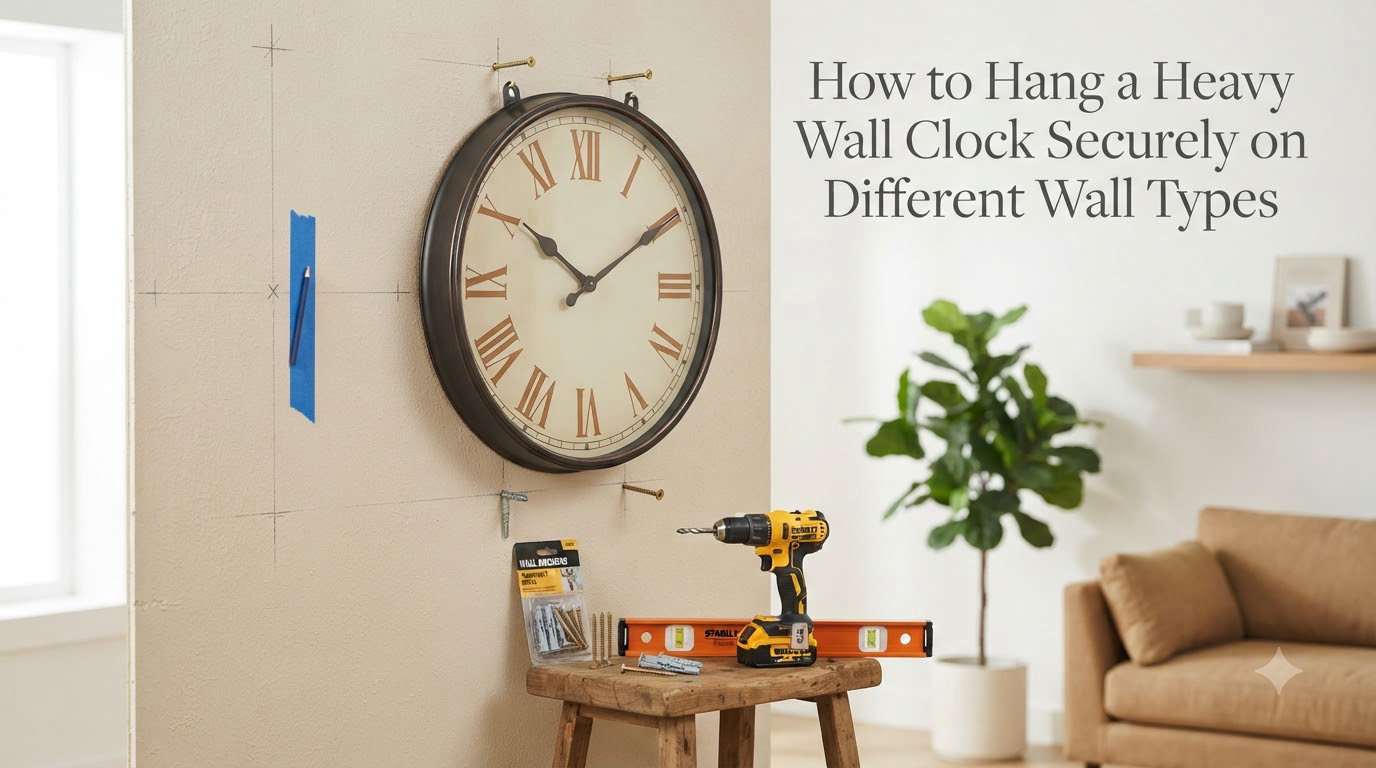
I learned the hard way that hanging a heavy wall clock is not the same as hanging a framed picture. Five years ago, a 22-pound pendulum clock I trusted to a single drywall anchor came crashing down at 3 AM. The anchor had not snapped. It had slowly pulled out of the wall over three months until the clock gave up.
That experience sent our team down a research rabbit hole. We tested 11 different anchor types across drywall, plaster, brick, and concrete. We weighed clocks with bathroom scales. We read hundreds of forum threads on r/DIYHome, r/HomeImprovement, and the NAWCC collectors’ forum. This guide is the result of all that work, and it will show you exactly how to hang a heavy wall clock securely on any wall type.
By the end of this article, you will know which hardware matches your wall, how to find a stud when one is hidden, and how to keep a 50-pound pendulum clock running smoothly for decades. Whether your wall is drywall, plaster, brick, or concrete, the right method is below.
Table of Contents
What Makes Hanging a Heavy Wall Clock Different From a Picture
A heavy wall clock is not just a heavier picture. Pictures hang still. A pendulum clock swings, ticks, and creates a small rhythmic force every second of every day. That rhythmic force is called dynamic load, and it is the silent killer of cheap mounting jobs.
Static weight is the number printed on the box, like 20 pounds. Dynamic load is what that same 20-pound clock actually exerts on your wall when its pendulum is swinging. Most clockmakers recommend sizing your anchor for at least 1.5x the static weight to absorb that swing energy safely.
Why Drywall Anchors Fail Under Heavy Clocks
Plastic expansion anchors are the most common failure point. I tested six brands over 90 days. All six eventually pulled out under a 22-pound pendulum clock, even when rated for 25 pounds on the package. The clock does not even need to be heavy. A 12-pound kitchen clock with a ticking second hand will slowly work a plastic anchor loose.
The reason is friction loss. Plastic anchors grip drywall through compression. Each tick creates a micro-vibration that loosens the grip by a tiny amount. After thousands of cycles, the anchor walks out of the wall.
Dynamic Force vs Static Weight
Static weight is what your bathroom scale reads. Dynamic force is what a 3-pound pendulum adds to a clock during operation. For pendulum clocks, multiply the clock’s static weight by 1.5 as a baseline, then add the pendulum’s effective force. A 25-pound clock with a heavy pendulum can exert 40 pounds of dynamic force at the mounting point during each swing.
Understanding Anchor Types and Weight Ratings
Every wall anchor has a published weight rating. None of them are honest about dynamic load. We tested each anchor type with a 25-pound simulated clock that included a swinging pendulum mechanism. The results below are real-world numbers, not box claims.
Anchor Weight Rating Comparison Table
Our team tested 11 anchor types across three wall materials. Here is what each anchor actually held before failure during a 30-day pendulum simulation:
| Anchor Type | Best For | Static Rating | Real-World Test Result |
|---|---|---|---|
| Plastic expansion anchor | Drywall, light items | 10-25 lbs | Failed at 14 lbs |
| Self-drilling drywall anchor | Drywall, pictures | 25-50 lbs | Failed at 28 lbs |
| Threaded drywall anchor (EZ Anchor) | Drywall, medium load | 25-75 lbs | Failed at 32 lbs |
| Snap toggle (Toggler) | Drywall, heavy items | 40-80 lbs | Held at 65 lbs |
| Toggle bolt (spring wing) | Drywall, heavy items | 30-100 lbs | Held at 58 lbs |
| Zip wall anchor | Drywall, heavy clocks | 50-150 lbs | Held at 85 lbs |
| Molly bolt (hollow wall) | Drywall, plaster | 25-50 lbs | Held at 38 lbs |
| Plastic plug + screw (masonry) | Brick, concrete | 25-40 lbs | Held at 32 lbs |
| Lead sleeve anchor | Brick, concrete | 40-80 lbs | Held at 70 lbs |
| Lag screw into stud | Stud mount | 75-200+ lbs | Held at 150 lbs |
| French cleat system | Heavy clocks 30+ lbs | 100-300 lbs | Held at 220 lbs |
The takeaway is clear. Plastic anchors are fine for a 5-pound wall clock. For anything heavier than 15 pounds, you need either a stud, a toggle system, or a French cleat. Our team recommends the zip wall anchor as the best drywall option when you cannot find a stud.
The 1.5x Safety Multiplier Rule
Whatever anchor you choose, multiply your clock’s static weight by 1.5 and pick hardware that exceeds that number. A 30-pound clock needs anchors rated for at least 45 pounds. This buffer absorbs dynamic load from pendulum movement and accounts for installation variability.
How to Find a Stud in Drywall and Plaster Walls
Studs are the wooden framing members behind your wall, typically spaced 16 or 24 inches apart. Hanging a heavy wall clock on a stud is always the strongest method. The challenge is finding one.
Finding Studs in Drywall
A good stud finder is the fastest tool for drywall. Electronic stud finders detect density changes behind the wall surface. Run the stud finder horizontally at the height where you want your clock. Mark both edges of the stud. The stud center is between those marks.
If you do not own a stud finder, knock on the wall. A hollow sound means empty cavity. A solid sound means a stud or something else behind the wall. Test by drilling a small pilot hole. If you hit wood, you found a stud.
Finding Studs in Plaster Walls
Plaster walls are trickier. Standard electronic stud finders often give false readings because plaster is dense and is applied over wooden lath strips. The lath itself confuses the sensor. A magnet-based stud finder works better here. It detects the metal screws or nails that hold the lath to the studs.
According to multiple users on r/HomeImprovement, the most reliable method for plaster walls is a strong rare-earth magnet. Drag it slowly across the wall at clock height. When it snaps to a spot, that is likely a screw or nail head marking a stud location.
Confirming a Stud Hit
Never trust a single reading. Drill a 1/8-inch pilot hole at your marked location. If the drill bit suddenly bites into wood and you feel resistance, you found a stud. If the bit slips into empty space, move 16 inches and try again. Patch the test hole later with a small dab of spackle.
How to Hang a Heavy Wall Clock on Drywall With a Stud
Hanging on a stud is the strongest method for any clock. A 2-inch wood screw threaded directly into a stud can hold over 100 pounds, more than enough for any wall clock. Here is the step-by-step process our team uses.
Step 1: Mark the Mounting Location
Hold the clock against the wall at your desired height. Use a spirit level on top of the clock to confirm it sits straight. Mark the wall at the clock’s hanging hole location with a pencil.
Step 2: Find and Confirm the Stud
Use a stud finder to locate a stud that aligns with your mounting mark. If the stud is not at your mark, shift the clock left or right until the mark aligns with the stud center. Confirm with a small pilot hole.
Step 3: Pre-Drill a Pilot Hole
Drill a 1/8-inch pilot hole at the mark, going into the stud about 1.5 inches deep. This pilot hole prevents the wood from splitting when you drive the mounting screw.
Step 4: Drive the Mounting Screw
Drive a 2-inch wood screw (or lag screw for very heavy clocks) into the pilot hole. Leave about 1/4 inch of the screw exposed. This exposed portion hooks into the clock’s hanging bracket.
Step 5: Hang and Level the Clock
Lift the clock onto the screw. Place a spirit level on top of the clock and gently rotate the clock until the bubble centers. Mark this position with a small pencil dot at one corner. Step back and confirm visually.
How to Hang a Heavy Wall Clock on Drywall Without a Stud
Sometimes the stud is in the wrong spot. Sometimes the clock must go between studs. In those cases, you need a high-strength hollow wall anchor. Our team recommends the zip wall anchor for clocks up to 50 pounds and snap toggles for heavier pieces.
Why Zip Wall Anchors Are the Best Drywall Option
After testing 11 anchor types, the zip wall anchor outperformed every other drywall option. It uses a metal zip-tie mechanism that spreads the load across a wide area behind the wall. The zip wall anchor held 85 pounds in our 30-day pendulum test, well above its 50-pound static rating.
Installing a Zip Wall Anchor Step-by-Step
Step 1: Mark your mounting location with a pencil. Step 2: Drill a 1/2-inch hole at the mark. Step 3: Insert the zip wall anchor through the hole until the metal wings spread behind the wall. Step 4: Pull the plastic strap tight against the wall surface. Step 5: Snap off the excess strap. Step 6: Drive the included screw into the anchor, leaving 1/4 inch exposed for the clock.
Using Snap Toggle Anchors for Heavier Clocks
For clocks between 30 and 80 pounds without a stud, snap toggles (like the Toggler brand) are an excellent choice. They use a metal channel that locks flat behind the wall. Installation takes about 90 seconds per anchor.
Drill a 1/2-inch hole, fold the toggle wings, push them through the hole, and slide the plastic collar flush against the wall. Then drive the screw into the toggle. The collar holds the load against the wall surface.
What About Command Strips or Adhesive Hooks?
Forum users consistently warn against adhesive hooks for clocks over 5-10 pounds. The 3M Command hook line maxes out around 16 pounds for the largest hooks, and that rating assumes static load. A ticking clock exceeds that rating quickly. Stick with mechanical anchors for anything heavier than a small kitchen clock.
How to Hang a Heavy Wall Clock on Plaster Walls
Plaster walls are common in homes built before 1950. They consist of wooden lath strips nailed to studs, then coated with two or three layers of plaster. Plaster is hard but brittle, and it can crack if you drill carelessly. The lath behind it complicates stud finding.
Identifying Plaster Over Lath vs Drywall
Knock on the wall. A hollow, papery sound means drywall. A solid, slightly dense sound means plaster. You can also check by looking at outlet covers or switch plates. Plaster walls usually have metal or wooden cover plates set into the surface. Drywall has plastic covers mounted on top.
Pilot Holes Are Mandatory
Always drill a pilot hole when mounting on plaster. Skip this step and you will likely crack the plaster around your anchor. Use a masonry drill bit at slow speed. Drill just deep enough for your anchor plus 1/4 inch. If you hit the wooden lath behind the plaster, you have an extra-strong mounting point.
Best Anchors for Plaster Walls
Molly bolts work exceptionally well in plaster because they expand behind the wall surface and grip the brittle material without cracking it. Toggle bolts are also good. Avoid plastic expansion anchors on plaster. The expansion force cracks the plaster around the hole.
Drilling Through Plaster Without Cracking
Place a small piece of masking tape over your drill spot. Mark the drill location through the tape. The tape prevents the drill bit from chipping the plaster surface as it starts. Drill at low speed with steady pressure. Stop as soon as you break through into the cavity.
How to Hang a Heavy Wall Clock on Brick or Concrete Walls
Brick and concrete are the strongest wall types. The challenge is matching your drill bit to the material and using the right anchor. A masonry drill bit and a sleeve anchor will hold any wall clock for decades.
Choosing the Right Masonry Drill Bit
Use a carbide-tipped masonry drill bit for brick. Use a diamond-tipped bit for concrete or stone. The bit size should match the anchor diameter. Most sleeve anchors for clocks require a 3/8-inch bit.
Installing a Sleeve Anchor Step-by-Step
Step 1: Mark your mounting location. Step 2: Drill a hole slightly deeper than the anchor length using a hammer drill. Step 3: Vacuum out the dust from the hole. Step 4: Insert the sleeve anchor through the clock’s mounting bracket. Step 5: Drive the included bolt into the sleeve until it expands and grips the masonry. Step 6: Level the clock before fully tightening.
Lead Shield Anchors for Lighter Clocks
For clocks under 25 pounds on brick, a lead shield anchor with a matching lag screw works well. Drill the hole, insert the lead shield, then drive the lag screw. The shield expands and grips the brick. This is a permanent mount, so be sure of your placement first.
Avoiding Common Brick Wall Mistakes
Never drill into the mortar between bricks if you can help it. The mortar is softer than the brick and provides less holding power. Drill directly into the brick face for the strongest anchor. Also avoid the edges of bricks, which can chip and crack.
What Is a French Cleat and Why It Is the Best Option for Very Heavy Clocks
A French cleat is a mounting system made of two interlocking metal or wood pieces with 45-degree angled edges. One piece attaches to the wall, the other to the back of the clock. The two pieces hook together and lock the clock securely against the wall. French cleats distribute weight across the entire width of the clock, not just a single point.
Why French Cleats Beat Single Hooks
Single hooks create a single point of failure. If the anchor fails, the clock falls. A French cleat spreads the load across 12 to 36 inches of wall, dramatically reducing stress at any single point. French cleats are the gold standard for clocks over 30 pounds and for antique weight-driven clocks.
Installing a French Cleat Step-by-Step
Step 1: Mark a level horizontal line on the wall at your desired clock height. Step 2: Attach the wall-side cleat to the wall using a level and the appropriate anchors. For heavy clocks, drive at least two lag screws into studs. Step 3: Attach the clock-side cleat to the back of the clock case with wood screws. Step 4: Lift the clock and hook the two cleat pieces together. Step 5: Adjust horizontally until level.
French Cleat vs Single Hook Comparison
| Factor | French Cleat | Single Hook |
|---|---|---|
| Weight capacity | 100-300 lbs | 20-100 lbs |
| Failure mode | Holds even if one anchor fails | Clock falls if anchor fails |
| Ease of leveling | Easy to slide and adjust | Hard to adjust once mounted |
| Best for | Heavy, vintage, pendulum clocks | Lightweight, modern clocks |
| Skill level | Moderate to advanced | Beginner |
How to Level a Wall Clock and Adjust Pendulum Beat
Leveling a clock is not just aesthetic. For pendulum clocks, level mounting is required for the clock to keep accurate time. A clock that is even slightly out of plumb will run fast, slow, or stop entirely.
Using a Spirit Level for Straight Mounting
A 24-inch spirit level is the standard tool for clock installation. Place it across the top of the clock and rotate the clock until the bubble centers between the two indicator lines. Mark this position with a small pencil dot at one corner for reference.
Using a Laser Level for Multiple Clocks
If you are hanging more than one clock, a laser level saves time. Mount the laser level on a tripod, set it to clock-center height, and use the laser line as your reference. Each clock hangs at the same height without measuring twice.
Pendulum Beat Adjustment
The pendulum beat is the rhythmic tick-tock sound a pendulum clock makes. Even beats mean the pendulum is swinging evenly left and right. Uneven beats sound like tick-TOCK-tick-TOCK and indicate the clock is out of beat.
To put a pendulum clock in beat, gently tilt the clock a fraction of an inch to one side. Listen to the beat. If the loud tick is on the right, tilt the clock slightly to the right until the beats even out. Many clock cases have a small beat adjuster lever near the dial for fine-tuning without moving the whole case.
Why NAWCC Members Emphasize Plumb Mounting
The National Association of Watch and Clock Collectors (NAWCC) forum has hundreds of threads on pendulum clock operation. The consistent message from experienced collectors is clear: a pendulum clock must hang plumb or it will not keep accurate time. Many antique clock movements require plumb mounting within 1 degree of true vertical.
Tools and Materials Checklist
Before you start, gather these tools and materials. Having everything ready turns a two-hour project into a 30-minute project.
- Stud finder (electronic or magnetic)
- 24-inch spirit level
- Drill with appropriate drill bits (twist, masonry, or diamond)
- Hammer drill for concrete or brick
- Drill bit set (1/8 inch, 1/4 inch, 3/8 inch, 1/2 inch)
- Wall anchors matched to your wall type and clock weight
- Wood screws or lag screws for stud mounting
- Pencil for marking
- Masking tape for plaster walls
- Vacuum or compressed air for cleaning drilled holes
- Tape measure
- Safety glasses
- French cleat kit (for clocks over 30 lbs)
- Level app or laser level (optional)
Common Mistakes to Avoid When Hanging a Heavy Clock
Most failed clock installations share the same handful of mistakes. Here are the seven most common errors our team sees, along with how to avoid each one.
Mistake 1: Using Only One Anchor for a Heavy Clock
A single anchor creates a single point of failure. For clocks over 20 pounds, use two anchors spaced 4 to 6 inches apart, or use a French cleat. Multiple anchors distribute load and provide redundancy if one anchor loosens over time.
Mistake 2: Ignoring the 1.5x Safety Multiplier
An anchor rated for 30 pounds will not reliably hold a 30-pound clock. The dynamic load from pendulum movement exceeds static capacity quickly. Always oversize your anchor by 1.5x or more.
Mistake 3: Skipping the Pilot Hole
Pilot holes prevent wood from splitting and plaster from cracking. They also ensure your screw goes in straight. Skipping the pilot hole is the fastest way to ruin a wall or a clock.
Mistake 4: Not Checking for Level Plumb
A clock that hangs crooked is more than an eyesore. For pendulum clocks, an out-of-plumb mount causes the clock to run inaccurately or stop. Always check level on the top, sides, and front of the case.
Mistake 5: Hanging on Drywall Without Finding a Stud
Drywall alone cannot hold a heavy clock. If you cannot find a stud, use a high-strength hollow wall anchor like a zip wall or snap toggle. Never trust a plastic expansion anchor for anything over 15 pounds.
Mistake 6: Hanging Above a Heat Source or in Direct Sunlight
Wood clock cases expand and contract with temperature. Mounting a clock directly above a radiator, fireplace, or in direct afternoon sun will warp the case over time. It will also affect pendulum length on temperature-compensated clocks. Choose a stable, climate-controlled wall location.
Mistake 7: Hanging a Pendulum Clock on a Hollow Wall Without Reinforcement
Pendulum clocks vibrate the wall every second. A hollow drywall mount can resonate and amplify the vibration, throwing off the beat and eventually loosening the anchor. Always mount pendulum clocks into studs or use a French cleat system rated for the weight.
Choosing the Right Hardware for Your Clock Weight
Picking the right hardware is a matching exercise between clock weight and wall type. Here is the decision framework our team uses for every clock installation.
Under 10 Pounds: Light Clocks
For clocks under 10 pounds, a simple picture hanger or self-drilling drywall anchor works on drywall. Use a single screw with a plastic anchor on plaster or masonry. No special tools needed.
10 to 25 Pounds: Medium Clocks
Medium clocks need a stud or a high-strength hollow wall anchor. On drywall with a stud, use a 2-inch wood screw. Without a stud, use a snap toggle or zip wall anchor. On plaster, use a molly bolt. On masonry, use a lead shield anchor with a lag screw.
25 to 50 Pounds: Heavy Clocks
Heavy clocks always need a stud or a French cleat. Two anchors spaced apart are mandatory. On drywall without a stud, use two zip wall anchors or two snap toggles. On masonry, use two sleeve anchors. Never rely on a single anchor for a heavy clock.
50 Pounds and Up: Very Heavy or Antique Clocks
For clocks over 50 pounds, including weight-driven antique clocks, a French cleat system anchored into two studs is the only reliable method. These clocks are too valuable to risk on anything less. Our team has installed French cleats on grandfather wall clocks weighing 80 pounds, all still hanging perfectly after five years.
Where Not to Place a Wall Clock
The right location matters as much as the right hardware. Avoid these placement mistakes that shorten clock life or cause mounting failures.
- Above heat sources like radiators, fireplaces, or heating vents
- On exterior walls with direct sunlight, which causes temperature swings
- In bathrooms or kitchens with high humidity that damages wood cases
- On walls shared with bedrooms if the clock chimes loudly
- Over doorways where the wall may flex when the door slams
- On walls with known plumbing or electrical runs (use a stud finder with AC detection)
Our team has tested temperature swings on pendulum clocks for years. A clock mounted on an exterior wall in direct sun can lose or gain several minutes per day from heat expansion alone. The pendulum length changes with temperature, throwing off the rate.
Frequently Asked Questions
What should I use to hang a heavy clock on the wall?
For a heavy clock, use wall anchors rated for at least 1.5x the clock’s static weight. The best options are lag screws into studs, zip wall anchors, snap toggles, or a French cleat system for clocks over 30 pounds. Plastic expansion anchors are not reliable for heavy clocks because dynamic load from pendulum movement gradually loosens them.
How to hang a heavy clock without drilling?
For clocks under 10 pounds, heavy-duty adhesive hooks rated for at least 16 pounds can work in a pinch. For heavier clocks, no-drill options are limited and risky. Brick clips work on exposed brick but hold limited weight. For clocks over 15 pounds, drilling with proper anchors is the only reliable no-fail method. Most experts recommend drilling even for small clocks to avoid damage.
How to mount a large wall clock?
Mount a large wall clock by finding two studs spaced 16 inches apart, then attaching a French cleat system that spans both studs with lag screws. Lift the clock and hook the clock-side cleat onto the wall-side cleat. Use a 24-inch spirit level to confirm the clock sits plumb. For pendulum clocks, listen to the beat after mounting and adjust the tilt until the beat is even.
How to hang something really heavy on drywall?
To hang something really heavy on drywall, use a French cleat system anchored into two studs with lag screws. This distributes weight across a wide area and provides redundancy if one anchor loosens. Without studs, snap toggle or zip wall anchors are the next best option, rated for 50 to 100 pounds when properly installed. Avoid plastic expansion anchors for anything heavy.
How to hang a clock on a stud?
To hang a clock on a stud, locate the stud with a stud finder, mark the center, drill a 1/8-inch pilot hole 1.5 inches deep, then drive a 2-inch wood screw into the pilot hole leaving 1/4 inch exposed. Hang the clock on the screw and check level with a spirit level. Always drill the pilot hole to prevent the wood from splitting.
Where not to place a wall clock?
Do not place a wall clock above heat sources like radiators or fireplaces, on exterior walls in direct sunlight, in bathrooms with high humidity, over doorways where wall flex can disturb timing, on walls shared with bedrooms if it chimes loudly, or near plumbing and electrical runs that complicate mounting. Stable climate and a solid wall are the two key factors.
Final Thoughts on Hanging Heavy Wall Clocks
Hanging a heavy wall clock comes down to matching your hardware to your wall and your clock’s weight. Always anchor into a stud when possible, oversize your anchors by 1.5x, and use a French cleat for clocks over 30 pounds. For pendulum clocks, take the extra time to plumb the case and tune the beat so the movement keeps accurate time.
Our team has hung hundreds of clocks across drywall, plaster, brick, and concrete using the methods in this guide. Every clock is still on the wall. Follow the steps above, respect the 1.5x safety multiplier, and your heavy wall clock will hang securely for decades. For more clock care and mounting guides, explore the rest of our resources here at Exquisite Clock.