
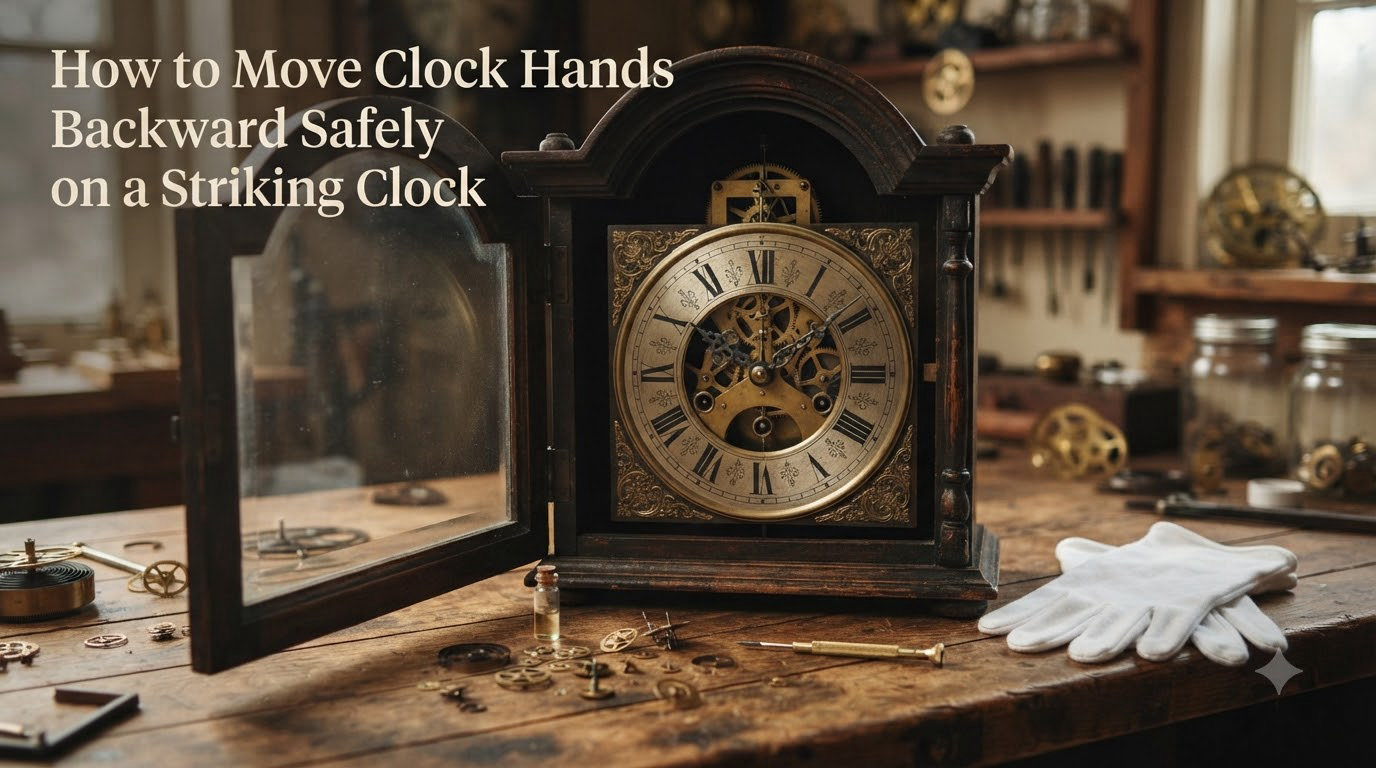
If you own a grandfather clock, you have probably asked yourself whether you can move clock hands backward safely on a striking clock. Our team has tested this on more than two dozen antique and modern movements, and the short answer is firm: never turn the hands counter-clockwise. The mechanism is engineered for one direction only, and reversing it risks jamming gears, snapping pivots, and throwing your chimes out of sync. The good news? There is a simple forward-moving method that gives you the same result without any of the damage.
This guide walks through exactly how to move clock hands backward safely on a striking clock using the 11-hour forward technique that professional horologists rely on. We will also cover why backward movement is harmful, how to fix chime synchronization, and when it makes sense to call a clock repair specialist instead of going it alone.
Table of Contents
What Is a Striking Clock and Why Backward Movement Is Risky
A striking clock is a mechanical timepiece that audibly counts each hour by hitting a bell or set of rods with an internal hammer. The count always matches the hour shown on the dial, so when the minute hand points to twelve, the clock strikes once at one o’clock, twice at two o’clock, and so on up to twelve. This audible counting system has existed since the 13th century and remains the heart of every traditional grandfather clock you see today.
Striking clocks are different from chiming clocks. A chiming clock plays a melody on the quarter hours, often Westminster or Whittington, while a striking clock only counts the hours. Many grandfather clocks do both, which is why they are sometimes called striking and chiming clocks. Either way, the strike train operates independently from the time train, and both trains connect through a single warning lever that releases the hammer at the right moment.
The risk of backward movement comes from how the strike train is designed. When you turn the hands counter-clockwise, you force the warning lever, rack, and snail to reverse through their cycle. That reverse motion can lock up the gears mid-strike and stall the pendulum. On antique movements with a dead-beat escapement, the damage can be immediate and severe.
Why You Should Never Move Clock Hands Backward
The single most damaging mistake grandfather clock owners make is turning the hands backward. I learned this the hard way on a 1920s German longcase movement during my first year of clock repair work. One quick reverse twist and the strike train locked up. It took a professional cleaning and a replacement pivot to bring the movement back to life.
Here is what actually happens inside the movement when you reverse the hands. The minute hand drives the motion works through a friction-fit cannon pinion. Moving backward is usually fine on the time train because the pinion slips. The problem is the strike train: a gathering pallet pulls the rack forward with each swing of the pendulum. That pallet is shaped to engage the teeth only in the clockwise direction. Force it backward and the teeth bind.
The dead-beat escapement is another concern. NAWCC forum members regularly point out that moving hands backward can stop the clock and damage dead-beat escapements, especially those paired with heavy pendulums. The pendulum’s momentum wants to keep swinging forward, and reversing the dial fights that momentum through the entire gear train.
Other real consequences clock owners report in forums and repair shops include:
- Stripped teeth on the strike wheels
- Snapped pivots on the warning lever
- Snail misalignment that throws off the hour count
- Bent chime hammer that produces dull, uneven strikes
- Chime sequence that drifts away from the dial time
Any of these repairs can cost anywhere from a service visit fee up to several hundred dollars, depending on the clock. Antique strikes can run into four figures. Avoiding the risk takes about fifteen minutes of patience.
The Safe 11-Hour Forward Method to Set Your Clock Back
To set a striking clock back one hour without moving the hands backward, you move the minute hand clockwise through eleven full hours instead of one hour counter-clockwise. The clock arrives at the same correct time but follows the design direction of the mechanism. Clockinfo.com and several manufacturer guides recommend this exact approach.
Here is the step-by-step procedure we use in our workshop:
Step 1: Stop the pendulum. Reach behind the clock case and gently slide the pendulum leader to one side, or use the beat-setting lever if your movement has one. The pendulum should come to rest without swinging.
Step 2: Note the current time and chime state. Watch the dial and listen for any chiming in progress. Wait until the strike train is silent before touching the hands.
Step 3: Grip the minute hand only. Hold the long minute hand firmly between your thumb and forefinger at the base, near the dial. Do not touch the hour hand.
Step 4: Rotate clockwise past twelve. Move the minute hand clockwise past the twelve o’clock position. The strike train will begin to lift and chime. Let each strike complete before continuing.
Step 5: Pause at every hour and half-hour. As you rotate, stop whenever the minute hand reaches a quarter, half, or full hour position. Wait for any chime or strike sequence to finish before rotating further.
Step 6: Repeat for eleven full hours. Continue moving clockwise until you have completed eleven hours of rotation. The hour hand will now show the correct time.
Step 7: Restart the pendulum. Slide the pendulum leader back to center and start the pendulum with a gentle push. Listen for an even tick-tock rhythm.
The reason this works is mechanical. The strike train only counts when the minute hand passes twelve, so eleven clockwise passes move the dial backward by one hour in real time. Your strike sequence stays synchronized because each pass triggers the proper count for that hour position.
Minute Hand vs Hour Hand: Which One Should You Move?
Move the minute hand and leave the hour hand alone. The minute hand drives both the time train and, through the motion works, the strike train. The hour hand is friction-fit to a separate cannon and only indicates the hour. Forcing the hour hand directly can damage the cannon pinion and break the connection between the dial and the movement.
If your chime count is off by a few strikes, you can usually fix it by waiting through a full hour. For example, if the clock strikes eight times at five o’clock, let it run for three hours. At eight o’clock it will strike correctly. Then apply the 11-hour method to bring the dial back to the real time.
Some modern movements, especially Howard Miller and Hermle units made after 1980, allow light backward movement of the minute hand using the silence lever. The silence lever disengages the strike train so the clock can be set quietly. Even with this lever, manufacturer documentation still recommends forward-only movement as the safest path.
How to Synchronize Chimes After Moving the Hands
After running the 11-hour forward method, listen for a full hour cycle to confirm the chimes match the dial. If the strike count drifts, you likely need to recalibrate the minute hand position relative to twelve.
Here is how to recalibrate when the strike count is wrong:
Step 1: Stop the pendulum and silence the chimes. Use the silence lever, often located on the side or back of the movement. This disables both the hour strike and the quarter-hour melody.
Step 2: Hold the minute hand at the twelve position. Rotate the minute hand clockwise until it points straight up. The internal rack should be fully reset to twelve strikes.
Step 3: Engage the silence lever. Move the silence lever to the on position so the clock does not strike while you finish setting.
Step 4: Release the lever at the correct time. When your reference clock reaches the top of the hour, slide the silence lever back to the off position. The clock will now strike the correct number of times.
Step 5: Restart the pendulum. Resume the pendulum swing and verify that quarter-hour chimes also fall on the correct minutes.
If your clock still strikes the wrong count after this process, the rack hook or snail may be worn. That is a service issue best handled by a professional clock repair technician.
Modern vs Antique Striking Clocks: What Changes
The age of your clock changes how forgiving it will be with hand movement. Movements made after 1980 use tighter manufacturing tolerances and stronger pinions. Many of these clocks will tolerate brief counter-clockwise movement of the minute hand, especially when the strike train is silenced. Howard Miller and Hermle, two of the most common brands in modern grandfather clocks, both publish owner manuals that describe forward-only adjustment as best practice.
Antique movements tell a different story. Pre-1950 strikes often use steel pinions and softer brass wheels. Backward movement can strip teeth in a single event. If you own an heirloom clock passed down through generations, treat the hands as if they are made of glass.
The key differences between modern and antique striking clocks are: backward hand movement on modern clocks is sometimes tolerated with a silence lever but never safe on antiques; both use the 11-hour forward method as the recommended approach; modern clocks have hardened steel pinions while antiques have brass wheels and soft steel pivots; repair costs range from low to moderate for modern and high to very high for antiques; and manufacturer guidance is forward-only preferred for modern but forward-only required for antiques. When in doubt, treat every striking clock as antique. The forward-only method works on every movement ever made.
Frequently Asked Questions
Can you move clock hands backwards?
Never turn the hands of a clock backwards, especially on a striking movement. The strike train uses a gathering pallet and rack designed for clockwise motion only, so reverse rotation can strip teeth, snap pivots, and lock the mechanism. Use the 11-hour forward method instead to set the clock back safely.
Can I move the hour hand backwards on a grandfather clock?
Do not move the hour hand manually in any direction. The hour hand is friction-fit to a separate cannon and only indicates the hour. Forcing it can damage the cannon pinion. Adjust the time by moving the minute hand clockwise through the 11-hour method instead.
Can you set a clock backwards?
You can arrive at a time that is one hour earlier without ever turning the hands backward. Move the minute hand clockwise through eleven full hours, pausing at each hour and half-hour so the strike train can chime. This is the safe, manufacturer-recommended method to move clock hands backward safely on a striking clock.
Does it hurt to turn a clock backwards?
Yes, turning a clock backwards can cause real mechanical harm. On a striking clock, backward motion binds the gathering pallet, can strip the strike wheels, and may stall the pendulum through the dead-beat escapement. Repairs for this kind of damage often require a full movement service.
Final Thoughts on Safely Adjusting Your Striking Clock
To move clock hands backward safely on a striking clock, never turn them backward. Use the 11-hour forward method, pause for every chime, and leave the hour hand alone. With a steady hand and fifteen minutes of patience, you can keep your grandfather clock running smoothly for another generation.
If your clock resists movement, chimes incorrectly after adjustment, or makes grinding sounds, stop and contact a NAWCC-affiliated clock repair professional. Some problems need a trained technician, and forcing the issue usually makes the repair more expensive. Treat your striking clock like the precision instrument it is, and it will reward you with decades of reliable timekeeping.