
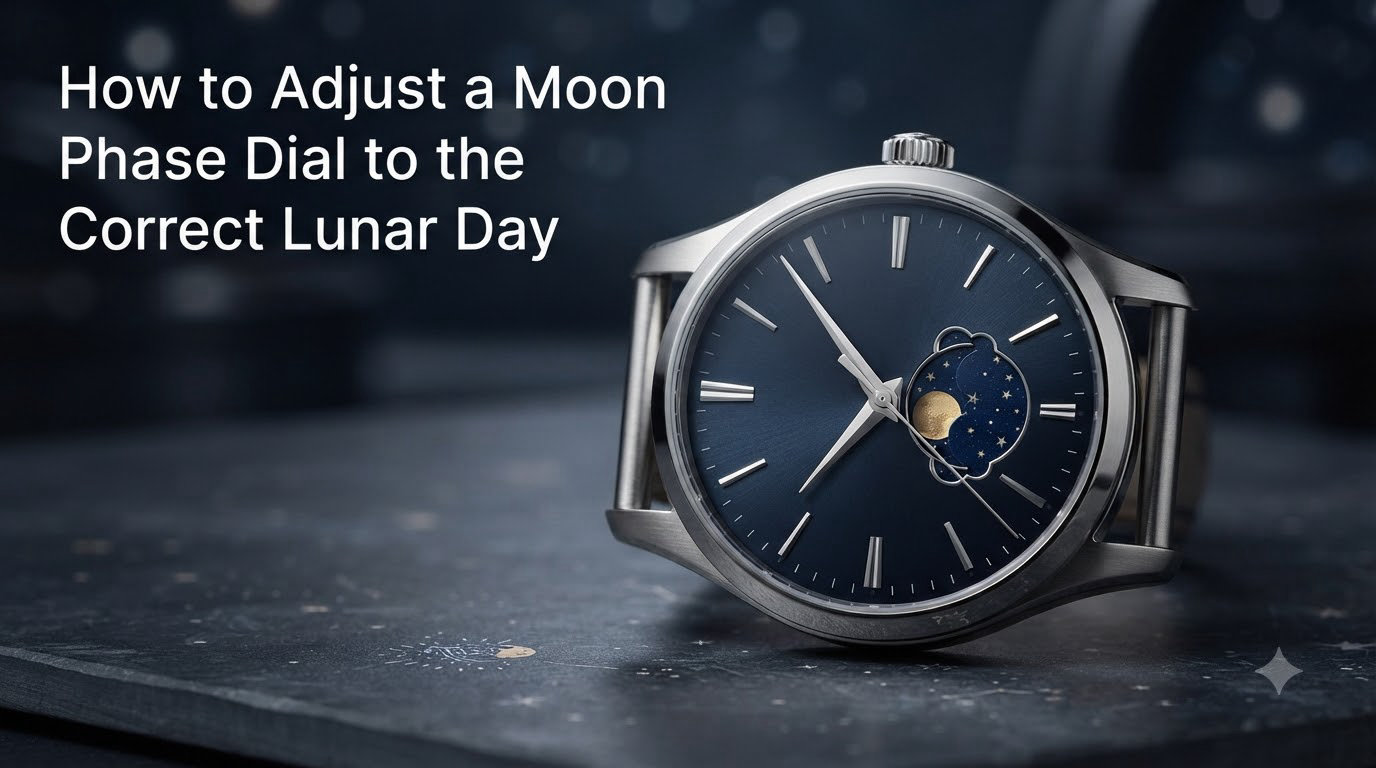
I learned how to adjust a moon phase dial the hard way. My grandfather clock’s moon dial was stuck for three months because I kept trying to force it forward while the mechanism was mid-advance. Once I understood the lunar cycle, the gear mechanics, and the right time to physically move the dial, the whole process took less than two minutes.
In this guide for 2026, I will walk you through exactly how to adjust a moon phase dial to the correct lunar day on a grandfather clock, wall clock, or wristwatch. I will show you three reliable methods for finding today’s lunar date, explain the mechanical side of things so the steps make sense, and cover the troubleshooting fixes I wish I had known on day one.
Table of Contents
What Is a Moon Phase Dial?
A moon phase dial is a clock or watch complication that shows the current phase of the moon through a small aperture on the dial. It tracks the 29.5-day lunar cycle by gradually rotating a printed disc behind the aperture, revealing a tiny moon at the appropriate phase for each day.
You will find moon phase dials on grandfather clocks, anniversary clocks, wall clocks, and high-end mechanical watches. The dial typically shows a stylized sky with two painted moons, and a small reading window or curved arch reveals the current moon position. Some displays use a single round aperture (a “radial” display), while others use a “bosom” shape that mimics the curved silhouette of the moon.
What does a moon phase dial do?
It displays the current lunar phase. As the disc rotates one notch every 24 hours, the visible moon in the aperture appears to wax or wane exactly as the real moon does in the sky. After 29.5 days, the disc completes one full rotation and the same moon phase appears again.
Understanding the Lunar Cycle (29.5 Days)
The lunar cycle, also called a synodic month, lasts 29.5 days. That is the time it takes for the moon to return to the same phase, for example from one full moon to the next. This is why the moon phase dial ticks off one day at a time rather than rolling through phases weekly.
Calendar months do not match the lunar cycle neatly. A 30-day calendar month has 30 days, but the lunar cycle is only 29.5 days. Over the course of a year, the moon phase and the calendar date drift apart. This is why you cannot simply set “day 15” on your dial and forget it. You need to find the actual lunar day for today’s date.
The lunar day is counted from the last new moon. Day 0 is the new moon, day 14 or 15 is the full moon, and day 29 returns to the new moon again. Each day on the dial corresponds to one of these 29 or 30 positions.
Why 29.5 days?
The moon orbits Earth in 27.3 days, but because Earth is also moving around the sun, the moon has to travel a bit further to catch up to the same phase. That extra distance adds about 2.2 days, giving us the 29.5-day synodic month. Clockmakers use this number because the moon dial must complete one full rotation in that exact time.
How Moon Dials Work Mechanically
A moon phase dial works through a 59-tooth gear. Each tooth represents half a day, and the gear advances the moon disc by one tooth every 24 hours. After 59 half-day increments, the disc has rotated one full notch per day for 29.5 days, completing one full rotation and showing the moon phases again.
Most moon dials display two moons on the disc, which is why 59 teeth cover 29.5 days. The two moons are 180 degrees apart on the disc, so each moon is on screen for about 14.75 days. The driving gear is connected to the hour wheel, so the disc advances automatically as the clock runs.
There are two main display styles. A “bosom” or curved aperture shows the moon as a crescent shape that fills or empties as it moves. A “radial” display uses a circular cutout that shows the moon as a full disc with a shadow painted on it. Both work the same way mechanically. The aesthetic is just different.
Watch vs clock mechanism
Wristwatch moon phase complications use the same 59-tooth gear principle but on a much smaller scale. Some high-end watches use a 135-tooth gear for finer accuracy. Watches typically have a corrector button you push with a stylus, while grandfather clocks have a dial you rotate by hand from the front or back.
A Brief History of Moon Dials
Moon dials have been part of clocks for centuries. They served a practical purpose in agriculture, where farmers relied on lunar cycles to plan planting and harvesting. The moon affects tides, animal behavior, and historically, the timing of certain crops.
By the 17th and 18th centuries, moon phase displays became a standard feature of longcase clocks in Europe. They were also essential for tracking ecclesiastical dates such as Easter, which depends on the first full moon after the spring equinox. Today, moon dials are mostly decorative, but they preserve a centuries-old connection between timekeeping and astronomy.
Step-by-Step: How to Adjust a Moon Phase Dial to the Correct Lunar Day
The general procedure to adjust a moon phase dial to the correct lunar day works on almost any clock or watch. Follow these steps to get an accurate reading without damaging the mechanism.
Step 1: Stop the clock or unscrew the crown
For grandfather and wall clocks, stop the pendulum or remove the clock from power before adjusting. For wristwatches, pull the crown out to the time-setting position. This prevents the gear from advancing while you set the dial.
Step 2: Find today’s lunar day number
Use one of the three methods below (actual moon, online calendar, or printed almanac) to determine the day of the lunar cycle. For example, if today is 7 days past the last full moon, you are on lunar day 22.
Step 3: Locate the lunar scale on the dial
Look for the small numbers printed around the moon aperture. On clocks, this is usually a 1 to 29 scale in the arch above the moon. On watches, the numbers may be printed on the bezel or around the dial. The number “0” or “1” represents the new moon, and “15” represents the full moon.
Step 4: Rotate the disc to match today’s lunar day
Apply gentle pressure with your fingers to the front of the moon dial and rotate it clockwise until the moon is positioned under the correct lunar day number. On watches, push the corrector button the same number of times as the days since the last new moon.
Step 5: Restart the clock and verify
For grandfather clocks, restart the pendulum or reattach the power. For watches, push the crown back in and wind if needed. Wait 24 hours and check that the moon has advanced by one position. If it has, your adjustment is correct.
Tip: Always adjust the moon phase dial when the clock is between 6:00 and 18:00 on the dial. Never adjust between 18:00 and 6:00 because the date mechanism is engaged during those hours and you may damage the gears.
Warning: If the dial feels stuck, do not force it. Move the hour hand forward by 24 hours to disengage the advancing mechanism, then try again. Forcing a stuck dial is the most common cause of broken index springs.
Method 1: Find the Lunar Day Using the Actual Moon
The simplest way to find today’s lunar day is to look up at the moon. Compare what you see to a printed moon phase chart. If the moon is half-full and the right side is illuminated, you are around day 7 of the waxing phase. If it is half-full with the left side illuminated, you are around day 22 of the waning phase.
This method is most accurate on nights when the moon is clearly visible. During the new moon phase, it is impossible (the moon is too close to the sun). During the full moon, day 14 or 15 is straightforward. For intermediate phases, use a printed chart as a reference for matching the moon’s appearance to its day number.
Method 2: Use an Online Moon Phase Calendar
The most reliable method is an online moon phase calendar. Websites like timeanddate.com or the U.S. Naval Observatory provide a free lunar day count for any date. Search “moon phase today” and you will see the current lunar day, illumination percentage, and days since the last new moon.
For watch owners, the Patek Philippe website offers a Geneva sky calculator that shows the exact moon phase for any date. This is the same tool Patek uses to set their moonphase watches before shipping. Bookmark it on your phone and use it whenever you need to adjust your dial.
Tip: Set a reminder to check your moon phase dial once a month. Even a perfectly adjusted dial will drift by one day every 2.7 years due to the 29.5-day cycle not matching calendar months.
Method 3: Use a Newspaper or Printed Almanac
Many newspapers and printed almanacs include a small moon phase section in their weather or calendar pages. Old Farmer’s Almanac publishes annual moon phase calendars that show the lunar day for every date of the year. This is the traditional method used by clockmakers for centuries.
To use this method, find today’s date on the printed calendar and read off the corresponding lunar phase. Mark the day number on a piece of paper, then rotate the moon dial until it sits under that number. This method works well if you prefer not to rely on internet tools.
Waxing vs Waning: Reading the Dial Correctly
Waxing means the moon is growing brighter, from new moon (day 0) to full moon (day 14 or 15). Waning means the moon is shrinking, from full moon back to new moon (day 29). On a moon phase dial, the moon appears to move from left to right during waxing in the Northern Hemisphere.
Most moon dials are manufactured for the Northern Hemisphere. If you live in the Southern Hemisphere, the moon is illuminated from the opposite side. You can flip the dial disc upside down to correct this, or rotate it 180 degrees so the waxing and waning match your sky view.
Which direction does the moon move on the dial?
In the Northern Hemisphere, the moon dial should move from right to left across the aperture as the lunar cycle progresses. If your dial moves in the opposite direction, you may have the disc installed backward. Remove the dial carefully and flip it.
Watch Moon Dials vs Clock Moon Dials
The adjustment process differs between watches and clocks. Wristwatch moon dials are adjusted with a corrector button, usually recessed into the case. You press the button with the provided stylus once per day to advance the moon. Some watches allow you to push the button multiple times in succession to fast-forward the moon past several days.
Grandfather clock moon dials are typically adjusted by hand. You apply gentle pressure to the front of the dial and rotate it clockwise. Some models have a small knob on the back of the movement that controls the dial. Refer to your clock’s manual for the exact method, as it varies by manufacturer.
Watch-setting precautions
Before setting a moonphase watch, pull out the crown and move the hands to 6:30. This moves the date mechanism out of the way so it does not interfere with the moon phase adjustment. Push the crown back in once you finish setting the moon, then reset the hands to the correct time.
Watch moon phases are also more accurate than clock moon phases. A typical wristwatch moonphase complication drifts by only one day every 2 to 3 years. Grandfather clocks drift faster because their gears have wider tolerances.
Common Mistakes and Troubleshooting
The most common mistake when adjusting a moon phase dial is forcing it during the advancing cycle. Between midnight and 6:00 AM on most clocks, the mechanism is engaged in changing the day. Trying to rotate the dial during this window can bend the index spring or strip the gear teeth.
Another common mistake is setting the dial based on the calendar date instead of the lunar day. Day 15 of the month is not the same as day 15 of the lunar cycle. Always confirm the lunar day using one of the three methods above before adjusting.
Index spring troubleshooting
The index spring is a small metal piece that locks the moon disc in place between advances. If it gets wedged behind the disc, the moon will appear stuck. To fix this, gently rotate the dial back and forth by a single tooth to release the spring. Do not force it through more than one tooth at a time.
If the index spring is bent or broken, you will need to remove the movement and replace the spring. This is a job for a professional clockmaker. Most index springs cost between $10 and $30 to replace, plus labor.
Why is my moon dial stuck?
A moon dial gets stuck for three main reasons. First, the clock is mid-advance, so wait 24 hours and try again. Second, the index spring is wedged, so gently rock the dial back and forth. Third, the drive gear is damaged, which requires professional repair. Most issues are the first two and can be solved without taking the clock apart.
How to safely force a stuck dial
If the dial will not move by hand, do not use pliers or screwdrivers. Move the hour hand forward by 24 hours to disengage the advancing mechanism, then try rotating the dial again. If it still will not move, the gear is damaged and you should consult a professional repair technician.
Maintenance Tips to Keep Your Moon Dial Accurate
Regular maintenance keeps your moon dial accurate and prevents costly repairs. Check the dial once a month and adjust if it has drifted by more than one day. Most moon dials drift by one day every 2 to 3 years on watches, and every 1 to 2 years on grandfather clocks.
Clean the dial aperture gently with a soft brush every six months. Dust buildup inside the aperture can obscure the moon and make it look like the dial is broken. Avoid spraying cleaners near the dial, as moisture can damage the painted surface.
Have your grandfather clock professionally serviced every 5 to 7 years. The watchmaker will oil the moon phase gears, inspect the index spring, and verify the drive mechanism. This prevents the most common moon dial failures and extends the life of your clock.
Moonphase accuracy limitations
Even a perfectly adjusted moonphase watch drifts by one day every 2.7 years because the lunar cycle is 29.53 days, not exactly 29.5. The 59-tooth gear is a clever approximation, but it is not perfect. High-end watches with 135-tooth gears reduce this drift to one day every 122 years, but most timepieces use the 59-tooth design.
Frequently Asked Questions
How to set moonphase correctly?
To set the moonphase correctly, first find today’s lunar day using an online moon phase calendar or by looking up at the moon. Then stop the clock or pull out the watch crown, locate the lunar scale on the dial, and rotate the moon disc until it sits under the correct day number. Restart the clock and verify after 24 hours that the moon has advanced by one position.
How to set the moon phase indicator?
To set the moon phase indicator, determine the current lunar day using an online calendar, a printed almanac, or the actual moon in the sky. Rotate the moon dial gently with your fingers until the printed moon appears under the correct day number on the lunar scale. For watches, use the corrector button on the side of the case.
What does a moon phase dial do?
A moon phase dial displays the current phase of the moon by gradually rotating a disc behind an aperture. It tracks the 29.5-day lunar cycle by advancing one position every 24 hours, showing the moon as it appears in the sky from new moon to full moon and back again.
Why is my moon dial stuck?
Your moon dial is stuck for one of three reasons: the clock is mid-advance (wait 24 hours), the index spring is wedged (gently rock the dial back and forth), or the drive gear is damaged (consult a professional). Most issues are the first two and can be resolved without taking the clock apart.
Final Thoughts
Learning how to adjust a moon phase dial to the correct lunar day is a five-minute task once you understand the lunar cycle and the mechanical side of things. The key steps are finding today’s lunar day with a reliable method, rotating the disc to the correct number, and avoiding common mistakes like forcing it during the advancing cycle.
Check your moon dial once a month, keep the aperture clean, and have your clock serviced every few years. With these habits, your moon phase display will stay accurate for decades and continue to be a beautiful connection between timekeeping and the sky above, well into 2026 and beyond.