
I remember the first time I saw a 400-day clock on my grandmother’s mantel. The little glass dome shimmered, the brass disc on top rotated almost silently, and I could not believe a single winding could keep it going for over a year.
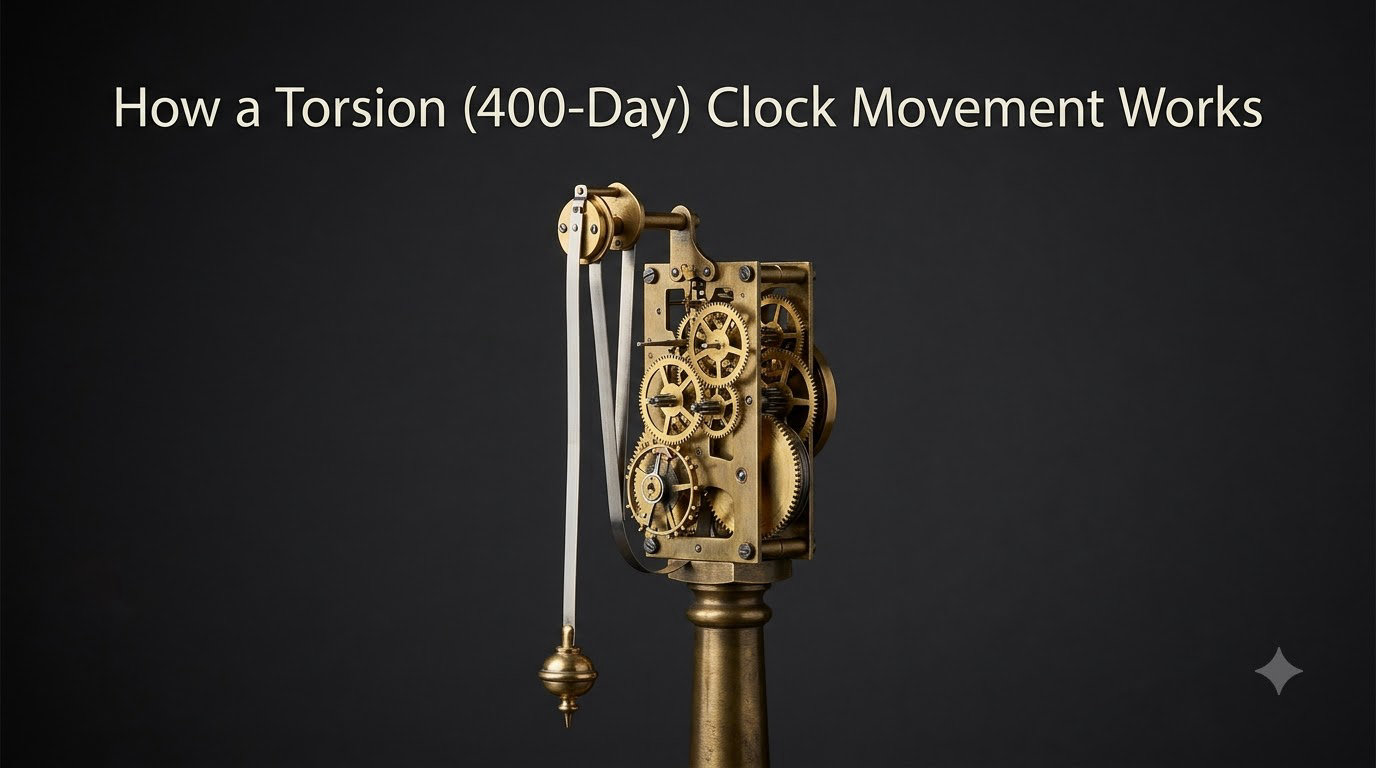
A torsion (400-day) clock movement works by using a slowly rotating pendulum disc suspended from a thin coiled wire instead of a swinging pendulum bob. That wire, called a suspension spring, twists and untwists as the disc turns, storing and releasing energy in a controlled rhythm. Each full rotation takes roughly 7.5 to 20 seconds, and the clock only needs winding about once every 400 days.
In this guide, I will walk you through every part of how a torsion clock movement works. We will look at the physics of the torsion pendulum, the key components inside the movement, the escapement that meters out energy, and the practical side of winding and troubleshooting. By the end, you will understand exactly why these anniversary clocks earned their nickname.
Table of Contents
What Is a Torsion Pendulum (400-Day) Clock?
A torsion pendulum clock, also known as a 400-day clock or anniversary clock, is a mechanical clock that keeps time with a slowly rotating weighted disc instead of a swinging pendulum bob. The disc hangs from a fine coiled wire called a torsion spring, and the entire assembly oscillates by twisting and untwisting that wire back and forth.
The defining feature of these clocks is the torsion pendulum itself. It rotates about the vertical axis of the wire, twisting it, rather than swinging like the pendulum on a grandfather clock. That single design choice is what gives the clock its long run time and its calm, almost hypnotic motion.
Most 400-day clocks are housed under a glass dome on a brass or chrome base. Four rotating balls or a flat disc sits at the top of the suspension, and the rotation is visible through the glass. The dial usually sits on the base facing up or sideways, depending on whether the clock is meant for tabletop display.
Two common sizes exist. A standard or full-sized 400-day clock has a pendulum that completes one full rotation every 7.5 seconds, so it turns eight times per minute. A miniature 400-day clock uses a smaller disc that rotates faster, often once every 2.5 seconds or six turns per minute.
The Physics Behind Torsion Pendulum Clocks
The torsion pendulum behaves like a harmonic oscillator that twists on a vertical axis. Energy from a wound mainspring is delivered in tiny pulses by the escapement, and each pulse nudges the disc slightly off-center. The suspension spring then provides a restoring torque, pulling the disc back toward its rest position.
Because the suspension spring is extremely thin and the disc has significant rotational inertia, the period of oscillation is much longer than a swinging pendulum of the same length. A swinging pendulum of about 25 cm beats once per second. A torsion pendulum of similar scale can take 7.5 to 20 seconds per full rotation, which is roughly eight to thirty times slower.
Slower oscillation means the clock spends far less energy per unit of time. The escapement only has to deliver a small impulse once per rotation, so the mainspring can keep the clock running for 400 days or more. That is the entire reason the movement is so energy-efficient.
The physics also explains why these clocks are so sensitive to disturbance. The long period comes from a very weak restoring force balanced against a relatively heavy rotating mass. A small change in friction, a draft, or a tilted base can shift the period noticeably, which is why precise leveling matters.
Why the Torsion Period Is So Long
The period of a torsion pendulum depends on the stiffness of the wire and the moment of inertia of the disc. A thinner or longer suspension spring gives a longer period, while a heavier disc also lengthens it. Designers tune both parameters to hit the target period for accurate timekeeping.
If the wire is too stiff, the disc rotates too fast and the clock gains time. If the wire is too soft or too long, the disc rotates too slowly and the clock loses time. That is why suspension spring replacement requires matching the exact original specification, not a generic substitute.
Key Components and Their Functions
A torsion clock movement has fewer moving parts than a typical pendulum clock, but each one matters. Here are the components you will find inside any standard 400-day clock, starting from the energy source and working outward.
The Mainspring and Barrel
The mainspring is a long flat strip of spring steel coiled inside a barrel. It stores the energy that drives the entire clock and is wound through the key on the dial face. Most 400-day clocks require only three to four half-turns or one to one and a half full turns of the winding key to fully wind the mainspring.
The barrel is mounted on the front plate and turns as the mainspring unwinds. It is geared to the train of wheels that ultimately drive the escape wheel. Because the clock runs so slowly, the mainspring does not need to deliver much torque, which is why the spring can be small and the clock can run for so long.
The Wheel Train
The wheel train is the series of gears that transmits energy from the mainspring barrel to the escape wheel. In a 400-day clock, the train is geared down by a large ratio because the escape wheel only needs to rotate at a slow rate. The exact ratio depends on the pendulum period, but it is much higher than in a one-second pendulum clock.
The Suspension Spring
The suspension spring is a thin coiled ribbon of special steel that supports the pendulum disc and provides the restoring torque. It is typically about 0.1 mm thick and is mounted between two small brackets, the upper and lower suspension pieces. The spring is the most fragile and most often replaced part on these clocks.
Quality torsion clocks use a Nivarox or similar low-thermal-expansion alloy for the suspension spring. Nivarox keeps the spring stiffness nearly constant across normal room temperatures, so the clock keeps accurate time even when the room warms up or cools down over the seasons.
The Pendulum Disc and Rotation Indicator
The pendulum disc is the visible rotating mass on top of the movement. It carries four small brass balls or a flat decorative disc as a rotation indicator, which makes the slow oscillation easy to see. The disc connects to the lower end of the suspension spring through a torsion staff, which is the thin vertical shaft that twists inside the clock.
The Crutch and Pallet Fork
The crutch is a small lever attached to the torsion staff that moves back and forth as the pendulum rotates. The crutch engages the pallet fork, also called the anchor, and each swing of the pendulum rocks the pallet fork by a few degrees. The pallet fork then locks and unlocks the escape wheel to keep time.
How the Escapement Mechanism Works
The escapement is the part of any mechanical clock that converts the stored energy of the mainspring into the controlled oscillation of the timekeeping element. In a torsion clock, the escapement is a recoil or deadbeat design similar to those used in mantel clocks, but it operates once per pendulum rotation rather than once per pendulum swing.
Each cycle of the escapement has three phases. First, the pallet fork locks the escape wheel in place so no energy can pass. Second, the pendulum disc rotates far enough to push the crutch against one arm of the pallet fork, unlocking the escape wheel. Third, the escape wheel rotates briefly, giving the pendulum a small impulse to keep it going, and then the pallet fork relocks the wheel.
Because the pendulum is rotating rather than swinging, the crutch motion is also a slow rotation. The pallet fork rocks back and forth through a small angle, just enough to release one tooth of the escape wheel at a time. The clicking sound you hear on a torsion clock is much softer and slower than the tick of a swinging pendulum clock.
On a typical 400-day clock with an 8-rotation-per-minute pendulum, you will hear about 4 clicks per second, or 240 per minute. That is roughly one-quarter the tick rate of a standard mantel clock, which is why torsion clocks are sometimes described as silent timekeepers.
What Happens During Flutter or Skipping
If the fork sits too high above the escapement, the lock is shallow and the escape wheel can skip teeth, producing an audible flutter. If the fork sits too low, the pendulum is over-impulsed and the clock runs fast or unreliably. Proper fork height is one of the most important adjustments in 400-day clock repair.
Why 400-Day Clocks Run So Long Between Windings
A torsion clock can run 400 days on a single winding because the pendulum oscillates so slowly that the escapement only releases energy about four to eight times per minute. The mainspring only loses a tiny amount of energy with each impulse, so its total stored energy can last well over a year.
By contrast, a one-second pendulum clock releases the escape wheel twice per second, or 120 times per minute. Over 400 days, that is roughly 691 million impulses compared to about 5.5 million for a torsion clock. The energy demand per unit of time is therefore massively lower for the torsion design.
Temperature Compensation With Nivarox
Ordinary spring steel changes stiffness with temperature. A warmer spring is slightly softer, which lengthens the pendulum period and makes the clock lose time. A cooler spring is slightly stiffer, which shortens the period and makes the clock gain time.
Nivarox is a low-thermal-expansion iron-nickel alloy developed in the 1930s for balance springs and torsion suspensions. When used as a suspension spring, it keeps the stiffness almost constant across normal room temperatures, so the clock stays accurate through the seasons. A 400-day clock with a Nivarox spring can hold time to within a minute or two per month, while a clock with a plain steel spring may drift more noticeably.
A Brief History of Torsion Clocks
The torsion pendulum principle was first described in 1656 by Christiaan Huygens, the same Dutch scientist who invented the swinging pendulum clock. Early torsion clocks used long thin metal wires and were not much more accurate than swinging pendulums, so the design was not widely adopted.
The modern 400-day clock as we know it was developed in the early 20th century. The German engineer Johannes Schatz patented a compact torsion movement in 1921, and his design was licensed to several makers, including Kundo and Kern. Schatz clocks became the dominant design through the 1950s and 1960s, often given as anniversary or wedding gifts, which is how the nickname anniversary clock stuck.
Production of new 400-day movements slowed after the 1970s as quartz clocks took over the consumer market. Today, most 400-day clocks in use are vintage pieces from the Schatz, Kundo, or Kern eras, and the market for parts and service has grown around keeping them running.
Common Brands: Schatz, Kundo, and Kern
Three names cover the majority of 400-day clocks you will encounter. Schatz was the original German maker of the modern anniversary clock and produced movements from the 1920s through the 1970s. Kundo was a licensee of the Schatz design and produced large numbers of clocks under the Kundo and Kundo-Kienzle names. Kern was a third German maker with its own variations on the torsion design.
Schatz clocks are generally considered the highest quality of the three, with brass movements, Nivarox suspension springs, and excellent finishing. Kundo clocks are the most common and were sold widely as gifts during the mid-20th century. Kern clocks are less common but well-regarded among collectors for their precision.
All three makers used the same basic movement architecture, so parts are often interchangeable between them. A Nivarox suspension spring from a Schatz will usually fit a Kundo, and the pallet assemblies are dimensionally similar across brands.
How the Atmos Clock Compares
The Atmos clock is a special category of torsion pendulum clock that does not need winding at all. Designed by Jean-Léon Reutter and produced by Jaeger-LeCoultre since the 1930s, the Atmos uses a sealed bellows filled with a gas that expands and contracts with changes in atmospheric temperature. Each tiny temperature change winds the mainspring by a fraction of a turn.
An Atmos can run indefinitely as long as the room temperature fluctuates by even a degree or two. Mechanically it is a torsion pendulum clock in every way, with a torsion staff, suspension spring, and pallet escapement. The only difference is the self-winding energy source that keeps the mainspring topped up.
Because the Atmos is far more complex and expensive than a Schatz or Kundo, it sits in its own collector category. If you are considering an Atmos, plan on professional servicing every ten years or so, and budget accordingly. For most collectors, a vintage Schatz anniversary clock offers the same satisfying mechanism at a small fraction of the cost.
Maintenance, Winding, and Troubleshooting
Owning a 400-day clock is mostly about setting it up carefully and being patient. Most problems come from rough handling, an uneven base, or an over-wound mainspring rather than from any failure of the movement itself.
Winding Instructions
Most 400-day clocks need only three to four anti-clockwise half-turns of the key to fully wind the mainspring. Insert the key gently, turn slowly, and stop as soon as you feel firm resistance. Over-winding is a real risk because the spring is small and the gear ratio is high.
Set the clock on a perfectly level surface before winding. The pendulum disc should hang straight down, with no lean to either side. If the clock is tilted, the pendulum period will be wrong and the clock will gain or lose time, or it may stop altogether.
Starting the Pendulum
Once the clock is wound, give the pendulum disc a gentle anti-clockwise twist to start the oscillation. About a quarter turn is enough. The disc should begin rotating slowly, and you should hear the soft click of the escapement within a few rotations.
If the pendulum does not start, do not keep winding. Check that the clock is level, that the suspension spring is intact, and that the escapement is not locked up by a foreign object. Continued winding without releasing the energy can damage the mainspring or the click mechanism.
Common Issues and Fixes
Clock stops after a short run. Usually this means the clock is not level or the suspension spring is damaged. Re-level carefully, and if the spring shows kinks or twists, plan a replacement.
Flutter or skipping teeth on the escape wheel. This is a fork height issue. The fork is sitting too high or too low on its pivot, so the lock is not firm. A small adjustment usually fixes it, but if you are not comfortable, take the clock to a specialist.
Clock gains or loses time noticeably. Slight inaccuracy is normal and can be corrected with the regulation nut under the dial. Major gain or loss usually means the suspension spring is the wrong specification or the clock is not level.
For most 400-day clock repairs beyond basic winding and leveling, I recommend sending the movement to a professional. A full overhaul typically costs $450 to $550 depending on the shop, and it includes cleaning, lubrication, pivot polishing, and replacement of worn suspension springs. The Horolovar 400 Day Clock Repair Guide is the standard reference used by most professionals, and it is worth reading if you want to attempt repairs yourself.
Professional repair shops can be found through the National Association of Watch and Clock Collectors (NAWCC) directory. Online communities at the NAWCC forums and the r/clocks subreddit are also excellent places to ask questions and get advice from experienced owners.
Frequently Asked Questions
How does a 400-day clock work?
A 400-day clock uses a slowly rotating pendulum disc suspended by a thin torsion spring. The mainspring stores energy, the escapement releases it in tiny pulses, and the torsion pendulum oscillates with a period of 7.5 to 20 seconds per rotation. Because the oscillation is so slow, very little energy is used per unit of time, so the clock can run 400 days or more on a single winding.
How do torsion clocks work?
Torsion clocks work by twisting and untwisting a thin suspension spring. The pendulum disc rotates back and forth as the spring stores and releases energy. Each rotation triggers the pallet escapement once, releasing a small amount of energy from the mainspring to keep the pendulum moving. This slow, low-energy oscillation is what gives torsion clocks their long run time.
How many turns to wind a 400-day clock?
Most 400-day clocks require three to four anti-clockwise half-turns of the winding key, or about one to one and a half full turns. Stop winding as soon as you feel firm resistance. Over-winding can damage the small mainspring, so slow and gentle is the rule.
Why is my 400-day clock so slow?
A 400-day clock is slow by design. Its pendulum completes only one rotation every 7.5 to 20 seconds, so it only ticks four to eight times per minute. This slow rate is normal and is what allows the clock to run for over a year on a single winding.
What is the suspension spring made of?
Quality 400-day clock suspension springs are made of Nivarox, a low-thermal-expansion iron-nickel alloy developed in the 1930s. Nivarox keeps the spring stiffness nearly constant across normal room temperatures, which keeps the clock accurate even when the temperature changes with the seasons. Cheaper clocks may use plain spring steel, which is more sensitive to temperature swings.
Final Thoughts on How a Torsion Clock Movement Works
A torsion 400-day clock movement works by combining a slow-rotating pendulum disc, a delicate suspension spring, and a precise pallet escapement. The torsion pendulum turns about the vertical axis of the wire instead of swinging, which gives the clock its famously long run time.
Now that you understand how each part contributes, you can appreciate why these anniversary clocks remain so loved a century after they first appeared. Whether you collect Schatz, Kundo, or Kern pieces, or you simply want to keep one running smoothly on your mantel, the basics of how a torsion clock movement works will guide every decision you make.