
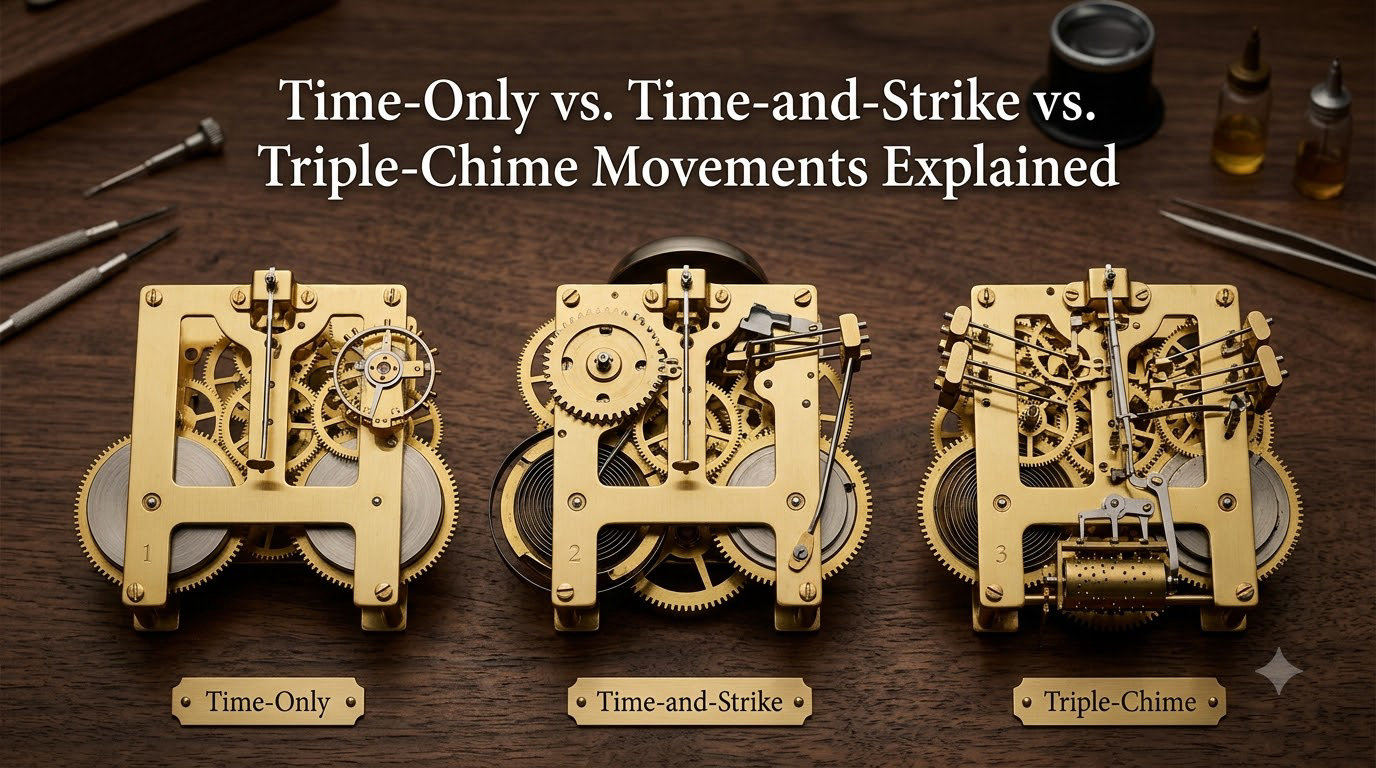
If you have ever stood in front of a grandfather clock and wondered why some tick quietly while others fill the room with melody, the answer lies inside the movement. The movement is the engine of any mechanical clock. It drives the hands, powers the striking, and produces those familiar chimes. Understanding how these movements differ is the key to choosing, maintaining, and appreciating a clock.
In this guide, we break down clock movements explained in plain language. We cover time-only movements that simply keep time, time-and-strike movements that count the hours, and triple-chime movements that play full melodies every fifteen minutes. Each type serves a different purpose, and the differences go far beyond sound.
Our team has spent years studying horological mechanisms, reading forum discussions from NAWCC members, and comparing the technical breakdowns from leading clock specialists. What we found is that most resources cover one or two movement types but rarely explain all three side by side. Even fewer discuss the history behind these mechanisms or help you decide which one fits your needs.
That is exactly what this article does. By the end, you will understand the mechanics behind hammers and rods, know the difference between a single train and a double train, and be able to identify which movement sits inside your own clock. You will also learn about passing strike, the three classic chime melodies, and the practical factors that should guide your next clock purchase.
Whether you are a collector, a first-time buyer, or someone trying to troubleshoot a clock that chimes at the wrong hour, this guide gives you the foundation you need.
Table of Contents
What Is a Time-Only Movement?
A time-only movement is the simplest type of mechanical clock movement. It does exactly one thing: it keeps time. There are no hammers, no bells, no chime rods, and no melody. The movement drives the hour and minute hands through a gear train regulated by an escapement and pendulum, and that is it.
Because it lacks a striking or chiming train, a time-only movement has a single winding point. You wind one mainspring or lift one weight, and the clock runs silently. This simplicity makes it the most reliable and lowest-maintenance movement type available. Fewer moving parts means fewer things can go wrong.
Time-only movements appear in a wide range of clocks. Schoolhouse wall clocks, regulator clocks, many anniversary clocks (also called torsion clocks), and simple mantel clocks all use time-only movements. If your clock has just one winding hole or one winding key position, you are looking at a time-only movement.
The trade-off is straightforward. You get accuracy, durability, and quiet operation, but you sacrifice the auditory charm that makes mechanical clocks so distinctive. For some owners, that silence is exactly what they want. A bedroom or study clock that runs without hourly interruption is often the goal.
What Is a Time-and-Strike Movement?
A time-and-strike movement keeps time and sounds the hour (and sometimes the half-hour) using a hammer that strikes a bell or gong. This is the movement most people picture when they think of a traditional clock. At the top of each hour, the hammer lifts and falls the correct number of times to count the hours. At twelve o’clock, it strikes twelve times. At one o’clock, it strikes once.
Many time-and-strike clocks also feature a half-hour strike, a single blow on the hour count to mark the halfway point. Some mantel clocks use what is called a Bim-Bam strike on the half-hour, producing a two-tone pattern rather than a single tone. This gives the clock more character without adding the complexity of a full chime melody.
Because a time-and-strike movement needs to power both the timekeeping function and the striking function, it typically uses two trains. A double train movement has two winding points. One train drives the clock hands through the escapement. The other powers the strike mechanism through a count wheel or rack-and-snail system that controls how many times the hammer falls.
The count wheel is a notched wheel that determines the number of strikes. As the wheel rotates, it aligns with a finger that releases the striking train at the correct count. The rack-and-snail system, used in higher-quality movements, is more reliable because it determines the strike count based on the actual position of the hour hand rather than a sequential wheel.
If your clock has two winding holes, it almost certainly has a time-and-strike movement. One winding point controls the time side, and the other controls the strike side. You need to wind both to keep the clock running and striking properly.
What Is a Triple-Chime Movement?
A triple-chime movement is the most complex and musically rich mechanical clock movement. It not only strikes the hour but also plays a full melody at each quarter-hour. The “triple” refers to the fact that these movements can typically play three different chime melodies, which the owner can select by moving a lever. The three standard melodies are Westminster, Whittington, and St. Michael.
Here is how the quarter-hour chiming works. At fifteen minutes past the hour, the movement plays the first portion of the melody. At thirty minutes, it plays a longer portion. At forty-five minutes, an even longer passage sounds. Then at the top of the hour, the movement plays the complete melody followed by the hour strike count.
This requires three separate trains. One train keeps time, one powers the hour strike, and one drives the chime melody. That is why triple-chime clocks have three winding holes. Each train has its own mainspring or weight, and all three must be wound for the clock to function fully.
The chime train drives hammers that strike tuned rods or tubular bells. In a triple-chime movement, multiple hammers work in sequence, each hitting a rod tuned to a specific note. The result is a recognizable melody rather than a simple count. This is what distinguishes a chime from a strike. A strike counts the hours with repetitive blows. A chime plays a melody with musical notes.
Triple-chime movements are most commonly found in grandfather clocks (longcase clocks), high-end mantel clocks, and some wall clocks. They are the centerpiece of the clock-collecting world because of their engineering complexity and the warmth their melodies bring to a home.
How Each Movement Works: The Mechanics Explained
To truly understand the difference between these movement types, you need to look inside. Every mechanical clock movement shares the same foundational components. The differences emerge in what gets added on top of the basic timekeeping system.
The Power Source: Weights and Springs
All mechanical movements need a power source. That power comes from either hanging weights or coiled mainsprings. Weights provide a consistent, steady force that drives the gear train with excellent accuracy. They are common in larger clocks like grandfather clocks and many wall clocks. Mainsprings, which are tightly wound ribbons of steel, are used in smaller clocks like mantel clocks and carriage clocks. They deliver power that gradually decreases as the spring unwinds, which can slightly affect timekeeping accuracy over the running period.
Each train in a movement needs its own power source. A time-only movement has one. A time-and-strike movement has two. A triple-chime movement has three. That is why counting the winding holes on the clock face tells you the movement type.
The Gear Train and Escapement
The power source releases energy through a series of gears called the gear train. At the end of that train sits the escapement, the component that divides the continuous force of the weight or spring into discrete, regulated ticks. The escapement interacts with the pendulum (or balance wheel in smaller clocks) to release one tooth of the escape wheel at a time, creating the familiar ticking sound.
The gear train also reduces the high-speed rotation of the mainspring barrel down to the slow, measured movement needed for the hour and minute hands. In striking and chiming movements, separate gear trains perform similar reduction work but feed into the striking and chiming mechanisms instead of the hands.
Hammers, Rods, Bells, and Gongs
This is where time-only, time-and-strike, and triple-chime movements diverge. A time-only movement has no sounding components at all. The silence is complete.
A time-and-strike movement adds a hammer and a sound producer. The hammer is a small lever with a padded head that lifts and falls against the sound source. That source can be a bell (a cup-shaped piece of brass or steel), a coil gong (a spiral of wire that produces a rich, resonant tone), or chime rods (straight metal rods of different lengths tuned to specific pitches). When the hammer strikes, the vibration of the bell, gong, or rod creates the sound you hear.
A triple-chime movement multiplies this setup. Instead of one hammer hitting one sound source, it uses multiple hammers hitting multiple rods in a programmed sequence. A typical triple-chime movement might have eight or more hammers striking a set of tuned rods. Each rod produces a different musical note. The movement’s chime train controls the order and timing of each hammer blow, creating the melody you recognize as Westminster or Whittington.
Tubular bells are another sound source found in higher-end clocks. These are long, hollow brass tubes suspended inside the clock case. Hammers strike the tubes to produce deep, cathedral-like tones. Clocks with tubular bells are prized for their rich, sustained sound.
Time-Only vs Time-and-Strike vs Triple-Chime: Comparison Table
The table below summarizes how the three movement types compare across the factors that matter most to clock owners.
| Feature | Time-Only | Time-and-Strike | Triple-Chime |
|---|---|---|---|
| Primary Function | Keeps time only | Keeps time and strikes hours | Keeps time, strikes hours, plays melodies |
| Number of Trains | 1 (single train) | 2 (double train) | 3 (triple train) |
| Winding Holes | 1 | 2 | 3 |
| Sound Produced | None (ticking only) | Hour count strike, optional half-hour | Quarter-hour melodies plus hour strike |
| Melodies Available | None | None | Westminster, Whittington, St. Michael |
| Complexity Level | Low | Medium | High |
| Maintenance Need | Low | Moderate | Higher |
| Common Clock Types | Schoolhouse, regulator, anniversary | Mantel, wall, kitchen clocks | Grandfather, high-end mantel, hall clocks |
| Best For | Quiet spaces, accuracy focus | Traditional charm without complexity | Full horological experience |
Use this table as a quick reference when shopping for a clock or identifying the movement inside one you already own. The winding hole count is the fastest identifier. One hole means time-only, two means time-and-strike, and three means triple-chime.
Single Train vs Double Train Movements
One of the most common sources of confusion for new clock owners is the concept of trains. A train is simply a complete set of gears, springs, and components that perform one function. Understanding how many trains your clock has tells you what it can do.
A single train movement has one power source and one gear train. That train does one job: it drives the hands through the escapement. This is your time-only movement. One winding hole, one function, and maximum simplicity.
A double train movement has two independent power sources and two gear trains. The time train regulates the hands. The strike train powers the hammer that counts the hours. Because the trains are independent, they run on separate mainsprings or weights. You wind the time side to keep the clock running and the strike side to keep it sounding. If you forget to wind the strike side, the clock keeps perfect time but goes silent.
A triple train movement adds a third train for the chime melody. Three power sources, three gear trains, and three winding holes. The chime train is the most complex because it must coordinate multiple hammers in sequence to produce a recognizable melody at four different points each hour.
This is why forum members on NAWCC and Reddit frequently ask about the three winding holes on their grandfather clock. Each hole controls a separate train. Knowing which hole does what helps you understand your clock’s behavior and diagnose problems when something stops working.
Passing Strike Explained
Passing strike is a variation that sits between time-only and time-and-strike. A passing strike movement strikes just once on the hour, regardless of which hour it is. It does not count. At three o’clock it strikes once. At nine o’clock it strikes once. At twelve o’clock it strikes once.
The name comes from the fact that the strike happens as the hour hand “passes” the twelve position. A small cam on the hour wheel lifts the hammer once and releases it. There is no count wheel, no rack-and-snail, and no strike train in the traditional sense. The mechanism is a simple trip lever.
Passing strike clocks are valued for their minimalism. They give you a gentle auditory marker on the hour without the repetitive counting of a full strike. Many antique French carriage clocks and some German mantel clocks use passing strike. If your clock strikes once at every hour and never varies, you likely have a passing strike movement.
Chime Melody Types: Westminster, Whittington, and St. Michael
Triple-chime clocks can play three distinct melodies, and each has its own character, history, and sound. Knowing these melodies helps you choose a clock that produces a sound you will enjoy hearing every fifteen minutes.
Westminster Chime
The Westminster chime is by far the most recognized clock melody in the world. It comes from the Great Clock at the Palace of Westminster (often called Big Ben, though Big Ben is technically the bell). The melody plays four notes at the quarter-hour, eight at the half, twelve at the three-quarter, and the full twenty-note sequence at the top of the hour before the strike.
The four opening notes are based on a phrase from Handel’s “I Know That My Redeemer Liveth.” If you have heard a clock chime in a movie, a train station, or a public building, it was almost certainly Westminster. Its familiarity is its greatest strength. Most people recognize it instantly, and it carries a sense of tradition and grandeur.
Whittington Chime
The Whittington chime is associated with the Church of St. Mary le Bow in London. According to legend, Dick Whittington heard the bells of St. Mary le Bow calling him back to London, where he would become Lord Mayor. The melody is brighter and more complex than Westminster, with a cascading quality that many clock owners find more interesting.
The Whittington chime uses a different sequence of notes that gives it a lighter, more playful feel. It is less commonly heard in public, which makes it a distinctive choice for someone who wants something different from the standard Westminster sound.
St. Michael Chime
The St. Michael chime originates from the bells of St. Michael’s Church in Charleston, South Carolina. These bells have a dramatic history. They were cast in London, shipped to Charleston, captured by pirates, recovered, and eventually hung in the church. During the American Revolution and later conflicts, the bells were damaged and recast multiple times.
The melody itself has a stately, solemn quality. It feels weightier and more reverent than the other two options. Some clock owners prefer St. Michael for evening settings where a more subdued melody is appropriate.
The History of Clock Movements
No major competitor in the clock movement space covers the history of these mechanisms. That is a gap we are filling here, because understanding how movements evolved makes the technical differences much easier to grasp.
The story begins in medieval Europe with the verge escapement. Early mechanical clocks from the 1300s used a crown-shaped escape wheel and a foliot (a crossbar with adjustable weights) to regulate time. These clocks were installed in monasteries and church towers. They had no pendulums, no hands, and no accuracy by modern standards. They simply rang a bell to mark the hours for prayer.
The verge and foliot movement was a time-and-strike mechanism from the very beginning. The word “clock” itself comes from the Latin “clocca,” meaning bell. Time and sound were inseparable from the start.
The next major leap came in 1656 when Christiaan Huygens, a Dutch scientist, built the first practical pendulum clock based on Galileo’s earlier theories. The pendulum dramatically improved accuracy. Clocks that lost or gained fifteen minutes per day could now stay accurate to within seconds. This innovation also enabled the development of the anchor escapement, which allowed for a narrower swing of the pendulum and made longcase (grandfather) clocks practical.
By the 1700s, clockmakers in England, France, and Germany were building increasingly sophisticated movements. The rack-and-snail striking system, patented by Edward Barlow in 1676 and refined throughout the 18th century, solved the problem of unreliable hour counts. Unlike the count wheel, which could fall out of sync, the rack-and-snail read the hour directly from the position of the hour hand.
The repeating watch mechanism, which let the owner pull a cord to hear the hour struck on demand, evolved into the chiming clock. Clockmakers began adding melody-producing mechanisms in the late 1700s and early 1800s. The Westminster chime, derived from the Great Clock installed in 1859, became the standard for chiming clocks and remains so today.
Tubular bells were introduced in the late 1800s by Walter Herschede in America, adding a richer tonal option to the existing rods and gongs. Around the same time, the triple-chime movement was developed to give owners a choice between multiple melodies using a simple selector lever. This brought the full range of clock movement types to the form we know today: time-only for simplicity, time-and-strike for tradition, and triple-chime for the complete horological experience.
Clock Types That Use Each Movement
Different clock styles traditionally pair with different movement types. Knowing these pairings helps you predict what movement a clock will have before you even look inside.
Grandfather clocks (longcase clocks): These are the classic home for triple-chime movements. Their tall cases provide room for long pendulums, heavy weights for three trains, and sets of chime rods or tubular bells. Some simpler grandfather clocks use time-and-strike movements, but the triple-chime is what most people expect.
Mantel clocks: These sit on the widest spectrum. Small mantel clocks often use time-only movements for quiet operation. Medium mantel clocks commonly use time-and-strike movements with a single hammer on a gong. High-end mantel clocks from makers like Hermle or Kieninger can feature full triple-chime movements with chime rods.
Wall clocks: Schoolhouse and regulator wall clocks typically use time-only movements for clean, silent operation. Kitchen clocks and gingerbread clocks from the late 1800s often used time-and-strike. Some modern wall clocks include triple-chime movements, though this is less common.
Anniversary clocks (torsion clocks): These use time-only movements with a rotating pendulum that completes one slow rotation per minute. They are designed to run for a year or more on a single winding, and they never strike or chime.
Carriage clocks: Small, portable clocks with handles. Most use time-and-strike or passing strike movements. A few high-end versions include repeating mechanisms but rarely full chimes.
Buying Considerations: Which Movement Should You Choose?
Choosing between time-only, time-and-strike, and triple-chime comes down to four factors: sound preference, maintenance willingness, placement, and budget. Here is how to think through each one.
Sound Preference
Ask yourself honestly how much sound you want from a clock. If silence is a priority, a time-only movement is the clear answer. It runs without any hourly interruption, which makes it ideal for bedrooms, offices, and reading rooms.
If you want the traditional clock experience without melody, time-and-strike is the sweet spot. You hear the hour count and maybe a half-hour mark, and then the clock goes quiet. Many owners find this exactly sufficient. It provides the connection to clock-keeping tradition without the constant activity of quarter-hour chiming.
If you want the full experience and actually enjoy hearing a melody every fifteen minutes, triple-chime is the only option that delivers. The Westminster sequence at the top of each hour, followed by the hour strike, is one of the most satisfying sounds in horology. But it plays four times per hour, day and night. Make sure you will not find that tiresome.
Maintenance Willingness
More trains mean more components, and more components mean more potential for service needs. A time-only movement may run for decades with basic cleaning and oiling. A time-and-strike movement needs similar care but with attention to the strike train. A triple-chime movement has the most to maintain: three trains, multiple hammers, and the coordination between chime and strike sequences.
Forum posts consistently show that troubleshooting chime problems is one of the most common challenges for clock owners. Chimes that fall out of sync, strike counts that are wrong, and melodies that play at the incorrect quarter are all issues that require patient adjustment or professional service.
Placement Matters
Where will the clock live? A triple-chime grandfather clock in a small apartment may overwhelm the space both physically and sonically. A time-only wall clock in a large hallway may feel too quiet for the setting. Match the movement to the room.
Also consider the night silence feature. Many modern triple-chime clocks include a lever that silences the chimes and strikes overnight. This is essential if the clock will live near a bedroom. Older antique clocks rarely have this feature, so factor that into your decision.
Budget and Value
Time-only movements are generally the most affordable because they have the fewest components. Time-and-strike movements cost more due to the additional strike train and sounding components. Triple-chime movements command the highest prices because of their mechanical complexity, the quality of their chime rods or tubular bells, and the engineering required to coordinate everything.
When evaluating value, remember that a well-made movement of any type can last for generations. The cheapest clock is not always the best value. Look for movements from reputable manufacturers, solid brass plates, and quality escapements. These factors affect longevity more than the number of trains.
FAQs
What is the difference between a chime clock and a clock strike?
A clock strike counts the hours by hitting a bell or gong the same number of times as the current hour. A clock chime plays a musical melody using multiple tuned rods or bells. A strike produces repetitive blows to count, while a chime produces a sequence of musical notes to create a melody. Triple-chime clocks do both: they chime a melody at each quarter-hour and strike the hour count after the full melody at the top of the hour.
What is a triple chime clock?
A triple chime clock is a mechanical clock with a movement that plays a full melody at each quarter-hour and strikes the hour count at the top of each hour. The word triple refers to the fact that these clocks can play three different melodies, typically Westminster, Whittington, and St. Michael, selectable by a lever. Triple-chime movements have three separate trains: one for time, one for the hour strike, and one for the chime melody.
What are the different types of clock movements?
The three main types of mechanical clock movements are time-only (keeps time with no sound), time-and-strike (keeps time and counts the hours with a bell or gong), and triple-chime (keeps time, strikes the hours, and plays melodies every quarter-hour). A fourth variation is the passing strike, which strikes once at each hour without counting.
What are the different types of clock chimes?
The three standard clock chime melodies are Westminster (from the Palace of Westminster, the most recognized clock melody worldwide), Whittington (from the Church of St. Mary le Bow in London, brighter and more complex), and St. Michael (from St. Michael’s Church in Charleston, South Carolina, stately and solemn). Some clocks also use Bim-Bam, a simpler two-tone strike pattern rather than a full melody.
What are the four types of clocks?
The four most common types of mechanical clocks are grandfather clocks (tall floor-standing cases, usually with triple-chime movements), mantel clocks (smaller clocks designed to sit on a shelf, with time-only or time-and-strike movements), wall clocks (mounted on the wall, often time-only), and anniversary clocks (glass-domed clocks with a rotating torsion pendulum that run for a year on one winding, always time-only).
Conclusion
Understanding clock movements explained comes down to three core types. Time-only movements keep time silently and reliably with a single train. Time-and-strike movements add an hour count using a hammer and bell or gong powered by a second train. Triple-chime movements layer full melodies on top of hour strikes using three coordinated trains, multiple hammers, and tuned rods or bells.
The quickest way to identify your movement is to count the winding holes. One means time-only, two means time-and-strike, and three means triple-chime. From there, you can understand what your clock does, how to maintain it, and what to expect from its sound.
Whether you are shopping for your first mechanical clock, trying to identify an heirloom, or troubleshooting a chime that strikes at the wrong hour, knowing these fundamentals puts you ahead. Choose the movement that matches your sound preference, maintenance willingness, and living space, and you will have a clock that brings the right balance of tradition and function to your home for years to come.