
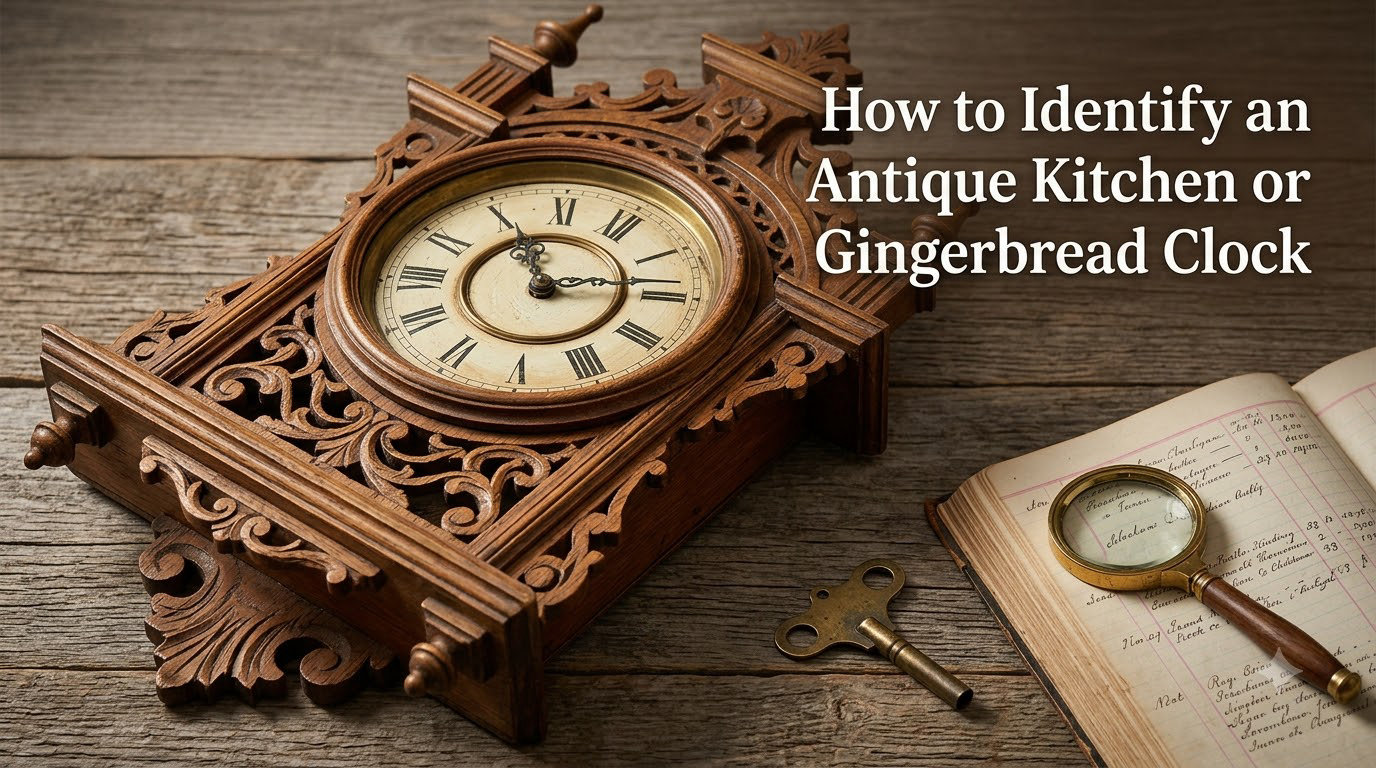
If you have inherited an ornate wooden shelf clock or spotted one at an estate sale, learning how to identify an antique gingerbread clock is the first step toward understanding its history, maker, and collectibility. These charming Victorian-era timepieces were produced in massive numbers between roughly 1880 and 1910, yet each carries distinct clues about who made it and when.
Our team has spent years studying American shelf clocks, consulting with NAWCC forum experts, and examining hundreds of kitchen clocks in person and online. Along the way, we learned that identification comes down to a combination of case design, maker marks, movement stamps, and historical context. No single clue tells the whole story.
This guide walks you through every step of the identification process. You will learn what defines a gingerbread clock, how to read its case and movement for maker clues, how to tell it apart from parlor clocks, and how to assess whether your clock is authentic and collectible. Whether you are a new collector, an inheritance recipient, or a seller trying to describe an item accurately, this information helps you make informed decisions.
Antique kitchen clock identification rewards patience and careful observation. Grab a flashlight, take your time, and let us walk through the process together.
Table of Contents
What Is a Gingerbread Clock?
A gingerbread clock is a type of antique American shelf clock known for its ornate, deeply carved wooden case, typically featuring steam-pressed decorative trim, a rosette at the top, and turned finials at the corners. Manufacturers produced these clocks primarily for kitchen and parlor placement, making them one of the most recognizable Victorian-era clock styles.
The name comes from the elaborate, frosting-like decoration on the wooden front face, which reminded observers of the ornate trim on a gingerbread house. The decorative patterns were pressed or carved into the wood using steam-pressing techniques that gave each clock a distinctive texture and depth.
Collectors sometimes use the terms gingerbread clock and kitchen clock interchangeably, though there are subtle distinctions we will cover later. For now, the key takeaway is that a gingerbread clock refers specifically to those ornately decorated shelf clocks with the characteristic carved or pressed ornamentation on the case front.
When Were Gingerbread Clocks Made?
Gingerbread clocks were primarily manufactured between 1880 and 1910, during the height of American industrial clock production. This roughly thirty-year window represents the golden age of mass-produced shelf clocks in the United States.
The timing was no accident. The late nineteenth century saw advances in steam-powered machinery, pressed-wood techniques, and spring-driven movements that allowed manufacturers to produce decorative clocks at scale. Companies like the Waterbury Clock Company, E. Ingraham Company, Ansonia Clock Company, and Gilbert Clock Company churned out thousands of these clocks annually.
If you own a true antique gingerbread clock, it almost certainly dates from this Victorian and Edwardian period. Clocks made after 1910 tended to feature simpler, less ornate cases as design tastes shifted toward cleaner lines. By the 1920s and 1930s, the elaborate gingerbread style had largely fallen out of fashion.
Knowing this production window is one of the fastest ways to begin narrowing down your clock’s age. A genuinely ornate, steam-pressed case points to that 1880 to 1910 era, while plainer cases suggest a later date or a different clock category entirely.
Key Identifying Features of a Gingerbread Clock
The fastest way to identify a gingerbread clock is by its case design, which combines several distinctive decorative elements. Once you know what to look for, these features are hard to miss.
The Steam-Pressed Wooden Case
The most defining characteristic of a gingerbread clock is its steam-pressed wooden front face. Manufacturers used steam and pressure to mold thin wooden panels into elaborate decorative patterns, creating relief designs with scrolls, florals, and geometric motifs.
This steam-pressing process allowed for mass production of ornate cases at a fraction of what hand-carving would cost. When you run your fingers over the front of a genuine gingerbread clock, you can feel the raised ornamentation distinctly from the flat background wood.
The Rosette at the Top
Most gingerbread clocks feature a decorative rosette centered at the top of the case, just above the dial. This circular or fan-shaped ornament serves as a visual anchor for the overall design and appears on models from multiple manufacturers.
The rosette is one of the features most commonly cited by NAWCC forum experts when helping collectors confirm a gingerbread identification. Its presence, combined with other case features, strongly suggests you are looking at a kitchen or gingerbread clock rather than a different shelf clock style.
Turned Finials at the Corners
Gingerbread clocks typically display turned wooden finials at the upper corners of the case. These small, decorative spires complete the ornate silhouette and are often original to the clock, though they frequently go missing over the decades.
Check whether the finials on your clock match each other in style and finish. Mismatched or missing finials can indicate replacement parts or loss over time, which is common and does not necessarily diminish the clock’s identity as a gingerbread piece.
The Dial and Numerals
Most gingerbread clocks feature porcelain or painted metal dials with either Arabic or Roman numerals. Arabic numerals became increasingly common in the later years of production, while Roman numerals appear more frequently on earlier models from the 1880s.
The dial sits behind a glass door that opens to reveal the clock face and winding arbors. This door-and-dial arrangement is standard across most American kitchen clocks of the period and provides another visual confirmation of the type.
How to Identify an Antique Gingerbread Clock: Step-by-Step
Identifying an antique gingerbread clock requires a systematic approach that examines the case, the movement, and any maker markings. Follow these steps in order to build a complete picture of your clock’s origins.
Step 1: Examine the Case Design
Start by confirming the clock has the characteristic gingerbread features described above. Look for the steam-pressed ornamentation, the rosette at the top, and corner finials. Measure the overall height, which typically falls between 18 and 26 inches for standard kitchen clocks.
Note the wood type and finish. Most original cases were made of oak, walnut, or mahogany, sometimes with darker stains. A clock with an unusually light or freshly refinished surface may have been restored or refinished at some point.
Step 2: Search for Maker Marks on the Dial
Open the glass door and examine the dial face carefully. Some manufacturers printed or stamped their name directly below the numeral 12 or above the numeral 6. Look for faint lettering that may have worn partially over the decades.
Use a flashlight at an angle to catch any impressed or printed marks that are hard to see in direct light. Even a partial name or logo can narrow your search significantly.
Step 3: Remove the Movement and Check the Backplate
The backplate of the clock movement is one of the richest sources of identification information. Carefully remove the movement from the case by unscrewing it from its mounting posts, taking care not to damage the pendulum or hands.
Once the movement is accessible, examine the backplate for stamped names, patent dates, and trademark logos. Manufacturers frequently stamped their name, city, and sometimes patent dates directly into the brass. These stamps are often the most reliable identification clue, since cases and dials can be swapped or refinished.
Step 4: Look for Paper Labels Inside the Case
Many manufacturers glued paper labels to the inside back or bottom of the clock case. These labels often contained the company name, address, model name, and sometimes instructions for setting up the clock.
Labels deteriorate over time, so yours may be partially missing or illegible. Even fragments can help. Use a magnifying glass and gentle lighting to read whatever survives, and photograph it for reference.
Step 5: Assess the Patina and Wear Patterns
Genuine antique clocks develop specific wear patterns over a century of use. Look for natural patina on the brass movement, wear on the winding arbors from decades of key use, and oxidation on the dial that follows natural aging patterns.
A clock that looks too clean, too uniform, or has modern screw heads and fresh glue may have been heavily restored or assembled from parts. This does not make it worthless, but it affects how you interpret the other identification clues.
Step 6: Cross-Reference with Manufacturer Catalogs
Once you have gathered case features, dial marks, backplate stamps, and label fragments, cross-reference your findings with manufacturer catalogs and reference books. The NAWCC maintains extensive archives, and online clock forums have databases of model photographs organized by maker.
This research step often confirms not just the manufacturer but the specific model and approximate production year. Take your time here, because accurate identification can significantly affect how you value, insure, or restore the clock.
Major Gingerbread Clock Manufacturers
Four companies dominated gingerbread clock production in the United States, and each left distinct identifying characteristics. Knowing the typical markings and style notes for each maker helps narrow your identification quickly.
Waterbury Clock Company
The Waterbury Clock Company, based in Waterbury, Connecticut, was one of the largest American clock manufacturers. Waterbury gingerbread clocks often feature robust brass movements with the company name stamped clearly on the backplate.
Waterbury cases tend toward heavy, deeply pressed ornamentation with a slightly darker finish than some competitors. Look for the name “Waterbury Clock Co.” or simply “Waterbury” stamped into the movement backplate, sometimes accompanied by a patent date.
E. Ingraham and Company
The E. Ingraham Company of Bristol, Connecticut, produced some of the most visually distinctive gingerbread clocks. Ingraham cases frequently feature elaborate rosette designs and highly detailed pressed patterns that collectors consider among the most attractive in the category.
Ingraham stamped their name and often a model or style name on the movement backplate. The company also used paper labels inside the case that listed the Bristol, Connecticut address. Ingraham movements are known for their reliable time and strike trains.
Ansonia Clock Company
The Ansonia Clock Company, originally of Ansonia, Connecticut and later of Brooklyn, New York, produced a wide range of shelf clocks including ornate gingerbread styles. Ansonia clocks are particularly noted for their alarm mechanisms, which many kitchen models included as a standard feature.
Look for “Ansonia Clock Co.” stamped on the backplate, sometimes with the Brooklyn address indicating a later production date. Ansonia dials sometimes carry the company name printed directly on the porcelain face.
Gilbert Clock Company
The Gilbert Clock Company of Winsted, Connecticut, produced gingerbread clocks with slightly simpler case designs than some competitors. Gilbert movements often carry the company name stamped on the backplate along with patent dates.
Gilbert clocks sometimes appear with paper labels rather than stamped movements, so check both locations. The company was known for affordable, reliable kitchen clocks that found their way into homes across America during the peak production years.
Kitchen Clock vs Parlor Clock: How to Tell the Difference
The terms kitchen clock and parlor clock are sometimes used interchangeably with gingerbread clock, but collectors recognize meaningful distinctions. Understanding these differences helps you categorize your clock accurately.
Kitchen clocks, including most gingerbread clocks, were designed for functional timekeeping in working areas of the home. They typically feature 8-day time and strike movements, alarm mechanisms, and cases measuring roughly 18 to 26 inches tall. The ornamentation is elaborate but the overall form remains practical and shelf-friendly.
Parlor clocks, by contrast, were intended for display in the formal front parlor. They tend to be larger, sometimes standing 30 inches or more, with more refined or classically inspired case designs. Parlor clocks may feature higher-grade movements, more expensive wood veneers, and decorative elements like columns or carved crests.
A useful rule of thumb is that gingerbread clocks almost always qualify as kitchen clocks based on size and intended placement. If your clock is particularly large, has column-adorned sides, or lacks the characteristic pressed ornamentation, it may be a parlor clock instead. When in doubt, focus on the case design and movement stamps rather than the broad category label.
Movement Inspection Guide
The clock movement holds some of the most reliable identification clues available, often more trustworthy than the case itself since cases can be refinished or swapped. Learning to inspect the movement properly is essential for serious identification work.
Opening the Case Safely
Begin by opening the clock case to access the movement. Most gingerbread clocks have a front-opening glass door that reveals the dial, and a back panel or open back that exposes the movement from behind. Remove the pendulum carefully before extracting the movement.
Take photographs at every stage so you can reassemble the clock correctly. Note the position of the strike hammer, the pendulum leader, and any warning levers before disconnecting anything.
Reading the Backplate
With the movement accessible, examine the backplate under good lighting. Use a magnifying glass to read stamped names, patent dates, and trademark symbols. Manufacturers stamped this information into the brass using steel dies, and the impressions often survive even when paper labels have disintegrated.
Common stamps include the company name, city of manufacture, and patent dates that can help pinpoint the production year. Record everything you find, including partial or worn stamps, since even fragments help with identification.
Identifying the Movement Type
Most gingerbread clocks use 8-day time and strike movements, meaning they run for approximately eight days on a single winding and strike the hour count on a bell or gong. Count the winding arbors on the dial face to confirm: two arbors indicate a time and strike movement, while a third arbor usually indicates an added alarm function.
The movement type itself can help confirm the era. Spring-driven 8-day movements with count wheel strike trains were standard for American kitchen clocks of the 1880 to 1910 period. If your movement looks dramatically different, it may be a replacement installed during a later repair.
Watching for Replaced Movements
One of the most common issues our team encounters is a gingerbread case fitted with a non-original movement. Over a century of use, many clocks had their movements replaced when the original failed. Signs of replacement include mismatched mounting holes, modern screw heads, and backplate stamps that do not match the case manufacturer.
A replaced movement does not render a clock worthless, but it does mean you cannot rely on the movement stamps alone for identification. In these cases, focus your research on the case design, label fragments, and construction techniques to determine the original maker.
Authentication and Condition Assessment
Once you have identified your clock’s likely maker and era, the next step is authentication and condition assessment. This process helps you understand what you have, what it is worth, and what restoration is appropriate.
The Authentication Checklist
Run through this checklist to assess authenticity. Does the case style match the production era? Do the movement stamps, paper label, and dial marks all point to the same manufacturer? Does the wood show appropriate age and patina for a clock made over a century ago?
Are the finials, feet, and decorative elements consistent with known models from that maker? Does the movement type match what the manufacturer typically used during that period? The more boxes you can check, the more confident your identification becomes.
Red Flags to Watch For
Certain warning signs suggest a clock may not be what it appears. Modern screws, fresh glue residue, or recently applied finish can indicate heavy restoration. A movement stamped with one manufacturer’s name inside a case clearly made by another suggests a marriage of parts rather than an original assembly.
A dial that looks too white and pristine for a clock of its claimed age may have been repainted or replaced. While these issues do not necessarily make a clock undesirable, they do affect value and should be disclosed if you plan to sell.
Restoration Pitfalls to Avoid
The most common mistake we see is over-restoration, particularly refinishing the original case. Many collectors and appraisers value original finish highly, even when it shows wear, because it confirms authenticity and age. Stripping and refinishing a case can actually reduce a clock’s collectible value.
If your clock has decades of grime, a careful cleaning with appropriate methods is usually preferable to aggressive refinishing. For movement issues, seek a clockmaker experienced with antique American movements rather than attempting repairs that could damage original components.
Forum insights from NAWCC members consistently emphasize that original condition, even with honest wear, is preferred over restored condition in the collector market. Document any work you do perform, and keep original parts even if you replace them with functional alternatives.
Condition Grading Basics
Collectors typically assess condition on a spectrum from poor to mint. A clock in poor condition may have a non-working movement, significant case damage, and missing parts. Average condition means the clock runs and displays reasonably well but shows normal wear. Excellent condition suggests original finish, working movement, and minimal wear for its age.
Be honest in your assessment. Overstating condition creates problems whether you are insuring, selling, or simply cataloging a personal collection. When in doubt, consult an experienced appraiser or post detailed photographs to a clock identification forum for community input.
Value Indicators for Antique Kitchen Clocks
Several factors influence what an antique kitchen or gingerbread clock is worth to collectors. Understanding these indicators helps you assess your clock without needing a professional appraisal for every piece.
The manufacturer matters significantly. Clocks from sought-after makers like Ansonia or Ingraham, especially rare or unusual models, tend to attract more collector interest than common models from lesser-known companies. The specific model and its relative scarcity within a manufacturer’s lineup also plays a role.
Originality is paramount. A clock with its original finish, original movement, original dial, and intact paper labels commands more respect than an identical model that has been refinished or fitted with replacement parts. Provenance, meaning documented ownership history, adds value when available.
Working condition affects value as well. A clock that runs and strikes properly is worth more than one that does not, though serious collectors often buy non-running examples for restoration. Rarity, desirability of the case design, and overall completeness of the clock round out the key value factors.
FAQs
What is a gingerbread clock worth?
Gingerbread clock values vary widely based on manufacturer, model rarity, originality, and working condition. Common models in average condition may appeal primarily to beginning collectors, while rare examples from sought-after makers like Ansonia or Ingraham with original finish and intact labels command significantly more interest. Originality and working condition are the strongest value drivers.
How do I identify my antique clock?
Identify your antique clock by examining four key areas in order. First, inspect the case design for characteristic features like steam-pressed ornamentation, rosettes, and finials. Second, open the glass door and look for maker names printed or stamped on the dial. Third, remove the movement and check the backplate for stamped company names and patent dates. Fourth, search inside the case for surviving paper labels with manufacturer details.
When were gingerbread clocks made?
Gingerbread clocks were primarily manufactured between 1880 and 1910 in the United States. This period coincided with advances in steam-powered machinery and pressed-wood techniques that enabled mass production of ornate clock cases. Major manufacturers including Waterbury, Ingraham, Ansonia, and Gilbert produced these clocks by the thousands during this Victorian and Edwardian era window.
Why are they called gingerbread clocks?
They are called gingerbread clocks because their ornate, deeply pressed wooden trim resembles the elaborate decoration on a gingerbread house. The steam-pressed patterns of scrolls, florals, and geometric motifs covering the case front gave the clocks a richly decorative appearance that reminded observers of frosting and baked ornamentation.
How do you know if an old clock is valuable?
An old clock is most likely valuable to collectors when it has original finish and movement, intact paper labels, a working mechanism, and comes from a recognized manufacturer like Ansonia, Ingraham, or Waterbury. Rarity of the specific model, overall completeness with original finials and parts, and documented provenance all increase value. Over-restoration or replacement parts generally reduce collector interest.
What are the different types of kitchen clocks?
Kitchen clocks from the antique era include gingerbread clocks with their ornate steam-pressed cases, simpler cottage clocks with minimal decoration, schoolhouse clocks with round dials in wooden surrounds, and ogee clocks with their distinctive S-curve molding. Within the gingerbread category itself, variations exist based on case size, ornamentation style, alarm function presence, and the specific manufacturer.
Putting It All Together
Learning to identify an antique gingerbread clock is a skill that improves with every clock you examine. The combination of case design analysis, maker mark research, movement inspection, and condition assessment gives you a reliable framework for understanding any kitchen clock that crosses your path.
Start with the case and its steam-pressed features, then work inward to the dial, backplate stamps, and paper labels. Cross-reference your findings with manufacturer catalogs and community resources like the NAWCC forums, where experienced collectors generously help with identification questions.
Remember that originality matters more than perfection in the collector world, and honest documentation of your clock’s condition serves you whether you are collecting, restoring, or selling. Every gingerbread clock has a story, and now you have the tools to begin reading it.