
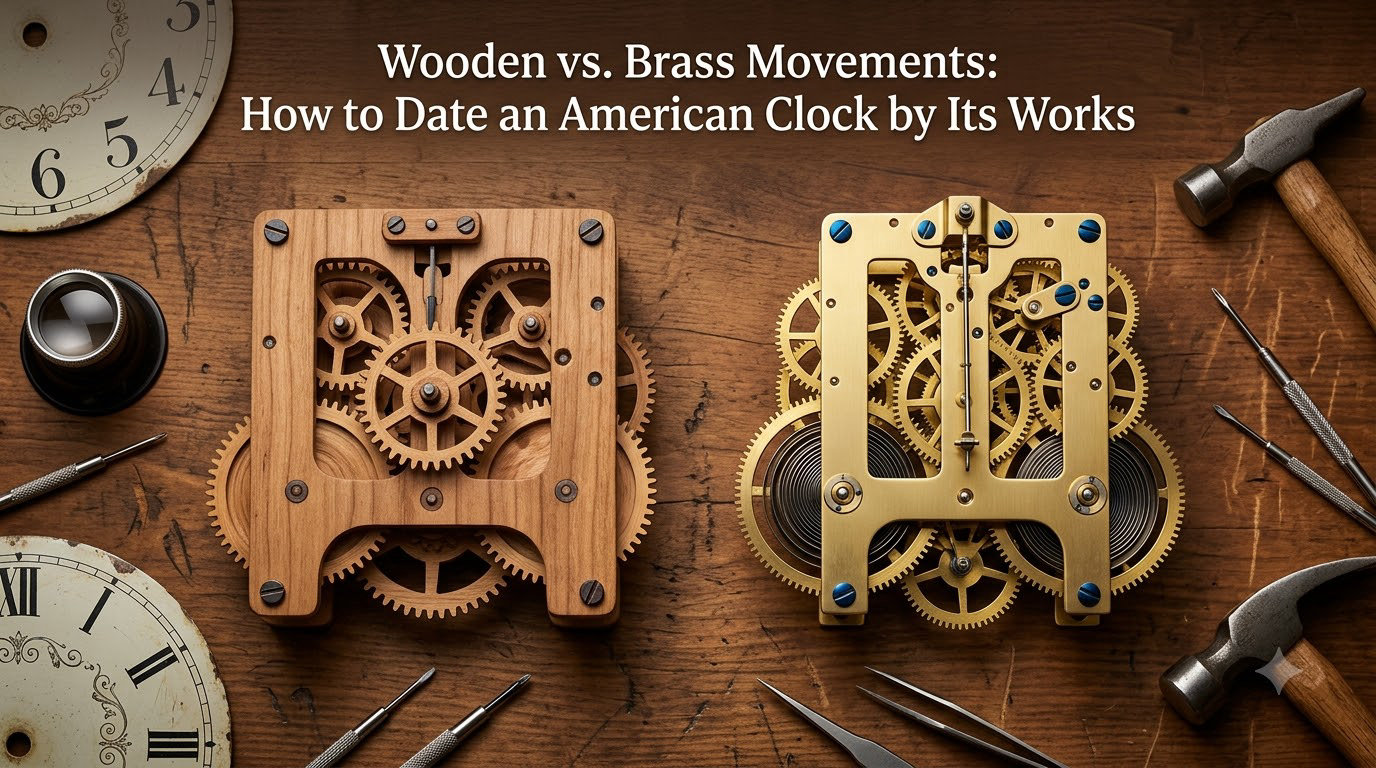
Pick up any American clock from the 1800s and the first question is always the same: how old is it? The dial, the case, even the label can all be replaced or repainted, but the movement – the working gears inside – tells the real story. Learning to read the movement is the single most reliable way to date an American clock, and it comes down to one big distinction: wooden movements versus brass movements.
Our team has handled hundreds of American clocks over the years, and the wooden-versus-brass question comes up nearly every time. In this guide, I will walk you through how to tell the two apart, what each tells you about the clock’s age, and the exact steps to date an American clock by its works.
Before we get into the identification details, a quick note on why this matters. American clocks from the 1830s and 1840s occupy a fascinating transition window. The industry was moving from hand-built wooden movements to factory-produced brass movements, and clocks made in that narrow band can look very different from piece to piece. Knowing what to look for helps you place a clock in time, value it correctly, and avoid the most common dating mistakes collectors make.
If you are new to clocks, do not worry. The wooden-versus-brass distinction is one of the easiest first steps to learn, and it gives you an answer to most of the dating questions you will run into. By the end of this article, you will be able to look at a movement and have a confident read within seconds.
Table of Contents
Wooden Movement Characteristics (1813-1842)
Wooden movements dominated American clockmaking from roughly 1813 to 1842. They were built from shaped wooden plates – usually birch, cherry, mahogany, or softwoods like pine – into which gears, pinions, and arbors were mounted on iron pivots. The look is unmistakable once you have seen a few: warm brown tones, visible grain, and a hand-built feel that no factory clock can mimic.
Eli Terry’s 1813 patent for a wooden shelf clock movement changed the American clock industry overnight. By mass-producing simple 30-hour wooden movements in Plymouth, Connecticut, Terry made clocks affordable for the average household. Before Terry, a clock was a tall case piece costing the equivalent of a month’s wages for an ordinary worker. After Terry’s innovation, a small shelf clock could be had for a few dollars, and suddenly every home could have one.
By the late 1830s, Terry’s factory and competitors like Seth Thomas were producing tens of thousands of wooden shelf clocks per year. The wooden movement era lasted about 30 years. That is a long run for any technology, and it means a huge number of these clocks survive today, often in surprisingly good condition.
Materials and Construction
Most wooden movements were cut from cherry or birch, which resisted warping better than softer woods. You will also see mahogany on higher-end pieces, often from Massachusetts makers like the Willards. Pine and other softwoods were used on the cheapest 30-hour movements, where cost was the primary concern.
German silver or brass bushings were rare on early wooden movements, so the pivots ran directly in holes drilled into the wood. Over time, those holes wore oval, which is why many wooden movements today need bushing work to run reliably. The wood itself can also shrink, warp, or crack if exposed to humidity swings, so storage conditions matter a great deal.
Gears, Pinions, and Escapements
The gears on a wooden movement were almost always cut from solid wood blanks and hand-finished. Wire teeth were sometimes soldered to wooden gear blanks in later wooden movements to improve accuracy. The wire teeth added strength and gave the gear a bristly appearance when you look at it from the side.
Escapements were typically anchor-type, though early examples sometimes used verge escapements derived from English traditions. The anchor escapement gave better timekeeping than the verge, and most American makers adopted it as a standard feature by the 1820s.
Wooden movements were usually weight-driven or short-mainspring designs, and most ran for only 30 hours between windings. A few 8-day wooden movements exist, but they are uncommon. The 30-hour limitation was acceptable for everyday home use, but it did mean the clock had to be wound daily – a chore that contributed to the eventual move to brass and spring-driven designs.
Common Wooden Movement Patterns
Two common plate shapes appear in American wooden movements. The simpler 30-hour movements use two flat plates with simple pillars between them. The 8-day wooden movements use a more complex bridge or skeleton frame. Both styles often have visible hand-cut gear teeth, which you can see clearly if you shine a flashlight at the right angle.
How to Spot a Wooden Movement in the Wild
Look for visible wood grain on the plates. Wooden movements almost always have a rich, uneven color that darkens with age. Gears are pale wood color, not the bright gold of brass. If you see iron or steel arbors with no bushings – or if the pivot holes show elongated wear – you are probably looking at a wooden movement.
Another giveaway is the smell. A wooden movement that has aged naturally has a faint woody, almost sweet aroma when you open the case. Brass movements do not. The smell test sounds silly, but experienced collectors use it more often than you would think.
Brass Movement Characteristics (Post-1840s)
Brass movements became standard in American clocks from about 1840 onward, with the change fully completed by the 1850s. Brass plates, brass gears, and brass pinions made clocks more durable, more accurate, and easier to mass-produce. By the time the Civil War ended, almost every American clock factory was using brass movements exclusively.
The transition was driven by both economics and engineering. Steel was expensive in the 1830s and 1840s, so brass mainsprings were used as an affordable substitute, and brass gears lasted longer than wooden ones. Mass production also relied on the precision and uniformity that brass stamped parts provided.
One fascinating detail from the era: brass mainsprings were used as a stopgap because steel was too costly. By the 1850s, steel mainsprings became affordable, and they replaced the brass ones. So a brass movement with a brass mainspring is usually a transitional piece from the 1840s or early 1850s, while a brass movement with a steel mainspring is post-1855 or so.
Brass Plates and Framing
Brass movements use two or more brass plates, usually about 2-3 millimeters thick, sandwiching the gear train. The plates are assembled on posts – hollow brass tubes that pass through both plates and lock the whole structure together. Polished, engraved, or japanned brass plates are common on higher-quality clocks, while cheaper production clocks sometimes have plain brass with a protective lacquer.
Japanning – a black lacquer finish often used on brass plates – was a popular decorative choice in the 1840s-1860s. A black japanned brass plate with gilt lettering is a hallmark of the mid-Victorian era and helps narrow the production date of a clock to a surprisingly narrow window.
Gears, Pinions, and Bushings
Gears and pinions in brass movements are cut from solid brass, often with hardened steel pinions at the gear centers. Mainsprings are made of flat steel coiled in a brass barrel. Critical pivot holes are fitted with brass bushings, which can be replaced as they wear. This is a major durability advantage over wooden movements.
The bushings are pressed into the brass plate and can be drilled out and replaced when they wear. This is the single biggest reason brass movements survive in working condition long after wooden movements have worn out. A well-maintained brass movement can run reliably for 100 years or more.
Power Source and Timekeeping
Brass movements are typically spring-driven, which made them suitable for smaller cases like mantel clocks, kitchen clocks, and banjo clocks that could not accommodate hanging weights. 8-day running time became standard, and accuracy improved noticeably. Striking trains often include count wheels or rack-and-snail systems that you can hear when the clock strikes the hours.
Spring-driven movements also made installation easier. You could place a brass-movement clock on a mantel, a shelf, or a wall without worrying about clearance for hanging weights. This flexibility in case design opened up new styles and new markets for American clockmakers.
Advanced Brass Movement Features
By the 1860s and 1870s, brass movements often included additional refinements. Lever escapements improved accuracy beyond the older anchor escapement. Compensation balances adjusted for temperature changes. Strike-silent levers allowed the owner to disable the striking mechanism at night. These features are visible on the movement itself and can help narrow a clock’s date to within a few years.
Wooden vs. Brass Movements: A Side-by-Side Comparison
Wooden and brass movements look and sound different, and each tells a specific story about when and where a clock was made. The table below lines up the key differences for quick reference.
| Feature | Wooden Movement | Brass Movement |
|---|---|---|
| Era of widespread use | 1813 – 1842 | 1840 – 1900s |
| Primary material | Cherry, birch, or mahogany plates | Brass plates and gears |
| Power source | Weights or short spring (mostly 30-hour) | Mainspring (mostly 8-day) |
| Pivot holes | Drilled directly in wood, often worn | Brass bushings, replaceable |
| Common case styles | Tall case, pillar-and-scroll, early shelf clock | Shelf, mantel, banjo, steeple, kitchen |
| Sound profile | Soft, woody tick; quieter strike | Sharp, sharper ringing tick; cleaner strike |
| Notable makers | Eli Terry, Seth Thomas, early Connecticut shops | Seth Thomas (post-1842), Ansonia, E. Howard, Seth Thomas factory |
| Typical condition issues | Shrinkage cracks, worn pivots, broken teeth | Worn bushings, dirty mainsprings, lacquer loss |
| Average running time | 30 hours (one day) | 8 days (one week) |
| Production volume | Limited to smaller workshops | Mass produced in factories |
Reading the Table at a Glance
If you only have 30 seconds with a clock, this table is your cheat sheet. Run through the rows in order: era, material, power source, case style. By the time you hit the fourth row, you should have a strong hypothesis about the clock’s date. The remaining rows are confirmation and context.
How to Date an American Clock by Its Works: Step by Step
Follow these five steps when you need to date an American clock by its works. Each step narrows the possibilities until you can place the clock within a few years.
Step 1: Identify the Movement Material
Open the door or remove the dial to expose the movement. Look for wood grain and warm brown plate color, which means a wooden movement and likely a date before 1842. If you see brass plates with engraved or japanned finish, you are looking at a brass movement, usually after 1840. This single observation places the clock in a roughly 30-year window.
Be careful with painted wooden plates. Some early brass plates were given a faux-wood finish to look like the older wooden movements, and some wooden plates were painted to look like brass. Touch the plate with a fingertip. Real brass feels cool and metallic. Real wood feels warm and slightly textured.
Step 2: Read the Maker’s Label and Stamp
Most American clocks carried paper labels inside the case or stamped signatures on the movement itself. Wooden movements often have inked or paper labels on the backboard; brass movements usually have an engraved maker’s name on the back plate or a stamped trade label inside the door. A label can date the printer’s known working years and constrain the clock’s date to a narrow band.
Paper labels are fragile. They often fade, tear, or fall off entirely. If the label is missing, look for a faint outline where the label used to sit, or for a small tack hole in the wood. Many collectors have been surprised to find a hidden label tucked behind a movement or under a liner.
Step 3: Examine the Dial
Dial materials changed predictably over the 19th century. Painted wooden dials were standard on early shelf clocks. By the 1840s, reverse-painted glass dials appeared, and by the 1850s, paper-on-wood and porcelain dials became common. A reverse-painted glass banjo dial means the clock is most likely after 1840.
Dial design also matters. Simple Arabic numerals on a plain background are typical of the 1810s-1830s. Roman numerals with maker’s signature painted on the dial became standard in the 1850s. By the 1870s, elaborate transfer-printed designs with floral motifs and advertising were common, especially on kitchen clocks.
Step 4: Match the Case Style
Case styles also evolved in a recognizable sequence. Pillar-and-scroll tops and splat-board cases are typically 1815-1830. Reverse-ogee cases appeared in the 1840s. Steeple, beehive, and banjo cases dominated the 1840s-1860s. Black mantel clocks and kitchen clocks with rosewood or walnut cases peaked in the 1870s-1890s.
Wood species also offer clues. Mahogany was the dominant wood for early American clock cases (1810s-1830s). Rosewood became popular in the 1840s-1850s. Walnut and birds-eye maple dominated the 1860s-1880s. Oak and chestnut appeared in later, more rustic clocks.
Step 5: Check the Serial Number
Major makers like Seth Thomas, E. Howard, and Ansonia kept serial number records. A quick lookup can date a clock within a year or two. If the serial number database shows the clock was made in 1856, but the movement is wooden, you have a contradiction worth investigating – it likely means the movement was replaced at some point.
The NAWCC database and several published reference books contain serial number information for major makers. Some manufacturers like Seth Thomas have very detailed records, while smaller makers have only fragmentary data. When in doubt, an appraiser with access to specialized references can often pin down a date that web research cannot.
Common Dating Pitfalls to Avoid
Replacement movements are the single biggest dating trap. Many American clocks had their movements swapped out over the decades, especially around 1900 when immigrant clockmakers took over repairs. Always check the case for signs of rework, mismatched screws, and labels that contradict the movement style.
Regional reproductions also exist. By the 1920s, there was a small but real market for reproduction banjo clocks and Willard-style regulators. Watch for crisp, machine-cut stamp marks and labels that look too clean relative to the case finish. Genuine antique labels show signs of age – foxing, fading, ink bleeding into the paper – that reproductions cannot easily fake.
Another common mistake is trusting the patent date alone. Many clocks bear patent dates for the movement design, but the actual production could be a decade later. Always cross-reference the patent date with the case style and dial to confirm a date range.
Key American Makers and Their Movement Types
A few major makers shaped American clock history. Knowing which era each worked in, and what movement materials they favored, helps you date clocks quickly.
Eli Terry (1772-1852)
Eli Terry patented the wooden shelf clock in 1813 and began mass-producing wooden movements in Plymouth and Bristol, Connecticut. By the late 1830s, Terry had switched to brass plates in some models, and by the 1840s, his firm had fully transitioned. If you see “Terry” or “E. Terry” on a wooden movement, you are most likely looking at an 1813-1842 piece.
Terry was also a pioneer of interchangeable parts. His factory used jigs and patterns to make wooden gears that were nearly identical from one clock to the next. This was an early step toward the mass production that brass movements would later make possible on an even larger scale.
Seth Thomas (1785-1859)
Seth Thomas started with Terry and founded his own company in 1813. He ran wooden movements until 1842, when he switched to brass. A Seth Thomas clock with a wooden plate is almost certainly pre-1842; one with brass plates is post-1842. This is one of the cleanest dating markers in the whole American clock industry.
Seth Thomas clocks are among the most commonly encountered American clocks today. The company produced millions of clocks across the 19th and into the 20th century, and surviving examples are widespread. If you learn the Seth Thomas dating markers, you can date a huge percentage of American clocks at a glance.
Chauncey and Noble Jerome
The Jerome brothers were major Connecticut clockmakers in the 1840s-1860s. They are known for sleek banjo clocks and steeple clocks with brass movements. A Jerome-branded brass movement is almost always post-1842.
Jerome clocks often feature elaborate reverse-painted glass dials with detailed scenes. A Jerome banjo clock with a glass dial showing a sailing ship or rural landscape is a classic American timepiece, and the brass movements are usually high-quality 8-day designs.
E. Howard and Company
E. Howard began in the 1840s and built a strong reputation for high-quality brass movements. Howard clocks are usually 8-day, with heavy brass plates and precise pivots. They continued production into the early 1900s, so a brass Howard movement could date anywhere from 1840 to 1900.
Howard also made tower and regulator clocks for public buildings, including train stations and city halls. These large brass movements are highly sought after by collectors and represent some of the best American clockmaking of the 19th century.
Waterbury, Ansonia, and New Haven
These three Connecticut cities became major clockmaking centers in the latter half of the 19th century. Waterbury was nicknamed “the brass city” for its clock and brass goods industry. Ansonia, New Haven, and later Bristol produced millions of brass-movement clocks for the mass market. Movements from these makers are usually clearly stamped with the city name and the maker’s mark.
Connecticut vs. Massachusetts Makers
Connecticut clockmakers, especially in Bristol, Plymouth, and Thomaston, focused on mass-produced wooden and brass shelf clocks. Massachusetts makers, especially the Willard family in Roxbury, favored higher-end tall case clocks with brass movements. Willard movements are usually brass, often weight-driven, and frequently found in tall case clocks.
The Willard family – including Aaron, Simon, and Benjamin – established a tradition of fine Boston-area clockmaking that influenced American design for decades. A tall case clock with a brass movement and a Massachusetts maker’s mark is often a more refined piece than a Connecticut factory clock of the same period.
Simon Willard and the Banjo Clock
Simon Willard patented the banjo clock in 1802. These distinctive wall clocks with their rounded top and pendulum window became a signature American form. Original Willards are rare and valuable, but the banjo form was widely copied through the 1840s-1860s by Jerome and other Connecticut makers using brass movements.
Advanced Dating Techniques for Difficult Cases
Some clocks resist easy dating. Movements have been swapped, labels are missing, and cases have been married. Here are three advanced techniques that help in tricky situations.
Hand-Finished vs. Machine-Cut Teeth
Look at the gear teeth under a loupe. Hand-cut teeth have slight irregularities and asymmetric profiles. Machine-cut teeth are uniform and crisp. This detail is invisible to the naked eye but very telling under magnification. Hand-cut teeth suggest an earlier piece (pre-1850), while machine-cut teeth suggest later production.
Fastener and Hardware Analysis
Hand-hammered nails and screws with irregular slots are typical of pre-1840 construction. Machine-made screws with clean, uniform slots suggest post-1840 production. Even the hinges on the case door carry dating information if you know what to look for.
Patina and Surface Analysis
Natural patina on brass, wood, and hardware helps indicate age, though reproductions sometimes attempt to mimic it. Genuine patina develops unevenly and cannot be perfectly replicated. Look for areas protected from cleaning and wear – inside the case, behind the dial, in the door recesses – where original patina often survives.
When to Seek a Professional Appraisal
If your clock has no label, no visible serial number, and a movement that mixes old wooden parts with newer brass pieces, professional help is worth it. A trained appraiser can disassemble the movement, examine wear patterns, and compare component styles against national museum collections. The National Association of Watch and Clock Collectors (NAWCC) maintains a directory of qualified appraisers, and many regional horological societies offer free verbal identification at antique shows.
Professional appraisals typically cost between $50 and $200 depending on the appraiser and the complexity of the clock. For rare or potentially valuable clocks, this is a worthwhile investment. Many auction houses also offer informal verbal opinions at no charge if you bring the clock to an appointment.
Preservation Tips for Antique Clock Movements
Once you have identified your clock, treat the movement gently. Avoid oiling wooden movements – the wood absorbs oil and can warp. For brass movements, use only clock-specific synthetic oils, never WD-40 or gun oil. Store clocks with stable humidity, ideally between 40 and 55 percent, to prevent wooden case shrinkage and brass corrosion.
When handling a movement, wear clean cotton gloves and lay it on a soft pad. Original movements are part of the clock’s value, and a dented plate or scratched dial can drop collector interest significantly.
If you are not opening the movement yourself, do not let a repair shop open it without your approval. Many original movements have been lost to over-eager servicing. Ask the shop to clean and oil the movement in place if possible, and to document the original condition with photos before any work begins.
Resources for Further Research
Three resources are particularly valuable for collectors who want to dig deeper. The NAWCC Bulletin publishes detailed articles on American clockmakers and movement types. The books by Tran Duy Ly on Seth Thomas and other Connecticut makers contain serial number records and detailed movement descriptions. The online forums at NAWCC and the clock-related Reddit communities are good places to post photos and ask questions.
Museum collections at the American Clock and Watch Museum in Bristol, Connecticut, and the National Watch and Clock Museum in Columbia, Pennsylvania, hold reference movements that can be studied in person. Both institutions also publish educational materials that are useful for collectors of all levels.
Frequently Asked Questions
How do you date a clock movement?
Open the clock and identify the movement material. Wooden movements are typical of American clocks made between 1813 and 1842, while brass movements became standard after 1840. Cross-reference the movement style with the maker’s label, dial, and case style to narrow the date to a specific range. The five-step process covered in this article gives you a complete dating workflow.
How can I tell how old my clock is?
Look at the movement material first – wood or brass. Then check the dial style, case form, and any maker’s label. Compare your findings with documented production dates for that maker, and use serial number lookup databases when available. Most American clocks can be dated within a five-year window using these clues.
How do you identify an antique American clock?
An antique American clock is identified by its movement type, dial style, case construction, and maker’s marks. Wooden movements, painted wooden dials, and pillar-and-scroll or tall case construction suggest pre-1842 production. Brass movements, reverse-painted glass dials, and banjo or steeple cases indicate post-1840 production. Most American antique clocks are considered antique if they are over 100 years old.
When did brass movements replace wooden ones in American clocks?
Brass movements replaced wooden movements in American clocks between 1840 and 1850. Seth Thomas switched in 1842, and most other Connecticut makers completed the transition by the late 1840s. By the 1850s, brass movements were the industry standard, and wooden movements were no longer produced in significant numbers.
What is the difference between wooden and brass clock movements?
Wooden movements use cherry, birch, or mahogany plates with wooden gears and iron pivots, and they were standard in American clocks from 1813 to 1842. Brass movements use brass plates, brass gears, mainsprings, and replaceable bushings, and they became standard after 1840. The material change improved accuracy, durability, and enabled mass production of smaller case styles such as banjo and steeple clocks.
Final Thoughts
Learning to date an American clock by its works comes down to one big skill: recognizing whether the movement is wood or brass. That single observation places the clock in a 30-year window, and the rest of the dating work is filling in the details. Look for the maker’s label, study the dial, and match the case to its era. With a little practice, you can pull off a backboard, glance at the movement, and have a confident date within minutes.
Pick up a few clocks at your next antique show and try the five-step process yourself. After a dozen or so, the wooden-versus-brass distinction becomes second nature, and you will be surprised how often the movement alone tells you everything you need to know about how to date an American clock by its works.
The wooden movement era is a remarkable chapter in American manufacturing history. Those pioneers turned clockmaking from a craft into an industry, and they did it with hand-built wooden gears in small Connecticut workshops. The brass movements that followed built on their foundation and made clocks common household items. Every American clock you pick up, whether it carries an 1820s wooden movement or a 1880s brass movement, is a small piece of that story.