
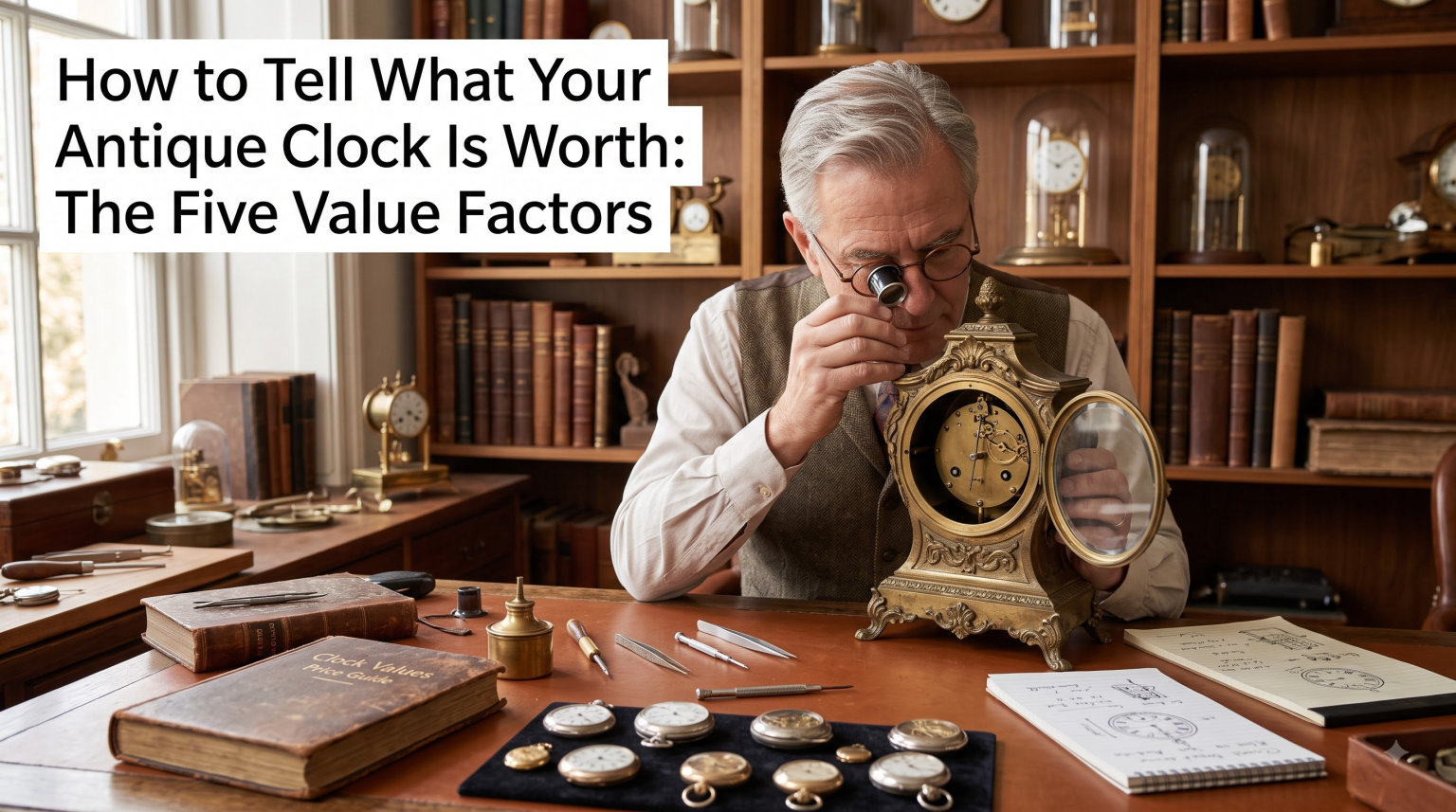
Antique clocks are among the most rewarding collectibles you can own. They combine engineering, artistry, and history in a single object that still functions decades or centuries after it was built. But when you inherit a clock or spot one at an estate sale, the first question that hits you is usually: what is this actually worth?
The answer comes down to five antique clock valuation factors that professional appraisers use every day. These factors are the maker, the movement, originality, condition, and recent comparable auction sales. Once you understand how each one works, you can look at any clock and form a reasonable estimate of its value before you spend money on an appraisal.
I have spent years studying clock identification and talking with collectors, restorers, and auction houses. What follows is a practical, step-by-step breakdown of those five factors, plus guidance on identifying your clock, avoiding common mistakes, and knowing when to call in a professional.
Here are the five value factors you need to assess:
Maker — Who built the clock and how sought-after is that maker today?
Movement — What type of mechanism powers the clock, and how complex is it?
Originality — How many parts are original versus replaced or modified?
Condition — What is the physical state of the case, dial, and movement?
Comparable auction sales — What have similar clocks actually sold for recently?
Table of Contents
The Five Antique Clock Valuation Factors Explained
Antique clock valuation factors work together as a system, not as a checklist where you pick one and ignore the rest. A clock with a famous maker can still lose value if the movement was swapped out. A clock in pristine condition might still be common enough to sell for under $200.
Each factor carries different weight depending on the type of clock. A tallcase grandfather clock lives or dies by its maker and case quality. A mantel clock is judged more on its movement and condition. Understanding these interactions is what separates a ballpark guess from a real valuation.
Let me walk you through each factor in detail.
Factor 1: The Maker — Who Built Your Clock
The maker is usually the single biggest driver of value. A clock signed by a renowned maker like Thomas Tompion, George Graham, or Simon Willard commands far more than an unmarked clock of the same age. Collectors pay premiums for names they recognize and trust.
Not all makers are created equal. English makers from London’s clockmaking district produced some of the most desirable clocks ever made. American makers like Seth Thomas, Ansonia, and Waterbury produced millions of clocks that are beautiful but relatively common. A Seth Thomas mantel clock from the late 1800s might sell for $100 to $300 today, while a Tompion bracket clock could reach six figures.
Here is how to identify the maker on your clock:
Movement stamps: Look for names or marks stamped directly on the brass plate of the movement. Many makers stamped their name, city, or a serial number.
Dial signatures: Painted dials and engraved silvered dials often carry the maker’s name and sometimes the city.
Paper labels: American shelf clocks frequently have paper labels pasted inside the case door or on the backboard.
Hallmarks and stamps: English clock cases sometimes carry silversmith or casemaker hallmarks that help narrow provenance.
Be careful with dial signatures, though. Many clocks were signed by the retailer who sold them, not the actual maker. A clock dial reading “J. Smith, London” might mean J. Smith was a shop owner who commissioned an anonymous clockmaker to build the movement.
I always tell people to research the maker’s reputation before assuming a signature means big money. Look up the name in reference books like Britten’s Old Clocks and Watches and Their Makers or the National Association of Watch and Clock Collectors (NAWCC) online database. If you cannot find the maker listed anywhere, that tells you something too.
Factor 2: The Movement — Mechanical Complexity
The movement is the heart of the clock, and its complexity directly affects value. A simple time-only movement with a single hand is worth less than a movement that strikes the hour, plays Westminster chimes, and includes a calendar or moon phase complication.
Several movement features add value:
Strike and chime trains: Clocks that strike on bells or chime on rods are more desirable than silent time-only movements.
Musical movements: Clocks that play multiple tunes on a cylinder or pinned barrel are rare and command high prices.
Complications: Moon phases, calendar work, equation of time, and automata all add complexity and value.
Escapement type: A deadbeat or chronometer escapement is more prized than a simple recoil escapement.
The movement alone, detached from the case, can be worth real money. I have seen forum members report movements selling for $200 to $400 and weights adding another $100. A high-quality movement by itself can outvalue a clock in a damaged or plain case.
Pay attention to whether the movement matches the case. A movement swap is one of the most common value killers. If your clock has a 1920s German movement inside an 1820s English case, the value drops sharply because the clock is no longer original.
Also note the power source. Weight-driven clocks generally indicate earlier, higher-quality construction. Spring-driven clocks became common in the mid-1800s and are found in most American shelf clocks. The distinction matters to collectors.
Factor 3: Originality — Original Parts vs Replacements
Originality measures how many parts on your clock are the ones that left the factory with it. Collectors prize originality above almost everything else. A clock with all original parts, even showing honest wear, is worth more than a clock that has been heavily restored with modern replacements.
Common parts that get replaced over a clock’s life include:
Pendulums and weights — often lost or swapped between clocks
Dials — repainted or replaced when paint flakes
Hands — broken and replaced with incorrect style
Movements — swapped when the original fails
Glass — replaced after breakage
Finials and decorative parts — broken and replaced
Each replacement reduces value. A clock with a replaced movement and repainted dial may lose half its potential value compared to an all-original example.
This is why the restoration question causes so much anxiety among clock owners. Forum users frequently ask whether they should restore a clock or leave it alone. The general consensus among experienced collectors is clear: over-restoration hurts value more than honest patina.
If you must restore, use reversible methods and period-correct parts. Never refinish an antique case to look new. Never repaint a dial unless the original is completely unreadable. And always document what was done so a future buyer knows the clock’s history.
One sign of originality to look for is patina on brass parts. A genuine antique movement will have a dark, even tarnish that develops over decades. Bright, freshly polished brass inside a clock case is a red flag that something was recently replaced or aggressively cleaned.
Factor 4: Condition — How to Assess Your Clock
Condition is about the current physical state of the clock, separate from originality. A clock can be entirely original but in poor condition, or it can be restored but in excellent running order. Both scenarios affect value in different ways.
Appraisers typically assess condition across three main areas:
Case: Look for cracks, splits, veneer loss, worm damage, warping, and previous repairs. Wooden cases are vulnerable to humidity and temperature changes.
Dial: Check for paint loss, crazing, cracks, and fading. Enamel dials can chip. Painted iron dials can rust.
Movement: Test whether the clock runs, strikes, and keeps reasonable time. Check for worn pivot holes, broken teeth, and excessive wear on the escapement.
A clock that runs and keeps time is worth more than one that does not. But a non-running clock is not worthless — many buyers purchase clocks specifically to restore them. The question is whether the cost of repair makes sense given the clock’s potential value.
Honest wear is acceptable to collectors. A clock that shows its age with minor scratches and a warm patina tells a story. A clock that has been sanded down, refinished, and made to look new has lost that story, and with it, much of its appeal.
I recommend photographing every flaw before seeking an appraisal. Document chips, cracks, repairs, replaced parts, and any damage. This transparency helps the appraiser give you an accurate number and protects you if you later sell.
Factor 5: Comparable Auction Sales — Researching Real Prices
The final factor is the one most people skip: researching what similar clocks have actually sold for. Asking prices mean nothing. Only completed sales tell you what buyers are willing to pay, and that is the truest measure of market value.
Here are the best resources for finding comparable auction sales:
LiveAuctioneers.com — Searchable archive of hammer prices from hundreds of auction houses. Filter by maker, type, and date.
Invaluable.com — Similar to LiveAuctioneers, with results from international auction houses.
eBay completed listings — Useful for common clocks under $500, though prices tend to run lower than auction results.
NAWCC message boards — Members share sale prices and valuation discussions for specific clock types.
Sotheby’s and Christie’s results — For high-end clocks, these auction houses publish detailed results with full descriptions.
When searching comparables, match your clock as closely as possible. Look for the same maker, same type (mantel, wall, tallcase), similar age, and similar condition. A sale price for a fully restored example does not apply to your clock if yours is in as-found condition.
Also pay attention to sale dates. The market for common clocks has declined over the past several years, as many forum members have noted. A comparable sale from five years ago may overstate what your clock is worth today. Focus on sales from the last 12 to 24 months for the most accurate picture.
I suggest gathering at least three to five comparable sales before forming a valuation range. If your clock is unusual and you cannot find close matches, that is a signal to consult a professional appraiser rather than guessing.
How to Identify Your Antique Clock
Before you can assess value, you need to identify what you have. Here is a simple step-by-step process:
Step 1: Look for a maker’s name on the dial, on the movement plate, or on a paper label inside the case.
Step 2: Determine the clock type — mantel, wall, tallcase (grandfather), bracket, carriage, or shelf. Each type has its own market.
Step 3: Estimate the age by examining the movement style, dial type, and case construction. Hand-cut movements with skeleton escapements suggest pre-1850. Mass-produced American shelf clocks are typically 1850 to 1930.
Step 4: Note the country of origin. English, French, American, and German clocks all have distinct characteristics and different collector bases.
Step 5: Photograph everything — the full clock, the dial, the movement, any marks or labels, the case back, and any damage.
Remember that a clock must generally be at least 100 years old to qualify as a true antique. Clocks from 50 years ago are vintage, not antique, and typically carry lower values.
Common Valuation Mistakes to Avoid
Over the years, I have seen clock owners make the same mistakes repeatedly. Avoiding these will save you money and disappointment.
Mistake 1: Assuming age alone equals value. A 150-year-old clock by an unknown maker in rough condition might sell for $75. Age is a starting point, not a price tag.
Mistake 2: Over-restoring before selling. Refinishing the case or repainting the dial can destroy the originality that collectors want. Leave restoration to the buyer unless the clock is genuinely unmarketable.
Mistake 3: Trusting asking prices as value. A clock listed at $2,000 on a dealer’s website tells you what the dealer hopes to get. It does not tell you what the clock will sell for.
Mistake 4: Ignoring replaced parts. A swapped movement or reproduction pendulum dramatically lowers value. Be honest about what is original and what is not.
Mistake 5: Confusing sentimental value with market value. A clock that has been in your family for four generations has immense personal worth. That does not translate to a higher price at auction.
When to Seek Professional Appraisal
You can research most of the five antique clock valuation factors on your own. But there are times when calling a professional appraiser is the right move.
Seek professional appraisal when your clock may be worth several thousand dollars or more, when you need a valuation for insurance or estate purposes, or when you cannot identify the maker and suspect the clock could be rare.
A qualified appraiser will examine the movement in person, which matters because photos cannot reveal worn pivots, repaired teeth, or replaced escapement parts. The Reddit clock communities consistently recommend professional in-person appraisal for clocks with serious value potential.
Look for appraisers certified by organizations like the American Society of Appraisers or the Appraisers Association of America. Members of the NAWCC can also direct you to specialists in your area.
Documenting Your Clock for Appraisal
Good documentation makes any appraisal faster, cheaper, and more accurate. Whether you are working with an appraiser or selling privately, taking the right photos and notes saves everyone time.
Here is what to document before you seek any valuation:
Full-front photograph of the clock in good lighting
Close-up of the dial showing any signature
Photograph of the movement with the dial or back plate removed
Any maker marks, stamps, or labels, photographed clearly
Photos of any damage, repairs, or replaced parts
The clock’s dimensions — height, width, and depth
Any known history, such as how long your family has owned it
Keep a file with these photos and notes. If you ever sell the clock, this documentation gives buyers confidence. If you insure it, the file serves as proof of condition and provenance. No competitor I reviewed covers this step, yet it is one of the most practical things you can do.
FAQs
How do I know if my antique clock is valuable?
Your antique clock is likely valuable if it was made by a recognized maker, has an original and complex movement, retains its original parts, is in good condition, and has recent comparable auction sales above $500. Check all five value factors before assuming value.
How to get an antique clock valued?
You can get an antique clock valued by researching comparable auction sales on LiveAuctioneers or Invaluable, consulting the NAWCC message boards for free estimates, or hiring a certified appraiser from the American Society of Appraisers for a formal written valuation. For clocks potentially worth over $1,000, always use a professional who examines the movement in person.
What are the most valuable antique clocks?
The most valuable antique clocks are those made by renowned makers such as Thomas Tompion, George Graham, and Simon Willard. English tallcase clocks from the 1700s, French mantle clocks with complex movements, and rare American shelf clocks by early makers can all reach five or six figures at auction.
How do I identify my antique clock?
Identify your antique clock by looking for the maker’s name on the dial, movement plate, or paper label inside the case. Determine the clock type, estimate the age from movement style and case construction, note the country of origin, and photograph all marks. Reference books like Britten’s Old Clocks and the NAWCC database help confirm the maker.
How much is a 100 year old grandfather clock worth?
A 100-year-old grandfather clock typically ranges from $200 to $5,000 depending on the maker, movement quality, originality, and condition. Common mass-produced models from the early 1900s often sell for $300 to $800, while clocks by sought-after makers in original condition can reach several thousand dollars.
Where is the best place to sell antique clocks?
The best place to sell antique clocks depends on value. For common clocks under $500, eBay and local auction houses work well. For higher-value clocks, use specialized auction houses like Sotheby’s or Christie’s, or sell through a reputable antique clock dealer. The NAWCC community can recommend specialists for your specific clock type.
Putting It All Together
Figuring out what your antique clock is worth comes down to assessing five antique clock valuation factors: the maker, the movement, originality, condition, and recent comparable auction sales. No single factor tells the whole story. A clock that scores well on all five is genuinely valuable, while a clock that excels on only one or two may be worth less than you hope.
Start by identifying your clock — find the maker, determine the type, and estimate the age. Then work through each factor honestly, documenting original parts, noting condition issues, and researching real sales data. Gather at least three to five comparable results before settling on a price range.
If your research suggests the clock could be worth serious money, bring in a certified appraiser. The investment in a professional opinion pays for itself when you are dealing with a clock that could be worth thousands. And whatever you do, resist the urge to over-restore — originality is the one thing you can never put back once it is gone.