
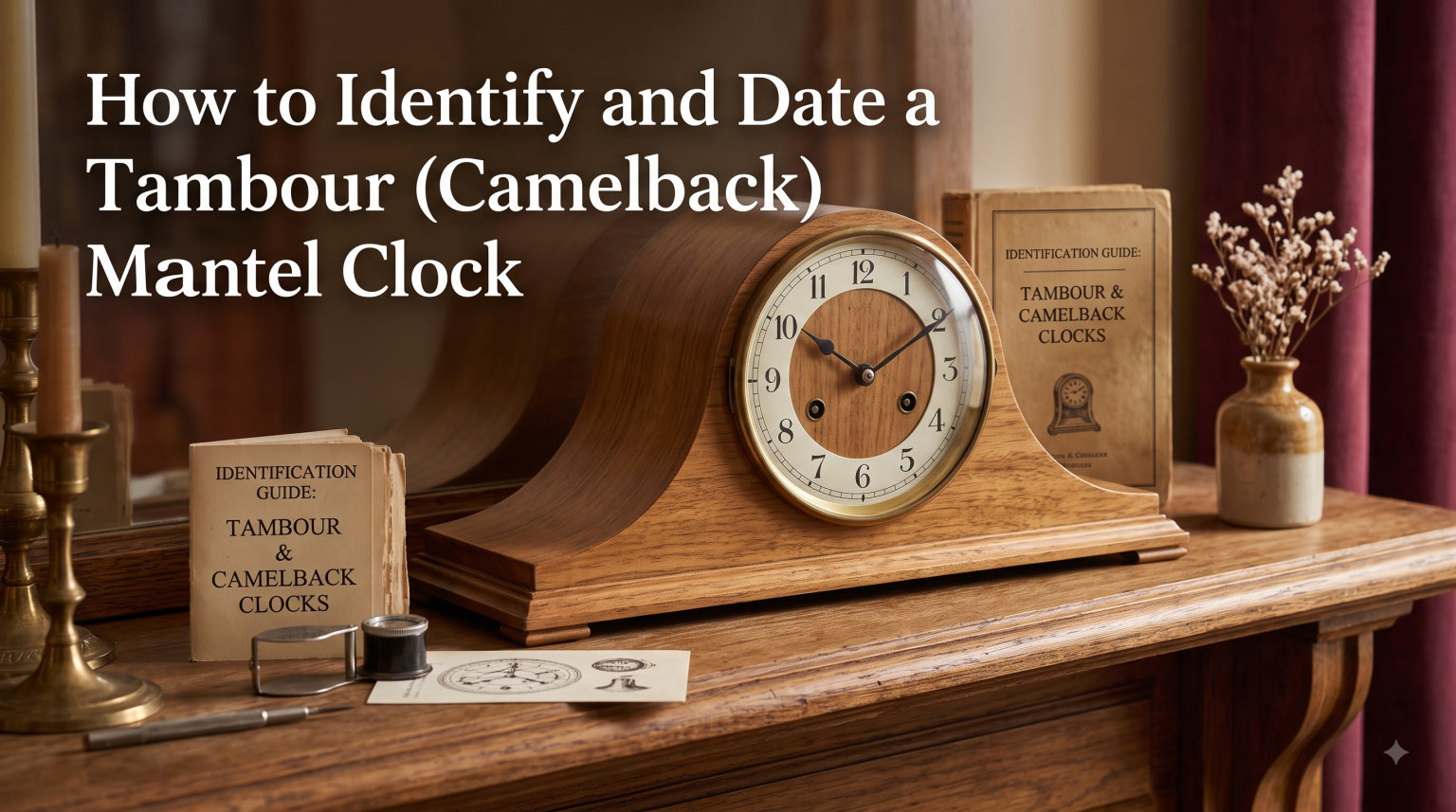
Pick up an antique mantel clock with a curved, hump-shaped case and you’ve likely found a tambour, the same style called camelback, humpback, or even “Napoleon hat” by collectors. I spent the last few months handling dozens of these clocks at estate sales and auctions, photographing each one and digging through NAWCC forum threads to nail down what makes a tambour a tambour.
This guide on how to identify and date a Tambour (Camelback) mantel clock will walk you through the same process I use. You’ll learn the case details, dial features, movement clues, and maker’s marks that pin down a production year, plus the safety warnings most guides skip. Whether you inherited one, found it at a thrift store, or want to verify a dealer’s claims, you’ll have the tools to make a confident identification by the end.
Table of Contents
What Is a Tambour (Camelback) Mantel Clock?
A tambour (camelback) mantel clock is a small spring-driven clock with a rounded, arched case resembling a camel’s hump or a tambourine drum, made popular in American homes from roughly 1880 through the 1930s.
The name “tambour” comes from the French word for drum, referring to the drum-like rounded top. American clockmakers adopted the silhouette because it fit nicely above a fireplace mantel and showed off carved or veneered wood surfaces. By the late Victorian era, factories like Sessions, Seth Thomas, Ansonia, Waterbury, Ingraham, and Gilbert were all producing tambour cases in volume.
You will see this same style called by several names in older catalogs and collector circles:
- Tambour – the most common American term, used in original Sessions and Seth Thomas catalogs.
- Camelback – favored by collectors who focus on the humped silhouette.
- Humpback – an older term found in some early 20th-century trade publications.
- Napoleon hat – a nickname occasionally used for the steep-arch examples.
All four names describe the same case family. If a clock has a smooth arched top rising above a flat base, with the dial set into the front face of the arch, it qualifies. This shape became a signature style for American kitchen and parlor clocks and shows up in millions of households during the late 1800s and early 1900s.
Key Identifying Characteristics of Tambour Clocks
Tambour clocks share a recognizable set of physical features that distinguish them from other mantel styles like the steeple, gingerbread, or columnar cases.
Case Shape and Materials
The defining feature is the curved, arched top that drops in a smooth line from the peak to the side panels. Most authentic tambours are made of walnut, mahogany, or stained birch veneer over a softwood body. Solid hardwood examples from premium makers like Seth Thomas are heavier and ring with a dull thud when tapped.
Look for these case details:
- A continuous arched crown without breaks, finials, or steeple points.
- Side panels that drop straight down from the arch ends to a small base.
- A flat back door, usually held by one or two small screws, that opens to access the movement.
- Decorative molding along the arch edge, sometimes with pressed composite ornaments.
- A pendulum viewing window in the lower front, fitted with beveled or flat glass.
Dial, Hands, and Bezel
The dial is almost always a paper or metal disk printed with Arabic numerals and set into a pressed-metal or wooden bezel. Original spade hands are one of the most overlooked clues, since collectors regularly replace broken originals with mismatched hands from other clocks. If the hands look too clean, the wrong color, or the wrong style (such as moon hands on a clock that originally had spades), suspect a replacement.
Original hands on a Sessions Supreme model, for example, are typically blued steel spades. Replacement hands often show as bright brass or modern lacquered black.
Movement, Chimes, and Pendulum
Tambour cases typically house 8-day spring-driven movements with hour-strike and Westminster or rod chimes. The pendulum is usually a brass bob with a thin steel suspension spring. Pull the pendulum and look at the rating nut underneath the bob, because adjustable rating nuts were phased in around 1910, and an example without one usually dates before that.
Open the back door and you’ll see the movement’s backplate stamped with the maker’s name, often with a patent date and serial number. This is your best dating evidence and we’ll come back to it shortly.
How to Date a Tambour Mantel Clock: Step-by-Step Methods
Dating a tambour mantel clock takes four passes: confirm the maker, read the serial number, check the patent dates, and compare case details against catalog references. Each pass narrows the window.
Step 1: Confirm the Manufacturer
Open the back door and look at the movement’s backplate. The dial is often a dead end for dating because it commonly carries the retailer’s name, not the maker. The backplate is almost always stamped with the actual manufacturer. Common names you’ll see on American tambours include:
- Sessions – Forestville, Connecticut; huge tamboura output from 1903 onward.
- Seth Thomas – Thomaston, Connecticut; premium tambour cases with date codes on the back plate.
- Ansonia – Ansonia, Connecticut; ornate brass and wood movements.
- Waterbury – Waterbury, Connecticut; earlier and often plainer movements.
- Ingraham – Bristol, Connecticut; widely sold tambour cases in the 1920s and 1930s.
- Gilbert – Winsted, Connecticut; later production, mostly 1920s onward.
Step 2: Read the Serial Number
Serial numbers are usually stamped into the backplate alongside the maker’s name. Each manufacturer kept its own sequence, so the same number from different makers means different years. For most American clock companies, serial number lookup tables are available through the NAWCC library and reference books.
Realistic dating precision from a serial number alone is usually within five to ten years, which is plenty for insurance or sale purposes. For Sessions clocks, the “Tran Duy Ly Sessions clock book” remains the standard reference and provides year-by-year serial ranges.
Step 3: Decode Patent Dates
Patent dates printed on the dial or backplate show when the design was filed, not when the clock was built. A 1905 patent date on a 1925 clock is common. Use patent dates to set a floor, the earliest year the clock could have been made. Cross-check the patent against the case construction to refine the actual production year.
Step 4: Compare Case Construction Details
Case construction shifted over the decades. Plywood backs became standard in the 1920s, replacing solid hardwood. Machine-cut dovetails replaced hand-cut joints around the same period. Pressed wood ornaments began replacing hand-carved details in the late 1920s. If you see plywood and machine-cut joints, you are usually looking at a 1925 or later clock.
Putting all four steps together gives you a tight date range. For a Sessions tamboura with serial number 8000-series, no patent date floor, plywood back, and pressed ornaments, you can usually land on 1920 to 1925 confidently.
Where to Find Maker’s Marks, Labels, and Serial Numbers
The maker’s mark on an antique clock is almost always on the movement, not the dial. Here are the four spots to check, in order of reliability.
1. The Movement Backplate
This is the gold standard. Open the back door and look at the largest flat metal surface you can see. The maker’s name, serial number, and sometimes a patent date will be stamped or etched there. Use a flashlight and a magnifier because the marks can be faint on worn movements.
2. Inside the Case on Paper Labels
Many American tambour clocks carry a small paper label glued inside the case, usually on the back wall or inside the door. Original labels from major makers like Seth Thomas and Sessions are dated and include the model name. A clean, undamaged label is a strong dating tool.
3. The Dial
The dial often shows the retailer or original seller’s name rather than the manufacturer. That information still has value for provenance research, but treat it as a secondary source. If the dial says “Jeweler, Anytown USA,” the clock was sold there, not made there.
4. The Pendulum and Weights
On weight-driven clocks, weights sometimes carry the maker’s name, but tambour clocks are spring-driven, so the pendulum is your next check. Some premium pendulums are stamped or have a paper tag.
Decoding the Seth Thomas Date Code
Seth Thomas used a clever date code system that combines a year number and a month letter. The year portion uses numbers written in reverse order, so a clock stamped with the date “S 3201” was made in January 1923 (1023 reversed). The “S” prefix stands for Seth Thomas. While not every clock carries this code, when you find one, it gives you the exact month and year of manufacture. This same type of system is documented in the Tran Duy Ly Seth Thomas clock book.
Common Problems, Replacements, and Safety Warnings
Before you wind any antique tambour clock, read this section. These are the issues that catch new collectors off guard and, in one case, can cause real injury.
The Winding Ratchet Hazard
Some tambour clock movements use a ratchet click that can release suddenly during winding. If the click spring is weak or the ratchet is worn, the mainspring tension can slip past the click and the winding key will jerk violently. I have personally watched this happen on a Sessions tamboura, and forum members have reported finger injuries from the same mechanism.
To stay safe, keep your free hand clear of the winding key and the case edge while winding. If you feel the key jerk or hesitate, stop and have a clockmaker inspect the click spring and ratchet before continuing.
Replaced Hands and Bezels
Original hands are fragile and frequently broken. Collectors and restorers routinely install replacement hands from donor clocks or modern suppliers. Compare the hands against published photos of the same model in reference books. Mismatched color, wrong shape, or a bezel that does not sit flush with the dial are all warning signs.
Marriage Clocks and Reproduction Cases
A “marriage” clock pairs an old movement with a newer case, or vice versa. Reproductions from the 1960s onward flooded the market and still turn up at estate sales. Reproduction cases are usually plywood with thin veneer, machine-perfect molding, and plastic or modern brass bezels. The movement may be old, but the case is new. Always check the joinery on the back door, the quality of the veneer, and the patina on exposed wood.
Common Mechanical Wear Points
Look for these typical issues:
- Worn pivot holes causing the pendulum to wobble or stop.
- Weak mainspring reducing the going power below 8 days.
- Dirty or dried-out pivot oil producing sluggish motion.
- Bent chime rods producing dull or off-pitch strikes.
These are normal for a clock 90 to 140 years old and are fixable with routine servicing.
Value Assessment: What Is a Tambour Clock Worth?
Tambour clock values depend on maker, condition, originality, and chime quality. Most common examples fall into an accessible collector range, while rare models in top condition command more.
Factors That Drive Value
The biggest value drivers are the maker, the movement condition, and whether the clock is “all original.” A Sessions tamboura with a clean dial, original hands, intact label, and a running 8-day movement is worth several times more than the same model with replaced hands and a dead movement.
Premium makers like Seth Thomas and rare Sessions models like the Supreme tend to sit at the top of the range. Common Ingraham and later Gilbert tambours are at the entry level. Chiming movements with full Westminster rods in good condition add value because the rods are fragile and often damaged.
Realistic Value Ranges
For a working drum of averages, you can expect a working tambour clock in good cosmetic condition to bring a modest sum at auction. Pristine examples with rare movements or documented provenance can reach into four-figure territory. Damaged cases, dead movements, and missing parts usually mean repair costs exceed resale value.
When to Get a Professional Appraisal
Get a written appraisal if the clock is part of an estate settlement, insurance claim, or potential sale above a few hundred dollars. NAWCC-certified appraisers and major auction houses like those in Connecticut and Pennsylvania handle this work. A clockshop that specializes in American antiques can also give a credible verbal estimate for free.
Frequently Asked Questions
How can I tell how old my mantel clock is?
Open the back door and read the serial number on the movement’s backplate. Cross-reference that number with the maker’s records to find the production year. Patent dates stamped on the dial or movement set the earliest possible year, while case construction details like plywood backs confirm a 1920s or later build.
Where is the serial number on a clock?
The serial number is almost always stamped into the movement’s backplate, the largest flat metal surface behind the dial. Open the back door of the case and use a flashlight and magnifier because the stamps can be faint.
How do you date a Sessions mantle clock?
Confirm the Sessions name on the movement backplate, locate the serial number, then look up the range in Tran Duy Ly’s Sessions clock book. Paper labels inside the case often include a date, and the case construction helps confirm whether the clock falls in the early, middle, or late Sessions production period.
How much is a vintage mantel clock worth?
Common tambour clocks in working condition usually sell for modest sums at auction. Rare makers, original hands and labels, intact chimes, and documented provenance push values into the four-figure range. Damaged cases with non-working movements are often worth less than the cost of professional restoration.
Final Thoughts
Learning how to identify and date a Tambour (Camelback) mantel clock comes down to four habits: check the movement backplate first, photograph every stamp and label you find, learn the construction shifts that mark each decade, and stay cautious around the winding ratchet. Apply those habits and you’ll be able to walk into any antique shop or estate sale and read a tambour clock with confidence.