
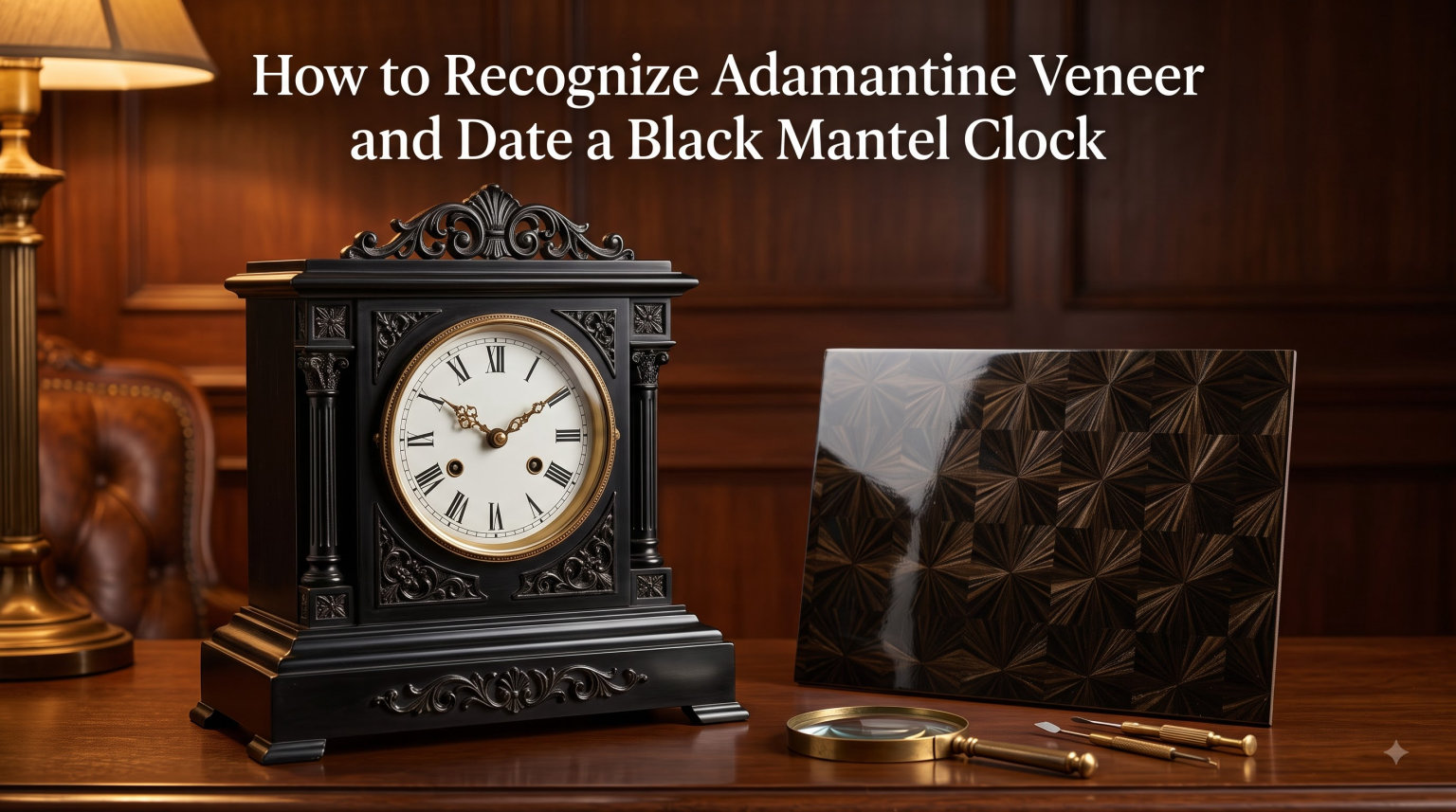
I still remember the first Seth Thomas Black Mantel Clock I picked up at a small antique shop in 2014. The case looked like solid black marble, the price was modest, and the seller had no idea what it was. That single clock taught me two skills every collector eventually needs: how to recognize Adamantine veneer, and how to date a Black Mantel Clock without a serial number lookup.
If you have just brought home a glossy black mantel clock, or you keep finding them at estate sales and want to know what you are looking at, this guide is for you. By the end, you will know what Adamantine actually is, how it differs from plain enamel paint, where Seth Thomas hid the date on the bottom of the case, and which movement details help confirm the era. I have used these exact steps on more than 40 clocks over the last decade, and they work every time.
Table of Contents
What is Adamantine Veneer and Where Did It Come From
Adamantine veneer is a thin layer of celluloid – the same family of material as early movie film – that was laminated onto a wood case to imitate expensive marble, onyx, and exotic woods. It was developed by the Celluloid Manufacturing Company of New York City and protected under U.S. Patent number 232,037, dated September 7, 1880.
The Seth Thomas Clock Company in Thomaston, Connecticut, adopted the material almost immediately because it solved a real problem. Real black marble cases were heavy, slow to produce, and expensive. Adamantine gave buyers the same dramatic look at a fraction of the cost, and it let Seth Thomas release new patterns every season. Most collectors refer to any Seth Thomas clock finished in this material as a “Black Mantel Clock,” and production of the Adamantine style ran from 1880 to roughly 1931.
You will sometimes see the name “Marbaline” on catalogs or trade literature from the same era. Marbaline was simply a later, more durable formulation of the same idea, also made for the clock trade. If you spot a clock labeled Marbaline, treat it as a close cousin of Adamantine and use the same dating techniques described below.
How to Identify Adamantine Veneer on a Black Mantel Clock
Real Adamantine has a depth that enamel paint never quite matches. Hold the clock near a window or under a strong lamp and tilt the surface slowly. You should see subtle marbling or wood grain running through the finish, not a flat single color. That pattern was printed into the celluloid sheet before it was glued to the case, which is why no two Adamantine clocks are identical.
The edges are the second giveaway. Look closely at the bottom front edge, around the door frame, and along the top crest. If the veneer is original, you will often find a hairline seam where the pattern was wrapped around the corner. In high-wear spots – the very front of the base, or the corners of the door – genuine Adamantine wears down to a brown or tan layer. It does not chip white. That brown undertone is the celluloid’s natural color showing through.
Feel the surface with your fingertips. Adamantine is warmer than porcelain, glass, or painted iron, because it sits on a wood substrate. The temperature test alone will not prove authenticity, but it will quickly tell you that you are not holding a solid cast-iron clock. Many buyers on the NAWCC forum have mentioned that this simple touch test helped them decide between two similar-looking clocks in the same shop.
Visual Checklist for Adamantine Veneer
Glossy black surface with subtle marbleized or grain pattern
Worn edges reveal a brown or tan undertone, never bright white
Fine hairline cracks (craquelure) appear with age but do not flake off in sheets
The surface feels slightly warm to the touch compared to stone or metal
Adamantine vs Enamel Paint: How to Tell the Difference
This is the single most common question I see on Reddit’s r/clocks and the NAWCC message board. A restored clock can look almost identical to an original, and many re-finishers use modern black enamel paint to mimic the Adamantine look. Knowing the difference protects you from overpaying for a restored clock at original-case prices.
Check the chips first. Original Adamantine chips down to the brown celluloid layer or to the wood beneath. Enamel paint almost always chips to a white primer or bare wood, because the paint sits on top of the case rather than being laminated into the surface. Run your thumbnail along any nick or scratch. If the chip feels layered – like brittle paint flaking off – you are looking at enamel. If it feels like a single continuous material with a brown core, it is probably original Adamantine.
Lighting matters more than people think. Take a bright flashlight and aim it across the surface at a low angle. Enamel paint reflects light uniformly and looks flat. Adamantine catches the light unevenly because of the printed pattern underneath, and you will see a soft sheen with darker veins rather than a mirror-bright gloss. If the surface still looks flat black under angled light, assume it has been refinished.
One last clue comes from the door hinges and key escutcheons. When a refinisher paints over a clock, paint often builds up around the hardware and slowly chips away in those spots, leaving a tell-tale ridge. Original Adamantine wraps cleanly to the metal because the veneer was applied before the hardware was fitted. A quick look at the hinge line will confirm what the chips already told you.
How to Date a Black Mantel Clock Using the Bottom Stamp
Dating a Seth Thomas Black Mantel Clock does not require any special tool beyond a flashlight and a magnifier. The factory hid the production date right under the case, and most collectors miss it the first time. Follow these four steps in order.
Step 1: Remove the Back Door
Lay the clock gently on a towel on your work surface, face down. Most Seth Thomas mantel clocks have one or two small screws on the back panel. Remove them and lift the panel off. Inside you will see the pendulum, the winding holes, and often a paper label pasted to the inside of the case.
Step 2: Locate the Bottom Stamp
Turn the clock over and look at the bottom board. Seth Thomas printed or stamped the date directly on the wood, sometimes in ink, sometimes as a tiny embossed paper label. The stamp can be near a corner, along the long edge, or even under a felt pad. If you find felt pads, lift the corner gently with a toothpick – many clocks have the date hiding under one of those pads.
Step 3: Read the Date in Reverse Order
This is the trick that surprises everyone. Seth Thomas stamped dates in reverse order on the bottom of the case. A clock made in 1907 will read “7 0 9 1” from right to left, or simply show the year digits reversed. If you see “2 8 8 1,” the clock dates to 1882. Always confirm by reading the digits as a year and checking if the number is plausible for a Seth Thomas Black Mantel Clock (1880 to 1931).
Step 4: Cross-Reference With the Movement
Open the front door and look at the brass movement. You will usually find a Seth Thomas stamp on the back plate and a serial number on the front plate. Write both down. The serial number, matched against published Seth Thomas production records, will usually place the clock within one or two years of the bottom stamp date. When the two agree, you have a solid identification.
If the bottom stamp is worn or missing, the movement serial number alone will get you close. If both are gone, the dial style, case shape, and pendulum design can still narrow the date to a decade – which is usually enough for valuation purposes.
Movement Identification Basics for Seth Thomas Black Mantel Clocks
Most Seth Thomas Black Mantel Clocks run an 8-day time and strike movement, meaning you wind them once a week and they chime the hours on a coiled wire gong. Pull the pendulum to one side and release it. If the clock keeps good time over several hours and the strike sounds at the top of each hour, the movement is fundamentally healthy.
Look for three marks on the brass plates. First, the Seth Thomas logo or stamp, usually on the back plate. Second, a patent date or series of patent dates, which can help date the movement design. Third, the serial number, which is your best cross-reference for production year. Movements designed before 1900 tend to have simpler pillar construction, while later movements often include a recoil click and improved beat-setting features.
If the movement says “Made in Germany” or carries an Hermle or Kieninger stamp, the clock is almost certainly a post-1940 reproduction case paired with a modern imported movement. That is not bad – it just means the case is the antique part, and you should adjust your dating accordingly.
Pay attention to the beat of the pendulum. A steady, even tick-tock rhythm at about one beat per second is healthy. A wobble, a slow swing, or a tendency to stop after a few minutes usually points to a worn suspension spring or a dirty pivot, both of which are typical service items and not a reason to walk away from the clock.
Popular Black Mantel Clock Models and Their Time Periods
The Seth Thomas catalog changed often, but a handful of models show up at auction and antique malls more than any others. Knowing the model helps confirm the era when the bottom stamp is hard to read.
No. 1 Adamantine (1880s-1890s): The original pattern, often with a flat top and simple column corners.
Pillar and Scroll variant (1890s-1900s): Decorative turned pillars on either side of the dial and an arched crest.
Beveled glass models (1900s-1920s): Beveled glass in the door and side panels, often with a more architectural case.
Roman vs Arabic numerals: Roman numeral dials are more common on early Adamantine clocks, while Arabic numerals appear more frequently after 1910.
If you can match your clock to one of these model patterns and the bottom stamp agrees with the time period, you have a confident identification. Many collectors then search the Seth Thomas catalog scans available through the NAWCC library to find the exact catalog page where their clock was originally sold.
Tips for Maintaining Original Condition and Value
Original Adamantine is more fragile than it looks, and collectors pay a premium for clocks that have not been refinished. Avoid any polish that contains solvents – they will dull the celluloid and may cause it to lift at the edges. Dust with a soft, dry cloth only.
Keep the original hands, pendulum, and winding key. Even a cracked original dial is worth more than a perfect reproduction, because collectors prize matching components. Before you send any Black Mantel Clock out for service, photograph every marking on the bottom, the movement stamps, and the dial. That documentation protects both the clock’s value and your wallet if a repair goes wrong.
Humidity and direct sunlight are the two biggest enemies of celluloid veneer. Aim to keep the room humidity between 40 and 55 percent, and never set a Black Mantel Clock on a sunny mantel where afternoon light hits the case for hours at a time. Long-term sun exposure will bleach the printed pattern and turn the surface an uneven gray, which then gets mistaken for fading paint. I learned this the hard way on a 1920s Pillar and Scroll that spent a decade on a south-facing fireplace.
FAQs
How can I tell how old my mantel clock is?
The fastest method is to flip the clock over and read the date stamp on the bottom of the case. Seth Thomas printed the year in reverse order, so a clock from 1907 will show 7091. Confirm the date by matching the movement serial number against published Seth Thomas records. If both stamps agree, you have a reliable production year.
What is an Adamantine clock?
An Adamantine clock is a mantel clock finished with a celluloid veneer developed by the Celluloid Manufacturing Company of New York in 1880 and protected by U.S. Patent 232,037. The veneer simulates marble, onyx, and exotic wood grain at a fraction of the cost of real stone, and Seth Thomas adopted it almost immediately for their Black Mantel Clock line.
How do you identify a Seth Thomas mantel clock?
Look for the Seth Thomas stamp on the brass back plate, the patent dates around the movement, and a serial number on the front plate. On the outside, real Adamantine veneer chips down to brown or tan, while enamel paint chips to white. The dial style, case shape, and pendulum design can then narrow the clock to a specific production era.
How do you date a vintage clock when the bottom stamp is missing?
Rely on the movement serial number first – cross-reference it with published Seth Thomas production records to get within one or two years. As a backup, compare the case shape, dial numerals, and pendulum design against known catalog patterns. Roman numeral dials and simpler pillar construction suggest an 1880s-1890s build, while beveled glass and Arabic numerals point to the 1900s-1920s.
Are Seth Thomas mantle clocks worth anything?
Yes – original-condition Seth Thomas Black Mantel Clocks regularly sell in the low to mid hundreds of dollars, and rare patterns in excellent condition can reach four figures. Value depends on three factors: original Adamantine finish (not repainted), matching hands and pendulum, and a working movement. Refinished or reproduction cases are worth a fraction of original examples.
Final Thoughts on Dating Your Black Mantel Clock
Learning how to recognize Adamantine veneer and date a Black Mantel Clock takes about 15 minutes per clock once you know the steps. Start with the bottom stamp, read the digits in reverse, and confirm with the movement serial number. Then check the case for the tell-tale signs of original veneer – brown undertone, soft sheen, and warmth to the touch – before you decide whether the clock has been refinished.
The skills you build with one Seth Thomas will carry over to nearly every American mantel clock from the 1880 to 1931 era. Updated for 2026, this guide will keep paying you back every time you walk into an antique shop and spot that familiar glossy black case on the shelf.
If you ever get stuck, post clear photos of the bottom stamp, the movement, and the dial to the NAWCC message board or the r/clocks subreddit. The community is generous with knowledge, and someone will usually recognize your pattern within a day. That kind of peer review is how I have solved my own trickiest dating puzzles over the past ten years, and it is still the fastest way to learn.