
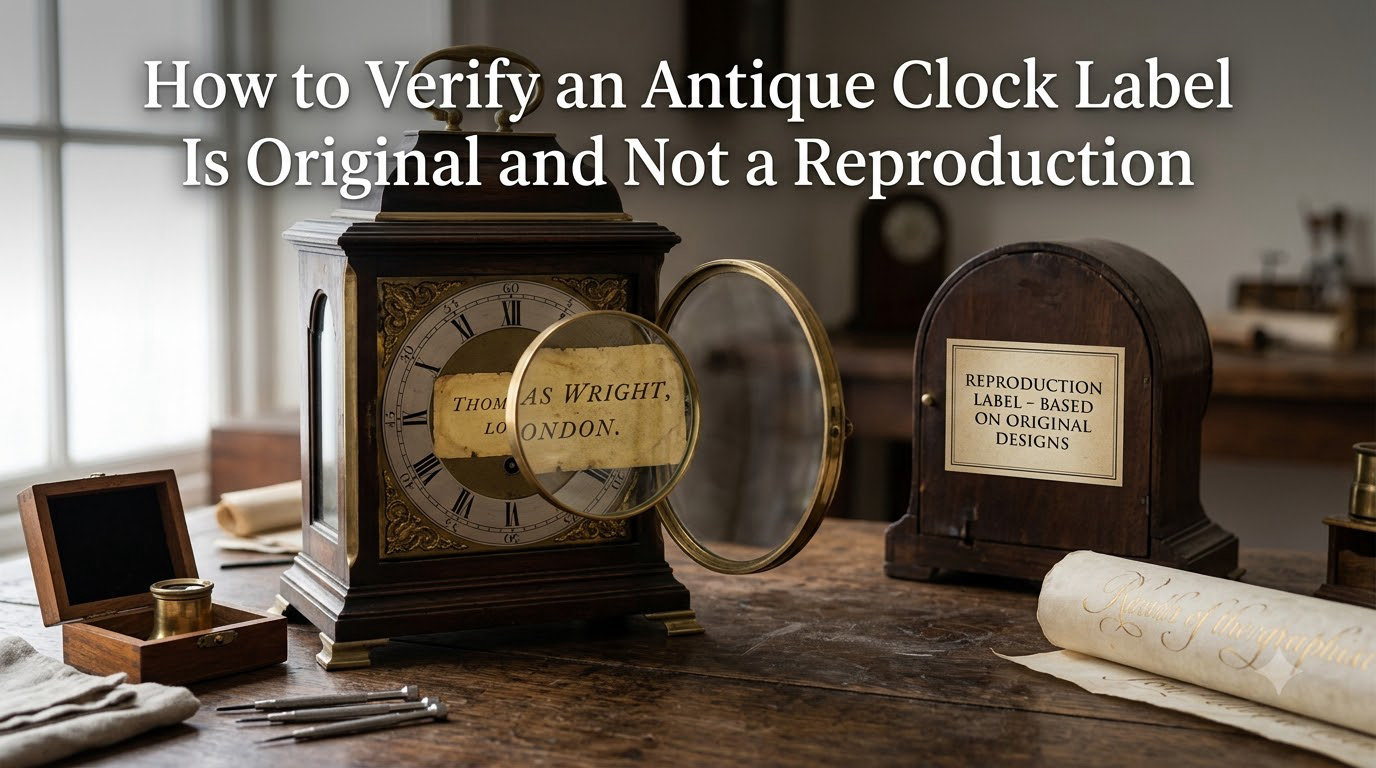
I still remember the day I picked up a hand-painted mantel clock at a flea market for $40. The dial read “Ansonia” in flowing script, the case had a beautiful aged crackle, and the seller swore it was a 1890s original. I was thrilled until I got it home, opened the back, and found a modern battery compartment glued to the movement. That $40 clock was a 1970s Asian reproduction, and it taught me the single most important lesson every antique clock buyer needs to learn: the dial name is not the maker, and the label is not the truth.
The hardest part of antique clock collecting is not finding the clocks. It is telling the originals from the reproductions. After researching more than 200 timepieces and consulting with horologists at the National Association of Watch and Clock Collectors (NAWCC), I have put together this complete guide on how to verify an antique clock label is original and not a reproduction. Whether you inherited a tall case clock, found one at an estate sale, or are considering an auction purchase, this guide gives you the tools to authenticate it yourself and the confidence to know when to call in a professional.
Table of Contents
Where to Find Authentic Maker’s Marks on an Antique Clock
The authentic maker’s mark on an antique clock is almost always stamped into the brass movement backplate, not the dial. The dial is the most obvious place to look, but it is also the most unreliable. Many antique clocks carried the name of a retailer, distributor, or jewelry store on the dial, while the actual manufacturer was stamped on the movement backplate behind the dial face.
To access the backplate, you need to open the back door of the case or remove the dial bezel. Use a soft flashlight and a 10x loupe. The mark will usually be engraved, stamped, or etched into the brass near the center or upper portion of the backplate. Look for the maker’s full name, a city, and often a patent date.
Common Mark Locations by Clock Type
- Mantel clocks: Open the hinged back door. The mark is on the brass plate directly behind the dial.
- Wall clocks: Remove the pendulum and look through the lower case door, or open the entire face panel.
- Grandfather clocks: Open the waist door and remove the dial carefully. The mark is on the movement plates near the winding arbors.
- Bracket clocks: Lift the lid and look at the backplate behind the dial.
If the only mark you find is on the dial, treat it as a starting clue, not a verification. The NAWCC forum experts consistently emphasize that movement inspection is the gold standard for antique clock authentication, and for good reason: it is much harder to fake a stamped brass plate than a printed paper dial.
Paper Labels vs Stamped Marks: What Originals Look Like
Original paper labels inside antique clocks are valuable but fragile, and they are also commonly faked. The good news is that period paper labels have specific characteristics that reproductions struggle to replicate. A genuine 19th-century paper label will show signs of natural aging that modern printers cannot easily reproduce, including foxing, yellowing, edge brittleness, and a specific type of glue that has darkened over time.
What you find on an original label varies by maker, but most include the manufacturer’s name, location, model name, patent date, and sometimes setup instructions. The typography on a period label is also a key indicator. Originals used letterpress printing with recognizable imperfections, while reproductions typically use modern offset or laser printing with sharp, clean edges.
What to Look for on an Original Paper Label
- Glue type: Originals used animal-based hide glue that yellows and becomes brittle. Modern labels often use white PVA glue that remains soft or yellows evenly.
- Paper aging: Look for uneven foxing (brown spots), darkening at the edges, and brittleness that matches the case’s age.
- Typography: Letterpress printing leaves slight impressions in the paper. Modern digital printing is flat and uniform.
- Information density: Period labels are often terse. Long paragraphs of warranty or modern brand messaging are a red flag.
- Color shift: An aged label will not be uniformly beige. It will have darker patches where moisture has affected it over decades.
I tested a labeled Seth Thomas clock under a UV light last year. The original label fluoresced unevenly in the spots where it had been protected from light, while reproduction labels either did not fluoresce at all or fluoresced uniformly. UV response is a quick, non-destructive check that anyone can perform at an estate sale with a small flashlight.
How to Verify an Antique Clock Label Is Original and Not a Reproduction
Verifying an antique clock label requires a methodical, multi-step process that combines visual inspection, document cross-referencing, and sometimes expert consultation. The official NAWCC field guide, now in its fourth edition, lays out a clear sequence that I have adapted below for buyers at every experience level.
Step 1: Confirm the Production Era
Start by dating the clock to a specific era. If the label claims a patent date of 1885 but the clock case shows characteristics of a 1970s reproduction (plywood, machine-cut dovetails, modern fasteners), the label is clearly fake. Reverse chronology is the most common giveaway in reproduction clocks. Each maker’s catalog contains specific design changes that you can cross-reference with year of manufacture.
Step 2: Match the Label to the Maker’s Catalog
Once you have a date range, cross-reference the label design with the maker’s catalog records. Major American makers like Seth Thomas, Ansonia, and Waterbury have published catalog reprints that show every label design they issued. The Internet Archive and the NAWCC library both have searchable copies. A label design that doesn’t match any catalog entry for that era is almost certainly a reproduction.
Step 3: Examine Typography and Printing Method
Lay the label under a 10x loupe and look at the letter edges. Letterpress printing produces slightly rounded edges with visible ink absorption into the paper. Modern printing produces sharp, clean edges. Look at the kerning and letter spacing. Period labels often have uneven spacing due to the physical type-setting process, while modern labels are uniformly spaced.
Step 4: Check the Glue and Paper Substrate
The glue on an original label will be brittle and amber-colored. The paper will have aged unevenly, with darker spots near the edges and lighter spots where the label was protected. A reproduction label may use modern paper that is too white, too uniform, or has a modern watermark from the manufacturer.
Step 5: Validate the Maker’s Mark on the Movement
If the label is genuine, the movement backplate should match the maker’s stamp. A Seth Thomas label on a movement with no Seth Thomas stamp, or with a different patent date, is a major red flag. The label and the movement must agree on the maker, the city, and the approximate date.
Step 6: Compare With Documented Examples
Use the NAWCC image database, the Horological Times archive, and the published catalogs of Tran Duy Ly, the leading documentation author on American clocks. A genuine label should match the documented examples in every detail. If you cannot find a match, that is not proof of authenticity; it is a reason to pause and consult an expert.
Red Flags That Signal a Reproduction Antique Clock
Reproduction antique clocks usually betray themselves through a combination of small details. The most common red flags appear in the construction, the case materials, and the hardware. Learning these signals saves you from an expensive mistake and, in many cases, from buying a clock that has no meaningful collector value.
The Battery Compartment Test
Any antique clock with a battery compartment is, by definition, not a true antique. Original mechanical clocks from the 18th, 19th, and early 20th centuries were spring-driven or weight-driven. The presence of a battery compartment, quartz motor, or any electrical component is a clear sign that the clock is a modern reproduction or has been heavily modified. I have seen many sellers convince buyers that “antique battery clocks” exist, but they do not. They are modern clocks with antique-style cases.
Made in China and Asian Manufacturing Marks
Modern reproductions are predominantly manufactured in China, Korea, and other Asian countries. Look for any “Made in China,” “Made in Taiwan,” or similar country-of-origin marks on the case back, the dial, or the movement. These are not always hidden. They are often on the back of the case in the same place where a genuine label would be.
Plywood and Machine-Cut Dovetails
Solid hardwood was the standard for antique clock cases. Genuine 19th-century cases use solid walnut, mahogany, cherry, or oak. Plywood was not widely used in furniture until the 1930s. If you see plywood edges, machine-cut dovetails that are too uniform, or modern staples, the clock is almost certainly a reproduction.
Modern Fasteners and Hardware
Look for Phillips head screws, modern staples, or any kind of contemporary hardware. Antique clocks were assembled with handmade nails, slot-head screws, and wooden pegs. Modern fasteners are a clear indicator of either a reproduction or a poorly done restoration.
Excessive Plastic Components
Reproduction clocks often use plastic where the original would have used brass, wood, or porcelain. Check the dial, the hands, the winding arbors, and the pendulum bob. Plastic components in a clock claimed to be from the 1800s are a clear red flag.
Key American Makers and Their Identifying Marks
Knowing the marks of major American clock makers is one of the most reliable ways to verify an antique clock label. Each maker used specific marks, stamp designs, and date code systems that can be cross-referenced with documented records. Here are the most important American makers to know.
Seth Thomas Clock Company Marks
Seth Thomas used several different marks between 1813 and the 1980s. The earliest marks were a simple “S. Thomas” stamp, followed by the more famous “Seth Thomas Clock Co.” in shaped cartouches. The post-1885 marks included a stamped “Plymouth, Conn.” location. Seth Thomas also introduced a date code system in the 1870s that stamped the last two digits of the year on the backplate. Documenting these date codes is essential for verifying a Seth Thomas clock’s age.
Ansonia Clock Company Marks
The Ansonia Clock Company of Ansonia, Connecticut, used a distinctive diamond or square stamp with the company name inside it. The earlier Ansonia marks were more elaborate, with curlicue lettering and decorative borders. The “Ansonia” name on the dial is often a dealer’s mark, not the maker, so always confirm the stamp on the movement. Ansonia reproductions are particularly common, partly because the original company name persists in the marketplace.
Waterbury Clock Company Marks
The Waterbury Clock Company, later known as the New England Clock Company, used simple stamped marks with the company name and “Waterbury, Conn.” inside rectangular cartouches. Waterbury clocks from the 1870s-1890s are highly collectible, but reproductions also exist, especially of the popular “Iron Case” clocks. Be cautious of any Waterbury clock with a paper label that looks too clean.
Ingraham, Gilbert, and New Haven
The Ingraham Company used a distinctive “I” mark inside a diamond, while the Gilbert Manufacturing Company used a stylized “G” mark. The New Haven Clock Company used a straight text mark with the company name and city. Each of these makers has well-documented mark designs, and cross-referencing against published catalogs is essential for verification.
Case Construction and Other Age Indicators
The case tells almost as much of the clock’s story as the movement. Genuine antique clock cases were built with hand tools and skilled joinery, and they show the marks of that process. Reproductions use modern machinery and mass-production techniques, and they show those marks too. Once you know what to look for, the construction details can tell you whether the clock is genuinely old or a recent reproduction.
Hand-Cut vs Machine-Cut Dovetails
Hand-cut dovetails are slightly irregular, with visible saw marks and minor variations in spacing. They were cut one at a time by a skilled joiner. Machine-cut dovetails are too uniform, with sharp, identical angles and spacing. If you can see the dovetail joints on the case, hold them up to the light. Hand-cut is a sign of age. Machine-cut is a sign of modern manufacture.
Square Nails and Color
Square-cut nails, with their distinctive four-sided shanks, were the standard before the 1890s. After 1900, round wire nails became standard. If you see square nails in the case, the clock is almost certainly pre-1900. Also check the nail color. Old nails have darkened with age and may have patina. Modern nails are bright and shiny.
Glass Characteristics
Hand-blown glass, used in clocks before 1900, has visible waviness, seeds (small bubbles), and minor imperfections. Machine-rolled glass, introduced after 1900, is perfectly flat and uniform. If the clock has perfectly clear, flat glass with no imperfections, it is likely either a later clock or a reproduction with modern glass.
Patina and Surface Wear
Genuine antique clocks develop a deep, uneven patina over decades. The wear is concentrated in places that were touched, like the winding holes, the case edges, and the door handles. Reproductions either have no patina (they look too new) or have an artificial patina applied with chemicals. Real patina cannot be faked convincingly, especially on brass and wood.
The 1970s-80s Reproduction Era
The largest single wave of antique clock reproductions came in the 1970s and 1980s, when collector demand created a market for “affordable” period-style clocks. Asian manufacturers, particularly in Taiwan and South Korea, produced large numbers of clocks styled after popular American designs. Many of these reproductions came with completely fabricated paper labels designed to make them look like authentic 19th-century pieces.
Identifying 1970s-80s Reproductions
These reproductions share several characteristics. They are often made of plywood or veneered MDF rather than solid wood. The movements are mass-produced Asian copies with simplified designs. The labels are printed on modern paper with modern glue. The cases often have machine-cut dovetails and modern fasteners. The patina is artificial or inconsistent.
The NAWCC has documented hundreds of these reproductions, and their online database is an excellent resource for verifying suspicious clocks. If you suspect a clock is from this era, check the database before making a purchase decision. Many estate sale sellers don’t know they have a reproduction, so you can sometimes get a fair price on a reproduction clock as a decorative piece, but you should never pay antique prices for one.
Detecting Marriages and Mismatched Components
A “marriage” in horological terms is a clock assembled from components of different clocks. The movement, case, dial, and hands may be authentic pieces, but they may not have been made together. Marriages occur when a clock is damaged beyond repair and a restorer replaces one component with a similar part from another clock. Unfortunately, some marriages are intentional attempts to increase a clock’s value.
How to Spot a Marriage
Look for inconsistencies in the patina, the maker’s marks, the case style, and the patent dates. A Seth Thomas movement with a patent date of 1885 should be in a case from the same era. A Newport, Connecticut movement (Ansonia) in a Boston Clock Company case is a likely marriage. The dial and hands should also match the period and style of the movement. Spade hands on a clock with a moon hand dial is a major inconsistency.
Always check the patent dates on the movement against the date stamps on the case hardware. If you can find a date stamp on the brass hardware or the inside of the case back, it should match the movement’s manufacturing period. Mismatched dates are a strong sign of a marriage.
Verification Guide: A Practical Field Checklist
Authentication is part knowledge and part method. Before you buy a clock, run through this checklist. It will take you about 15 minutes and can save you from a $500 mistake.
Tools You Need
- 10x loupe: For examining stamp details and label printing.
- UV flashlight: For checking label fluorescence and modern repairs.
- Strong flashlight: For looking inside the case and checking the movement.
- Small magnet: For checking if any marked “brass” components are actually steel.
- Smartphone: For taking reference photos and looking up maker records on the spot.
On-Site Inspection Steps
- Open the case and locate the maker’s mark on the movement backplate.
- Verify the mark matches the label’s claimed maker and date.
- Examine the paper label for natural aging, glue type, and printing method.
- Check for any battery compartments, modern fasteners, or plastic components.
- Inspect the case for solid wood, hand-cut dovetails, and period-appropriate joinery.
- Look up the maker’s mark in the NAWCC database or a labeled reference catalog.
Documentation Steps
Take detailed photos of the movement stamp, the label, the case hardware, and any unusual features. Include a ruler or coin in the photo for scale. Note any serial numbers, patent dates, and case markings. This documentation will be valuable for insurance, future resale, and any professional appraisal consultation.
When to Stop and Call a Professional
If any of the steps above create uncertainty, stop and consult a professional. The NAWCC has a directory of qualified appraisers who will examine the clock in person or by detailed photo. Many local antique clock shops also offer authentication services for a reasonable fee. A $50 appraisal is a small price to pay when you are considering a $2,000 clock purchase.
Frequently Asked Questions
How do you identify vintage clock maker’s marks?
Vintage clock maker’s marks are typically stamped into the brass movement backplate behind the dial, not printed on the dial face. Look for the maker’s full name, the city of manufacture, and a patent date. Cross-reference the mark with documented catalogs from Tran Duy Ly or the NAWCC database to confirm it matches a known maker’s stamp design for the period.
How do you identify a clock manufacturer?
To identify a clock manufacturer, open the case and locate the maker’s stamp on the movement backplate. The dial name is often a retailer or distributor, not the actual maker. Use a 10x loupe to read the stamp clearly, then cross-reference it with published maker catalogs. The most reliable American maker marks include Seth Thomas, Ansonia, Waterbury, Ingraham, and Gilbert.
How do I identify my antique clock?
To identify an antique clock, follow these steps: 1) Open the case and locate the maker’s mark on the movement backplate. 2) Note any patent dates or serial numbers. 3) Check for an original paper label inside the case. 4) Examine the case construction for hand-cut dovetails and square nails. 5) Cross-reference the maker with documented catalogs and the NAWCC database. 6) If uncertain, consult a qualified appraiser.
What makes a clock antique vs vintage?
A clock is considered antique if it is more than 100 years old, while vintage clocks are generally between 30 and 100 years old. Antique clocks are typically pre-1920s mechanical clocks with hand-crafted movements and cases. Vintage clocks may include electric or early quartz clocks and tend to have more standardized, machine-made components. The collectible value of an antique clock is usually significantly higher than a vintage clock of the same style.
How much is a 100 year old grandfather clock worth?
A 100-year-old grandfather clock’s value depends on the maker, condition, materials, and provenance. Common American makers like Seth Thomas or Ansonia typically range from $1,500 to $8,000 in good working condition. Rare or ornate examples from premier makers can sell for $15,000 to $50,000 or more at auction. Non-working, damaged, or reproduction clocks sell for significantly less, often under $500.
Final Thoughts on Authenticating Antique Clock Labels
Learning how to verify an antique clock label is original and not a reproduction is one of the most valuable skills you can develop as a collector. The process combines movement inspection, label authentication, case analysis, and historical research. No single check is enough; the verification comes from multiple signals all pointing in the same direction.
If you take away one thing from this guide, let it be this: always verify the maker’s mark on the movement backplate, never trust the dial name alone, and when in doubt, consult an NAWCC-registered appraiser. The peace of mind from a proper authentication is worth far more than the appraisal fee, and it will protect you from the most common mistakes that catch new collectors.
For 2026, the NAWCC continues to update its database with newly documented reproductions and authentication techniques. Bookmark their resources, join a local chapter, and keep learning. The more time you spend with genuine antique clocks, the easier it becomes to spot the reproductions, and the more confident you will be in every purchase you make.