
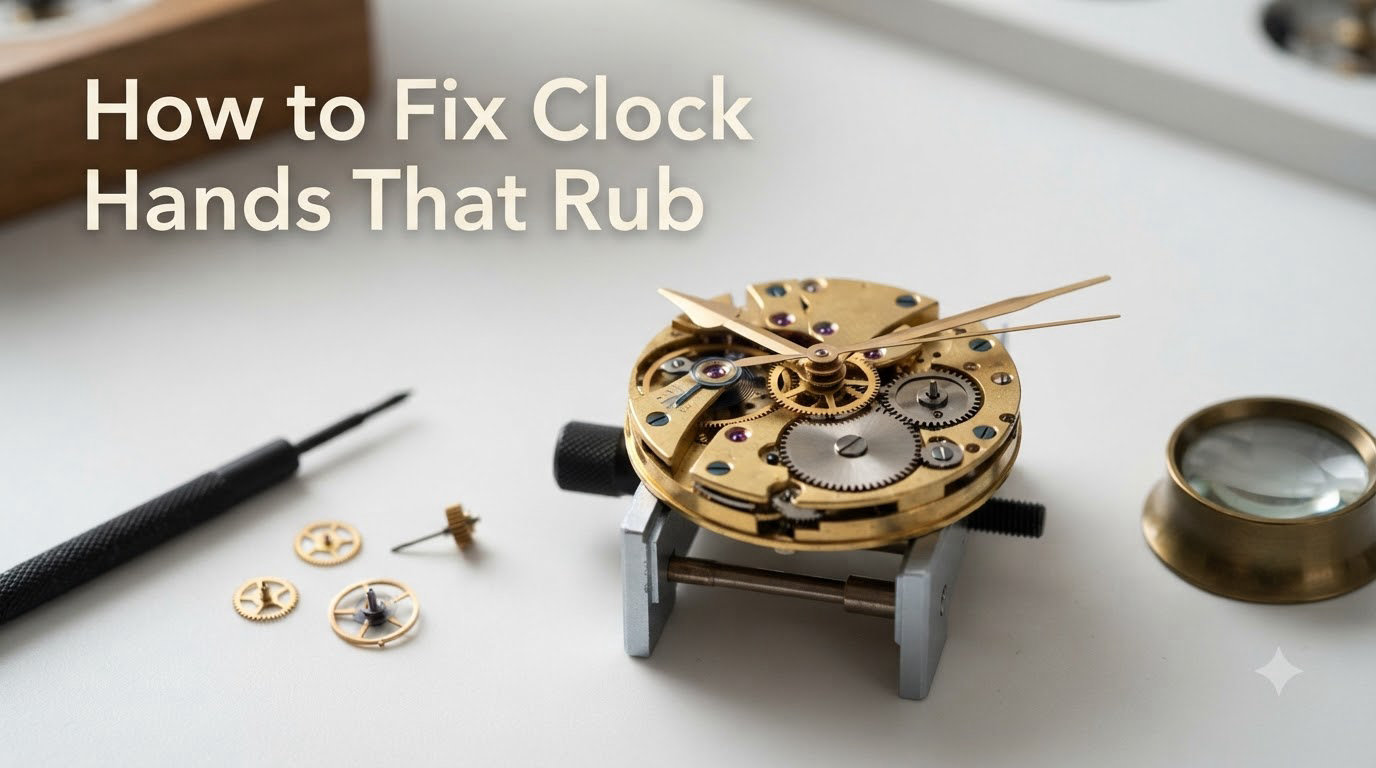
That faint scraping sound from your wall clock is the first sign that something has shifted. Rubbing clock hands will drain batteries faster, scratch your dial, and eventually stop the movement entirely. In this guide, I’ll walk you through how to fix clock hands that rub so you can stop the noise and keep your timepiece running smoothly for years to come.
I have repaired dozens of quartz and mechanical clocks in my own home over the last several years. Most rubbing problems come down to three things: bent hands, a loose hand nut, or hands that were reinstalled in the wrong order after a battery swap. Each one is fixable in under an hour with basic tools.
Table of Contents
What Causes Clock Hands to Rub Against Each Other or the Dial
Clock hands rub because the gap between them, or between a hand and the dial, has closed up. That usually happens for one of three reasons.
The most common cause is a bent hand. A nudge during cleaning, a bump during shipping, or even years of vibrations can twist a hand just enough to push it into the one above it. Once bent, the minute hand will scrape the hour hand every revolution and the dial may show faint scuff marks.
The second cause is a loose hand nut. Each hand sits on a stepped shaft, and most are held down by a tiny brass nut. When that nut loosens, the hand drops down the shaft and presses against the hand below it. Battery changes are the usual trigger, since people often grip the hands too firmly when pulling the clock off the wall.
The third cause is wrong reassembly. Hands must go back on in a specific order, usually second, minute, then hour, and each one needs to clear the one beneath it. Skip a step or rotate a hand the wrong way and you will get rubbing almost immediately.
Tools You Will Need to Fix Clock Hands That Rub
You don’t need a full watchmaker’s bench. A handful of household items will handle 90 percent of rubbing problems.
- Small needle-nose pliers (smooth jaws, no teeth)
- A thin flathead screwdriver or a dedicated hand remover tool
- Soft microfiber cloth or cotton towel
- Small bowl to catch the center cap and nut
- Magnifying glass or reading glasses for tiny parts
- A fresh battery if you are doing a battery swap at the same time
- Optional: a clock hand puller, which costs a few dollars and prevents bent hands during removal
Lay everything out before you start. Hands and nuts are small, and the center cap is the easiest part to lose.
How to Fix Clock Hands That Rub: Step-by-Step Guide
Follow these six steps in order. Do not skip the inspection stage, because bending a hand back the wrong way will crack it.
Step 1: Prepare Your Workspace and Remove the Clock
Take the clock off the wall and lay it face-up on a soft towel. A towel cushions the bezel and stops the dial from getting scratched if you set the clock down too quickly. Work somewhere flat, bright, and free of clutter, since the parts you will remove are very small.
If the clock is a battery-powered quartz, pull the battery now so the hands do not tick while you are working on them. A running movement adds friction and can bend a hand if you grip it too hard.
Step 2: Remove the Center Cap
The center cap is the small dome or disc sitting on top of the hands. It hides the hand nut and gives the clock a finished look. Pry it straight up with a thin flathead screwdriver wrapped in a scrap of cloth, or pop it off with your fingernail if it sits loosely.
Set the cap in your bowl right away. They are the part people lose most often, and replacements are not always available for older clocks.
Step 3: Take Off the Hands in the Correct Order
Always remove hands top-down. That means the second hand first, then the minute hand, then the hour hand. Going in the wrong order can bend the longer hands or knock the movement out of alignment.
Grip each hand as close to the center as possible and pull straight up with steady pressure. Wiggle gently side to side if a hand refuses to budge. For stubborn hands, slide a hand puller under the base and lift evenly. Never pry from the tip of a hand, since that is what bends them in the first place.
Under each hand sits either a tiny nut or a press-fit friction collar. Place those in your bowl too, and remember which hand each one came off.
Step 4: Inspect Each Hand and the Movement Shaft
Lay the hands flat on the towel and look at each one against a straight edge. Any twist, kink, or curve that breaks the line means the hand is bent and needs straightening. Look at the central hole as well. If the hole is ovaled out, the hand has been spinning freely on a loose shaft and will need a soft solder build-up or replacement.
Check the movement shaft for any dirt, corrosion, or fluff. A cotton bud with a drop of isopropyl alcohol cleans most grime. Do not use WD-40 or household oils on a clock movement, since they collect dust and gum up the gears.
Step 5: Straighten Bent Hands and Reassemble in the Right Order
To straighten a bent hand, lay it on a hard flat surface and press gently along the bend with your thumb. Work from the center outward, since the tip will flex back more easily than the base. For sharper bends, use smooth-jaw needle-nose pliers and apply light pressure, checking your progress after every squeeze.
Reinstall hands in the reverse order: hour hand first, then minute, then second. Each hand must sit flat against its own step on the shaft without touching the hand beneath it. There should be a visible gap of about a millimetre between every hand and the dial. Tighten each nut just enough to hold firm, then back off a quarter turn so the hands do not bind.
Step 6: Set the Time Correctly and Test
Set the clock to 10:10 before you put the battery in. The 10:10 position is the standard because the hands frame the brand logo and clear the date window on most dials. Move the hands forward only, by turning the minute hand clockwise. This avoids stressing the movement, especially on mechanical clocks where backwinding can damage the escapement.
Reinsert the battery and watch for a full minute. If the hands sweep without scraping and the second hand ticks cleanly, you have solved the rubbing problem. If you still hear a tick-tick-tick on each revolution, a hand is bent again and you need to repeat Step 4 and Step 5.
Differences Between Quartz, Mechanical, and Antique Clock Repairs
Not all clocks take kindly to the same repair. Knowing what type you have saves you from breaking something expensive.
Quartz wall clocks are the most forgiving. They use a small battery movement with a stepped plastic shaft, and hands usually press on rather than screw. You can usually fix a rubbing quartz clock in twenty minutes with nothing but a towel and a flathead screwdriver.
Mechanical clocks, including grandfather clocks and weight-driven wall clocks, are more delicate. The hands are heavier, the shafts are finer, and the movements have many more parts. Never force a hand off a mechanical clock, and never use lubricants. If the rubbing is caused by a worn movement rather than bent hands, send the clock to a professional rather than risk the pivots.
Antique clocks deserve the most caution. Soft solder, original patina, and irreplaceable hands mean a bad repair can wipe out hundreds of dollars of value. For any antique worth more than a few hundred dollars, take it to a specialist before you touch the hands.
Prevention Tips to Stop Hands From Rubbing Again
Avoiding rubbing hands is easier than repairing them. A few small habits will keep your clocks quiet for years.
Always remove a battery clock from the wall before changing the battery. Grip the case, never the hands, and never spin the hands manually to set the time. Use the set knob on the back of the movement instead.
Keep clocks away from high-vibration spots like speakers, washing machines, and slamming doors. Constant micro-vibrations slowly loosen hand nuts and twist brass hands. If you must hang a clock in a busy hallway, mount it on a rubber anti-vibration pad.
Check the hand nuts once a year. A quick quarter-turn with a needle-nose plier keeps every hand seated firmly. You will not need to remove the hands for this, just steady each one and confirm it does not wobble when you touch it.
When to Call a Professional Clock Repairer
DIY repair is fine for a basic quartz wall clock. Other situations call for a trained horologist.
Call a professional if the hands feel gritty or the movement makes a grinding noise, since the bushings inside the movement may be worn. A binding chime or stuck pendulum in a grandfather clock is another signal that the problem is deeper than the hands. Finally, any antique clock, any clock with sentimental value, or any clock worth more than you paid for your car should be evaluated before you touch it.
A professional hand re-fit typically costs between fifty and a hundred and fifty dollars and protects the value of the clock. That is far cheaper than replacing a snapped hand or a damaged movement.
Frequently Asked Questions About Rubbing Clock Hands
How do I fix the hands on my clock?
Remove the clock from the wall, take off the center cap, then pull each hand straight up starting with the second hand. Inspect for bends, straighten gently, and reinstall in reverse order, hour first. Tighten each hand nut just enough to hold firm, leaving a small gap between every hand and the dial.
Is it okay to move clock hands backwards?
On quartz clocks, moving the hands backwards is generally fine for small adjustments. On mechanical clocks, never move the hands backwards, because you can damage the escapement or unwind the mainspring. Always turn the minute hand clockwise when setting the time.
How do you fix clock hands that are stuck?
Stuck hands usually mean the hand nut is too tight or the hands are corroded onto the shaft. Remove the center cap, grip each hand near the base, and wiggle gently side to side while pulling up. A drop of penetrating oil on the shaft can free corrosion, but never use WD-40 inside the movement.
What causes clock hands to rub?
Clock hands rub because of bent hands, a loose hand nut, or improper hand alignment after a battery change. Bent hands usually come from bumps during shipping or cleaning. A loose nut lets the hand drop onto the hand beneath it. Wrong hand order during reassembly creates immediate rubbing.
Is it worth repairing a clock?
It is worth repairing most modern quartz clocks, since a new movement costs only a few dollars. Antique clocks and heirloom mechanical clocks are usually worth repairing too, because they hold sentimental and resale value. Cheap dollar-store clocks are generally not worth the labor.
Final Thoughts on Fixing Rubbing Clock Hands
Rubbing clock hands are one of the most common and most fixable clock problems. With a towel, a small screwdriver, and about thirty minutes of careful work, you can stop the scraping, protect the dial, and keep your clock ticking for years. If the problem goes deeper than the hands, or if the clock is a valuable antique, hand it over to a professional rather than risk a costly mistake.