
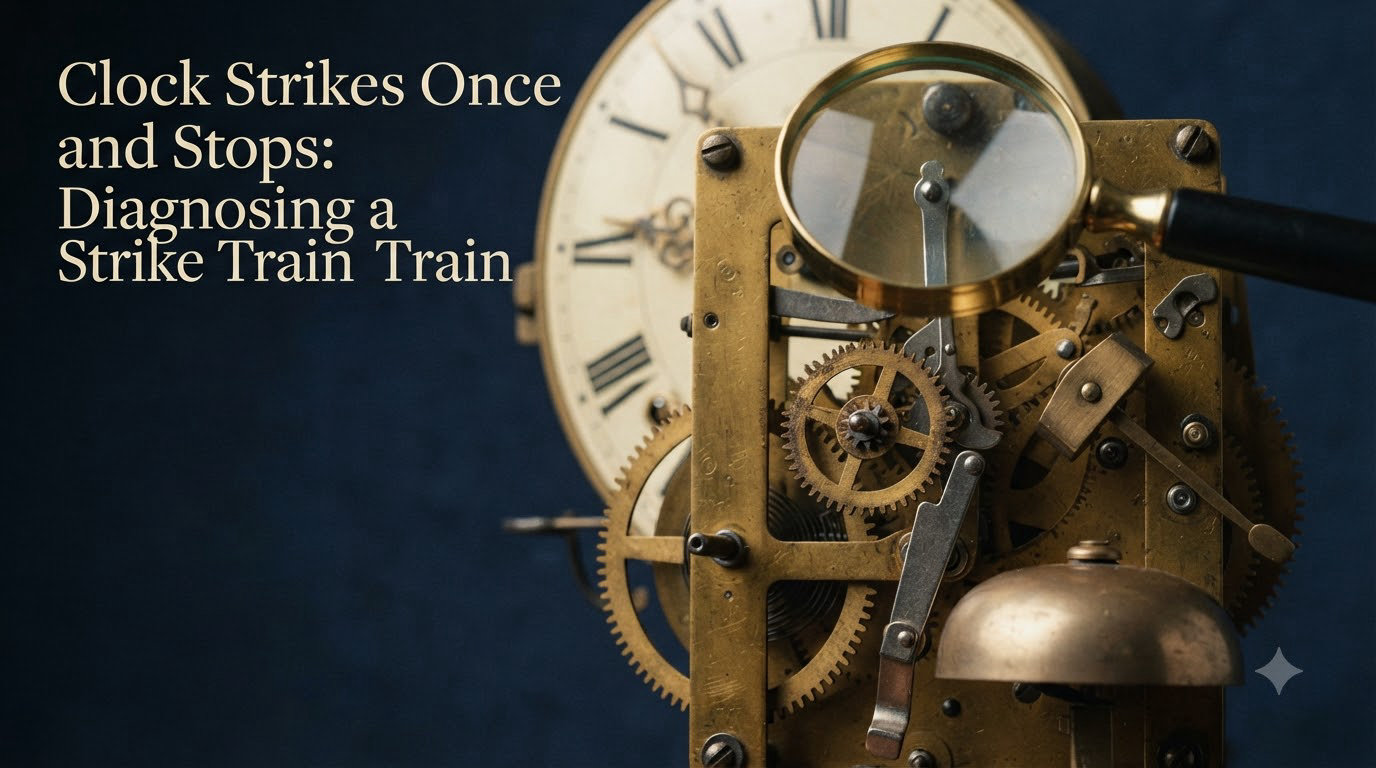
You wind your grandfather clock, set the pendulum swinging, and wait for the hour. Instead of the full sequence of strikes, you hear a single clang followed by silence. The clock strikes once and stops, leaving you wondering what went wrong inside that brass mechanism.
This scenario is one of the most common complaints we hear from mechanical clock owners. A stuck strike train can happen in grandfather clocks, mantel clocks, wall clocks, and bracket clocks alike. The good news is that most causes are diagnosable at home with patience and the right approach.
In this guide, we walk through exactly how to approach stuck strike train clock diagnosis. We cover how the striking mechanism works, the step-by-step diagnostic procedure, the most common causes of a strike train stopping after one blow, and when you should hand the job to a professional.
Whether you own a weight-driven floor clock or a spring-driven mantel piece, understanding the strike train gives you the confidence to identify the problem instead of guessing. Let us break it down.
Table of Contents
What Is a Strike Train? Understanding the Striking Mechanism
A strike train is the independent gear train inside a mechanical clock that powers the hour strike (and sometimes the half-hour strike). It is completely separate from the time train, which is the gear system that keeps the clock hands moving and the pendulum swinging.
This separation matters enormously for diagnosis. If your clock keeps perfect time but fails to strike, the time train is healthy and the problem lives entirely within the strike train. That narrows your troubleshooting focus significantly.
Most mechanical striking clocks have two trains: the time train and the strike train. Some chiming clocks have three: time, strike, and chime. Each train has its own mainspring or weight, its own gear sequence, and its own locking mechanism.
The strike train stores energy from either a coiled mainspring or a descending weight. It releases that energy in controlled bursts to drive a hammer that strikes a bell or gong. A count wheel or rack-and-snail system determines how many times the hammer falls for each hour.
How the Strike Train Works
The strike train operates in a cycle that repeats every hour. Energy builds in the mainspring or weight, a locking mechanism holds everything still, and at the appointed moment the train releases and runs through its striking sequence.
Here is what happens in a typical strike cycle on a count-wheel clock. About ten minutes before the hour, the minute hand lifts a warning lever, putting the strike train into what clockmakers call the warning phase. The train unlocks just enough to advance slightly and then locks again on a warning stop.
When the minute hand reaches the hour, a trip lever releases the warning stop. The strike train runs freely, and the count wheel rotates. A locking lever drops into a slot on the count wheel at the correct count, stopping the train after the right number of strikes.
If any part of this sequence fails, the clock can strike once and stop, strike the wrong number, or not strike at all. Understanding this cycle is the foundation of every diagnosis we describe below.
Strike vs. Chime: Knowing the Difference
People often use strike and chime interchangeably, but they are different mechanisms. A strike is a count of blows on a single bell or gong, usually matching the hour number. A chime is a melody played on multiple rods or bells, like the Westminster Quarters.
Knowing which train is malfunctioning changes your diagnosis entirely. If your clock plays the Westminster melody correctly but fails to count the hour, your chime train is fine and your strike train is the problem. This distinction prevents you from chasing the wrong set of gears.
Diagnosing a Stuck Strike Train: Step-by-Step Procedure
Diagnosing a stuck strike train requires a methodical approach, not guesswork. We recommend working through these five steps in order, because each step eliminates possible causes and narrows the search. Skipping ahead often leads to unnecessary adjustments that create new problems.
Before you begin, remove the clock from its case or open the access panels so you can see the movement. Have good lighting and a magnifying lens ready. Never force any component, and if something resists gentle pressure, stop and reassess.
Step 1: Check the Power Source First
The simplest explanation for a clock that strikes once and stops is a lack of power in the strike train. On a weight-driven clock, check whether the strike weight has been pulled up fully. A partially raised weight may deliver enough energy for one strike but not a full sequence.
On a spring-driven clock, the strike mainspring may be fully wound down or, conversely, fully wound and set. A mainspring that has been left wound for months can take a set and lose its power curve. Try winding the strike spring fully, then test the strike again.
Also verify that the strike weight is on the correct side. Grandfather clocks typically have three weights, and the strike weight is usually on the left side. If the weights were swapped during a previous service, the strike train will underperform.
Step 2: Determine If the Clock Is Stuck in Warning Phase
If the power source checks out, the next question is whether the strike train is locked in the warning phase and never releasing. This is one of the most common causes of a single strike followed by silence.
To test this, manually advance the minute hand toward the hour while watching the movement closely. Around the 50-minute mark, you should see a warning lever lift and the strike train advance slightly with a distinct click. That click means the train entered the warning phase correctly.
Now continue advancing to the hour. At the top of the hour, a trip lever should release the warning stop and the train should run. If you hear one strike and then the train locks up again, the release happened but something prevented the full run.
If the train never enters the warning phase at all, the problem is upstream. The lifting lever or warning lever may be bent, loose, or obstructed. If it enters warning but never releases, the trip lever is the suspect.
Step 3: Inspect the Count Wheel and Locking Lever
The count wheel (also called the count disk) is a notched wheel that determines how many strikes occur at each hour. A locking lever drops into progressively deeper slots on the count wheel to stop the train after the correct number of blows.
Examine the count wheel slots under magnification. Look for shallow or worn notches, burrs, or a buildup of old oil and dirt. A slot that has worn shallow may not hold the locking lever securely, causing the train to slip past and strike one extra time, or to lock prematurely after a single strike.
Check the locking lever itself. It should drop cleanly into the count wheel slot under its own spring tension. If the lever is bent, the tip may not engage the slot at all, or it may catch on the rim and lock the train after one blow.
Gently test the locking lever by pressing it toward the count wheel with a toothpick while the train is in warning. If it drops in cleanly but the train still stops after one strike, the locking cam or stop lever deeper in the train may be the actual culprit.
Step 4: Examine the Trip Lever and Lifting Levers
The trip lever releases the strike train from the warning phase at the exact moment the minute hand reaches the hour. If this lever is misaligned, the train either never releases or releases only partially.
Reddit users and NAWCC forum members frequently report trip lever problems after someone has pulled a chain too hard or bumped the movement during cleaning. A sharp tug on a weight chain can knock the trip lever out of position relative to the warning stop.
Inspect the trip lever for proper alignment with the warning stop pin. When the minute hand reaches twelve, the trip lever should push the warning lever off its stop cleanly and completely. A partial release can let the train run for one strike, then re-lock.
Also check the lifting levers that connect the minute hand motion to the warning and trip systems. These thin brass levers can bend over decades of use. A bent lifting lever changes the timing of the warning and release cycle, producing exactly the symptom of a single strike followed by silence.
Step 5: Test the Hammer Assembly and Gong
The final component to check is the hammer assembly itself. The hammer must lift and fall freely on its pivot. If the hammer is binding on its arbor, or the hammer spring has lost tension, the strike train may run but produce only one audible blow.
Watch the hammer during a strike attempt. If the train runs but the hammer barely moves, the hammer lift cam or hammer tail may be worn. If the hammer lifts but does not fall back quickly enough, the hammer spring is weak or the pivot is gummy.
Also check the position of the hammer relative to the gong or bell. A hammer that rests too close to the gong can dampen it, while one too far away produces a weak strike. Both can make you think the train stopped when it actually ran but the sound was wrong.
Common Causes When a Clock Strikes Once and Stops
After walking hundreds of clock owners through this diagnostic process, we have found that a handful of causes account for the vast majority of single-strike-then-stop problems. Here are the six most common culprits, ranked by frequency.
Dried Oil and Gummy Pivots
The single most common cause of a sluggish or stuck strike train is old, dried oil on the pivots. Clock oil does not last forever. Over five to ten years, it oxidizes into a gummy residue that creates drag on the steel pivots running in their brass bushings.
The strike train is usually affected before the time train because it sits idle for most of the hour and then demands sudden, fast rotation. Gummy pivots can deliver enough energy for one strike but not sustain the full sequence. This is why cleaning and oiling solves a surprising number of strike problems.
Worn Bushings Causing Gear Misalignment
Steel pivots rotate inside brass bushings, and over decades the steel wears the brass. A worn bushing allows the gear to tilt or shift sideways, which changes the depth of the gear teeth engagement. Misaligned gears bind, skip, or lock up entirely.
Bushing wear is especially common in the faster-running gears of the strike train, near the mainspring barrel. If you can rock a gear arbor sideways visibly, the bushing is worn enough to cause problems. Worn bushings require replacement, which is a job for a skilled repairer.
Count Wheel Slot Wear and Shallow Notches
Over decades of use, the count wheel slots can wear shallow from the repeated impact of the locking lever. A shallow slot may not hold the locking lever at the right depth, causing premature locking after one strike.
This problem tends to appear at specific hours rather than randomly. If your clock strikes correctly at some hours but stops after one blow at others, count wheel wear is the likely cause. The affected slots correspond to the hours that fail.
Bent or Misadjusted Locking Lever
The locking lever must drop into the count wheel slot at a precise angle and depth. A lever that has been bent, even slightly, can catch on the rim of the count wheel and lock the train prematurely.
This often happens during well-meaning DIY attempts to adjust the strike. If someone has bent the locking lever trying to fix a different problem, the cure becomes worse than the disease. The lever must be perfectly straight and properly tensioned by its spring.
Trip Lever Misalignment After Chain Pull or Movement
As we noted in the diagnostic steps, a trip lever knocked out of alignment is a frequent cause reported on clock repair forums. A hard pull on a weight chain, dropping the clock, or even moving it across a room can shift the trip lever relative to the warning stop.
The symptom is distinctive. The clock enters the warning phase normally but never fully releases at the hour. You hear one tentative strike as the train partially releases, then it re-locks. Realignment of the trip lever requires careful adjustment of its position relative to the warning stop pin.
Mainspring Set or Weak Strike Weight
A mainspring that has been left fully wound for months or years can take a permanent set, reducing its power output. Similarly, a strike weight that is too light for the movement (sometimes because the wrong weight was installed) cannot drive the full strike sequence.
This cause produces a consistent pattern. The clock strikes fully when freshly wound or weighted, but the strike count drops as the spring unwinds or the weight descends. If the strike works at the top of the winding cycle but fails toward the bottom, suspect a weak mainspring or insufficient weight.
How to Fix a Stuck Strike Mechanism Safely
Some strike train problems are fixable at home. Others require a professional clockmaker with specialized tools. Here is how to approach repairs safely, and where to draw the line.
What You Can Safely Do Yourself
If your diagnosis points to dried oil on the pivots, you can attempt a careful cleaning. Apply a small amount of dedicated clock oil (never household oil) to each pivot point in the strike train. Use the tip of a needle to deliver a single droplet, then run the strike train manually several times to distribute the oil.
If the problem is a trip lever knocked out of alignment, you may be able to reposition it gently with fine-nosed pliers. Make tiny adjustments and test after each one. Never bend a lever aggressively, as brass snaps easily.
For a hammer assembly that is binding, clean the hammer pivot with a lint-free cloth and apply a trace of clock oil. Adjust the hammer position so it rests about one millimeter from the gong at rest.
What NOT to Do: The WD-40 Warning
Never use WD-40 on a clock movement. This is the most repeated warning on every clock repair forum, and for good reason. WD-40 is a penetrating solvent, not a lubricant. It dissolves any remaining clock oil, then evaporates and leaves a sticky varnish that accelerates wear.
Also avoid household oils like 3-In-One or sewing machine oil. These are too heavy for clock pivots and will gum up within months. Use only oil specifically formulated for mechanical clocks, applied in tiny quantities.
Do not attempt to disassemble the movement if you lack experience. The strike train contains springs under significant tension. A mainspring released unexpectedly can cause serious injury and will certainly damage the movement.
When to Call a Professional Clockmaker
If your diagnosis points to worn bushings, a set mainspring, or a badly bent locking lever, the repair requires tools and skills beyond most DIYers. Bushing replacement requires a bushing tool, a staking set, and experience reburring. Mainspring replacement requires a winder and protective equipment.
If you have cleaned and oiled the pivots, verified the power source, and confirmed the levers are straight, but the clock still strikes once and stops, the problem is likely deep inside the gear train. At that point, a professional cleaning and overhaul is the most cost-effective path.
Look for a clockmaker affiliated with the NAWCC or the British Horological Institute. Ask about their experience with your specific clock type, whether grandfather, mantel, or bracket. A qualified repairer will diagnose the problem before quoting a price.
Preventing Strike Train Problems in 2026
Most strike train failures are preventable with regular maintenance. We recommend having your mechanical clock professionally cleaned and oiled every five to seven years. This single step prevents the dried oil and bushing wear that cause most stuck strike train problems.
Between services, keep the clock in a stable environment. Extreme temperature and humidity swings accelerate oil degradation and wood movement. Avoid placing the clock near heating vents, drafty windows, or exterior walls.
Wind the strike train consistently. On a weight-driven clock, pull the strike weight up before it reaches the bottom of its travel. On a spring-driven clock, wind the strike mainspring at regular intervals rather than letting it fully run down.
Never force the minute hand if it resists. If the hand sticks, something in the motion work or strike release system is binding. Forcing the hand can bend levers and create exactly the trip lever misalignment problems we described above.
FAQs
Why has my clock stopped striking?
A clock stops striking most often because of dried oil on the pivots, a worn bushing in the strike train, or a misaligned trip lever that fails to release the train from the warning phase. Check the power source first, then determine whether the train enters and exits the warning phase correctly.
What causes a clock strike train to stop midway?
The most common causes are count wheel slot wear, a bent locking lever that catches the wheel rim, gummy pivots that cannot sustain fast rotation, or bushing wear that misaligns the gears. A weak mainspring or insufficient strike weight can also cause the train to run out of energy mid-sequence.
How to fix a stuck strike mechanism?
Start by cleaning and oiling the pivots with dedicated clock oil. Verify the strike weight or mainspring is fully powered. Check the trip lever alignment and the locking lever for straightness. If the problem persists after these steps, worn bushings or a set mainspring likely require professional repair.
Why does my clock remain in warning phase?
A clock stuck in warning phase has usually suffered a trip lever misalignment, often caused by a hard chain pull or movement during transport. The warning lever lifts correctly but the trip lever fails to push it off the warning stop at the hour, so the train never fully releases to strike.
Can you use WD-40 on clock movements?
No, never use WD-40 on a clock movement. WD-40 is a solvent that dissolves existing clock oil and leaves a sticky residue that accelerates wear. Use only oil specifically formulated for mechanical clock pivots, applied in tiny droplet quantities to each pivot point.
Conclusion: Getting Your Clock Striking Again
A clock that strikes once and stops is telling you exactly where the problem lives: inside the strike train. By working through the five-step diagnostic procedure we outlined, you can pinpoint whether the issue is as simple as dried oil or as complex as a worn bushing.
Remember that stuck strike train clock diagnosis starts with the basics. Verify the power source, confirm the warning phase cycle, and inspect the count wheel, locking lever, and trip lever before touching any tools. Most single-strike problems trace back to one of these areas.
If your diagnosis points beyond DIY territory, a qualified clockmaker can restore the movement to full health. Understanding how the strike train works puts you in control of the conversation and helps you make informed decisions about your clock’s care.