
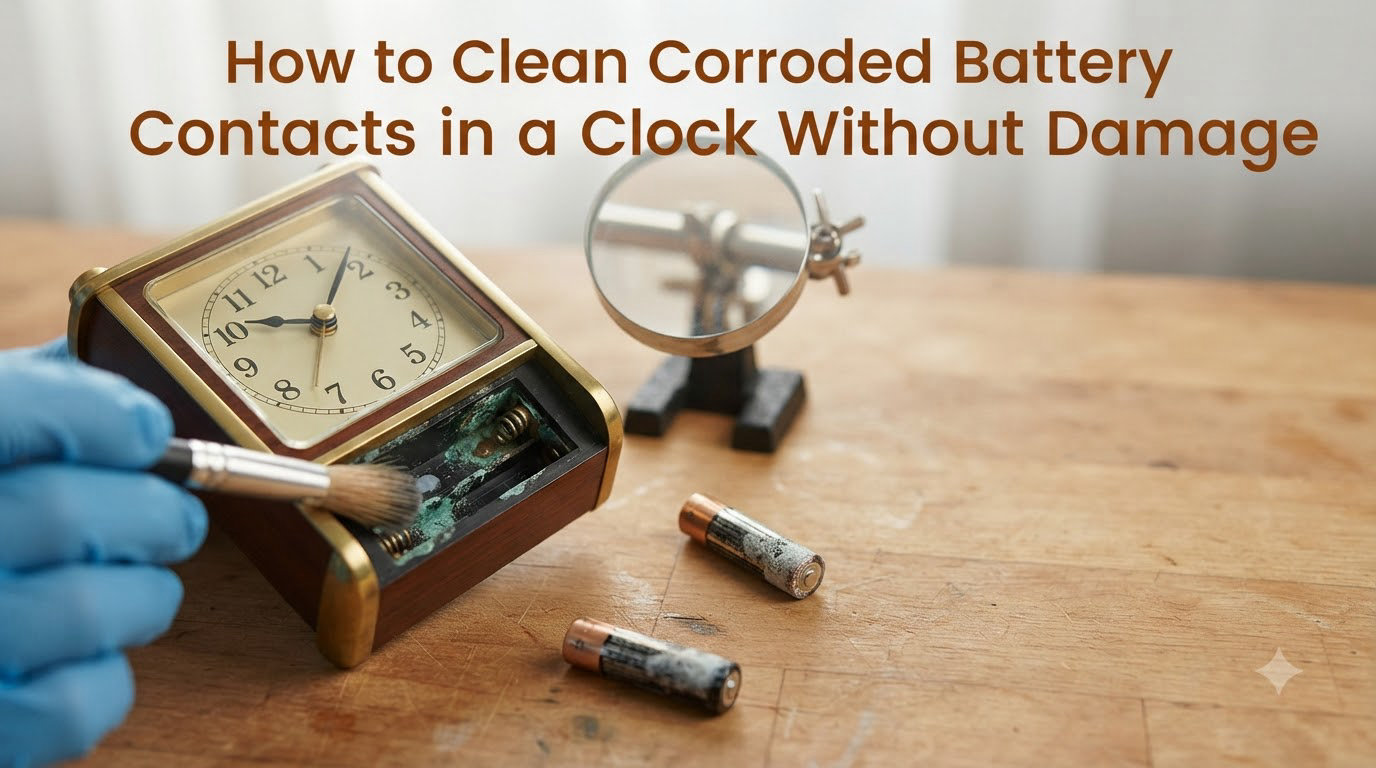
You open the battery compartment of your favorite wall clock, and there it is. A crusty white powder coats the metal contacts, and the clock has stopped ticking. If you need to clean corroded battery contacts in a clock, you are in the right place.
Battery corrosion is one of the most common reasons battery-powered clocks stop working. The good news is that most clocks can be saved with a few household supplies and about 20 minutes of your time.
In this guide, I will walk you through the exact process our team uses to clean corroded battery contacts without damaging delicate clock components. We will cover the chemistry behind the corrosion, the safest cleaning solutions, step-by-step instructions, and prevention tips to keep your clocks running for years.
Table of Contents
Why Clocks Are Especially Vulnerable to Battery Corrosion
Clocks face a unique problem that most other battery-powered devices do not. They often sit forgotten for months or even years with the same set of batteries inside.
When a clock sits idle, the batteries slowly discharge and eventually leak. The tight battery compartments in many wall clocks and mantel clocks trap moisture and accelerate the corrosion process.
I have seen analog clocks where batteries were left in so long that the corrosion ate completely through the contact spring. Vintage clocks are even more at risk because their metal contacts are often made of softer, thinner materials that corrode faster than modern plated contacts.
Alarm clocks and digital clocks face a different challenge. Their circuit boards sit directly beneath the battery compartment, so any leaked electrolyte can spread to sensitive electronics and cause permanent damage if left untreated.
What Is Battery Corrosion? Understanding the Chemistry
Battery corrosion starts with a chemical called potassium hydroxide. This is the electrolyte inside standard alkaline batteries, and it is highly alkaline, meaning it is caustic on the base end of the pH scale.
As a battery ages or discharges completely, its casing weakens and the potassium hydroxide leaks out through the seals. When this electrolyte meets the air inside your clock’s battery compartment, it reacts with carbon dioxide and forms potassium carbonate.
That white, crusty powder you see on the contacts is potassium carbonate. It is a crystalline substance that blocks electrical contact between the battery and the clock movement, which is why your clock stops running.
Understanding this chemistry matters because it tells us how to clean the corrosion safely. Since the leaked material is alkaline, we need a mild acid to neutralize it. This is why white vinegar and lemon juice work so well.
One important note: the potassium hydroxide in fresh leakage can irritate your skin and eyes. Always wear protective gloves before handling corroded batteries or touching the affected area.
Safety Precautions Before You Start
Safety comes first when dealing with battery corrosion. The chemicals involved can cause skin irritation and eye damage, so take a few minutes to protect yourself.
Wear disposable gloves made of nitrile or rubber. Avoid touching the white corrosion powder with your bare hands, as it can dry out and irritate your skin.
Put on safety glasses or goggles. This is especially important when removing stuck batteries, since dried corrosion flakes can fly into your eyes unexpectedly.
Work in a well-ventilated area. Open a window or work outdoors if possible. The cleaning solutions produce mild fumes, and you do not want to breathe in corrosion dust.
Wash your hands thoroughly with soap and water after you finish, even if you wore gloves. Keep children and pets away from your work area until everything is cleaned up.
Tools and Materials You Will Need
Gather your supplies before you start so you do not have to stop mid-cleaning. Here is what our team recommends:
Disposable nitrile or rubber gloves
Safety glasses or goggles
White vinegar or lemon juice (your neutralizing acid)
Cotton swabs (Q-tips work well for tight clock compartments)
An old soft-bristled toothbrush (dedicated to cleaning only)
Isopropyl rubbing alcohol (70 percent or higher)
A microfiber cloth or paper towels
A small flathead screwdriver or toothpick for scraping stubborn deposits
A sealable plastic bag for disposing of corroded batteries
Fresh batteries for testing
Most of these items are already in your kitchen or garage. If you have a choice, white vinegar tends to be the most effective and affordable option for neutralizing alkaline corrosion.
How to Clean Corroded Battery Contacts in a Clock: Step by Step
Follow these seven steps to safely clean corroded battery contacts in a clock without causing damage. Each step builds on the previous one, so work through them in order.
Step 1: Remove the Old Batteries
Put on your gloves and safety glasses before opening the battery compartment. Gently remove the old batteries and set them aside in a sealable plastic bag.
If a battery is stuck, do not pry hard against the contacts. You can bend or break the delicate metal springs inside a clock battery compartment. Instead, try tapping the clock gently on a padded surface to loosen the battery, or use a plastic spudger to work it free slowly.
Never use metal tools like screwdrivers to pry stuck batteries directly against the contacts. The contacts in clocks are thin and can snap off, turning a simple cleaning job into a repair project.
Step 2: Remove Large Chunks of Corrosion
Before applying any liquid, brush away the loose crusty deposits. Use a dry toothbrush or a cotton swab to gently sweep the bulk of the white powder out of the compartment.
Tap the clock gently to dislodge loose flakes. Collect the debris on a paper towel and dispose of it in your regular trash, since the potassium carbonate is largely inert at this stage.
This step prevents the loose powder from turning into a messy paste when you apply your cleaning solution in the next step.
Step 3: Neutralize the Corrosion with Vinegar or Lemon Juice
Dip a cotton swab in white vinegar or lemon juice. Apply it directly to the corroded contacts and let it sit for about 30 seconds to one minute.
You will see a slight fizzing reaction. This is the acid neutralizing the alkaline potassium carbonate residue, and it means the cleaning solution is working.
For light to moderate corrosion, one or two applications are usually enough. For heavier buildup, repeat this step two or three times, using a fresh cotton swab each time.
Avoid soaking the compartment. Clock movements and circuit boards can be damaged by excess liquid, so use just enough to wet the contacts.
Step 4: Scrub the Contacts Clean
After the corrosion has softened, use your soft-bristled toothbrush to gently scrub the metal contacts. Work in small circular motions to lift away the remaining residue.
For tight spaces inside small clock battery compartments, wrap a small piece of cloth around a toothpick and use it to reach into corners. Cotton swabs also work well for detail cleaning around contact springs.
Be patient with stubborn spots. It is better to scrub gently multiple times than to scrape aggressively and risk bending a contact out of shape.
Step 5: Rinse with Rubbing Alcohol
Once the corrosion is gone, use a cotton swab dipped in isopropyl rubbing alcohol to wipe down all the cleaned surfaces. The alcohol dissolves any remaining residue and removes leftover moisture.
Rubbing alcohol is ideal for this step because it evaporates quickly and leaves no residue behind. It also displaces any water-based vinegar or lemon juice that might linger in the compartment.
Pay special attention to the negative contact spring and the positive contact plate. These are the two points where the battery connects, and they need to be completely clean for the clock to work.
Step 6: Dry Everything Completely
Let the battery compartment air dry for at least 15 minutes. You can speed this up by dabbing the area with a microfiber cloth or paper towel.
Do not use a hair dryer on high heat, as hot air can warp plastic compartments or damage sensitive clock movements. If you want to speed up drying, use a fan on a low, cool setting.
Before moving to the next step, double-check that every surface is bone dry. Even a tiny amount of moisture left on the contacts can cause new corrosion to form almost immediately.
Step 7: Test with Fresh Batteries
Insert a brand-new set of batteries and check whether the clock starts running. For analog clocks, listen for the ticking sound and watch the second hand. For digital clocks, check that the display lights up correctly.
If the clock does not start, remove the batteries and recheck the contacts. A thin film of corrosion or a slightly bent contact spring can still prevent a good connection.
Try gently tightening the contact spring with a small tool if it appears loose. Sometimes the corrosion physically deforms the spring, and a slight adjustment restores the electrical connection.
Choosing the Right Cleaning Solution
Not all cleaning solutions work the same way on battery corrosion. The right choice depends on what you have available and how heavy the corrosion is.
White vinegar is our top recommendation for clock battery compartments. It contains acetic acid at about 5 percent concentration, which is strong enough to dissolve potassium carbonate but gentle enough for delicate contacts. It is also inexpensive and available in every grocery store.
Lemon juice works almost as well as vinegar. It contains citric acid, which neutralizes alkaline corrosion effectively. Some people prefer it because the smell is more pleasant, but it can leave a slightly sticky residue if you do not rinse it off completely with alcohol.
Baking soda mixed with a small amount of water forms a paste that some guides recommend. However, baking soda is itself alkaline, so it does not neutralize alkaline corrosion the way an acid does. It works better for acidic corrosion from car batteries (lead-acid), not for the alkaline corrosion found in clock batteries.
For alkaline battery corrosion in clocks, stick with an acidic solution like vinegar or lemon juice, followed by an alcohol rinse. This two-step approach is what professional repair technicians use.
Clock-Specific Cleaning Tips
Different types of clocks need slightly different approaches. Here is what our team has learned from cleaning dozens of clock battery compartments.
Analog wall clocks usually have a single small battery compartment on the back. The contacts are typically a thin metal spring and a flat plate. These are easy to clean but easy to damage, so use cotton swabs rather than a toothbrush for the tight spaces.
Digital alarm clocks often have circuit boards near the battery compartment. Be extra careful not to let liquid drip onto the board. If corrosion has already spread to the circuit board, use a cotton swab with rubbing alcohol only and avoid acidic solutions near the electronics.
Mantel and vintage clocks may have brass or copper contacts that tarnish along with corroding. After cleaning the corrosion, you can polish these contacts gently with a pencil eraser to restore conductivity. The eraser trick is an old clockmaker’s secret that works surprisingly well.
Outdoor clocks face additional moisture exposure. After cleaning and drying, consider applying a thin layer of dielectric grease to the contacts before installing new batteries. This creates a moisture barrier without interfering with the electrical connection.
If your clock has a Quartz movement module that sits directly behind the battery compartment, take care not to push corrosion debris into the movement housing. Hold the clock so gravity pulls debris away from the movement as you clean.
Dealing with Heavy Corrosion and Stuck Batteries
Sometimes the corrosion is so severe that standard cleaning methods are not enough. I have encountered clocks where the battery had leaked so badly that the entire contact spring was encrusted.
For heavy corrosion, soak a cotton pad in vinegar and press it against the affected area for five to ten minutes. This gives the acid time to penetrate and soften the thick crust before you scrub.
For batteries that are truly stuck, try wrapping a rubber band around the battery for grip and gently twisting it back and forth. If that fails, use a pair of needle-nose pliers wrapped in electrical tape to grip the battery without shorting the contacts.
Reddit users in the r/batteries community report that sometimes a battery leaks and actually welds itself to the contact. In these cases, you may need to carefully break the bond with a small flathead screwdriver, working from the side rather than prying upward against the contact.
If the contact breaks during removal, you may be able to solder a replacement contact tab. However, this requires soldering skills and may not be worth the effort for inexpensive clocks.
How to Prevent Future Battery Corrosion in Clocks
Prevention is always easier than cleaning. A few simple habits will keep your clocks running and corrosion-free for years.
Change clock batteries on a regular schedule. Our team replaces clock batteries twice a year when we change the clocks for daylight saving time. This simple routine prevents batteries from sitting long enough to leak.
Remove batteries from clocks you are not using. If you store a clock or take it down temporarily, always take the batteries out first. A clock in a drawer with batteries inside is a corrosion waiting to happen.
Use quality alkaline batteries from reputable brands. Cheap or off-brand batteries are more likely to leak because they have weaker seals. The small price difference is not worth the risk to your clocks.
Avoid mixing old and new batteries in the same clock. When you mix batteries at different charge levels, the weaker battery can reverse-charge and leak. Always replace all batteries in a clock at the same time.
Consider lithium batteries for clocks that are hard to reach or that you do not check often. Lithium batteries have a much lower leak rate than alkaline batteries and can last for years in a low-drain device like a clock.
Check your clocks periodically. A quick visual inspection of the battery compartment every few months catches early signs of leakage before corrosion has a chance to build up and cause damage.
When to Seek Professional Clock Repair
Most clock battery corrosion can be handled at home, but some situations call for a professional. Knowing when to stop and call an expert can save you from causing further damage.
If the corrosion has eaten through a contact entirely and it has broken off, a clock repair specialist can often replace the contact or install a new battery compartment module. This is worth doing for valuable or sentimental clocks.
If corrosion has spread to the circuit board in a digital clock and cleaning does not restore function, a technician can diagnose whether the board is salvageable. Sometimes a single corroded component can be replaced for a fraction of the cost of a new clock.
For vintage or antique clocks, professional repair is almost always the better choice. These clocks often have irreplaceable parts, and a specialist understands how to clean them without reducing their value.
Proper Disposal of Corroded Batteries
Never throw heavily corroded batteries in your regular household trash. They contain chemicals that can leach into soil and groundwater.
Place corroded batteries in a sealable plastic bag or tape over the terminals with electrical tape. This prevents any remaining leakage from spreading and keeps the terminals from contacting each other.
Take them to a battery recycling center, a household hazardous waste facility, or a retailer that accepts used batteries. Many hardware stores and electronics retailers have free battery recycling drop-off bins.
If the battery is actively leaking when you remove it, double-bag it and transport it to a hazardous waste facility as soon as possible. Do not store leaking batteries in your home.
FAQs
How do you clean corroded battery terminals on a clock?
Remove the old batteries, brush away loose corrosion, then dip a cotton swab in white vinegar and apply it to the contacts for 30 to 60 seconds. Scrub gently with a soft toothbrush, rinse with rubbing alcohol, and let it dry completely before installing fresh batteries.
How to clean battery contacts from corrosion?
Use a mild acid like white vinegar or lemon juice on a cotton swab to neutralize the alkaline corrosion. Scrub with a soft-bristled toothbrush, then wipe with isopropyl rubbing alcohol to remove residue and moisture. Dry fully before reinstalling batteries.
Is WD-40 good for cleaning battery contacts?
WD-40 is not ideal for cleaning battery corrosion. It is a lubricant and water-displacement spray, not a neutralizing agent. It can help dislodge stuck batteries and leave a protective coating, but it will not dissolve alkaline corrosion the way vinegar or lemon juice does.
Can I use hydrogen peroxide to clean battery contacts?
Hydrogen peroxide is not recommended for cleaning alkaline battery corrosion. It is a mild oxidizer rather than an acid, so it does not effectively neutralize the alkaline potassium carbonate. White vinegar or lemon juice are much better choices for this task.
Conclusion
Cleaning corroded battery contacts in a clock is a straightforward process once you understand the chemistry and follow the right steps. Neutralize the alkaline corrosion with an acid like white vinegar, scrub gently, rinse with rubbing alcohol, and dry thoroughly before installing fresh batteries.
The key to doing this without damage is patience and gentleness. Clock contacts are delicate, and taking a few extra minutes to clean carefully will save you from costly repairs or replacements down the road.
Remember that prevention is your best tool. Change your clock batteries regularly, remove batteries from idle clocks, and use quality batteries to avoid leaks in the first place. With these habits, you can keep every clock in your home running reliably through 2026 and beyond.