
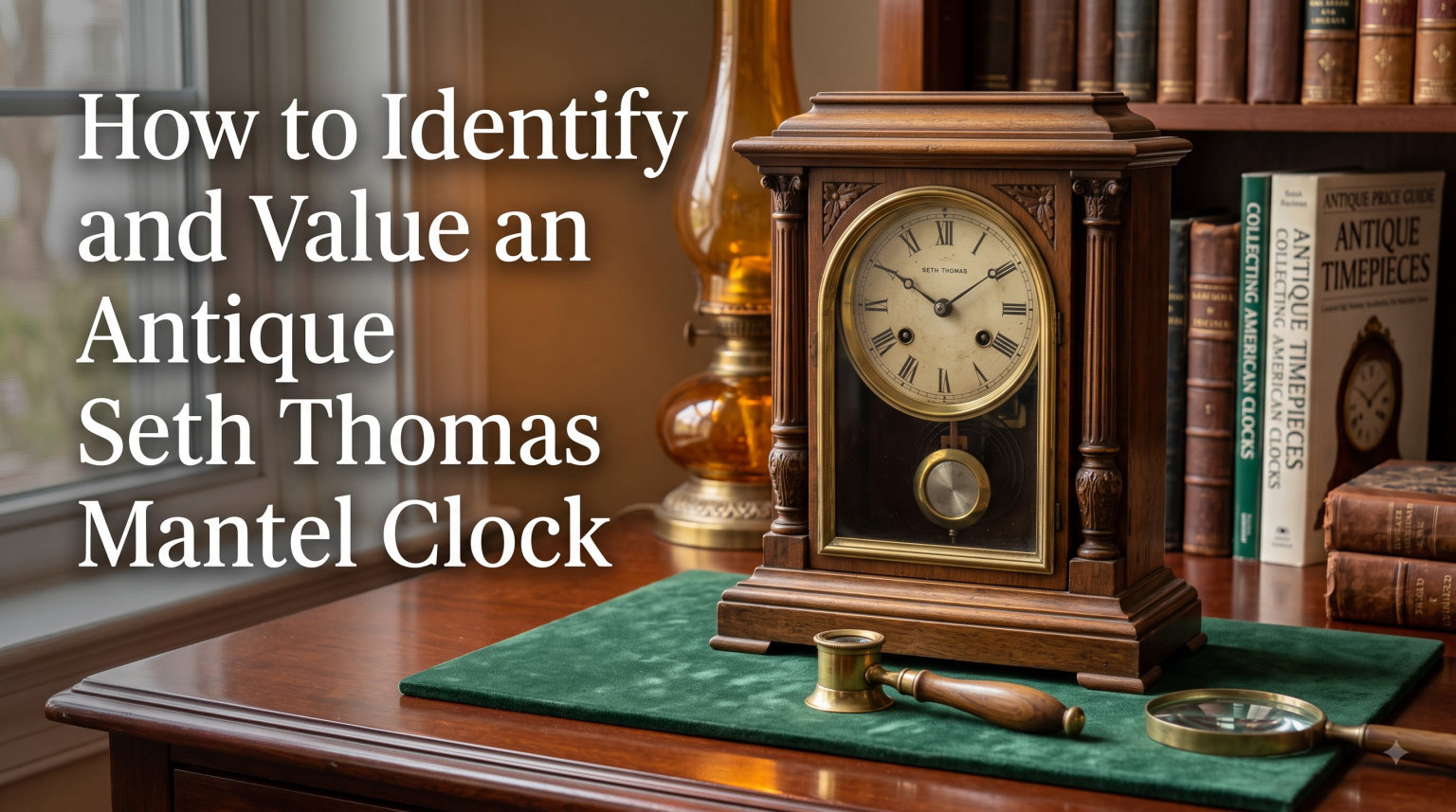
If you have inherited or found an old mantel clock with the Seth Thomas name on it, you are holding a genuine piece of American clockmaking history. Knowing how to identify and value an antique Seth Thomas mantel clock helps you understand its age, rarity, and fair market price. This guide walks you through every step of the process, from locating hidden labels to decoding date stamps and comparing recent sale prices.
I have spent years studying antique clock movements, labels, and case construction, and the methods below are the same ones professional appraisers use. Whether you want to sell, insure, or simply learn more about your clock, you will find clear, actionable steps here. Seth Thomas mantel clock identification comes down to five key checks, and we will cover each one in detail.
Table of Contents
A Brief History of Seth Thomas Clocks
Seth Thomas founded his clock company in 1813 in Plymouth Hollow, Connecticut, and officially established the Seth Thomas Clock Company in 1817. The town was later renamed Thomaston in his honor. From those early years through the mid-20th century, the company produced millions of clocks, ranging from simple shelf clocks to ornate mantel clocks and tall case clocks.
Understanding this production timeline matters because the materials and markings changed over time. Early clocks from the 1810s through the 1830s used wooden gear movements. By the 1840s, Seth Thomas shifted to brass movements, which are more durable and easier to date.
The late 1800s brought the popular adamantine-finish clocks, and the early 1900s saw the rise of slate and marble-look mantel clocks. The company changed hands several times in the 20th century and eventually ceased American production. Original Seth Thomas clocks made in Thomaston, Connecticut, before the 1950s carry the most collector interest.
Knowing which era your clock came from is the foundation of accurate identification and valuation. The steps below will help you narrow that era with confidence.
Step 1: Locate and Read the Label
The paper label is the first and most reliable identifier on any Seth Thomas mantel clock. Most Seth Thomas mantel clocks have a printed paper label glued to the inside of the case, usually on the backboard behind the pendulum or on the inside of the front access door. Open the case carefully and use a flashlight to scan the back panel and the inner surfaces.
Original labels include the company name, city (Thomaston, Connecticut), and sometimes a model name or patent date. Some labels list the clock style or case type. Labels from the 1860s onward often say “Seth Thomas Clock Company” or “S. Thomas.”
Earlier labels from the 1840s and 1850s may simply read “Seth Thomas, Plymouth Hollow, Conn.” If the label says Plymouth Hollow, the clock was made before the town was renamed in 1865. This single detail can instantly narrow your production window by decades.
Keep in mind that labels fade, tear, or fall off over decades of use. A missing label does not mean the clock is not authentic, but it does make identification harder. If the label is intact and legible, write down every word and number you see.
Even partial text helps narrow the production period. Forum collectors on the NAWCC message boards frequently remind newcomers to look behind the dial face as well, since some models carry a secondary label or stamp there.
Step 2: Decode the Date Stamp
Seth Thomas stamped date codes on the brass movements of its clocks starting in 1881. These stamps are one of the most accurate ways to pinpoint when a clock was made. The date code appears as a number stamped on the back plate of the movement, typically near the center or along one edge.
The format uses a month-day-year system where the last digit represents the year within a decade. The stamp “3651” means the clock movement was finished on March 6, 1881. The first digit (3) is the month, the next two digits (65) represent the day within the year, and the last digit (1) is the year digit.
The last digit resets each decade, so “1” in this context means the first year of that decade. Appraisers cross-reference this with label information and case style to confirm the correct decade. This cross-checking step is what makes the date stamp system reliable rather than ambiguous.
Another example: a stamp reading “1812” corresponds to January 8, 1882, based on the same system. The year digit “2” places it in the second year of the decade. A clock with an adamantine case and a date stamp ending in “5” is almost certainly from 1885 or 1895, not 1875, because adamantine finishes were not introduced until the 1880s.
If your clock predates 1881, it will not have this date stamp system. For those earlier clocks, you rely on movement material and case style to estimate the production period. Clocks made after the 1930s sometimes lack date stamps as well, so the system is most useful for the 1881 to 1930 production window.
Step 3: Examine the Movement Material
The material used for the clock movement gears tells you which era the clock came from. Seth Thomas used wooden gear movements in its earliest clocks, from the 1810s through approximately the late 1830s. If your clock has wooden gears inside the movement, it dates from this early period and is among the more historically significant pieces.
Starting in the early 1840s, the company transitioned to brass movements. Brass was more precise, lasted longer, and allowed for thinner plates. If your movement has brass plates and brass gears, the clock was made after roughly 1840.
The transition was gradual, but by 1845 nearly all Seth Thomas mantel clocks used brass movements. Within brass movements, there are further dating clues to look for. Early brass movements from the 1840s to 1860s often have thicker plates and use a time-and-strike design with count wheel striking.
Later movements, from the 1880s onward, tend to have thinner plates and may include more refined rack-strike mechanisms. The presence of a wire gong versus a bell can also hint at the production decade, with gongs becoming common in the late 19th century.
Removing the movement from the case is not necessary for this check. Simply open the access door and look at the visible plates and gears. If you see wood, you have a pre-1840 clock; if you see brass, you have a post-1840 clock.
Step 4: Read the Movement Stamps
Beyond the date code, Seth Thomas stamped additional information on the back plate of the movement. These stamps include the company logo or name, a serial number, and sometimes a part or model number. The logo helps confirm authenticity, and the serial number can help place the clock within the production sequence.
Look for “Seth Thomas” or “ST” stamped into the brass back plate, usually near the top or center. The stamp is typically recessed into the metal, so angle your light to create shadows that make it visible. Some movements also carry a separate stamp with a number like “89” or “124,” which refers to the movement model or caliber.
Serial numbers are sequential within a model line, meaning higher numbers generally indicate later production. Unfortunately, Seth Thomas did not publish complete serial number records, so you cannot do an exact lookup. However, experienced collectors and NAWCC members have compiled informal databases that can help approximate a production date from a serial number combined with other clues.
If you find no stamps at all on the movement, the plate may have been replaced during a past repair. It could also mean the clock is from an era when stamping was inconsistent. A movement with clean, matching stamps that align with the case style and label is a strong sign of an original, authentic clock.
Step 5: Identify the Case Style and Material
The case material and style provide another layer of dating information and often have the biggest impact on collector value. Seth Thomas produced mantel clock cases in several distinct materials over the decades. Knowing the material helps you estimate the era and understand what collectors look for.
Mahogany and rosewood veneer cases were common from the 1840s through the 1870s. These cases often feature scrollwork, columns, or steeple designs. The steeple clock, with its pointed Gothic arches, was a signature Seth Thomas style from the 1840s and 1850s and remains highly recognizable today.
Adamantine clocks, introduced in the 1880s, have a durable celluloid veneer that mimics expensive materials like onyx, marble, or tortoiseshell. These clocks were produced through the 1920s and are among the most commonly found Seth Thomas mantel clocks today. Adamantine cases typically have a glossy, patterned finish that has held up remarkably well over a century of use.
Slate and faux-marble clocks, popular around 1900, have heavy stone or composition cases that look like carved marble. These sell at auction for moderate prices because they were mass-produced, though ornate examples in excellent condition can command more. Wooden cases from the 1920s through 1940s, including boudoir and chime clocks, round out the later production era.
Common Seth Thomas Mantel Clock Models
While Seth Thomas made hundreds of models, several are encountered frequently by collectors and appraisers. Recognizing these models helps you describe your clock accurately when seeking an appraisal or comparing sale prices.
The Steeple clock (1840s to 1860s) features twin pointed Gothic arches on top and is one of the most iconic American clock designs. The Column and Cornice styles from the 1860s and 1870s have symmetrical columns flanking the dial. The Adamantine series (1880s to 1920s) includes many case shapes, from rectangular temple styles to round-top cabinet designs.
The World and Office Calendar clocks from the late 1800s include calendar mechanisms and dual dials. The Sonora chime clocks from the early 1900s use resonant bells to produce melodic Westminster chimes and are sought after by collectors. The Tambour style, with its curved camel-back shape, was a dominant design from the 1920s through the 1940s and is one of the most frequently inherited clocks today.
No comprehensive model number reference list exists publicly, which is a gap many forum users have noted. If you cannot match your clock to a known model name, describe the case shape, material, dial type, and movement stamps in detail. This gives experts enough information to help identify it.
How to Assess Condition
Condition is the single biggest factor in value after rarity and age. A clock in working, original condition with minimal wear is worth significantly more than an identical model that has been heavily refinished or has a non-running movement.
The first condition factor is functionality: does the clock run and keep time? A working movement adds value and signals that the gears, mainsprings, and pendulum are intact. The second factor is originality: is the original finish still present?
Over-cleaning or stripping an old patina reduces collector value considerably. The third factor is the glass: is it original and undamaged? Replacement glass is acceptable but lowers value slightly.
The fourth factor is the dial and hands: are they original to the clock? Repainted dials or replaced hands are common in restored clocks and reduce authenticity. Always inspect for case damage too, such as cracks in adamantine veneer, chips in slate, or splits in wooden cases.
A clock with a tight, solid case, original finish, running movement, and clean dial is considered excellent condition. Moderate wear with a running but serviced movement and minor case issues places a clock in good condition. Non-running clocks with case damage fall into the fair or poor category.
How to Determine Value
Once you have identified the era, model, and condition of your clock, you can estimate its value by comparing it to recently sold examples. The most reliable sources are completed auction results and sold listings on marketplaces. Active asking prices often reflect seller hopes rather than market reality.
Slate and faux-marble Seth Thomas mantel clocks from around 1900 in working condition generally sell for $50 to $150 at auction. Adamantine clocks from the 1880s to 1910s typically bring $75 to $250 depending on case style and condition. Steeple and column clocks from the mid-1800s in excellent original condition can reach $200 to $500.
Rare Sonora chime clocks and early wooden-movement clocks can exceed $500 and occasionally top $1,000 for exceptional examples. These ranges reflect recent market activity, but values shift over time. Always check current sold listings for the most up-to-date picture.
Factors that increase value include rarity of the model, original unrestored condition, presence of original labels, and desirable case finishes. Factors that decrease value include non-running movements, replaced or refinished cases, missing components, and common models in average condition. Compare your clock to at least three to five sold examples of the same model and era to arrive at a realistic estimate.
For insurance purposes, professional appraisers typically value clocks at replacement cost, which is higher than auction value. If you need a formal appraisal for estate or insurance reasons, contact a certified appraiser through the American Society of Appraisers or the National Association of Watch and Clock Collectors.
Red Flags: Spotting Reproductions and Fakes
Reproduction clocks exist, and knowing how to distinguish them from genuine antiques protects you from overpaying. Several warning signs can help you identify a reproduction or a clock with significant replacement parts.
First, check the movement stamps. A genuine Seth Thomas movement has hand-stamped markings that are slightly irregular in depth and spacing. Modern laser-etched or machine-stamped markings look too uniform and crisp by comparison.
Second, examine the case construction. Authentic 19th-century cases use hand-cut dovetails or wooden pegs, not modern Phillips-head screws or staples. Third, look at the patina on any exposed brass.
Real antique brass develops a warm, natural tarnish over decades. A movement that looks freshly polished or has a uniform fake patina may have been recently manufactured or altered.
Fourth, be wary of labels that look too new or too perfect. A 150-year-old paper label should show some foxing, fading, or edge wear. A crisp, bright label on an otherwise aged clock may be a reproduction applied to deceive.
Finally, check for modern materials anywhere in the clock, such as plastic gears, modern glue, or synthetic finishes. None of these belong in a clock made before 1950.
Restoration Considerations
Many clock owners wonder whether to restore a non-running clock or leave it as-is. The answer depends on your goals and the clock’s significance.
If you plan to sell, a running clock generally sells faster and for more money. This is true only if the repair is done by a qualified clockmaker using period-appropriate parts. Poor repairs that use modern substitutes can actually lower value.
If your clock is a rare or early model, consult a specialist before any work begins. For common models like adamantine and tambour clocks, professional cleaning and repair typically costs $100 to $300 and usually adds more value than it costs.
Never refinish an original case to make it look newer. Collectors prize original finishes and natural patina. Light cleaning is acceptable, but stripping and revarnishing removes the history that makes the clock valuable. When in doubt, less intervention is almost always the better choice.
FAQs
Are old Seth Thomas clocks valuable?
Yes, old Seth Thomas clocks have collectible value, but the amount varies widely by model, age, and condition. Common adamantine and slate mantel clocks from around 1900 typically sell for $50 to $250, while rare steeple clocks, Sonora chime clocks, and early wooden-movement models can reach $500 or more. The most valuable clocks are original, unrestored, working examples from the mid-1800s.
How do you tell the age of a Seth Thomas mantel clock?
To tell the age of a Seth Thomas mantel clock, follow these steps: 1) Open the case and look for a paper label with the city name, which indicates the era (Plymouth Hollow means pre-1865, Thomaston means post-1865). 2) Find the date code stamped on the brass movement back plate, which uses a month-day-year digit system starting in 1881. 3) Check the movement material: wooden gears mean pre-1840, brass means post-1840. 4) Identify the case material, such as adamantine (1880s to 1920s) or slate (around 1900), to confirm the era.
How do I know if my antique clock is valuable?
Your antique clock is likely valuable if it has several of these traits: it runs and keeps time, it has its original finish and components, the paper label is intact, the case has no major damage, and the model is rare or from an early production era. Compare your clock to recently sold examples of the same model to gauge market value. Clocks with replaced parts, heavy refinishing, or non-running movements are worth less.
How much is my antique mantel clock worth?
The value of an antique Seth Thomas mantel clock depends on model, age, and condition. Common slate and adamantine mantel clocks from circa 1900 sell for $50 to $250 at auction. Mid-1800s steeple and column clocks in excellent condition can sell for $200 to $500. Rare Sonora chime clocks and early wooden-movement examples can exceed $500. Check completed auction listings and sold marketplace results for the most accurate estimate of your specific clock.
Where is the label on a Seth Thomas clock?
The paper label on a Seth Thomas mantel clock is usually glued to the inside of the case. Check the backboard behind the pendulum, the inside of the front access door, or behind the dial face. Open the case carefully with a flashlight and inspect every interior surface. Labels can fade or fall off over time, so a missing label does not rule out authenticity.
What are the different models of Seth Thomas clocks?
Common Seth Thomas mantel clock models include the Steeple clock (1840s to 1860s), the Column and Cornice (1860s to 1870s), the Adamantine series (1880s to 1920s), the World and Office Calendar clocks (late 1800s), the Sonora chime clocks (early 1900s), and the Tambour style (1920s to 1940s). Each model has distinct case shapes and movement features that help with identification.
What does the date stamp mean on a Seth Thomas clock?
The date stamp on a Seth Thomas clock movement uses a month-day-year digit format introduced in 1881. For example, the stamp 3651 means March (3), day 65 within the year, and the last digit 1 represents the first year of that decade. You confirm the correct decade by cross-referencing the case material and label information. This system was used primarily from 1881 through the 1930s.
Conclusion
Identifying and valuing an antique Seth Thomas mantel clock comes down to a methodical five-step process: find the label, decode the date stamp, examine the movement material, read the movement stamps, and identify the case style. Combine what you learn from each step to estimate the production era and assess the condition. Then compare your clock to recently sold examples to arrive at a realistic market value.
Remember that originality and condition matter more than age alone. A common clock in excellent original condition can be worth more than a rare model that has been poorly restored. If you need a formal valuation for insurance or an estate, consult a certified appraiser through the American Society of Appraisers or the NAWCC.
With the steps in this guide, you now have everything you need to start your Seth Thomas mantel clock identification with confidence in 2026. Take your time with each step, and your clock will reveal its full story.