
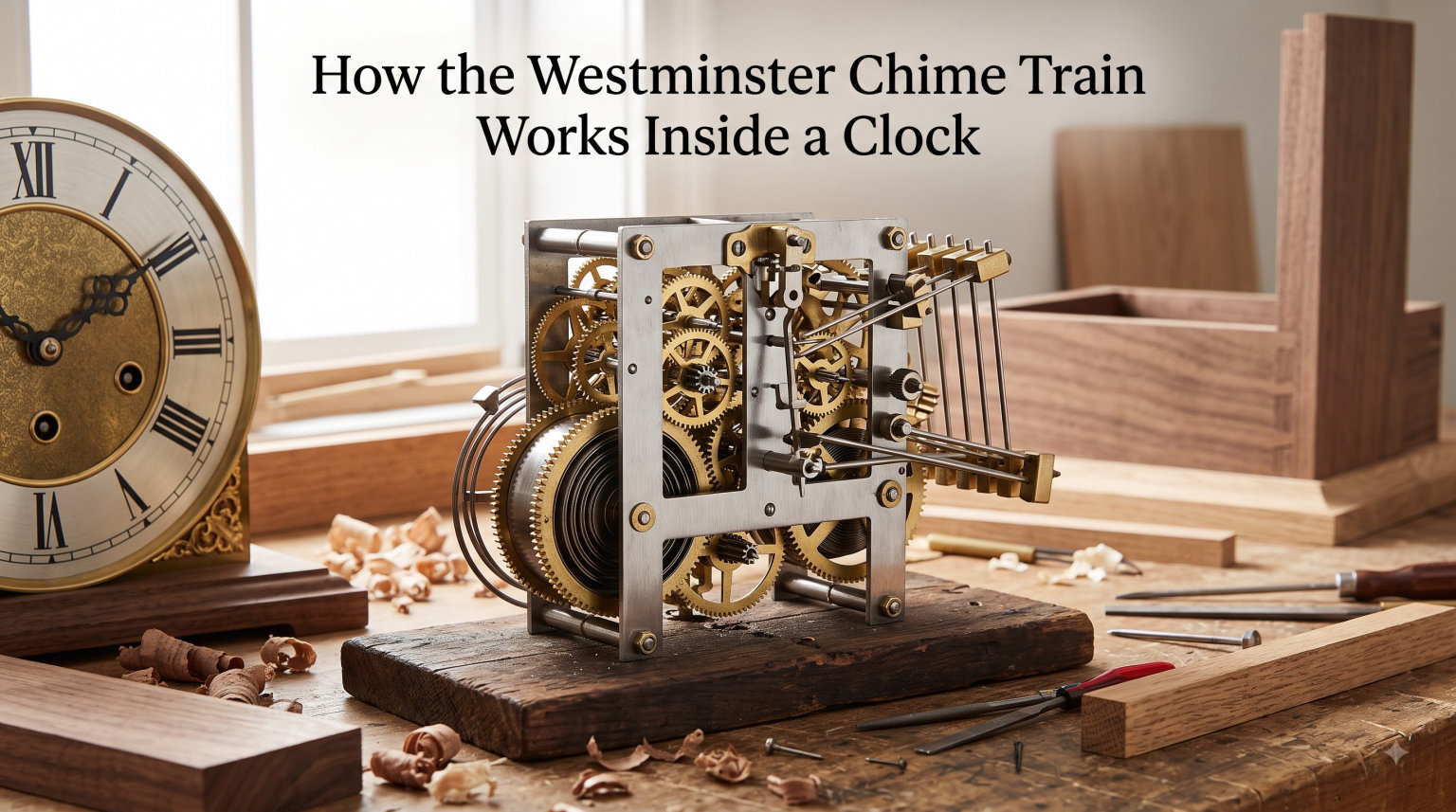
That familiar four-note melody ringing from a grandfather clock every fifteen minutes is the sound of one of the most clever mechanical systems ever built. Understanding how the Westminster chime train works inside a clock reveals a world of precision engineering where cams, pins, levers, and gears cooperate to produce perfect timing without a single electronic component. I have spent years studying, repairing, and admiring these movements, and the more I learn, the more I respect the horologists who designed them over two centuries ago.
In this guide, our team breaks down exactly how the Westminster chime train operates, component by component. You will learn what triggers the quarter-hour chimes, how the clock knows whether to play four notes or sixteen, and the remarkable auto-correction system that keeps everything synchronized. We also cover troubleshooting, maintenance, and the differences between mechanical and quartz Westminster chime clocks.
Whether you own a mantel clock, a wall clock, or a full-sized grandfather clock, the principles here apply broadly. By the end, you will understand exactly what is happening inside the case every time those hammers lift and fall.
Table of Contents
What Is the Westminster Chime? History and Origin
The Westminster chime is a four-note melody played in specific patterns at each quarter hour, most famously associated with the Great Clock of Westminster (commonly called Big Ben) in London. The tune consists of the notes G, F, E, and B, arranged in a sequence that changes slightly at each quarter to build progressively toward the full melody.
Despite the name, the melody did not originate at Westminster. It first appeared in 1793 at the Church of St. Mary the Great in Cambridge, which is why it is also known as the Cambridge Quarters. The composer is believed to be either Dr. John Randall or William Crotch, a professor of music at Cambridge. The melody was later adapted for the Great Clock of Westminster in 1859, and from that point it became inextricably linked with the clock tower itself.
The choice of these four specific notes was deliberate. They create a harmonically pleasing phrase that works in any permutation, meaning each quarter-hour variation still sounds musical. This is one reason the Westminster chime has endured for over 230 years and remains the most popular chime melody on clocks sold worldwide today.
Our team has worked with dozens of Westminster chime clocks, from antique 8-day mechanical movements to modern battery-operated quartz versions. The melody is the same, but the mechanisms producing it are fundamentally different. Before diving into those differences, let us look at how the traditional mechanical chime train actually functions.
How the Westminster Chime Train Works: Core Components
The Westminster chime train is a gear-driven power system inside a mechanical clock that controls when and how the clock plays its melody. It is one of three separate trains found in a typical Westminster chiming clock: the time train (which moves the hands), the chime train (which plays the melody), and the strike train (which counts the hours). Let us walk through each component of the chime train.
The Gear Train and Mainspring: Power Source
Every chime train starts with a power source, which is either a wound mainspring or a descending weight. When you wind a Westminster chime clock, you are storing energy in the mainspring or lifting a weight that will slowly release its energy over the next seven or eight days. This stored energy flows through a series of gears called the gear train, which reduces the high torque of the mainspring into controlled, measured rotation.
The gear train includes a great wheel, which is the largest gear directly connected to the spring barrel or weight drum. From there, power transfers through intermediate gears down to the pin drum assembly. At the end of the train sits the escapement, a small mechanism that regulates the speed of rotation and prevents the entire system from unwinding in a fraction of a second.
Without the escapement, all that stored energy would release instantly and the hammers would fire in a chaotic burst. The escapement ticks at a steady rate, ensuring the chime plays at a controlled, musical pace. This is the same principle that governs the ticking of the time train, just applied to the chime side of the movement.
The Pin Drum: The Brain of the Chime
The pin drum is a cylindrical drum covered in raised pins that acts as a mechanical programmer for the chime melody. As the pin drum rotates, these pins lift small levers connected to hammers. Each hammer corresponds to one of the chime rods tuned to a specific note. When a pin passes under a lever, it lifts the corresponding hammer, and when the pin releases, a spring drives the hammer down onto the chime rod to produce a note.
The arrangement of pins on the drum determines the entire melody. The pins are positioned so that the hammers fire in the correct order for each quarter-hour variation. A pin drum on a Westminster chime clock typically has four hammers striking four different rods, and the pin pattern encodes every note of every quarter sequence across roughly 360 degrees of rotation.
Think of the pin drum as a music box cylinder, but instead of plucking tuned teeth, it lifts hammers that strike rods. The precision required to place each pin in exactly the right position is extraordinary, which is why quality pin drums are machined to tolerances measured in fractions of a millimeter.
The Locking Plate: Controlling Run Duration
The locking plate is a notched disc that determines how long the chime train runs at each quarter hour. It has notches cut at specific positions corresponding to the quarter-hour intervals. When the chime train is at rest, a locking lever sits in one of these notches, physically blocking the gear train from turning.
Every fifteen minutes, the minute hand mechanism triggers a release. The locking lever lifts out of its notch, and the chime train begins to run. The pin drum starts rotating, and hammers begin striking notes. After the correct number of notes has played, the locking lever drops into the next notch on the locking plate, bringing everything to an immediate stop.
The depth and spacing of these notches directly control whether the clock plays four, eight, twelve, or sixteen notes. This is how the locking plate differentiates between the first, second, third, and fourth quarter sequences without any electronics or counters. It is purely mechanical programming through careful geometry.
The Center Cam and Lifting Lever: The Trigger System
The center cam is a cam mounted on the center arbor of the clock, the same shaft that carries the minute hand. This cam has four lobes positioned at 90-degree intervals, one for each quarter hour. As the minute hand turns, the center cam rotates with it, and each lobe reaches a specific position at the quarter, half, three-quarter, and full hour marks.
A lifting lever rides on the surface of this cam. When a lobe passes under the lifting lever, it raises the lever, which in turn lifts the locking lever out of its notch on the locking plate. This is the trigger that starts the chime sequence. Once the chime train has completed its run and the locking lever drops into the next notch, the system resets and waits for the next cam lobe.
This design means the chime is triggered entirely by the position of the minute hand. There is no separate timing mechanism. The same shaft that tells you the time also tells the clock when to play its melody, ensuring they can never drift apart under normal operation.
The Warning Pin and Warning Run: Preventing Misfires
The warning pin is a small pin on the gear train that catches a detent lever shortly before the chime is about to begin. This creates what clockmakers call the warning run, a short burst of activity where the gear train starts moving a few degrees before the full chime sequence begins. The purpose is to ensure that the locking lever is fully lifted and seated before the main chime run starts.
Without the warning run, the chime train might start hesitantly, producing a garbled first note or two. The warning pin catches the mechanism, lets it build momentum for a fraction of a second, and then releases it cleanly into the full sequence. This is why a well-adjusted Westminster clock produces a crisp, confident first note rather than a stumble.
If you have ever heard a clock that seems to hesitate or stutter before chiming, a misadjusted warning pin or detent is often the culprit. This is one of the most common adjustments our team makes during servicing.
The Quarter-Hour Chime Sequence Explained
The Westminster quarter chime sequence follows a precise pattern that builds from four notes at the first quarter to sixteen notes at the full hour. Each quarter adds another permutation of the four-note phrase, creating a melody that grows in complexity as the hour approaches.
At the first quarter (15 minutes past), the clock plays four notes in the sequence E, F, G, B. This is the shortest variation and serves as the opening phrase of the melody. At the half hour (30 minutes past), the clock plays eight notes, repeating the initial four-note phrase in a different order to create the second measure.
At the three-quarter mark (45 minutes past), twelve notes play, adding a third variation of the phrase. Finally, at the top of the hour, the full sixteen-note melody plays, completing all four measures of the tune. After the full Westminster chime at the hour, the strike train takes over to count the hour on a deeper-toned bell or gong.
Our team often helps clock owners who are confused because their clock seems to be playing the wrong number of notes. In most cases, the clock is perfectly fine, but the quarter sequence has gotten out of sync with the actual time. This brings us to one of the most fascinating features of the Westminster chime train.
The Hour Strike Mechanism
The hour strike is handled by a completely separate train from the chime train, called the strike train. After the full sixteen-note Westminster melody plays at the top of the hour, the strike train activates and counts the current hour by striking a bell or gong the correct number of times. At three o’clock, it strikes three times. At twelve o’clock, it strikes twelve times.
The strike train uses a counting mechanism, typically a rack and snail, to determine how many times to strike. The snail is a cam attached to the hour wheel that has twelve steps of increasing radius, one for each hour. A rack with teeth drops onto the snail, and the position of the snail determines how many teeth are available for the strike train to count.
Each tooth on the rack corresponds to one strike. As the strike train runs, a gathering pallet lifts the rack one tooth at a time, and with each lift, a hammer falls onto the bell. When the rack has been fully gathered, the strike train locks and waits for the next hour. This mechanical counting system is remarkably reliable and has been used in essentially the same form for over two centuries.
The Auto-Correction Feature: Self-Synchronizing Chimes
The auto-correction feature is a built-in mechanism that automatically brings the chime and strike sequences back into sync with the displayed time if they ever fall out of alignment. This is one of the most ingenious aspects of the Westminster chime train, and it solves a problem that would otherwise require manual intervention every time the clock was off by even one quarter.
Here is how auto-correction works. The mechanism includes a correction cam and a correction hook that compare the position of the chime locking plate with the position of the center cam. If the chime train is behind, the correction hook engages and allows the chime train to run through extra cycles until it catches up. If the chime is ahead, the mechanism skips the next quarter and waits for the clock to catch up.
In practice, this means that if your Westminster chime clock gets out of sync, you can often just leave it alone. Within two hours or less, the auto-correction feature will bring the chime sequence back into perfect alignment with the time shown on the dial. Forum users on the NAWCC message board frequently report this exact experience, noting that auto-correction typically resolves sync issues in under two hours.
This feature becomes especially valuable after you have moved the silence lever or experienced a temporary power interruption to the chime train. Rather than manually re-synchronizing everything, the clock fixes itself.
Mechanical vs Quartz Westminster Chime Clocks
Modern Westminster chime clocks come in two fundamentally different types: traditional mechanical movements and electronic quartz movements. Both produce the same familiar melody, but they achieve it through completely different means. Understanding the differences helps you appreciate the engineering in each and choose the right type for your needs.
Mechanical Westminster chime clocks use the pin drum, locking plate, and gear train system described throughout this guide. They require winding every seven or eight days and produce their sound through hammers striking tuned metal rods. The tone is warm, resonant, and physically produced by metal vibrating inside the clock case. These clocks represent centuries of refinement and offer a tangible connection to horological history.
Quartz Westminster chime clocks replace the entire mechanical chime train with a small electronic circuit and a speaker. A microchip stores a digital recording of the Westminster melody and plays it through a piezo or small speaker at the appropriate intervals. These clocks run on batteries, require no winding, and are far less expensive to manufacture. The trade-off is that the sound quality, while often quite good, lacks the acoustic richness of actual hammers striking rods.
One advantage of quartz movements is consistency. The digital recording plays the same melody every time with no variation, whereas a mechanical clock’s tone can shift slightly depending on temperature, humidity, and the condition of the movement. On the other hand, mechanical clocks can be repaired and serviced indefinitely, while quartz movements are typically replaced as a complete unit when they fail.
Our team appreciates both types for different reasons. Mechanical clocks are living machines that reward attention and care. Quartz clocks offer reliability and accessibility for anyone who wants the Westminster melody without the maintenance commitment.
Troubleshooting Common Westminster Chime Issues
When a Westminster chime clock stops playing correctly, the problem usually falls into one of a few common categories. Here are the issues our team encounters most frequently, along with practical steps to address them.
The Chime Is Out of Sync With the Time
This is the single most common complaint from Westminster clock owners. The clock shows 3:00 but plays the quarter-hour chime, or the hour strike does not match the hour hand position. In most cases, the fix is simple. If your clock has auto-correction, wait two hours and the mechanism will self-synchronize. If it does not correct itself, turn the minute hand clockwise to the next quarter and let the chime play, then continue advancing quarter by quarter until the chime sequence matches the time.
The Clock Stops Chiming Entirely
If the clock keeps time but stops chiming, the chime train may have run out of power. Check whether the chime spring needs winding. On weight-driven clocks, make sure the chime weight is properly seated and has not run down. Another possibility is that the silence lever has been engaged accidentally, which disconnects the chime train entirely. Our team has seen many cases where a clock owner moved the silence lever without realizing it would stop the chime.
The Hammers Strike the Wrong Notes or Hit Multiple Rods
If the melody sounds wrong, individual hammers may be out of adjustment. Each hammer should rest just above its corresponding chime rod, roughly 1 to 2 millimeters of clearance. If a hammer is too high, it may fail to strike. If it is too low, it may rest on the rod and dampen the note. Carefully bend the hammer wire to adjust its position, making tiny movements and testing after each adjustment.
The Chime Stutters or Hesitates Before Playing
A hesitation before the chime begins usually points to the warning pin or detent being out of adjustment. The warning run should be smooth and brief. If the mechanism struggles to gather momentum, the gear train may also need cleaning and oiling. Dirt and dried oil in the pivots create drag that the power source cannot overcome cleanly.
You Moved the Silence Lever and Now the Chime Is Wrong
This is a well-documented issue discussed extensively on clock repair forums. Moving the silence lever while the chime is in mid-sequence can leave the locking plate in the wrong position, causing the chime to play the wrong number of notes at subsequent quarters. The solution is to let the auto-correction feature handle it, or manually advance the minute hand through each quarter until the sequence realigns.
Maintenance Tips for Your Westminster Chime Clock
Proper maintenance keeps a Westminster chime train running accurately and sounding beautiful for decades. Here is what our team recommends based on years of working with these movements.
Wind on a Consistent Schedule
For spring-driven clocks, wind all three trains (time, chime, and strike) every seven days on the same day each week. Do not let the springs run fully down before winding, as this puts maximum stress on the mechanism when it restarts. Establishing a routine prevents the situation where the chime stops mid-week because only the time train was wound.
Oil the Movement Every Two to Three Years
Mechanical clock movements require periodic lubrication. Use only clock oil, never general-purpose household oil, which will gum up and attract dust. Apply a tiny drop to each pivot point in the gear train. If you are not comfortable doing this yourself, a professional clockmaker can service the movement for a reasonable cost. A well-oiled movement runs quieter, keeps better time, and lasts significantly longer.
Have the Movement Cleaned Every Five to Seven Years
Even with regular oiling, old oil eventually oxidizes and combines with dust to form an abrasive paste inside the bearing surfaces. Every five to seven years, the movement should be completely disassembled, cleaned in an ultrasonic bath, and reassembled with fresh oil. This process, called an overhaul, is the single most important factor in extending the life of a mechanical Westminster chime clock.
Keep the Clock Level
Westminster chime clocks, especially mantel and wall clocks, rely on being level to function properly. An unlevel clock causes the hammers to strike unevenly, the gear train to run with varying friction, and the entire beat of the movement to shift. Use a small level to check both side-to-side and front-to-back orientation whenever you move the clock.
Never Force the Hands
If you need to set the time, always move the minute hand clockwise and pause at each quarter to let the chime play before continuing. Never move the hands backward while the chime train is engaged, as this can damage the locking plate, bend the lifting lever, or throw the auto-correction mechanism into confusion. If you need to set the clock back, stop the pendulum, wait for the real time to catch up, and restart.
FAQs
How does a clock chime work?
A clock chime works by releasing stored energy from a wound spring or descending weight through a gear train. This power rotates a pin drum covered in raised pins that lift hammers, which then strike tuned chime rods to produce notes. A locking plate with notches controls how long the mechanism runs, determining whether 4, 8, 12, or 16 notes play at each quarter hour.
How often do you wind a Westminster chime clock?
Most Westminster chime clocks are designed as 8-day movements, meaning they need to be wound once per week. You should wind all three trains (time, chime, and strike) on the same day each week. Do not let the springs fully run down before winding, as restarting from zero puts extra stress on the mechanism.
How to fix clock chime mechanism?
Start by checking if the silence lever is engaged or if the chime spring needs winding. If the chime is out of sync, advance the minute hand clockwise through each quarter and let the chime play at each stop until the sequence matches the time. For hammers striking wrong notes, gently bend the hammer wires to adjust clearance above each chime rod. If problems persist, the movement may need cleaning and oiling by a professional.
What is the difference between Westminster and Whittington chimes?
The Westminster chime plays four notes (G-F-E-B) in progressively longer sequences at each quarter, building from 4 to 16 notes across the hour. The Whittington chime is a different melody based on changes ringing from St. Mary le Bow church in London, using a longer and more complex sequence of notes. Westminster is the most common chime on consumer clocks, while Whittington appears on higher-end triple-chime movements.
Is it okay to move clock hands backwards?
No, you should never move the hands backwards on a mechanical Westminster chime clock while the chime train is engaged. Forcing the hands backward can damage the locking plate, bend the lifting lever, and disrupt the auto-correction mechanism. Always move the minute hand clockwise, pausing at each quarter to let the chime complete. If you must set the clock back, stop the pendulum and wait for real time to catch up.
Conclusion
Understanding how the Westminster chime train works inside a clock transforms that familiar melody from a simple sound into an appreciation of genuine mechanical artistry. The pin drum, locking plate, center cam, warning pin, and auto-correction feature work together with no electronics, no batteries, and no digital programming to produce perfect music on schedule, week after week, year after year.
Whether you are troubleshooting an out-of-sync chime, deciding between a mechanical or quartz movement, or simply curious about what happens inside the case, the principles in this guide give you the foundation to work confidently with Westminster chime clocks. Take care of the movement, keep it wound and oiled, and it will reward you with that timeless four-note melody for generations.