
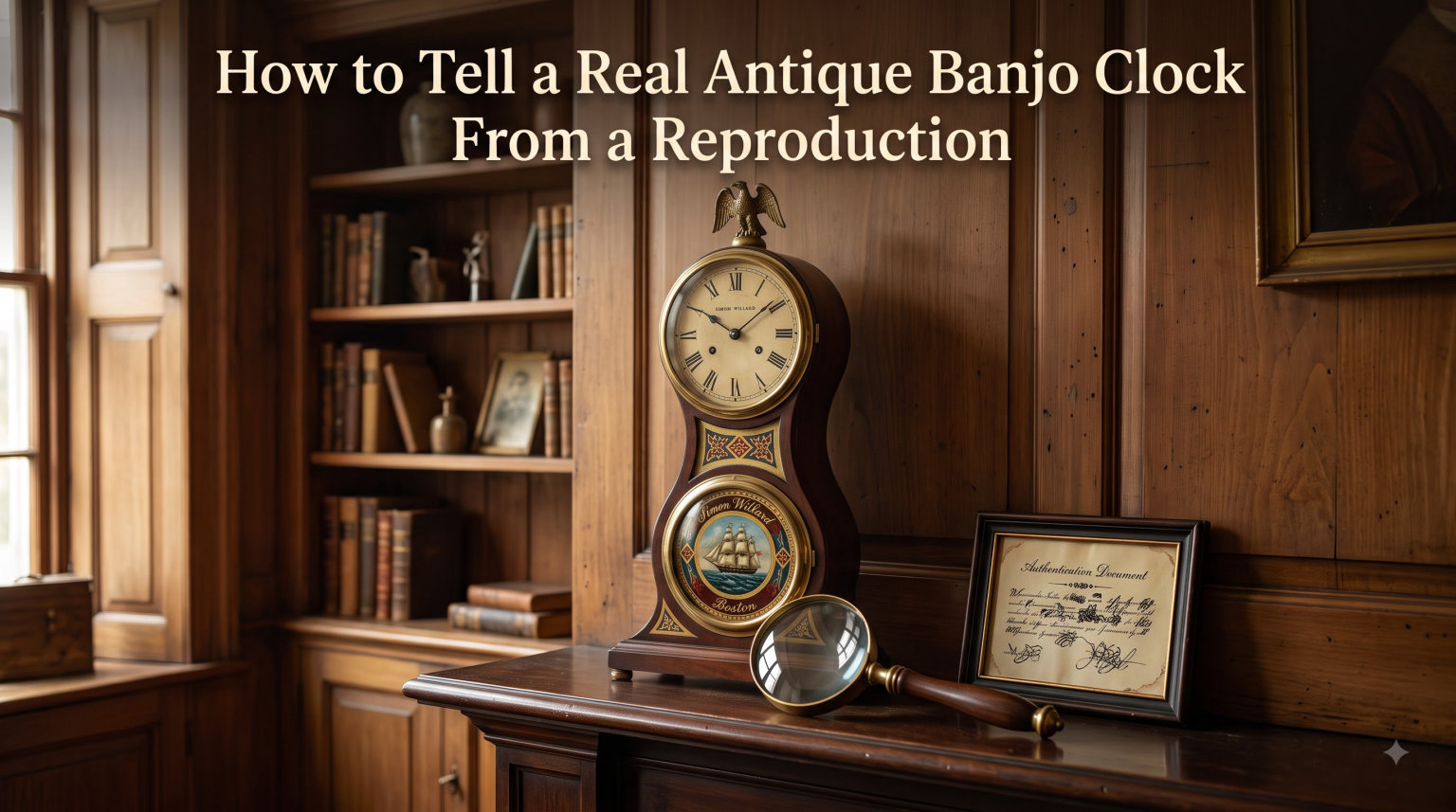
Antique banjo clock authentication is a skill that separates a genuine Federal-era treasure from a convincing reproduction worth a fraction of the price. If you have inherited a banjo-shaped wall clock, spotted one at an estate sale, or are considering a purchase from an antique dealer, knowing what to look for can save you thousands of dollars and deep regret.
I have spent years studying Simon Willard patent timepieces, talking with NAWCC members, and examining dozens of clocks side by side. The authentication process comes down to checking a handful of specific markers on the movement, the case, the dial, and the painted glass tablets. Once you know what an authentic banjo clock should look like inside and out, the reproductions become far easier to spot.
This guide walks you through every step of the process. You will learn the history behind these clocks, the anatomy you need to understand before inspecting one, and the exact authentication markers that separate an original from a copy. I will also cover common reproduction tells, value factors, and when it makes sense to call in a professional appraiser.
Whether you are a seasoned collector or someone who just inherited a clock from a grandparent and has no idea what they are holding, this guide will give you the confidence to evaluate any banjo clock that crosses your path in 2026 and beyond.
Table of Contents
The History of Banjo Clocks and Simon Willard
The banjo clock traces directly back to Simon Willard of Grafton, Massachusetts, who patented his improved timepiece design on February 8, 1802. Willard called his creation a “patent timepiece,” and the patent gave him exclusive rights to the design for a period of years. The name “banjo clock” came later, coined by collectors who noticed the case shape resembled the musical instrument.
Before Willard’s invention, most American households relied on tall case clocks, which were expensive, floor-standing, and required significant space. Willard designed a compact wall clock that used a weight-driven eight-day movement, meaning it only needed winding once a week. The efficient movement, combined with the elegant Federal-style case, made accurate timekeeping accessible to a broader segment of the American middle class.
Willard’s workshop in Boston and later Roxbury produced these patent timepieces from the early 1800s through the 1840s. His sons, particularly Simon Willard Jr. and Aaron Willard Jr., continued the family tradition and produced their own variations. Apprentices and competitors in the Boston area also created banjo-style clocks, which means not every authentic antique banjo clock came directly from Simon Willard Senior’s hands.
Understanding this history matters for authentication because it tells you the time period, the geographic origin, and the range of makers you should expect to find. An authentic banjo clock from the Federal period (roughly 1802 through 1840) will reflect the materials, construction methods, and decorative styles available in early nineteenth-century New England. If the clock shows signs of modern manufacturing, it cannot be a genuine period piece.
The patent timepiece design was widely admired and frequently copied, even during Willard’s lifetime. After the patent expired, other clockmakers produced similar designs throughout the nineteenth and early twentieth centuries. The most common reproductions and revivals date from the late 1800s through the mid-1900s, and modern replicas continue to be manufactured today. This long history of copying is exactly why authentication skills are so important.
Banjo Clock Anatomy: Understanding the Parts
Before you can authenticate a banjo clock, you need to understand its anatomy. The banjo-shaped case consists of three main sections, and each one carries authentication clues.
The top section is the drum head, a circular housing that contains the clock movement. The drum head holds the circular dial, the brass bezel that frames it, and the glass door that protects the dial face. The movement sits behind the dial, and this is where most authentication evidence lives.
The middle section is the throat, the long narrow portion that connects the drum head to the bottom section. On authentic Willard patent timepieces, the throat often features a reverse-painted glass tablet with decorative designs. The throat also houses the pendulum rod, which drops down from the movement to the pendulum bob below.
The bottom section is the pendulum box or lower box, a rectangular compartment where the pendulum swings and the driving weight descends. This section typically has a glass door on the front, often with another reverse-painted tablet. The weight cord runs through the throat and into this lower compartment.
Additional terms you will encounter include the brass bezel (the ring that holds the glass over the dial), the reverse-painted glass tablets (decorative panels painted on the back side of the glass), and the back plate (the brass plate on the movement where maker’s marks and signatures are typically found). Knowing these terms will help you follow the inspection steps that follow and communicate effectively with appraisers or dealers.
How to Tell a Real Antique Banjo Clock From a Reproduction: Key Authentication Markers
The most reliable way to tell a real antique banjo clock from a reproduction is to examine the maker’s signature, the movement markings, the case materials, and the aging patterns on all components. Each of these markers tells a story, and when they all align with the early nineteenth century, you can be confident in authenticity. When they conflict, you are likely looking at a reproduction or a heavily altered clock.
Examine the Maker’s Signature
An authentic Simon Willard signature is painted or inked directly on the dial beneath the original varnish layer. The signature should show natural aging consistent with a 200-year-old surface, including subtle crackling, slight fading, and a patina that developed over decades. The signature should not sit on top of cracks, chips, or worn areas, which would indicate it was applied after the dial aged.
Reproductions often feature signatures that look too crisp, too uniform, or too freshly applied. If you see a signature painted over existing craquelure or sitting on top of a chip, that is a major red flag. An authentic signature was applied when the dial was new, so the aging should affect the signature and the surrounding paint equally.
Check the Back Plate for Maker’s Marks
The brass back plate on the movement is where clockmakers stamped their marks, initials, or serial numbers. Simon Willard and his workshop used specific stamping conventions that experts can identify. Look for hand-stamped initials, die-stamped maker names, or serial numbers that match known Willard formats.
Modern reproductions may have engraved or etched marks that look different from hand-stamped originals. Hand stamping leaves slightly irregular impressions with displaced metal around the edges. Modern engraving tools create cleaner, more uniform lines that simply did not exist in the early 1800s.
Assess the Patina on Brass Components
Genuine antique brass develops a specific patina over two centuries that cannot be convincingly faked with chemical treatments. The brass bezel, the movement plates, and the pendulum bob should all show consistent aging. Look for a warm, mellow tone with subtle oxidation rather than a forced green or artificially darkened surface.
If the brass looks freshly polished in some areas and dark in others without a logical reason, someone may have tried to create a false patina. Authentic patina develops uniformly across surfaces exposed to the same environment.
Inspect the Reverse-Painted Glass Tablets
The reverse-painted glass tablets on authentic banjo clocks show period-appropriate designs, pigments, and painting techniques. Early nineteenth-century tablets use specific color palettes and design motifs that reflect Federal-era taste. The paint should show natural aging, including slight fading, crackling, or minor losses consistent with age.
Reproduction tablets often use modern paints that age differently from period pigments. The designs may be more elaborate or less detailed than authentic examples, and the painting technique may appear too uniform or mechanical.
Movement Inspection: What Is Inside the Case
The movement is the heart of any banjo clock, and it holds some of the strongest authentication evidence. To inspect the movement, you need to carefully open the clock case and access the drum head compartment. If you are not comfortable doing this yourself, a clockmaker or appraiser can handle it for you.
Identify a Weight-Driven Eight-Day Movement
Authentic Simon Willard patent timepieces use weight-driven eight-day movements. This means a heavy brass weight provides the power, and the clock runs for approximately eight days on a single winding. The weight cord winds around a barrel in the movement, and gravity pulls the weight down over the course of the week.
Reproductions, particularly those from the twentieth century, often use spring-driven movements instead. If you find a mainspring where a weight barrel should be, the movement is likely not original to an early Willard patent timepiece. Some high-quality reproductions do use weight-driven movements, so this is not conclusive on its own, but a spring-driven movement in a case that claims to be early Willard is an immediate red flag.
Examine the Gear Train and Escapement
The gear train on an authentic early nineteenth-century movement will show hand-finishing marks, slightly irregular tooth profiles, and brass that has aged naturally. The escapement, which regulates the timekeeping, should match known Willard designs. The dead-beat escapement was a signature feature of Willard’s patent timepieces, providing the accuracy that made these clocks famous.
Modern gear trains use machine-cut gears with perfectly uniform teeth. While some early industrial-era clocks had semi-machined gears, the finishing marks should still reflect the manufacturing methods of the period. If the gears look too perfect or the brass is too bright, the movement may be modern.
Look for Serial Numbers and Construction Details
Simon Willard and his workshop stamped serial numbers or assembly marks on movement components. These marks help match the movement to specific production periods. The back plate should show hand-stamped markings, and internal components may have scribed reference marks used during assembly.
The winding arbor, where the winding key inserts, should show wear consistent with decades of weekly winding. The arbors on reproductions often look too clean or show the wrong type of wear pattern. Original arbors develop a specific polished wear pattern from the key that differs from modern reproductions.
Case Construction and Materials: What Authentic Wood Looks Like
The wooden case of an authentic banjo clock carries its own set of authentication markers. Simon Willard and his contemporaries used specific materials and construction techniques that reflect early nineteenth-century cabinetmaking practices.
Evaluate the Veneer and Wood Species
Authentic Federal-period banjo clocks typically feature mahogany veneer over a primary wood case, often pine or another inexpensive domestic wood. The veneer should show natural aging, including patina development, minor shrinkage cracks, and color changes consistent with two centuries of exposure. Figure grain patterns in the veneer should match period expectations for figured mahogany.
Reproductions may use thinner modern veneer, different wood species, or artificially aged finishes. If the veneer looks too uniform, too thick, or has a modern adhesive pattern visible from the back, the case is likely not period.
Check the Joinery and Hardware
Hand-cut joinery is a hallmark of early nineteenth-century cabinetmaking. Look at the joints connecting the case sections, the door construction, and how the backboard attaches. Authentic banjo clocks use hand-cut screws, forged nails, and hand-fitted joints that show slight irregularities from being made by hand.
Machine-cut screws, which have uniform threads and perfectly centered slots, did not become common until after the Civil War. Finding Phillips-head screws or wire brads in a clock claiming to be from 1802 is an instant giveaway that the piece is a reproduction or has been significantly altered.
Examine the Finish
The original finish on an antique banjo clock is typically shellac or a natural varnish. Over two centuries, this finish develops crazing (fine crack patterns), mellows in color, and may show wear from handling and environmental exposure. The finish should look consistent across the case, with natural variation in high-wear areas like edges and corners.
Modern finishes, including polyurethane and lacquer, look and feel different from period shellac. They do not craze the same way and often have a plastic-like appearance. If the finish looks too glossy, too uniform, or does not show any crazing, it may be a modern application.
Common Reproduction Tells: Red Flags That Scream Fake
Certain warning signs appear again and again on reproduction banjo clocks. Knowing these tells can help you quickly filter out obvious copies and focus your attention on clocks that warrant closer inspection.
Modern Screws and Hardware
Phillips-head screws, wire brads, and stamped metal brackets are modern hardware that should never appear on a genuine early nineteenth-century banjo clock. If you see any of these inside the case or on the backboard, the clock is either a reproduction or has been substantially reworked. Check the hinges, the backboard attachment points, and any mounting hardware.
Freshly Applied Signatures on Aged Surfaces
One of the most common reproduction tricks is applying a fake Simon Willard signature to an old dial or case. If the signature looks newer than the surrounding surface, sits on top of cracks or wear, or uses ink that has not aged with the rest of the piece, it was likely added to deceive. A loupe or magnifying glass can reveal whether the signature is under or over the original varnish layer.
Uniform or Artificially Accelerated Patina
Authentic patina develops unevenly because different surfaces receive different amounts of handling, light exposure, and air circulation. A clock with perfectly uniform darkening across all brass components may have been chemically treated to simulate age. Real aging creates variation, and the absence of that variation is suspicious.
Wrong Movement Type in the Case
If a clock case is styled as an early Willard patent timepiece but contains a spring-driven movement, the movement is either a replacement or the entire clock is a reproduction. Weight-driven movements leave specific marks inside the case, including wear patterns from the weight cord and mounting points for the weight barrel. If these signs are absent, the case and movement may not be an original pairing.
Suspicious Provenance or Pricing
A genuine Simon Willard patent timepiece in good original condition commands a significant price. If a dealer is offering one at a surprisingly low price with a vague story about its history, proceed with extreme caution. Authentic clocks typically come with some form of provenance, whether that is family history, prior sale records, or appraisal documentation. A complete lack of history combined with a bargain price is a red flag.
Value Assessment: What Makes a Banjo Clock Worth Money
Several factors determine what an authentic banjo clock is worth. The most valuable clocks are those made by Simon Willard himself or his immediate family members, in original condition with original components, and with documented provenance.
Maker attribution is the single biggest value driver. A clock signed by Simon Willard Sr. commands the highest premium, followed by those signed by his sons and close associates. Clocks by other Boston-area makers of the period are also valuable but typically less so than Willard-signed pieces.
Original condition matters enormously. A clock with its original movement, dial, tablets, and finish is worth more than one that has been restored or had parts replaced. Even sympathetic restoration can reduce value compared to an untouched original. Collectors prize clocks that have aged naturally without intervention.
Provenance documentation adds value and confidence. A clock with a documented chain of ownership, prior appraisal records, or exhibition history carries a premium over a clock with no history. If you are buying, ask for any documentation the seller can provide.
Decorative elements also affect value. Elaborate reverse-painted tablets, gilded case elements, and unusual design features can increase desirability among collectors. Rarity of the design and the condition of these decorative elements both factor into the final valuation.
When to Seek Professional Authentication
If you are evaluating a clock with significant potential value, professional authentication is worth the investment. A mistake in judgment can cost you far more than the appraisal fee.
The National Association of Watch and Clock Collectors (NAWCC) is the premier resource for clock authentication in the United States. NAWCC members include leading experts on Simon Willard and American Federal-era clocks. The organization’s forums provide a community where experienced collectors offer guidance based on photographic evidence.
For high-value clocks, consider hiring a certified appraiser who specializes in early American timepieces. A professional appraisal provides documentation that supports insurance coverage, estate valuation, and resale. The cost of an appraisal is typically a small fraction of the clock’s value.
You should also seek expert help if the authentication markers are ambiguous or conflicting. Some clocks are genuinely difficult to evaluate because they have had legitimate period repairs or replacement parts installed decades ago. An expert can distinguish between period repairs and modern alterations.
Conservation vs Restoration: Preserving Authenticity
One important distinction that comes up frequently in the collector community is the difference between an authentic clock with replaced parts and an outright fake. A clock that had a damaged part replaced fifty or a hundred years ago is still authentic. It is not a reproduction. A fake is an item deliberately made to deceive buyers into thinking it is something it is not.
Conservation focuses on preserving the original materials and preventing further deterioration. This might involve stabilizing a loose veneer piece, cleaning a movement carefully, or protecting the surface from environmental damage. Conservation maintains the clock’s authenticity and value.
Restoration involves replacing or repairing components to return the clock to working or visual condition. While some restoration is necessary to keep a clock running, excessive restoration can reduce collector value. If you own an authentic banjo clock, consult a horological conservator before making any changes to the original materials.
FAQs
How much is a banjo clock worth?
An authentic Simon Willard patent timepiece in good original condition can range from several thousand dollars to over $50,000 depending on maker attribution, condition, provenance, and decorative features. Clocks by other makers or those with replaced parts are worth significantly less. Professional appraisal is recommended for accurate valuation.
When were banjo clocks made?
Banjo clocks were invented by Simon Willard, who received his patent on February 8, 1802. Authentic period examples were produced from 1802 through the 1840s by Willard and his contemporaries. Later reproductions and revivals were made from the late 1800s through the mid-twentieth century, and modern replicas are still produced today.
How to tell if an antique clock is valuable?
A valuable antique clock will have an attributed maker, original components and finish, documented provenance, and period-appropriate construction. Check for hand-stamped maker’s marks on the movement, natural patina on brass and wood, hand-cut screws, and consistent aging across all components. Consult NAWCC resources or a certified appraiser for confirmation.
How do you identify a clock manufacturer?
Look for the maker’s signature on the dial, stamped marks on the brass back plate of the movement, serial numbers, and construction details consistent with known makers. Simon Willard and his workshop used specific stamping conventions and movement designs that experts can identify. Compare these against reference materials from NAWCC or museum collections.
How old are banjo clocks?
The oldest authentic banjo clocks date to 1802, when Simon Willard received his patent for the timepiece design. Period examples from the Willard workshop and contemporaries were made through the 1840s. This means genuine antique banjo clocks are over 180 years old, with the earliest examples now exceeding 220 years of age.
Conclusion
Telling a real antique banjo clock from a reproduction comes down to careful inspection of the signature, the movement markings, the case construction, and the aging patterns across all components. The steps in this guide give you a framework for evaluating any banjo clock you encounter, whether at an estate sale, an antique shop, or in a family inheritance.
When the authentication markers all point to the early nineteenth century, you may be looking at a genuine Simon Willard patent timepiece. When the signs conflict, take your time, ask questions, and do not be afraid to walk away or seek a second opinion from the NAWCC community or a certified appraiser. The cost of professional authentication is always lower than the cost of a costly mistake.