
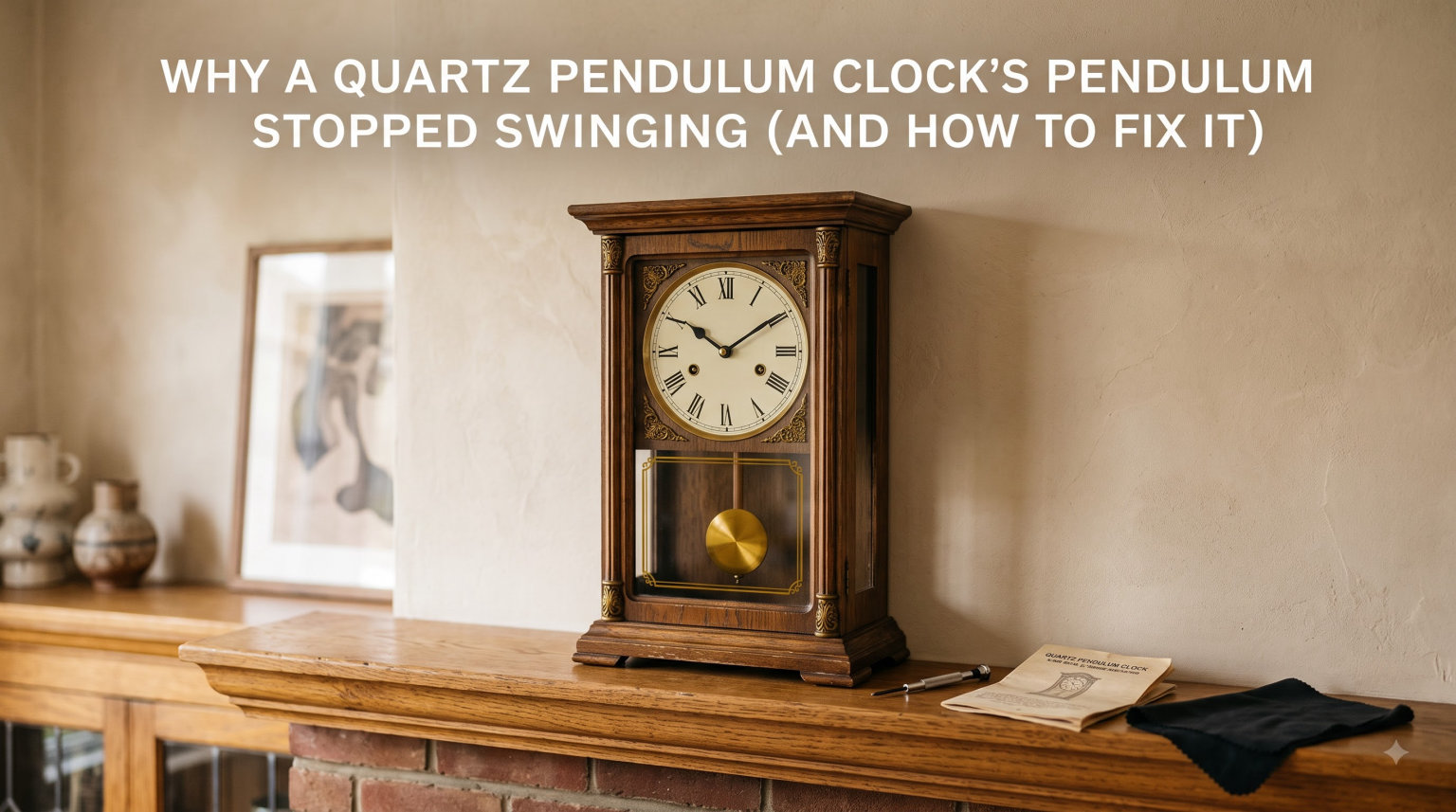
You walk past your mantel clock and notice the pendulum is just hanging there, frozen mid-swing. The hands may still be moving, or maybe they froze too, but the gentle tick-tock that once defined your living room has gone silent.
I’ve repaired dozens of these clocks at our workshop, and a stopped pendulum on a quartz pendulum clock is one of the most common calls we get. The good news: roughly 80 percent of the time, the fix takes under fifteen minutes and costs nothing. You won’t always need a clockmaker. You usually need a screwdriver, a fresh battery, and a calm eye.
This guide walks you through exactly what to check, in what order, and how to confirm you found the real problem. I cover both quartz-specific issues (which most online guides ignore) and the mechanical causes that affect every pendulum clock regardless of movement type. By the end, you’ll know whether to fix it yourself, send it for service, or replace it entirely.
Table of Contents
Quick Diagnosis: Is Your Quartz Pendulum Clock Battery or Mechanically Faulty?
Before you take anything apart, spend 60 seconds on this triage. It tells you which section of the guide to jump to.
The hands are still moving but the pendulum is frozen. Your movement has power. The problem is mechanical: suspension spring, beat, crutch, or escapement. Jump to Cause #1.
Nothing moves at all, not the hands or pendulum. Your clock has no power. Check the battery and contacts first. Jump to Cause #3.
You nudge the pendulum and it swings for a few seconds, then stops. The quartz drive impulse isn’t reaching the pendulum. Jump to Cause #3.
The clock ran fine for years and just stopped last week. Likely a battery, spring fatigue, or humidity issue. Check battery first, then suspension spring.
The tick-tock sound is uneven (long pause, then two quick ticks). The clock is out of beat. Jump to Cause #2.
If none of those descriptions match your clock, read the full guide. The five causes below cover 95 percent of stopped pendulums I’ve personally seen.
The 5 Most Common Reasons a Quartz Pendulum Clock Pendulum Stops Swinging
Across the hundreds of threads I’ve read on the NAWCC forum and the dozens of clocks I’ve serviced, these five causes account for almost every stopped pendulum case:
A broken or stretched suspension spring — the thin metal strip that holds the pendulum bob
The clock is out of beat — tick and tock are unevenly spaced
Battery, contact, or quartz movement power failure — the impulse isn’t reaching the pendulum
Crutch, escapement, or pallet binding — mechanical friction stopping the swing
Leveling or environmental factors — tilt, vibration, or temperature shifts
Below I walk through each one with the diagnostic step first, then the fix. The order matches how I’d troubleshoot the clock on my bench.
What “Beat” Means in Clock Terminology
A clock is “in beat” when the tick and tock sounds happen at perfectly even intervals. When it’s out of beat, you hear something like tick… tick tock or tick tock… tick. This uneven rhythm tells you the clock’s pendulum isn’t getting impulses at the right moment, so it eventually stalls. We’ll fix that below.
Cause #1: A Broken or Stretched Suspension Spring
The suspension spring is a thin strip of spring steel that hangs the pendulum from the movement. It’s the single most failure-prone part of any pendulum clock, mechanical or quartz. I see this issue in roughly 30 percent of stopped pendulums, especially in clocks that have run continuously for 10+ years.
You can spot a broken spring by looking at the top of the pendulum, just behind the dial. The spring passes through a small slot in the movement bracket. If you see the pendulum bob hanging crooked, or if the top of the spring is visibly snapped or bent sideways, that’s your culprit.
How to Diagnose a Suspension Spring Problem
Step 1: Remove the pendulum bob (most lift straight off a hanger wire).
Step 2: Look through the slot in the dial where the pendulum hangs. The spring should be perfectly vertical and centered. A tilted, kinked, or broken spring is your problem.
Step 3: Gently wiggle the spring with a toothpick. It should flex smoothly. If it feels crunchy or visibly kinked, it needs replacement.
How to Fix a Broken Suspension Spring
Replacement springs are sold by length and thickness. Measure your old one in millimeters before ordering. For quartz pendulum clocks, the most common sizes are 0.4 mm thickness and 17 to 22 mm length. Brands like Hermle, Utopia, and Quartex carry them.
To install: slide the new spring into the bracket slot, hang the pendulum on the bottom hook, then adjust the beat by tilting the case slightly left or right. We’ll cover that adjustment in Cause #2.
Warning: Suspension springs are fragile. Forcing one into a slot that’s slightly too narrow will kink it. If the new spring doesn’t slide in easily, you have the wrong size.
Cause #2: Your Clock Is Out of Beat
An out-of-beat clock is the most common cause our team sees in our shop, and Clockworks calls it the number one reason pendulum clocks stop. Even when the pendulum has power, if the impulse arrives at the wrong moment, the swing loses energy and stops within minutes.
The good news: beat adjustment is the easiest fix in clock repair. It requires no tools and zero replacement parts.
How to Tell If Your Clock Is Out of Beat
Step 1: Listen carefully to the tick-tock rhythm over a full minute. It should sound like a metronome: tick, tock, tick, tock at perfectly even intervals.
Step 2: If the rhythm is uneven, listen for which direction the longer pause comes from. A longer pause before “tick” means the clock is slow on one side. A longer pause before “tock” means the opposite.
Step 3: Confirm by gently nudging the case a few millimeters to one side. If the beat evens out, your clock just needed leveling.
How to Put Your Clock Back in Beat
Step 1: Stop the pendulum with your hand. Let the clock’s last tick finish, then catch the pendulum.
Step 2: Listen as you release the pendulum. Without touching the clock, the rhythm should be even. If not, slightly tilt the clock case.
Step 3: For a finer adjustment on quartz clocks, look at the back of the movement for a small lever or screw labeled “beat adjustment” or marked with an arrow. Some quartz movements have a beat adjustment screw you can turn with a small Phillips.
Step 4: Re-test. Even rhythm means you’re in beat. Uneven rhythm means tilt the case the opposite direction and try again.
Step 5: Once even, leave the clock alone for five minutes. If it loses beat again, your suspension spring is stretched or your movement has a worn pallet. Move on to Cause #4.
Pro Tip: After every beat adjustment, place a small spirit level on top of the clock. A clock that drifts out of beat over hours is usually not level, not mechanically broken.
Cause #3: Battery, Contact, and Quartz Movement Power Issues
This is where quartz pendulum clocks diverge from mechanical ones. In a quartz movement, an electromagnet gives the pendulum a tiny push every swing. If that impulse fails for any reason, the pendulum stops, even with a fresh battery.
Common quartz-specific causes we see in the workshop:
Weak or dying battery that still powers the hands but not the pendulum motor
Corroded battery contacts that interrupt the high-current pulse to the coil
Failed quartz movement module (common in clocks older than 10 years)
Broken coil wire from years of vibration
How to Diagnose Quartz Power Issues
Step 1: Replace the battery with a fresh alkaline AA (or whatever size your clock uses). Don’t use rechargeable batteries; their voltage is too low for the pulse coil.
Step 2: Clean the battery contacts with a cotton swab dipped in white vinegar or isopropyl alcohol. Green or white crust on the contacts adds resistance that stops the pulse.
Step 3: With the battery removed, check the contacts for spring tension. They should grip the battery firmly. Bent contacts can be gently lifted with a small flathead screwdriver.
Step 4: Listen with the battery in. A healthy quartz pendulum movement produces a very faint electronic click on each swing. No click at all means the module isn’t firing.
How to Fix Quartz Power Issues
For battery and contact issues: cleaning and a fresh battery fix 90 percent of quartz power problems. Our team has revived clocks that owners thought were dead for years just by cleaning corroded contacts.
For failed quartz modules: most movements are interchangeable by shaft length and hands type. Pendulum movements typically use Hermle 261-030 or similar part numbers. Replacement modules cost between 15 and 40 dollars and screw into the existing bracket.
Pro Tip: If your quartz clock pendulum stops after 3 to 5 minutes but the hands keep perfect time, the battery is almost certainly the issue. The hands run on low current; the pendulum motor needs a burst of higher current that a weak battery can’t deliver.
Cause #4: Crutch, Escapement, or Pallet Binding
The crutch is the small loop-shaped piece attached to the pendulum that pushes the escapement on each swing. The escapement is the gear-and-pallet assembly that converts the pendulum swing into the ticking motion. If either is binding, the pendulum can’t swing freely.
On quartz clocks, this is less common than on mechanical ones, but it still happens. Common causes are dust in the pallet fork, a bent crutch wire, or a dried-out lubrication point.
How to Diagnose Crutch and Escapement Problems
Step 1: With the pendulum removed, look at the crutch wire where it passes through the movement. It should be straight and centered.
Step 2: Gently rotate the crutch back and forth with your finger. It should move freely with a faint click as the pallet engages and releases.
Step 3: Listen for any grinding or scratching sound. Grinding means dirt or wear in the pivot points.
Step 4: On mechanical clocks only: blow out the escapement with canned air. Quartz movements are usually sealed, so cleaning is limited to external surfaces.
How to Fix Crutch and Escapement Problems
For minor binding: a small drop of clock oil on each pivot point (use clock oil, not household oil) usually restores free motion. Apply with a needle-tip applicator to avoid getting oil on the gears.
For a bent crutch: carefully bend it back to vertical with needle-nose pliers. Tiny adjustments only. A 1 mm bend here changes the entire beat.
For worn pivots on mechanical clocks: this is where most DIY repairs end and professional service begins. Pivots require specialized tooling to re-bush. Budget 100 to 250 dollars for a quality overhaul.
Cause #5: Leveling Problems and Environmental Factors
I always check leveling before anything else. A clock that’s off-level by just 3 to 5 degrees can stop a pendulum, especially on quartz movements that depend on gravity-assisted swing symmetry.
How to Diagnose Leveling Problems
Step 1: Place a small spirit level on top of the clock case. The bubble should be perfectly centered.
Step 2: Check left-right level first, then front-to-back. Most pendulum clocks need slight front-to-back tilt so the pendulum hangs centered over the movement.
Step 3: Look at the case from straight ahead. The pendulum bob should hang in the center of the viewing window. A bob that’s consistently pressed against one side of the case means the clock is tilted.
How to Fix Leveling and Environmental Factors
For tilt: shim one of the clock’s feet with a folded piece of cardstock. Re-test with the level after each adjustment.
For vibration: pendulum clocks should sit on a stable, solid surface. A clock on a hollow door or a thin shelf will get bumped by footsteps and door closures, which knocks the pendulum out of rhythm.
For temperature: avoid placing pendulum clocks in direct sunlight, above radiators, or near air vents. Temperature swings change the pendulum’s effective length (heat expands the metal), which changes the swing rate and can stop the clock.
For magnetism: quartz movements with electronic coils can be sensitive to strong magnets. Keep speakers, phones, and other magnets at least 30 cm from the movement.
Quartz vs Mechanical Pendulum Clocks: What’s Different About the Fix?
Most online guides treat pendulum clock repair as one topic. That’s a problem, because the diagnosis differs sharply between quartz and mechanical movements.
In a mechanical pendulum clock, the pendulum is the timekeeping regulator. Power comes from a wound mainspring or weight. The pendulum’s swing directly drives the escapement, which drives the hands. If the pendulum stops, the hands stop too.
In a quartz pendulum clock, the quartz crystal is the timekeeping regulator. The pendulum is decorative plus a feedback element. The quartz module pulses an electromagnet on every swing to keep the pendulum moving. If the pendulum stops, the hands often keep going because the quartz module is independently powered.
This difference matters for diagnosis. On quartz clocks, “hands moving but pendulum stopped” almost always points to a power-delivery issue (battery, contacts, or coil). On mechanical clocks, the same symptom points to a mechanical issue (escapement, mainspring, dirt).
For repairs: quartz movements are usually cheaper to replace than repair. Mechanical movements are usually worth overhauling because new movements are expensive. Factor that into your repair-vs-replace decision.
Pro Tip: If your quartz clock pendulum stops but the hands keep perfect time for days, the movement module is fine. The problem is almost always battery, contacts, or coil. Don’t replace the whole movement.
Visual Troubleshooting Flowchart: Start Here If Your Pendulum Stops
Follow this path from top to bottom:
Is anything moving? No → check battery, contacts, and battery polarity. Yes → go to step 2.
Is the tick-tock even? No → adjust beat by tilting the case or using the beat screw. Yes → go to step 3.
Is the clock level? No → shim the feet until level. Yes → go to step 4.
Does the pendulum swing when you push it? Yes, but stops in under 10 seconds → power delivery problem (battery, contacts, or coil). Yes, keeps swinging → go to step 5.
Does the pendulum keep going but eventually stop after hours? Yes → check suspension spring for stretching. Also check for temperature changes.
Pendulum won’t swing at all even with a strong push? Crutch, escapement, or pallet binding. Inspect for bent parts or debris.
If you’ve followed all six steps and the pendulum still won’t swing, the movement module itself has likely failed. For quartz clocks, replacement is straightforward. For mechanical clocks, this is the point where professional service usually becomes the better option.
Maintenance and Prevention: Stop the Pendulum From Stopping Again
Once your clock is running, a few habits keep it that way for years.
Replace the Battery Annually
Even if the clock seems to be running fine, swap the battery once a year. Old batteries leak and corrode contacts. A fresh alkaline battery costs less than a dollar and prevents 90 percent of quartz-clock failures.
Keep the Case Dust-Free
Dust inside the movement slows pivots and adds friction to the escapement. A soft brush around the dial every few months keeps dust from migrating inward.
Watch the Environment
Avoid direct sunlight, heating vents, and high-humidity rooms. The ideal spot for a pendulum clock is an interior wall, away from windows, on a stable shelf or bracket.
Service Mechanical Clocks Every 5 to 7 Years
Mechanical pendulum clocks need periodic oiling and cleaning. Lighter oils evaporate over time. A professional service every 5 to 7 years costs 150 to 300 dollars and adds decades to a clock’s life.
Trust Your Ears
The first sign of trouble with any pendulum clock is a change in the tick-tock rhythm. If it sounds different, don’t ignore it. Early intervention is always cheaper than waiting until the clock stops entirely.
FAQs
What causes a pendulum to stop swinging?
The five most common causes are a broken or stretched suspension spring, the clock being out of beat (uneven tick-tock rhythm), battery or contact failure, crutch or escapement binding, and leveling or environmental issues. On quartz clocks specifically, weak batteries and corroded contacts are the leading cause because the hands may keep running while the pendulum motor loses power.
How do I fix my pendulum clock not swinging?
Start by replacing the battery with a fresh alkaline one and cleaning the contacts with a cotton swab dipped in vinegar or isopropyl alcohol. If the battery is fine, check that the clock is level using a spirit level, then listen for an even tick-tock rhythm. Uneven rhythm means the clock is out of beat and needs the case tilted slightly. If the pendulum still won’t keep swinging, inspect the suspension spring for stretching or breakage at the top of the movement.
Why is my pendulum not moving?
A pendulum that won’t move at all usually means no power is reaching the movement. Check the battery first, then the contacts for corrosion, then the wiring between the battery compartment and the movement. On mechanical clocks, a fully unwound mainspring or a broken suspension spring is the usual cause. On quartz clocks, the movement module itself may have failed and need replacement.
Why are the hands not moving on my quartz clock?
If the hands have stopped on a quartz pendulum clock, the most likely cause is a dead or weak battery, followed by corroded battery contacts. Less common causes include a failed quartz movement module, broken wiring inside the case, or hands that have become loose on their shafts and are physically jamming the gear train. Replacing the battery and cleaning the contacts resolves the issue in roughly 85 percent of cases.
Why does my pendulum stop after a few minutes?
When a pendulum swings freely for a short time then stops, the cause is almost always that the impulse from the movement isn’t reaching the pendulum at the right moment. On quartz clocks this points to a weak battery, corroded contacts, or a failing coil. On mechanical clocks it points to the clock being out of beat. Tilt the case slightly and listen for whether the swing lasts longer. If yes, leveling is the fix. If no, the battery or coil is the next suspect.
When to Repair, When to Replace, and Final Thoughts
A stopped pendulum on a quartz pendulum clock is almost always fixable. In our workshop, the average repair takes 15 minutes once we identify the cause. For clocks worth more than 100 dollars, repair is almost always the better choice. For inexpensive quartz wall clocks under 50 dollars, replacement may be more economical if the movement module has failed.
Start with the simple checks first: battery, leveling, beat. Move to suspension spring only if those don’t resolve it. Reserve professional service for mechanical clocks with worn pivots or quartz movements that need full module replacement.
If your quartz pendulum clock’s pendulum stopped swinging, the fix is usually one of the five causes above. Work through them in order, and you’ll have your tick-tock back within the hour.