
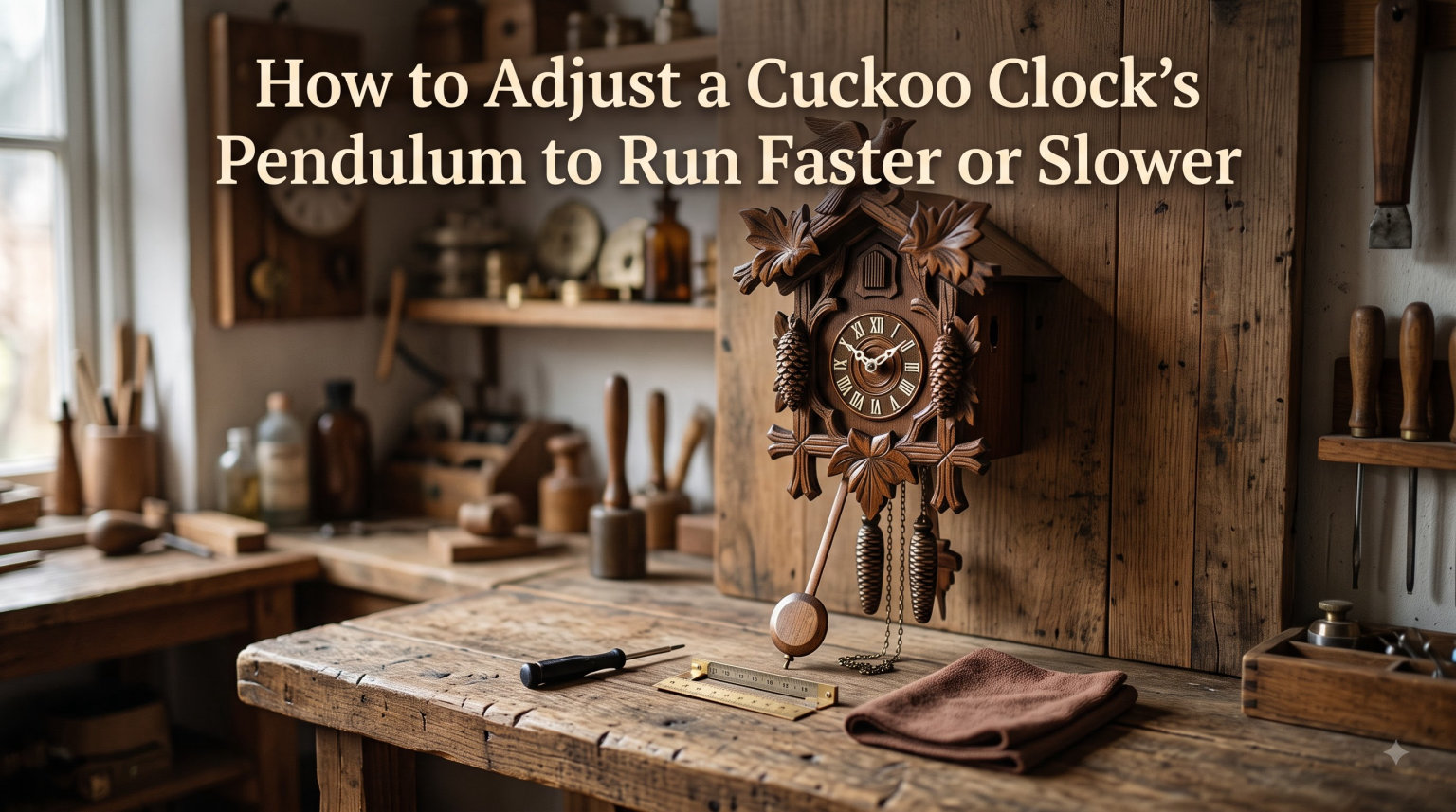
To adjust a cuckoo clock’s pendulum, slide the pendulum bob (or the decorative maple leaf) up the rod to make the clock run faster, or slide it down to make the clock run slower. For clocks with a rating nut at the bottom of the pendulum, turn the nut clockwise to speed the clock up and counterclockwise to slow it down. That single principle controls all mechanical cuckoo clock timekeeping, and once you understand why it works, you can fine-tune your clock to keep accurate time within a few seconds per day.
If your cuckoo clock runs fast or slow, you are not alone. Nearly every mechanical cuckoo clock owner I have spoken with has faced this exact frustration. The good news is that learning to adjust a cuckoo clock pendulum is straightforward once you know the mechanics behind it. In this guide, I will walk you through the physics, the step-by-step adjustment process, troubleshooting for a pendulum that stops swinging, and the common mistakes that throw off timekeeping accuracy.
Everything here applies to traditional mechanical cuckoo clocks from the Black Forest region of Germany, whether you own a 1-day or 8-day movement. Quartz (battery-operated) cuckoo clocks work differently and do not use a free-swinging pendulum for timekeeping, so the adjustments in this guide will not apply to those models.
Table of Contents
How Pendulum Adjustment Works: The Physics Explained
A pendulum’s swing speed depends entirely on its effective length, which is the distance from the pivot point to the pendulum’s center of weight. Shorten that distance and the pendulum swings faster, which makes the clock run faster. Lengthen that distance and the pendulum swings slower, making the clock lose time.
This relationship comes from a fundamental law of physics. The time it takes a pendulum to complete one full swing (called the period) follows the formula T = 2π multiplied by the square root of length divided by gravity. Gravity is constant, so the only variable that matters for your clock is pendulum length.
Here is the part most guides skip. When you slide the pendulum bob or the maple leaf up the rod, you move the center of weight closer to the pivot point. That shortens the effective length. A shorter effective length means a shorter period, so the pendulum ticks faster and the clock’s hands advance more quickly. The clock runs fast.
When you slide the bob or leaf down the rod, you move the center of weight farther from the pivot. The effective length grows, the period lengthens, and each tick-tock takes a fraction longer. The clock runs slow.
Understanding this matters because it tells you exactly what to do. If your clock runs slow, you need to speed it up by shortening the pendulum, which means sliding the weight up. If your clock runs fast, you need to slow it down by lengthening the pendulum, which means sliding the weight down. I like to remember it with a simple phrase: up is faster, down is slower.
How to Adjust a Cuckoo Clock’s Pendulum to Run Faster or Slower
The adjustment method you use depends on which type of pendulum your cuckoo clock has. Some clocks use a decorative pendulum leaf (often carved as a maple leaf) that slides along the rod, while others use a rating nut threaded onto the bottom of the pendulum rod. Both methods accomplish the same thing: changing the effective length of the pendulum.
Method 1: Adjusting the Pendulum Leaf (Maple Leaf)
Most traditional Black Forest cuckoo clocks use a decorative carved leaf that slides freely on the pendulum rod. Here is how I adjust one step by step.
Step 1. Gently stop the pendulum from swinging and hold it steady with one hand.
Step 2. With your other hand, grip the pendulum bob or leaf and slide it a small distance along the rod. Move the leaf up if the clock runs slow (to speed it up) or down if the clock runs fast (to slow it down).
Step 3. Make only a small adjustment each time, about the width of the leaf itself. Large moves overshoot the correct position and you will end up chasing the accuracy back and forth.
Step 4. Restart the pendulum swinging with a gentle push and let the clock run.
Step 5. Wait a full 24 hours, then compare your cuckoo clock to an accurate reference like a phone or digital clock. Note how many minutes it gained or lost.
Step 6. Repeat the process with another small adjustment until the clock keeps accurate time.
Method 2: Adjusting the Rating Nut
Some cuckoo clocks (and many larger mechanical clocks) use a rating nut threaded onto the bottom of the pendulum rod, just beneath the bob. Turning this nut moves the bob up or down in precise increments.
Turn the rating nut clockwise (to the right) to raise the bob up the rod, which shortens the effective length and speeds the clock up. Turn it counterclockwise (to the left) to lower the bob, which lengthens the pendulum and slows the clock down.
The advantage of a rating nut is precision. Each full turn moves the bob by a known amount, so you can track your adjustments more carefully than with a sliding leaf. The principle is identical, though. Up means faster, down means slower.
How Much Should You Move the Leaf Each Time?
A good rule of thumb I use is to move the leaf or bob by about one to two millimeters for every minute of error per day. If your clock loses three minutes in 24 hours, slide the leaf up roughly three to six millimeters. This gets you close on the first try, and then you fine-tune from there.
Antique cuckoo clocks often need more patience. Their movements may have wear that introduces inconsistency, so accept that finding the sweet spot can take several rounds of small adjustments over a week or two.
How to Speed Up a Slow Cuckoo Clock
If your cuckoo clock runs slow and loses time over the course of a day, the pendulum is swinging too slowly and the effective length is too long. To speed the clock up, slide the pendulum bob or maple leaf up the rod toward the clock case, or turn the rating nut clockwise to raise the bob.
I recommend the approach that forum users on r/clocks swear by: move the bob up a little more than you think you need, so the clock briefly runs fast. Then nudge it back down in tiny increments until the time evens out. This brackets the correct position from both sides and helps you find the sweet spot faster than creeping up on it from below.
After each upward adjustment, give the pendulum a gentle start and let it run for a full day before checking. Resist the temptation to adjust every few hours. The pendulum needs enough time to show a measurable difference, and checking too soon leads to over-correction.
One more thing to check before you blame the pendulum: make sure the clock is fully wound. A nearly exhausted mainspring (on an 8-day clock) or a weight that has nearly reached the bottom of its chain (on a 1-day clock) can cause the clock to slow down even when the pendulum is set correctly.
How to Slow Down a Fast Cuckoo Clock
If your cuckoo clock runs fast and gains time, the pendulum is swinging too quickly and the effective length is too short. To slow the clock down, slide the pendulum bob or leaf down the rod away from the clock case, or turn the rating nut counterclockwise to lower the bob.
Move the weight down in small increments, just as you would when speeding up the clock. A downward shift of a few millimeters can correct a clock that gains a couple of minutes per day. After adjusting, restart the pendulum and let it run for 24 hours before you measure the result against a reliable time source.
A clock that runs fast is generally easier to correct than one that runs slow, because a fast clock usually means the pendulum simply sits a little too high on the rod. Lowering it is a clean, predictable fix.
However, if the clock runs dramatically fast (gaining many minutes per hour rather than per day), the problem is likely not the pendulum position. That points to a mechanical issue such as a worn escapement or a gear that is slipping, and the clock may need professional servicing.
How to Get Your Cuckoo Clock In Beat
Before fine-tuning the pendulum for speed, your cuckoo clock must be “in beat.” Being in beat means the clock produces an even, rhythmic tick-tock sound with equal spacing between the tick and the tock. A clock that is out of beat ticks unevenly (tick-TOCK or TOCK-tick), and this unevenness can stop the pendulum entirely or make timekeeping erratic regardless of how you adjust the bob.
Here is how to check and fix the beat. First, listen closely to the ticking while the pendulum swings. An in-beat clock sounds perfectly balanced, like a metronome: tick, tock, tick, tock. If you hear an uneven rhythm, the clock is out of beat and needs correcting.
The simplest fix, and one that forum users frequently mention, is to tilt the entire clock case very slightly to the left or right on the wall. Try leaning the case a fraction to one side and listen to whether the ticking evens out. A tiny shift of the case is often all it takes to bring the beat into balance.
If tilting the case works but you do not want a crooked clock on your wall, the permanent fix is to bend the crutch wire. The crutch is the thin wire that connects the clock movement to the pendulum and pushes it back and forth. With the clock stopped, gently bend the crutch wire a tiny amount in the direction that corrects the uneven tick. Restart the pendulum and listen again. Repeat with very small bends until the tick-tock is perfectly even.
Once the clock is in beat, only then should you adjust the pendulum bob for speed. Adjusting speed on an out-of-beat clock is like tuning an instrument that is out of tune to begin with. Get the beat right first, and the speed adjustments will actually hold.
How Long to Wait Between Adjustments
Wait a full 24 hours between each pendulum adjustment before evaluating the result. This is the timeframe no competing guide mentions, and it is the single most common reason people fail to get their cuckoo clock accurate. Checking the clock after only a few hours gives you unreliable data, because small mechanical variations and temperature changes cause short-term swings that do not reflect the true daily rate.
Here is the routine I follow. Set the cuckoo clock to the exact correct time using a phone or a reliable wall clock. Then leave the pendulum untouched for one full day. After 24 hours, compare the cuckoo clock’s time to your reference and note the difference in minutes, including whether it is fast or slow.
That measurement tells you exactly how to adjust. If the clock lost two minutes, slide the leaf up a small amount. If it gained one minute, slide the leaf down slightly. Reset the hands to the correct time, restart the pendulum, and wait another 24 hours.
Most cuckoo clocks need two to four rounds of this cycle to reach good accuracy. Once your clock holds within about a minute per day, you can consider it well-adjusted for a mechanical timepiece. Temperature and humidity shifts will always cause minor drift, so expect to make a tiny seasonal touch-up once or twice a year.
Troubleshooting: Why Your Pendulum Stops Swinging
A pendulum that stops after a few minutes or a few hours is the most common cuckoo clock problem, and it usually has nothing to do with the pendulum adjustment itself. The cause is almost always that the clock is not level, is not in beat, or has a mechanical obstruction. Here are the causes I check, in order.
The Clock Is Not In Beat
This is the number one cause of a stopping pendulum. If the tick-tock is uneven, the pendulum does not receive an equal push on each swing and gradually loses momentum. Follow the in-beat adjustment process above, and the pendulum will usually keep running.
The Clock Is Not Hanging Level or Plumb
Even a fraction of a degree off level can stop a pendulum. Place a small spirit level on top of the clock case and adjust the mounting until it reads perfectly level. If your wall is uneven, shim the low side with a small folded card behind the case until the clock hangs plumb.
The Chains or Weights Are Tangled
Check that the chains run freely through the sprockets and that the weights hang straight down without touching the wall or each other. A chain that has jumped off its sprocket or a weight resting against the clock case can bind the movement and stop the pendulum. Gently reseat any tangled chains before restarting.
The Pendulum Is Hitting Something
Make sure the pendulum has clearance to swing its full arc without striking the clock case, the weights, or the wall behind it. Even light contact on each swing will drain the pendulum’s energy and bring it to a stop within minutes.
The Movement Needs Cleaning and Oiling
Multiple forum users report that their cuckoo clocks only ran reliably after a cleaning and oiling. Dust and old oil create friction in the escapement that the pendulum cannot overcome. If your clock has run for several years without service, a professional cleaning may be the only real fix. A well-maintained mechanical movement should be cleaned and oiled every three to five years.
The Clock Is Underpowered
If you replaced a weight with a lighter one, or if the movement is worn and creates excess friction, the driving force may be too weak to keep the pendulum going. Use the correct weights specified for your clock. Never substitute a heavier weight to force the issue, as this can damage the movement.
Common Mistakes to Avoid
Through testing and from what clock owners share in forums, a handful of mistakes account for nearly every adjustment failure. Avoid these and you will save yourself hours of frustration.
Adjusting too often. Tweaking the pendulum every few hours prevents you from reading the true daily rate. Always wait 24 hours between adjustments.
Moving the leaf too far at once. Large jumps overshoot the correct position and send you bouncing between too fast and too slow. Make small, millimeter-scale moves.
Ignoring the beat. No amount of bob adjustment will fix a clock that ticks unevenly. Always correct the beat before tuning the speed.
Forcing parts. If the leaf or rating nut resists movement, do not force it. Forcing can bend the pendulum rod or damage threads. Stop and inspect for a set screw or obstruction.
Forgetting to wind. A clock slowing down is often just a clock running low on power. Confirm the clock is fully wound before assuming the pendulum needs adjustment.
FAQs
How do I make my cuckoo clock run faster?
Slide the pendulum bob or decorative leaf up the rod toward the clock case to shorten the effective pendulum length, which makes the clock run faster. If your clock has a rating nut at the bottom of the pendulum, turn the nut clockwise to raise the bob and speed up the clock. Make a small adjustment, wait 24 hours, and compare to a reliable time source before fine-tuning further.
How do you make a pendulum swing slower?
To make a pendulum clock run slower, slide the pendulum bob or leaf down the rod away from the clock case, which lengthens the effective pendulum and slows the swing rate. On clocks with a rating nut, turn the nut counterclockwise to lower the bob. Wait a full day after each small adjustment to measure the effect accurately.
Do you need to shorten the pendulum if the clock runs slower?
No, you do not cut or physically shorten the pendulum. You shorten the effective length by sliding the bob or leaf up the rod (or turning the rating nut clockwise). The effective length is the distance from the pivot to the center of weight, and reducing that distance speeds the clock up. Never cut the pendulum rod itself.
Why is my cuckoo clock running slow even after adjusting the leaf?
The most likely cause is that the clock is not in beat, meaning the tick-tock is uneven. An out-of-beat clock loses efficiency and runs slow regardless of pendulum position. Check that the clock hangs level and listen for an even tick-tock. Other causes include a movement that needs cleaning and oiling, a nearly exhausted mainspring, or an adjustment that needs more time (wait a full 24 hours between moves).
Conclusion
Learning how to adjust a cuckoo clock’s pendulum to run faster or slower comes down to one rule: slide the bob or leaf up to speed the clock up, and down to slow it down. Get the clock in beat first, make small adjustments, and always wait 24 hours between each change to read the true daily rate. With a little patience over a week or two, your mechanical cuckoo clock can keep time accurate to within a minute a day. Give it that care and your Black Forest timepiece will reward you with reliable, charming timekeeping for years to come.