
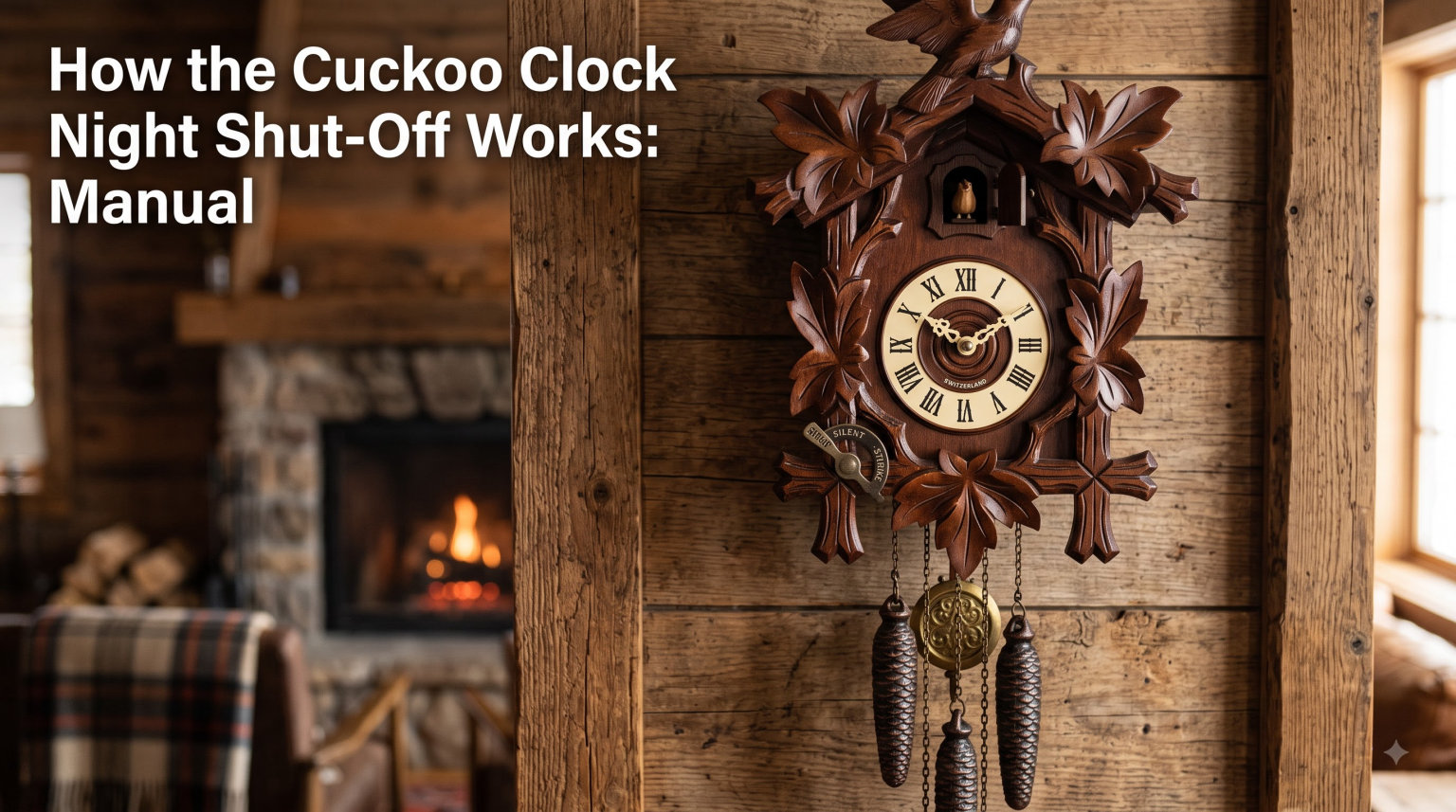
That cheerful cuckoo call you love during the day becomes a different story at 2 a.m. If your clock lives anywhere near a bedroom, the cuckoo clock night shut off is the feature standing between you and a sleepless night. Yet most clock owners I talk to are unsure which type their clock has, how it actually works inside, or whether they’re flipping the lever the right way.
This guide breaks down exactly how each shut-off system functions, from the simple manual lever on a traditional mechanical clock to the light-sensitive quartz models that silence themselves. I’ll compare all three types side by side, walk through the internal mechanisms, and help you figure out which one suits your situation. By the end, you’ll know precisely how to keep your clock ticking in peace after dark.
Table of Contents
What Is a Cuckoo Clock Night Shut-Off?
The cuckoo clock night shut off is a built-in feature that silences the cuckoo call, music, and any moving figures during nighttime hours while the clock itself continues keeping perfect time. Think of it as a mute button for the sound without pausing the actual timekeeping movement. The gears, pendulum, and hands all keep running normally. Only the bellows that produce the cuckoo whistle and the music box mechanism are disabled.
There are three distinct types of night shut-off systems found across modern and traditional cuckoo clocks:
Manual shut-off: A physical lever on the side or bottom of the clock case that you flip by hand.
Automatic (mechanical) shut-off: A built-in mechanical timer linked to the clock’s gear train that silences sound during preset hours automatically.
Quartz light sensor shut-off: A photoresistor in battery-operated clocks that detects darkness and mutes the cuckoo without any timer or human input.
Each system achieves the same goal through a completely different approach. Manual is fully in your control, automatic runs on a mechanical schedule, and quartz reacts to ambient light levels. The type your clock uses depends on its movement, so understanding the difference matters when shopping or troubleshooting.
How Manual Night Shut-Off Works
The manual night shut off is the oldest and most common system, found on the vast majority of traditional mechanical cuckoo clocks from the Black Forest region. It uses a simple metal lever, usually protruding from the right side or the bottom edge of the clock case, that you physically move to engage or disengage the sound.
Here is what happens inside the clock when you flip that lever. The cuckoo sound is produced by a pair of bellows, small chambers that push air through brass whistles when the clock strikes. One bellow creates the “cu” syllable and the other produces the “ckoo” syllable, together mimicking the European cuckoo bird’s two-note call.
When you move the lever to the shut-off position, it pushes a thin metal wire or bar directly in front of the bellows arms. This physical obstruction prevents the bellows from compressing and pushing air through the whistles. The clock still tries to call, the cuckoo bird may still pop out of its door, but no air moves through the pipes, so no sound comes out.
The music box mechanism is silenced the same way. A separate linkage either lifts the music box governor away from the comb teeth or physically blocks the air supply to the music bellows, depending on the clock’s design.
Manual Lever Position: Up or Down?
The most common question I see in clock forums is which way the lever should point. On most Black Forest clocks, the convention is lever down means sound on and lever up means sound off. But this is not universal. Some manufacturers reverse this, and some side-mounted levers flip left-to-right rather than up-and-down.
The safest approach is to test it yourself. Flip the lever to one position, advance the minute hand to the next hour or half-hour, and listen. If the clock stays silent, that position is your shut-off. Mark it with a small dot of nail polish or a sticker so you never have to guess again.
Pros and Cons of Manual Shut-Off
The manual system’s biggest advantage is simplicity. There is no sensor to fail, no battery to die, and no timer to drift out of sync. A lever is just a piece of metal, and it works the same way on day one as it does after thirty years. That reliability is why many owners of older mechanical clocks prefer this approach.
The downside is that you must remember to flip it every night and turn it back on every morning. If you forget, you either get woken up at 3 a.m. or miss the cuckoo call all day. For clocks in hard-to-reach spots like high on a wall or above a staircase, the daily ritual can become tedious.
How Automatic (Mechanical) Night Shut-Off Works
The automatic mechanical night shut off eliminates the need to flip a lever every night. Instead, it uses a cam or program wheel connected to the clock’s existing gear train to silence the cuckoo during preset hours without any electrical components. It is purely mechanical, powered by the same weights that drive the clock.
These clocks typically have a three-position switch or lever: On (sound always active), Off (sound always disabled), and Auto (sound automatically silenced during preset night hours). When set to Auto, a program wheel inside the movement rotates once every 24 hours in sync with the timekeeping gears.
The program wheel has a raised lobe or cut-out section that corresponds to the nighttime hours. Most commonly, this preset window runs from approximately 8:00 p.m. to 8:00 a.m., though some manufacturers use 9:00 p.m. to 8:00 a.m. or 9:00 p.m. to 7:30 a.m. As the wheel rotates into the night window, a follower arm drops into the cut-out, which engages the same bellows-blocking mechanism as the manual lever.
When the wheel rotates past the cut-out back into daytime, the follower lifts and the bellows are released to produce sound again. The beauty of this system is that it is entirely self-contained. No batteries, no light sensors, no electronics. It runs off the gravitational energy stored in the clock’s cast-iron weights.
What to Know About Automatic Shut-Off
One thing to keep in mind is that the preset hours are fixed at the factory. You cannot change the 8 p.m. to 8 a.m. window on most models. If your schedule is unusual, the fixed window may not match your actual sleep hours.
Also, because the shut-off is linked to the clock’s gear train, the timing depends on the clock being set to the correct time. If the clock runs slow or fast and you do not correct it regularly, the automatic window will drift out of sync with real nighttime.
How Quartz Light Sensor Night Shut-Off Works
Quartz cuckoo clocks take a fundamentally different approach. Instead of a mechanical program wheel, they use an electronic light sensor, called a photoresistor or LDR (light-dependent resistor), mounted on the clock case or movement board. This sensor continuously measures the ambient light level in the room.
When the room gets dark, the resistance in the photoresistor changes. Once light drops below a certain threshold, the clock’s microcontroller interprets this as nighttime and disables the audio output. The cuckoo bird and music are silenced automatically. When light returns in the morning, the sensor detects the brightness increase and re-enables the sound.
Because the shut-off is triggered by actual darkness rather than a fixed clock time, it adapts naturally to seasonal changes. On a long winter evening, the clock goes silent earlier. On a bright summer night, it may keep calling a bit longer. There is no program wheel to drift out of sync and no lever to flip.
Quartz Night Shut-Off Advantages and Limitations
The light sensor system is genuinely hands-free. You set the clock once, and it manages its own quiet hours forever. This makes quartz clocks ideal for bedrooms, nurseries, and hallways where you want zero maintenance. The sensor is also more forgiving than a fixed timer because it responds to real-world lighting.
However, there are trade-offs. If someone turns on a light in the middle of the night, the sensor may interpret the brightness as daytime and trigger a cuckoo call at 3 a.m. Conversely, a dimly lit room during the day could cause premature silencing. The sensor threshold is factory-set and cannot be adjusted on most consumer models.
Battery dependence is another consideration. When batteries weaken, the sensor and sound electronics may behave unpredictably. And because quartz movements use pre-recorded digital bird calls rather than actual bellows, some traditionalists feel the sound quality does not match a mechanical clock.
Manual vs Quartz vs Automatic: Side-by-Side Comparison
No competitor in the current search results lays out these three systems in a clear comparison. So here is a breakdown of how they stack up against each other across the factors that matter most.
| Feature | Manual Lever | Automatic (Mechanical) | Quartz Light Sensor |
|---|---|---|---|
| How sound is silenced | Physical bar blocks bellows | Program wheel blocks bellows | Electronics disable audio output |
| User effort required | Flip lever twice daily | Set to Auto once | None after setup |
| Power source for shut-off | None (purely mechanical) | Clock weights (mechanical) | Batteries |
| Night window | Whenever you choose | Fixed (typically 8 p.m. to 8 a.m.) | Varies with actual darkness |
| Adapts to seasons | Yes (manual control) | No (fixed clock hours) | Yes (tracks real light levels) |
| Sound quality | Authentic bellows | Authentic bellows | Digital recording |
| Maintenance | Virtually none | Occasional sync check | Battery replacement |
| Risk of unexpected noise | Only if you forget to flip | Low (mechanical reliability) | Room lights can trigger false calls |
| Typical price range | Standard on most mechanical clocks | Premium mechanical models | Standard on battery-operated clocks |
As you can see, no single system wins every category. Manual gives you total control but demands daily attention. Automatic mechanical offers set-and-forget convenience with authentic sound but locks you into factory-preset hours. Quartz provides the most effortless operation but trades away the real bellows tone and depends on batteries.
Which Night Shut-Off Type Is Right for You?
Choosing the right shut-off comes down to where your clock lives and how much involvement you want. For a bedroom or nursery, I recommend either a quartz light sensor clock or a mechanical clock with automatic shut-off. Both silence themselves without any action from you, which matters when you are already half asleep and do not want to reach for a lever on the wall.
For a living room, den, or kitchen, a manual lever is perfectly adequate. You are likely awake during the clock’s active hours, and if you want quiet during a movie or conversation, you flip the lever and flip it back afterward. The control is a feature, not a chore, in spaces you use primarily during the day.
If authenticity matters to you and you love the genuine bellow-driven cuckoo call, stick with a mechanical clock, either manual or automatic. The digital sound on quartz models has improved over the years, but traditionalists can usually tell the difference. A mechanical clock with automatic shut-off gives you both authentic sound and hands-free operation, which is why these models tend to cost more.
For high or hard-to-reach placements, avoid manual-only clocks. Climbing on a chair twice a day to reach a lever is not sustainable. An automatic or quartz clock saves you the hassle entirely.
Finally, if you live somewhere with dramatic seasonal light changes, a quartz light sensor adapts naturally while a mechanical automatic stays locked to clock time. In northern regions where sunset shifts by hours between summer and winter, the light sensor’s flexibility is a real advantage.
Troubleshooting Common Night Shut-Off Problems
Even the best shut-off systems occasionally misbehave. Here are the most common issues I encounter and how to fix them.
The Manual Lever Does Not Silence the Clock
If flipping the lever does nothing, the connecting wire inside may have slipped out of position or bent. Remove the clock from the wall carefully, open the back panel, and check that the lever’s wire arm still reaches the bellows. A wire that has shifted or a lever that has loosened over years of use can lose its connection. Gently reposition the wire so it sits directly in front of the bellows arms when the lever is in the off position.
The Automatic Shut-Off Triggers at the Wrong Time
This almost always means the clock’s time has drifted from actual time. Because the program wheel is driven by the same gears as the clock hands, if the clock runs five minutes slow over a few weeks, the shut-off window shifts too. Reset the clock to the correct time, and the automatic window will realign. If the clock consistently loses or gains time, adjust the pendulum bob slightly, sliding it up to speed the clock up or down to slow it.
The Quartz Light Sensor Acts Erratically
Erratic behavior on a quartz clock usually points to weak batteries. As voltage drops, the sensor threshold becomes unreliable, and the clock may chirp at odd hours or stay silent during the day. Replace all batteries with fresh alkaline cells at the same time. If the problem persists, the photoresistor itself may be faulty, which typically requires replacing the movement module.
Another common issue is placing a quartz clock near a window with streetlights or near an appliance with an indicator LED. These small light sources can trick the sensor into thinking it is daytime. Moving the clock to a wall away from ambient light sources usually solves this.
The Clock Stops Running Entirely
If the clock stops, first check whether the shut-off lever is jammed. A lever stuck in a half-position can bind the movement and stop the entire clock. Move the lever fully to one side or the other. On mechanical clocks, also verify the weights are hanging freely and not touching anything, and that the clock is level, as an tilted clock can cause the pendulum to bind.
FAQs
How to stop cuckoo clock from going off at night?
To silence a cuckoo clock at night, locate the night shut-off lever on the side or bottom of the clock case. On most mechanical clocks, flipping the lever up engages the shut-off, which physically blocks the bellows from producing sound. Quartz clocks with light sensors silence themselves automatically when the room goes dark. You can also set an automatic mechanical clock to its Auto position to silence sound during preset hours, typically 8 p.m. to 8 a.m.
Do cuckoo clocks go off at night?
Yes, a cuckoo clock without a night shut-off will call every hour and half-hour around the clock, including throughout the night. Most modern clocks include a night shut-off feature (manual lever, automatic timer, or light sensor) to prevent this. If your clock does go off at night, check whether the shut-off lever is in the correct position or whether the automatic setting needs adjustment.
What are the disadvantages of quartz cuckoo clocks?
The main disadvantages of quartz cuckoo clocks are the use of digital recordings rather than authentic bellows for the cuckoo call, reliance on batteries that need periodic replacement, and potential for the light sensor to trigger unexpected sounds if room lights are turned on at night. They also lack the mechanical craftsmanship and heirloom quality of traditional weight-driven clocks.
Do cuckoo clocks turn off at night?
Most modern cuckoo clocks can turn off at night using a night shut-off feature. Manual shut-off requires flipping a lever each night. Automatic mechanical shut-off silences the clock during preset hours without input. Quartz light sensor shut-off detects darkness and mutes the clock automatically. The clock continues keeping time in all cases, only the sound and music are disabled.
What are the common problems with cuckoo clocks?
Common cuckoo clock problems include the night shut-off lever not working due to a bent connecting wire, the clock running fast or slow requiring pendulum adjustment, the automatic shut-off triggering at wrong times due to time drift, quartz sensors acting erratically from weak batteries, and the clock stopping entirely if weights are obstructed or the case is not level.
Conclusion
Understanding how the cuckoo clock night shut off works transforms your experience as a clock owner. The manual lever gives you complete, reliable control with authentic bellows sound but demands a daily ritual. The automatic mechanical system offers set-and-forget convenience during fixed hours, powered entirely by your clock’s weights. And the quartz light sensor adapts to real darkness for the most hands-free operation available.
Whichever system your clock uses, the key is knowing what is happening inside that wooden case. Once you understand the bellows, levers, program wheels, and sensors, you can troubleshoot confidently and choose your next clock with clarity. Now go enjoy your cuckoo clock, day and night.