
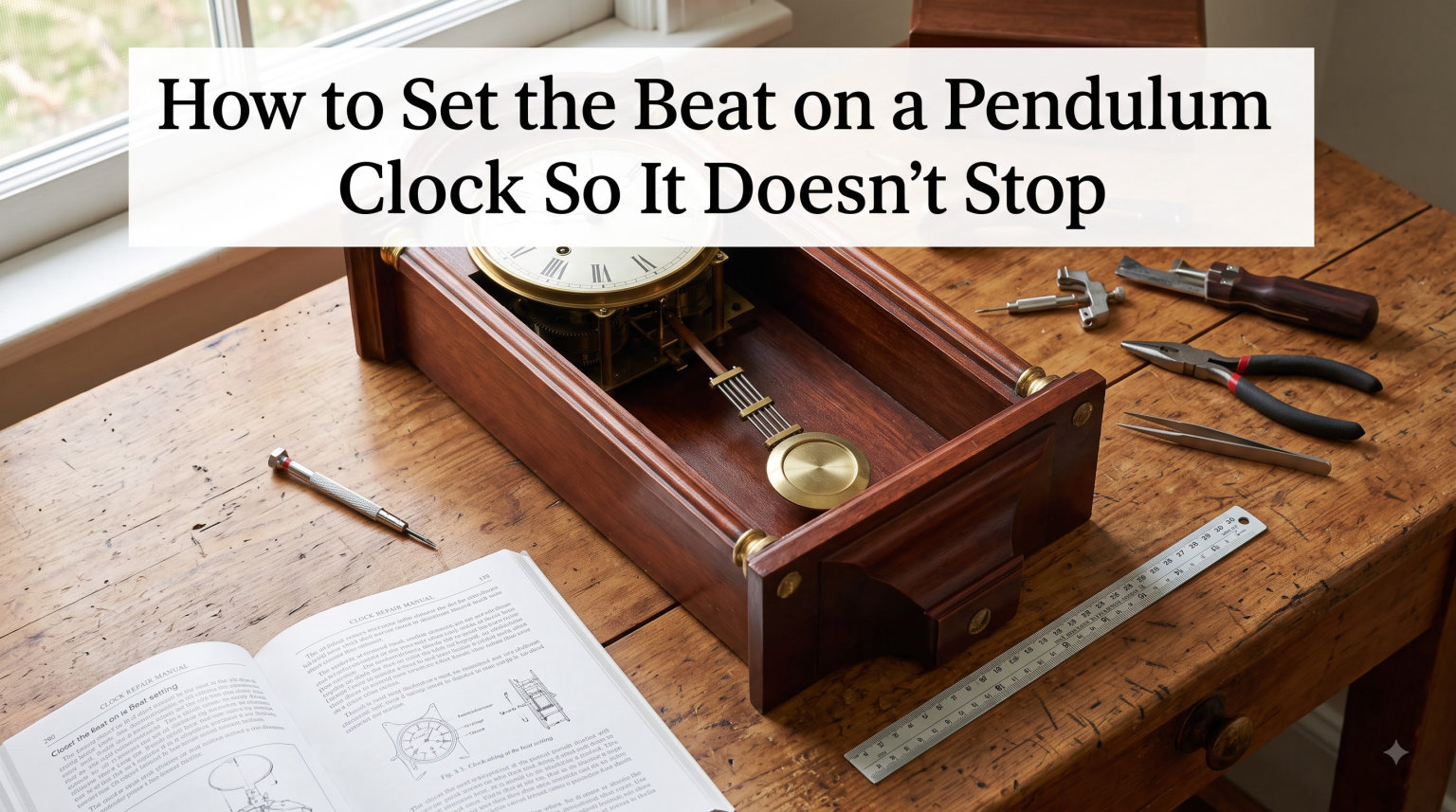
If your pendulum clock keeps stopping after a few minutes, you are not alone. This is one of the most common issues clock owners face, and in the vast majority of cases the clock is not broken at all. It simply needs to be put “in beat.”
Learning how to set the beat on a pendulum clock so it doesn’t stop is a skill that saves frustration, repair bills, and the disappointment of a silent heirloom sitting motionless on your wall or mantel. The process is straightforward once you understand what beat means and how to listen for it.
I have worked with pendulum clocks for years, and I can tell you that nearly every “stopped” clock I have encountered was fixed by a simple beat adjustment. In this guide, I will walk you through what beat is, how to tell if your clock is out of beat, and two proven methods to fix it. I will also cover what to do when beat setting alone does not solve the problem.
Table of Contents
What Is Clock Beat and Why It Keeps Your Pendulum Running
Beat is the even rhythm of the tick-tock sound your clock makes as it runs. A clock is “in beat” when the time between each tick and each tock is exactly equal. Picture the steady, metronome-like rhythm of a well-running clock: tick, tock, tick, tock, with perfect even spacing between every sound.
When a clock is out of beat, that rhythm becomes uneven. Instead of a steady tick-tock, you hear something closer to tick-tick…tick-tick, where the two sounds bunch together followed by a pause. That uneven spacing is the single biggest reason a pendulum clock stops swinging.
To understand why, it helps to know a little about how the mechanism works. Your pendulum connects to the clock movement through a small rod called the crutch. The crutch links to the pallets, which interact with a toothed gear called the escape wheel.
Each time the pendulum swings, the pallets catch and release the escape wheel teeth. This delivers a tiny push, called an impulse, that keeps the pendulum moving. That impulse is the heartbeat that powers every swing.
Here is the key: those impulses need to arrive at exactly the right moment in the pendulum’s swing. The ideal moment is when the pendulum passes through dead center, the lowest point of its arc. When the clock is in beat, the impulse arrives symmetrically on both sides of dead center, giving the pendulum an equal push in each direction.
When the clock is out of beat, those impulses arrive at the wrong time. One side gets too much push, the other gets too little. The pendulum loses energy on the weak side and, after a few minutes or hours, it simply does not have enough momentum to complete its swing. The clock stops.
Think of it like pushing a child on a swing. If you push at exactly the right moment each time, very little effort keeps them going forever. Push too early or too late, and the swing loses momentum and stops. Your pendulum clock works the same way.
How to Check If Your Clock Is In Beat
The fastest way to check whether your clock is in beat is to listen. This is the single most important diagnostic skill in clock care, and it takes only a minute to learn.
Start the pendulum swinging gently and sit close to the clock in a quiet room. Listen carefully to the tick-tock pattern. If the sounds are evenly spaced, you will hear a steady, relaxing rhythm that sounds like a metronome. This means the clock is in beat.
If the sounds are unevenly spaced, you will hear the tick and tock clustered together. It sounds like “tick-tick…tick-tick…tick-tick” with a noticeable gap between each pair. That clustered pattern is the hallmark of a clock that is out of beat, and it tells you exactly what needs fixing.
Sometimes the difference is subtle and hard to hear. I recommend using a free metronome app on your phone as a reference tool. Set the app to match the approximate speed of your clock’s ticking, then compare what you hear from the clock to the steady beat of the metronome.
Any unevenness becomes much more obvious when you have a perfect reference to compare against. If you are new to this, try the metronome trick two or three times and your ear will quickly learn to spot the difference on its own.
You can also do a visual check. Watch the pendulum as it swings and notice whether it travels an equal distance to the left of center as it does to the right. When a clock is out of beat, the pendulum swings noticeably farther in one direction than the other.
Equal swing distance on both sides is another sign the clock is properly in beat. Between listening and watching, you will have no trouble diagnosing the problem.
One important note: you should check the beat every time you move the clock. Even a gentle shift of a few millimeters can throw the beat off. This is why so many clocks stop after being moved, even across the same room.
The movement changes the relationship between the case and the pendulum’s center of swing. A clock that ran perfectly on one shelf may stop the moment you relocate it to another.
How to Set the Beat on a Pendulum Clock: Two Proven Methods
There are two reliable ways to set the beat on a pendulum clock. The first method, tilting, is the quickest and easiest approach and works well for most mantel and wall clocks. The second method, adjusting the crutch, is a more permanent fix that corrects the underlying issue so the clock sits perfectly level and still runs in beat.
Before we get started, here is a helpful memory aid that clock enthusiasts on the NAWCC forums call “Arjay’s Maxim”: Tilt her till she ticks with pride, then adjust the crutch toward the high side. That single sentence captures the entire process.
You tilt the clock to find the correct beat position. Then, if you want the clock to sit level again, you bend the crutch to shift the beat center back to where it belongs. That is the whole technique in a nutshell.
Method 1: The Tilting Method (Easiest Approach)
The tilting method is the fastest way to get a stopped clock running again. It works by shifting the entire clock case slightly until the pendulum’s swing is centered over the crutch again. No tools required, no disassembly, and you can do it in under five minutes.
Here is the step-by-step process:
Place the clock on a stable, level surface. Make sure the clock is sitting on something solid that will not wobble. For wall clocks, check that the hanging hook is secure and the clock is flush against the wall.
Start the pendulum swinging gently. Pull the pendulum to one side, about two inches, and release it. Do not push it, just let gravity do the work.
Listen to the tick-tock rhythm. Determine whether the tick and tock are evenly spaced or clustered together. Remember: even spacing means in beat, clustered sounds mean out of beat.
Tilt the clock slightly to one side. Lift one side of the clock case just a few millimeters. If the tick-tock becomes more even, you are tilting in the right direction. If it gets worse, tilt the other way.
Listen for even spacing between tick and tock. Keep adjusting the tilt in small increments until the rhythm sounds perfectly steady, like a metronome.
Shim the clock in that position. Once you have found the angle where the clock ticks evenly, slide a small shim (a folded piece of cardboard, a coin, or a wood wedge) under the raised side to hold it in place.
Let the clock run for at least 15 minutes. If the pendulum is still swinging steadily after 15 minutes, the beat is set correctly and the clock should continue running.
The tilting method is quick and effective, but it has one drawback: your clock will not sit perfectly level. For many people this does not matter, especially with mantel clocks. But if the tilted look bothers you, or if you have a wall clock that looks crooked, you will want to use Method 2 to make a permanent correction.
One more tip: if you have trouble hearing the difference, try placing your ear close to the clock face. You can also press a screwdriver handle against the case and listen through it. The metal conducts sound and makes the tick-tock pattern much easier to distinguish.
Method 2: Adjusting the Crutch (Permanent Fix)
The crutch adjustment method corrects the beat at its source so your clock can sit perfectly level and still run properly. It takes a few more minutes than tilting and requires a gentle hand, but it is the right long-term solution.
First, let me explain what the crutch is. The crutch is a thin rod or wire that extends downward from the clock movement and connects to the pendulum leader, the short rod that the pendulum hangs from. The crutch passes through a loop or slot in the pendulum leader and transfers the impulse from the movement to the pendulum on every swing.
When a clock is out of beat, the crutch is slightly bent to one side of dead center. Bending it back to center corrects the beat permanently. Here is how to do it:
Stop the clock and remove the pendulum. Gently stop the pendulum swinging and lift it off its suspension point. Set it aside somewhere safe where it will not roll or fall.
Locate the crutch. Look at the back of the clock movement. The crutch is the thin rod hanging straight down from the movement, ending in a loop or bent end that the pendulum leader passes through.
Determine which way to bend. Remember Arjay’s Maxim: “adjust the crutch toward the high side.” The high side is whichever side you had to raise during the tilting method. If you tilted the clock to the right to get it in beat, bend the crutch slightly to the right.
Bend the crutch in very small increments. Use your fingers to gently bend the crutch wire just a millimeter or two. This is not a big adjustment. Too much bend will overshoot and put the clock out of beat in the other direction.
Rehang the pendulum and restart the clock. Put the pendulum back in place, start it swinging, and listen to the rhythm.
Test and repeat if needed. If the tick-tock is still uneven, stop the clock, remove the pendulum, and bend the crutch a tiny bit more in the same direction. Repeat this cycle until the clock sits level and ticks evenly at the same time.
Run the clock for 30 minutes to confirm. Once it sounds right and the case is level, let it run for at least half an hour. If the pendulum is still going strong, the beat is set correctly.
Now, there are two types of crutch you might encounter, and they require slightly different handling:
Wire crutch: This is the most common type, found on most modern and many vintage clocks. The crutch is a single piece of bent wire that you can bend gently with your fingers or with needle-nose pliers wrapped in cloth to avoid scratching.
Always bend the wire itself, not at the point where it attaches to the movement, which can be fragile. A small, careful bend in the middle of the crutch rod is all you need.
Flat or friction-joint crutch: Some clocks, particularly certain grandfather and antique movements, use a crutch that attaches to the pallet arbor with a friction joint. On these clocks, instead of bending the wire, you hold the crutch firmly and rotate it slightly around the friction joint.
Loosen the joint, nudge the crutch a degree or two in the right direction, and retighten. This type of adjustment is more precise and avoids fatiguing the metal over time.
If your clock has a crutch that seems impossible to bend, do not force it. Some crutches are deliberately stiff, and forcing them can damage the movement. In that case, the tilting method remains a perfectly acceptable permanent solution.
Why Your Clock May Still Stop After Setting the Beat
Sometimes you set the beat perfectly, the tick-tock sounds even and steady, and the clock still stops. This is frustrating but not unusual. When beat setting does not solve the problem, several other issues may be at play.
Let me walk you through the most common culprits, starting with the ones people overlook most often.
The clock is not level front to back. Most people check side-to-side leveling but forget about front-to-back. A clock that leans forward or backward, even slightly, can cause the pendulum to rub against the case or the movement plates.
Use a small bubble level and check both directions. This is one of the most commonly overlooked causes of persistent stopping.
The hands are touching each other or the dial. If the minute hand is slightly bent and catches on the hour hand, the clock will stop every time they pass each other. Gently press the hands flat against the dial, making sure they do not touch each other or scrape the dial surface.
Check that the second hand, if your clock has one, is not catching on the minute hand either. A barely visible bend in any hand can be enough to stop the whole mechanism.
The pendulum is hitting something. Inside the clock case, the pendulum bob needs a clear path to travel. If chime rods, weights, cables, or the case wall are even slightly in that path, the pendulum will drag and lose energy.
Open the case door and watch the pendulum swing through a full cycle. Look for anything it comes close to or brushes against, and reposition the obstruction.
The movement needs cleaning or oiling. Mechanical clocks need oiling every two to three years and a full cleaning every five to ten years. Over time, old oil turns gummy and creates friction that slows or stops the mechanism.
If your clock has not been serviced in years, this is likely the cause. A clock that ran fine for a decade and then gradually started stopping is a classic sign of a movement that needs professional attention.
The suspension spring is worn or bent. The suspension spring is the thin strip of metal at the top of the pendulum that flexes with each swing. If it is bent, cracked, or fatigued, the pendulum will not swing freely.
Inspect it carefully for any deformation. A replacement suspension spring is inexpensive and can be installed by a careful hobbyist or a professional.
There is a power problem. If your clock is weight-driven, make sure the weights are the correct ones for that clock and are hung in the right positions. Some clocks use different weights for time, strike, and chime functions.
If spring-driven, make sure the mainspring is fully wound. A clock that is only partially wound may run but lack the power to keep the pendulum going through the full cycle.
When to call a professional: If you have set the beat, confirmed the clock is level in all directions, checked for obstructions, and the clock still stops, it is time to consult a clock repair specialist. Old clocks may have worn pivots, cracked bushings, or accumulated dirt that requires professional cleaning.
A good horologist can diagnose and fix these issues. A routine service typically costs far less than replacing a cherished clock.
Prevention Tips: Keep Your Clock in Beat for Years
The best fix for a stopping clock is preventing the problem before it starts. A few simple habits will keep your pendulum clock running reliably for years.
Always remove the pendulum before moving the clock. This is the single most important rule of clock care. The pendulum swinging freely during transport can damage the suspension spring, bend the crutch, and knock the movement out of adjustment.
Remove the pendulum, wrap it in soft cloth, and transport it separately. This one habit prevents more clock damage than any other precaution.
Keep the clock on a stable surface away from vibrations. A clock that sits on a wobbly table or a shelf that shakes when people walk by will constantly go out of beat. Choose a solid, stable location.
Avoid placing clocks near speakers, washing machines, or anything that generates vibration. Even subtle shaking can gradually shift the beat over time.
Oil the movement on a regular schedule. Most clocks need a drop of clock oil on the pivot points every two to three years. Use only oil designed for clocks, never household oil, which attracts dust and turns gummy.
If you are not comfortable doing this yourself, a clock shop can handle it quickly. Regular oiling is the cheapest insurance against expensive repairs.
Avoid adjusting the case once the clock is running well. Once you have your clock in beat and running reliably, try not to move or jostle the case. Even small shifts can throw the beat off.
If you need to dust or clean around the clock, do so gently without pressing on the case. Treat it as the delicate instrument it is.
Keep a record of when the clock was last serviced. A small note taped inside the case door with the date of the last cleaning and oiling will help you track maintenance. This is especially valuable for antique clocks that get passed down through generations.
Different Clock Types and Beat Setting Specifics
While the principles of beat setting are the same across all pendulum clocks, each type has a few specifics worth knowing. Here is a quick guide to the most common clock styles.
Grandfather clocks: These tall floor clocks are the most sensitive to beat because their long pendulums have a wide swing. Use the crutch adjustment method for a permanent fix, as tilting a 6-foot-tall case is impractical. Check that the clock is stable on the floor and that all four leveling feet are firmly in contact with the ground.
Mantel clocks: These are the easiest to adjust because you can pick them up and tilt them freely. The tilting method works perfectly here, and a small shim under one side is a perfectly acceptable permanent solution. Just be sure the clock sits on a surface that will not shift.
Wall clocks: Wall clocks can be tilted slightly by loosening the hanging screw and inserting a small shim between the bottom of the clock and the wall. For a permanent fix, the crutch adjustment method is preferred so the clock hangs flush.
400-day clocks (anniversary clocks): These clocks use a rotating torsion pendulum instead of a swinging one, and they have a different beat-setting process altogether. They use a tiny adjustment on the fork where the suspension spring meets the movement. If you own one of these and it stops, look for a guide specific to torsion clocks.
FAQ
Why does the pendulum keep stopping on my clock?
The most common reason a pendulum keeps stopping is that the clock is out of beat, meaning the tick-tock rhythm is uneven. When impulses arrive at the wrong time in the pendulum swing, the pendulum loses energy and stops. Other causes include the clock not being level front to back, hands touching each other, the pendulum hitting chime rods or weights, or the movement needing cleaning and oiling.
How to adjust pendulum clock beat?
To adjust the beat, start the pendulum and listen to the tick-tock. If the sounds are clustered together rather than evenly spaced, tilt the clock slightly to one side until the rhythm sounds steady. For a permanent fix that lets the clock sit level, stop the clock, remove the pendulum, and gently bend the crutch wire a millimeter or two toward the high side (the side you had to raise). Rehang the pendulum and test, repeating in small increments until the beat is even.
Why does one pendulum stop and the other keep going?
If you have two pendulum clocks and one stops while the other runs fine, the stopped clock is simply out of beat or has a different issue like a dirty movement or an obstruction. Each clock is independent, and factors like placement, leveling, and maintenance affect them differently. A clock on a less stable surface or one that has not been serviced will be more prone to stopping.
Why does a pendulum stop after some time?
A pendulum stops after running for a while because it is gradually losing more energy than it receives. This happens when the clock is out of beat and the impulses arrive at the wrong point in the swing. It can also happen when the movement lacks sufficient power due to old oil, a worn suspension spring, or the mainspring running down. Setting the beat correctly addresses the most common cause.
Conclusion
Knowing how to set the beat on a pendulum clock so it doesn’t stop is a skill every clock owner should have. The process comes down to two simple methods: tilting the clock case to find the correct angle, and adjusting the crutch for a permanent fix. Once you can listen for that even tick-tock rhythm, you have the most important diagnostic tool in clock care.
Remember Arjay’s Maxim: tilt her till she ticks with pride, then adjust the crutch toward the high side. Start with the tilting method for a quick fix, and move to the crutch adjustment when you want the clock to sit level and run reliably for the long term.
If beat setting does not solve the stopping, work through the troubleshooting checklist: check front-to-back leveling, inspect the hands for interference, verify the pendulum has a clear path, and consider whether the movement needs cleaning or oiling. When in doubt, a professional clock repair specialist can diagnose deeper mechanical issues and get your treasured timepiece keeping perfect time once again.