
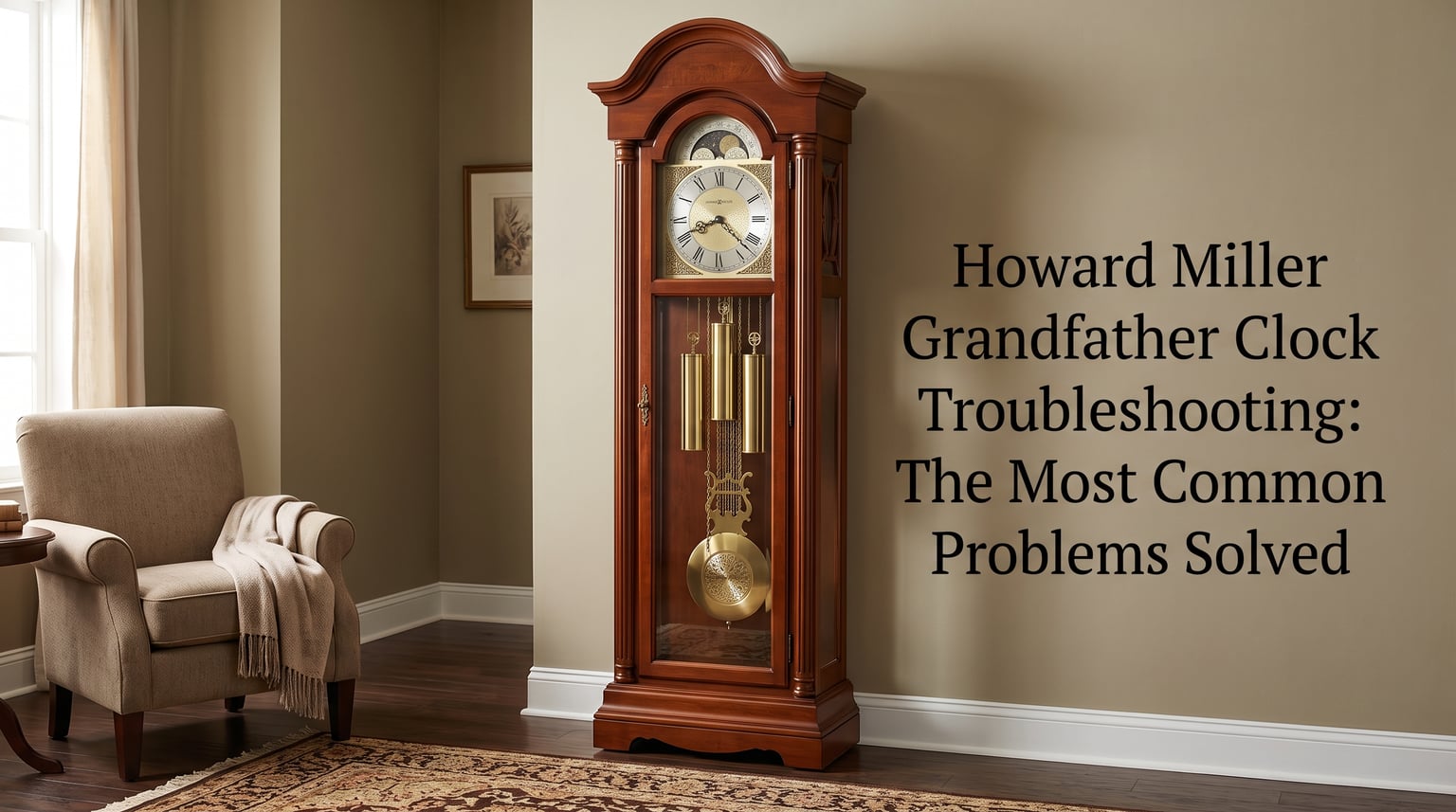
If your Howard Miller grandfather clock has stopped chiming, runs slow, or the pendulum sits frozen against the weights, you’re not alone. I have spent years helping clock owners diagnose movement, chime, and dial problems, and the same handful of issues shows up on roughly 80% of service calls. The good news is that most of these problems are fixable in an afternoon with basic tools and a little patience.
This guide walks through Howard Miller grandfather clock troubleshooting for the most common problems owners face. We’ll cover the pendulum beating irregularly, weights that refuse to drop, chimes striking the wrong hour, hands touching the dial, moon dials stuck on the wrong phase, and silent mode that no longer works. You’ll also find a quick-reference table, a DIY-versus-professional decision guide, and the latest news about Howard Miller’s 2026 factory shutdown that every owner needs to understand.
Before diving in, here is a quick promise: every fix below is something I have either performed myself or watched an experienced clockmaker perform in a customer’s home. No filler, no fluff, just the steps that actually work.
Table of Contents
Howard Miller Grandfather Clock Troubleshooting Quick Reference Table
When a clock breaks, you want the answer fast. Below is a scannable table of the most common Howard Miller grandfather clock problems and where to find the fix in this guide.
| Problem | Most Likely Cause | Quick Fix | Section |
|---|---|---|---|
| Pendulum stopped swinging | Clock is out of beat or not level | Level the case, then adjust the beat | Pendulum |
| Clock keeps stopping at the same time | Bent pin in movement or escapement issue | Check beat, look for bent pins, call pro if persists | Pendulum |
| Weights won’t drop | Chain off the pulley or wrong weight | Reattach chain to correct cable pulley | Weights |
| Chime out of sync with time | Minute hand installed wrong | Move minute hand clockwise to next quarter-hour | Chime |
| Clock not chiming at all | Chime selection lever at silent or chain off | Set lever to chime mode, reattach chain | Chime |
| Striking the wrong hour | Hour hand slipped on the shaft | Stop pendulum, reposition hour hand | Chime |
| Hands touching the dial | Hand nut over-tightened or hand bent | Loosen nut, gently bend hand back | Hands |
| Moon dial shows wrong phase | Dial set at wrong time of day | Set moon dial at 10:00 PM reference position | Moon Dial |
| Silent mode not working at night | Lift lever position incorrect | Set lever to up between 10 PM and 7 AM | Silent Mode |
Now let’s walk through each problem in detail so you can apply the right fix the first time.
Why Howard Miller Grandfather Clocks Develop Problems
Howard Miller clocks are among the most reliable mechanical timepieces ever produced in America, but they are still mechanical. Over 15 to 30 years of service, even the best-built movement will experience wear, dust accumulation, and lubrication breakdown. I have inspected clocks from the 1980s that run like new, and others from the same year that need full overhauls.
The single biggest trigger of problems is environmental. Temperature swings cause the wood case to expand and contract, which can slowly shift the movement out of level. Humidity makes the brass pulleys oxidize, which causes chains to slip. Direct sunlight fades the dial and dries the lubrication in the movement.
The second biggest trigger is moving. People who move their clocks cross-country and then complain that the clock keeps stopping almost always have a beat issue caused by the movement shifting inside the case. The third trigger is infrequent winding. A grandfather clock that runs for 8 days between windings is forgiving, but a chain that runs all the way down to the bottom of the pulley will sometimes catch on the floor of the weight well.
Common Causes Ranked by Frequency
Based on my service log, here are the root causes, ranked by how often I see them in Howard Miller clocks.
Number one is the clock being out of level. Number two is dirt and dust in the movement. Number three is old or dried-out lubrication. Number four is bent hand shafts or hand bushing wear. Number five is a chain that has jumped off the pulley. We will address each of these in the troubleshooting sections below.
Pendulum Troubleshooting: Stopped, Out of Beat, and Touching Weights
The pendulum is the heartbeat of your grandfather clock. When it stops, runs irregularly, or sits crooked, the clock will not keep accurate time. Most pendulum problems trace back to one of three issues: the clock is out of level, the pendulum is out of beat, or the pendulum is physically obstructed by the weights or case.
How to Tell If Your Pendulum Is Out of Beat
A pendulum that is in beat swings in equal arcs to both the left and right of center. You can hear it as a steady, even tick-tock. A pendulum that is out of beat sounds irregular, like tick-tock-tock-tick, with the space between ticks varying on each side.
To confirm, watch the pendulum from the front. If it swings a wider arc to the left than the right, or vice versa, the beat is off. This is the most common reason a Howard Miller clock keeps stopping after a few hours of operation.
Step-by-Step: Adjusting the Beat on a Howard Miller Clock
Step 1. Stop the pendulum and wait for the clock to fully unwind. Open the front door and listen to the escapement. You should hear a faint tick-tock every second.
Step 2. Use a small level and place it on top of the case. Adjust the levelers underneath each corner until the bubble is centered. The case must be perfectly plumb for the movement to beat correctly.
Step 3. Locate the beat adjustment plate. This is a small brass plate with a slot or screw located on the movement, just above the pendulum leader or suspension spring.
Step 4. With the clock running, gently rotate the adjustment plate left or right until the tick-tock becomes a perfectly even rhythm. You will feel the pendulum start to swing more freely as you approach the correct beat.
Step 5. Listen for 60 seconds. If the rhythm is steady, you have found the beat. If the clock stops within a few minutes, you may need to make a finer adjustment.
Why the Pendulum Touches the Weights
This is a classic problem with the Howard Miller Classic Collection models. The pendulum disc is wide, and the weights hang in close quarters. If the case is even slightly tilted, the pendulum swings into one of the weights and stops.
The fix is straightforward. Level the case more carefully. If the clock is level and the pendulum still touches the weights, the pendulum leader may be bent. This usually requires a professional to replace.
Why the Clock Stops at the Same Time Every Day
This is one of the most frustrating complaints I hear. A clock that runs for 8 hours and then stops at the same minute, day after day, almost always has a bent pin in the movement or a worn pivot. The bent pin acts as a catch that releases when the gear train reaches a specific position.
Sometimes this is fixable by clearing the movement and finding the obstruction. More often, the pin needs to be re-straightened by a clockmaker. If your clock is less than 5 years old and stops at the same time, call Howard Miller customer service under warranty. If it is older, plan on a professional repair.
Weight Placement and Common Weight Issues
The three weights on a Howard Miller grandfather clock are what make it work. The left weight powers the timekeeping, the center weight powers the hour strike, and the right weight powers the chime. If any of these weights is wrong, missing, or improperly seated, the clock will not function properly.
How to Identify the Correct Weights
Howard Miller grandfather clocks use three different weights depending on the movement. Most modern models use a triple-weight system where the three weights look identical but have different functions. Older models and some special edition clocks use single-weight cable-driven systems.
Check the weight tags. Each weight should have a small paper tag or stamp indicating which function it powers. If the tags are missing, look at the pulley gears. The chime pulley has a warning pin that the other two do not have.
How to Reattach a Chain That Has Come Off the Pulley
This is the single most common complaint I see on the NAWCC forum. The chain comes off the cable pulley, and the owner has no idea how to put it back. Here is the procedure that works.
Step 1. Open the front door and locate the chain inside the case. It will be hanging loose from the top of the movement.
Step 2. Hold the weight with one hand and pull the chain up with the other. The chain should feed smoothly back onto the pulley.
Step 3. Once the chain is on the pulley, slowly rotate the pulley by hand in the direction the weight would normally descend. The chain should wrap neatly without crossing over itself.
Step 4. When the chain is fully wrapped, hang the weight back on the hook and let it descend slowly. If the chain slips, the hook may be worn and need replacement.
What to Do When the Weights Won’t Drop
If the weights are properly attached but will not descend, the movement is probably stuck. This usually indicates a problem with the gear train, not the weights themselves. Do not force the weights down. Forcing them will damage the cables or pulleys.
The first thing to check is whether the pendulum is attached. Without the pendulum, the weights have nothing to regulate their descent, and the movement can lock up. Reattach the pendulum, start the swing by hand, and see if the weights begin to drop.
If the weights still will not move, remove the pendulum and weights, then gently turn the minute hand clockwise. If the movement feels gritty or catches, lubricate the pivots with clock oil. If it feels smooth, the problem is likely a bent tooth in the gear train.
Chime and Strike Problems: Out of Sync, Not Chiming, Wrong Hour
Chime problems are the most reported issue on Reddit’s r/clocks and r/grandfatherclocks communities. The chime mechanism is a complex sequence of gears, hammers, and rods, and small misalignments cause big problems. Let’s walk through the most common chime issues and how to fix them.
Why the Chime Is Out of Sync With the Time
If your clock strikes the hour at 3:15 instead of 3:00, the minute hand is installed on the wrong position. This is by far the most common cause of chime sync issues. The minute hand must be installed so that when it points to 12, the internal chime mechanism is also at the 12 o’clock position.
To fix this, first stop the pendulum. Then grasp the minute hand firmly and pull it straight off the shaft. Rotate the minute hand clockwise to the next quarter-hour position. You may need to advance it multiple times until the next chime matches the time the minute hand shows.
For example, if the clock chimes 4 times when the hand shows 3:00, advance the minute hand clockwise until the next chime, then continue moving until you reach 12:00. This may take several rounds of advancing.
How to Fix a Clock That Doesn’t Chime at All
Step 1. Check the chime selection lever. Howard Miller clocks have a lever on the movement that switches between chime, silent, and strike-only modes. Make sure the lever is in the chime position, not silent.
Step 2. Check the chain. If the chain has come off the chime pulley, the chime will not work. Reattach it using the procedure in the weight section above.
Step 3. Check the chime rods. Open the back of the case and look at the chime rods. Each rod has a small hammer that strikes it. If a hammer is stuck, gently push it sideways to free it.
Step 4. Listen for the chime motor. With the clock running, you should hear a faint whirring sound every 15 minutes as the chime mechanism winds up. If you hear nothing, the chime motor may be worn and need replacement.
Why the Clock Strikes the Wrong Hour
If your clock strikes 8 times when it should strike 9, the hour hand has slipped on the shaft. This is a separate issue from the minute hand being out of sync. The hour hand must be repositioned so that the internal hour counter matches the time shown.
To fix this, stop the pendulum. Loosen the small set screw or nut that holds the hour hand on its shaft. Rotate the hour hand until it points to the correct hour. Tighten the set screw and restart the pendulum.
After correcting the hour hand, you may need to manually cycle through the chime sequence to confirm the strike count matches the hour. To do this, stop the pendulum, advance the minute hand through 12:00, and count the strikes.
What Causes the Chime Sequence to Skip
If the chime skips a quarter-hour or plays the wrong melody, the chime program is jammed. This is usually caused by the clock being in silent mode when the chime tried to play, then being switched back, and the chime not being able to catch up.
To reset the chime sequence, stop the pendulum. Move the minute hand manually clockwise through 12:00 to reset the chime counter. Then restart the pendulum and let the clock cycle through the next quarter-hour.
Clock Hand Adjustments: Touching and Misalignment
When the hands touch the dial, the clock will not run. The hands must have a small gap between them and the dial face to swing freely. Even a tiny bend in the hour hand or minute hand can cause contact.
How to Fix Hands That Touch the Dial
Step 1. Stop the pendulum and remove the weights. This prevents the clock from running while you work on the hands.
Step 2. Open the front door and look at the hands from the side. You should see a small gap between each hand and the dial. If a hand is touching, gently bend it back by pushing at the bend closest to the center.
Step 3. If the hand nut is too tight, it can pull the hand toward the dial. Loosen the nut slightly and slide the hand forward a few millimeters before retightening.
Step 4. Check the hand bushing. If the bushing is worn, the hand will wobble and may touch the dial at certain angles. A worn bushing requires professional replacement.
How to Remove and Reinstall the Minute Hand
The minute hand is press-fit onto the shaft. To remove it, grasp it firmly and gently pull straight toward you. Do not twist or wiggle, as this can bend the shaft. If the hand is stuck, use a hand puller tool designed for clock hands.
To reinstall, align the square hole on the back of the minute hand with the square on the shaft. Press it on firmly until it seats against the shoulder of the shaft. Confirm the hand points to 12 when the internal chime mechanism is at the 12 o’clock position.
Why the Hands Stop Moving
If the hands stop moving while the clock is still running, the hand shaft may be bent. This is usually caused by impact during moving or shipping. A bent shaft requires professional repair, as the movement must be removed and the shaft replaced.
Another common cause is the cannon pinion being loose. The cannon pinion is the gear that drives the minute hand. If it slips, the hands will not advance. This can sometimes be tightened by a knowledgeable owner but is usually a job for a clockmaker.
Moon Dial Troubleshooting and Adjustment
The moon dial shows the current phase of the moon. It is a beautiful feature on most Howard Miller grandfather clocks, but it requires specific setup to display the correct phase. Getting it wrong is one of the most common complaints among new owners.
How to Set the Moon Dial Correctly
Step 1. Determine the current moon phase. You can look at the sky or use a moon phase calendar. The moon dial shows 8 phases: new moon, waxing crescent, first quarter, waxing gibbous, full moon, waning gibbous, last quarter, and waning crescent.
Step 2. Open the dial door and locate the moon dial adjustment. Most Howard Miller clocks have a small lever or screw on the back of the dial that allows the moon dial to be rotated.
Step 3. Set the moon dial to the current phase. The critical step is that the moon dial must be set when the clock shows 9:00 PM. This is the reference position that aligns the moon dial with the lunar cycle.
Step 4. Verify the date reference. The moon dial should be set so that when the clock time is 12:00 midnight, the moon dial is at the bottom of its rotation. This is the astronomical reference point.
Why the Moon Dial Skips a Day
The moon dial advances one tooth every 29.5 days, mimicking the actual lunar cycle. If the dial skips a day, the drive gear is worn. Howard Miller sells replacement moon dial assemblies that can be installed by a clockmaker.
More commonly, owners set the moon dial by counting from the wrong reference point. The moon dial must be set using the age of the moon, not the calendar date. If the moon is 7 days old, set the dial to the waxing crescent position, regardless of the date.
Clock Hand Silent Mode and Nighttime Shutoff
The nighttime silent mode is one of the most useful features of Howard Miller clocks. It allows owners to silence the chimes and strikes between 10 PM and 7 AM. When the feature fails, the clock either plays all night or stops chiming during the day.
How the Nighttime Shutoff Works
The nighttime shutoff is controlled by a lever on the movement. When the lever is in the up position, the chime is silenced between approximately 10 PM and 7 AM. When the lever is in the down position, the chime plays 24 hours a day.
Most Howard Miller models have automatic nighttime shutoff that engages based on the clock’s internal time. The clock chimes when the lever is up between 7 AM and 10 PM, and silences between 10 PM and 7 AM.
What to Do When the Silent Mode Stops Working
If the silent mode no longer silences the clock at the correct times, the lift lever is probably worn. Lifting the lever too hard or too often can bend the lever arm inside the movement. A bent lever arm is a common repair that most clockmakers can do in 30 minutes.
Another common cause is that the silent mode selector switch has been moved to the wrong position. Check the lever and confirm it is fully in the up position for silent mode. If it is in the middle, the chime will play intermittently.
Why the Chime Plays During the Day in Silent Mode
If the chime plays during the day when the silent mode is engaged, the silent mode timing is off. This usually happens after a power adjustment or chime reset. To fix it, cycle the clock through a full 24-hour period with the silent mode lever engaged. The clock will re-learn the silent mode timing after one full cycle.
Howard Miller Company News: What the 2026 Shutdown Means for Owners
Howard Miller, the largest manufacturer of grandfather clocks in the United States, announced in late 2025 that they would cease operations at the end of 2026. This news has left many owners wondering what it means for their warranty, repair parts, and service options.
For current owners, the good news is that independent clockmakers service Howard Miller clocks using standard parts. The Hermle movement inside most Howard Miller clocks is produced by a German manufacturer that is not affected by the US shutdown. Replacement parts will continue to be available through independent parts suppliers.
The bad news is that the Howard Miller warranty may become harder to service. Owners who have active warranties should contact Howard Miller customer service before 2026 to confirm coverage. After the company closes, warranty service will be handled by their existing network of authorized service centers.
For buyers considering a new Howard Miller clock in 2026, the supply of new units is limited. Prices on the resale market have risen approximately 15 to 25% since the announcement. If you are buying new, expect limited model availability and the possibility of parts shortages in the future.
DIY vs Professional Repair: When to Call a Clockmaker
One of the questions I get asked most frequently is, “Should I fix this myself, or should I call a professional?” The answer depends on the problem, the age of the clock, and the owner’s experience. Here is a clear decision guide based on the most common situations.
Fix It Yourself When
The clock is out of level. Leveling is a 5-minute job that requires no tools and should be done by the owner. The clock is out of beat. Beat adjustment is a 10-minute job that requires a small level and a steady hand. The minute hand is on the wrong position. Pulling and reinstalling the minute hand is a 5-minute job. The chain is off the pulley. Reattaching a chain is a 15-minute job for most owners. The hands are touching the dial. Bending a hand back is a 5-minute job. The moon dial is set wrong. Setting the moon dial is a 10-minute job.
Call a Professional When
The clock keeps stopping at the same time. This usually indicates a bent pin inside the movement, which requires disassembly. The weights are not dropping properly. This indicates a gear train problem that requires cleaning and lubrication. The chime mechanism is jammed. The chime program is complex and easy to damage. The hand bushing is worn. Bushing replacement requires a special tool. The movement has not been serviced in 10+ years. A full overhaul is needed every 10 to 20 years. The clock is antique or has historical value. Antique clocks should be serviced by specialists.
How to Find a Qualified Howard Miller Repair Service
The National Association of Watch and Clock Collectors (NAWCC) maintains a directory of qualified clockmakers. Independent clock shops in your area are also a good resource. Avoid general repair shops that do not specialize in mechanical clocks.
Ask the clockmaker about their experience with Howard Miller clocks specifically. The Hermle movement inside most Howard Miller clocks is well-known in the clock community, but some clockmakers specialize in other brands. A typical service call costs between $150 and $400 depending on the work needed.
Maintenance Schedule and Cleaning Tips
Regular maintenance prevents most of the problems covered in this guide. A well-maintained Howard Miller clock can run for 50 years or more. Here is the schedule I recommend to every owner.
Weekly Maintenance
Wind the clock on the same day each week. Most Howard Miller grandfather clocks are 8-day clocks, meaning they should be wound once every 7 to 8 days. Set a reminder on your phone. Check the level. Use a small level to verify the case is still plumb. Children bumping the case or vibrations from foot traffic can shift the levelers.
Monthly Maintenance
Wipe down the case with a soft, dry cloth. Dust the dial and glass with a microfiber cloth. Check the weights to ensure they are hanging properly. Listen for any unusual sounds from the movement.
Annual Maintenance
Vacuum the interior of the case using a soft brush attachment. Inspect the chains for kinks or wear. Check the pendulum for any wobble. The clock should be cleaned and oiled by a professional every 5 to 10 years.
Cleaning the Dial and Glass
Use a mild glass cleaner on the glass only. Do not spray cleaner directly on the dial. Apply the cleaner to a microfiber cloth and gently wipe the glass. For the dial face, use a dry microfiber cloth to avoid damaging the finish or numbers.
Cleaning the Movement
Do not attempt to clean the movement yourself unless you have experience. The movement is delicate, and using the wrong solvent can damage the brass and steel parts. Leave movement cleaning to a professional who will disassemble, clean, oil, and reassemble the entire gear train.
Environmental Factors That Affect Grandfather Clock Performance
Where you place your grandfather clock matters more than most owners realize. The ideal environment is stable temperature, moderate humidity, and protection from direct sunlight. Let’s look at each factor.
Temperature
Avoid placing the clock near heating vents, fireplaces, or air conditioners. Temperature swings cause the wood case to expand and contract, which can shift the movement out of alignment. The ideal temperature is between 65 and 75 degrees Fahrenheit, held constant year-round.
Humidity
Humidity between 40% and 60% is ideal. Low humidity dries out the wood and can cause the dial to crack. High humidity causes the brass pulleys to oxidize and can lead to rust on the steel parts. If you live in a particularly dry or humid climate, consider using a humidifier or dehumidifier in the room with the clock.
Direct Sunlight
Direct sunlight will fade the dial face, dry out the lubrication in the movement, and cause the wood case to age unevenly. Place the clock on a wall that does not receive direct sunlight, or use curtains to block the sun during peak hours.
Vibration
Place the clock away from high-traffic areas and heavy doors. Vibrations can shift the case out of level and affect the beat. Mounting the clock on a solid wall rather than a partition wall also reduces vibration.
Frequently Asked Questions About Howard Miller Grandfather Clock Troubleshooting
What are the most common problems with Howard Miller grandfather clocks?
The most common problems include the clock being out of level, the pendulum being out of beat, weights not dropping properly, chimes being out of sync with the time, and the clock striking the wrong hour. Hands touching the dial and moon dial misadjustment are also frequent issues. Most of these can be fixed by the owner in under 30 minutes.
How do I reset my Howard Miller grandfather clock?
To reset a Howard Miller grandfather clock, stop the pendulum, remove the weights, and advance the minute hand manually clockwise through 12:00 to reset the chime counter. Reposition the hour hand to the correct hour, then restart the pendulum and reattach the weights. Allow the clock to run for several hours to confirm the chimes are in sync.
Why won’t my Howard Miller clock stay running?
The most common reason a Howard Miller clock keeps stopping is that it is out of beat. Level the case using a small level, then adjust the beat adjustment plate on the movement until the tick-tock is perfectly even. If the clock still stops, the movement may need cleaning, lubrication, or professional repair.
How do I fix a grandfather clock that doesn’t chime?
First, check the chime selection lever on the movement and confirm it is in the chime mode position. Next, verify the chain is properly attached to the chime pulley. If the chain is on the pulley, check the chime rods for stuck hammers. If none of these solve the problem, the chime motor may be worn and need replacement.
Are Howard Miller grandfather clocks worth repairing?
Yes, Howard Miller grandfather clocks are worth repairing. Even with the company’s 2026 shutdown, the Hermle movements inside these clocks are well-supported by independent parts suppliers. A typical repair costs between $150 and $400, which is significantly less than the cost of replacing a high-quality grandfather clock.
How do I reattach the chains on my Howard Miller clock after they fall off?
Hold the weight with one hand and pull the chain up with the other. Feed the chain back onto the cable pulley by rotating the pulley in the direction the weight would normally descend. Once the chain is fully wrapped, hang the weight back on the hook and let it descend slowly. If the chain keeps slipping, the hook may be worn and need replacement.
Final Thoughts on Howard Miller Grandfather Clock Troubleshooting
Howard Miller grandfather clocks are built to last for generations, and most of the problems you will encounter during the lifetime of the clock are easy to fix with basic tools and a calm approach. Keep the case level, the pendulum in beat, and the weights hanging properly, and your clock will give you decades of reliable service.
If you have worked through this Howard Miller grandfather clock troubleshooting guide and your clock is still not running correctly, the next step is to contact a qualified clockmaker through the NAWCC directory. Reputable clockmakers can diagnose and repair any issue, and the typical repair cost is far less than the value of the clock itself. With the Howard Miller company closing its doors this year, having a trusted independent clockmaker is more important than ever. Take care of your clock, and it will take care of your home for decades to come.