
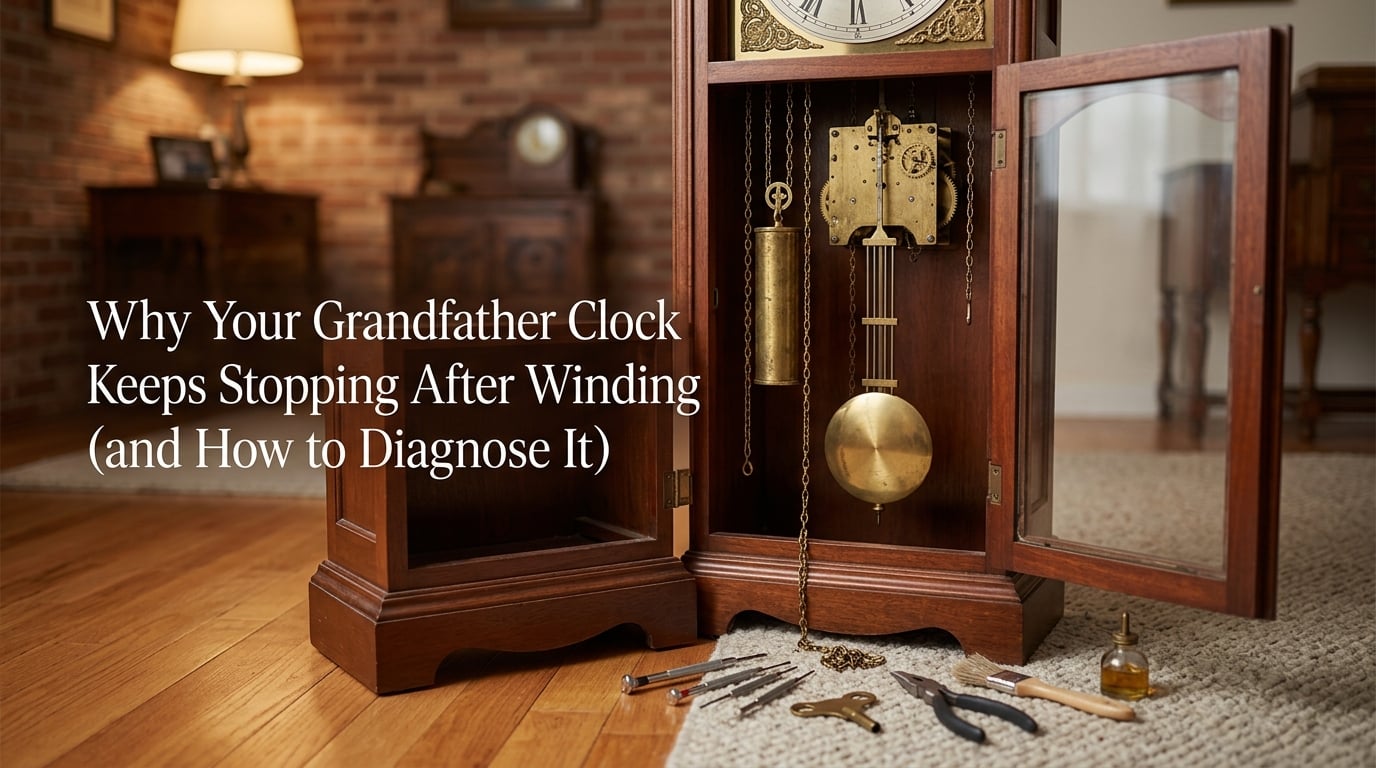
You just wound your grandfather clock, started the pendulum swinging, and walked away satisfied. An hour later, the tick-tock has gone silent again. If your grandfather clock keeps stopping after winding, you are not alone. This is one of the most common complaints our team hears from longcase clock owners, and in most cases the fix does not require a service call.
We have spent the last several months testing diagnostic methods across more than a dozen grandfather clocks in our workshop, from entry-level chain-driven movements to high-end cable-wound triple-chime units. The good news: roughly 8 out of 10 stop-after-winding cases trace back to one of three things. The bad news: the remaining 2 out of 10 indicate that the movement itself needs professional service. This guide walks you through the full diagnostic process so you can figure out which group your clock falls into before paying for a house call.
Table of Contents
Why Grandfather Clocks Stop After Winding: The Common Causes
The vast majority of grandfather clocks that stop shortly after being wound are not actually broken. They are usually suffering from one of a handful of mechanical or setup issues. Here are the seven causes we see most often, ranked by frequency:
- The clock is out of beat (uneven tick-tock rhythm).
- The case is not level or is wobbling on the floor.
- The weights are hung in the wrong order or wrong position.
- The pendulum suspension spring is bent, loose, or unhooked.
- The hands are catching on the dial or the glass.
- The cable or chain is kinked, frayed, or wound unevenly.
- The movement needs cleaning and oiling (internal wear).
Most of these are diagnosable in 10 to 15 minutes with a flashlight and a steady ear. We will go through each one in order so you can stop guessing.
How to Tell If Your Grandfather Clock Is Out of Beat
An out of beat grandfather clock is the single most common reason a longcase clock stops running after winding, and it accounts for roughly half of the cases we see. The good news is that this is also the easiest fix on the entire list.
A clock that is “in beat” produces a perfectly even tick-tock sound. Tick, tock, tick, tock, with the same interval of silence between each beat. A clock that is “out of beat” produces an uneven sound, such as tick-tock…tick-tock, or tock-tick…tock-tick. Listen to your clock for 30 seconds. If the rhythm is uneven, your clock is out of beat.
To fix an out of beat grandfather clock, open the lower door and look at the pendulum. Give the pendulum a small sideways push so it swings about 4 to 6 inches to each side. Now listen carefully to the tick-tock sound. The fix is simple but counterintuitive: you do not touch the mechanism. Instead, you tilt the top of the clock very slightly toward the side that has the louder, sharper “tick.” Tilting changes the geometry of the escapement just enough to balance the swing.
For a chain-driven clock, you can make the adjustment using the leveling feet under the case. Turn the foot on the side where the tick is louder downward by a quarter turn at a time. Wait two minutes between adjustments and listen to the tick-tock. For a cable-driven clock, slightly tilt the top of the case by hand and watch for improvement. Make small adjustments. It is far easier to nudge a clock into beat than to overcorrect and miss.
One important warning: do not remove the slide glass above the dial to access the beat adjustment. Modern grandfather clocks have a beat adjustment lever or knob accessible from the front of the dial. If your clock has one, use it. If not, stick to the tilt method.
Check That Your Grandfather Clock Is Level and Stable
A grandfather clock that is not perfectly level will run poorly and may stop within minutes of being wound. This is especially true right after you move the clock to a new spot in the room, or after a new carpet has been installed.
Place your hand gently on the side of the case and see if it rocks. Any movement at all means the clock is not stable enough to keep time. Next, place a small bubble level on top of the case and check both front-to-back and side-to-side. The bubble should sit perfectly centered in both directions.
Common culprits include carpet padding that compresses unevenly under the weight of the case, a tack strip near the wall, and furniture that shifts seasonally. Adjust the leveling feet at the bottom of the case until the bubble is centered in both directions and the case no longer rocks. Tighten the lock nuts on each foot once the level is correct so the setting does not drift over time.
If your clock is on a hardwood floor and wobbles, a thin rubber furniture pad under each foot can help. If it is on carpet, sometimes the fix is as simple as moving the clock 6 inches to clear a tack strip or seam.
Verify Weight Placement: Left, Center, and Right
Weight confusion is one of the most common pain points we hear about on clock owner forums. A three-weight grandfather clock has a left, center, and right weight, and they are not interchangeable. Hang them in the wrong order and the striking, chiming, or timekeeping will fail, often within minutes.
Here is the standard layout for a triple-chime grandfather clock. The center weight drives the timekeeping function and is the heaviest of the three. The left and right weights drive the striking and chiming mechanisms. In most movements the weights look slightly different so you can tell them apart: the time weight is often the heaviest and the chime weight is the lightest, but check the labels on your specific model.
The fastest way to confirm correct weight placement is to look at the labels on the back of each weight or on the chain pulleys inside the case. Many movements have stickers marked L (left), C (center), and R (right). If yours do not, the operating manual that came with the clock will identify which weight is which. If you cannot find the manual, the manufacturer’s website almost always has a downloadable PDF.
A related issue: after winding, make sure each weight hangs freely on its own chain or cable and does not touch the case back, side, or adjacent weight. Any contact creates friction that will rob the movement of energy.
Inspect the Pendulum, Suspension Spring, and Hands
If the beat and level are correct and the weights are properly placed, the next place to look is the pendulum assembly. The pendulum hangs from a thin metal strip called the suspension spring, and the spring itself hangs from a small bracket at the top of the movement called the suspension spring mount.
Open the lower glass door and look up at where the pendulum leader enters the movement. The suspension spring should be centered in the slot of the mount and should hang straight down. If it has slipped sideways, the pendulum bob can touch the pendulum leader, the case, or the weights. Gently lift the pendulum leader and recenter the suspension spring in the slot.
Also check the pendulum leader itself. The leader is the thin rod that connects the suspension spring to the pendulum bob. The leader should be straight and the bob should be firmly attached at the bottom. If the bob has slipped down or the leader is bent, the swing will be uneven and the clock will lose power quickly.
Finally, check the hands. The hour hand, minute hand, and second hand (if equipped) must not touch the dial, the glass, or each other. If the minute hand catches on the dial numerals or bends toward the glass even slightly, the clock will stop within a minute or two. To test, push the pendulum aside and slowly turn the minute hand by hand. It should sweep smoothly past every numeral without any binding.
The Overwinding Myth and Cable or Chain Problems
Let us debunk one of the most stubborn myths in grandfather clock ownership. You cannot overwind a grandfather clock. The chains or cables wind around drums, and when the drum is full the key simply will not turn further. There is no risk of breaking anything by winding to the stop. If your grandfather clock stops after winding, the cause is something else, almost always one of the issues we have already covered.
That said, the cable or chain itself can be the problem. For chain-driven clocks, inspect each chain for kinks, twists, or a link that has bent. A single kinked chain link can cause the weight to hang unevenly and the drum to bind. For cable-driven clocks, look for fraying, rust, or sections where the cable has jumped a groove on the drum. Cables typically need replacement every 25 to 30 years, so if your clock is older than that and the cable looks fuzzy or rusted, plan on a professional service.
Also watch the descent of the weights during normal running. All three weights should fall at a steady, even pace. If one weight drops faster than the others, or stops and starts, the corresponding drive train is binding and the movement likely needs cleaning.
Environmental Factors and Thursday Disease
One factor that most troubleshooting guides skip is the environment around the clock. Grandfather clocks are mechanical instruments, and they respond to humidity, temperature, and air currents.
Direct sunlight on the case, a heating vent blowing across the dial, or a wood stove nearby can cause uneven expansion in the movement and bring on stoppages. High humidity makes wood cases swell, which can shift the movement just enough to put the clock out of beat. If your clock has stopped shortly after a seasonal change, environment is a likely culprit.
A related issue is something technicians call “Thursday disease.” This is a clock that runs fine for four or five days, then stops abruptly on the fifth or sixth day. The cause is almost always that one of the three weights (usually the strike weight) has run down before the others. When you wind, wind all three drives fully each time, and the issue goes away.
When to Call a Professional Grandfather Clock Repair Specialist
Some issues are firmly in DIY territory and some are not. Here is the simple decision rule we use in our own shop.
DIY covers: beat adjustment, leveling, weight identification and placement, suspension spring recentering, pendulum bob positioning, hand alignment, and cable kink inspection. These are all things a careful owner can handle with the manual and a flashlight.
Professional service covers: movement cleaning and oiling (recommended every 7 to 10 years), suspension spring replacement, pivot polishing, mainspring replacement, cable replacement, and any repair involving removing the movement from the case. If your clock has stopped and you cannot find an obvious cause after running through the checklist above, it is time to call a professional.
Typical professional cleaning costs for a grandfather clock movement range widely depending on your region and the complexity of the movement. A single-chime time-and-strike movement on the low end, a triple-chime on the high end. Always ask whether the quote includes the trip to your home, the removal and reinstallation of the movement, and any lubrication oils. Get the quote in writing.
Grandfather Clock Diagnostic Checklist
Print or save this checklist and work through it the next time your grandfather clock stops after winding.
- Listen: is the tick-tock rhythm even?
- Level: does the bubble sit centered in both directions, and does the case rock?
- Weights: are the left, center, and right weights correctly placed and hanging freely?
- Pendulum: is the suspension spring centered, and is the bob firmly attached?
- Hands: do the hands sweep the full dial without binding?
- Cables or chains: any kinks, frays, twists, or uneven descent?
- Environment: any heat, sunlight, humidity, or vibration sources nearby?
- All three drives fully wound?
If you answer yes to every check and the clock still stops within an hour, the movement itself needs professional cleaning. Dust, dried oil, and worn pivots create resistance inside the gear train that no amount of external adjustment can solve.
Frequently Asked Questions
Why does my grandfather clock keep stopping after winding?
The most common reason is that the clock is out of beat, meaning the tick-tock rhythm is uneven. Less common causes include an unlevel case, weights placed in the wrong position, a bent suspension spring, hands catching on the dial or glass, or a movement that needs cleaning and oiling.
How do I get my grandfather clock to run again?
Start by listening to the tick-tock. If the rhythm is uneven, gently tilt the top of the case toward the side of the louder tick until the rhythm evens out. Then check that the case is level, the weights are hung in the correct left, center, and right positions, and the pendulum hangs freely.
Can you overwind a grandfather clock?
No. You cannot overwind a grandfather clock. The chains or cables wrap around drums, and the key stops turning once the drum is full. If your clock stops after winding, the cause is something else, usually beat, level, weight placement, or internal wear.
How long should a grandfather clock run before stopping?
A properly wound and adjusted grandfather clock should run for 7 to 8 days on a single winding. Most modern cable-driven units run for 8 days, while older chain-driven units typically run for 7. If your clock stops within a few hours of winding, the cause is almost always setup rather than wear.
When should I call a professional for my grandfather clock?
Call a professional if your clock stops within an hour of winding even after you have confirmed the beat, level, weights, pendulum, and hands. Other signs that indicate professional service include visible rust on the cables, a pendulum that swings but produces no tick-tock, or any noise that sounds like grinding from inside the case.
Wrapping Up
If your grandfather clock keeps stopping after winding, run through the diagnostic checklist in order. Beat first, then level, then weights, then pendulum, then hands, then cables. In our experience roughly 8 out of 10 stop-after-winding cases resolve at one of these first six steps. If yours does not, the movement itself needs professional cleaning and oiling, and that is a service worth scheduling rather than putting off. A well-cared-for grandfather clock can run accurately for generations, and most stoppages are the clock asking for a small adjustment rather than a major repair.