
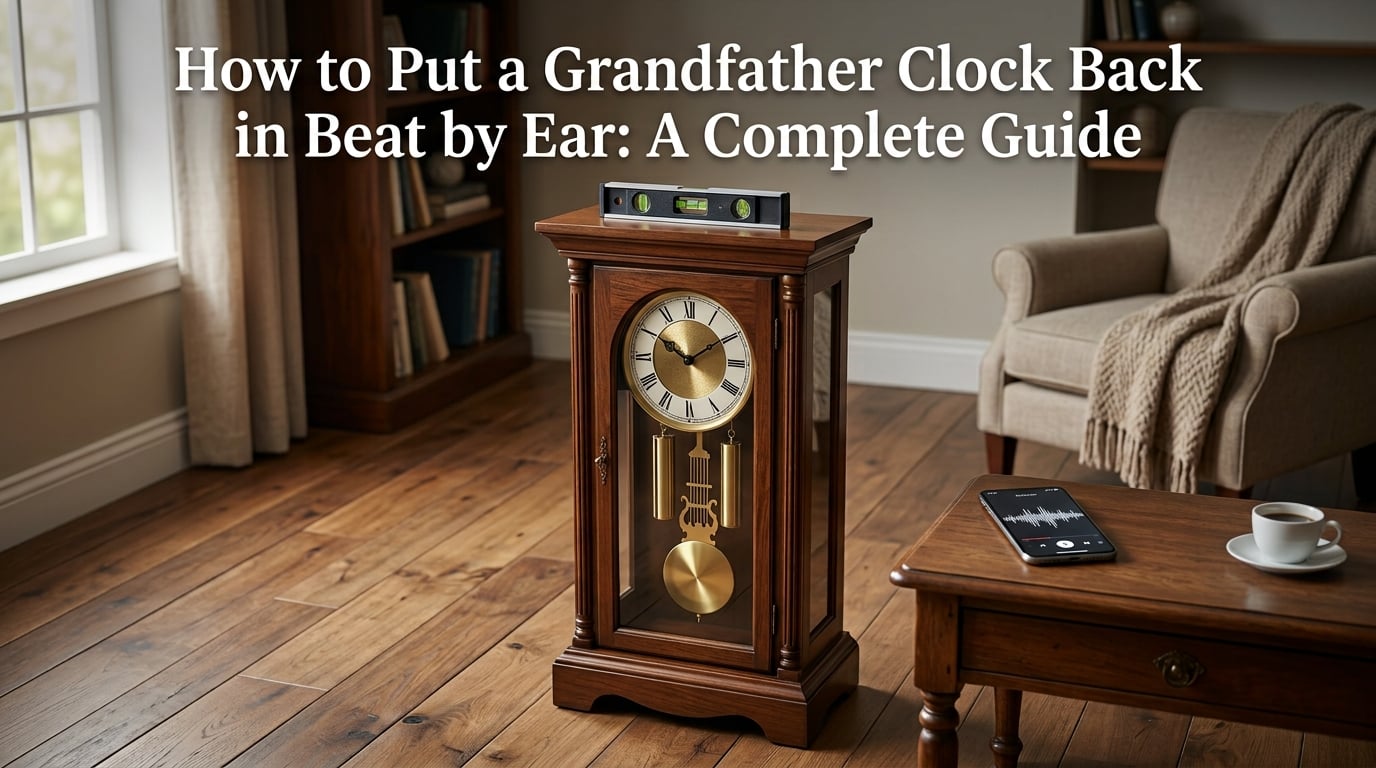
If your grandfather clock stopped running after you moved it, bumped it, or restarted it after storage, the problem is almost always the beat. Learning how to put a grandfather clock back in beat by ear is one of the most useful skills a clock owner can have. It takes about ten minutes, costs nothing, and can save you a repair bill that might run into hundreds of dollars.
A clock’s “beat” is the even tick-tock rhythm it produces when running correctly. When that rhythm becomes uneven, the pendulum loses efficiency and the clock stops. The good news is that you do not need special tools or years of experience to fix it.
In this guide, I will walk you through exactly how to listen for an uneven beat, how to level your clock case, and how to adjust the crutch to restore that perfect tick-tock. I have used these same techniques on cable-driven and chain-driven clocks, and they work on nearly every mechanical longcase clock made in the last century.
Table of Contents
What Is a Grandfather Clock Beat?
The beat of a grandfather clock refers to the even spacing between each tick and each tock as the pendulum swings. When a clock is in beat, the pendulum travels an equal distance to the left and right of its center point. That equal travel produces a steady, rhythmic sound: tick, tock, tick, tock.
Each tick and tock happens when a pallet on the escapement releases a tooth on the escape wheel. One side releases on the left swing, the other on the right swing. If both swings are equal in distance, the time between releases stays perfectly even.
When the clock is out of beat, one swing is longer than the other. You hear it as an uneven rhythm like tick-tock, tick, tock. The longer swing wastes energy, the pendulum loses amplitude, and eventually the clock stops running altogether.
How to Tell If Your Grandfather Clock Is Out of Beat
You can diagnose a grandfather clock beat problem entirely by ear. Listen closely to the ticking pattern for about 30 seconds. An in-beat clock produces an even, metronome-like rhythm where every interval between sounds is identical.
An out-of-beat clock produces an uneven pattern. The classic sign is what clockmakers call a “limping tick.” You will hear something like tick-tock, pause, tick-tock, pause. Or it may sound like tick, long pause, tock, short pause, tick.
Here is a quick way to compare the two patterns:
In beat: tick-tock-tick-tock-tick-tock (even spacing throughout)
Out of beat: tick-tock, tick, tock, tick-tock, tick, tock (uneven grouping)
Badly out of beat: tick, long silence, tock, long silence, tick (clock will stop within minutes)
If the clock stops after running for only a few minutes, or if the pendulum swing is visibly lopsided, you are almost certainly dealing with a beat issue. A well-regulated pendulum should swing evenly on both sides with a total travel of about 4 to 6 inches depending on the clock.
Why Clocks Go Out of Beat After Moving
Moving a grandfather clock is the number one cause of beat problems. When you tilt the clock even slightly during transport, the movement shifts relative to the pendulum suspension. Even a fraction of a degree of change can throw off the beat enough to stop the clock.
Bumping the case, carrying it up or down stairs, or loading it into a vehicle all introduce small shifts. The crutch, which is the thin rod that connects the movement to the pendulum leader, can also get slightly bent during handling.
Another common trigger is winding. When you wind a cable-driven clock, the cable spool changes diameter as it fills or empties. This can cause a momentary pause or tug on the movement, nudging the pendulum out of its beat. Many clock owners report their clock going out of beat every time they wind it, a problem that proper beat setting resolves.
Temperature and humidity changes can also affect the suspension spring over time. A thin suspension spring that has aged may develop a slight twist, throwing off the beat gradually.
How to Put a Grandfather Clock Back in Beat by Ear
You can put a grandfather clock back in beat using only your ears and your hands. No tools are required, though a small spirit level helps for the first step. Follow these five steps in order, and make small adjustments rather than large ones.
Step 1: Level the Clock Case Front to Back and Side to Side
Start by checking that the clock case is level. Place a spirit level on top of the case and check both side-to-side and front-to-back. Many people only level side to side, but front-to-back leveling matters just as much for the beat.
If the floor is uneven, use the clock’s adjustable leveling feet if it has them. If your clock does not have adjustable feet, slide thin shims under the corners. A folded business card or a couple of paper shims work surprisingly well. Clock repair forums are full of success stories from people who fixed their beat problem with nothing more than a piece of cardboard under one corner.
Get the case as level as you reasonably can before moving on. Leveling alone fixes the beat in many cases, especially right after a move.
Step 2: Start the Pendulum Swinging
Once the case is level, hang the pendulum on the suspension spring or leader at the top. Make sure it hangs straight and is not twisted. The pendulum bob, the round disc at the bottom, should hang centered in the case without touching the sides.
Gently push the pendulum to one side and release it. Give it enough of a push to get a healthy swing going. You want to see the bob travel a few inches to each side of center. Do not push too hard, as over-swinging can damage the suspension spring.
Let the pendulum settle into its natural rhythm for about 30 seconds before you start listening critically.
Step 3: Listen to the Tick-Tock Rhythm
Stand close to the clock and listen carefully to the ticking. Close your eyes to focus on the sound. Try to identify whether one side of the swing takes longer than the other.
If the tick comes quickly after the tock, but then there is a long pause before the next tick, your clock is out of beat toward that longer-pause side. The general rule is this: the crutch needs to be adjusted in the direction of the longer pause.
Say the pattern is tick, short pause, tock, long pause, tick. The crutch needs to move toward the side where the long pause occurs. Remembering this rule is the key to adjusting by ear correctly.
Step 4: Adjust the Crutch in Small Increments
Stop the pendulum gently and hold it still. The crutch is the thin vertical rod that hangs down from the movement and passes behind or through the pendulum leader. It is what pushes the pendulum back and forth as the escape wheel ticks.
Grasp the crutch rod firmly but gently between your thumb and forefinger. Bend it very slightly in the direction of the longer pause you identified. We are talking about a tiny adjustment, maybe the thickness of a coin. Do not bend it dramatically, or you will overshoot and create the opposite problem.
Restart the pendulum and listen again. If the rhythm is more even but still not perfect, stop and make another small bend in the same direction. If the rhythm got worse, you bent the wrong way. Reverse the direction slightly.
This is an iterative process. Expect to make three to five small adjustments before you nail the beat. Patience here pays off.
Step 5: Test the Beat and Fine-Tune
Once the tick-tock sounds even to your ear, let the clock run for at least 15 minutes. A truly in-beat clock will keep running and maintain a steady pendulum swing. If the clock stops within that time, the beat is still off and you need to repeat Step 4.
For final confirmation, set the clock to the correct time and leave it overnight. If it is still running in the morning, your beat adjustment was successful. At that point, any minor timekeeping inaccuracy is a regulation issue, not a beat issue, and can be corrected by adjusting the pendulum bob up or down.
Using a Smartphone App to Detect Beat
If you have trouble hearing the beat by ear, a smartphone can help you visualize the tick-tock pattern. This technique comes straight from clock enthusiast forums, where users on Reddit’s r/clocks and r/Horology communities regularly recommend it.
The simplest method uses the Voice Memos app built into your phone. Open the app, start a recording, and hold your phone near the clock movement for about 30 seconds. Stop the recording and play it back while watching the waveform on screen.
An in-beat clock produces a waveform with perfectly even spacing between the spikes. An out-of-beat clock shows uneven gaps. You can clearly see which side of the swing takes longer, which tells you exactly which direction to bend the crutch.
There are also dedicated clock timing apps available for iOS and Android. These apps measure the beat error in milliseconds and display it numerically. A beat error of zero means the clock is perfectly in beat. Most enthusiasts aim for an error under 20 milliseconds.
Using an app is especially helpful if you are new to listening for beat. Once you have used the visual method a few times, you will start to recognize the sound patterns by ear naturally.
Common Problems That Mimic an Out-of-Beat Clock
Sometimes a clock sounds out of beat but the real problem is something else entirely. Before you spend time bending the crutch, check these three common culprits.
Hand Position and Clearance
The hour and minute hands must not touch each other or rub against the dial. If the minute hand drags on the hour hand as it passes, it creates resistance that slows or stops the pendulum. This mimics a beat problem but is actually a hand alignment issue.
Check that the second hand, if your clock has one, is not catching on the minute hand either. Gently press the hands toward the dial to tighten them if they are loose, or pull them slightly away if they are rubbing.
Pendulum Dragging on Chime Rods
Behind the pendulum, many grandfather clocks have a set of chime rods. If the pendulum bob swings too wide or is positioned too far back, it can brush against these rods. Even light contact creates drag that kills the pendulum swing.
Shine a flashlight behind the pendulum and watch it swing. If you see the bob touching anything, reposition it slightly forward on the leader. The bob should clear all rods and case components by at least a quarter inch on each side.
Weight Positioning and Chain Issues
Make sure the three weights hang freely and do not touch each other or the inside of the case. On chain-driven clocks, check that the chains are not twisted or crossed on their sprockets. A twisted chain introduces friction that stops the movement.
For cable-driven clocks, ensure the cables wind evenly on the barrels. A cable that has jumped off its track will jam the movement and stop the clock regardless of beat.
The Auto-Beat Feature on Modern German Movements
If your grandfather clock was built after roughly 1985 with a German movement from Hermle, Kieninger, or Urgos, it may have an auto-beat feature. This is a small friction-fit slip clutch on the crutch that allows the beat to self-adjust.
To use the auto-beat feature, you simply over-swing the pendulum. Push the pendulum bob much farther to one side than its normal travel and release it. The extra force causes the crutch to slip on its clutch and re-center itself to the correct beat position.
After over-swinging, let the pendulum settle and listen. If the movement has auto-beat, the tick-tock should be even after just one or two over-swings. This eliminates the need for manual crutch bending on these movements.
Not all modern movements have this feature, and older movements almost never do. If over-swinging does not fix the beat after two attempts, your clock likely needs manual crutch adjustment as described in the steps above.
When to Call a Professional Clock Repairer
Most beat adjustments are straightforward DIY fixes. However, there are situations where calling a professional clock repairer makes sense. If you have tried leveling, crutch adjustment, and over-swinging and the clock still stops within minutes, the movement may need cleaning or have worn pivots.
A clock that has not been serviced in 10 to 15 years may have gummed-up oil causing excessive friction. In that case, no amount of beat adjustment will keep it running. The movement needs to be cleaned and lubricated.
If you hear grinding noises, see a visibly bent crutch that will not hold its position, or notice the suspension spring is cracked or kinked, stop and call a professional. These are hardware problems that require replacement parts and specialized tools.
FAQs
How do I get my grandfather clock back in beat?
First level the clock case front to back and side to side. Then start the pendulum swinging and listen for an uneven tick-tock rhythm. Bend the crutch rod slightly in the direction of the longer pause between ticks, restart the pendulum, and repeat until the rhythm sounds even. Test by letting the clock run for 15 minutes.
How to fix a pendulum clock that is out of beat?
Level the clock case, then adjust the crutch, which is the thin rod connecting the movement to the pendulum leader. Bend it in tiny increments toward the side of the longer pause in the tick-tock pattern. Test after each adjustment until the rhythm is even.
Why does my grandfather clock stop after moving?
Moving tilts or shifts the movement relative to the pendulum suspension, throwing the beat off. The pendulum then swings unevenly and stops. Re-level the case and adjust the crutch to restore the even tick-tock rhythm.
Can I adjust the beat without removing the pendulum?
Yes. You can bend the crutch rod through the access door or dial opening while the pendulum remains hanging. Make small bends and test after each one. On modern German movements with auto-beat, you can simply over-swing the pendulum without any bending.
Conclusion
Knowing how to put a grandfather clock back in beat by ear is a skill that pays off every time you move, wind, or restart your clock. The process comes down to leveling the case, listening for the uneven tick-tock, and making small crutch adjustments until the rhythm evens out.
I have seen inherited clocks that sat silent for years come back to life after a five-minute beat adjustment. The techniques in this guide work on virtually every mechanical longcase clock, from chain-driven models to cable-driven heirlooms.
Take your time with each step, use your phone to visualize the pattern if your ear needs practice, and do not be afraid to make several small adjustments. Once you hear that perfect, even tick-tock, you will know your grandfather clock is back in beat and ready to run reliably for years to come.