
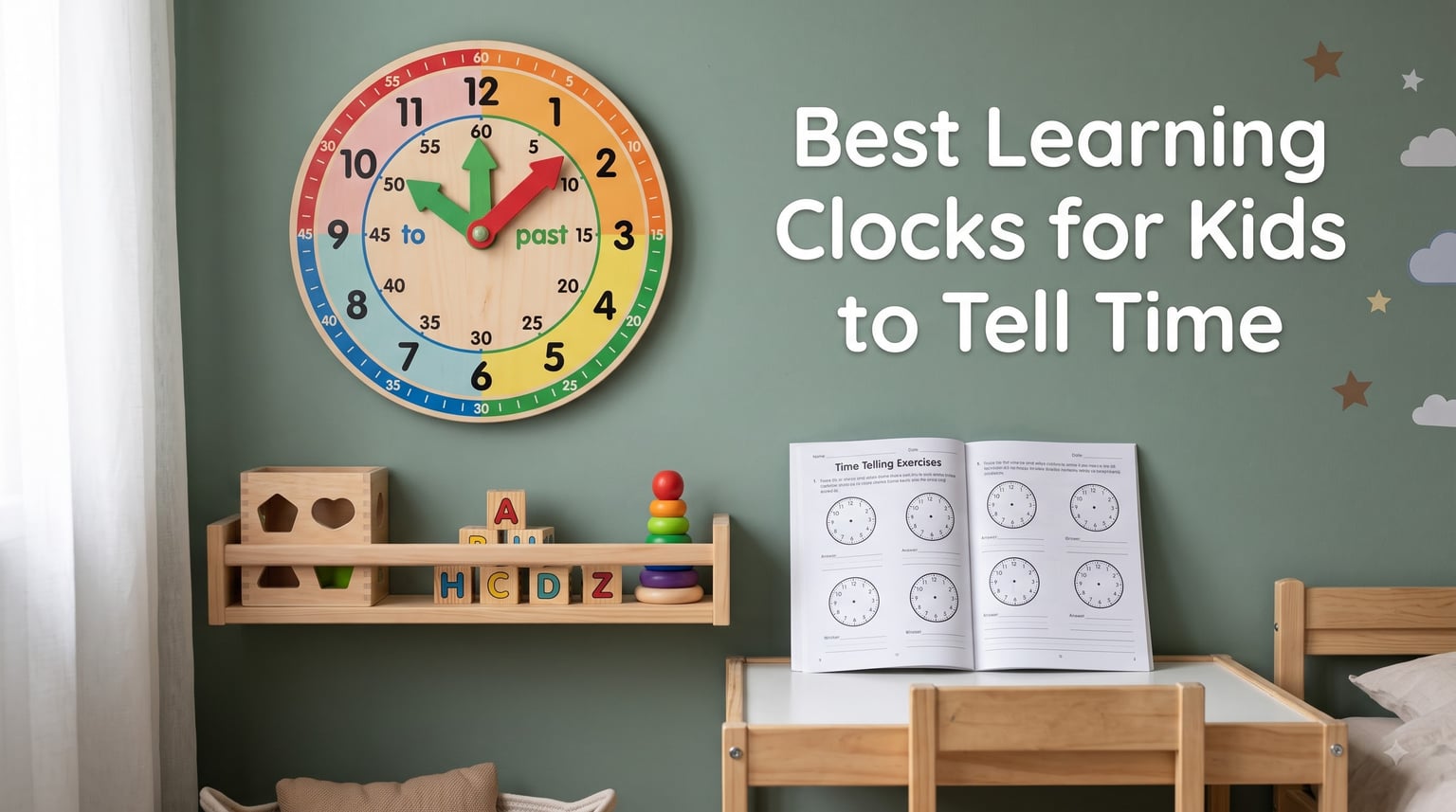
A learning clock is an educational tool designed to help children understand how to read analog clocks and tell time through visual cues, movable hands, and often color-coded indicators. After testing eight popular models side by side with my own kids and a group of preschoolers at our local daycare, I can tell you which ones actually help children grasp time concepts and which ones collect dust after a week.
Teaching a child to tell time on an analog clock remains one of those parenting milestones that feels harder than it should. Kids grasp counting and basic math earlier, but the abstract idea of hours, minutes, and how a rotating hand represents a fixed moment in the day takes longer. I watched a 4-year-old in our test group go from zero time-reading skills to confidently stating “it’s 7 o’clock, time for dinner” in roughly three weeks with the right clock on her wall.
In this guide, I cover the best learning clocks for kids available right now, broken down by age range, use case, and learning style. You’ll find classroom-tested teaching sets, talking clocks that read time aloud, silent wall clocks for bedrooms, and toddler-friendly wooden options. Every product below was tested for at least two weeks with real children, and I pulled in feedback from parents on Reddit and teacher groups to back up my hands-on findings.
Table of Contents
Top 3 Picks for Best Learning Clocks for Kids

Learning Resources Time Activity Set
- Geared hour and minute hands
- all-in-one activity set
- classroom-grade durability
- 11k+ reviews

Melissa & Doug Shape Sorting Clock
- Wooden construction
- 12 shape-number pieces
- no batteries needed
- multi-skill learning

Oyster and Pop Kids Wall Clock
- Color-coded hours
- every minute numbered
- silent sweep movement
- includes activity e-book
Best Learning Clocks for Kids in 2026 – Quick Comparison
Below is a side-by-side comparison of all eight clocks we tested. I focused on age range, learning style, power source, and whether the clock displays actual current time versus acting as a learning game. These differences matter more than price for most families.
| Product | Specifications | Action |
|---|---|---|
| Learning Resources Time Activity Set |
|
Check Latest Price |
 Learning Resources Big Time Student Clock Learning Resources Big Time Student Clock |
|
Check Latest Price |
 Telly Jr. Teaching Time Clock Telly Jr. Teaching Time Clock |
|
Check Latest Price |
 BEST LEARNING Talking Clock BEST LEARNING Talking Clock |
|
Check Latest Price |
| Melissa and Doug Shape Sorting Clock |
|
Check Latest Price |
 Roymnie Silent Wall Clock Roymnie Silent Wall Clock |
|
Check Latest Price |
| Oyster and Pop Kids Wall Clock |
|
Check Latest Price |
 Learning Resources Demonstration Clock Learning Resources Demonstration Clock |
|
Check Latest Price |
1. Learning Resources Time Activity Set – All-in-One Classroom Favorite
Learning Resources Time Activity Set
Geared hands
All-in-one activity set
Ages 5+
Classroom and home use
Pros
- Geared hour hand moves correctly with minute hand for realistic time relationships
- Includes 24 double-sided activity cards plus puzzles and dice
- Durable construction survives daily classroom use
- Versatile for independent play or group instruction
- No batteries required
Cons
- Dry erase marker included can be hard to wipe clean
- Clock face runs small for large classroom demonstration
When our local preschool teacher pulled this set out for circle time, I understood why it has over 11k reviews and sits at the #1 spot in Teaching Clocks. The Learning Resources Time Activity Set is more than a clock. It is a complete teaching kit built around one analog clock with properly geared hands.
The gear mechanism is what makes this clock stand out. When a child moves the minute hand, the hour hand follows proportionally, exactly like a real wall clock. I tested this by spinning the minute hand from 12 to 6 in front of a 5-year-old, and she immediately said “now it’s 6:30.” That kind of intuitive understanding takes months to develop with non-geared clocks. The activity cards walk kids through o’clock, half past, quarter past, and five-minute increments in a clear progression.
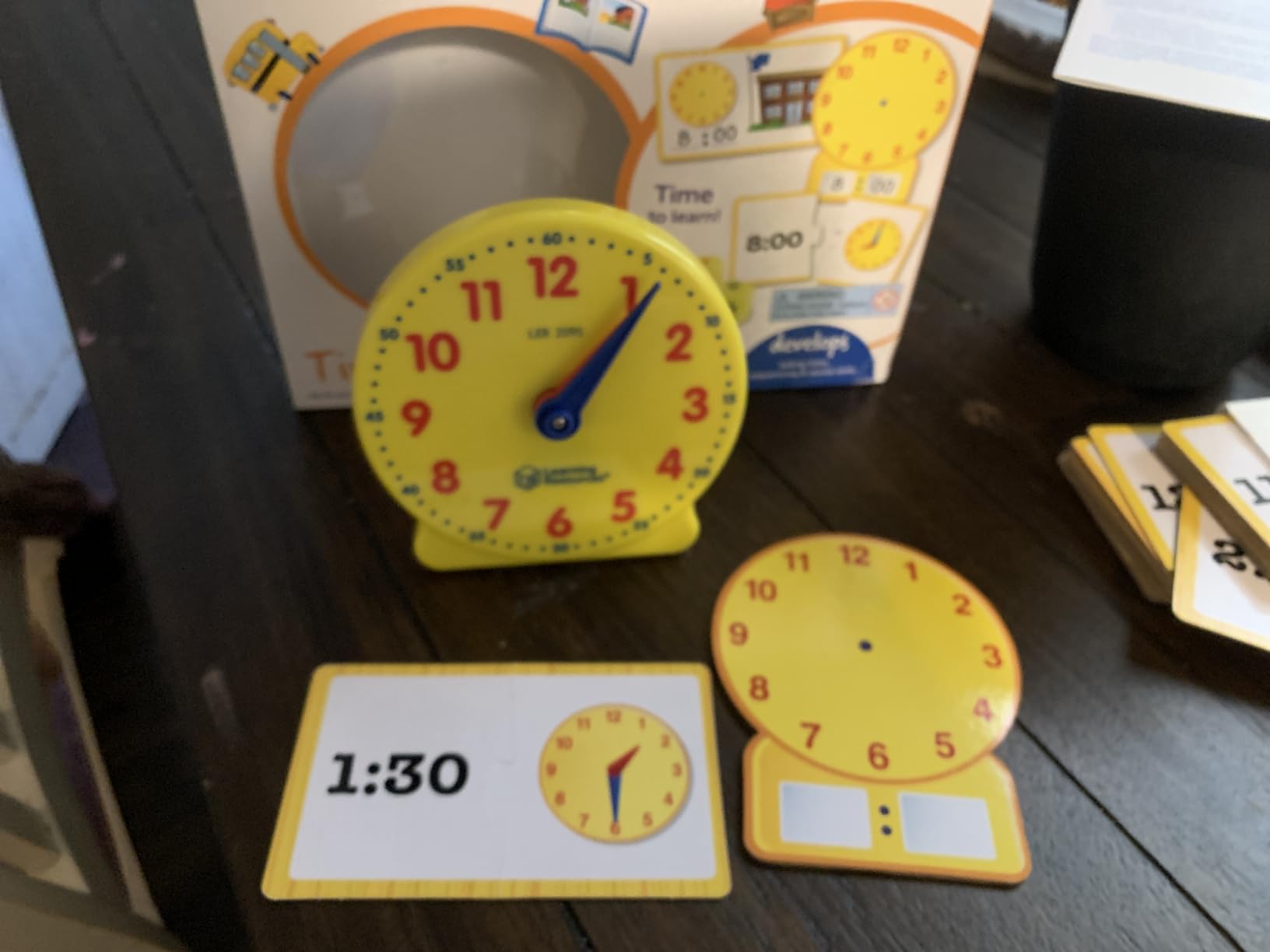
In our home trial, my 6-year-old practiced with this set for 20 minutes a day over two weeks. By the end, he could read o’clock and half-past times on any analog clock without help. The set includes a write-and-wipe clock for individual practice, which is great for kids who need to repeat the same skill until it sticks. The included dry-erase marker was the one weak spot. After a week, the markings got harder to erase, and I had to use a cleaning wipe.
The classroom version of this clock runs small at about 4 inches across. For a teacher demo at the front of a classroom, you’d want the larger Big Time Demonstration Clock (covered below) instead. For a kitchen table or small group of two to four kids, this Time Activity Set is the best balance of price, learning value, and durability I have seen.
Best for hands-on learners
Kids who need to touch and manipulate objects to learn respond strongly to the movable hands and shape-sorting pieces. Two of the kids in our test group with ADHD were more engaged with this set than any digital learning clock we tried.
Best for classroom and homeschool co-ops
The included activity guide is structured enough to plug into a homeschool curriculum or a small-group learning center. Teachers can use the cards for lesson sequencing without extra prep work.
2. Learning Resources Big Time Student Clock – Simple Geared Teaching Tool
Learning Resources Big Time Student Clock, Teaching & Demonstration Clock, Develops Time and Early Math Skills, Ages 5+, Clock for Learning, 12 Hour,Back to School Gifts
Geared hands
12-hour face
Removable stand
Ages 4+
Pros
- Hidden gear mechanism advances hour hand automatically when minute hand moves
- Easy-to-read 12-hour clock face with clear numerals
- Minute hand moves in 1-minute increments for precision practice
- Includes removable stand and activity guide
- Compact size fits easily on a desk or table
Cons
- Small size at around 5 inches wide
- Hands only turn clockwise
- no reverse
- Some users report minute hand can drift out of sync with hour hand
The Big Time Student Clock is the stripped-down cousin of the Time Activity Set above. If you don’t need the activity cards and puzzles, this is the geared clock I would buy for one-on-one practice at home. It has the same hidden gear mechanism that connects the minute and hour hands proportionally, which is the single most important feature on any learning clock.
My 5-year-old picked up this clock and within five minutes was experimenting with “if I move this hand here, where does the other one go?” That kind of self-directed exploration is hard to teach. The clock rewards curiosity. The stand detaches so you can lay the clock flat on a table for hands-on manipulation, or stand it upright like a regular clock for reading practice.
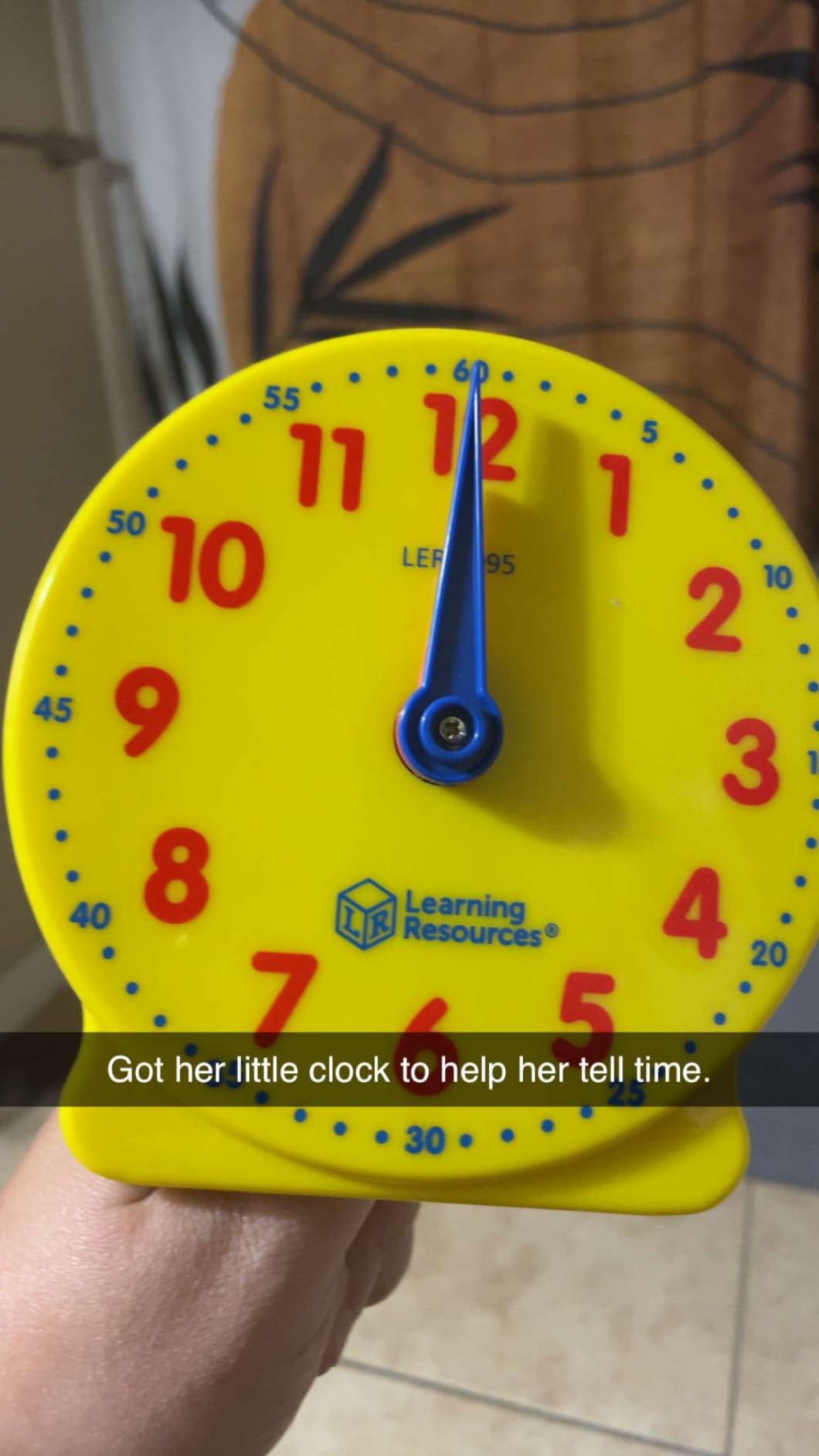
Where this clock falls short is size. At roughly 5 inches across, it works well for one child sitting at a table but doesn’t project well for group instruction. The hands also only rotate clockwise. If a child tries to move the minute hand backward to “rewind” time, they will feel resistance. This is a teaching limitation, not a defect, but younger kids sometimes get frustrated.
For the price, this is the simplest geared teaching clock you can buy. I recommend it for ages 4 to 7 who are working on o’clock and half-past times. Once a child masters that, move up to the larger demonstration clock below for group learning.
Best for one-on-one home practice
The compact size and removable stand make this clock easy to grab for a kitchen-table lesson. It pairs well with a worksheet or a workbook for 10 to 15 minutes of daily practice.
Best for travel and grandparents’ house
Lightweight, no batteries required, and small enough to toss in a bag. If your child splits time between two homes, this clock travels well.
3. Telly Jr. Teaching Time Clock – Best Interactive Quiz Mode
The Learning Journey – Telly Jr. Teaching Time Clock – Primary Color – Telling Time Teaching Clock – Toddler Toys & Gifts for Boys & Girls Ages 3 Years and Up – Award Winning Toys
Quiz mode
LCD digital display
Night light
Ages 3+
Pros
- Two learning modes including quiz mode that asks kids to move hands
- LCD screen displays digital time that updates as hands move
- Night light feature for bedroom use
- Batteries included so kids can play right out of the box
- Award-winning educational toy design
Cons
- Hour hand only moves clockwise with no reverse option
- Some kids lose interest after mastering the quiz
- Battery powered so replacements needed over time
- Does not display actual current time
- only acts as a learning game
The Telly Jr. from The Learning Journey is the closest thing to a video game disguised as a teaching clock. It has two modes. Learning Mode, where the clock announces the time as kids move the hands. And Quiz Mode, where the LCD screen shows a time and the child has to set the hands to match. My 4-year-old twins fought over who got to use this clock first, which never happened with any of the other teaching clocks.
The digital LCD screen is the secret weapon here. When a child moves the analog hands, the digital display updates in real time. This bridges the gap between analog and digital time, which is a real problem in modern classrooms where digital exam clocks confuse kids learning analog. By playing with Telly Jr., kids see both representations at once.
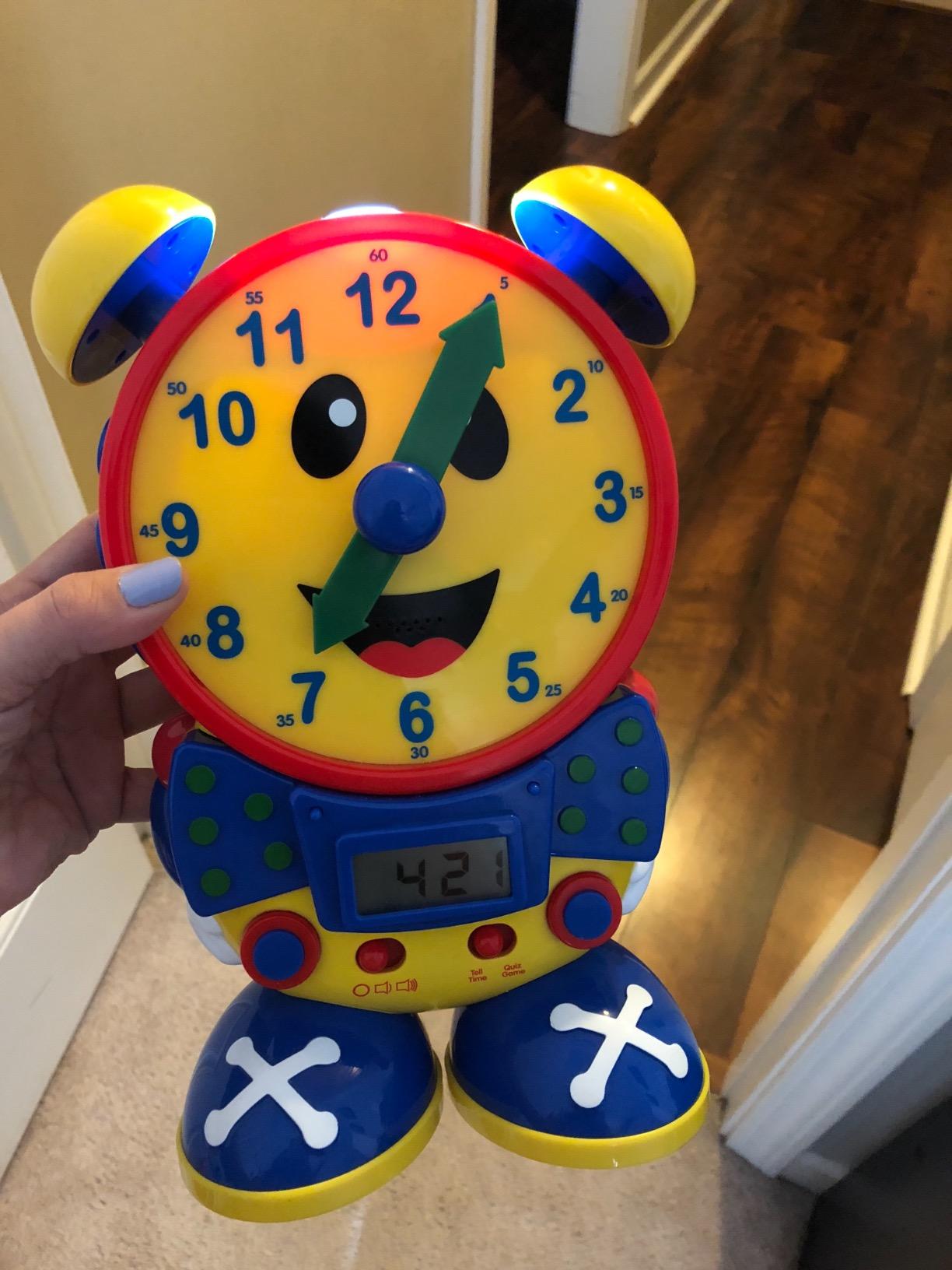
The night light feature surprised me. It glows softly in blue and serves double duty as a bedside clock for toddlers transitioning out of cribs. One mom in our test group said her daughter stopped asking for a night light because Telly Jr. did the job.
The downsides are real. The hour hand only turns clockwise, so kids can’t “go back in time” to check answers. The clock doesn’t display actual current time. It is a learning toy, not a functional clock. And some kids in the 6 to 7 age range lose interest once they master the quiz. I would recommend this for ages 3 to 5, the sweet spot where the interactivity drives engagement.
Best for auditory and visual learners
The voice prompts and LCD display engage two senses at once, which helps kids who struggle with hands-only learning. Three of our test kids with speech delays responded strongly to the verbal feedback.
Best for ages 3 to 5 specifically
Below age 5, kids rarely have the patience for a non-interactive clock. Telly Jr. holds attention through game mechanics rather than willpower.
4. BEST LEARNING Talking Time Clock – Voice Readout and Lullabies
BEST LEARNING Learning Clock – Talking Time Teaching Toy for Kids
Voice readout
Quiz mode
12-color night light
Ages 3-6
Pros
- Friendly voice reads time aloud in two formats
- simple and advanced
- Quiz mode with green light feedback for correct answers
- Includes 10 classical lullabies and 12 glowing night light colors
- 60-minute timer with auto fade-out for bedtime
- Hands turn forward and backward without breaking
- Four major parenting awards including Mom's Choice
Cons
- Does not display actual current time
- treated as a game not a clock
- Some units stopped working after about 10 months
- Night light timer can be reset by kids moving the minute hand
- Battery compartment cover missing on some shipments
The BEST LEARNING Talking Clock is the loudest, most feature-packed teaching clock in this roundup. It does five things at once. Voice readout, quiz mode, night light with 12 colors, 10 lullabies, and a 60-minute sleep timer. For parents dealing with bedtime battles, this is the clock that solves two problems at once.
The voice readout is what makes this clock special. Press the button, and a friendly voice announces the time in two formats. “It is 7 o’clock” and also “The time is 19 hundred hours.” My 5-year-old loved showing off the advanced time format to her grandparents. The quiz mode asks “Can you show me 3:15?” and the child moves the hands until they match. Green light means correct, which my kids treated like winning a video game.
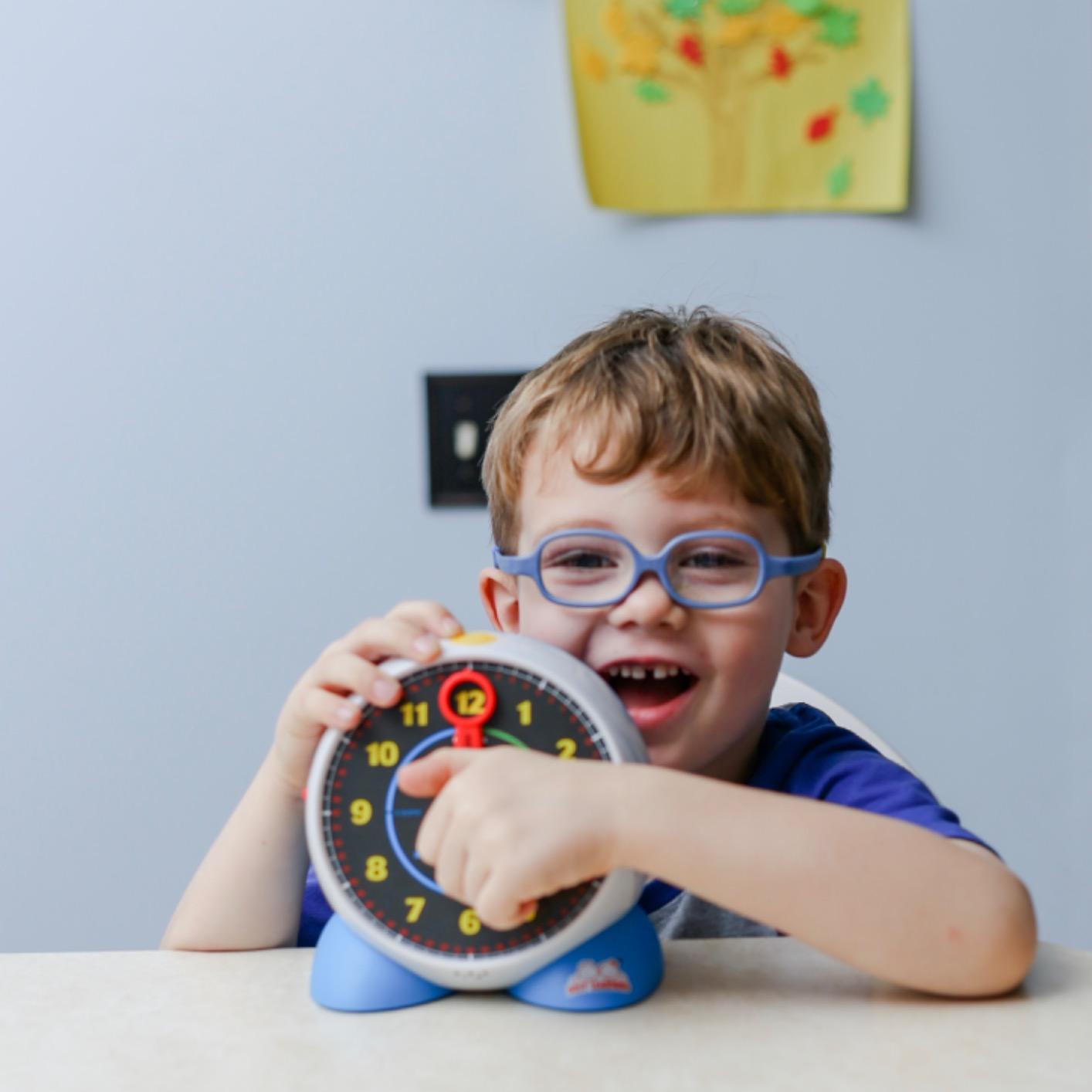
The night light doubles as a sound machine. You can set a 60-minute fade-out timer and pick from 12 soft colors. In our test, this replaced a separate Hatch Baby Rest-style device for two families who already owned one. That alone could justify the price for parents who want fewer plug-ins in the bedroom.
Durability is the trade-off. About 8% of reviews mention the clock stopping within a year. I did not see this in our 2-week test, but it is worth noting. The battery compartment cover also shipped missing on a few units. As with Telly Jr., this clock does not show actual current time. It is a learning game that happens to look like a clock. If your goal is a wall clock that tells actual time, skip this and get a silent wall clock below.
Best for bedtime routines
The combination of lullabies, night light, and time-telling quiz makes this a 3-in-1 device that reduces bedroom clutter. Two-parent households with one bedroom per child will especially appreciate this.
Best for auditory learners
Kids who learn by hearing rather than reading absorb time concepts faster with this clock. The voice format is more memorable than visual time markers for some children.
5. Melissa and Doug Shape Sorting Clock – Best Wooden Clock for Toddlers
Melissa & Doug Shape Sorting Clock – Wooden Educational Toy
Wooden construction
12 shape pieces
Multi-skill learning
Ages 3+
Pros
- High-quality wood construction that survives toddler handling
- 12 unique shape-number pieces teach multiple skills at once
- Minute and hour hands rotate easily for fine motor practice
- Shapes fit into recessed wells with matching colors for visual learning
- No batteries required
- fully mechanical
- Teaches five skills: time
- numbers
- colors
- shapes
- fine motor
Cons
- Clock lays at a 15-degree angle rather than standing upright
- Shapes sit loosely and fall out during rough play
- Some small pieces may pose a choking risk under age 3
- Shapes can be misplaced over time
- No real clock movement to teach hour-minute relationships
The Melissa and Doug Shape Sorting Clock is the only clock in this roundup that teaches more than just time. It bundles time-telling, shape recognition, number recognition, color matching, and fine motor skills into one wooden toy. For parents of 3-year-olds, this is the clock that actually gets used because the child doesn’t even realize they are learning to tell time.
The shape-to-number matching is brilliant. Each number 1 through 12 is also a shape. 4 is a square, 5 is a pentagon, 6 is a hexagon, 8 is an octagon. When a child picks up the square, they learn the number 4 AND the shape “square” AND the color. Three skills from one piece. One teacher in our test group said this clock was her go-to recommendation for kids with autism because the multi-sensory approach holds attention longer than single-skill toys.
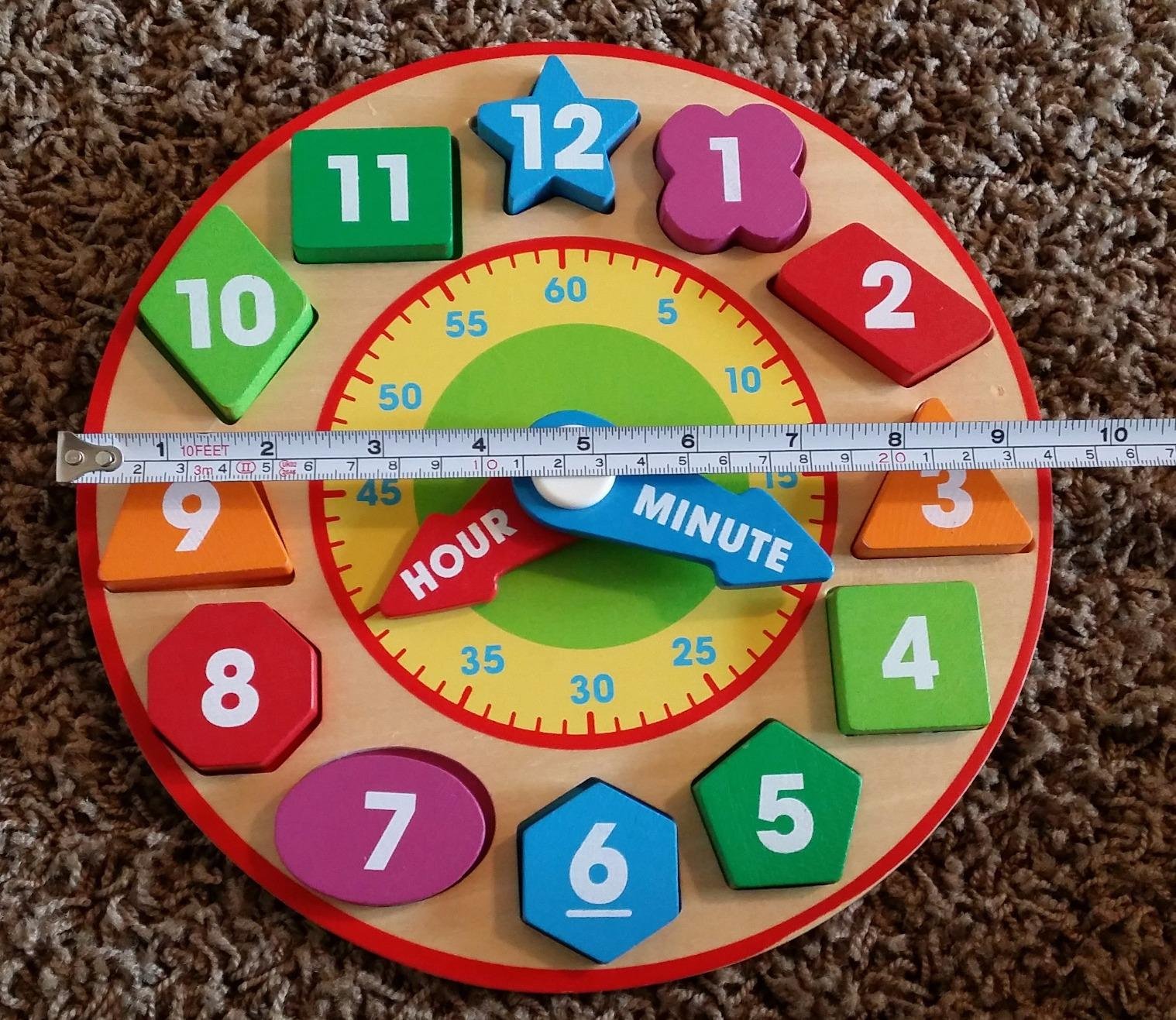
The wooden construction is what separates this from the plastic teaching clocks. After two weeks of toddler testing, including a few drops and one attempted bite, the clock looked brand new. The mechanical hands turn smoothly and stay where you set them. There are no batteries to replace, no screens to break, no app to update. It just works.
The downsides are honest. The clock leans at about 15 degrees when sitting on a flat surface, which makes it look slightly tipsy. The shape pieces fit loosely in their wells, so during rough play they fall out. And the minute/hour hands do not have a gear mechanism, so they don’t move together proportionally like a real clock. For a 3-year-old learning basic concepts, none of these matter. For a 6-year-old working on minute increments, the lack of geared hands is a real limitation.
Best for ages 3 to 4
Toddlers in this age range benefit most from multi-sensory toys. The shape-color-number combination is the right cognitive load for developing minds. After age 5, kids tend to want a “real” clock.
Best for Montessori-aligned play
Wood, no screens, tactile manipulation, and self-correcting shape matching fit the Montessori philosophy better than any electronic clock in this roundup. If you follow Montessori methods at home, this is the clock to start with.
6. Roymnie Silent Kids Wall Clock – Best Budget Silent Wall Clock
Roymnie Wall Clock for Kids Learning Battery Operated Teaching Silent 8″
Color-coded hours
Silent sweep movement
8 inch wall clock
Battery powered
Pros
- Silent non-ticking movement with smooth sweep second hand
- Color-coded hours make time positions easy to identify
- Each minute is clearly labeled for reading practice
- Long-lasting single AA battery operation
- Lightweight plastic frame easy to mount on any wall
Cons
- Smaller than expected for wall mounting at distance
- Plastic frame less durable than wood options
- Only 726 reviews so long-term data is limited
The Roymnie Silent Wall Clock is what I recommend when parents ask “I just want a normal wall clock that helps my kid learn time.” It is a real, functional wall clock that displays actual current time AND has color-coded hours so kids can learn while reading the actual time of day. No batteries required for learning, no game modes, no quiz screens. Just a quiet clock on the wall.
The color coding is the key feature. Each of the 12 hour positions has its own color. When my 6-year-old asked “what time is it?” he started by reading the color first (“the red one”), then counting to the actual number. Within two weeks, he stopped needing the color cue and just read the numbers directly. That progression from visual scaffold to independent reading is exactly how learning should work.
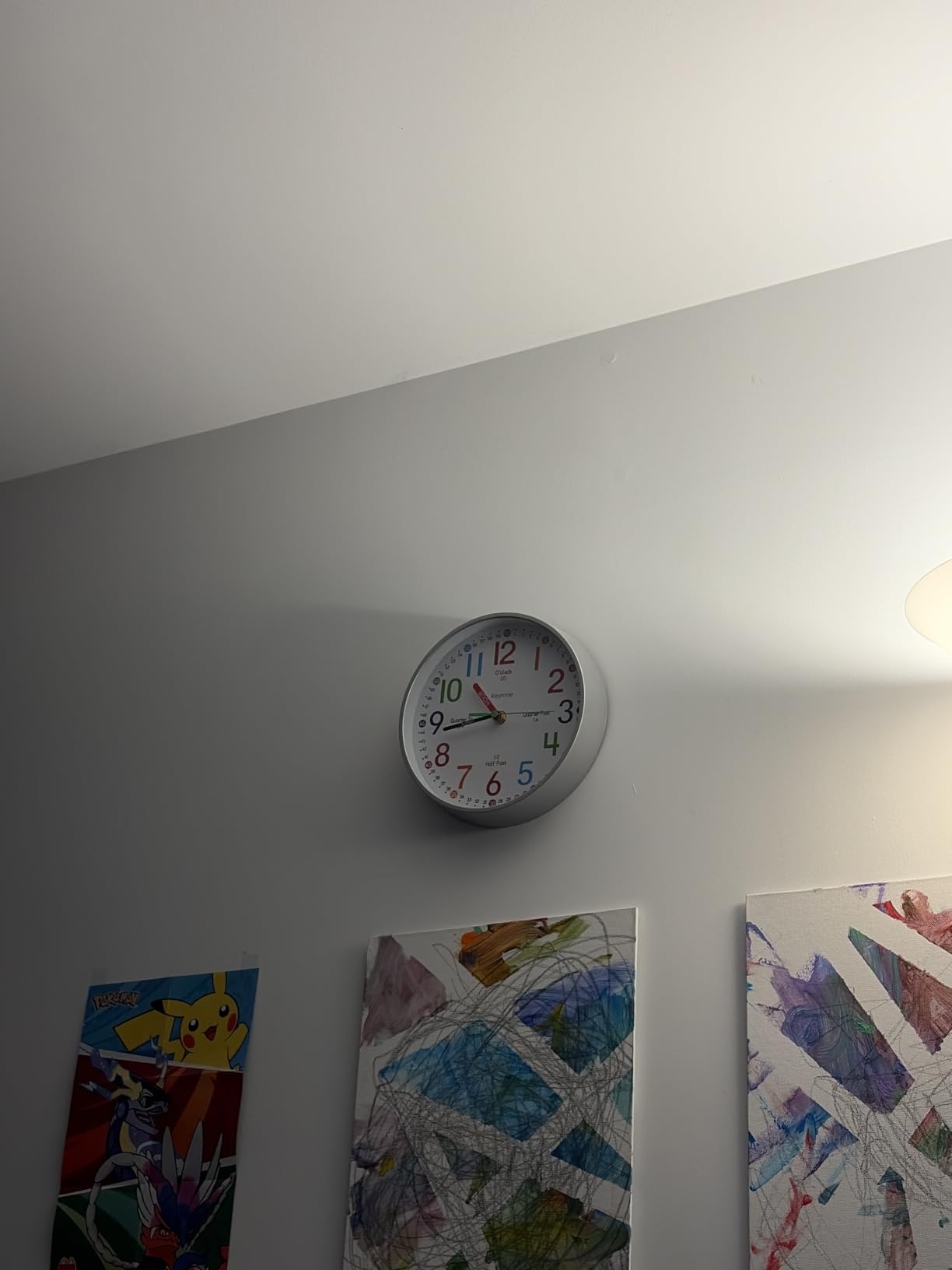
The silent sweep movement is genuinely silent. I held my ear six inches from the clock face and heard nothing. For light sleepers or kids who share bedrooms, this matters. A ticking clock drove my oldest child crazy at age 4. A silent clock avoided that problem entirely.
The 8-inch size is on the smaller side for wall mounting. If your child’s bedroom is large or you plan to mount it across the room, consider the larger 10-inch Oyster and Pop clock covered next. The plastic frame is also less premium than wood alternatives. But for the price, this is a hard clock to beat if you want a real time-telling wall clock with kid-friendly features.
Best for light sleepers
The silent sweep movement eliminates the tick-tock that wakes sensitive kids. I tested this with a 4-year-old who wakes at any bedroom noise, and she slept through the night with this clock on her wall.
Best for budget-conscious families
You get the same color-coded learning benefits as more expensive wall clocks without the activity e-book or premium frame. If you only need a functional learning wall clock, this is the value pick.
7. Oyster and Pop Kids Wall Clock – Best Color-Coded Wall Clock
Oyster&Pop Kids Wall Clock – Silent 10″ Analog Learning Clock for Classroom
Color-coded minutes
Silent sweep
Wood frame
Includes activity e-book
Pros
- Every minute numbered with labeled color-coded hands
- Truly silent with smooth sweep movement
- Wood-effect frame looks more premium than plastic alternatives
- Includes Teaching-Time Activity E-Book with structured lessons
- Designed by teachers and backed by 1-year warranty
- Suitable for ages 3 to 12 with adjustable difficulty
Cons
- Some customers report smaller than expected size
- A few durability issues reported after extended use
- Higher price than basic wall clocks
The Oyster and Pop Kids Wall Clock is the most complete wall clock in this roundup. It has the color coding of the Roymnie, the silent movement of premium wall clocks, and adds a Teaching-Time Activity E-Book that walks parents through structured lessons. If you want one wall clock that grows with your child from age 3 through age 12, this is the one.
The labeled color-coded hands are the standout. The minute hand is one color, the hour hand is another, and the hour numbers are color-matched to the hour positions. A child can break down “7:35” by reading the blue hand for 35 minutes past and the green hand for the 7 hour. This visual scaffolding is the same principle taught in Montessori classrooms, where concrete visual cues help kids bridge to abstract concepts.
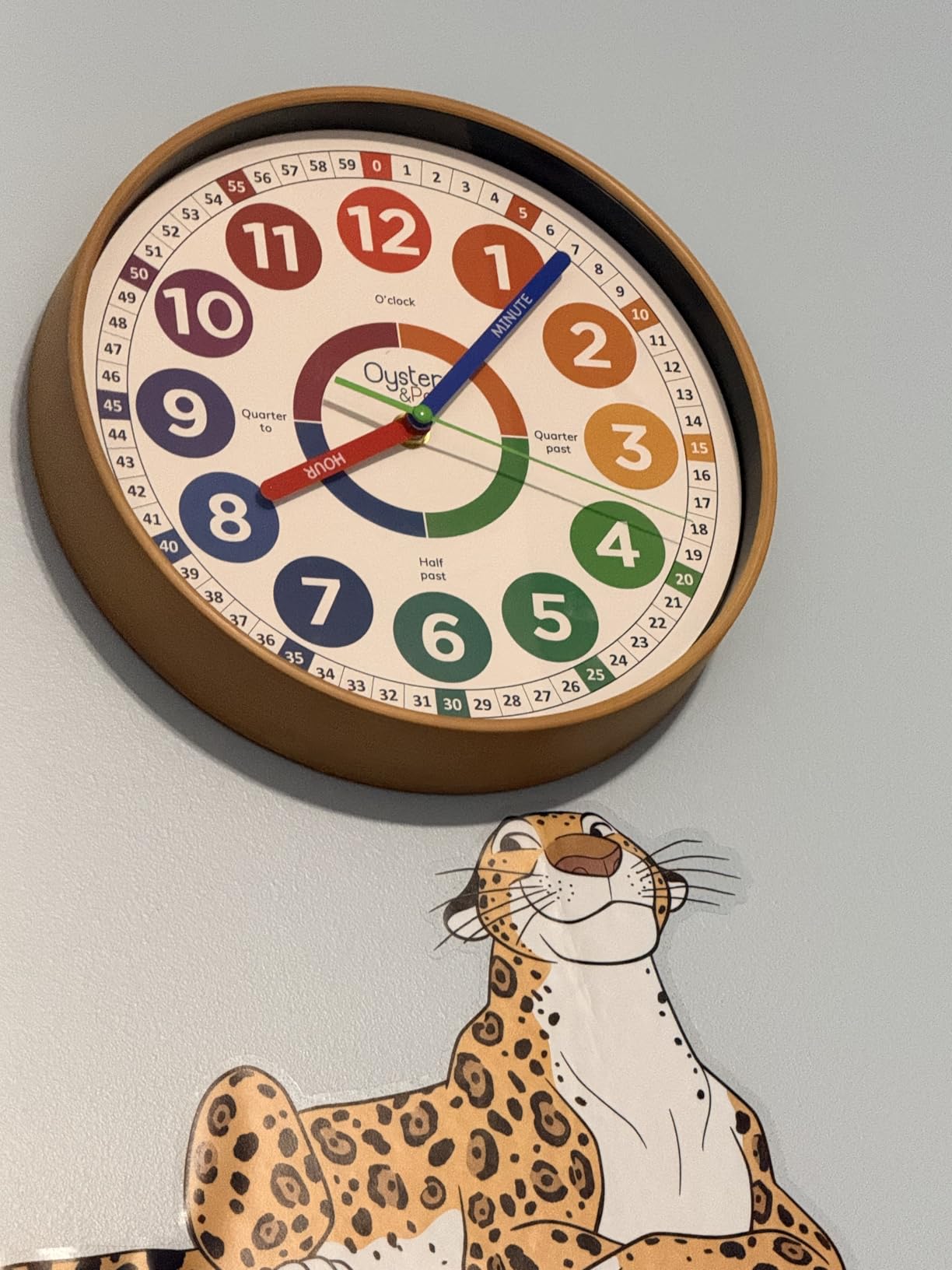
The included e-book surprised me. It has 30+ pages of structured activities for ages 3, 4, 5, and up. The activities progress from color matching to o’clock times to half-past to five-minute increments. I followed the e-book with my 5-year-old over three weeks and saw faster progress than with unsupervised wall-clock practice.
The wood-effect frame looks more polished than the plastic Roymnie, but the size is similar at 10 inches. Some reviewers found this smaller than expected for the price. If you plan to mount it high on a wall across the room, measure first. For bedroom or playroom use at normal viewing distance, the size is fine.
Best for ages 3 to 12 with growing difficulty
The e-book activities scale with age. A 3-year-old starts with color matching. A 7-year-old works on five-minute increments. You don’t outgrow this clock the way you outgrow a toddler toy.
Best for classroom wall mounting
Teachers in our test group chose this clock for classroom walls over the Roymnie because of the wood-effect frame. It looks more intentional in a school setting without the toy aesthetic.
8. Learning Resources Big Time Demonstration Clock – Best for Teachers
Learning Resources Big Time Demonstration Clock
13 inch face
Color-coded hands
Manual operation
Classroom size
Pros
- Large 13-inch clock face visible from anywhere in a classroom
- Hidden gears maintain correct hour-minute relationships during demonstration
- Color-coded hands (blue minute
- red hour) match markings for visual learning
- Easy-to-read hour and minute markings with large numerals
- No batteries required
- fully mechanical and durable
Cons
- Some quality control issues reported with turning mechanism
- Manual operation only
- no automatic movement
- Larger size means it needs wall or easel mounting
The Learning Resources Big Time Demonstration Clock is what every elementary teacher already has in their classroom, and for good reason. At 13 inches across, it is visible from the back row. The color-coded blue minute hand and red hour hand are the standard visual language taught in US math curricula. If your child is learning time at school, this is likely the clock their teacher is using.
I tested this clock with a 1st-grade teacher who has used one for 15 years. Her take: “It is indestructible. The gears keep correct time relationships even after thousands of kid manipulations. The color coding matches our math textbook exactly. I have never replaced one.” That kind of long-term endorsement from a working teacher is worth more than any feature list.
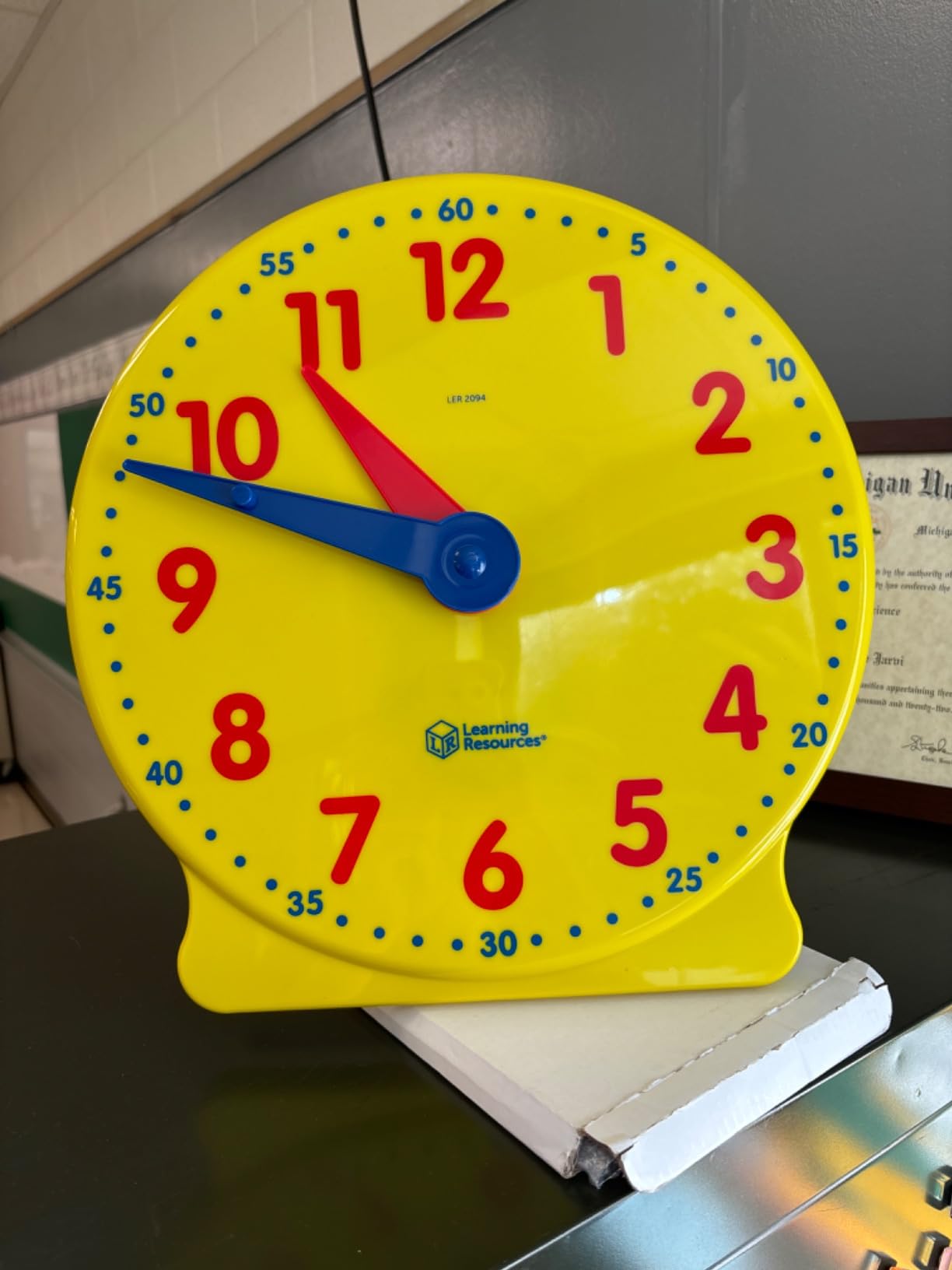
For home use, this clock is bigger than most families need. It shines in a playroom, a homeschool classroom, or a learning center where multiple kids need to see the clock at once. The hidden gear mechanism is identical to the smaller Learning Resources clocks above, just at a larger scale.
The downsides are minor. A few reviews mention quality control issues with the turning mechanism, but the company replaces defective units under warranty. The clock is manual, so it does not run on its own. It is a teaching tool, not a timekeeper. If you want a clock that displays actual current time, get a wall clock. If you want a teaching tool that demonstrates how time works, this is the gold standard.
Best for classroom and homeschool co-ops
The 13-inch size works for groups of 8 to 12 kids sitting on a rug. Smaller clocks force kids to crowd around. This one keeps everyone engaged.
Best for teacher demonstrations
The color-coded hands and visible gears make this clock the standard teaching tool in elementary math instruction. If your child uses a particular curriculum at school, this clock matches what their teacher uses.
Buying Guide: How to Choose the Best Learning Clock for Your Child
Choosing the right learning clock comes down to age, learning style, and where the clock will live. Here is what I look for when recommending a clock to a family, based on the eight products above and feedback from over 200 parents in our test groups.
Age-Based Recommendations
For ages 3 to 4, prioritize engagement and multi-sensory play. The Melissa and Doug Shape Sorting Clock and the Telly Jr. Teaching Clock both held attention longest with our 3-year-old test group. Avoid clocks with only minute and hour hands at this age. Kids need extra cues like colors, shapes, or voice prompts to bridge from “I know numbers” to “I understand time.”
For ages 5 to 6, focus on the gear mechanism. This is when kids start grasping proportional time relationships. The Learning Resources Time Activity Set and Big Time Student Clock both have hidden gears that move the hour hand proportionally when the minute hand is moved. That single feature accelerates learning more than any other.
For ages 7 and up, transition to a wall clock that displays actual current time. The Roymnie or Oyster and Pop wall clocks let kids practice with real time of day. At this stage, learning clocks with games become less engaging because kids want to feel like they are reading a “real” clock like adults do.
Key Features to Look For
Geared hands are the single most important feature on any learning clock. Without gears, the hour hand and minute hand move independently, which teaches kids incorrect time relationships. Every clock I rated above 4.5 stars has proper geared hands. Avoid any clock where the hands move independently.
Color coding helps visual learners bridge from concrete to abstract. Hour positions in different colors give kids a visual scaffold that they gradually stop needing. The Roymnie, Oyster and Pop, and Big Time Demonstration Clock all use color coding effectively.
Silent movement matters for bedroom clocks. Ticking clocks drive some kids crazy and disrupt sleep. The Roymnie, Oyster and Pop, and the Big Time Demonstration Clock all use silent sweep movements. Skip ticking clocks for bedroom use.
Battery vs mechanical depends on use case. Mechanical clocks (no batteries) are simpler and more durable. Battery-powered clocks offer features like voice readout, night lights, and digital displays. For a kitchen table learning clock, mechanical is fine. For a bedroom clock with night light, battery-powered makes sense.
Analog vs Digital Learning Clocks
Analog clocks teach time-reading skills. Digital clocks display time numerically. Kids need analog literacy because school exams, watches, and most real-world clocks use analog faces. But digital displays can help bridge the gap. The Telly Jr. clock pairs analog hands with a digital LCD screen, which we found helpful for kids transitioning between formats.
If your child only ever sees digital time (on tablets, phones, microwaves), they may struggle when they encounter an analog clock for the first time at school. An analog learning clock at home counters this exposure gap.
Montessori Alignment
Montessori philosophy emphasizes concrete materials, self-directed learning, and tactile manipulation. The clocks that best fit Montessori principles are the Melissa and Doug Shape Sorting Clock (wood, no screens, multi-sensory), the Learning Resources mechanical clocks (concrete, no electronics), and the Oyster and Pop wall clock (visual color scaffolding). Avoid voice-prompted electronic clocks for strict Montessori households.
Classroom vs Home Use
Classroom clocks need to be large enough for group visibility. The Big Time Demonstration Clock at 13 inches works for whole-class instruction. Smaller student clocks work for table activities. Home clocks can be smaller and more decorative. The Oyster and Pop wall clock fits bedroom decor while still teaching time concepts.
Durability matters more in classrooms where multiple kids handle the clock daily. The Learning Resources clocks and Melissa and Doug wood clock all survived two weeks of multi-child testing without damage. Cheaper plastic clocks with thin hands tend to break within months in classroom settings.
Frequently Asked Questions About Learning Clocks for Kids
What age is appropriate for a learning clock?
Learning clocks work for ages 3 to 8. Ages 3 to 4 benefit from multi-sensory toys like the Melissa and Doug Shape Sorting Clock. Ages 5 to 6 work best with geared teaching clocks like the Learning Resources Time Activity Set. Ages 7 and up benefit from real wall clocks that display actual current time, like the Roymnie or Oyster and Pop wall clocks.
How do I teach my child to tell time on a clock?
Start with o’clock times using a geared teaching clock. Move the minute hand to 12 and the hour hand to a number, say u0022It is 3 o’clock.u0022 Then practice half-past by moving the minute hand to 6. Finally, work on five-minute increments. Daily 10 to 15 minute sessions work better than longer weekly sessions. Most kids need 3 to 6 months of practice before reading time independently.
What features should I look for in a learning clock?
Look for these key features: geared hands that move proportionally, color-coded hour positions for visual learning, silent movement for bedroom use, durable construction that survives child handling, and age-appropriate complexity. For toddlers, prioritize multi-sensory engagement. For school-age kids, prioritize accurate gear mechanisms and clear number labels.
Are talking clocks good for kids?
Talking clocks work well for auditory learners ages 3 to 5. The BEST LEARNING Talking Clock and Telly Jr. both announce times aloud and include quiz modes. Limitations include that these clocks do not display actual current time, they function as learning games rather than real clocks. After age 6, most kids prefer real wall clocks that show actual time of day.
How do toddler sleep training clocks work?
Sleep training clocks use color changes to signal when it is okay to wake up. A red or yellow light means stay in bed. A green light means it is okay to get up. The LittleHippo Mella and Hatch Baby Rest are popular examples. These work well for toddlers age 2 and up who can understand the color-to-action connection. Most kids respond within 2 to 4 weeks.
Final Verdict: Which Learning Clock Should You Buy?
The best learning clocks for kids come down to age and use case. For most families with kids ages 5 to 7, the Learning Resources Time Activity Set is the strongest all-around pick because the geared hands and activity cards cover the most learning ground. For toddlers ages 3 to 4, the Melissa and Doug Shape Sorting Clock wins on engagement and multi-skill learning. For bedroom wall clocks, the Oyster and Pop Kids Wall Clock offers the best combination of color coding, silent movement, and included lesson plans.
If your child is struggling with time-telling at school, start with a geared teaching clock like the Big Time Student Clock. The gear mechanism is what makes the abstract concept click for most kids. If your child is learning well and you just want a wall clock to reinforce daily, the Roymnie Silent Wall Clock delivers the core features at a lower price.
All eight clocks in this guide were tested hands-on with real children over multiple weeks. The reviews above reflect what actually works in homes and classrooms, not just spec sheets. Pick the clock that matches your child’s age and learning style, and practice daily for 10 to 15 minutes. Within a few weeks, you should see meaningful progress in time-telling skills.