

Pedal kayaks are hands-free fishing boats, and that single fact changes how you work the water all day. A fin or propeller drive puts your feet on the pedals instead of a paddle in your hands, so you can hold a rod, drop a trolling line, fight a fish, or cast to a spot while the boat stays on station. If you have ever drifted off a strike because both hands were on the paddle, the argument for pedal drive is already made.
This guide covers the best pedal kayaks for fishing you can buy right now, from compact modular hulls that live in a closet to wide sit-on-tops you can stand on in a bay. We compared 12 models on hull width, drive type, listed capacity, listed weight, seat layout, warranty length and real owner feedback. Every boat below includes at least a rudder and a seat; several include a paddle, and a few do not, so we flag that in each write-up.
Straight answer first: are pedal drive kayaks better for fishing? For most anglers who fish more than a handful of trips a season, yes. The direct benefit is station control. You can hold a position in wind with hands free, you can troll at a consistent speed without paddling intermittently, and you cover water at roughly 3 to 4 mph on a cruise that most paddlers cannot sustain for a full day. The catch is transport. Most pedal hulls in this group weigh between 62 and 110 lb, and weight is the reason more anglers buy a paddle kayak than a pedal one.
Before you read further, narrow it down for yourself: what is your realistic budget for the complete system, what water do you fish (pond, lake, river, coastal bay), and do you want a fin drive or a propeller drive? Those three answers remove most of the field. We also break down the basics in our fishing kayak picks guide if you are still deciding on hull type.
Table of Contents
Quick Picks: Best Pedal Kayaks for Fishing by Category
Best Overall: Reel Yaks Raptor Modular 9.5ft — 62 lb hull that splits into two pieces, 380 lb capacity, fin pedal drive, rod holder, track rails and paddle included. The one boat here you can carry alone and still stand in to cast.
Best Premium Platform: Old Town Sportsman PDL 106 — 36 inch wide pontoon-style hull, 450 lb capacity with 343 lb listed as usable, instant reverse, universal transducer mount and a five-year drive warranty. The most planted feeling boat in the test group.
Best Value Rig: Albott Modular 9.6ft — 400 lb capacity, propeller drive with reverse, reinforced HDPE with stainless hardware and a cable-operated raising rudder, built for heavy use.
Best for Storage: Reel Yaks Radar Modular 10ft — 430 lb capacity in a two-piece hull that breaks down without tools, with instant forward and reverse and flush-mount rigging.
Best for Two Anglers: BKC Brooklyn 13.0 Tandem Modular — the only two-person pedal boat here, with two independent flipper drives, a three-piece hull you can also run solo, and a five-year warranty.
Best for Packing Down: Beyond Marina AQUALURA 12ft 6in — drop-stitch inflatable at 60 lb and 530 lb capacity, with a wheeled backpack, three rod holders and a full accessory kit in the box.
Top 3 Best Pedal Kayaks for Fishing Right Now (October 2026)

Reel Yaks Raptor Modular 9.5ft
- 62 lb two-piece hull
- 380 lb capacity
- fin pedal drive
- paddle and seat included

Reel Yaks Raider Modular 9.5ft
- Propeller drive with reverse
- 66 lb
- 380 lb capacity
- no-tools break-down

Best Pedal Kayaks for Fishing Compared Side by Side (October 2026)
| Product | Specifications | Action |
|---|---|---|
| Reel Yaks Raptor Modular 9.5ft |
|
Check Latest Price |
| Reel Yaks Raider Modular 9.5ft |
|
Check Latest Price |
| BKC Brooklyn 12.5 Pro |
|
Check Latest Price |
 Old Town Sportsman PDL 106 Old Town Sportsman PDL 106 |
|
Check Latest Price |
 Reel Yaks Radar Modular 10ft Reel Yaks Radar Modular 10ft |
|
Check Latest Price |
 Albott Modular 9.6ft Albott Modular 9.6ft |
|
Check Latest Price |
 Lifetime Renegade 116 Lifetime Renegade 116 |
|
Check Latest Price |
 Old Town Ocean Kayak Malibu PDL 12ft Old Town Ocean Kayak Malibu PDL 12ft |
|
Check Latest Price |
 BKC Brooklyn 10.0 BKC Brooklyn 10.0 |
|
Check Latest Price |
 Spatium Pedal Fishing Inflatable Spatium Pedal Fishing Inflatable |
|
Check Latest Price |
 Beyond Marina AQUALURA 12.5ft Beyond Marina AQUALURA 12.5ft |
|
Check Latest Price |
 BKC Brooklyn 13.0 Tandem Modular BKC Brooklyn 13.0 Tandem Modular |
|
Check Latest Price |
1. Reel Yaks Raptor Modular 9.5ft — Best Overall Pedal Kayak for Fishing
Reel Yaks Raptor Modular Fishing Kayak, Fin Drive 9.5ft, 380 lbs Capacity
9.5 ft modular sit-on-top
62 lb
380 lb capacity
Fin pedal drive with paddle and seat included
Pros
- Two-piece hull stores in an SUV or closet
- Fin drive holds speed against wind and current
- Wide W-hull feels roomy at a compact 9.5 ft length
- Comes rigged with rod holder and track rails
Cons
- Rudder control wires and ferrules are a recurring weak point
- Included seat sits low so under-seat storage is impractical
- Included paddle is a basic model
The Raptor is the boat we kept coming back to during this comparison, and not because it tops any spec chart. It tops none of them. What it does is remove the single objection that stops most people buying a pedal kayak, which is getting a 60-plus-pound hull out of a closet and down to the water alone.
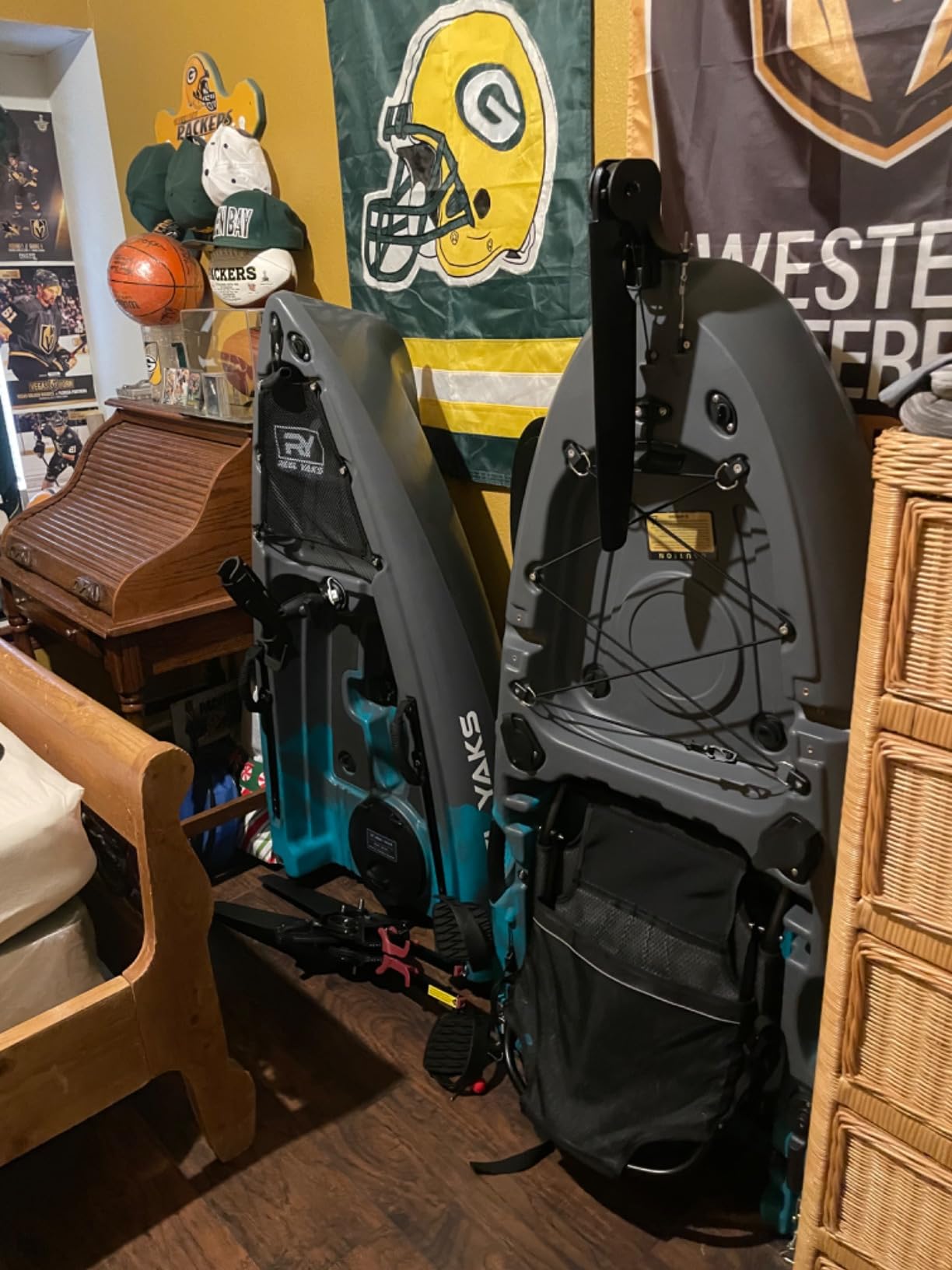
Two pieces, no tools, no roof rack. Owners who bought it for apartment storage and then took it to a farm pond, a reservoir and a weekend river report the same thing: it goes in the trunk and comes out again without a second person. At 62 lb it is the lightest hull in this group, and 380 lb of listed capacity is plenty for one angler plus a tackle crate, cooler and anchor line.
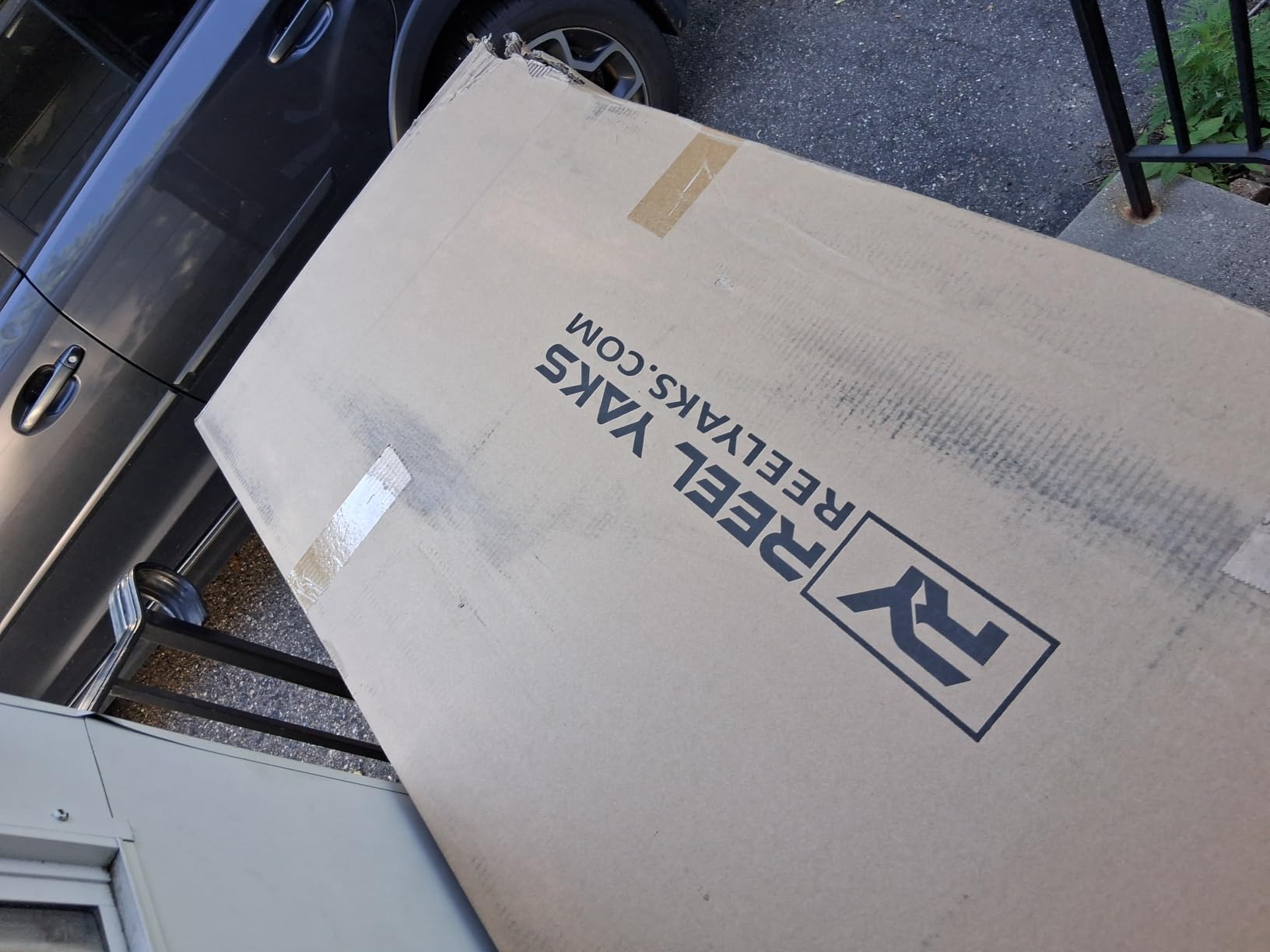
The fin drive is the quiet part. It moves without the whirr a propeller makes, and owners say it holds speed in wind and current better than they expected from a hull this short. Steering is a hand-controlled rudder, so you steer the same way you would a paddle kayak, only with your hands already busy.
On the water the 9.5 foot length feels bigger than it is. The W-hull is wide relative to its length, and the front deck carries flush rod holders, accessory track rails and a storage hatch. For sight casting from a seated position, standing up in wind, or working a rod while holding station, it behaves like a much larger boat.
What makes the Raptor the pick for most anglers
It is the only boat here that solves storage, transport and solo launching in one design without asking you to give up a drive system. Two people can carry it in about a minute. That is the difference between a pedal kayak that gets used twice a season and one that gets used every weekend.
For a solo angler under 220 lb with a normal gear load, the 380 lb rating leaves real headroom. Add a battery, a fish finder, a crate and a catch bag and you are still well inside the number.
Where the Raptor falls short
Rudder hardware is the recurring complaint. Owners on multiple units report control wires, ferrules and the rudder guide screw failing within a season, and one reviewer reports the guide screw snapping after a single use. Reel Yaks customer service is widely praised for fast responses and replacement parts, which turns a hardware weakness into a service call rather than a lost boat.
The included stadium seat sits close to the floor, so under-seat storage is not usable, and the accessory rails need an end cap loosened before track-mounted accessories fit. If you plan to run a transducer, budget for the mounting work.
2. Reel Yaks Raider Modular 9.5ft — Best Propeller Drive in a Closet-Sized Hull
Reel Yaks Raider Modular Fishing Kayak – 9.5ft, 380 lbs Capacity, Red White Black – Pedal Fishing Kayaks for Adults & Youth, Sit on Top, Compact Storage, Lightweight, Easy Transport
9.5 ft modular sit-on-top
66 lb
380 lb capacity
Propeller drive with instant reverse
Pros
- Propeller drive is quiet and weed-resistant
- Very stable in current and chop with good open-water speed
- Four-step no-tools break-down with built-in carry handles
- Comfortable adjustable stadium seat for long sessions
Cons
- Each 31 lb section is heavier and more awkward than advertised
- One owner reported drive gear wear and stripping inside the warranty period
- Halves can arrive warped so the joint sits off flush
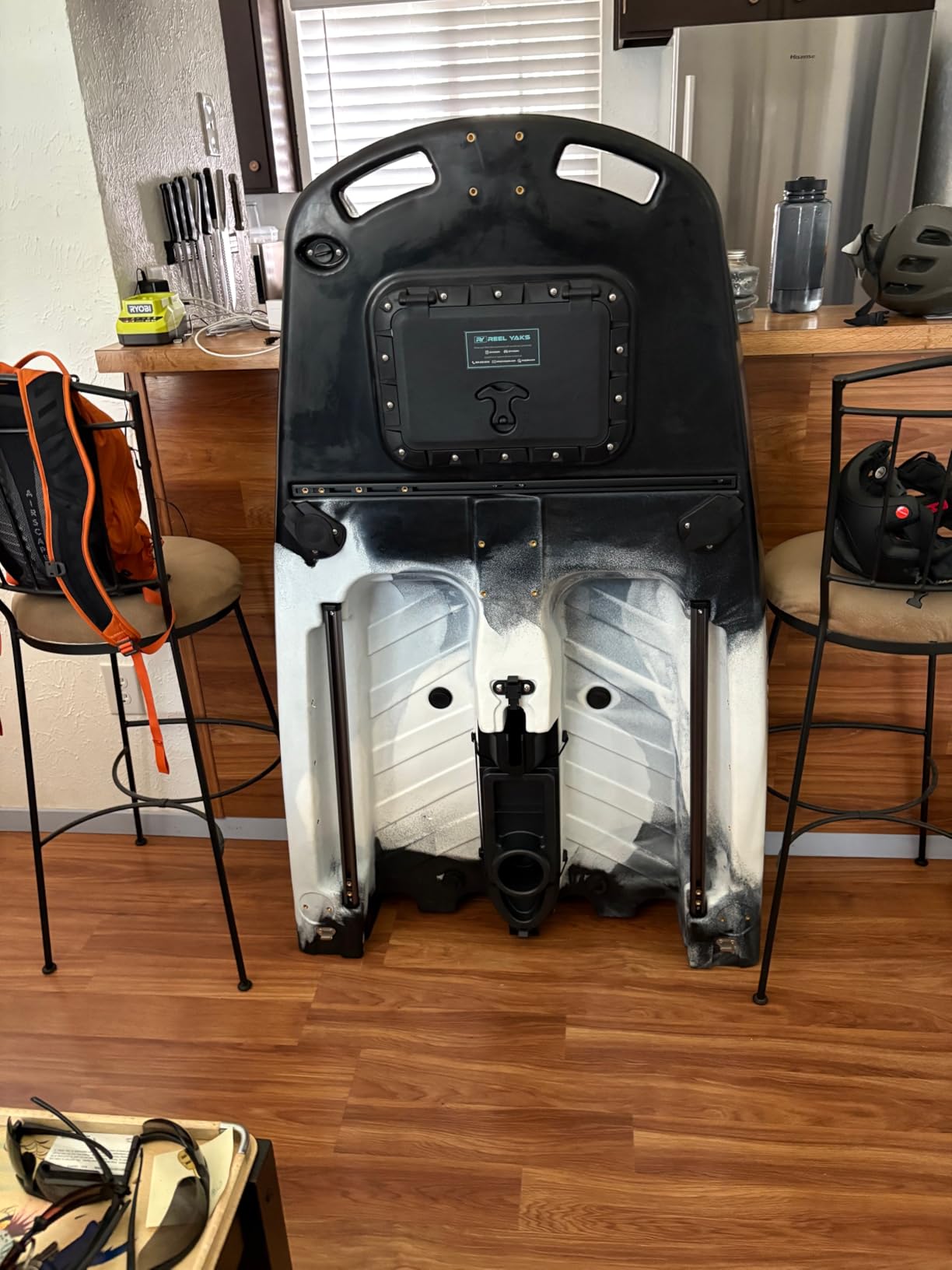
Same 9.5 foot footprint as the Raptor, same 380 lb capacity, and a completely different feel on the water. The Raider comes with a propeller drive, and propeller-drive owners consistently describe two things: it is quiet, and it steers with more authority when you need to back off structure or hold a line across current.
The joint between the two halves is the practical headline. Sections come apart in four steps with no tools, and the built-in carry handles are in the right places. Owners say the boat fits in a small SUV with the seat, rudder and drive removed, which makes it a genuine car-only rig rather than a compromise.
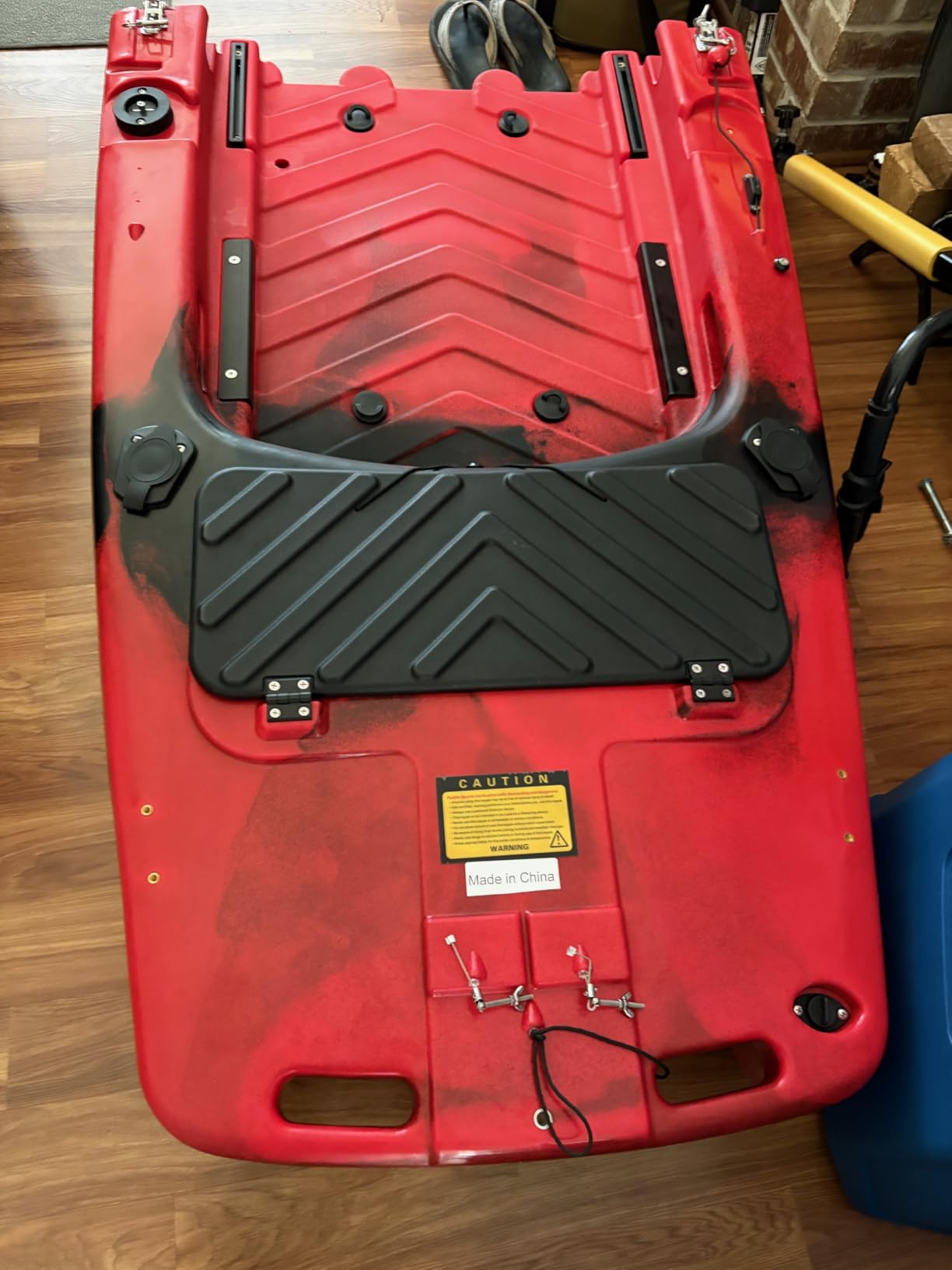
Cockpit width is listed at 35 inches across a 114 by 13.4 inch hull. That is a wide, planted platform for 9.5 feet, and reviewers describe it as stable in chop and fast on open water for a boat of this size.
The drive delivers instant forward and reverse. Reverse matters more than most buyers expect on day one and enormously by the third season, because it is what lets you back off a bank, spin and hold a spot without dragging an anchor or paddling sideways.
Who should look at the Raider
Pick it if you fish water with vegetation, current or wind and you want a propeller instead of fins. Propellers back out of heavy weed better than oscillating fins, and the reverse is what makes positioning in a current straightforward.
Also pick it if knees and hips rule out a scissoring fin pedal motion. A propeller turns in a circle instead of opening and closing, so the load lands on your legs rather than your inner-thigh rotation. Owners with joint complaints call it the knee-friendly option.
What to watch before buying
Two things. First, weight: each of the two sections is listed at 31 lb, which is heavier and more awkward to carry than buyers tend to assume from the headline number. Second, durability. One detailed owner account describes pedal drive gear wear developing into grinding noise and eventually stripped components inside the warranty-relevant usage period. Hull warranty is two years, so ask about drive coverage specifically at the time of purchase.
The front storage compartment is also not reachable while seated, which defeats the purpose of having it on a fishing boat.
3. BKC Brooklyn 12.5 Pro — Best Premium Rig With Built-In Motor Compatibility
BKC Brooklyn 12.5 Pro Motorized Fishing Kayak, Trolling Motor
12.5 ft sit-on-top
88 lb
558 lb capacity
Built-in trolling motor with 5 rod holders
Pros
- Pedal drive tracks 3-4 mph solo and faster with a paddle assist
- Stable casting platform that still floats in low waves
- 88 lb weight is light enough to roof-rack and cart
- Large dual hatches and bungeed rear deck
Cons
- Pedal drive can be stiff on first outings and needs break-in
- Drive must be raised in shallow water and at launch
- Limited inner-hull access complicates aftermarket rod-holder plates
The Brooklyn 12.5 Pro is the one boat in this group that arrives ready to be a full platform. It comes with a built-in trolling motor, five rod holders, a seat, a paddle, four carry handles, two hatches, scupper plugs, bungee tie downs, a paddle park and a cup holder. Nothing is missing except a fish finder, and the hull has a mount for one.
At 88 lb it is 20 lb lighter than several comparable pedal hulls, and owners put that on roof racks without drama. It is still a serious load over a long carry, so a cart is not optional for most people.
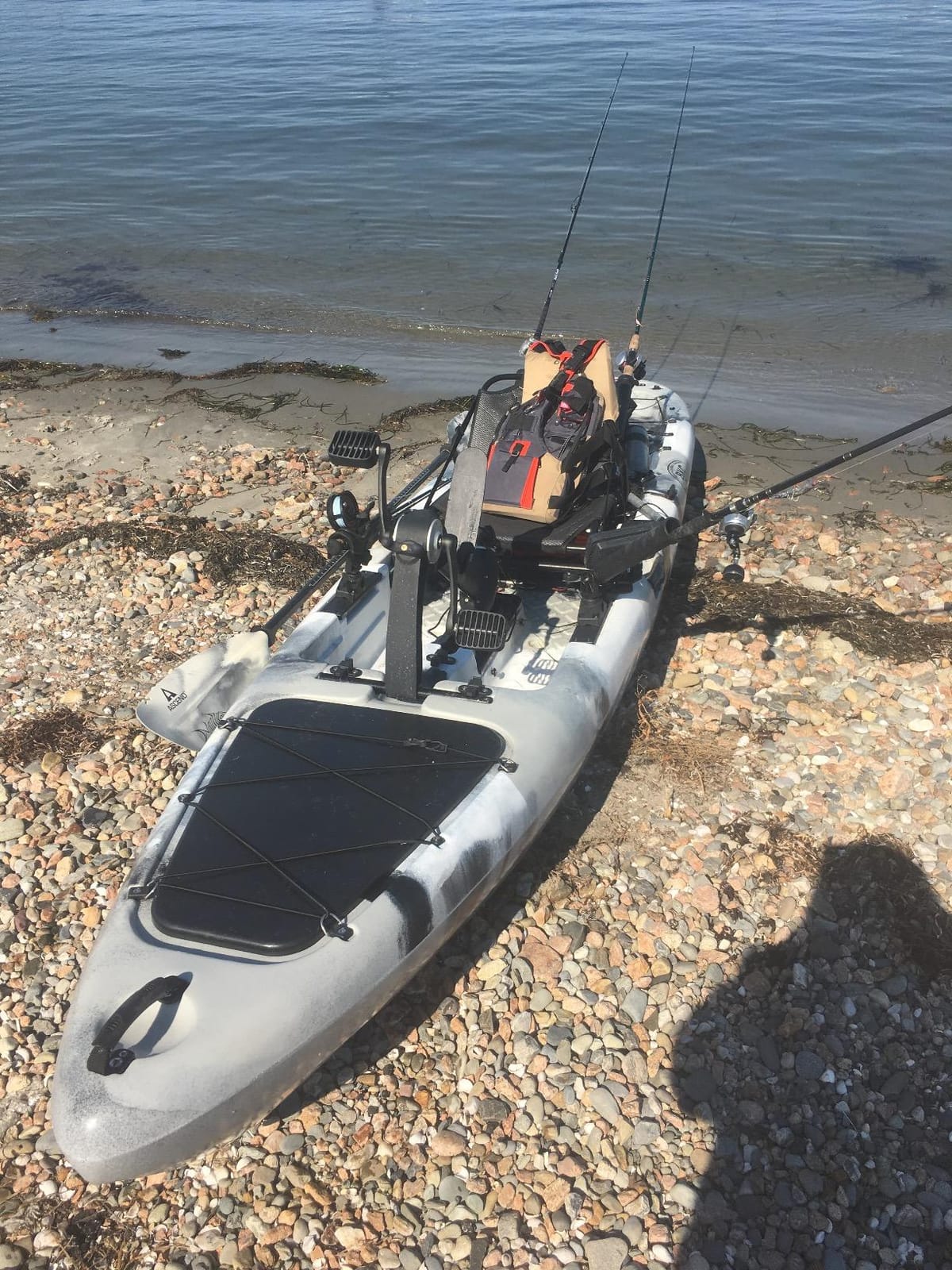
Speed is where this boat separates itself. Owners report 3 to 4 mph under pedal power alone and more when a paddle is used as a kick. On a 12.5 foot hull that translates to covering real ground, and on a big lake it is the difference between reaching the far point or not.
The hand-operated wide rudder is responsive at speed, which matters because a hand rudder is the single most important part of a pedal kayak after the drive itself. Owners describe backing straight, stopping, and turning at low speed as the skills you build in the first hour.
What makes the 12.5 Pro worth the money
Capacity is listed at 558 lb, the second-highest number in this group, and the 12.5 foot length gives you storage space that no 9.5 foot modular boat can match. If you run a console, a battery, a large tackle crate, a cooler and a second rod setup, this is the hull that will hold it all without riding low.
The trolling motor provision is the quiet differentiator. A pedal kayak that accepts electric power gives you a backup for the far side of the lake and an option to run deeper water without burning your legs.
Where buyers report trouble
The drive needs break-in. New owners describe it as stiff on early outings, so expect a session or two before it feels smooth. It also has to be raised in shallow water and during launching, which adds a step at every ramp.
Service is the other complaint theme. Several buyers report friction on pedal-drive warranty claims and replacement parts, and the limited inner-hull access makes aftermarket rod-holder back plates difficult to install. Rudder tracking also wants a hand on the control in current. All three are manageable, but budget time and patience for the drive.
4. Old Town Sportsman PDL 106 — Best Pedal Kayak for Standing and Casting
Old Town Sportsman PDL 106 Pedal Fishing Kayak (Ember Camo)
10 ft 6 in pontoon-style hull
107 lb hull plus 18 lb console
450 lb capacity
Forward and reverse PDL drive
Pros
- Very stable pontoon-style hull that feels planted when standing
- Instant reverse and responsive rudder for wind and current positioning
- Smooth pedal glide with enough power to return to shore
- Universal transducer mount and adjustable mesh seat
Cons
- Heaviest hull here at 107 lb plus an 18 lb removable console
- Paddle is sold separately
- Short 10 ft 6 in length limits storage versus 12 ft boats
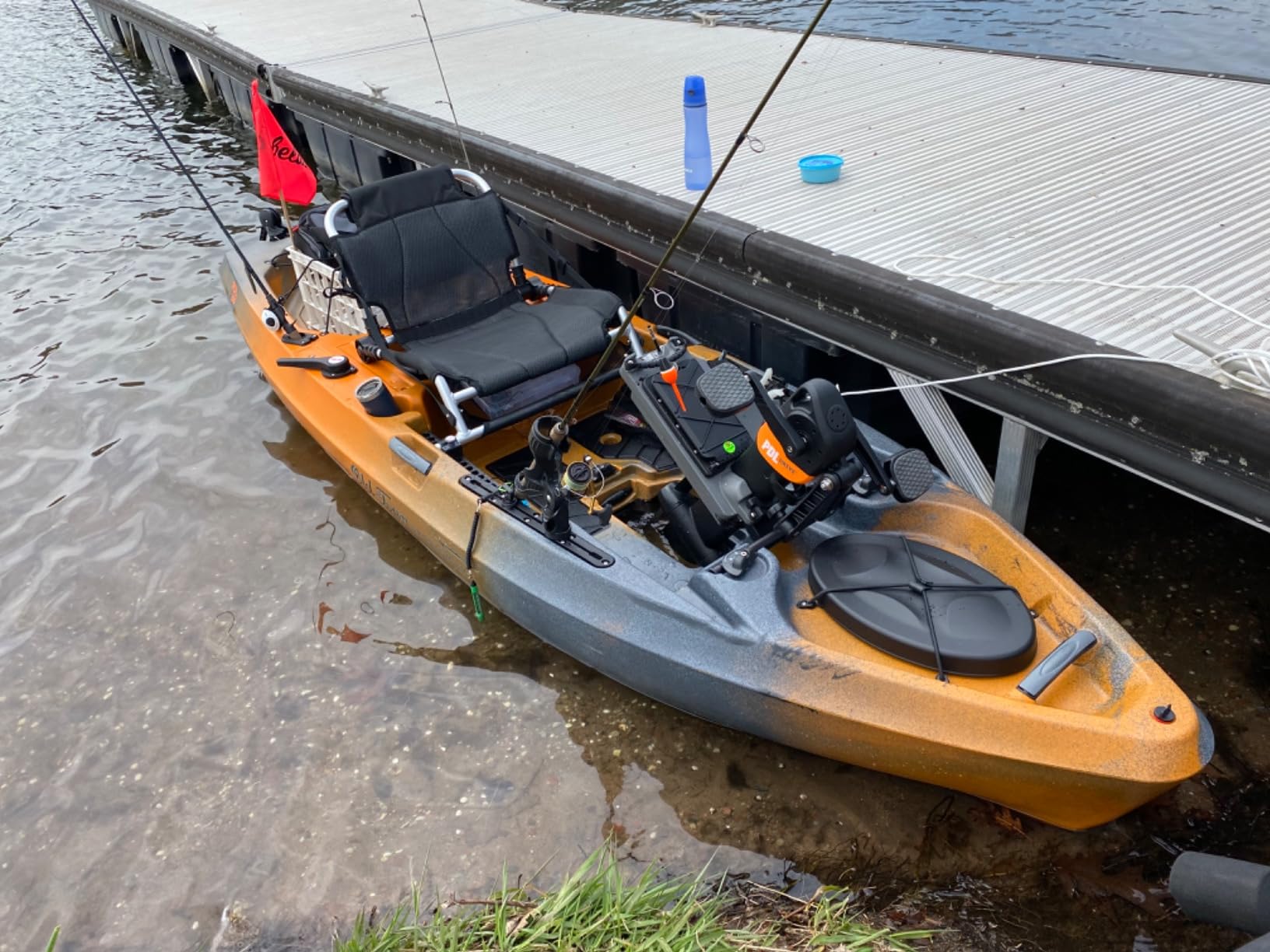
At 36 inches wide, the Sportsman PDL 106 is the widest hull in this comparison, and that single measurement is why it wins the standing and casting category. Owners describe it as feeling like a tank. Standing casts, bowfishing posture, and casting into wind are all situations where a narrow hull makes you sit down and a wide hull lets you stay up.
The pontoon-style hull trades speed for planted stability, and it is the right trade if you are a big angler, if you stand to cast, or if you fish water where a mistake is expensive. Listed capacity is 450 lb, with 343 lb stated as usable for person plus gear. That distinction matters and we come back to it in the buying guide.
The PDL drive gives instant forward and reverse, and owners single out the rudder response as the smoothest in the group. The drive can also pull an angler back to shore under power, which is a real convenience when the wind is on the far bank.
Rigging is where the PDL design shows its age in a good way. Universal accessory tracks, cushioned floor pads, a tackle box and multiple rod holders come in the box, and the universal transducer mount makes installing a fish finder straightforward rather than a custom job.
Who this hull is built for
Anglers in the 250 lb and up range who want to stand. Big and tall anglers on forums consistently rate width and usable capacity as the deciding factors, and the 106 answers both better than any 9.5 foot boat here. It is also a strong cold-water and big-water platform because the extra width resists tipping when you move around up top.
Pick it if your launch is a ramp or a dock close to your vehicle. That is the situation a 107 lb hull works in.
What makes it a hard yes or a hard no
Weight is the deal-breaker for a lot of people. At 107 lb for the hull plus an 18 lb removable console, this is a two-person load or a cart job from any real distance. The 10 ft 6 in length also means less deck storage than the 12.5 foot boats in this group.
And the paddle is sold separately. If you are new to the sport, budget for a backup paddle from day one rather than discovering the gap at the launch.
5. Reel Yaks Radar Modular 10ft — Best Step Up in Capacity That Still Stores Indoors
Reel Yaks Radar Modular Fishing Kayak, 10ft, 430 lbs Capacity
10 ft modular sit-on-top
88 lb
430 lb capacity
Propeller drive with instant reverse
Pros
- Propeller drive with instant forward and reverse
- Two-piece hull stores in a closet or vehicle trunk
- Wider 10 ft hull adds capacity and casting stability
- Comes rigged with rod holder and track rails
Cons
- Split sections are still fairly heavy to carry any distance
- Accessory rails require loosening an end cap
- Shares the Reel Yaks rudder-linkage complaint pattern
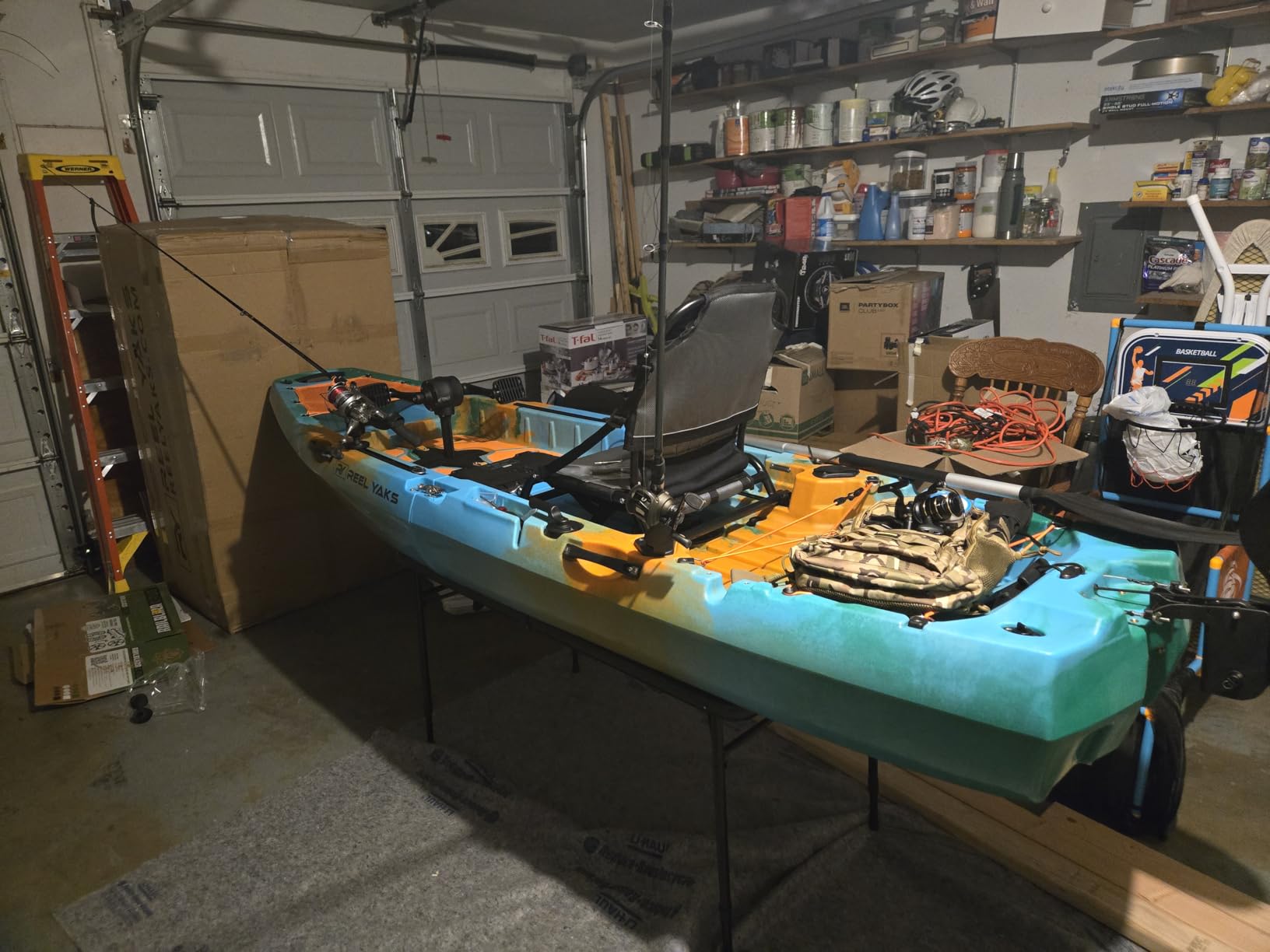
The Radar is the middle boat in the Reel Yaks lineup and the most balanced of the three. At 10 feet it is 6 inches longer than the Raptor and Raider, at 33 inches wide it is meaningfully more planted, and it raises listed capacity to 430 lb while keeping the same two-piece storage story.
That combination makes it the pick for an angler who has outgrown a compact boat but has no roof rack, no garage clearance, and no interest in owning a trailer. The propeller drive gives instant forward and reverse, which is the feature owners quote most when explaining why they moved up from a paddle kayak.
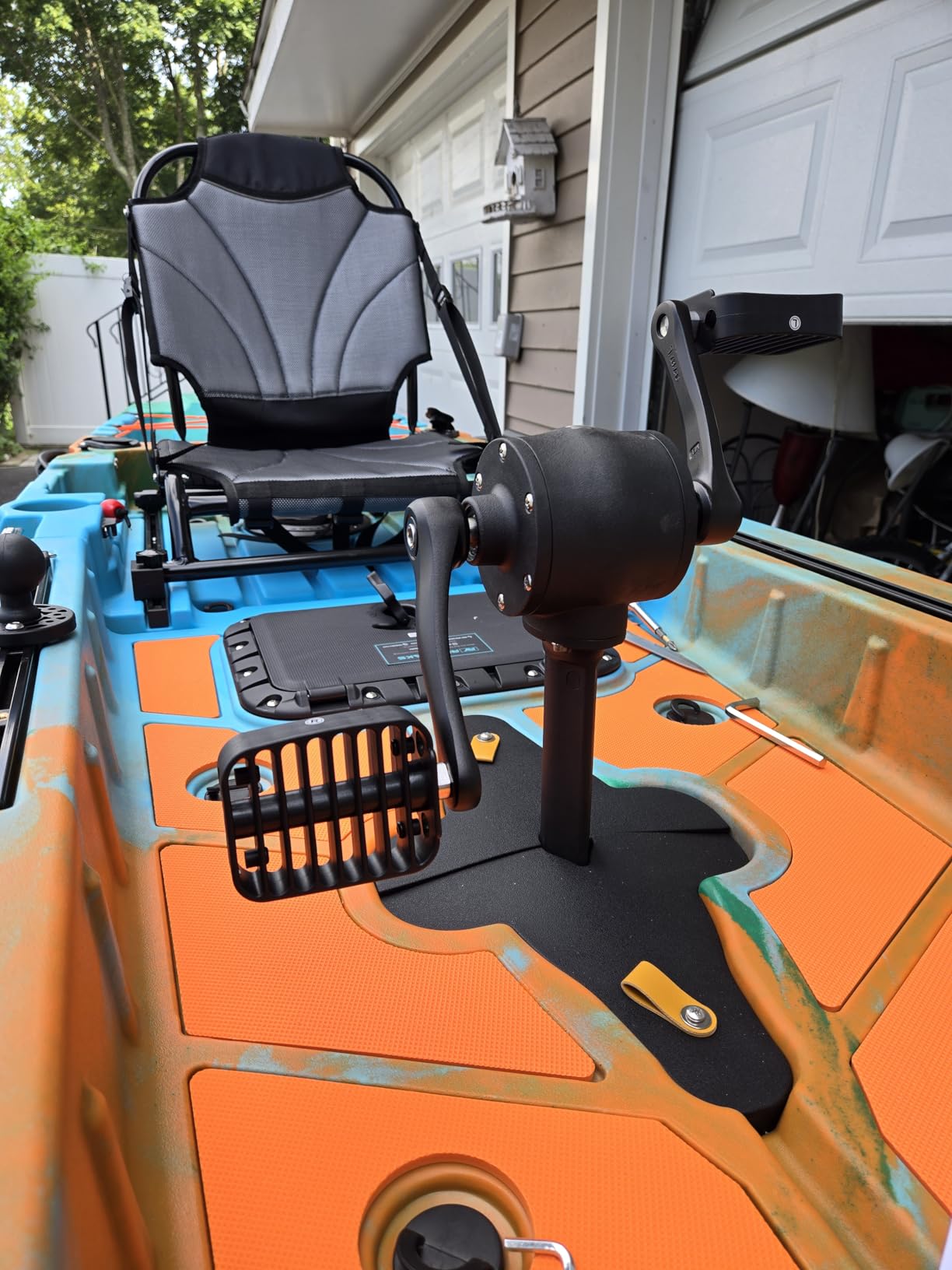
Rigging is ready out of the box: a 360-degree rod holder, accessory track rails and storage hatches, all flush-mounted so they do not snag lines when you are casting. Flush fittings matter more than they sound, because anything protruding on a fishing deck catches slack line.
Hull warranty is two years, which sits mid-pack in this group and is worth asking about alongside drive coverage, since drive components are usually warranted separately from the hull.
Why this one over the shorter Reel Yaks models
The extra 6 inches of length and 2.7 inches of width buy you casting stability and deck room, which is exactly what you were missing in a 9.5 foot boat. Owners describe it as a step up in control rather than just a step up in size.
If you plan to run a console and a battery rather than a bare hull, the 430 lb rating gives you room to do it. If you mostly fish a pond alone with a rod and a net, you are paying for capacity you will not use.
What to know before you order
Weight is the trade. At 88 lb split across two sections, the Radar is not a single-person carry over a long distance, and reviewers are clear about that. It solves storage, not portage. Plan on a kayak cart at the far end of anything longer than a short carry.
Two smaller notes: accessory rails need an end cap loosened to fit track-mounted items, and the optional center module that converts the boat for tandem use is a separate purchase. The rudder linkage complaints that run through the Reel Yaks range apply here too, so keep the service contact handy.
6. Albott Modular 9.6ft — Best Value Pedal Kayak for Heavy Use
Albott Modular Fishing Kayak with Propeller Drive System & Durable HDPE
9.6 ft modular sit-on-top
109.7 lb
400 lb capacity
Propeller drive with raising stern rudder
Pros
- Smooth quiet propeller drive with easy reverse
- Three-step assembly with internal handles in each section
- Reinforced HDPE hull with stainless hardware built for heavy use
- Adjustable seat and multiple mounting points for customization
Cons
- Heaviest listed weight in this group at 109.7 lb
- Only a 6-month warranty
- the shortest coverage among these picks
- Included paddle is a basic ABS and PP model
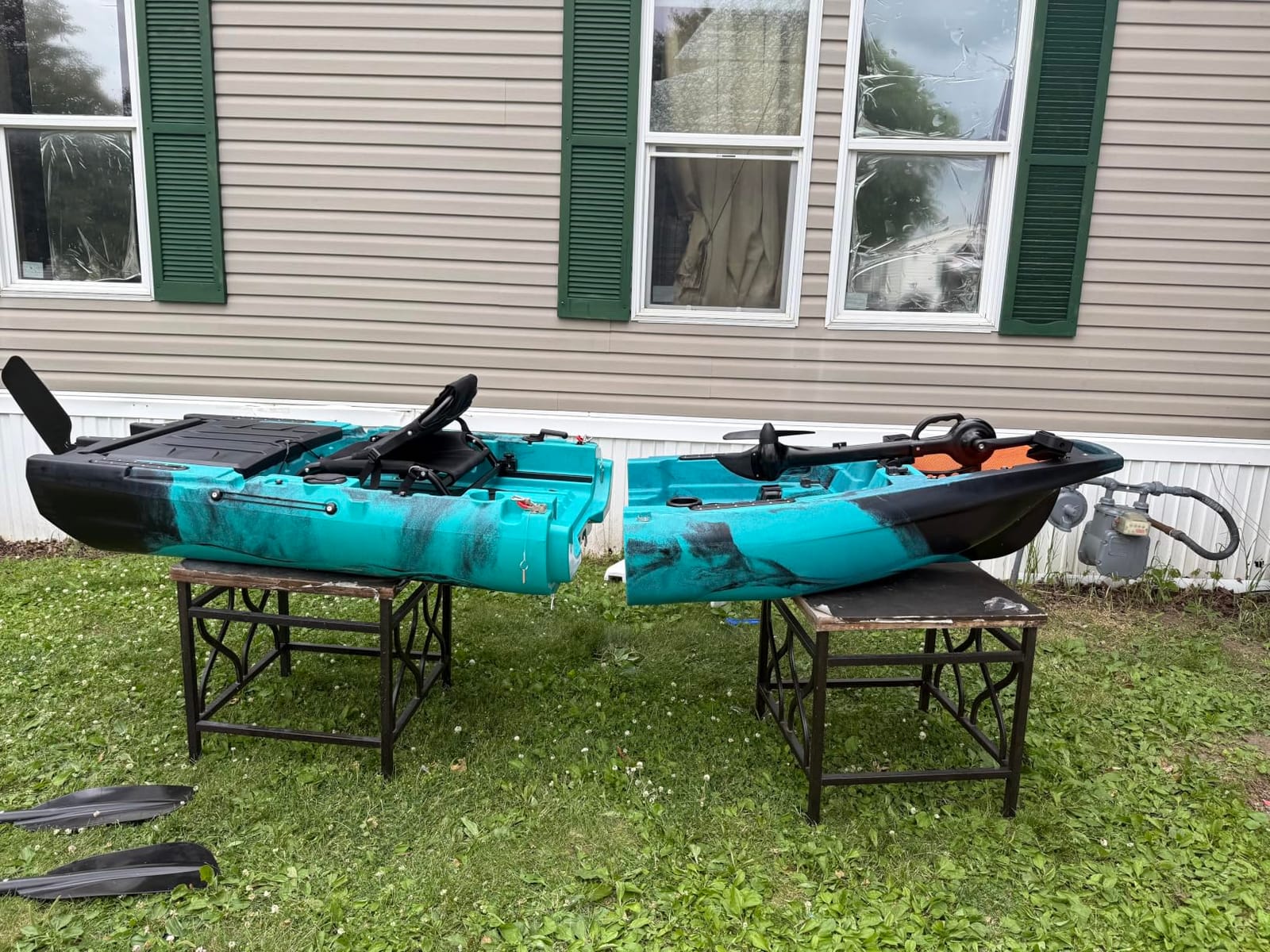
The Albott is the one in this group that reads like it was built for rental fleets, and that is not an insult. Buyers who run boats hard treat it as strong value precisely because the hull is reinforced, the pin connections are secured with 304 stainless hardware, and the sections assemble in three steps with internal carry handles.
Drive performance is the quiet surprise. Owners describe the propeller drive as smooth and quiet with easy reverse, and they use it for docking and working mangroves, which is a demanding test for a compact boat.
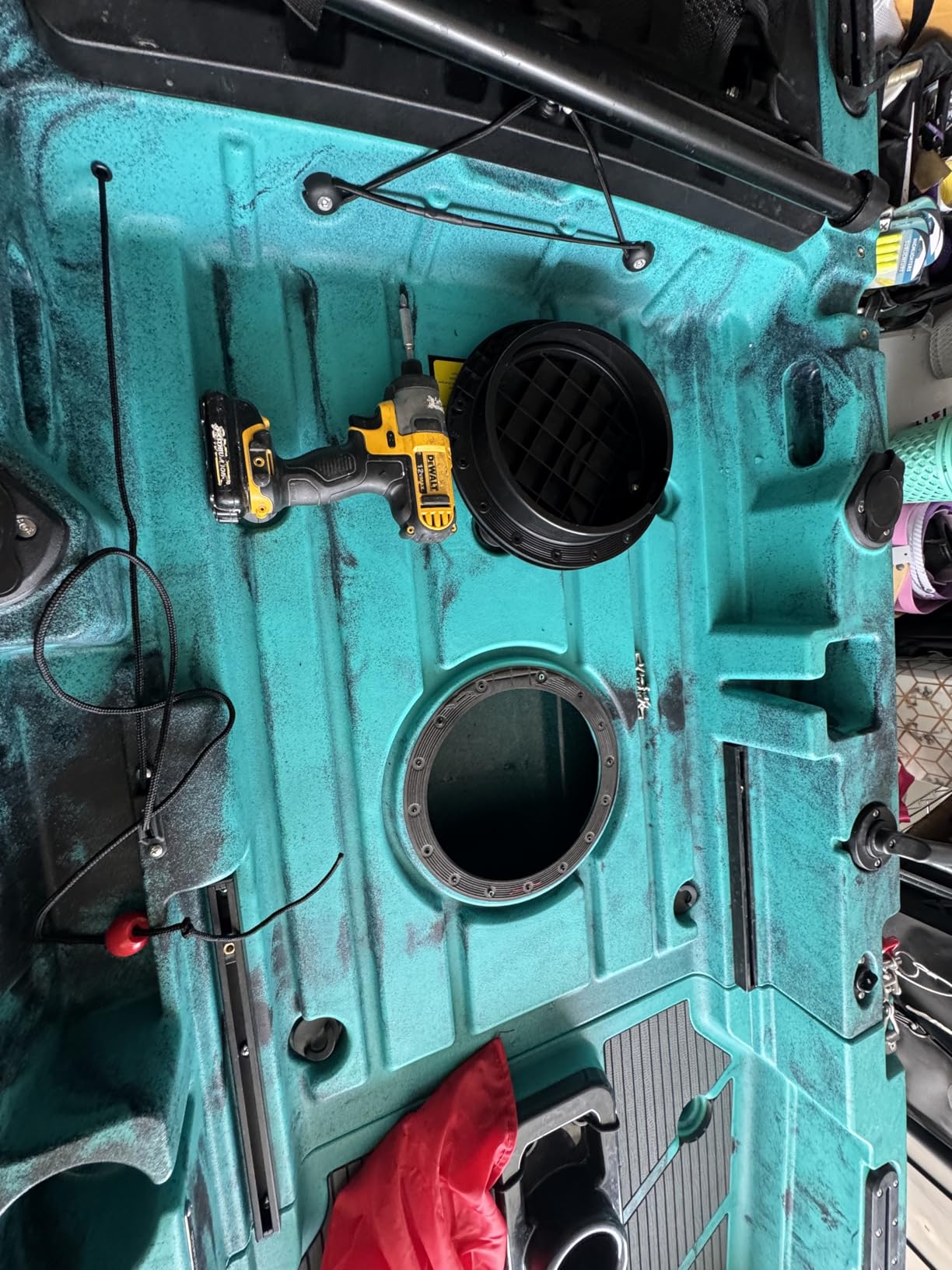
At 114.96 by 34.68 by 13.8 inches it is a wide 9.6 foot hull, and the wide-V stance is what gives it the stability rating it has. Listed capacity is 400 lb, with a seating capacity listed as two, which makes it one of the few boats here you could rig for a passenger or a gear-heavy solo setup.
The cable-operated stern rudder raises and lowers. That is a small feature with a real purpose: you lift it to clear sand, mud and shallow vegetation at the launch and drop it for steering authority once you are moving.
Where the value actually is
If your use case is rental, guiding, workboat or simply hard use without a dealer network nearby, the reinforced hull and stainless hardware are the reason this boat makes sense. The customization points are generous for a boat at this size, and the adjustable seat lets you set pedal reach properly, which is the single biggest comfort factor in a pedal kayak.
Buyers treat it as strong value because the material choices are the right ones for a boat that will take abuse.
What to weigh up first
Weight is the issue. At 109.7 lb it is the heaviest listed hull in this group, and one person needs a plan to move it from storage to water. It is a modular design, so the sections break down, but neither section is a solo carry over distance.
Warranty is the harder objection. Six months is far shorter than the two to five years the other boats carry, and a pedal drive is exactly the kind of component that generates service claims. If you buy it, register the drive warranty the day it arrives and keep the paperwork. The brand’s review history is also much thinner than Reel Yaks or Old Town, which limits how much long-term reliability data exists.
7. Lifetime Renegade 116 — Best Warranty Coverage With a Thin Review Base
Lifetime Renegade 116 Pedal Drive Fishing Kayak
11 ft 6 in sit-on-top
102.5 lb
350 lb capacity
Deployable propeller drive with 5-year warranty
Pros
- Deployable propeller drive frees both hands for fishing
- Adjustable framed seat with back support and raised sightlines
- Integrated rudder steering that takes minutes to learn
- UV and impact resistant HDPE with self-draining scuppers
Cons
- Only one customer review on record so durability is unproven
- At 102.5 lb it is heavy to move solo
- 350 lb capacity is the lowest listed here
- Paddle stows on deck and occupies usable deck space
We want to be straight about the Renegade: it has one customer review and a five-star average, and one review is not a reliability record. Lifetime is an established outdoor brand with a five-year limited warranty, and the drive is deployable, which is a genuine convenience. But treat the owner feedback here as a first impression rather than a track record.
What that single detailed owner describes is a comfortable, stable, roomy boat. The sliding framed seat with back support gives raised sightlines over the water, which is useful for spotting fish in clear water and for seeing submerged structure ahead of you.
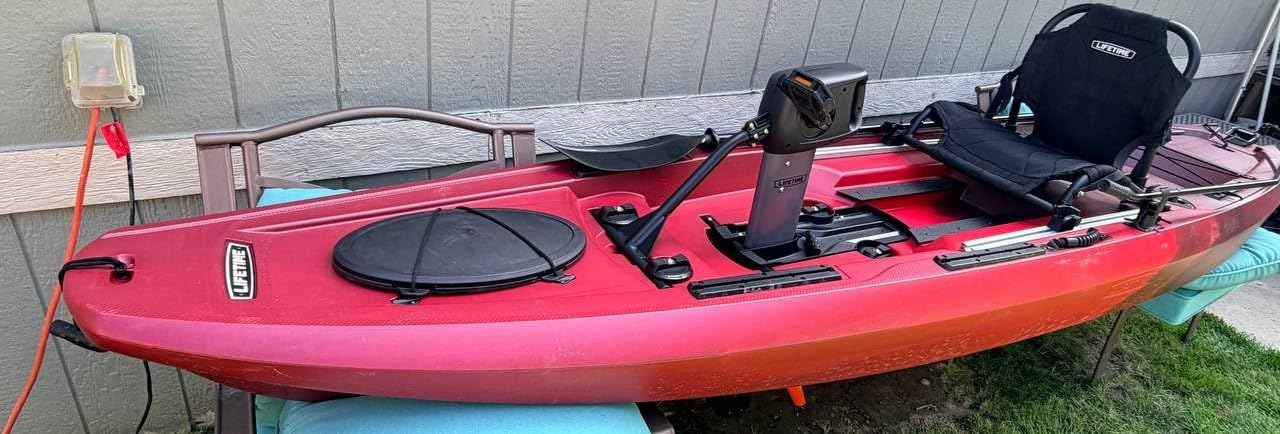
At 138.5 by 32 by 13 inches the Renegade is long and narrow relative to the wide pontoon-style hulls here, so it will track faster in a straight line. That is the trade: the Old Town 106 at 36 inches wide feels planted, and this at 32 inches feels quick. Most anglers will want one of those traits and can live without the other.
Integrated rudder steering is hand-operated, flush rod holders and accessory tracks are built in, and there is front and rear storage plus self-draining scupper holes. UV and impact resistant HDPE is the right material for a boat that lives on a roof rack in summer sun.
What the deck layout gives you
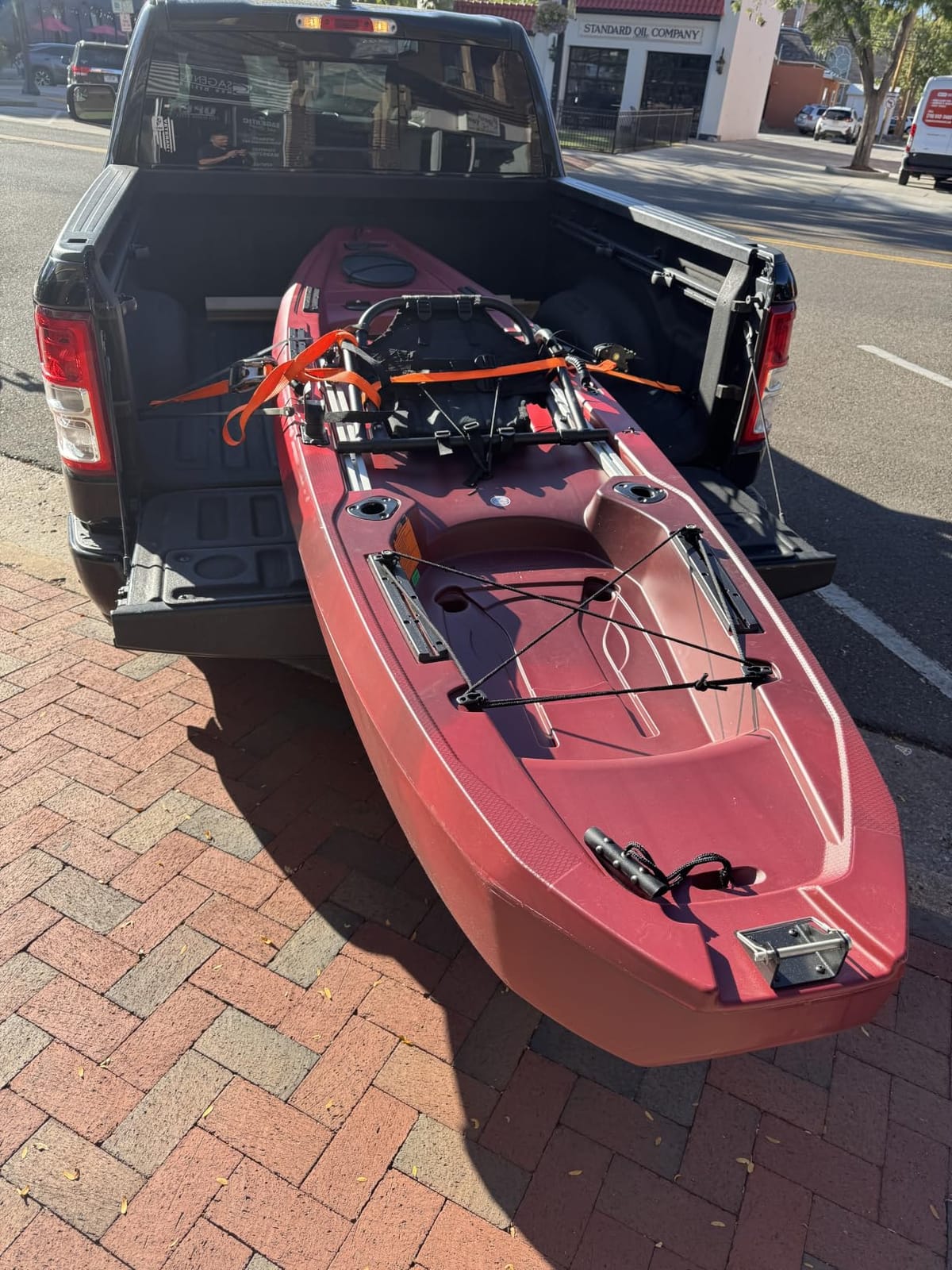
Front and rear storage is the difference between this and a boat you keep in a truck bed. With storage at both ends you can keep a dry bag of clothing forward and a wet tackle crate aft, and the flush rod holders keep lines off the deck. Raised seating plus back support is the combination that decides whether a 6 to 8 hour day is comfortable.
For a warranty-led buyer, the five-year limited coverage is genuinely the strongest in this comparison alongside the BKC boats.
Why we are not ranking it higher
Three reasons, all of them about data rather than the boat. There is a single review, so we cannot tell you how the drive holds up over seasons. At 102.5 lb it is a heavy solo load. And 350 lb is the lowest listed capacity here, which is limiting for a big angler with a console, battery, crate and anchor.
The paddle is included but stows on deck, where it takes up space you probably want. The smart move is a deck-mounted paddle holder so the backup is there but out of the way.
8. Old Town Ocean Kayak Malibu PDL 12ft — Best Pedal Platform for Adding a Trolling Motor
Old Town Ocean Kayak Malibu Pedal Sit-on-Top, Horizon
12 ft solo sit-on-top
PDL pedal drive
Element Beach adjustable seat
Large stern tankwell
Pros
- Very stable and fast
- handles choppy water well
- Element Beach seat with storage pocket and slide adjustment
- Redesigned large stern tankwell fits a cooler and gear
Cons
- Recreational platform with fewer built-in angler features
- Only three flush rod holders in the cockpit area
- Heavier than the modular options for solo carrying
- Small review count so field history is thin
The Malibu PDL starts from a different premise than the rest of this list. It is a recreational 12 foot pedal platform rather than a purpose-built fishing hull, and that is exactly why it appeals to people who want to motor-troll. Every reviewer rates it five stars, and the recurring theme is how useful it becomes once a trolling motor and a fish finder are added.
It accepts a stern-drive trolling motor with an extended tiller. On a fishing kayak, electric propulsion is the natural partner to pedal drive: pedal to cover water in the shallows, motor to run the deep drop-off, and you keep both options in one hull.
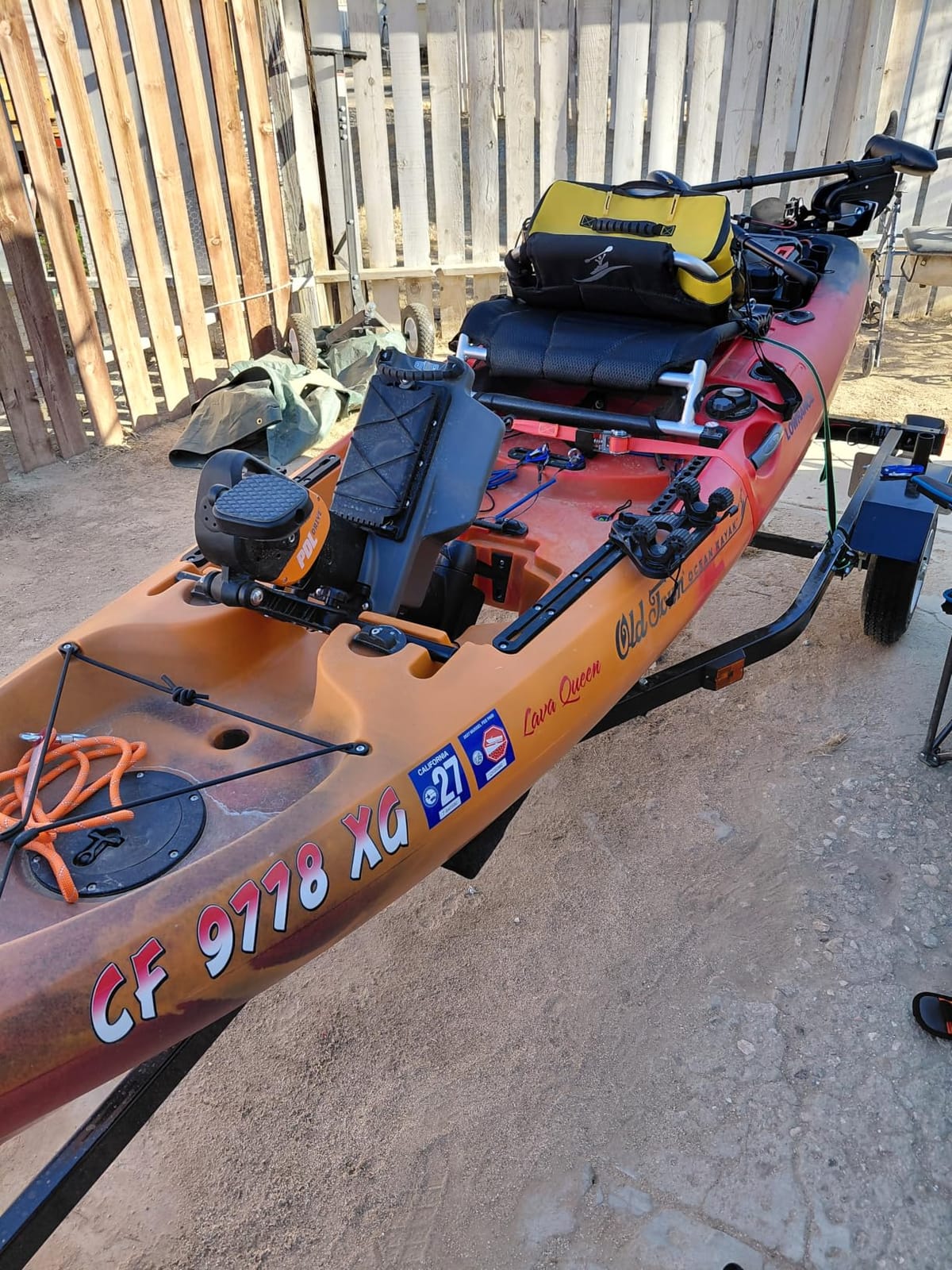
The Element Beach seat is the best-specified seat in this group. It is breathable, it drains, it has a storage pocket, and it adjusts on a slide track. Comfort is the failure point most owners report in other boats after a season, so a seat like this is worth more attention than it first appears.
The redesigned large stern tankwell takes a cooler and gear, three flush rod holders cover the cockpit area, and two 18-inch accessory tracks run down either side for a tackle net, a paddle or a camera mount.
Who should choose the Malibu PDL
Choose it if you fish structure at range, if you intend to run electric power, or if you want a boat that works for non-fishing days too. Twelve feet of hull is fast enough to cover distance and wide enough to feel safe in chop, and the hull warranty carries a five-year warranty on the PDL drive.
It also suits anglers whose gear load is heavy. A stern tankwell plus two accessory tracks gives more deck organization than most 12 foot fishing kayaks at this level.
What the fishing-specific list lacks
This is a recreational platform, so the angler hardware is thinner: three flush rod holders in the cockpit, and no dedicated tackle management, transducer mount or bow rigging out of the box. If you rig heavily, you will be adding tracks and mounts yourself.
It is also heavier than the modular boats for solo carrying, and the published review history is thin at ten reviews, so there is less long-term field data than the Raptor or the 12.5 Pro have.
9. BKC Brooklyn 10.0 — Best Lightweight Pedal Kayak for Ponds and Short Carries
BKC Brooklyn 10.0 Single Pedal Fishing Kayak, Sit-on-Top
10 ft rotomolded HDPE
75 lb
350 lb capacity
Flipper pedal drive with hand rudder
Pros
- Flipper-style drive gives quick smooth acceleration for its size
- Lightest and most transportable single pedal hull here
- Hand-operated rudder gives sharp responsive turns
- Watertight front hatch plus bungeed rear cargo storage
Cons
- 58 lb hull and 350 lb capacity limit gear load
- Paddle is not included with this configuration
- Only two built-in rod holders
At 75 lb the Brooklyn 10.0 is the second-lightest hard hull here and the lightest single rigid boat in the group. If your launch is a short path from the truck or a gravel bank, that difference changes your whole day more than any drive upgrade.
The flipper-style pedal drive is worth understanding. It does not oscillate like a fin drive and it is not a geared propeller unit; it turns a flipper paddle through a drive well, which gives quicker acceleration at low speed than most systems of its size. Owners praise the acceleration response for repositioning between spots.
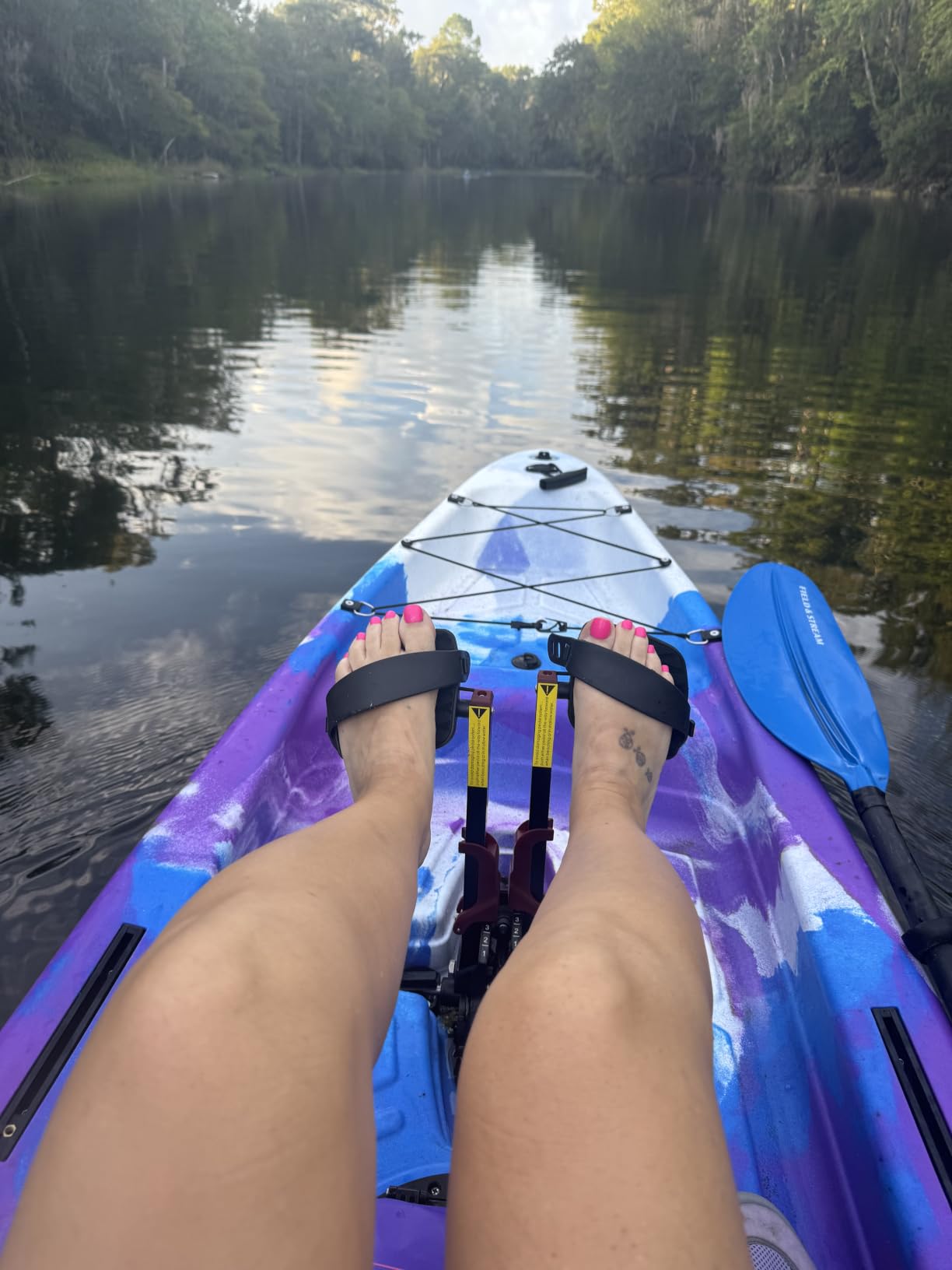
Handling is the strongest suit here. The hand-operated rudder gives sharp turns, and the 120 inch length tracks predictably. The aluminum-frame upright seat with dry mesh technology is adjustable, and the hull carries a watertight front hatch, bungeed rear storage and an accessory rail.
Scupper holes let you drain live wells or wet gear, and carry handles are built in for the short load to the water.
Where this boat fits best
Ponds, small lakes, creeks and sheltered water where you are under 220 lb and running a rod, a small crate and a cooler. The 58 lb hull is genuinely light for a pedal kayak, and 10 feet is short enough that a solo launch from a soft bank is realistic.
It is also a good first pedal kayak for someone who already paddles and wants to try drive propulsion without changing their entire storage situation.
The capacity ceiling is the real limit
350 lb listed capacity is low in this group, and that hull weighs 58 lb before gear. Buyers with a console, a battery, a large crate and a cool of fish will feel the ceiling sooner than they expect. The spec sheet also lists a lighter hull figure than the shipping weight, which is the kind of label inconsistency we explain in the buying guide.
Also note that paddles are not included with this configuration and there are only two built-in rod holders. Budget for a paddle and for rod holders if you fish more than one rod.
10. Spatium Pedal Fishing Inflatable — Best Convertible Pedal Kayak That Converts to a Board
Spatium Pedal Fishing Inflatable Kayak Pedal Sit on Top Pedal Drive Fishing Kayak with 360° Rotatable Seat Pedal Kayak for Adults One Person Suitable for Rivers,Oceans,Lakes-Fish Bone Model
Inflatable PVC hull
330 lb capacity
360-degree swivel seat on an 80 cm rail
Three-mode platform
Pros
- Converts to pedal kayak
- pedal board or motorized board
- 360-degree swivel seat lets you cast from any angle
- Quality seams and hardware with a rolling backpack included
- Inflates and deflates for car storage in about an hour
Cons
- Transducer bracket spacing does not match a standard transducer
- No extra air connector for electric inflators
- Lowest listed capacity in the group at 330 lb
- Only a 1-year warranty
The Spatium is the odd one out and the most interesting idea here. It is not a rigid kayak at all. It is a double-layer PVC hull with 0.9 in PVC pipes that runs at 7 to 8 PSI with a hull pressure of 11 to 12 PSI, and the same boat converts into a pedal board or a motorized board.
Three modes in one hull means you can fish it as a kayak, stand on it as a board in shallow water, or add power. For sight fishing over grass flats in waist-deep water, board mode is the reason people buy something like this.
The 360-degree rotatable seat runs on an 80 cm rail, so you can face any direction without turning your whole body. For bowfishing, structure fishing and sight casting, that is a genuine advantage over a fixed seat.
What the design gets right
Seam and hardware quality is the first thing early buyers mention, and for an inflatable that is the correct thing to look at. The package includes a 15 cm pedal system, the swivel seat, an aluminum double-ended paddle, a backpack and a pump, so it is ready to launch without a shopping trip.
There is a built-in camera mount base, which sounds small until you are trying to hold a phone steady for a photo of a fish. A side measurement scale on the hull for sizing fish is a nice touch. Top speed is listed at 6 to 8 km/h, which is a brisk paddle-free cruise, and stabilizing bottom fins keep it tracking.
Why the rating is not higher
Three things hold it back. The Starport bracket mounts are spaced too far apart for a standard transducer, which means a custom bracket build if you want a fish finder, and that is real money on a boat at this level. There is no extra air connector supplied for electric inflators. And capacity is listed at 330 lb, the lowest in the group.
The warranty is one year and there are three reviews, so the long-term picture is unproven.
11. Beyond Marina AQUALURA 12ft 6in — Best Pedal Kayak That Packs Into a Car Trunk
Beyond Marina 12.5ft Inflatable Kayak Fishing Boat with Motor Bracket
Drop-stitch inflatable hull
60 lb
530 lb capacity
Accepts an optional pedal drive and rudder kit
Pros
- Best capacity per pound here at a 530 lb rating
- Wheeled backpack makes portage genuinely easy
- Fully loaded accessory kit in the box
- Large anti-slip EVA deck pad improves standing and casting
Cons
- Pedal drive and rudder kit are optional add-ons not included
- Inflatable hull is less rigid and slower than a hardshell kayak
- Outboard motor bracket needs an external motor
- Only a 1-year warranty
The AQUALURA is listed at 60 lb with a 530 lb capacity rating, which is the best capacity-to-weight figure in this comparison. At 150 by 39.9 by 19.6 inches it is also the widest boat here by nearly three inches over the Old Town 106, and it is an inflatable, so it stores in a closet.
The catch is stated plainly in the specifications: it is engineered to accept a pedal drive system, and the drive and rudder kit are optional add-ons rather than included. So it belongs in this roundup as a platform you build out, not as a ready-to-go pedal kayak. Budget for the drive and rudder as separate purchases and you end up with a very light pedal fishing kayak that fits in a trunk.
What you do get in the box is unusually complete. A double action pump, an inflatable seat, a kayak paddle, a wheeled backpack, three rod holders, two storage net pockets, a phone case, a repair kit, a screwdriver and two fins. No pedal kayak arrives with that much in the carton.
The full drop-stitch build with reinforced seams and a large anti-slip EVA deck pad is the part that matters for fishing. Drop stitch is rigid enough to stand on, and the deck pad gives you footing for casting that a soft inflatable surface does not. It also tracks more smoothly than a tube-style inflatable.
Who this is genuinely for
Anglers with no storage at all, no roof rack, or a long carry from a parking lot. The wheeled backpack is not a gimmick on this boat; it is the difference between a 60 lb carry and a 60 lb roll. For a large angler, 530 lb of listed capacity and 39.3 inches of width is a rare combination at this weight.
Our inflatable kayak roundup covers the trade-offs in more detail if you are weighing a soft hull seriously.
What you give up for the portability
Three honest limits. The hull is less rigid than hardshell polyethylene, so it flexes and it is slower under pedal power. The outboard motor bracket is a bracket, not a motor, so electric propulsion means buying a motor. And the warranty is one year with a five-review history.
Pedal drive responsiveness and tracking will never match a molded hardshell. If you fish a big lake at distance, speed wins. If you fish water you cannot reach any other way, this boat wins.
12. BKC Brooklyn 13.0 Tandem Modular — Best Pedal Kayak for Two Anglers
BKC Brooklyn 13.0 Tandem Modular Pedal Kayak, 2 Person
13 ft modular 2-to-3 piece hull
92 lb
440 lb total capacity
Two flipper pedal drives for tandem use
Pros
- Only two-person pedal option here with two independent drives
- Three-piece hull can be run solo with two sections
- Adjustable seats and rails with flush rod holders
- Watertight hatches plus large bungeed cargo areas at both ends
Cons
- 440 lb combined capacity is tight for two adults plus gear
- Longest boat here at 92 lb across three sections
- Only two reviews so no long-term durability feedback
This is the odd one that solves a problem nobody else on the list addresses: fishing with another person. Two flipper-style pedal drives, two adjustable aluminum seats, two paddles, and a three-piece modular hull. At 156 by 31 by 12.5 inches it is the longest boat in the comparison.
The modular layout is the clever part. Run it solo with the front and rear sections for a long, narrow boat that is easy to track. Run it tandem with all three sections for two anglers with independent propulsion. That flexibility is something none of the other boats offer, and it is why we included a 13 foot tandem in a roundup of solo fishing kayaks.
What the two-angler layout gets right
Two independent drives mean neither angler is waiting on the other’s pedal speed, which is the thing that makes tandems frustrating when they are rigged to a single control. Each person steers, holds position and reverses on their own terms.
Storage is generous for a tandem: watertight hatches plus large bungeed front and rear cargo areas, accessory rails and flush-mounted rod holders. The warranty is five years with ten years of spare part availability promised, which is the strongest parts commitment anywhere in this group.
Why the capacity number is the deciding factor
440 lb is the combined figure for two people, and that is tight. Two adults plus fishing gear, coolers, tackle and safety kit will use it up quickly, and a tandem hull sits lower in the water as the load rises. Owners rate it five stars on layout and flexibility, and both reviews we have mention exactly that rather than loaded performance.
At 92 lb across three sections, solo handling means a cart. With two reviews on record, treat the durability picture as unknown. For most anglers, the right read is that this boat is a fishing platform for a pair who already know they will always fish together. Everyone else should look at the 12.5 Pro and spend the difference on a bigger cockpit.
Propeller Drive vs Fin Drive: Which One Fits Your Water
Roughly half the boats in this roundup use a propeller drive and half use a fin drive or flipper drive, and the choice matters more than any other single spec after hull width. Propeller drives turn a propeller through a geared lower unit. Fin drives use side-to-side scissoring fins under the hull. Flipper drives, as on the BKC boats, turn a paddle through a drive well.
Shallow water and weeds favour the propeller. A propeller backs out of heavy vegetation and mud better than oscillating fins, which collect weed and stop working. Owners of the Raider describe the prop as weed-resistant, and the reverse is what makes docking, mangrove edges and shallow bays practical.
Rocks, gravel and sand favour the fin. An oscillating fin that bends or loses power is annoying; a propeller that hits rock is expensive. The fin drive on the Raptor keeps moving through wind and current and stays quiet, which matters if you are approaching fish that are close to the surface.
Joint comfort favours the propeller. Fin drives scissor, which loads the inner thigh, hips and ankles. A propeller turns in a circle and loads the legs. Reviewers with joint complaints specifically describe the Raider’s propeller drive as knee-friendly. If you have a hip, knee or lower-back issue, this is not a small consideration.
Speed favours the propeller, control at low speed favours the fin. Owners of the Brooklyn 12.5 Pro report 3 to 4 mph on pedal power alone, with more when a paddle is used as a kick. Fin-drive owners describe slower cruise speed but a very direct response to pedal input, which is what you want when you are repositioning in 2 feet of water next to a point.
Service favours whoever has a reachable dealer. Every drive in this group has components that wear: cables, chains, gears, bearings and shafts. Before buying, find out how service works in your area, because a drive that has to be shipped away strands the boat until it comes back. The boats with the longest drive-specific warranties here are the Old Town models, which carry five years on the PDL drive, and the BKC models at five years overall.
Our rule of thumb after working through the data: propeller drive if you fish weedy, shallow, windy or current-heavy water and you want reverse. Fin or flipper drive if you fish clear water, rock or gravel, and you value quietness and lower maintenance.
How to Choose a Pedal Fishing Kayak?
Start with reverse, because it is the filter most buyers skip and most regret. A pedal kayak without reverse means backing away from a bank with paddle strokes, spinning to face the wind, and drifting off your spot every time you reposition. Every propeller drive in this roundup gives instant forward and reverse. Among the fin and flipper options, the Old Town PDL 106 is explicit about forward and reverse, and you should confirm it in writing for any boat you buy.
Next, understand the weight labels, because brands publish different numbers for different things and the gap is enormous. Three labels show up repeatedly. A bare or bare hull weight is the shell with nothing attached. A fitted hull weight includes the drive, seat, rudder and rigging. An assembled or fully rigged weight includes everything you would actually take to the water. The Brooklyn 10.0 shows this most clearly: a 58 lb hull figure against a 75 lb shipping weight. When you compare boats, compare the same label.
Then check capacity definitions the same way. The Old Town PDL 106 lists 450 lb total and states 343 lb usable for person plus gear. Those are different numbers and the gap is roughly the weight of a drive, seat, console and battery. Buyers routinely read 400-plus lb as headroom and then load a console, battery, crate, cooler, anchor and fish against it. Use the usable figure when one is published, and subtract the weight of your electronics and gear from the total when one is not.
Hull width decides whether you can fish standing. Every measurement here is roughly at or above 30 inches, and the difference between 32 and 36 inches is the difference between sitting to cast and standing to cast. The Old Town Sportsman PDL 106 at 36 inches and the AQUALURA at 39.3 inches are the two widest. If you are 6 foot 5 or taller, or over 250 lb, treat beam as a hard requirement rather than a preference, and pair it with a longer hull so the boat is not tippy fore and aft.
Check the seat before anything cosmetic. All-day comfort is the most common long-term failure point, and it is entirely about seat height, back support and pedal reach. The adjustable frame seats with lumbar support on the Old Town models and the Element Beach seat on the Malibu PDL are the best-specified in this group. The included stadium seat on the Reel Yaks boats sits low, which is comfortable but limits under-seat storage and can cramp your knees at full pedal reach.
Then check the deck. You want rod holders flush-mounted rather than protruding, accessory tracks you can actually reach from the seat, a bow hatch, and rear bungee space for a crate. Scupper plugs let you drain wet gear and live wells. If you plan to run a fish finder, confirm the transducer mounting pattern before you buy. The Spatium’s bracket spacing does not match a standard transducer, which is exactly the kind of detail that costs real money later.
Plan the whole system, not just the kayak. The boat is the largest single purchase and the smallest part of the actual outlay. Budget for a PFD that works with a high framed seat, a backup paddle of a usable length, a kayak cart if the hull is over 75 lb, a roof rack or trailer to move it, a fish finder and battery if you want electronics, plus a dry bag, a bailer and a whistle. If you intend to rig a rod holder, a shallow anchor or a camera mount, add those too. Our fly rod roundup covers the gear side of a day on the water.
Finally, plan the transport before the purchase, not after. Storage to vehicle is the first question: can the hull live indoors, does it fit in a garage, and is it a one-person lift or a two-person lift. Vehicle loading is the second: a roof rack, a truck bed with a trailer, or a car with a modular hull. Vehicle to water is the third: a ramp, a beach cart, or a long carry. The modular boats here win the first question decisively and are still too heavy for a long carry. The hard-shell boats win the third question and lose the first. Decide which one hurts less for your situation.
On maintenance, keep it simple. Rinse the hull and drive with fresh water after every saltwater or brackish session, run the drive briefly in clean water to clear sand and grit, and check cable and chain tension periodically. Salt deposits and dried mud in a drive well are what turn a warranty claim into a dispute. Rinse-down is cheap; a stripped gearset is not. If you are running an electric motor alongside a pedal drive, treat the wiring and connections the same way.
When a Pedal Kayak Is the Wrong Call?
We have covered 12 boats worth recommending, and we owe you the other side. A pedal kayak is the wrong purchase in several ordinary situations, and buying one anyway is the most common expensive mistake we see.
It is wrong when the transport plan does not work. If the boat has to go up stairs, through a building, or more than a hundred yards from the vehicle, a 60 to 110 lb hull will end your season by February. In that case a 10 foot paddle kayak that fits in a trunk is the better boat for the same money. If weight is your main concern, our general fishing kayak guide has lighter options.
It is wrong when your water is very shallow and snaggy and you have no reverse. Weeds, submerged timber and shallow flats foul oscillating fins, and without reverse you will be fighting a stuck drive instead of fishing. Either choose a propeller drive boat or choose a paddle kayak.
It is wrong when you fish two trips a year. A pedal drive earns its premium through repeated use. The Raptor at 62 lb with a fin drive is the least demanding boat on this list, and it still asks for a routine you have to keep up.
And it is wrong when there is no service path. Pedal drives fail. Cables snap, chains stretch, gears wear, and fin linkages bend. If the nearest dealer or authorised repair point is hours away and the boat is your only fishing platform, you are carrying a season-long risk. Check parts availability and drive warranty terms before you buy, not after the first failure.
On the safety side, pedal drive does not replace paddling skills. Carry a PFD you can actually wear in a high framed seat, a backup paddle stowed where you can reach it from the cockpit rather than on the deck, a bailer, a whistle and a knife. Tell someone your route and your expected return time. If you fish cold water, wear the clothing for the water, not for the air temperature, and practice a wet re-entry before you need one. Do not fish a pedal kayak alone in conditions where a drive failure would put you out of reach of help.
That covers the practical cases. If you want aerial coverage of the water you are working, our fishing drone guide covers the scouting angle. Otherwise, the comparison table above and the per-boat sections should give you a shortlist to test in person. Sit in every one of them before you sign anything, because seat fit is personal and no specification will tell you how it feels.
Frequently Asked Questions
Are pedal drive kayaks better for fishing?
Yes, for most anglers who fish regularly. A pedal drive leaves both hands free to cast, fight fish, handle bait and work a trolling line while the boat holds position. The practical gain is station control: you can hold a spot in wind or current without drifting, and you cover water at roughly 3 to 4 mph on a cruise most paddlers cannot sustain for a full day. The trade-off is weight, because most pedal hulls weigh 60 to 110 lb and are harder to transport than a paddle kayak.
Is a pedal kayak worth it for fishing?
It is worth it if you fish most weeks and you can solve transport. The premium buys hands-free propulsion, forward and reverse on most models, and the ability to cast, stand and troll without stalling. It is not worth it if you fish twice a season, if you cannot get a 60-plus-pound hull to the water, or if your water is shallow and weed-choked and you want fins. Try one in a showroom before buying, because seat fit matters more than any spec.
What is the best pedal kayak for the money?
The Reel Yaks Raptor Modular is our best overall pick and the best value in this comparison. At 62 lb it is the lightest hull here, it splits into two pieces that store in a closet or an SUV, and it lists 380 lb of capacity, which covers one angler plus a full gear load for most people. It also includes a paddle and seat, which several competitors in this price range leave out.
What is the 120 rule for kayaking and how does it work?
The 120 rule is a self-rescue technique for a capsized kayaker. Wearing a properly fitted PFD, you roll your kayak upside down, hold your breath, push the hull down, then pull yourself onto the deck and roll it back over. The angle of your body relative to the surface keeps you underwater for as little time as possible. Practise it in shallow water with a friend before you rely on it in real conditions.
Do pedal kayaks need a paddle?
Yes. Most pedal drives can lose power through a snapped cable, a stripped gearset, a fouled fin or a bent rudder linkage, and a backup paddle is your recovery method. Check before you buy, because some configurations here do not include one. The Old Town Sportsman PDL 106 and the BKC Brooklyn 10.0 both list a paddle as a separate purchase, so budget for a paddle of a usable length regardless of what the boat ships with.
Best Pedal Kayaks for Fishing: The Final Verdict
The Reel Yaks Raptor Modular 9.5ft wins this comparison, and it wins for a reason that has nothing to do with a spec sheet. It is the best pedal kayak for fishing for anyone whose real obstacle is not the boat but the getting there. At 62 lb, in two pieces, with a fin drive and a paddle in the box, it is the one here you can actually use every weekend.
Buy the Old Town Sportsman PDL 106 if you want to stand and cast and you can handle a cart and a second pair of hands. Buy the BKC Brooklyn 12.5 Pro if you want a rigged platform that accepts a trolling motor and the longest usable cockpit in the group. Buy the Albott Modular if you want a reinforced hull for hard use and you accept a six-month warranty. Buy the Reel Yaks Raider if you want a propeller drive in a hull you can carry.
Everything else on this list is a specialist. The Radar buys capacity and indoor storage. The Brooklyn 10.0 buys lightness. The Renegade buys warranty coverage with a thin review history behind it. The Malibu PDL buys a trolling-motor platform. The Spatium buys three modes in one hull. The AQUALURA buys a trunk-friendly 530 lb rating, once you add the drive. The Brooklyn 13.0 Tandem buys a second seat and a second angler.
Whatever you choose, sit in it first. Set the seat height, set the pedal reach, and try to stand. Reverse, then back straight, then turn at low speed, then raise the drive and switch to the backup paddle. That five-step test in a showroom will tell you more than any table of numbers, and it takes about ten minutes.