
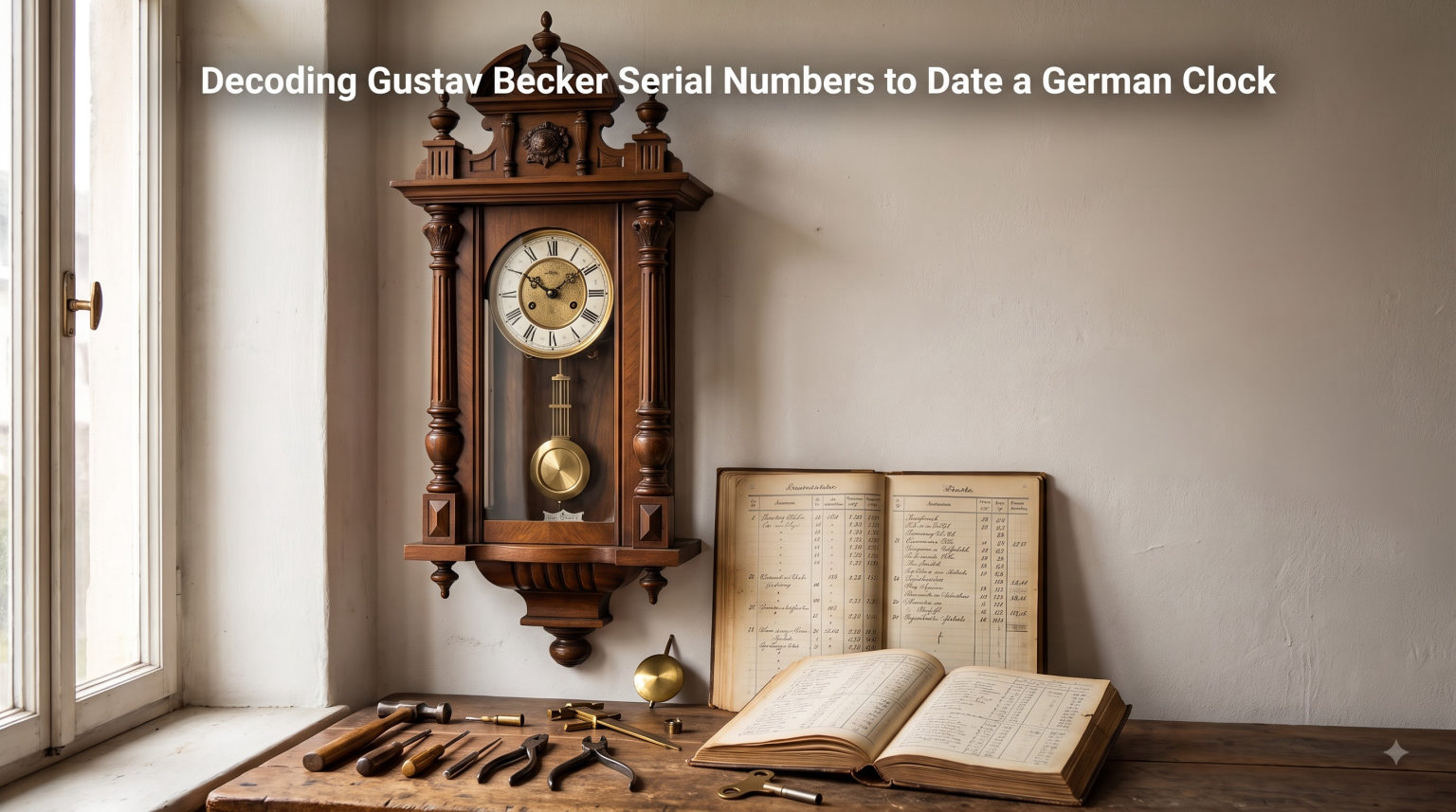
Dating a Gustav Becker clock requires a combination of evidence: the serial number, the trademark, the movement features, and the case style. No single clue tells the whole story, and relying on just one often leads to an inaccurate date.
If you have inherited or purchased a vintage German clock bearing the Gustav Becker name, you are holding a piece of horological history. These timepieces were manufactured between 1847 and 1927, and understanding exactly when yours was made can reveal its authenticity, rarity, and collector value.
This guide walks you through the complete process of decoding Gustav Becker serial numbers. We cover where to find the serial number, how to convert it to a production date, the critical difference between the Freiburg and Braunau factories, and the trademark variations that help narrow down a manufacture year. By the end, you will have the tools to date your clock with confidence rather than guesswork.
Table of Contents
What Are Gustav Becker Serial Numbers?
Gustav Becker serial numbers are unique identifying numbers hand-stamped onto the back plate of each clock movement during production. They were assigned sequentially, starting fresh at the beginning of each manufacturing year. This sequential system is what allows collectors to estimate when a clock left the factory.
For example, a low serial number like 783 points to early production from around 1851, while a number in the millions suggests a much later manufacture date. The numbering system ran continuously through decades of production, creating a timeline that reference books have mapped to approximate years.
It is important to understand that these numbers were stamped by hand, which means the digits can vary in depth and alignment. They are not printed labels or engraved plates. This hand-stamped quality is actually one way to confirm authenticity, as modern reproductions rarely replicate the imperfect, period-correct stamping style.
The most widely used reference for converting these numbers to dates comes from Karl Kochmann, whose books on German clock trademarks and serial numbers remain the industry standard. Collectors and dealers rely on Kochmann’s charts as the authoritative source for Gustav Becker production dating.
A Brief History of Gustav Becker Clocks (1847 to 1927)
Gustav Becker founded his clockmaking workshop in 1847 in Freiburg, Silesia, which was then part of Prussia and is now in modern-day Poland. What began as a small operation grew into one of the most respected clock manufacturers in continental Europe.
Becker earned a reputation for precision movements and earned medals at international exhibitions, including the Silesian Trade Exhibition in 1850 and later the prestigious Gold Medal at the 1852 Leipzig Exhibition. These accolades helped establish his brand across European markets and eventually worldwide.
The Freiburg factory remained the primary production site for decades. A second factory was later established in Braunau, which is now in the Czech Republic. This second facility is where the dating complications begin, and we address that distinction in detail later in this guide.
Production of Gustav Becker clocks continued until approximately 1927. After this period, the original company’s independent production ceased. Clocks bearing the Gustav Becker name produced after this timeframe are generally the result of brand acquisitions or later manufacturers using the established name.
Where to Find the Serial Number on a Gustav Becker Movement
The serial number on a Gustav Becker clock is located on the back plate of the movement, not on the case, dial, or pendulum. Finding it requires accessing the internal mechanism, which means you will need to open the clock case carefully.
Here is a step-by-step approach to locating the serial number:
Step 1: Remove the clock from the wall or open the case door, depending on whether you have a wall clock, mantel clock, or grandfather clock. Lay the clock on a soft, clean surface to avoid scratching the case.
Step 2: Locate the movement, which is the brass mechanism behind the dial. The back plate is the flat brass surface facing away from the dial, opposite the front of the clock.
Step 3: Inspect the back plate for hand-stamped numbers. The serial number is typically stamped in an open area of the plate, often near the edge or beside a bearing post. It will be a sequence of digits with no prefix letters in most cases.
Step 4: Use good lighting and possibly a magnifying glass. Hand-stamped numbers can be shallow, especially on older clocks where the brass has aged or tarnished. A soft brass polish on a small area can improve visibility without damaging the plate.
Step 5: Record the number exactly as it appears, including any uncertainty about partially stamped digits. Also note any other markings nearby, such as the trademark, DRP stamps, or P-codes, as these all contribute to the dating process.
Some Gustav Becker movements do not have a visible serial number. This is particularly common with clocks from the Braunau factory. If you cannot find a serial number, you will need to rely entirely on trademark analysis, movement features, and case style to estimate the date.
Gustav Becker Serial Number Date Chart
Once you have located and recorded the serial number, the next step is to cross-reference it with a production date chart. The chart below is based on the widely referenced Kochmann data, which maps serial number ranges to approximate production years for Freiburg factory clocks.
Important: This chart applies only to clocks manufactured at the Freiburg factory. If your clock was made at the Braunau factory, serial number dating is not reliable and you should skip to the next section.
Serial numbers 1 to 7,000: approximately 1847 to 1851
Serial numbers 7,000 to 50,000: approximately 1851 to 1860
Serial numbers 50,000 to 150,000: approximately 1860 to 1875
Serial numbers 150,000 to 500,000: approximately 1875 to 1890
Serial numbers 500,000 to 1,000,000: approximately 1890 to 1900
Serial numbers 1,000,000 to 1,500,000: approximately 1900 to 1910
Serial numbers 1,500,000 to 2,000,000: approximately 1910 to 1920
Serial numbers 2,000,000 to 2,300,000: approximately 1920 to 1927
As an example documented on NAWCC forums, serial number 2195930 dates to approximately 1924, which falls within the final production range. This kind of real-world confirmation helps validate the chart’s reliability for Freiburg clocks.
Keep in mind that these dates are approximate. Serial numbers began at the start of each production year, but the exact transition points between years are not perfectly documented. A clock with a number near a boundary could fall on either side of the listed year.
The chart works because the Freiburg factory maintained a sequential numbering system across its entire production run. This continuity is what makes serial number dating possible. Without continuous records, the system breaks down, which is exactly what happened at the Braunau factory.
Freiburg vs Braunau: The Factory Distinction That Changes Everything
This is the single most important distinction in Gustav Becker clock dating, and it is also the most commonly misunderstood. Clocks from the Freiburg factory can be dated using serial numbers. Clocks from the Braunau factory cannot.
The reason is straightforward. The Freiburg factory used a continuous, sequential serial numbering system that ran from the founding of the company through the end of production. This allows each number to be mapped to an approximate year. The Braunau factory used a different numbering approach, and no complete production records have survived. Without records connecting Braunau serial numbers to specific years, accurate dating by number alone is impossible.
Many sellers and even some reference sources make the mistake of applying the Freiburg serial number chart to Braunau factory clocks. This produces dates that look precise but are essentially meaningless. If you are evaluating a clock for purchase and the seller cites a specific year based on a serial number, your first question should be which factory produced the movement.
So how do you tell which factory made your clock? Here are the key indicators:
Freiburg factory markers: Look for a continuous serial number on the back plate, the classic Gustav Becker trademark with the anchor and crown, and medal stamps that reference specific exhibition awards. Freiburg clocks also tend to show the higher-quality movement construction that earned Becker his reputation.
Braunau factory markers: Braunau clocks often have serial numbers that do not fit the Freiburg chart cleanly, or they may lack a visible serial number entirely. The movement construction can differ in subtle ways from Freiburg examples. Some Braunau movements carry different stamping patterns or lack the medal trademarks found on Freiburg production.
When in doubt, the Gustav Becker trademark itself can offer clues. The evolution of the trademark over time, combined with movement features, helps experienced collectors determine factory origin even when the serial number is ambiguous.
The bottom line is this: if you cannot confidently confirm your clock is from the Freiburg factory, do not rely on a serial number date. Use trademark analysis, movement examination, and case style instead. An approximate date from multiple evidence types is far more reliable than a precise-looking date from the wrong chart.
Identifying Gustav Becker Trademarks and Stamps
The Gustav Becker trademark is one of the most recognizable marks in antique German clock collecting. It features the letters GB, typically enclosed in or accompanied by an anchor and a crown. This trademark was stamped on the movement back plate alongside the serial number.
The trademark changed over the decades of production, and those changes are useful for dating. Early clocks from the 1850s and 1860s carry a simpler version of the mark. As Becker earned exhibition medals, he added medal stamps to the trademark, often showing the year and location of the award.
Here is what to look for when examining trademarks:
The GB anchor and crown: This is the core Gustav Becker mark. Its presence confirms the movement is a genuine Becker product, assuming it has not been falsely applied. Examine the stamping quality for the hand-stamped characteristics described earlier.
Medal stamps: These reference specific awards, such as the 1852 Leipzig medal or later exhibition prizes. A medal stamp with a year gives you a firm date floor, meaning the clock must have been produced in or after that year.
Trademark style evolution: The lettering style, the presence or absence of specific decorative elements, and the overall design of the trademark all shifted over time. Comparing your trademark to documented examples in reference books helps narrow the production period.
One common point of confusion is that a medal stamp from 1852 does not mean the clock was made in 1852. It means the clock was made in 1852 or later, because Becker proudly stamped his award medals on movements for years after winning them. This is why a single trademark date should never be treated as the manufacture date on its own.
Understanding DRP and P-Code Markings
Beyond the serial number and trademark, Gustav Becker movements often carry additional stamped markings that collectors encounter. Two of the most common are DRP stamps and P-codes, and understanding what they mean prevents dating errors.
DRP stands for Deutsches Reichspatent, which translates to German Imperial Patent. When you see DRP stamped on a movement, it indicates that a specific feature or mechanism was patented. This patent marking tells you the clock was produced after the patent was granted, but it does not pinpoint a manufacture year. DRP marks are useful as supporting evidence but should not be confused with date indicators.
P-codes, such as P112, are model or design reference codes. These indicate specific model information within the Becker product line. Like DRP stamps, P-codes do not directly indicate the manufacture date. They can, however, help identify the model type and, when cross-referenced with known model production periods, contribute to the overall dating picture.
The key takeaway is that these markings provide context but not dates. Always treat them as supporting evidence alongside the serial number, trademark, and physical movement characteristics rather than standalone date indicators.
Common Dating Mistakes and How to Avoid Them
Over years of community discussion on forums like the NAWCC message board, several recurring mistakes have emerged in Gustav Becker clock dating. Recognizing these pitfalls will help you avoid repeating them.
Mistake 1: Applying the Freiburg chart to Braunau clocks. This is the most common and most damaging error. It produces dates that appear precise but are actually meaningless. Always confirm factory origin before relying on a serial number date.
Mistake 2: Relying on the serial number alone. A serial number gives you an approximate production year, but it does not account for movement replacements, case marriages, or other factors that can mislead. Always cross-check with the trademark and movement features.
Mistake 3: Confusing case style with movement date. Cases were sometimes reused, replaced, or updated independently of the movement. The movement serial number dates the movement, not necessarily the case. A clock with an 1880s movement in a 1900s case is entirely possible.
Mistake 4: Treating medal stamps as manufacture dates. As explained earlier, a medal stamp establishes the earliest possible year, not the actual year of production. A clock stamped with the 1852 medal could have been made any time from 1852 onward.
Mistake 5: Ignoring the absence of a serial number. If your clock has no serial number, that absence itself is information. It may indicate a Braunau origin or a clock that falls outside the standard Freiburg numbering system. Do not force a date onto a clock that lacks the evidence to support one.
The best approach, consistently recommended by experienced collectors, is to gather every piece of evidence available and let the combined picture tell the story. No single marking should override the weight of multiple corroborating clues.
FAQs
How to date a Gustav Becker clock?
Dating a Gustav Becker clock requires combining multiple evidence types: the serial number on the movement back plate, the trademark stamps, movement construction features, and case style. Only Freiburg factory clocks can be dated by serial number using the Kochmann reference chart. Cross-reference all available clues rather than relying on any single marking.
Are Gustav Becker clocks valuable?
Gustav Becker clocks can be valuable, particularly early Freiburg factory examples in original condition with authentic movements and intact trademarks. Value depends on age, rarity, model type, condition, and authenticity. Accurate dating and confirmed factory origin directly affect collector interest and market value.
How do I identify a German clock?
Identify a German clock by examining the movement back plate for manufacturer trademarks, serial numbers, and patent markings. Gustav Becker clocks carry the distinctive GB anchor and crown trademark. Reference books like those by Karl Kochmann document German clock trademarks and help confirm manufacturer identity.
When were Gustav Becker clocks made?
Gustav Becker clocks were manufactured from 1847, when Gustav Becker founded his workshop in Freiburg, Silesia, until approximately 1927. The Freiburg factory was the primary production site, with a later second factory in Braunau. Clocks produced after 1927 under the Becker name are typically from later brand acquisitions.
How can you tell the age of a clock?
To determine a clock’s age, examine the serial number on the movement, identify the manufacturer trademark and any medal stamps, assess movement construction features, and evaluate case style. For Gustav Becker Freiburg clocks, the serial number chart maps numbers to approximate production years. Combine all evidence for the most accurate estimate.
Bringing It All Together
Decoding Gustav Becker serial numbers to date a German clock is a process that rewards patience and careful examination. The serial number is your starting point, but it is only reliable for Freiburg factory clocks, and even then it provides an approximate rather than exact date.
The most accurate dating comes from combining every available clue: the serial number, the trademark and medal stamps, the movement construction, DRP and P-code markings, and the case style. When these evidence types agree, you can date your clock with real confidence.
Always remember the critical distinction: Freiburg clocks can be chart-dated by serial number, while Braunau clocks cannot. If you are uncertain about factory origin, prioritize trademark analysis and movement features over the serial number alone. And for the most authoritative reference, consult Karl Kochmann’s books on German clock trademarks and serial numbers.
If you are still uncertain after gathering all the evidence, the collector community is an invaluable resource. Forums like the NAWCC message board connect you with experienced enthusiasts who can help verify your findings and confirm dates based on first-hand examination of similar clocks. Taking the time to authenticate your clock properly preserves its history and protects its value for the future.