
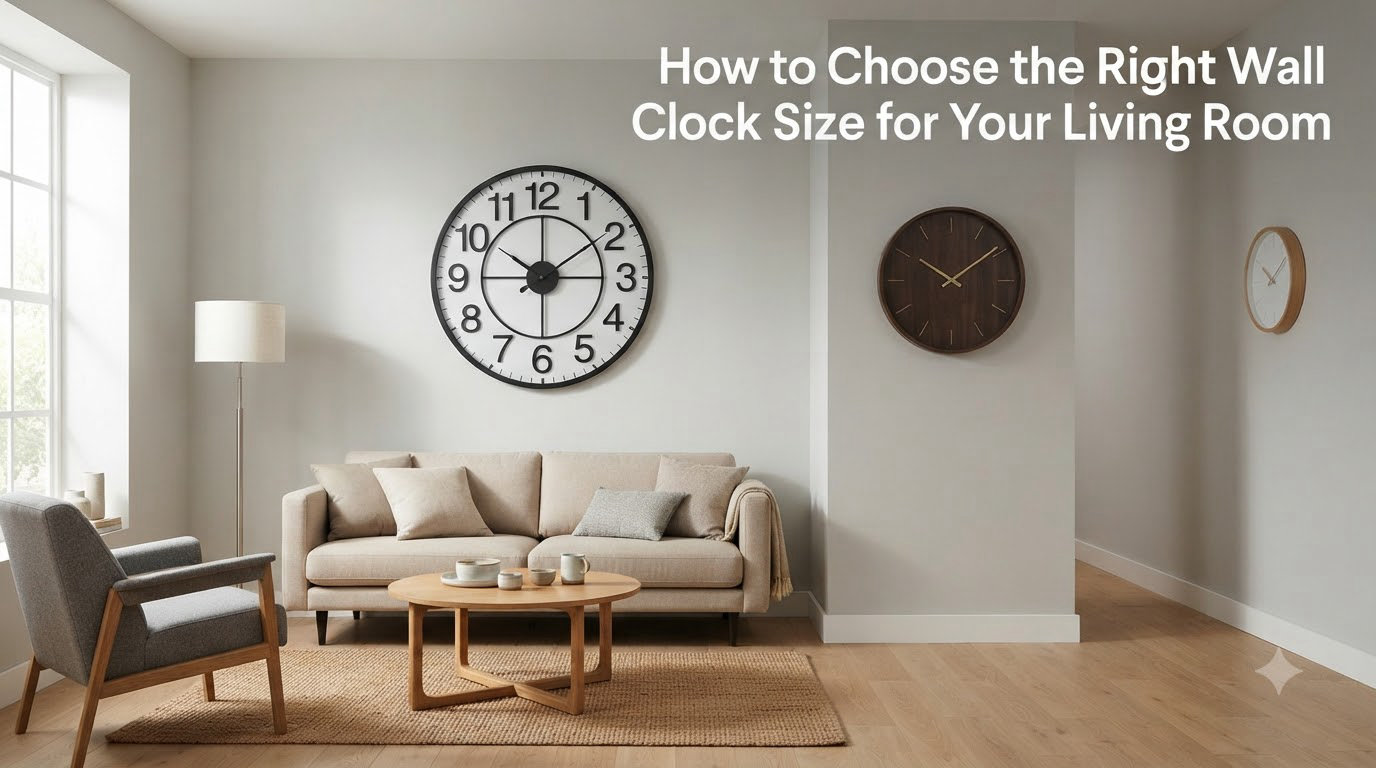
Learning how to choose the right wall clock size for your living room can be the difference between a polished, designer-quality wall and one that feels awkwardly empty or overwhelmingly cluttered. I have helped friends and family size clocks for all types of homes, and the same issues come up every single time. People guess, they buy a clock that looks perfect online, and then it arrives looking tiny on a massive blank wall.
The right clock size depends on your wall dimensions, your furniture proportions, and the visual balance you want to create. A wall clock is not just a timepiece. It is a design element that anchors a space, draws the eye, and ties your decor together. When the size is right, everything in the room feels intentional. When it is wrong, even guests notice something feels off without knowing exactly why.
In this wall clock size guide, I will walk you through the golden ratio rule, standard clock dimensions, placement height guidelines (including ceiling height factors no one else covers), and step-by-step measuring instructions. By the end, you will know exactly what diameter clock your living room needs.
Table of Contents
Wall Clock Size Guide: Understanding Standard Dimensions
Wall clocks fall into four general size categories, and understanding these ranges is the first step in making the right choice. Each category serves a different purpose and suits different room scales.
Small wall clocks (under 12 inches) work best in compact spaces like bathrooms, narrow hallways, or small home offices. In a living room, a clock this small will almost always look lost unless it is part of a gallery wall arrangement.
Medium wall clocks (12 to 18 inches) are the sweet spot for smaller living rooms, apartments, and condos. They are large enough to read from across the room but will not dominate a modest wall.
Large wall clocks (18 to 24 inches) are ideal for standard living rooms with average wall space. This is the most popular size range for living room use, striking a balance between visibility and proportion.
Oversized wall clocks (24 inches and above) make a statement. These clocks become the focal point of a room, working best in large living rooms, open-plan spaces, and on feature walls with plenty of blank space. Some oversized clocks reach 36 inches or more in diameter.
Knowing these categories helps you narrow your search quickly. But picking a category is only the beginning. The real work is matching that size to your specific wall and furniture.
How to Choose the Right Wall Clock Size for Your Living Room
Choosing the right wall clock size for your living room comes down to one core principle: proportion. Your clock needs to relate visually to the wall it hangs on and the furniture beneath it. When I help people pick clocks, I always start with the golden ratio rule, and it has never steered anyone wrong.
The Golden Ratio Rule for Clock Sizing
The golden ratio rule for wall clocks is simple: your clock diameter should be roughly one-third to one-half the width of the furniture piece or wall span it hangs above. This creates visual balance without overwhelming or underwhelming the space.
For example, if your sofa is 84 inches wide, your clock should measure between 28 inches (one-third) and 42 inches (one-half) in diameter. If you are hanging the clock on a bare wall without furniture below it, use the available wall width as your reference point instead.
This ratio works because it mimics proportions found everywhere in good design. A clock that is too small relative to the furniture looks like an afterthought. A clock that is too large competes with the furniture for attention and makes the arrangement feel top-heavy.
Step-by-Step Choosing Process
Follow these steps to choose your clock size with confidence:
1. Identify the wall where the clock will hang. Is it above the sofa, the fireplace, or a bare feature wall?
2. Measure the width of the furniture piece or wall span below the clock location.
3. Apply the golden ratio by calculating one-third and one-half of that measurement. This gives you your clock diameter range.
4. Account for other decor on the wall. If you have framed art or shelving nearby, subtract some width to avoid crowding.
5. Factor in viewing distance. In a large living room where you sit 12 feet from the wall, lean toward the larger end of your range so the clock remains readable.
This five-step approach takes the guesswork out of the process. I have seen people go from total confusion to confident decisions in under ten minutes using this method.
Living Room Clock Size by Room Dimensions
The fastest way to find your ideal clock diameter is to match it to your room size. Here is a reference table I built from real-world sizing experience and design principles that consistently produce balanced results.
| Room Size | Wall Type | Recommended Clock Diameter |
|---|---|---|
| Small (under 150 sq ft) | Narrow or shared wall | 10 to 14 inches |
| Medium (150 to 250 sq ft) | Standard wall above sofa | 14 to 20 inches |
| Large (250 to 400 sq ft) | Wide feature wall | 20 to 28 inches |
| Extra large / open-plan (400+ sq ft) | Expansive bare wall | 28 to 36 inches or larger |
For large living rooms and open-plan spaces, aim for a clock measuring 24 to 36 inches in diameter. For compact areas and smaller rooms, 10 to 18 inches is the ideal range. These numbers align with the golden ratio rule and produce a balanced look every time.
Keep in mind that these ranges assume the clock is the primary decorative element on that wall. If you plan to surround it with a gallery wall or shelving, step down one size category so the clock complements rather than competes with surrounding pieces.
Wall Clock Placement Guidelines: Height, Clearance, and Ceiling Height
Clock placement matters just as much as size. Even a perfectly sized clock looks wrong when it is hung too high, too low, or crowded against furniture. Here is what you need to know about placement, including ceiling height factors that most guides skip entirely.
Eye-Level Placement: The Starting Point
The general rule is to hang your wall clock at eye level, which means the center of the clock should sit approximately 57 to 60 inches from the floor. This is the same height standard used for hanging art, and it creates a natural viewing line when someone is standing or sitting in the room.
When hanging above furniture like a sofa or console table, leave 4 to 6 inches of clearance between the bottom of the clock and the top of the furniture. If the furniture is tall and the clock would end up above eye level, adjust the furniture or choose a smaller clock that fits the reduced wall space.
Ceiling Height Impact on Clock Size and Placement
Ceiling height changes the equation, and this is something almost no guide covers. Here is how to adjust based on your ceiling:
Standard 8-foot ceilings: Stick to the 57-to-60-inch center height. Clocks measuring 14 to 20 inches work best because there is limited vertical wall space. An oversized clock on an 8-foot ceiling can feel cramped and overwhelming.
9-foot ceilings: You gain about 12 inches of vertical space. This lets you go slightly larger (20 to 28 inches) and gives you flexibility to position the clock a touch higher if needed. Many newer homes have 9-foot ceilings, making this a common scenario.
10-foot ceilings and above: Large and oversized clocks (24 to 36+ inches) shine here. You have the vertical room to support a bigger piece without it feeling stuffed. You can also center the clock slightly higher, around 60 to 66 inches, to account for the increased ceiling height.
Placement Above Specific Furniture
Above a sofa: The clock should span roughly one-third to one-half the sofa width. Center it horizontally over the sofa and leave 4 to 6 inches of clearance from the sofa back.
Above a fireplace: Choose a clock diameter that is no wider than the mantel or the fireplace opening. The clock above fireplace size should typically measure 12 to 20 inches, depending on the mantel width, so it sits comfortably within the visual frame.
On a bare feature wall: This is where oversized clocks work beautifully. Use the full wall width as your reference point for the golden ratio rule. Make sure the clock center still lands at eye level.
How to Measure Your Wall for the Perfect Clock Fit
Measuring your wall before you shop is the single most effective way to avoid sizing mistakes. I cannot tell you how many times someone has shown me a photo of their wall and asked what size clock they need, and my first response is always the same: grab a tape measure.
Here is the step-by-step process I recommend:
Step 1: Measure the wall width. Use a tape measure to determine the width of the wall section where the clock will hang. If the clock is going above furniture, measure the width of the furniture piece instead. Write this number down.
Step 2: Apply the golden ratio. Divide your wall or furniture width by 3 to get your minimum clock diameter. Divide it by 2 to get your maximum clock diameter. This range is your target size.
Step 3: Measure available vertical space. Measure from the top of your furniture (or floor if hanging on a bare wall) to the ceiling. Subtract your desired eye-level center point and half the clock diameter to confirm the clock will fit vertically without crowding.
Step 4: Check for obstacles. Note any light switches, vents, window frames, or corners that could interfere with the clock or throw off the visual balance.
Step 5: Make a paper template. Cut a piece of craft paper or cardboard to your chosen clock diameter and tape it to the wall. Live with it for a day. This simple trick has saved people from costly mistakes more times than I can count.
The paper template step sounds tedious, but it takes five minutes and gives you a real-world preview. I have had friends who were certain they needed a 30-inch clock realize that 22 inches looked far better once they saw the template on the wall.
Open-Plan Space Sizing Challenges
Open-plan living spaces create a unique sizing challenge because walls are taller, longer, and often visible from multiple angles. A clock that looks right from the kitchen island might look tiny from the dining area across the room.
In open-plan spaces, lean toward oversized wall clocks measuring 28 inches or more. The scale of these rooms demands a statement piece that can hold its own against expansive wall surfaces. When in doubt, go bigger than you think you need.
Also consider the viewing distance. In an open-plan layout, people may view the clock from 15 to 20 feet away. A clock under 18 inches becomes nearly invisible at that distance. Prioritize readability by choosing a clock with high-contrast numerals and large hands.
Finally, think about sightlines. Walk through your open-plan space and note every angle from which the clock will be visible. Make sure the size and placement work from the most common seating and standing positions, not just from the sofa directly below it.
Style and Proportion: Matching Clock Size to Your Decor
Clock size and style are deeply connected. A large minimalist clock with clean lines reads very differently than a large ornate clock with heavy detailing, even at the same diameter.
For modern and minimalist interiors, large and oversized clocks work particularly well because the clean design fills space without adding visual clutter. A 30-inch minimalist clock on a bare wall looks intentional and architectural.
For traditional or ornate interiors, be more conservative with size. A clock with heavy decorative elements can overwhelm a wall at large diameters. Stick closer to the one-third mark of the golden ratio rule rather than pushing toward one-half.
Statement wall clocks are designed to be the focal point of a room. If you want the clock to serve this role, choose the larger end of your size range and keep surrounding decor minimal. If the clock is secondary to other elements like a large art piece or a TV, size down and let it play a supporting role.
Vastu Considerations for Wall Clock Placement
For households that follow Vastu Shastra, wall clock placement involves directional and positional guidelines in addition to sizing concerns. These principles come from traditional Indian architecture and design philosophy.
According to Vastu, the most favorable direction for a wall clock is the north, east, or west wall of the living room. Avoid placing clocks on the south wall, as this direction is associated with different energies in Vastu practice.
Vastu also recommends that clocks hang at a height where they are easy to read without straining the neck, which aligns well with the eye-level placement rule. Clocks should never lean or hang crookedly, as this is considered inauspicious.
From a sizing perspective, Vastu favors round, square, or rectangular clocks depending on the direction. Round clocks pair well with west-facing walls, while rectangular clocks are recommended for east-facing walls. These shape considerations can be layered on top of the sizing guidelines above.
Common Wall Clock Sizing Mistakes to Avoid
After years of helping people choose wall clocks, the same mistakes appear repeatedly. Here are the most common ones and how to avoid them.
Mistake 1: Choosing a clock that is too small. This is the number one issue I see. People buy a 12-inch clock for a wall that needs 24 inches, and the result looks like a tiny dot on a massive surface. When in doubt, size up.
Mistake 2: Hanging the clock too high. Forum discussions on Reddit and home decor communities confirm this. Most people hang clocks well above eye level, often near the ceiling. The clock center should sit at 57 to 60 inches from the floor, period.
Mistake 3: Ignoring furniture proportions. A clock that is wider than the sofa beneath it looks unbalanced. Always measure the furniture width first and apply the golden ratio rule.
Mistake 4: Forgetting about other wall decor. If you have a gallery wall, floating shelves, or a TV on the same wall, the clock needs to fit within that arrangement, not compete with it. Reduce the clock size if other elements share the space.
Mistake 5: Buying based on the product photo alone. Product images rarely show the clock in a real room with real furniture. Always measure your space and compare dimensions before purchasing.
FAQs
How big should a living room clock be?
A living room clock should typically be between 18 and 24 inches in diameter for a standard-sized room. For large living rooms or open-plan spaces, aim for 24 to 36 inches. Small living rooms under 150 square feet can use clocks in the 12 to 18 inch range.
How do you choose the right size wall clock?
Choose the right size wall clock by applying the golden ratio rule: the clock diameter should be one-third to one-half the width of the furniture or wall span it hangs above. Measure your sofa or wall width, divide by 3 for the minimum and by 2 for the maximum clock diameter.
What is the best size for a wall clock?
The best size for a wall clock depends on the room. Small rooms need 10 to 14 inch clocks, medium rooms need 14 to 20 inch clocks, and large rooms need 20 to 28 inch clocks. Oversized clocks measuring 28 to 36 inches work best in large or open-plan spaces.
How high should I hang a wall clock in my living room?
Hang a wall clock so the center sits 57 to 60 inches from the floor, which is standard eye level. When hanging above furniture, leave 4 to 6 inches of clearance between the bottom of the clock and the top of the furniture piece.
What size wall clock works above a sofa?
A wall clock above a sofa should measure one-third to one-half the width of the sofa. For an 84-inch sofa, choose a clock between 28 and 42 inches in diameter. Center the clock horizontally over the sofa and leave 4 to 6 inches of clearance from the sofa back.
Conclusion
Now you know how to choose the right wall clock size for your living room. Start by measuring your wall or furniture width, apply the golden ratio rule to find your diameter range, and factor in ceiling height and placement guidelines. The paper template trick is your best friend, so do not skip it.
The right clock transforms a blank wall into a purposeful design statement. Take the time to measure, calculate, and preview before you buy, and you will end up with a clock that fits your space perfectly for years to come.