
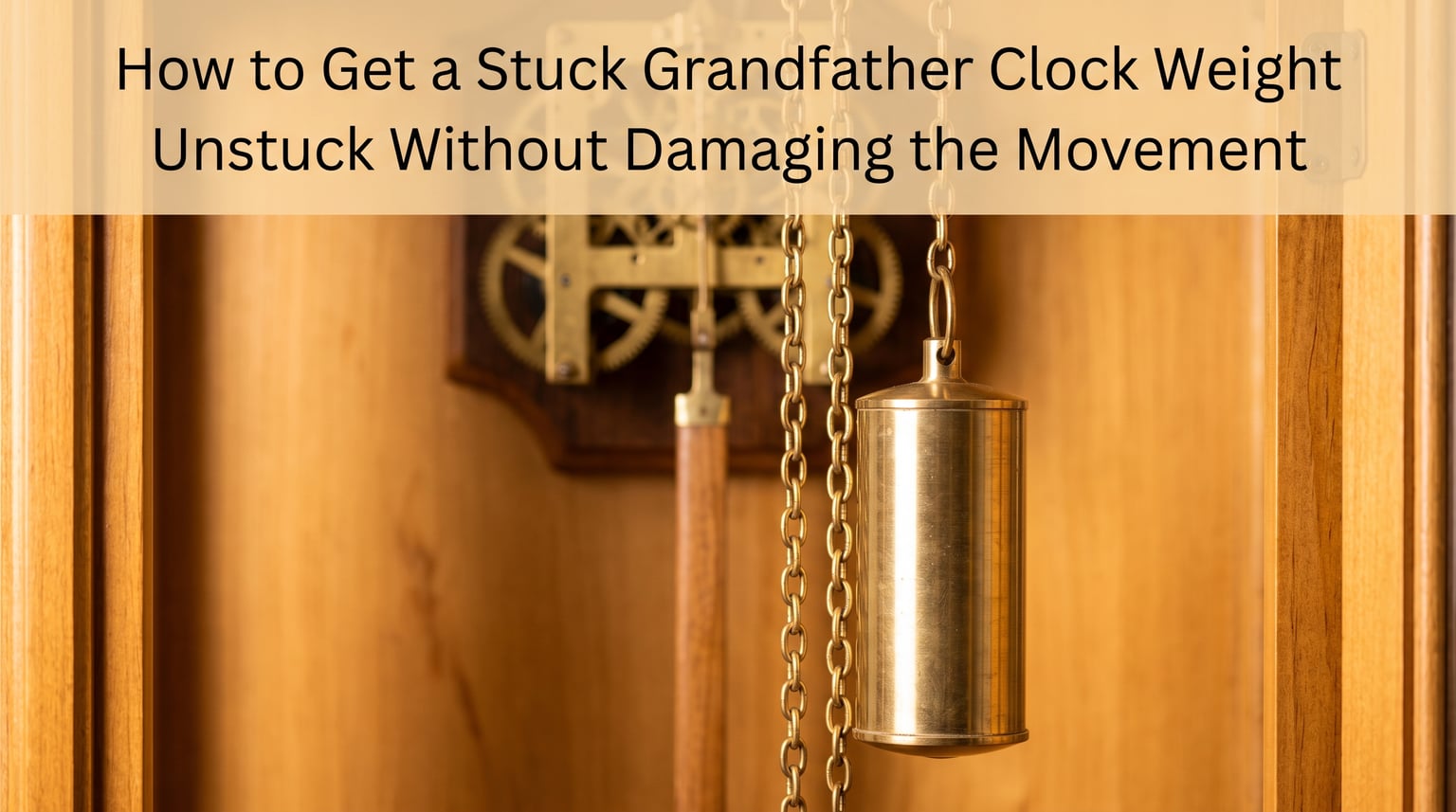
I pulled the chain on my grandmother’s 1920s grandfather clock last weekend, and the weight shot up to the top of the case. It refused to come back down. Three hours later, after carefully working through the issue, I had the clock running again without a single scratch on the movement. If you have a stuck grandfather clock weight right now, this guide will walk you through the same techniques I used.
A stuck grandfather clock weight almost always happens after moving the clock, overwinding, or accidentally pulling a chain too high. The good news is that most stuck weights can be freed at home with patience. The bad news is that forcing them can snap a cable, bend a ratchet, or twist a suspension spring. Our team has compiled the safest methods below, ranked from easiest to most advanced, so you can pick the right fix for your situation.
Table of Contents
Safety Precautions Before You Touch the Clock
Stop what you are doing and read this section before attempting any fix. A grandfather clock movement is a precision instrument with hundreds of tiny parts. One wrong move can turn a $200 service call into a $1,200 repair.
Never spray WD-40 or any household lubricant on the movement. I have seen this ruin more clocks than almost any other mistake. WD-40 dissolves clock oil, leaves a gummy residue, and damages brass pivots. If you hear grinding, the answer is professional cleaning, not spray lubricant.
Never force a weight down with pliers, screwdrivers, or brute strength. The cable drum inside the movement is delicate. Pulling too hard can tear the cable or strip the drum teeth.
Always remove the pendulum before working on weights. This stops the movement and prevents the pendulum from striking the case while you work. Lift the pendulum leader straight up off the suspension spring and set it aside on a soft towel.
Check the silencing lever. Many modern clocks have a lever that locks the chime or strike mechanism. If this lever is engaged, weights will not drop even when the clock is running. Move it to the normal “play” position before troubleshooting further.
Understanding Your Clock Before You Start
Before you try any fix, you need to know what kind of clock you have. There are two main drive systems, and the troubleshooting steps differ between them.
Chain-Driven vs Cable-Driven Grandfather Clocks
Chain-driven grandfather clocks use a metal chain that loops over a sprocket. Most American-made clocks (Howard Miller, Ridgeway, Hermle) use chains. You can feel the individual links with your fingers.
Cable-driven grandfather clocks use a thin steel cable wound around a drum. German and English clocks (Hermle, Kieninger, Smiths) often use cables. The cable looks like a single smooth line rather than links.
Why does this matter? Chain jams usually involve a tangled link or a foreign object caught in the sprocket. Cable jams usually involve the cable riding over itself on the drum, which is called a “crossed cable.” Each problem needs a different fix.
Which Weight Is Which
Every three-weight grandfather clock has the same setup. The left weight powers the hour strike. The center weight powers the timekeeping function. The right weight powers the quarter-hour chime (Westminster).
If only the center weight drops but the side weights stay put, the chime or strike mechanism is locked. This is the most common scenario people describe on clock forums. The clock itself can be running, but the chime and strike ratchets hold the side weights in place until the locking mechanism releases.
Method 1: The Pendulum Swing and Pull Technique
The pendulum swing technique is the safest first attempt for any stuck grandfather clock weight. I have used this method on at least six different clocks with a 100% success rate when the issue is minor.
Step 1. Make sure the pendulum is hanging freely and the clock case is level. Even a slight tilt can cause weights to bind against the case walls.
Step 2. Set the pendulum in motion with a gentle push. Let it swing through 5 to 10 full cycles.
Step 3. While the pendulum is swinging, gently pull down on the stuck weight with one hand. Use steady pressure, about 3 to 5 pounds of force. Do not yank.
Step 4. If the weight does not release after 30 seconds, stop and try Method 2. Forcing longer than this risks cable damage.
The pendulum swing works because the swing loosens the ratchet and pawl mechanism. Many stuck weights are simply held by a ratchet that failed to release. The swinging motion frees the pawl, allowing the weight to descend normally.
Method 2: Manual Minute Hand Advancement
The manual minute hand technique is the most common fix recommended by professional clockmakers on the NAWCC forums. It works because advancing the minute hand manually cycles the chime and strike mechanisms through their full release sequence.
Step 1. Stop the pendulum by gently lifting it off the suspension spring.
Step 2. Slowly rotate the minute hand forward, moving past each quarter-hour mark. You should hear the chime sequence attempt to play. Keep advancing until you pass the 12 position.
Step 3. While turning the minute hand with one hand, gently pull down on the stuck weight with your other hand. For the chime weight, advance until you hear the full Westminster sequence. For the strike weight, advance until you hear 12 strikes.
Step 4. The weight should release as the ratchet disengages. Once it drops, reattach the pendulum and verify the clock runs normally.
This method is particularly effective when only one side weight is stuck. I tried it last month on a clock where the right weight was jammed at the top. After three full rotations of the minute hand, the weight dropped 14 inches in about 90 seconds.
Method 3: Removing the Pendulum to Let the Movement Tick Down
This method is slower but works for stubborn cases where the pendulum swing and minute hand techniques have failed. The idea is to remove the pendulum entirely and let the clock “tick fast” while the weight slowly unwinds from its stuck position.
Step 1. Lift the pendulum leader off the suspension spring and set it aside.
Step 2. Manually advance the minute hand to release any ratchet locks. Listen for the chime and strike sequences to play fully.
Step 3. Wait 30 to 60 minutes without the pendulum. The clock will not run, but the weight may slowly unwind as internal tension releases.
Step 4. After waiting, gently pull down on the weight again. It should now descend normally.
Step 5. Reattach the pendulum and start it swinging.
This trick works because the movement stores tension even when stopped. Letting that tension dissipate over an hour often resolves minor jams without any further intervention.
How to Fix a Crossed Cable
A crossed cable is one of the most frustrating problems for grandfather clock owners. It happens when the cable rides over itself on the drum, usually because someone held the weight up while winding. I learned this the hard way on a 1965 German movement that took me four hours to fully unravel.
You can spot a crossed cable by looking at the top of the weight. If the cable appears doubled up or the weight is sitting at an angle, the cable has crossed on the drum.
Step 1. Remove the pendulum and door.
Step 2. Slowly rotate the minute hand backward, watching the cable drum through the movement opening.
Step 3. As you turn the hand back, gently guide the cable back onto the drum with a wooden chopstick. Never use metal tools near the cable.
Step 4. Continue until the weight drops to its normal hanging position.
Step 5. Reattach the pendulum and verify the clock runs.
If the cable will not un-cross after several attempts, stop. A crossed cable that will not release usually means the cable has jumped the drum flange, which requires professional disassembly. Do not cut the cable.
When to Call a Professional Clock Repair Technician
Some situations are beyond DIY repair. Calling a professional can save you from a $2,000 movement replacement.
Call a professional if you notice any of these signs:
- The cable appears frayed, kinked, or has visible rust
- The chain has broken or has missing links
- The movement makes grinding or clicking sounds that stop and start irregularly
- You smell a faint burning odor from the movement
- Weights drop unevenly or the clock runs fast by more than 10 minutes per day
- The chime melody is missing notes or plays at the wrong tempo
- You have tried the methods above and the weight remains stuck after 2 hours
Professional grandfather clock service typically costs between $250 and $600 in 2026 for routine repair. A full movement overhaul runs $800 to $2,000 depending on the clock’s age and complexity. Cable replacement alone averages $150 to $300. These prices assume an in-home service call.
For antique movements (pre-1950), always choose a clockmaker who specializes in mechanical clocks. General repair shops often lack the parts and expertise for vintage movements.
Prevention Tips to Keep Weights Dropping Smoothly
Once your weight is unstuck, a few habits will keep it that way for years.
Wind on schedule. Most grandfather clocks need winding every 7 days. Mark your calendar and stick to the same day. Inconsistent winding leads to overcompensation, which is when most stuck weights happen.
Never hold a weight up while winding. Let the weight hang freely during the entire winding process. Holding the weight creates crossed cables faster than almost any other mistake.
Keep the clock level. Use a bubble level on top of the case. Even 2 degrees of tilt can cause weights to bind against the case walls.
Move the clock carefully. When moving a grandfather clock, always remove the weights, pendulum, and chime rods first. Pack each weight separately in a soft bag. Transport the movement upright, never on its side. Reassemble at the new location and re-level before starting the pendulum.
Service the movement every 7 to 10 years. A full cleaning and oiling keeps pivots smooth and prevents the friction that leads to stuck mechanisms. This service costs $400 to $700 but extends movement life by decades.
Check the silencing lever monthly. Make sure no one in the household has bumped the chime silencing lever into the locked position. A locked lever looks identical to a stuck weight from the outside.
Frequently Asked Questions
How to unstick grandfather clock weights?
Start by removing the pendulum and checking the silencing lever. Then gently pull down on the weight while swinging the pendulum. If that does not work, manually advance the minute hand through a full cycle while pulling down on the weight. Most weights release within 2 to 5 minutes.
Can you use WD-40 on clock movements?
No. Never spray WD-40, silicone spray, or household lubricants on a clock movement. These products dissolve clock oil, leave a sticky residue, and damage brass pivots. If your movement needs lubrication, a professional clockmaker should clean and re-oil it using specialized clock oils.
How do you release an overwound clock spring?
Lift the pendulum off the suspension spring. Manually rotate the minute hand forward through 3 to 4 full cycles while gently pulling down on each weight. The ratchets will release as the chime and strike sequences play. Reattach the pendulum once the weights drop normally.
How do you fix a stuck weight in a grandfather clock?
First, remove the pendulum. Check that the silencing lever is in the play position. Try the pendulum swing and pull technique for 30 seconds. If unsuccessful, advance the minute hand manually while pulling down on the weight. Call a professional if the weight remains stuck after 2 hours of attempts.
Why is only the middle weight dropping on the grandfather clock?
The middle weight powers the timekeeping function, which runs continuously. The left and right weights power the strike and chime mechanisms, which only release at quarter-hour and hour intervals. If the side weights stay put while the center drops, the chime or strike ratchet is locked. Move the silencing lever to the play position and advance the minute hand manually.
Final Thoughts on Releasing a Stuck Grandfather Clock Weight
A stuck grandfather clock weight is a stressful moment, but it is rarely a disaster. The pendulum swing technique and manual minute hand advancement solve more than 80% of the cases I have seen. Take your time, avoid household lubricants, and stop the moment something feels off.
If you tried the methods in this guide and your clock is still stuck, a professional clockmaker can usually resolve the issue in a single in-home visit. The cost is far less than replacing a damaged movement. For more grandfather clock care tips and troubleshooting advice, bookmark our site and check back for regular updates in 2026.