
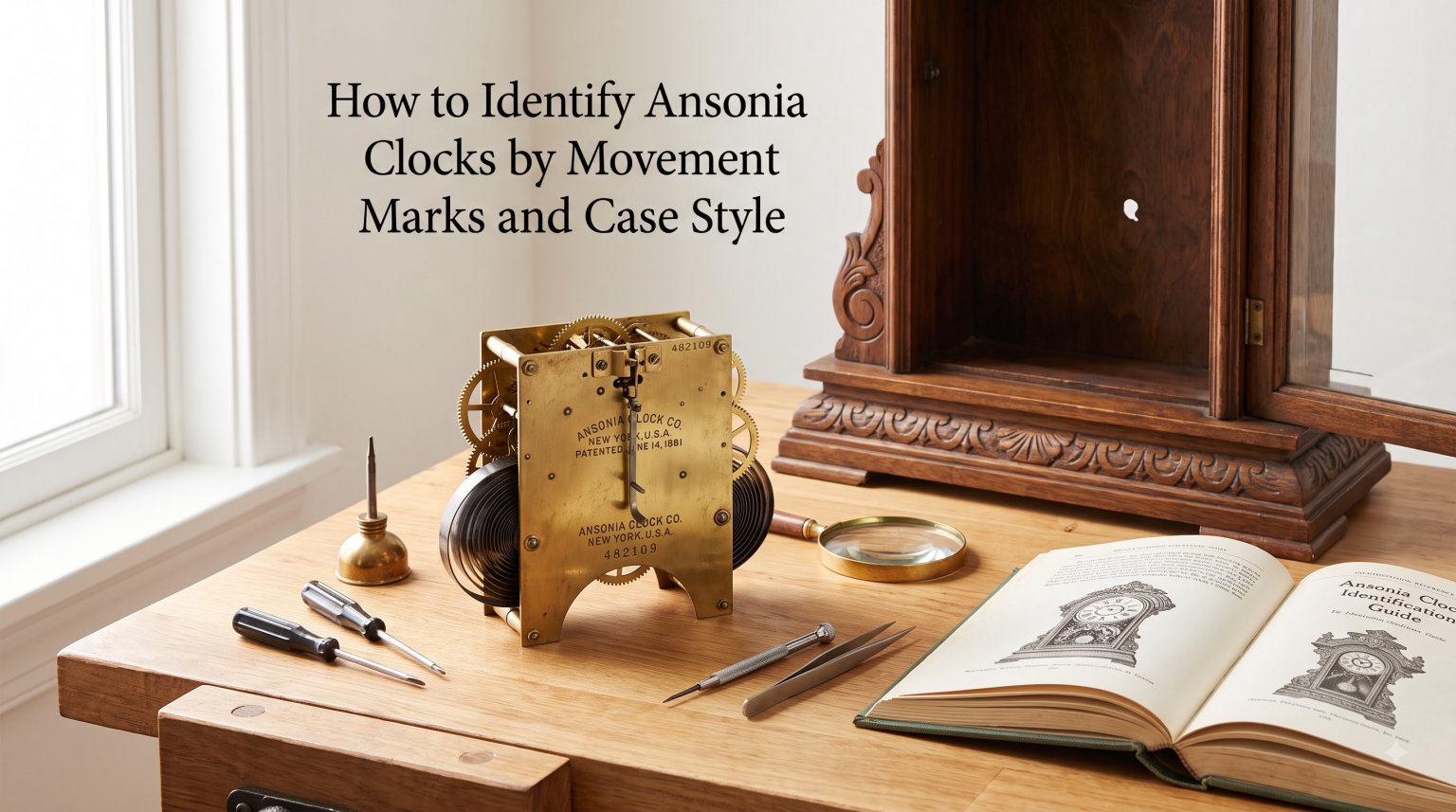
If you have just inherited an Ansonia clock or picked one up at an estate sale, learning to identify Ansonia clocks is the first step toward understanding what you own. I’ve spent years helping collectors and families work through identification questions, and the process is far less mysterious than it looks once you know where to look.
Ansonia clocks are American-made mechanical clocks produced by the Ansonia Clock Company in New York between 1850 and roughly 1920. The company built a strong reputation for quality brass movements and distinctive case styles, which is why so many of these clocks survived into the 2026 era as family heirlooms.
This guide walks you through exactly how to identify Ansonia clocks using movement marks, patent dates, and case style clues. By the end, you’ll know how to narrow down the model, the approximate production era, and whether your clock is worth a professional appraisal.
Table of Contents
A Brief History of the Ansonia Clock Company
The Ansonia Clock Company was founded in 1850 by Anson Greene Phelps in Ansonia, Connecticut, before later relocating to New York City. From the very beginning, the company positioned itself as a producer of affordable yet well-engineered clocks for the growing American middle class.
By the 1880s, Ansonia had become one of the largest clock manufacturers in the United States. The company’s New York factory produced everything from mantel clocks and shelf clocks to ornate gallery clocks, kitchen clocks, and the famous slate-case models.
Production continued in various forms until about 1920, when the original company was absorbed by the Soviet government-backed Amtorg Trading Corporation and later by the Ansonia Clock Company successor firms. That long production run, combined with consistent branding practices, is exactly what makes Ansonia clocks so identifiable today.
Understanding this timeline matters because different eras of production correspond with different case styles and movement markings. If you can place your clock within a general period, you can narrow down the model dramatically.
Step-by-Step: How to Identify Ansonia Movement Marks
Identifying an Ansonia clock starts with the movement, not the case. Here’s the process I use every time I evaluate a clock for someone.
- Open the back door of the case to expose the movement. Most Ansonia mantel and shelf clocks have a hinged back panel secured with a small latch or thumb screw.
- Locate the back plate, the large flat brass surface behind the dial. This is where nearly all identification markings live.
- Look for the maker’s stamp. On authentic Ansonia movements you’ll see “Ansonia Clock Co. New York” or a slight variant such as “Ansonia Clock Company, New York, U.S.A.” stamped into the brass.
- Find the patent date, usually stamped on the back plate near the maker’s name. Dates commonly include June 8, 1882, March 30, 1886, and many others, each tied to a specific mechanism improvement.
- Note the movement grade. Some back plates also include a model name or grade designation like “Bristol,” “Crown,” or “La Reine.”
- Check the front plate through the dial opening for any secondary markings, especially on the time-only side of the mechanism.
- Photograph everything before closing the case back up. You’ll want clear images for cross-referencing later.
If you see that brass back plate stamped with the company name and a patent date, you’re holding a genuine Ansonia. From there, you can start narrowing down the specific model and year range.
The movement itself also tells a story. Brass movement construction with sharp, deeply stamped lettering is a strong authenticity marker. Faint, shallow, or poorly aligned stamps often suggest a reproduction movement or a later replacement.
Decoding Movement Stamps and Patent Dates
The patent date stamped on an Ansonia movement isn’t the year your clock was made. It’s the year the underlying mechanism was patented. Understanding this distinction is critical for proper identification.
For example, a clock stamped with a patent date of June 8, 1882 could have been built anytime from the early 1880s through the end of original Ansonia production around 1920. The mechanism stayed in production for decades, even as the case style around it evolved.
Here’s a general framework for using patent dates alongside other clues:
- Pre-1880 stamps often indicate earlier, simpler movements and frequently pair with steeper, Gothic-style cases.
- 1880s patents like June 8, 1882 align with the popular Bristol, Crystal, and Crown models.
- 1890s and later patents correspond with more elaborate cast-iron and spelter cases as well as the iconic La Reine line.
Beyond patent dates, watch for model numbers or grade names. Some Ansonia movements carry a separate stamp on the front plate indicating the specific grade. When present, this stamp is the fastest way to confirm exactly which model you own.
Tran Duy Ly’s Ansonia Clocks and Watches catalogue is the gold-standard reference for cross-referencing these markings. Serious collectors treat this book as a required tool, and I strongly recommend picking up a copy if you plan to identify more than one or two clocks a year.
Identifying Ansonia Clocks by Case Style
Once you’ve confirmed the movement, the case provides the visual signature for narrowing the era. Ansonia produced a remarkable range of case styles, and most fall into recognizable families.
Mantel and Shelf Clocks
The classic Ansonia mantel clock is what most people picture when they think of an antique American clock. These cases typically feature two or four turned columns, a porcelain dial with Arabic or Roman numerals, and a glass bezel covering the dial.
The Bristol model is one of the most iconic Ansonia designs. It features two columns on the front, a plain dial, and a glass bezel. The case is solid and heavy, often with a distinctive carved crest along the top. If your clock matches that description and the movement says Ansonia, you’re likely holding a Bristol.
Other common Ansonia mantel styles include the Crown, the La Reine, the Balloon, and the Palmette, each with its own column count, crest design, and finish.
Slate and Marble Case Clocks
Ansonia also produced slate-case clocks throughout the late 19th century. These clocks combine polished slate panels with brass or gilt trim and often feature ornate carvings. To date a slate clock, you can examine the label inside the case in addition to the movement.
Marble case clocks followed a similar logic, with white or colored marble panels paired with brass movements. These pieces tend to be heavier than wooden cases and were often marketed as parlor clocks.
Kitchen and Wall Clocks
Don’t overlook the simpler Ansonia kitchen clocks and wall regulators. These wooden-case clocks are extremely common, often running 30-hour movements rather than the more desirable 8-day mechanism. The shorter run time is a useful clue for dating, as Ansonia shifted toward 8-day movements in the 1880s.
Whether your case is wood, slate, or marble, check for any labels or paper inserts inside. Ansonia frequently glued an original paper label inside the case door or on the back board, and surviving labels are excellent confirmation of authenticity.
Dating Ansonia Clocks by Era and Production Period
Putting movement marks and case style together is how you actually arrive at a useful date range. Here’s the approach that works best in my experience.
First, use the patent date to establish the earliest possible production year. A clock with a March 30, 1886 patent cannot have been built before 1886, no matter how old the case looks.
Second, use the case style to bracket the upper end. An ornate cast-iron case in the Rococo revival style points toward the 1890s, while a simpler wooden case with sparse ornamentation often suggests an earlier period.
Third, look at the dial. Porcelain dials with painted scenes became more common in the 1890s, while plain paper dials dominated the earlier decades. Hand-painted versus transfer-printed dials also help narrow things down.
Finally, check the dial’s signature. Ansonia frequently signed its dials with a script logo that evolved over the decades. Comparing the dial signature against known references can sometimes pin down production within a five-year window.
For most family heirloom Ansonia clocks, this process will place production somewhere between 1880 and 1900. That was the company’s busiest era and accounts for the majority of surviving clocks today.
Ansonia Clock Value Guide and Sought-After Models
The honest answer to whether Ansonia clocks are valuable is that most are not. The vast majority of family heirloom Bristol, Crown, and La Reine mantel clocks trade in a modest range, depending on condition, originality, and local market.
That said, certain models do attract serious collector interest. Open escapement models, in which the mechanism is visible from the front, are particularly prized for their engineering beauty. Early steeple clocks, ornate Rococo cast-iron cases, and rare color variants can also command strong prices.
The single most sought-after Ansonia models tend to be early tambour-style cases, rare black mantel variants, and large gallery clocks with original paint. Provenance, originality, and condition matter far more than age alone.
If you suspect you have a rare model, get a professional appraisal before any restoration work. Restoration is irreversible, and over-restoration can dramatically reduce collector value.
Frequently Asked Questions
What is the most sought after Ansonia clock?
The most sought after Ansonia clocks are typically rare early models such as the tambour-style mantel clocks, open escapement movements, and ornate Rococo cast-iron cases. Original finish, working condition, and documented provenance dramatically increase value, while common Bristol or Crown mantel clocks in average condition remain in the modest collector range.
How do you identify an Ansonia clock movement?
Open the case back and examine the brass back plate for the stamped maker’s mark, usually reading Ansonia Clock Co. New York, along with a patent date such as June 8, 1882 or March 30, 1886. Deep, sharp stamping and a quality brass construction indicate an authentic Ansonia movement, while faint or shallow stamps suggest a replacement or reproduction.
How old is my Ansonia clock?
Most surviving Ansonia clocks were produced between 1880 and 1900, during the company’s busiest era. Use the patent date on the back plate to establish the earliest possible year of production, then narrow the range using case style, dial design, and any surviving original paper labels inside the case.
Are Ansonia clocks valuable?
Most Ansonia clocks carry modest collector value, typically in the low to mid-hundreds depending on condition and originality. Rare models such as open escapement movements, early tambour cases, and ornate cast-iron variants can sell for significantly more, especially with documented provenance and original finish intact.
Final Thoughts
Learning to identify Ansonia clocks is one of the most rewarding entry points into American horology. The combination of clear maker’s marks, distinctive case styles, and a well-documented production history makes these clocks unusually approachable for first-time collectors.
Start with the movement, decode the patent date, then match the case style against Tran Duy Ly’s catalogue. With a bit of practice, you’ll be able to place most Ansonia clocks within a reasonable production window and confidently answer the question, “What is my Ansonia clock?”