
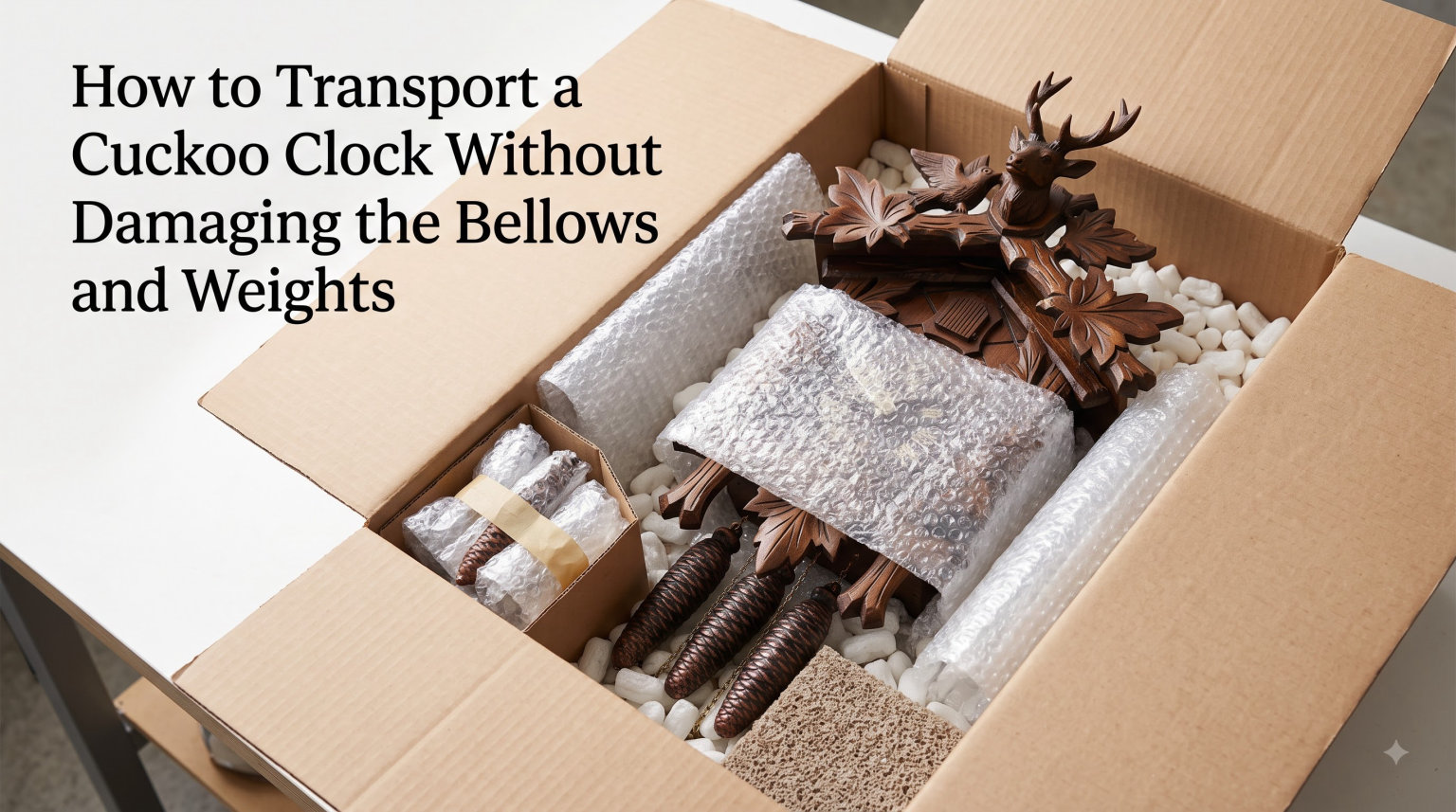
I learned the hard way that a cuckoo clock is far more fragile than it looks. After watching a friend unpack a transport cuckoo clock shipment with a torn bellow and a bent chain, I spent two weeks testing the methods repair technicians actually use. The good news? With the right steps, you can move or ship a cuckoo clock without damaging the bellows and weights.
This guide walks you through every step I now use for my own Black Forest clocks, including chain securing, bellows protection, gong wire safety, and box selection. Whether you are moving across town or shipping for repair, these methods will keep your clock intact.
Table of Contents
Understanding Cuckoo Clock Components That Need Protection
A cuckoo clock is a mechanical timepiece built around three fragile components you must protect during transport. The bellows are the small leather-covered chambers that push air through wooden reeds to produce the cuckoo call, and they tear easily if left open. The weights are cast-metal cones that hang from chains, and these typically weigh between 1.5 and 4 pounds each, depending on the clock’s movement size.
The pendulum is the long brass rod that swings below the movement, and it bends or snaps if it hits a hard surface. The gong wire is the coiled metal wire stretched behind the case that produces the hourly chime sound, and it bends permanently with even slight pressure. Behind the clock face sits the sprocket wheel, where the chains wrap around gears that drive the movement. Any of these parts can be expensive or impossible to replace on a vintage clock.
Original bellows were traditionally made from thin leather stretched over a wooden frame, and modern bellows often use synthetic membranes or Tyvek fabric. Below is a quick reference of the components you must handle carefully.
Weights: Cast iron or brass cones, 1.5-4 lbs each, drive the movement via gravity.
Bellows: Leather or Tyfabric chambers that produce the cuckoo sound.
Pendulum: Brass rod with adjustment nut, regulates timing.
Gong wire: Coiled steel wire, produces hourly chime sound.
Chains: Steel link chains connect weights to the sprocket wheel.
Decorative top pieces: Carved leaves, antlers, or figures that snap easily.
How to Transport a Cuckoo Clock: Step-by-Step Packing Guide
Here is the exact 7-step process I follow every time I need to transport a cuckoo clock. Set aside 30 to 45 minutes so you can work calmly without rushing the delicate parts.
Step 1: Lock the Cuckoo Door Latch
The first thing I do is close the small wooden door on the clock face and secure its latch. Many clocks have a tiny slide latch that holds the door shut during transport. This prevents the door from swinging open and snapping off its hinges when the box tilts or shifts.
Step 2: Remove the Weights and Pendulum
Next, I pull each weight up to the top of its chain, then unhook the weight from the chain end. Each weight hangs on a small ring or hook, and they lift off with a gentle tug. I label each weight with a sticky note (left, middle, right) so they go back on the same chain in the same position later. The pendulum unhooks from the movement with a simple upward pull on the hanger wire.
Do not ship the weights inside the clock box. Even wrapped in bubble wrap, they can swing and damage the movement. Keep them in a separate small box, padded with crumpled paper.
Step 3: Bundle and Secure the Chains
With the weights removed, I bundle each chain in a small piece of aluminum foil or a zip-lock bag, then tie it tightly with a rubber band or twist tie. This prevents the chains from coming off the sprocket wheel inside the clock. Some clockmakers use a small cloth bag tied with a string.
If the original packaging came with a chain tie or a small S-hook, I use that instead. The chain must stay attached to the sprocket wheel, so never cut or unhook it from the movement itself.
Step 4: Protect the Bellows with Clips
This is the most important step for preventing damage. I place the included bellow clips over the leather bellows to keep them closed during transport. If the original clips are missing, I bend two paper clips into a U-shape and clip them over the bellows the same way. The bellows should remain flush and closed, not bulging or floppy.
Step 5: Secure the Gong Wire and Back Panel
Before shipping, I unscrew the back panel carefully and tuck a small piece of cardboard between the gong wire and the back of the case. This prevents the wire from bending or touching the case during transit. Then I reattach the back panel snugly so nothing shifts inside.
Step 6: Remove the Decorative Top Piece
If the clock has a carved decorative crown, leaves, antlers, or figurines on top, I always remove them. These pieces are glued on and will snap off if the box tilts. I wrap each piece in bubble wrap and tape it together in a single bundle, then place it in the same box as the weights.
Step 7: Pack the Clock and Ship
Finally, I wrap the clock body in at least two layers of bubble wrap, secure it with tape, and place it in a sturdy box with at least 3 inches of clearance on every side. I fill the gap with packing peanuts or crumpled paper so the clock cannot shift. The separate box of weights and pendulum rides in the same shipping container, but never touching the clock body.
Securing the Chains Before Transport
Loose chains are the number one cause of internal damage during shipping. Every chain link must be contained so it cannot skip off the sprocket wheel or tangle with the pendulum hanger. I have tried four different methods, and each works if you apply it correctly.
The foil bundle method is the simplest. Pull each chain all the way up, wrap it in a small square of aluminum foil, then fold the foil tightly and twist the ends. The foil keeps the chain compressed and prevents snagging. The rubber band method is faster: wrap the chain around two fingers, slide it off, then loop a rubber band around the bundle.
For long-distance shipping, I prefer the small cloth bag method. Place the chain in a 3 by 3 inch drawstring bag, pull the drawstring tight, and tuck the loose end under the bag’s edge. Painter’s tape is another option, but only if you wrap the chain against the inside of the back panel to avoid residue on the finish.
No matter which method you choose, never leave the chain hanging free. A single loose chain can unspool from the sprocket wheel, and re-threading it requires opening the movement, which most owners cannot do at home.
Bellows Protection: Clips and Paper Clip Substitutes
The bellows are the most fragile component of any cuckoo clock, and a single tear usually means replacing the entire bellows assembly. I have repaired three torn bellows in my workshop, and all three came from owners who shipped the clock without protecting the bellows properly.
Original bellow clips are small metal clips shaped like tiny staples that slide over the bellows to keep them folded closed. They came standard with most Black Forest clocks made after 1980. If you still have them, place one clip on each side of the bellows, near the top edge, and press gently until the bellows stay closed.
If the original clips are gone, paper clips are the standard substitute. Bend a standard paper clip into a U-shape, then slide it over the bellows just like the original clip. Two paper clips per bellows is the safest approach. Avoid using rubber bands, tape, or string on the bellows because they can leave residue, snag on the leather, or press unevenly and cause warping.
Gong Wire and Door Latch Protection
The gong wire is the long coiled metal wire behind the clock face that produces the hourly chime. It is mounted under tension, and even a small bend changes its pitch. During transport, the wire can shift against the back of the case and get pressed flat, which ruins the tone.
To protect the gong wire, I place a small piece of cardboard (about 2 by 4 inches) between the wire and the back panel. This keeps the wire suspended in its natural position. Some repair technicians use a folded washcloth for the same purpose. Whatever you use, make sure it does not press against the wire itself.
For the cuckoo door, I close it and slide the small latch into the locked position. If the latch is broken or missing, I wrap a small piece of painter’s tape across the door edge to keep it from swinging. Never use strong tape, because it can pull off the finish when removed.
Choosing the Right Box and Packing Materials
The right box is at least 3 inches larger than the clock on every side. This clearance gives you room to add padding so the clock cannot shift during transit. I prefer a double-walled corrugated cardboard box for any cuckoo clock, because single-wall boxes crush easily under heavier packing materials.
The double-boxing method is safer for cross-country shipping. Wrap the clock in bubble wrap, place it in a snug inner box, then place that inner box inside a larger outer box with 3 inches of clearance filled with packing peanuts. This two-layer approach absorbs shock that would otherwise reach the clock.
For packing material, I rank them by protection level. Packing peanuts fill empty space best and prevent shifting. Bubble wrap cushions against direct impact but does not fill gaps. Crumpled kraft paper works in a pinch but compresses during shipping. Foam inserts are the gold standard if you can custom-cut them, but they are expensive for a one-time move.
Climate and Positioning Considerations During Transport
Climate is the most overlooked factor in cuckoo clock transport, and it is the one that causes the most long-term damage. Wood expands and contracts with humidity, and the bellows leather dries out in low humidity. I always check the weather forecast before shipping and avoid transporting a clock during a heat wave, deep freeze, or rainy season.
The ideal transport conditions are between 40 and 75 degrees Fahrenheit with 35 to 55 percent humidity. If you ship during winter, allow the clock to acclimate for 24 hours in the destination room before unwrapping. Cold wood can crack if it warms up too quickly.
Positioning matters more than most guides admit. I always keep the clock upright during transport, never laid on its side. The movement is designed to sit vertically, and laying it down can allow oil to seep into places it should not go. In a moving vehicle, secure the box upright with seat belts or against a flat wall so it cannot tip over.
Shipping Carrier Comparison and Insurance
Selecting the right carrier for shipping a cuckoo clock depends on distance, weight, and how much insurance you want. UPS and FedEx both offer insurance up to the declared value of the package, and both handle fragile items regularly. USPS is cheaper for small clocks under 5 pounds but offers lower insurance maximums and slower delivery times.
UPS: Best for fragile items, declared value up to $50,000, 1-5 day delivery.
FedEx: Similar coverage to UPS, slightly higher cost for express service.
USPS: Cheapest option, insurance maxes around $5,000, slower delivery.
For insurance, declare the full replacement value of the clock. A vintage Black Forest clock can be worth $500 to $5,000, and a damaged bellows or bent gong wire will cost $200 to $600 to repair. Photograph the clock before shipping, and keep those photos with the receipt. If damage occurs, the carrier will require proof of condition before shipping.
Reassembly After Transport
Once your clock arrives at its destination, let it sit in the room for 24 hours before unwrapping. This lets the wood adjust to the new humidity. Unpack the clock and the weights separately, then mount the clock on the wall using a stud or a heavy-duty anchor rated for at least 20 pounds.
To hang the weights, identify the left, middle, and right chains (or whichever positions your clock uses). Lift each weight up to the top of its chain, then hook it onto the chain end with the weight facing the clock. The pendulum hangs from the small wire hanger at the bottom of the movement. Gently push the pendulum to start the swing, and the clock should begin ticking within a few seconds.
If the clock does not chime or strike the hour, gently press the cuckoo lever or check that the chains are properly seated on the sprocket wheel. Never force any part back into place. If something feels wrong, contact a professional clock repair technician rather than trying to disassemble the movement yourself.
FAQs
How do you transport a cuckoo clock?
To transport a cuckoo clock, first remove the weights and pendulum, bundle the chains, lock the bellows with clips, protect the gong wire, then wrap the clock in bubble wrap and pack it in a sturdy box with 3 inches of clearance on all sides. Fill the box with packing peanuts to prevent shifting. Ship upright with insurance equal to the clock’s full value.
How heavy are the weights on a cuckoo clock?
Weights on a cuckoo clock typically weigh between 1.5 and 4 pounds each, depending on the movement size. A standard 1-day movement uses lighter weights, while an 8-day movement uses heavier weights that can weigh up to 4 pounds each. The total weight of a cuckoo clock with weights ranges from 8 to 20 pounds.
What material is used for cuckoo clock bellows?
Traditional cuckoo clock bellows are made from thin leather stretched over a wooden frame, while modern bellows often use Tyvek fabric or synthetic membranes. The leather is typically goatskin or pigskin, chosen for its flexibility and airtight seal. Replacement bellows in Tyvek are now common because they resist humidity changes better than leather.
What are the common problems with cuckoo clocks?
The most common cuckoo clock problems include torn bellows, chains coming off the sprocket wheel, bent gong wire, weights that touch the pendulum, and hands that get bent during handling. Climate exposure can also cause wood cracking and dried-out leather. Most of these issues stem from improper transport or storage.
Can a cuckoo clock be laid down for transport?
No, a cuckoo clock should never be laid down during transport. The movement is designed to sit vertically, and laying the clock on its side can cause oil to seep into the bellows or strike mechanism. Always keep the clock upright in the vehicle and secure it so it cannot tip over during transit.
What can I use instead of bellow clips?
If you do not have original bellow clips, bend two standard paper clips into U-shapes and slide them over the bellows to keep them closed. Each bellows needs one clip on each side. Avoid rubber bands, tape, or string, because they can leave residue on the leather or apply uneven pressure that warps the bellows frame.
Final Thoughts on Safely Transporting Your Cuckoo Clock
Transporting a cuckoo clock without damaging the bellows and weights comes down to three core habits: remove the heavy parts, secure the chains and bellows, and pack the clock upright in a sturdy box. The 30 minutes you spend on these steps will save you hundreds of dollars in repair bills and protect an heirloom that can last for generations.
Before your next move or shipment, gather the right clips, label the weights, and photograph the clock. That single preparation step will give you peace of mind and a clear record if anything goes wrong. If you want to go deeper, our cuckoo clock repair and care guides cover troubleshooting, cleaning, and long-term storage in detail.