
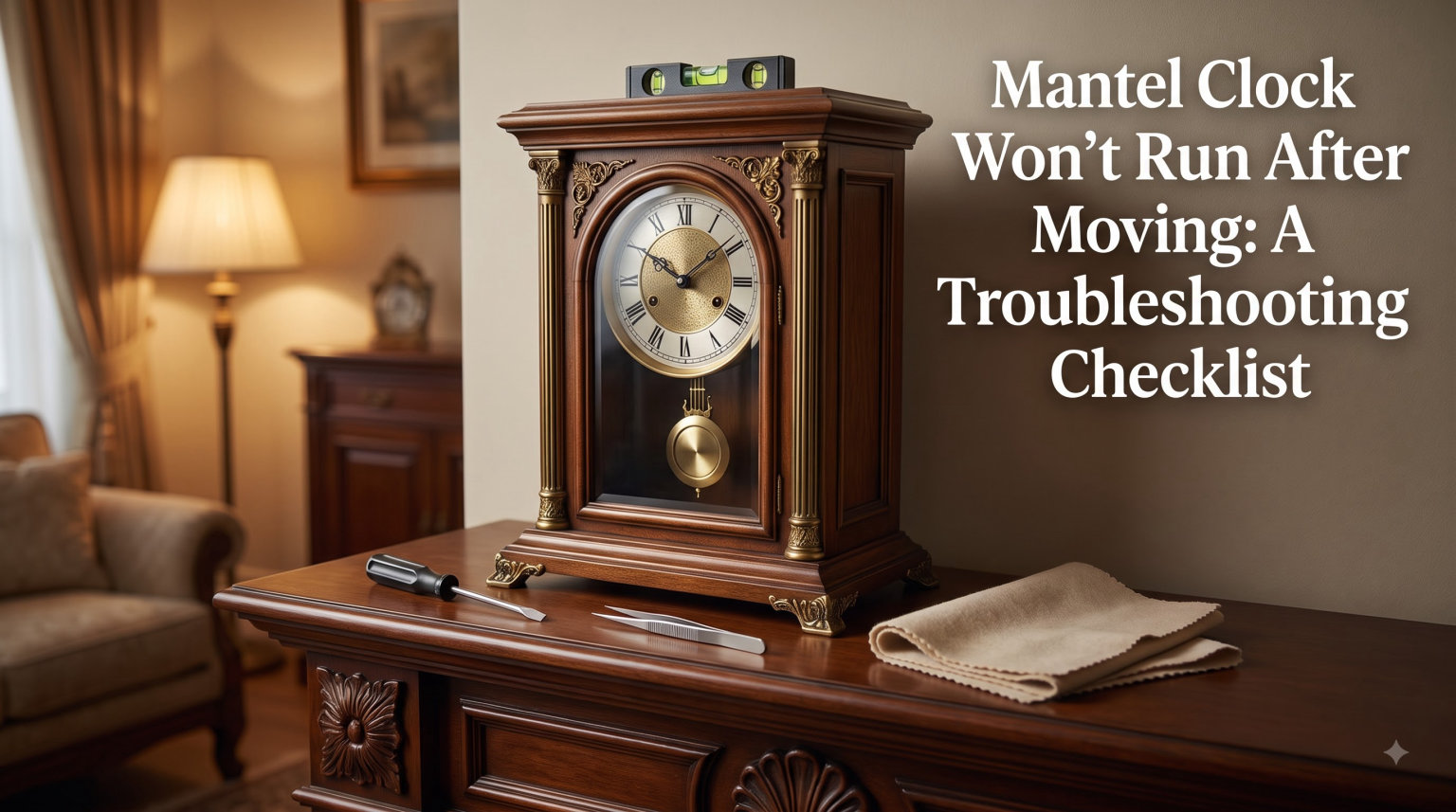
So you packed up your mantel clock, drove it across town (or across the country), set it on the new mantel, and nothing happened. The pendulum refuses to swing. The hands sit frozen. Maybe the chime is silent. This is one of the most common problems clock owners face, and the good news is that most of the time, the fix is simpler than you think.
When a mantel clock won’t run after moving, the culprit is almost always a mechanical issue caused by transport vibration, a shift in the clock’s level, or a pendulum component that came loose in transit. These clocks are precision instruments with delicate internal parts, and even a careful move can knock something out of alignment.
I have helped dozens of clock owners restart their timepieces after a relocation, and the vast majority of problems trace back to five or six fixable issues. In this guide, I will walk you through a quick troubleshooting checklist you can run right now, then dig into each step in detail. By the end, you will know exactly what to check, what to avoid, and when it is time to call a professional.
This mantel clock troubleshooting guide covers mechanical spring-driven and weight-driven clocks. If your clock runs on batteries or quartz movement, the troubleshooting path is different, and I address that in the FAQ section below.
Table of Contents
Quick Troubleshooting Checklist
Run through this checklist in order. Most stopped clocks come back to life within the first three steps.
- Check the level. Place a small bubble level on top of the clock case. Adjust shims under the clock until it reads level front to back and side to side. The movement inside the case must also be level, not just the outer housing.
- Inspect the suspension spring. Look at the thin metal strip at the top of the pendulum assembly. If it is bent, broken, or detached from its bracket, the pendulum cannot swing.
- Reattach and position the pendulum. Hang the pendulum on the suspension spring leader. Make sure it hangs through the slot in the crutch foot and swings freely without touching anything.
- Wind the clock fully. A clock that ran out of power during the move will not start until it is rewound. Turn the winding key or Arbor until you feel firm resistance.
- Give the pendulum a push. Gently push the pendulum bob to one side and release. A clock that is level and wound should keep swinging on its own within a few minutes.
- Check for obstructions. Make sure the pendulum is not hitting the case, the chime hammers are not blocking the chime rods, and the hands are not touching each other or the dial.
- Listen for the tick. A healthy mechanical clock produces an even, rhythmic tick-tock. An uneven or muffled sound signals an escapement or leveling problem.
If none of these steps brings your clock back to life, continue to the detailed sections below. The answer is likely in the deeper troubleshooting steps or may require professional attention.
Common Causes: Why Mantel Clocks Stop After Moving
Understanding why your clock stopped helps you diagnose the right fix instead of guessing. Here are the five most common reasons a mantel clock won’t run after moving house.
Internal Parts Shifted During Transport
Even on a smooth drive, vibrations from the road travel through your clock’s movement. Gears, pinions, and arbors sit in tiny pivot holes, and a bump can shift a component just enough to create friction or stop the gear train entirely. This is especially common in older clocks with worn pivot holes that have more play than they should.
The chime and strike mechanisms are also vulnerable. Hammers can jam against rods, and levers can slip out of their proper positions. When this happens, the clock may tick but fail to chime, or it may stop running altogether because the jammed train locks the movement.
Level and Surface Changes
A mantel clock is calibrated to run on a level surface. The pendulum depends on gravity, and even a slight tilt changes the swing arc enough to stop the clock. Your old mantel may have been perfectly flat, while the new one has a subtle slope.
This is the single most common cause of a stopped clock after a move. Clock collectors on the NAWCC forums repeat this advice constantly: check the level first, both front-to-back and side-to-side, and confirm the movement itself is level inside the case. Many clock cases are not perfectly square, so a level case does not guarantee a level movement.
Suspension Spring Damage or Detachment
The suspension spring is the thin, flexible metal strip that holds the pendulum. During a move, this part is fragile and easily bent or snapped off its mounting bracket. If the pendulum was left attached during transport, the bouncing almost certainly damaged the spring.
A damaged or detached suspension spring means the pendulum has nothing to swing from. You might see the pendulum hanging crooked, swinging for a few seconds and stopping, or not starting at all. Replacing a suspension spring is a straightforward repair, but the clock will not run until it is done.
Lubrication Disturbed by Vibration
Over years of use, the oil inside a clock movement settles into the pivot holes where it belongs. Road vibration can cause that oil to migrate away from the pivots, leaving dry spots that create excess friction. A clock that ran smoothly before the move may suddenly feel sluggish or stop.
This problem builds over time. The clock might run for a day or two after the move, then gradually lose time and stop as the dry pivots generate more and more friction. If your clock ran fine before the move but started losing time in the days after, disturbed lubrication is a likely suspect.
Temperature and Humidity Shifts
A new home means a new environment. Changes in temperature and humidity affect the wooden case, the metal movement, and even the pendulum’s swing rate. Wood can swell or shrink, shifting the movement’s mounting points. Extreme dryness can cause old lubricant to thicken, while high humidity can promote light surface corrosion on steel parts.
Give your clock a few days to acclimate to its new environment before assuming something is broken. Sometimes a clock simply needs to settle into the new temperature and humidity before it runs reliably again.
Detailed Troubleshooting Steps
Now let us walk through each troubleshooting step in detail. Work through them in order, and do not skip ahead. A clock that appears to have a pendulum problem may actually have a leveling issue underneath.
Step 1: Level the Clock Properly (Front to Back and Side to Side)
Leveling is the first and most important step. Without a level clock, nothing else will work correctly. You need a small bubble level, the kind used for hanging pictures or shelves.
Place the level on top of the clock case and check both directions. Adjust by sliding thin shims (paper, cardboard, or wooden wedges) under the base until the bubble is centered. Now comes the part most people miss: the movement inside the case must also be level, not just the outer housing.
Many clock cases are not perfectly square, and the movement may be mounted slightly off. Open the back door or remove the case back and place the level directly on the movement plate. If the movement reads tilted while the case reads level, you need to adjust the shims until the movement itself is level in all directions.
One Reddit clock owner solved a months-long problem with this exact step: “I didn’t level the clock top to bottom. Make sure the movement is level both in and out and side to side.” Check every direction, because a clock tilted in just one axis can stop running.
Step 2: Inspect and Reattach the Pendulum
If your pendulum was removed for the move, you need to reinstall it correctly. If it was left in place, inspect it for damage or misalignment. Either way, the pendulum must hang from the correct point and swing through the crutch foot without obstruction.
Locate the pendulum leader, the thin rod that hangs from the suspension spring. The pendulum bob attaches to the bottom of this leader, usually by a hook or a threaded nut. Hang the pendulum so the rod passes through the slot in the crutch foot, the small lever connected to the escapement.
The crutch foot must not grip the pendulum rod tightly. It should have a small amount of side-to-side play so it can impulse the pendulum on each swing. If the crutch foot is bent or pinching the rod, the pendulum will stop after a few swings. Gently bend the crutch foot to open the slot if needed.
Also verify the pendulum is not touching the case walls, the chime rods, or any other internal part. Even light contact will kill the swing within minutes.
Step 3: Check the Suspension Spring
The suspension spring is critical and fragile. It is the thin metal strip at the very top of the pendulum assembly that flexes back and forth, allowing the pendulum to swing. If it is damaged, the clock cannot run.
Remove the pendulum and examine the suspension spring closely. Look for these problems:
- Detachment: The top of the spring should be firmly clamped or screwed to its bracket. If it has come loose, reattach it carefully.
- Bends or kinks: The spring must be perfectly straight. Even a small bend changes the pendulum’s swing arc and stops the clock. Replace a bent spring rather than trying to straighten it.
- Cracks or breaks: A cracked or snapped spring will not support the pendulum. Replacement springs are inexpensive and available from clock supply shops.
- Wrong type: If the spring was replaced at some point with the wrong thickness or length, the pendulum may not swing properly. Match the replacement to your clock’s specifications.
One clock owner on Reddit discovered their suspension spring had simply come off its mounting arm: “That stick you hang the pendulum on is called the suspension spring arm.” If yours is detached, reattaching it may be all you need to do.
Step 4: Wind the Clock Fully
A mechanical mantel clock stores energy in a wound mainspring. During a move, the clock may sit unwound for days or weeks, and it may have run down completely. A clock with no stored energy cannot run, no matter how perfectly it is leveled.
Locate the winding arbors, the holes in the dial where you insert the winding key. Most mantel clocks have two or three arbors: one for the time train, one for the strike train, and sometimes a third for a separate chime train. Wind each one by turning the key clockwise until you feel firm, consistent resistance.
You may have heard that you can “overwind” a clock. This is a myth. What people call overwinding is usually a mainspring that has bound up due to old, sticky oil, or a mainspring that has reached the end of its service life. Wind firmly until you feel resistance, and do not force it past that point.
If a winding arbor spins freely with no resistance at all, the mainspring may be broken. A broken mainspring requires professional repair or replacement.
Step 5: Restart the Pendulum Correctly
Once the clock is level, the pendulum is attached, the suspension spring is intact, and the mainspring is wound, it is time to start the clock. This step sounds simple, but doing it wrong can leave you thinking the clock is broken when it just needs a proper start.
Push the pendulum bob gently to one side, about two to three inches from its resting center. Release it smoothly. Do not push too hard, as excessive force can damage the suspension spring or the escapement.
Listen to the tick. A properly running clock produces an even, balanced tick-tock, with equal spacing between each sound. If the tick is uneven (tick-TICK-tock or tick-tock-TOCK), the clock is “out of beat” and will stop within minutes.
To correct the beat, you need to adjust the crutch position slightly. Bend the crutch wire gently in the direction needed to even out the tick. Make tiny adjustments and test after each one. Some modern clocks have a self-adjusting “auto-beat” mechanism that corrects itself after a few swings.
If the pendulum swings evenly and the tick is balanced but the clock still stops after a few minutes, the problem is likely deeper in the movement. Try the next steps, or consider that the movement may need cleaning and oiling.
Step 6: Check the Chime and Strike Mechanism
Some mantel clocks stop running entirely when the chime or strike train jams. The three trains (time, strike, and chime) share the same movement, and a jammed strike train can lock the entire system.
First, check the chime hammers. They should rest just above or barely touching the chime rods, not pressed hard against them. If a hammer is jammed against a rod, gently lift it back to its resting position. Road vibration commonly knocks hammers out of alignment.
Next, try setting the clock to the correct time by moving the minute hand clockwise only. Never move the minute hand counterclockwise on a chiming clock, as this can jam the strike mechanism. Let the clock chime at each quarter-hour point naturally rather than forcing it past the chime sequence.
If the chime runs but the clock still does not keep time, the chime train may be consuming too much power due to a lubrication issue or a worn part. A clock that chimes but does not tick usually has a problem in the time train specifically.
Some clocks have a chime shut-off lever. Make sure it is in the “on” position if you want the chime to run. A jammed shut-off mechanism can sometimes block the chime train from operating, which on some movements also stops the timekeeping.
Step 7: Inspect the Hands and Dial
It sounds simple, but bent or touching hands will stop a clock. The minute hand and hour hand must clear each other at every position, and neither should touch the dial or the glass cover.
Watch the hands as they pass the 12 o’clock position. This is where the hour and minute hands come closest together. If they rub or catch, gently bend the hour hand slightly closer to the dial or the minute hand slightly away.
Also check that the minute hand is not rubbing against the hour pipe or the center arbor. A hand that is pressed on too tightly after a move can drag on the dial and stop the clock. Loosen the small nut holding the minute hand if it appears too tight.
If the second hand is present, make sure it is not catching on the minute hand or the dial glass. A dragging second hand is a common cause of intermittent stopping that only happens at certain times.
Safety Precautions: What Not to Do
Before you attempt any repair, understand what can cause permanent damage. Clock movements are precision instruments, and the wrong approach can turn a simple fix into an expensive professional repair.
Never Use WD-40 or Household Oils
This is the most important warning in this entire guide. Never use WD-40, 3-in-One oil, sewing machine oil, or any household lubricant on a clock movement. These products are too thick, attract dust, and gum up the delicate pivots within weeks.
Experienced clock owners and repair professionals are unanimous on this point. As one Reddit contributor put it: “Applying a little synthetic clock oil to the spring will help it run smoother. Absolutely NO WD-40, 3-in-1 home oil, sewing machine oil.” Only use oil specifically formulated for clock movements, applied in tiny amounts to the correct pivot points.
Do Not Force Stuck Parts
If a key will not turn, if a hand will not move, or if a component resists adjustment, stop. Forcing a stuck part usually breaks something expensive. Mainsprings store enormous energy and can cause injury or damage if they snap. Chime trains can jam in ways that require a trained hand to release safely.
Never Move the Minute Hand Counterclockwise
On chiming clocks, always move the minute hand clockwise to set the time. Turning it backward can jam the strike and chime trains, bend levers, and knock the rack-and-snail mechanism out of sync. If you need to set the time backward, move the hand clockwise through a full revolution instead.
Support the Movement When the Case Is Open
If you remove the case back or open the movement for inspection, be aware that some components are only held in place by gravity and their mounting screws. Do not tip the clock while the back is open, as parts can shift or fall out of position. Keep the clock upright at all times during inspection.
When to Seek Professional Help
Not every clock problem is a DIY fix. Knowing when to stop and call a professional can save your clock from further damage and save you money in the long run.
Signs You Need a Horologist
A horologist is a professional who specializes in clock and watch repair. Consider calling one if you observe any of the following:
- The clock is level, wound, and properly assembled but still will not run. This points to an internal movement problem that requires disassembly.
- You hear grinding, clicking, or scraping inside the movement. These sounds indicate damaged gears, broken teeth, or a mainspring problem.
- A mainspring is broken. Replacing a mainspring requires special tools and training. The spring is under extreme tension and can cause serious injury.
- The clock is an antique or family heirloom. The risk of devaluing or damaging an irreplaceable clock outweighs the cost of professional service.
- The movement has not been serviced in 7 to 10 years. Clocks need periodic cleaning and oiling. Old oil turns to gum and acts as an abrasive rather than a lubricant.
DIY Fixes vs Professional Repair
Here is a practical guideline for deciding which problems you can handle yourself and which require a professional.
DIY-appropriate fixes: Leveling the clock, reattaching the pendulum, winding the mainspring, adjusting the beat, straightening a chime hammer, and inspecting hands for contact. These are non-invasive adjustments that do not require opening the movement.
Professional-level repairs: Replacing a mainspring, disassembling and cleaning the movement, replacing worn pivot holes (rebushing), repairing broken gear teeth, and servicing the chime or strike trains internally. These require specialized tools, training, and often replacement parts.
A full movement service from a professional horologist typically includes ultrasonic cleaning, inspection of every part, rebushing worn pivots, and re-oiling with the correct synthetic clock oil. If your clock has not had this service in many years, a professional cleaning may be the real solution even if the immediate problem appears minor.
For antique or high-value clocks, a professional is almost always worth the investment. Improper DIY repairs can reduce a clock’s value and create problems that are more expensive to fix than the original issue.
Preventing Problems on Your Next Move
The best troubleshooting happens before the move. If you prepare your clock properly for transport, you can avoid most post-move problems entirely.
Always remove the pendulum before moving a mantel clock. Wrap it separately in soft cloth and pack it where it will not bend or crush. Removing the pendulum protects the fragile suspension spring from damage during transit.
For chiming clocks, secure the chime hammers by taping them gently to their resting position or removing them if the design allows. This prevents the hammers from banging against the chime rods and causing damage.
Transport the clock upright, never on its side or face-down. Pad the case thoroughly to absorb vibration. If possible, carry the clock in the passenger cabin of your vehicle rather than the trunk or a moving truck, where vibration is more severe.
At the destination, let the clock sit for 24 hours before restarting it. This allows the movement to settle and the lubricant to redistribute. After that, follow the quick checklist above to bring it back to life.
Frequently Asked Questions
What are the common problems with mantel clocks?
The most common mantel clock problems are the clock being out of level, a damaged or detached suspension spring, a pendulum that is misaligned or touching the case, a run-down mainspring, and disturbed lubrication. After moving, leveling issues and suspension spring damage account for the majority of stopped clocks. Chime hammer misalignment and bent hands are also frequent post-move problems.
Why does my mantle clock stop working?
A mantle clock stops working when something disrupts the balance of power between the mainspring, the escapement, and the pendulum. The most common causes are the clock being out of level, the pendulum not swinging freely, a damaged suspension spring, the mainspring being fully unwound, or old gummed-up oil creating excess friction in the pivot holes. Start by checking the level and the suspension spring.
Why is my clock not working even with new batteries?
This article covers mechanical mantel clocks, but if your clock is battery-operated (quartz) and stopped working with fresh batteries, the problem is usually the battery contacts being corroded, the wrong battery size, a damaged quartz movement, or hands that are binding against each other. Check the battery compartment for corrosion first, then verify the hands move freely. Quartz movements are inexpensive to replace if the unit itself has failed.
Can you use WD-40 on clock movements?
No, never use WD-40 on a clock movement. WD-40 is not a lubricant designed for precision instruments. It is too thick, attracts dust and debris, and gums up the tiny pivot holes in a clock movement within weeks. Only use synthetic oil specifically formulated for clock movements, applied in very small amounts to the correct pivot points. Using WD-40 or household oils will require a professional cleaning to reverse the damage.
Conclusion
When your mantel clock won’t run after moving, the problem is almost always fixable with patience and the right approach. Start with the quick checklist: level the clock, inspect the suspension spring, reattach the pendulum, wind the mainspring, and give it a proper start. These five steps solve the vast majority of post-move clock problems.
If you have worked through every step and the clock still will not run, it may need professional cleaning, a new mainspring, or rebushing of worn pivots. A qualified horologist can diagnose internal movement issues that are beyond the scope of home repair. The investment is worthwhile, especially for a clock with sentimental or antique value.
Treat your mantel clock as the precision instrument it is. Use only the correct clock oil, never force stuck parts, and always prepare the clock properly before your next move. With the right care, a quality mantel clock will keep accurate time for generations.