
There is nothing more frustrating than a clock that refuses to keep time. You wind it, set the pendulum swinging, walk away, and an hour later it has stopped again. If your wall clock pendulum keeps stopping, you are dealing with one of the most common mechanical clock problems owners face. The good news is that most causes are surprisingly simple to diagnose and fix at home, without special tools or a trip to a repair shop.
In our experience helping clock owners troubleshoot this exact issue, roughly 80 percent of stopped pendulums come down to a single cause: the clock is out of beat. We have seen inherited mantel clocks that sat silent for decades spring back to life after a two-minute adjustment. Our team put together this guide to walk you through every possible cause, ranked from most to least likely, so you can find the problem fast and get your clock ticking again.
By the end of this article, you will know exactly how to diagnose your clock, what each symptom means, and whether you can fix it yourself or need to call a professional. Let us start with the most likely culprit.
Table of Contents
Why Your Wall Clock Pendulum Keeps Stopping: The Root Causes
A pendulum clock stops for a handful of well-understood reasons. The pendulum needs a steady, precisely timed impulse from the escapement to keep swinging, and anything that disrupts that energy transfer will eventually bring it to a halt. Here are the causes we see most often, in order of how common they are:
Out of beat — The tick and tock are unevenly spaced, robbing the pendulum of power.
Clock not level — A crooked clock throws off the beat and the swing arc.
Hands touching — The hour, minute, or second hands rub against each other or the dial.
Pendulum dragging — The pendulum or its leader bumps into chime rods, weights, or the case.
Broken suspension spring — The thin spring that holds the pendulum leader is bent or cracked.
Dirt and old oil — The movement is gummed up and needs cleaning and oiling.
Worn pivots or weak mainspring — Deeper mechanical wear that reduces power to the escapement.
Clock not wound — Simply needs winding, which is easy to overlook.
We will walk through each of these in detail, starting with the one that accounts for the vast majority of cases.
The Number One Cause: Your Clock Is Out of Beat
If your wall clock pendulum keeps stopping, the first thing to check is the beat. Being “in beat” means the tick and the tock are evenly spaced, like a steady heartbeat. When a clock is out of beat, the ticks come at uneven intervals, and the pendulum does not receive consistent impulses from the escapement to keep it swinging. Think of it like pushing someone on a swing: if you push at the wrong moment, you actually slow them down instead of helping.
This is why a clock often stops right after being moved, bumped, or even given a too-aggressive push to restart the pendulum. Any physical disturbance can shift the beat slightly, and even a tiny misalignment is enough to stop the clock within minutes. Forum members on r/clocks and the NAWCC message boards report that beat adjustment alone solves the majority of stopped-pendulum cases.
Here is the key insight: your clock is probably not broken. It just needs a simple adjustment to get the tick-tock rhythm back to even.
How to Tell If Your Clock Is Out of Beat
The diagnostic test takes about thirty seconds. Start the pendulum swinging gently and listen closely to the sound it makes. A clock that is properly in beat produces a steady, even “tick . . . tock . . . tick . . . tock” with perfectly equal spacing between each sound. If you hear something closer to “tick-tock . . . . tick-tock” where the sounds come in pairs with a gap afterward, your clock is out of beat.
Many clock owners are surprised to learn what a proper tick-tock should sound like. The two sounds should be mirror images of each other in timing, not clustered together. If the rhythm sounds rushed or galloping, that uneven beat is draining power from the pendulum on every cycle. Even a clock that runs for several hours before stopping often has a beat that is slightly off, just barely providing enough impulse to keep going for a while before friction wins.
Grab a phone and record a short audio clip if you are unsure. Listening back to the recording can make an uneven beat much more obvious than trying to judge it in real time.
How to Set the Beat on Your Pendulum Clock
Setting the beat is a straightforward process once you understand what you are adjusting. The goal is to shift the pendulum leader (the thin rod that connects the suspension spring to the pendulum itself) slightly to one side so that the tick and tock become evenly spaced. Here is our step-by-step method:
Step 1: Remove the pendulum from the clock and set it aside safely. This gives you access to the pendulum leader and prevents accidental damage.
Step 2: Locate the pendulum leader where it attaches to the suspension spring at the top. On most wall clocks, this is visible just behind the dial opening or through an access panel on the back.
Step 3: Gently bend the pendulum leader slightly to one side, just a millimeter or two. The direction depends on which way your beat is off. If the tick comes too quickly after the tock, bend the leader toward the side of the tick. If the tock comes too quickly, bend it the other way.
Step 4: Rehang the pendulum and start it swinging. Listen to the rhythm again.
Step 5: Repeat the process in small increments until the tick and tock are evenly spaced. Patience matters here. Tiny adjustments make a big difference.
Some clocks have a self-adjusting beat mechanism that makes this even easier. On those models, you can simply push the pendulum all the way to one side until you feel resistance, then let go. The mechanism automatically recenters the beat. If your clock has this feature, this one motion may solve the problem entirely.
Clock Leveling: Why It Matters and How to Check
A clock that is not perfectly level cannot be in beat, which makes leveling the foundation of a running pendulum. Many owners check that their clock is level side-to-side but miss the equally important front-to-back level. A clock tilted even slightly forward or backward will throw off the escapement geometry and stop the pendulum.
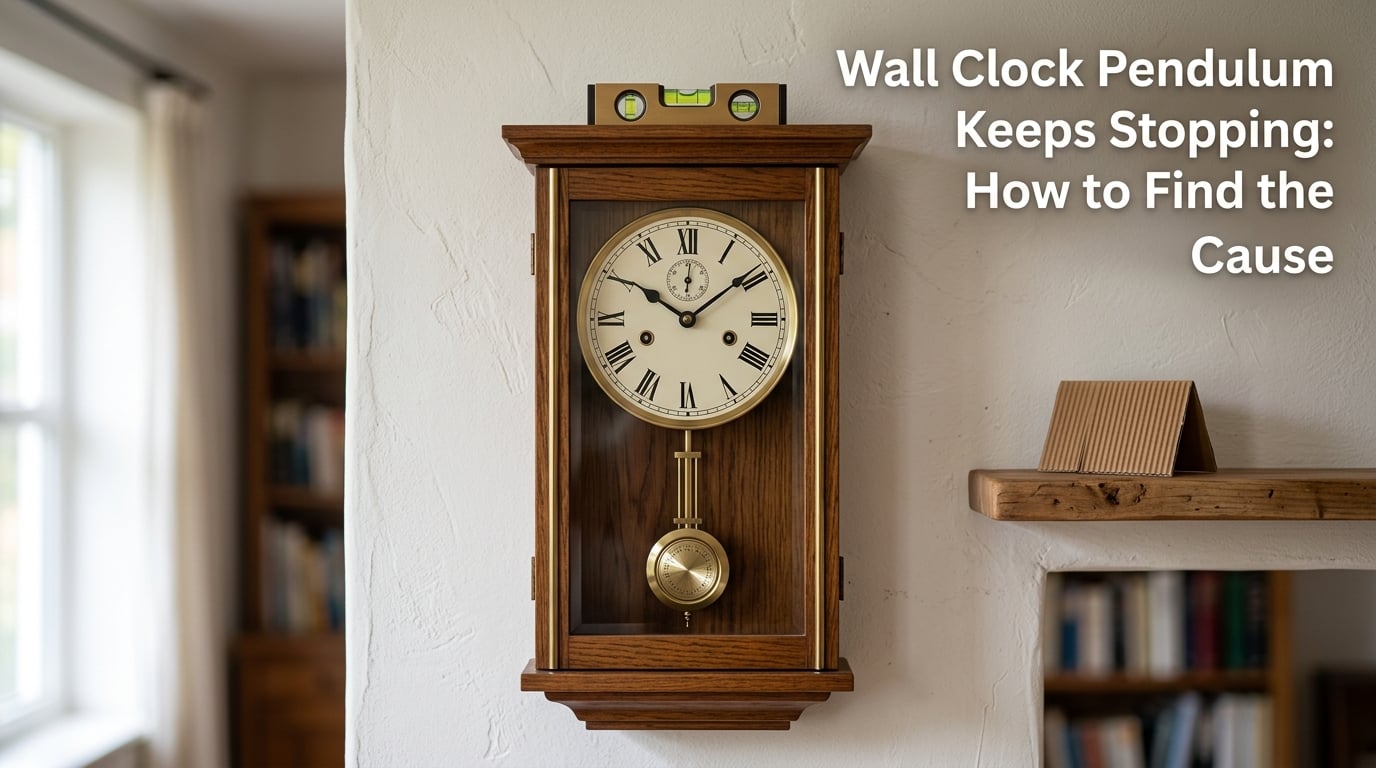
Place a small bubble level on top of the clock case, checking both directions. If you do not have a level, you can use the clock itself as a diagnostic tool. Start the pendulum swinging and watch which way it tends to drift or stop. The pendulum will often favor one side when the clock is tilted, giving you a clue about which way to adjust.
Forum users frequently report success simply by sliding a piece of cardboard or a folded piece of paper under one edge of the clock to level it. This low-tech fix has revived countless stopped clocks. If your clock is mounted on a wall, check that the mounting screw or nail has not shifted, and verify that the wall itself is not causing a slight tilt.
Remember that a clock can be perfectly level when first hung and then drift out of level over months as the wall settles or the mounting hardware loosens. Rechecking the level should always be your second step after checking the beat.
Hands Touching: A Silent Cause of Stopping
If your clock is in beat and level but the pendulum still stops, check the hands. The hour, minute, and second hands must move freely without touching each other or rubbing against the dial face or the glass cover. Even light friction between hands creates enough drag to stop the movement over time.
Watch the hands closely as they pass each other, particularly around the twelve o’clock position where the hour and minute hands are closest. If you see the minute hand hesitate, jump, or push the hour hand as they cross, they are making contact.
Fixing this requires a gentle touch. Use a pair of tweezers or your fingertips to carefully bend the offending hand slightly away from the other. Bend near the center boss, not at the tip, and make only a tiny adjustment. The hands should have visible clearance between them at every point in their rotation. Also check that the second hand is not rubbing against the minute hand or catching on the dial.
Pendulum Dragging on Chime Rods or Weights
Physical interference is another common reason a pendulum stops after running for a short time. The pendulum bob needs a clear path for its full swing arc, and anything in that path will steal energy and eventually stop the clock. On chiming clocks, the chime rods hang close to the pendulum path and can cause subtle dragging.
Start the pendulum and watch it from the side as it swings. Look for any point in the arc where the pendulum bob, leader, or rod comes close to another component. On weight-driven clocks, check that the weights are hanging straight down and not angled toward the pendulum. On chiming clocks, verify the chime rods are in their proper positions and have not been bent inward.
If you find contact, the fix depends on what is touching. Weights can usually be straightened by adjusting how they hang on their cables or chains. Chime rods that have been bent may need gentle finger pressure to move them back into position. Never force anything, as these components are delicate and can snap.
Suspension Spring Inspection
The suspension spring is the thin, flexible strip of metal that supports the pendulum leader and allows it to pivot. This component is critical to proper pendulum operation, yet it is rarely discussed in troubleshooting guides. A damaged or bent suspension spring can cause erratic pendulum behavior, intermittent stopping, or a complete failure to run.
Remove the pendulum and examine the suspension spring closely. It should be straight, flat, and free of cracks, kinks, or creases. Even a slight bend in the spring changes how the pendulum hangs and disrupts the beat. If the spring has a visible crease or crack, it needs to be replaced.
Suspension springs are inexpensive and available from clock supply shops, but the replacement must match the original dimensions closely. A spring that is too stiff or too thin for your clock’s movement will cause timing and power problems. If you inherited an antique clock that has been transported without removing the pendulum, the suspension spring is one of the first things to inspect, as it is easily damaged in transit.
When Your Clock Needs Cleaning and Oiling
If you have ruled out beat, leveling, hands, and physical interference, the next most likely cause is a movement that needs cleaning and oiling. Clock oil dries out over time, and dried oil combines with dust to create a gummy residue that increases friction throughout the movement. This friction robs power from the escapement, and eventually there is not enough energy left to keep the pendulum swinging.
A clock that gradually slowed down over months or years before stopping is a classic sign of dirty, dry pivots. This differs from a clock that stopped suddenly after being moved, which points to a beat or leveling problem instead. If your clock has not been serviced in five to ten years, it is likely overdue for cleaning.
Signs that your clock needs cleaning include visible dark residue around pivot holes, a pendulum that swings with a noticeably smaller arc than it used to, and a movement that sounds gritty or labored when running. Proper cleaning requires removing the movement from the case, disassembling it, and bathing the parts in cleaning solution. This is a job most owners should leave to a professional unless they have experience with clock repair.
Oiling is simpler but must be done correctly. Use only clock oil, never household oils like WD-40 or sewing machine oil, which will gum up and damage the movement. Apply a tiny drop to each pivot point using a precision oiler. Over-oiling is just as harmful as under-oiling, as excess oil attracts dust and forms sludge.
Worn Pivots and Weak Mainsprings
These are the deeper mechanical issues that no amount of beat adjustment or leveling will fix. Pivots are the polished steel ends of the gear arbors that rotate in holes in the clock plates. Over decades of use, these pivots wear down and the holes enlarge, creating excess play that reduces the precision of the escapement. A clock with worn pivots may run erratically, stop frequently, or fail to keep accurate time even when in perfect beat.
Weak mainsprings cause a similar problem from a different angle. The mainspring stores the energy that drives the entire movement, and as springs age they lose tension. A weak spring cannot deliver enough impulse to the escapement to keep the pendulum swinging through its full arc, especially as the spring winds down between windings.
Both of these issues require professional repair. Worn pivots need to be repivoted or have bushings installed to restore the proper fit, and weak mainsprings need to be replaced. These are precision tasks that call for specialized tools and expertise. If your clock is an antique or has significant sentimental value, a professional restoration is worth the investment.
Quick Troubleshooting Checklist
Use this ordered checklist to diagnose your clock systematically. Work through it in sequence, since each step rules out a cause before you move to the next.
Is the clock wound? Wind the mainspring fully and see if the pendulum keeps running.
Is the clock level? Check both side-to-side and front-to-back with a bubble level.
Is it in beat? Listen for an even tick-tock rhythm. Adjust the beat if uneven.
Are the hands free? Watch the hands cross and look for any contact or rubbing.
Is the pendulum path clear? Check for contact with chime rods, weights, or the case.
Is the suspension spring intact? Remove the pendulum and inspect for bends or cracks.
Has it been serviced recently? If it has been over five years, consider cleaning and oiling.
Is there visible wear? Erratic running and small swing arc suggest worn pivots or weak springs.
If steps one through six do not solve the problem, the issue is almost certainly inside the movement and will require professional attention.
When to Call a Professional Clockmaker
Knowing when to stop troubleshooting and call a professional saves time and prevents accidental damage. If your clock needs cleaning and oiling, has worn pivots, or has a weak mainspring, those are jobs for a trained horologist. Attempting them without proper tools and experience can turn a repairable clock into a ruined one.
Antique clocks and grandfather clocks in particular deserve professional care. If your clock has been sitting unused for years, inherited from a family member, or transported without proper preparation, a full inspection by a clockmaker is the safest path to getting it running reliably again. Professional cleaning typically costs less than most people expect and can add decades of life to a clock.
FAQs
What causes a clock pendulum to stop swinging?
The most common cause is the clock being out of beat, meaning the tick and tock are unevenly spaced so the pendulum does not receive consistent impulses. Other causes include the clock not being level, hands touching each other, the pendulum dragging on chime rods or weights, a damaged suspension spring, a movement needing cleaning and oiling, or worn pivots and weak mainsprings.
What does it mean when your pendulum stops moving?
When a pendulum stops moving, it means the clock is no longer delivering enough energy through the escapement to keep it swinging. In about 80 percent of cases this simply means the clock is out of beat or not level, both of which are easy to fix. If the clock slowed gradually over months before stopping, it likely needs cleaning and oiling.
Why does one pendulum stop and the other keep going?
If you have two pendulum clocks and one stops while the other keeps running, the stopped clock has a specific issue such as being out of beat, not level, or having hands that are touching. Each clock is independent, so a problem in one does not affect the other. Check the stopped clock individually using the troubleshooting checklist, starting with the beat and leveling.
How to reset a pendulum clock?
To reset a pendulum clock, first wind it fully. Then check that the clock is level in both directions. Start the pendulum swinging gently by pushing it to one side and releasing. Listen for an even tick-tock rhythm. If the rhythm is uneven, adjust the beat by slightly bending the pendulum leader to one side until the tick and tock are evenly spaced. Recheck the level after making any adjustments.
Conclusion
A wall clock pendulum that keeps stopping is almost always fixable, and in most cases the solution takes just a few minutes. Start with the beat, check the level, and work through the troubleshooting checklist in order. By far the most common fix is simply getting that tick-tock rhythm back to an even cadence, which solves the problem for the majority of clocks.
If your clock still stops after you have ruled out every cause on the checklist, the movement likely needs professional cleaning, oiling, or repair. There is no shame in calling a clockmaker for a clock that has served your family for decades. With proper care, a well-maintained pendulum clock can run reliably for generations, and there is nothing quite like the steady tick-tock of a clock you brought back to life yourself.