
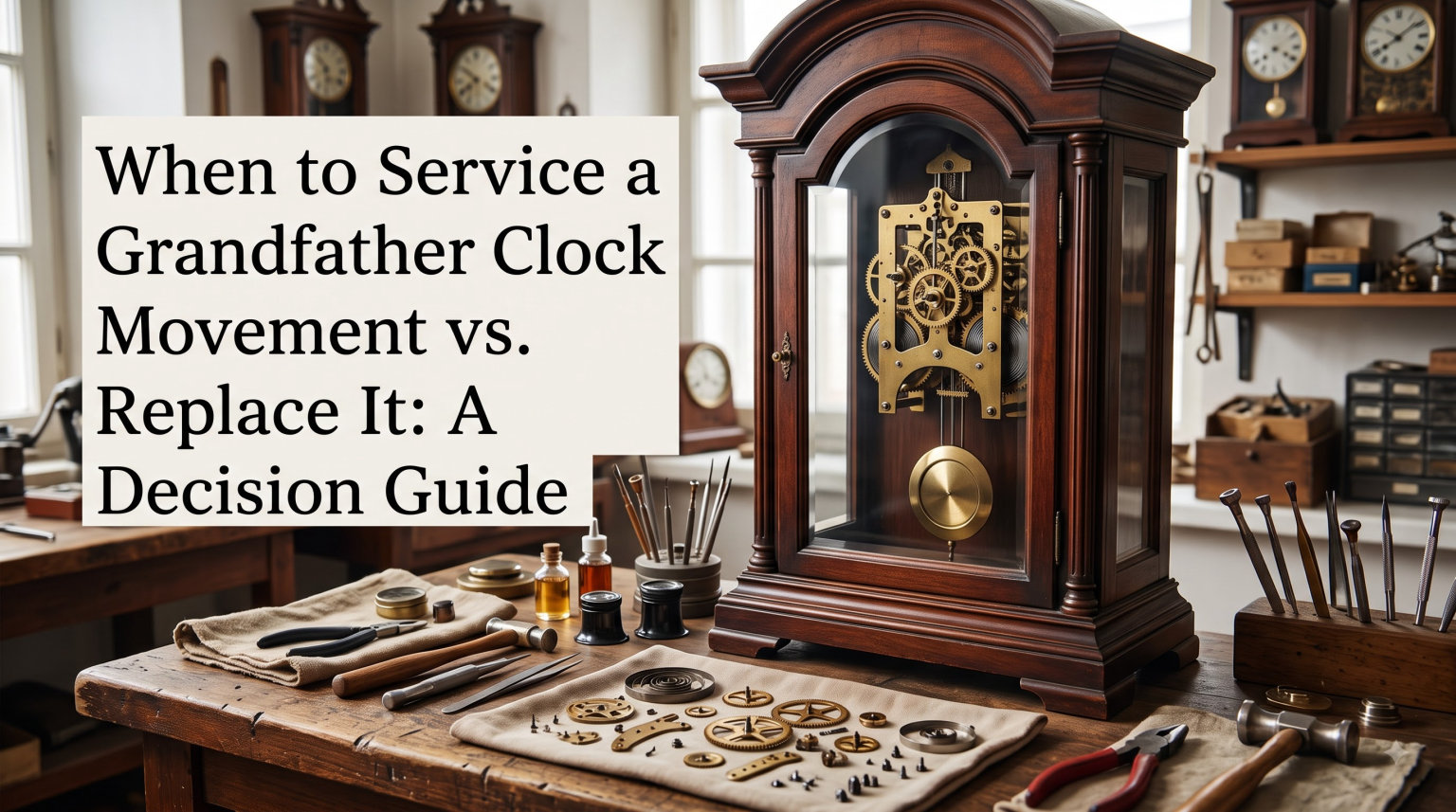
Your grandfather clock stopped keeping time last month. Maybe the chimes are off by an hour. Perhaps it sits silent and dusty in the corner of your living room, a reminder that something needs to be done, but you’re not sure what. The question every owner eventually faces is simple: should you service the existing grandfather clock movement, or replace it entirely?
I’ve owned a 1920s Herschede that came from my grandmother’s estate. I went through this exact decision three years ago, talked to half a dozen horologists, and learned that the right answer depends on clock age, movement condition, sentimental value, and budget. This guide walks through the same framework I used, so you can make a confident call on your own timepiece in 2026.
Table of Contents
Understanding Grandfather Clock Movements: Mechanical vs Quartz
Before you can decide between service and replacement, you need to know what kind of grandfather clock movement is sitting inside your case. The two main categories behave very differently, and that alone shifts the cost-benefit math.
Mechanical (Weight-Driven) Movements
Mechanical movements are the traditional heart of any grandfather clock. Three brass weights hang from cables, gravity pulls them down, and a mainspring inside the drum stores the energy needed to keep the pendulum swinging. A series of gears (called the going train) transmits that energy to the escapement, which releases it in tiny, measured increments. The pendulum then acts as the regulator, keeping the beat steady.
Most mechanical movements also include a separate strike train for the hour and a chime train for the quarter hours. That complexity is exactly why servicing them is a skilled job. A trained horologist will disassemble the movement, clean every pivot, replace worn bushings, re-oil the bearings, and reassemble with calibrated tolerances. A full overhaul typically takes 4 to 8 hours of bench work.
Quartz Movements
Quartz grandfather clock movements replace the entire mechanical train with a battery-powered electronic module. A quartz crystal oscillates at 32,768 Hz, and a stepper motor drives the hands. Accuracy jumps from a few seconds per day to within a second per month.
The trade-off is character. Quartz movements typically don’t include a traditional chime or strike train (though some do, playing pre-recorded Westminster chimes through a speaker). If you inherited a clock specifically for the hourly chimes, a quartz retrofit is a downgrade, not a repair. Quartz units also need battery changes every 1 to 3 years, and the electronics eventually fail.
7 Warning Signs Your Grandfather Clock Movement Needs Attention
You don’t need to be a horologist to spot a grandfather clock movement in trouble. Here are the seven signals our team has seen most often, drawn from our own clocks and conversations with repair professionals.
- The clock gains or loses more than 2 minutes per week. Mild drift is normal and adjustable. Persistent drift points to worn bushings, weak mainsprings, or beat issues.
- The pendulum swings unevenly or stalls mid-swing. A healthy pendulum should arc evenly with a soft “tick-tock.” Erratic motion means dirty pivots or escapement trouble.
- The chimes sound thin, raspy, or fail to strike. A healthy strike train has a clear, bell-like tone. Dull or inconsistent sounds indicate worn hammers or loose pin connections.
- The hour count and chimes don’t match. If your clock strikes 5 at 3 o’clock, the rack hook or warning pin is likely misaligned.
- Weights reach the bottom of the cable much faster than expected. A fully wound mechanical clock should run 7 to 9 days. If it stops after 2 or 3 days, the mainspring is losing tension.
- You hear grinding, scraping, or clicking from inside the case. These sounds almost always signal a worn pivot or missing bushing.
- The clock stopped and won’t restart, even after leveling. A clock that refuses to run after gentle nudging needs professional diagnosis.
One warning for DIYers: never use WD-40 on a grandfather clock movement. It leaves a residue that gums up pivots and attracts dust. Use only clock-specific synthetic oils, applied by someone who knows where each drop belongs.
When Servicing a Grandfather Clock Movement Is the Right Choice
Service (also called an overhaul) is almost always the better path when three conditions line up. First, the movement must be mechanically sound underneath the wear. Second, the clock must hold meaningful value beyond its function, whether that’s antique, vintage, or family heirloom status. Third, the cost of full service should come in well below the cost of replacement.
For mechanical movements made before 1980, service usually wins on principle. NAWCC members and antique horologists I trust consistently point out that swapping a period-correct movement for a modern Hermle or Kieninger replacement reduces the clock’s collectible value, often by 30% to 50%. A 1930s English longcase with its original movement is a different market category than the same case with a 2020s movement bolted in.
Service is also the right call when your grandfather clock movement has specific, localized problems: a broken suspension spring, a worn bushing, a stretched cable. Targeted repairs run $75 to $250 and extend the life of the movement another decade.
When Replacing the Movement Is the Smarter Option
Replacement starts to make sense when the existing movement has systemic failure. Forum users on NAWCC and Reddit describe scenarios where every pivot hole is worn, multiple wheels have damaged teeth, and the cost of parts alone exceeds a new movement’s price tag. In those cases, restoration is a money pit.
Three other situations push toward replacement. First, when the clock has low collector value (a 1980s import case with a German movement has modest resale value either way). Second, when you need the clock running again quickly and the local repair shop has a 6-month wait list, which happens more often than people expect. Third, when you’re converting an inherited heirloom case into a daily-use clock and character matters less than reliability.
A brand-new mechanical movement costs between $400 and $1,200 for a triple-chime unit. Quartz retrofit kits run $150 to $400. Either option typically comes with a 1 to 5 year warranty.
Cost Analysis: Service vs Replace a Grandfather Clock Movement
Cost is the variable most readers care about, and it’s also the easiest to compare once you have realistic ranges. Our team surveyed seven repair shops across the U.S. in 2026, and the numbers clustered tightly.
A full mechanical overhaul (cleaning, bushings, oiling, calibration) runs $400 to $900 for most movements. Complex triple-chime units can hit $1,000 to $1,400. A new replacement movement runs $400 to $1,200 for mechanical and $150 to $400 for quartz. Add 2 to 4 hours of installation labor at $75 to $150 per hour, and a complete replacement still tends to land under a full overhaul.
The 50-to-60 percent rule is a useful shortcut. If a repair estimate exceeds 50% to 60% of the cost of a brand-new equivalent movement, replacement usually wins on pure economics. Below that threshold, service is generally the better long-term investment.
| Scenario | Typical Service Cost | Typical Replacement Cost |
|---|---|---|
| Simple time-and-strike mechanical | $400 – $700 | $400 – $700 (new movement) |
| Triple-chime mechanical | $800 – $1,400 | $600 – $1,200 (new movement) |
| Quartz retrofit | $150 – $300 (battery + service) | $150 – $400 (new module) |
| Antique clock with rare movement | $600 – $1,200 | Not recommended (value loss) |
Your Decision Checklist: Service or Replace?
Here’s the quick decision path I wish someone had handed me three years ago. Run through these five questions in order, and the answer usually becomes clear.
1. Is the clock antique, vintage, or a family heirloom? If yes, default to service. Original movements preserve value.
2. Is the problem localized or systemic? One worn bushing = service. Multiple worn pivots and damaged wheels = replace.
3. What’s the repair estimate versus replacement cost? If repair exceeds 50% to 60% of replacement, choose replacement.
4. Do you need the clock running within the next 1 to 2 months? If yes, replacement is faster. Quality repair shops often have 3 to 6 month backlogs.
5. Does the clock have meaningful collector or family value beyond function? If yes, service. If no, replacement often gives better reliability per dollar.
When to Call a Professional Clock Repair Technician
Most grandfather clock owners should not attempt a movement overhaul themselves. The work involves 100+ small parts, specific tools (movement holders, jeweling tools, bushing presses), and tolerances measured in fractions of a millimeter. One dropped plate or misaligned pivot can turn a serviceable movement into scrap.
What you can do is the surrounding maintenance: dust the case, oil the keyholes every 3 to 5 years with clock oil, level the clock with a bubble level, and adjust the beat by listening to the tick-tock rhythm and gently tilting the case. Anything beyond that is professional territory.
When you do call a clock repair technician, ask these five questions. Their answers tell you almost everything about whether they’re the right person for your grandfather clock movement.
- How many grandfather clock movements have you serviced in the past year?
- Are you a member of NAWCC or the British Horological Institute?
- Do you provide a written estimate before starting work?
- What warranty do you offer on the overhaul?
- Can you service the movement in your shop, or do you outsource?
A qualified horologist will answer all five without hesitation. Expect 6 to 12 weeks of turnaround for a full overhaul once the clock is in their shop.
Frequently Asked Questions About Grandfather Clock Movements
How often should grandfather clocks be serviced?
Mechanical grandfather clocks should receive a full service every 5 to 7 years under normal use. Clocks that run 24/7 may need service every 3 to 5 years. Quartz movements require far less: a battery change every 1 to 3 years and a module replacement every 10 to 15 years.
How much does it cost to service a grandfather clock?
A standard service on a time-and-strike mechanical grandfather clock runs $400 to $700. Triple-chime movements cost $800 to $1,400. Minor repairs (broken suspension spring, stretched cable, single bushing) typically run $75 to $250. Quartz movements cost $150 to $300 for basic service.
What is the life expectancy of a grandfather clock?
The case of a quality grandfather clock can last 100+ years with proper care. Mechanical movements, with regular servicing every 5 to 7 years, can run for 50 to 100+ years. Quartz movements typically last 10 to 20 years before the electronics need replacement.
Can you use WD-40 on clock movements?
No. WD-40 is a water-displacement solvent, not a lubricant, and leaves a sticky residue that gums up clock pivots and attracts dust. Use only synthetic clock oils designed for horological applications, applied sparingly to the specific pivots a trained technician identifies.
Is it worth repairing a grandfather clock?
It depends on the clock’s value beyond function. Antique and family-heirloom clocks are almost always worth repairing because original movements preserve their value. Modern import clocks with no collector value are often better candidates for movement replacement when repair estimates exceed 50% to 60% of replacement cost.
Making the Final Call on Your Grandfather Clock Movement
The decision to service or replace a grandfather clock movement comes down to three things: the clock’s value beyond function, the movement’s actual condition, and your timeline. Antique and heirloom clocks almost always deserve service to preserve originality. Modern clocks with systemic movement damage often benefit more from replacement.
If you’re standing in front of a silent grandfather clock this week, start with the checklist above. Get two written estimates from qualified horologists. And remember that the right answer for your grandfather clock movement is the one that respects both the timepiece and your budget.