
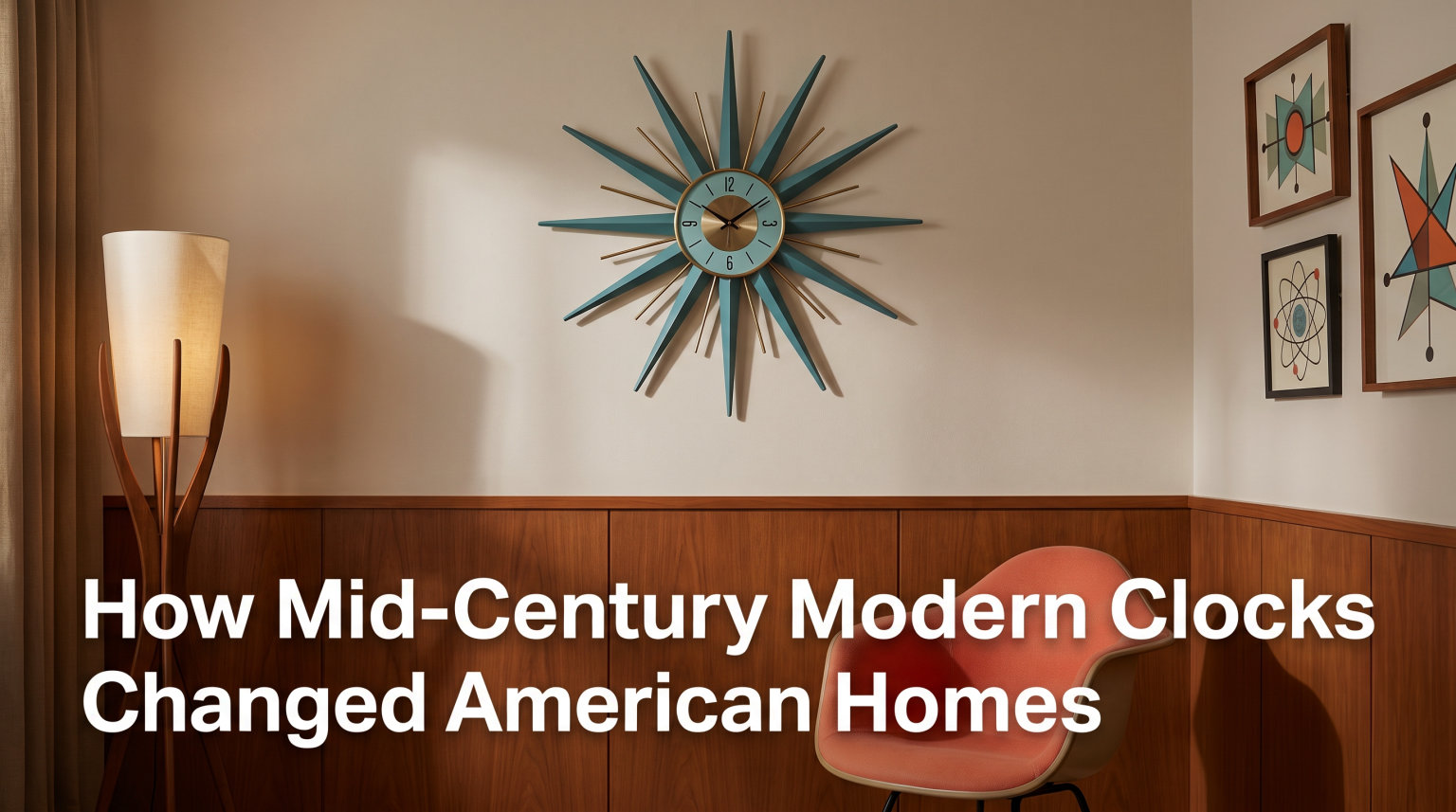
Walk into almost any American home built between 1945 and 1970, and you would likely spot something unexpected on the wall. Not a painting. Not a mirror. A clock that doubled as sculpture.
This was the mid-century modern clock: a piece with brass spokes radiating from a central dial, wooden balls orbiting like tiny planets, or a sunburst of teak and metal that captured the confidence of an entire era. These timepieces did something no clock had done before in American homes. They made timekeeping an act of self-expression.
I have spent years studying how mid-century modern design reshaped domestic interiors, and the story of the clock is one of the most fascinating chapters. These pieces appeared at a moment when American homes, tastes, and values were all changing simultaneously. The result was a transformation still visible on walls across the country today.
In this guide, I will walk you through exactly how mid-century modern clocks changed American homes. We will cover the post-war cultural shift that made this movement possible, the designers who reimagined the clock as functional art, the iconic models that defined the era, and why collectors still chase these pieces in 2026.
Whether you are a design enthusiast, a vintage collector, or someone who remembers a brass sunburst clock hanging in your grandparents’ living room, this history reveals something deeper about what Americans valued during the mid-twentieth century. These clocks were never just about telling time. They were about telling a story of progress, optimism, and the belief that ordinary objects deserved extraordinary design.
Table of Contents
Post-War America Built a New Kind of Home
The end of World War II brought changes to American domestic life that would have been unimaginable a decade earlier. Millions of servicemen returned home, the GI Bill made homeownership possible for a generation, and the country redirected its industrial might toward building rather than fighting.
The numbers tell a staggering story. Between 1946 and 1960, developers built more than 13 million new housing units in the United States. Communities like Levittown on Long Island sprouted from farmland into fully formed suburbs almost overnight. These were not the Victorian mansions or Craftsman bungalows of previous generations. They were something entirely new.
The architecture reflected a different set of priorities. Open floor plans replaced compartmentalized rooms. Picture windows framed the backyard rather than the street. Vaulted ceilings and exposed beams created a sense of spaciousness that felt distinctly modern. Every wall in these new homes was an opportunity, a blank canvas that called out for objects matching the architectural mood.
Traditional clocks did not fit this new world. Grandfather clocks and ornate pendulum pieces belonged to earlier eras of American design. They were heavy, formal, and deeply rooted in a past that post-war families were ready to leave behind.
Americans wanted objects that felt fresh, functional, and confident. Things that expressed optimism about the future rather than reverence for the past. Designers recognized this shift, and a new movement was born.
The homes changed first. Then the objects inside them changed to match. And few objects changed as dramatically as the clock.
How Mid-Century Modern Clocks Changed American Homes
To understand how mid-century modern clocks changed American homes, you have to understand what hung on walls before they arrived.
For most of American history, clocks were utilitarian objects or inherited status symbols. Grandfather clocks stood in hallways as markers of family longevity. Pendulum wall clocks ticked in kitchens and parlors. Schoolhouse clocks with their round faces and simple surrounds served their purpose without drawing attention. Clocks told time. That was their job.
Mid-century modern clocks shattered that convention. They were among the first everyday household objects that Americans chose primarily for their design rather than their function. A Sunburst Clock hanging above a credenza was not there because someone needed to know the hour from across the room. It was there because it looked stunning.
This shift had a ripple effect across interior design. MCM clocks trained American homeowners to think of functional objects as opportunities for artistic expression. If a clock could be sculpture, why not a lamp? Why not a chair? The clock helped normalize the idea that everyday items deserved the same design consideration as fine art.
The placement of clocks changed too. Before the mid-century era, clocks typically occupied kitchens, hallways, and entryways, functional spaces where checking the time made sense. MCM clocks migrated into living rooms, dining areas, and even bedrooms. They became focal points, conversation starters, and centerpieces of interior design schemes.
Collectors and design enthusiasts I have spoken with consistently point to this as the defining contribution of MCM clocks. On forums like Reddit’s r/Design and r/architecture, users praise the way these pieces blurred the line between function and decoration. One collector described her George Nelson Ball Clock as “the first thing guests notice when they walk in, and it has been hanging there since 1958.”
The cultural symbolism ran deep. During the atomic age, Americans were fascinated by science, space, and the promise of technology. A clock with radiating spokes echoed diagrams of atomic structures. A sunburst design evoked images of cosmic energy and space exploration. These were not accidental aesthetic choices. They reflected a nation that saw itself standing at the dawn of a new scientific age.
In this way, mid-century modern clocks served as mirrors of American aspiration. They told visitors that the homeowner was modern, forward-thinking, and design-conscious. They signaled belonging to a culture that valued progress, creativity, and beauty in equal measure.
George Nelson Reinvented What a Clock Could Be
No discussion of mid-century modern clocks is complete without George Nelson. As design director at the Howard Miller Clock Company from the late 1940s through the 1950s, Nelson fundamentally redefined what a clock could look like and mean.
Nelson ran a design studio in New York that functioned more like an experimental workshop than a traditional manufacturing operation. He hired talented young designers, including Irving Harper, who would contribute significantly to the studio’s clock designs, and encouraged them to think beyond convention. The studio’s philosophy was simple: ordinary objects deserve extraordinary design.
The partnership between Nelson and Howard Miller proved remarkably productive. Howard Miller, founded in 1926 in Zeeland, Michigan, had built its reputation on traditional wall clocks and mantel pieces. Nelson’s involvement pushed the company into bold new territory, resulting in dozens of clock designs over a creative period that spanned roughly two decades.
What made Nelson’s approach different was his refusal to treat the clock as a timekeeping device first and a decorative object second. In his view, the equation was reversed. A wall clock spent most of its existence being looked at rather than read. So why not design it primarily as a visual object that also happened to tell time?
This philosophy produced designs that defied convention. Instead of traditional clock faces with numerals and hands, Nelson’s clocks used abstract forms. Balls, spokes, spindles, and geometric shapes represented hours. Some designs eliminated numbers entirely, relying on the positions of distinctive elements to convey time.
Forum discussions among collectors frequently cite Nelson’s name as a primary indicator of authenticity and value. Designer attribution matters enormously in the MCM clock market. A clock bearing a George Nelson or Howard Miller label commands respect that generic reproductions simply cannot match.
The Nelson studio did not work in isolation. The mid-century movement included other influential designers and companies, but Nelson’s work for Howard Miller remains the most recognized and influential body of MCM clock design. His studio’s creations defined the visual language that we now associate with the entire genre.
Five Iconic Clock Designs Defined the Mid-Century Era
The mid-century modern movement produced dozens of memorable clock designs, but a handful achieved iconic status. These are the pieces that collectors hunt for, that museums display, and that still influence clock design decades later.
The Ball Clock Brought Playfulness to Wall Decor
The Ball Clock, introduced around 1947, is perhaps the most recognized mid-century clock ever made. Its design features a central dial surrounded by twelve wooden balls arranged on metal spokes, each ball marking an hour position.
The origin story of the Ball Clock has become design legend. According to accounts from Nelson’s studio, the concept emerged during an informal evening gathering that included Isamu Noguchi, Buckminster Fuller, and other creative figures. Whether this origin is entirely accurate or has grown more colorful with retelling, the design itself remains undeniable. It brought a sense of playfulness and warmth to wall decor that was entirely new.
Collectors consistently identify the Ball Clock as the defining symbol of the mid-century clock era. Its silhouette appears on everything from greeting cards to coffee table books about American design. If you have seen a mid-century clock in a film, magazine, or television show set in the 1950s or 1960s, chances are it was a Ball Clock or something inspired by one.
The Sunburst Clock Channeled Atomic Age Optimism
The Sunburst Clock, sometimes called the Star Clock, took the radiating-spoke concept even further. Its design featured tapered wooden or metal rays extending outward from a central disk, creating a form that evoked both cosmic imagery and the molecular diagrams of atomic science.
This was a clock that spoke the visual language of its era. The atomic age fascination with science, energy, and structure found direct expression in the sunburst form. Hanging one on your wall was, in a sense, declaring your enthusiasm for the modern age and everything it promised.
The Sunburst Clock also demonstrated how MCM designers used familiar materials in unfamiliar ways. Walnut, brass, and steel, materials with long histories in decorative arts, were arranged in configurations that felt entirely fresh and contemporary.
The Eye Clock Made Timekeeping Conversational
The Eye Clock took an even more sculptural approach. Its design resembled a large, stylized eye, with the clock face forming the iris. It was playful, surreal, and impossible to ignore.
This piece exemplified the mid-century willingness to inject personality and humor into functional objects. The Eye Clock did not just tell time. It seemed to be watching you, which made it an instant conversation piece in any room where it hung.
The Asterisk Clock Turned Punctuation Into Design
The Asterisk Clock used the familiar typographic symbol as its primary design motif. Its clean, graphic quality made it feel like a piece of modern art that happened to tell time. The design demonstrated the mid-century movement’s comfort with abstraction and bold minimalism.
The Spindle Clock Brought Wood Back to the Wall
The Spindle Clock used elongated wooden spindles radiating from a central point, creating a form that felt both architectural and organic. It celebrated the natural beauty of wood grain while maintaining the geometric precision that defined the MCM aesthetic. This design showed that modernism did not have to mean cold or industrial. It could be warm, textured, and deeply connected to natural materials.
Five Design Principles Separate MCM Clocks From Everything Before
Mid-century modern clocks share a set of design principles that distinguish them from both their predecessors and later imitations. Understanding these principles helps explain why these pieces looked so different from anything Americans had seen before.
1. Minimalism ruled. MCM clocks stripped away unnecessary ornamentation. No scrollwork, no decorative molding, no excessive numerals. Every element served the design, and anything that did not contribute to the visual impact was eliminated.
2. Clean lines defined the silhouette. Whether the design was a ball clock with straight spokes or a sunburst with tapered rays, the lines were crisp, confident, and unambiguous. These were objects that knew exactly what they wanted to be.
3. Organic forms softened the geometry. Despite their clean lines, MCM clocks often incorporated curved, natural shapes. The wooden balls of the Ball Clock, the tapered rays of the Sunburst, and the rounded elements of the Eye Clock all introduced warmth and approachability into designs that could otherwise feel cold.
4. Bold colors made statements. While many MCM clocks used natural wood tones and brass, others embraced vivid colors. Mustard yellow, turquoise, coral red, and deep teal all appeared in mid-century clock palettes. These pops of color reflected the era’s confidence and willingness to experiment.
5. Function and form were equals. A mid-century clock worked beautifully as a timekeeper, but it also worked as wall art. Designers refused to sacrifice either quality. The result was objects that were genuinely useful and genuinely beautiful, with no compromise between the two.
These principles were not arbitrary. They reflected broader mid-century modern values: simplicity over excess, confidence over timidity, and the belief that good design should be accessible to ordinary people, not just the wealthy elite.
MCM Clocks Used Bold New Materials Like Walnut, Brass, and Plastic
The materials used in mid-century modern clocks tell their own story about American innovation and changing tastes during the post-war era.
Wood remained fundamental to MCM clock design, but the way designers used it changed dramatically. Walnut became a favorite for its rich, dark grain and warm appearance. Teak, popularized by Danish modern furniture that strongly influenced American design, offered a golden tone that complemented the muted color palettes of mid-century interiors. Oak provided durability and a lighter, more casual look.
These woods appeared in clock balls, spindles, rays, and frames, often finished with natural oils rather than heavy stains. The goal was to celebrate the material’s inherent beauty rather than mask it behind thick lacquer or dark finishes.
Brass was the signature metal of the era. It appeared in clock hands, spokes, bezels, and decorative elements. Brass brought warmth and a touch of glamour without the stuffiness of gold. It also developed a natural patina over time, which collectors now prize as evidence of age and authenticity.
Steel and aluminum provided structural support and visual contrast. These industrial metals connected MCM clocks to the manufacturing innovations of the war years, when American industry had perfected mass production techniques that were now being applied to consumer goods.
Plastics and early synthetic materials represented the future. The post-war era saw rapid development of new polymers and molded materials, and MCM designers eagerly incorporated them. Plastic allowed for forms that would have been difficult or impossible to achieve with traditional materials. It also embodied the mid-century faith in technological progress and the idea that science would improve daily life.
What made these material choices remarkable was their combination. A single clock might pair hand-finished walnut with machined brass and molded plastic, blending old-world craftsmanship with cutting-edge manufacturing. This fusion of traditional and modern was at the heart of the mid-century aesthetic.
Forum members and collectors frequently note that material quality is one of the most reliable indicators of authenticity. Genuine MCM clocks feature solid wood components, substantial brass hardware, and construction techniques that reflect genuine craftsmanship. Reproductions often substitute thinner materials and cheaper finishes that do not hold up over decades of use.
The Quartz Revolution Made Clocks Cheaper But Ended an Era
By the late 1960s, a technological shift was underway that would change the clock industry forever. Quartz movement technology, which used the precise vibrations of a quartz crystal to keep time, began replacing mechanical movements in consumer clocks and watches.
Quartz was a remarkable achievement. It kept time more accurately than any mechanical movement, required minimal maintenance, and could be manufactured at a fraction of the cost of traditional mechanisms. For consumers, this meant reliable timekeeping became more affordable than ever before.
But the quartz revolution had an unintended consequence for clock design. When the movement inside a clock became cheap and standardized, manufacturers had less incentive to invest in the exterior design. Clocks became commodities rather than designed objects. The incentive to collaborate with visionary designers like George Nelson diminished when a basic plastic clock could keep better time for less money.
This shift coincided with changing tastes in the broader culture. The bold optimism of the atomic age gave way to the more turbulent mood of the late 1960s and 1970s. Design priorities shifted, and the mid-century modern aesthetic fell out of mainstream favor.
For a time, MCM clocks disappeared from American walls. Sunburst clocks came down. Ball clocks went into boxes. The designs that had defined an era were replaced by digital clocks, novelty clocks, and a general retreat from the idea that a clock should be a sculptural object.
The quartz revolution did not kill mid-century design. But it did mark the end of the era when clocks were treated as primary design objects in American homes. That role would have to wait for rediscovery.
MCM Clocks Remain Design Icons in 2026 and Beyond
The mid-century modern revival began quietly in the late 1990s, when design enthusiasts and collectors started rediscovering the furniture, lighting, and decorative objects of the post-war era. By the 2010s, the movement had become a full-scale cultural phenomenon.
Today, in 2026, mid-century modern clocks are more popular than at any point since their original era. Reproductions from major manufacturers sit alongside authentic vintage pieces in homes across the country. The aesthetic has become so mainstream that it influences everything from big-box retail to high-end interior design.
Why has MCM design endured while so many other styles have faded? The answer lies in its core principles. Clean lines never go out of style. Minimalism feels right in small modern spaces. The combination of wood, brass, and geometric forms works in nearly any interior context. And there is an inherent optimism in these designs that continues to resonate with people across generations.
Younger generations have embraced MCM with particular enthusiasm. For millennial and Gen Z homeowners, these pieces represent authenticity, craftsmanship, and a connection to a period of American history that feels increasingly distant. A vintage George Nelson clock hanging on a wall is not just decor. It is a tangible link to a design legacy.
Online communities have flourished around MCM collecting. Facebook groups, Reddit threads, and Instagram accounts dedicated to mid-century design have thousands of active members who share finds, discuss authentication, and celebrate the enduring appeal of these pieces. The community that has grown around MCM design ensures that knowledge about identification, restoration, and history continues to spread to new enthusiasts.
The market for authentic pieces has grown accordingly. Original Howard Miller and George Nelson clocks command significant interest from collectors. This demand has inspired manufacturers to produce high-quality reproductions that capture the spirit of the originals for those who cannot find or afford vintage pieces. Whether you choose an original or a well-made reproduction, the design language of mid-century modernism translates beautifully to contemporary spaces.
How to Identify and Find Authentic Mid-Century Modern Clocks
If you want to bring a piece of this design history into your own home, knowing how to separate authentic MCM clocks from reproductions is essential. Collectors I have spoken with share consistent advice on what to look for.
Start with labels and markings. Genuine mid-century clocks from Howard Miller typically carry a foil label or stamped marking on the back or inside the mechanism housing. George Nelson designs produced under the Howard Miller name often include specific model numbers and designer attribution. These markings are one of the most reliable indicators of authenticity, though they can wear off or be removed over decades.
Examine the materials closely. Authentic MCM clocks use solid wood components, not veneer over particle board. Brass elements have weight and substance rather than thin plating. The overall construction feels solid and purposeful, the product of a manufacturing era that valued durability alongside design.
Look at the movement. Original MCM clocks were mechanical, typically using spring-driven or early electric movements. A clock with a quartz movement is almost certainly a reproduction or has been retrofitted with a modern mechanism. Neither situation is necessarily bad, since quartz movements are more reliable and require less maintenance, but it affects collectibility and historical value.
Pay attention to design details that are difficult to replicate cheaply. The proportions of wooden balls, the taper of sunburst rays, the weight and finish of brass spokes. These details reveal quality differences between originals and lower-quality reproductions. When you hold a genuine piece, the craftsmanship is usually apparent.
Know where to look. Estate sales and auctions are excellent sources for authentic pieces, particularly in regions with strong mid-century architectural heritage like Southern California, the Pacific Northwest, and parts of the Midwest. Online marketplaces connect sellers and buyers globally, though you should verify authenticity carefully before purchasing. Specialty dealers in mid-century modern furniture and decorative arts often carry verified clocks with documented provenance.
Understand that condition matters but is not everything. Some collectors prize clocks in original, untouched condition, accepting patina and wear as evidence of authenticity and history. Others prefer professionally restored pieces that function reliably. Either approach is valid. What matters is understanding what you are buying and why.
Reddit communities and Facebook groups dedicated to MCM collecting are invaluable resources. Members routinely share authentication tips, discuss specific models, and help newcomers avoid common pitfalls. Engaging with these communities before making a purchase can save significant time, money, and disappointment. Experienced collectors are often generous with their knowledge and happy to help newcomers learn the ropes.
Finally, provenance adds tremendous value for serious collectors. A clock with a clear chain of ownership, original purchase documentation, or connection to a notable collection carries a premium that reflects its historical significance. For most people, though, the joy of owning an MCM clock comes not from its investment value but from the daily pleasure of living with a beautifully designed object.
FAQs
What are the key characteristics of mid-century modern design?
Mid-century modern design emphasizes clean lines, geometric shapes, organic forms, minimalism, functionality over ornamentation, and the integration of natural and manufactured materials. MCM pieces typically feature bold but restrained colors, low horizontal profiles, and a balance between beauty and utility that makes everyday objects feel like art.
Who designed the famous Ball Clock?
The Ball Clock is attributed to George Nelson’s design studio, produced in partnership with the Howard Miller Clock Company around 1947. Design legend suggests it was conceived during an evening gathering that included Isamu Noguchi and Buckminster Fuller, though studio member Irving Harper likely played a significant role in the final design.
When did mid-century modern design begin?
The mid-century modern movement emerged in the mid-1940s following World War II and remained influential through the late 1960s and early 1970s. The period from roughly 1945 to 1970 represents the core era of MCM design, though its influences appeared earlier in European modernism and its legacy continues to shape interior design today.
Is mid-century modern still popular today?
Yes, mid-century modern design remains widely popular. The style experienced a major revival starting in the late 1990s and has since become a dominant influence in contemporary interior design. MCM clocks, furniture, and decor are sought after by collectors, designers, and homeowners who appreciate the movement’s clean aesthetics and timeless principles.
What materials were used in mid-century modern clocks?
MCM clocks commonly used walnut, teak, and oak for wooden components, brass for metal accents and structural elements, and steel or aluminum for hardware. Some designs incorporated early plastics and molded synthetic materials, reflecting the era’s enthusiasm for technological innovation. The combination of natural and industrial materials was a hallmark of the style.
How can I tell if a clock is authentic mid-century modern?
Look for original manufacturer labels or markings, particularly from Howard Miller or George Nelson. Check for solid wood construction, substantial brass hardware, and mechanical or early electric movements rather than quartz. Authentic pieces show quality craftsmanship in their joinery, finishes, and overall construction weight that reproductions typically lack.
What is the difference between mid-century and mid-century modern?
Mid-century refers broadly to anything produced during the middle of the twentieth century, roughly the 1930s through the 1960s. Mid-century modern specifically refers to the design movement characterized by clean lines, minimalism, organic forms, and functional beauty that emerged after World War II. All MCM is mid-century, but not all mid-century design is modern in the MCM sense.
Understanding how mid-century modern clocks changed American homes means understanding a country in transition. After World War II, Americans built new homes, adopted new values, and embraced a design language that reflected their optimism about the future.
Clocks became the unlikely ambassadors of this transformation. They hung on living room walls as sculptural declarations of modernity. They trained homeowners to see everyday objects as opportunities for beauty. And they captured the spirit of an age that believed science, design, and progress could build a better world.
That belief still resonates. In 2026, mid-century modern clocks continue to inspire collectors, designers, and anyone who appreciates the principle that functional objects deserve thoughtful design. The clocks changed American homes once, and in many ways, they are still changing them.