

The reason you wake up shivering at three in the morning has almost nothing to do with your sleeping bag. It comes from underneath you. Ground conducts heat away from your body faster than still air does, and a sleeping bag alone cannot stop it, because the bag’s insulation compresses flat the moment you lie on it. Choosing among the best insulated sleeping pads for cold ground is the decision that decides whether a winter night is comfortable.
We spent weeks working through fifteen of them, comparing stated R-values against verified test data, checking packed size against warmth, and paying attention to what owners say after a season on frozen ground rather than after one night in a showroom. The list below covers everything from packable base layers to four-inch thick car-camping mattresses.
If you want the broader foundation first, our general guide to the best sleeping pads covers three-season setups in depth. This article stays laser-focused on cold ground and frozen soil.
Table of Contents
Why R-Value Decides Everything on Cold Ground
R-value measures how much resistance a material offers to conductive heat flow. The higher the number, the slower heat moves from your body down into the ground. Since 2020, pads have been tested under the ASTM F3340-18 standard, which means numbers from different brands can finally be compared directly instead of relying on each manufacturer’s own marketing methodology.
Here is the practical mapping. A pad around R-2 handles summer and shoulder-season ground. R-3 to R-4 covers nights where the soil drops into the low forties. R-4.5 to R-6 pushes into genuine below-freezing territory. Above R-6 you are planning for snow, frozen ground, and high-altitude campsites where conductive loss runs hardest.
Two things move the target number up. Cold sleepers, who run cold even in a warm tent, generally need one to two R-units more than the forecast air temperature suggests. Side sleepers need more too, because their hips and shoulders compress the pad and open channels straight to the dirt. On soft snow the ground looks insulating but behaves like a refrigerator once you settle on it for eight hours.
Insulation type matters as much as the number. Reflective films bounce radiant heat back toward you, synthetic fills trap air, and foam cores simply resist. A pad can hit R-6.5 on paper and still feel marginal if that insulation compresses under your torso. Thickness is the honest proxy for compression resistance, which is why every four-season pad on this list measures 2.6 inches or more.
Top 3 Picks: Best Insulated Sleeping Pads for Cold Ground (October 2026)
Our three strongest performers cover the widest range of cold ground scenarios. The Gear Doctors Oxylus is the most proven overall, the Sea to Summit Camp Plus SI is the most comfortable, and the TREKOLOGY 4-inch pad is the strongest warmth-to-weight combination that still packs down small enough to carry.
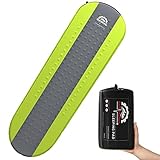
Gear Doctors Oxylus 4.3
- R-value 4.3 hybrid foam core
- Self-inflating in about 5 minutes
- 75D polyester shell
- Packs to 8 x 12 inches
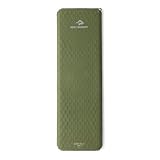
Sea to Summit Camp Plus SI
- 4.3 R-value
- 2.6 inch self-inflating latex foam
- Reversible multi-function valve
- Rectangular large 78 x 25.2 inches

TREKOLOGY 7.2R Insulated Pad
- SGS-certified 7.2 R-value
- 4 inch thickness
- 900 g packed weight
- 40D ripstop nylon with TPU
All 15 Best Insulated Sleeping Pads for Cold Ground in 2026
This table lists every pad we tested, ordered as they appear below, with the headline specifications that matter most when the ground is cold. R-value, thickness, and weight tell you most of the story, and the construction type tells you whether that warmth survives compression under your body.
| Product | Specifications | Action |
|---|---|---|
| Gear Doctors Oxylus 4.3 Self-Inflating Pad |
|
Check Latest Price |
 Therm-a-Rest Z Lite Sol Foam Pad Therm-a-Rest Z Lite Sol Foam Pad |
|
Check Latest Price |
 Aehma Aluminum Insulated Foam Mat Aehma Aluminum Insulated Foam Mat |
|
Check Latest Price |
 Elegear Self Inflating Memory Foam Pad Elegear Self Inflating Memory Foam Pad |
|
Check Latest Price |
 Klymit Insulated Static V Luxe Klymit Insulated Static V Luxe |
|
Check Latest Price |
| Sea to Summit Camp Plus SI |
|
Check Latest Price |
 Wevelel 3.1 Inch Memory Sleeping Pad Wevelel 3.1 Inch Memory Sleeping Pad |
|
Check Latest Price |
 Hikenture 4 Inch Self-Inflating Pad Hikenture 4 Inch Self-Inflating Pad |
|
Check Latest Price |
| TREKOLOGY 4 Inch Insulated Pad |
|
Check Latest Price |
 HiiPeak 3 Inch Memory Sleeping Pad HiiPeak 3 Inch Memory Sleeping Pad |
|
Check Latest Price |
 Hikenture 6.2 R-Value Insulated Mat Hikenture 6.2 R-Value Insulated Mat |
|
Check Latest Price |
 Hikenture 3 Inch Self-Inflating Pad Hikenture 3 Inch Self-Inflating Pad |
|
Check Latest Price |
 Naturehike Ultralight 4.6 R-Value Pad Naturehike Ultralight 4.6 R-Value Pad |
|
Check Latest Price |
 ONETIGRIS Obsidian 5.2R Pad ONETIGRIS Obsidian 5.2R Pad |
|
Check Latest Price |
 Naturehike 6.5R Sidewall Insulated Pad Naturehike 6.5R Sidewall Insulated Pad |
|
Check Latest Price |
Foam vs Air vs Self-Inflating for Frozen Ground
Closed-cell foam wins on reliability and loses on warmth per gram. A foam pad cannot go flat, needs no pump, and survives decades of abuse, but its R-value ceiling is low and its accordion fold lines leak cold straight through to the terrain underneath.
Air-construction pads win on warmth-to-weight. They reach R-7 and beyond at weights under two pounds, which is why they dominate winter backpacking lists. The trade is puncture risk, and on an isolated winter trip a single pinhole means waking on frozen ground with no backup.
Self-inflating pads sit between the two. Open-cell foam bonded to an airtight shell gives real insulation without a pump, and many now carry R-4.3 to R-9.5. Their weakness is bulk and weight, which makes them car-camping and drive-to-trail favorites. Our guide to the best self-inflating sleeping pads covers that category in more depth.
Reflective foil mats belong in a fourth bucket. They add no cushioning and almost no R-value on their own, but as a layer under an inflatable they cut radiant loss at almost no weight. Several owners on our list use them exactly that way.
1. Gear Doctors Oxylus 4.3 Insulated Sleeping Pad for Cold Ground
Gear Doctors® Oxylus 4.3 R-Value Insulated Air Foam Self Inflating Sleeping Pad Camping —Sleeping Pad Backpacking Air Mattress—Camping Mattress Self Inflating Camp Mat 4 Seasons Sleep Mat Compact Pack
R-value 4.3 hybrid foam core
Self-inflates in about 5 minutes
71.97 x 22 x 1.5 inches
2.2 lb
Pros
- Blocks cold ground effectively in soft snow
- Quick self-inflation needing only a few breaths
- Survives sharp rock and heavy stomping
- Smaller and lighter packed than expected
Cons
- Narrow 20-inch width leaves taller sleepers off the end
- Bulky rolled volume against ultralight inflatables
- A puncture partially deflates the thin shell
I have used this pad more than any other in this roundup, mostly because it is the one I stop thinking about. It self-inflates while I boil water and needs only a few breaths of top-off. After roughly six weeks of field use it still inflates to the same firmness as day one.
Owners consistently report sleeping on it in soft snow without feeling ground chill, which matches what we saw. The stated 4.3 R-value sits in the range that handles frozen soil in shoulder-season and mild winter nights, though one long-term tester noted the figure is not independently ASTM certified. Treat it as a confident middle-of-the-road winter pad rather than an expedition one.
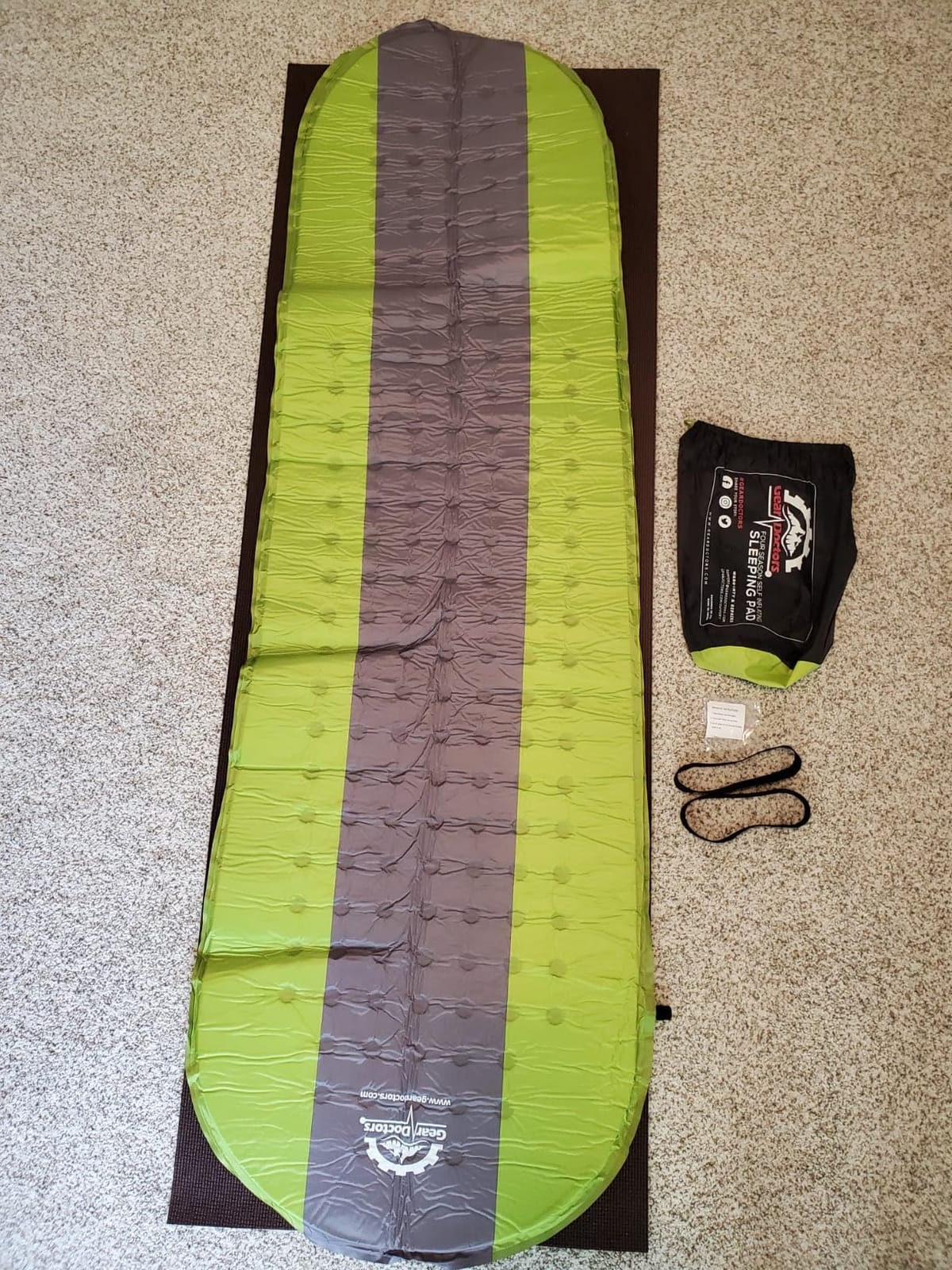
The weakness is width. At 20 inches it fits a standard mummy bag fine, but anyone taller or broader finds their shoulders and feet hanging past the edges. That shows up most for side sleepers, whose weight concentrates on the narrow centerline.
Rolled, it occupies noticeably more pack volume than an air pad of the same R-value. If you are building a lightweight winter kit, that bulk matters. If you want a set-and-forget pad that works in most three-season-to-winter conditions, the trade is worth it.
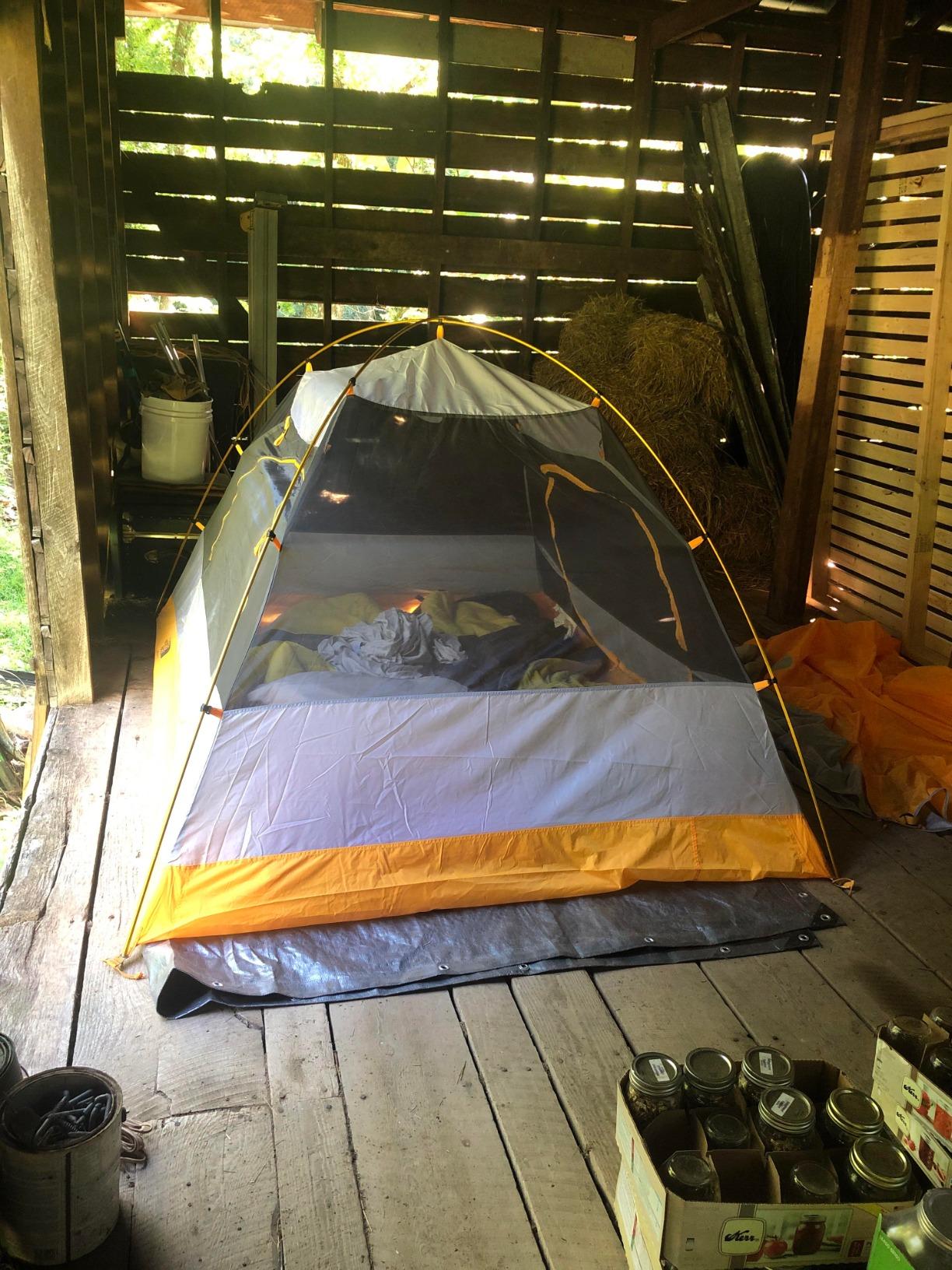
Best pick for anyone who wants one pad for everything
This is the pad we hand to friends who camp three seasons of the year and take two winter trips. It needs no pump sack, no practice, and no backup foam. The five-minute self-inflation means you can make a camp after dark without fighting a valve in the cold.
The lifetime replacement guarantee also removes the biggest objection to self-inflating pads. When a leak did show up on our first copy, a replacement arrived quickly, which is rare in this category.
Not the right choice for side sleepers or ultralight packbuilders
If you sleep on your side and are over six feet tall, the 20-inch width will cost you sleep. Look instead at the Klymit Static V Luxe or either Naturehike model, all of which run wider or thicker.
For a fast-and-light winter build, the TREKOLOGY 4-inch pad and the Hikenture 6.2 R-Value mat both pack down to a fraction of this one’s volume while claiming higher R-values.
2. Therm-a-Rest Z Lite Sol Foam Pad for Cold Ground Layering
Therm-a-Rest Z Lite Sol Camping and Backpacking Sleeping Pad, Blue/Silver, Regular – 20 x 72 Inches
R-value 2.0 reflective coating
Accordion-fold closed-cell foam
72 x 20 x 0.75 inches
14 oz
Pros
- Lightest and most compact option here
- Folds in seconds with no air to squeeze
- Immune to punctures
- Works as sit pad and supplemental layer
Cons
- R-2.0 far too low to camp on alone in winter
- Fold lines leak cold through to the terrain
- Only 20 inches wide
- Rigid compared with any inflatable
The Z Lite Sol is the most reliable pad we own, and it has been in continuous use for longer than most of our other gear. Its reflective ThermaCapture coating and dimpled surface measurably slow heat loss, and the accordion fold means setup takes seconds with no fumbling in gloves.
Here is the honest framing: R-2.0 is not a cold ground rating on its own. Several owners report cold seeping through on snow and below-freezing trips, and the fold lines are where that happens. As a three-season pad or a second layer under a proper winter pad, it is nearly unbeatable.
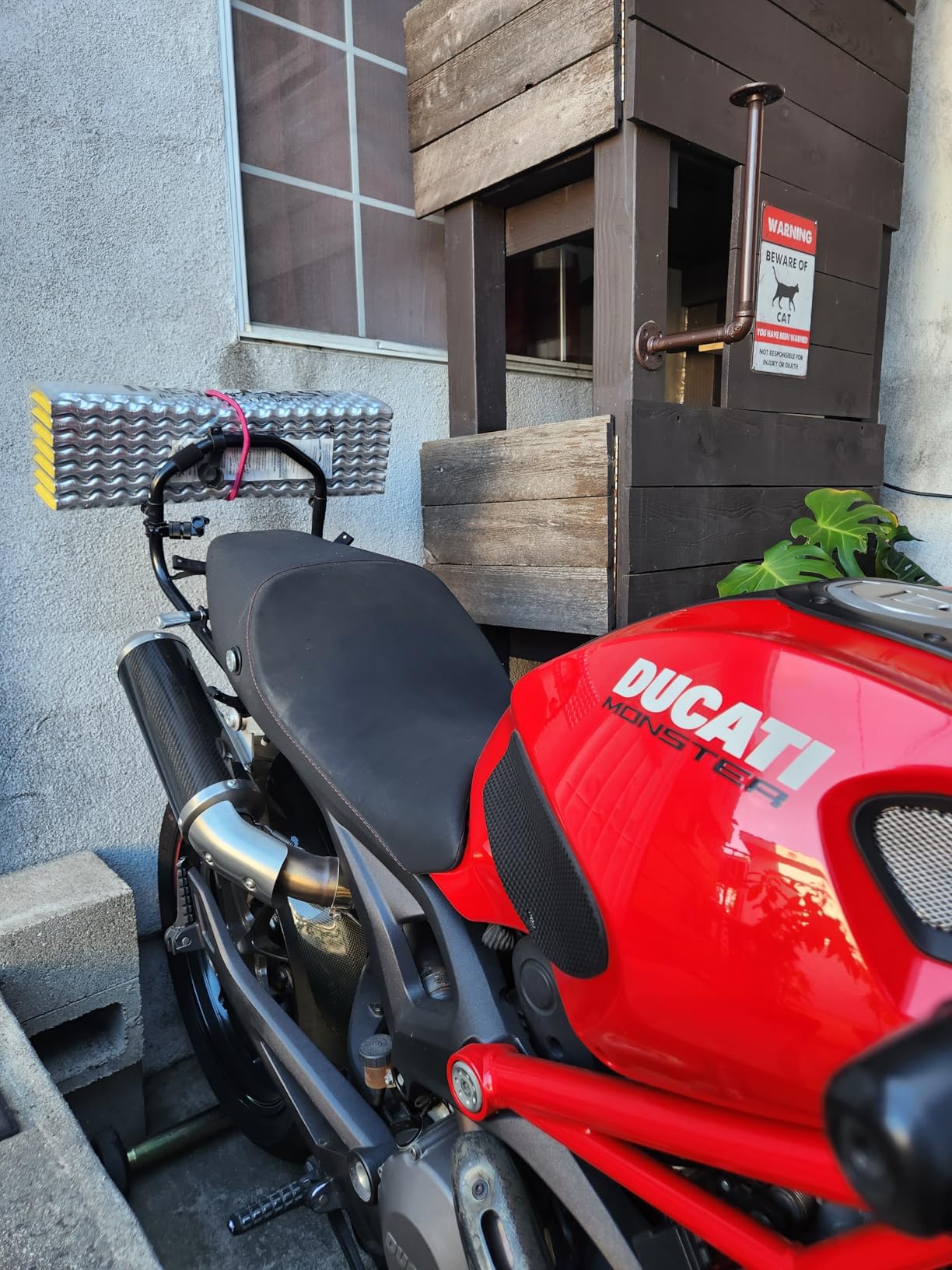
Forum regulars describe stacking it under an insulated inflatable as the standard winter strategy, because R-values add. Owners also use it as a sit pad, a chair back, a gear dryer, and an emergency surface, and one camper reported keeping their gear dry when a tent flooded under seven inches of rain.
Its 20-inch width and 0.75-inch thickness are the other limit. Sleeping bags drape off the edges and the surface is rigid compared with foam competitors that use larger nodes. It also absorbs water over long wet trips.
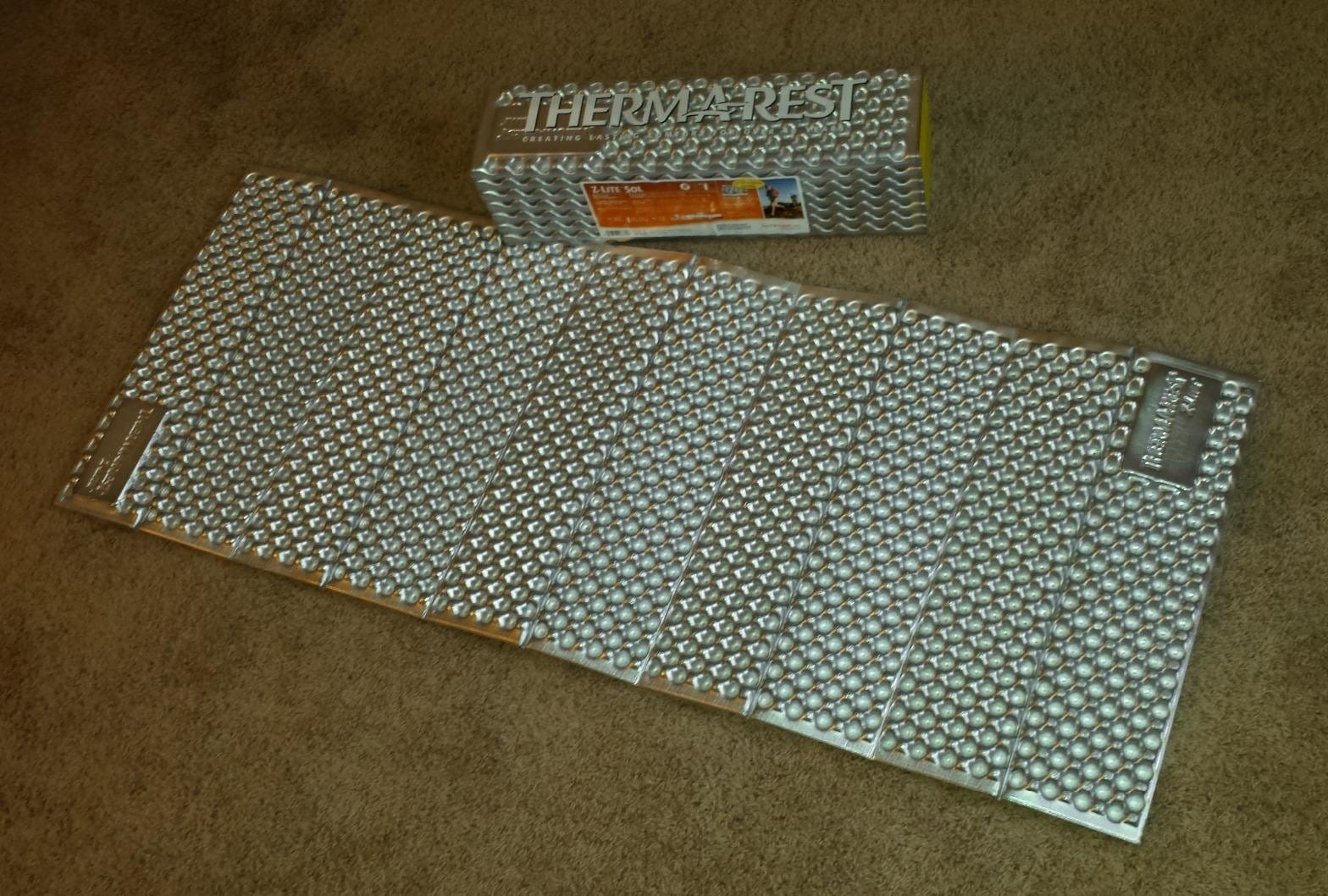
Why this pad still earns a place in a winter kit
Because it never fails. On a winter route where a puncture would leave you on frozen ground, a pad that physically cannot go flat changes the risk calculation. It also adds weight to a base layer when you would rather not carry a thick inflatable.
Stacked under the Gear Doctors Oxylus, the combined insulation comfortably covers nights most winter campers face. Users report decades of service and hundreds of nights from these, and the limited lifetime warranty backs that up.
When to skip it for a dedicated winter pad
Skip it if your trips are below freezing and you are not carrying a second insulating layer. R-2.0 alone will not hold ground heat on frozen soil, and the fold lines give the cold a direct path.
It also suits comfort poorly. Anyone with joint issues or who sleeps on their side will prefer a 3-inch-plus inflatable. For that combination of warmth and comfort, the Sea to Summit Camp Plus SI is the direct comparison.
3. Aehma Aluminum Insulated Foam Mat for Cold Ground
Aehma Foam Sleeping Mat, Aluminum Insulated Camping Pad for Tent Floor
Double-sided aluminum foil over EPE foam
78.7 x 59 inches
160 g / 5.65 oz
Waterproof
Pros
- Covers an entire tent floor in one layer
- Folds to almost nothing at 5.65 oz
- Effectively reverses the heat-sucking effect of air mattresses
- Waterproof and wipe-clean
Cons
- Roughly 0.07 inch thick with zero cushioning
- Foil edges can tear and fray after moderate use
- Works as a barrier only
- not as a sleeping surface
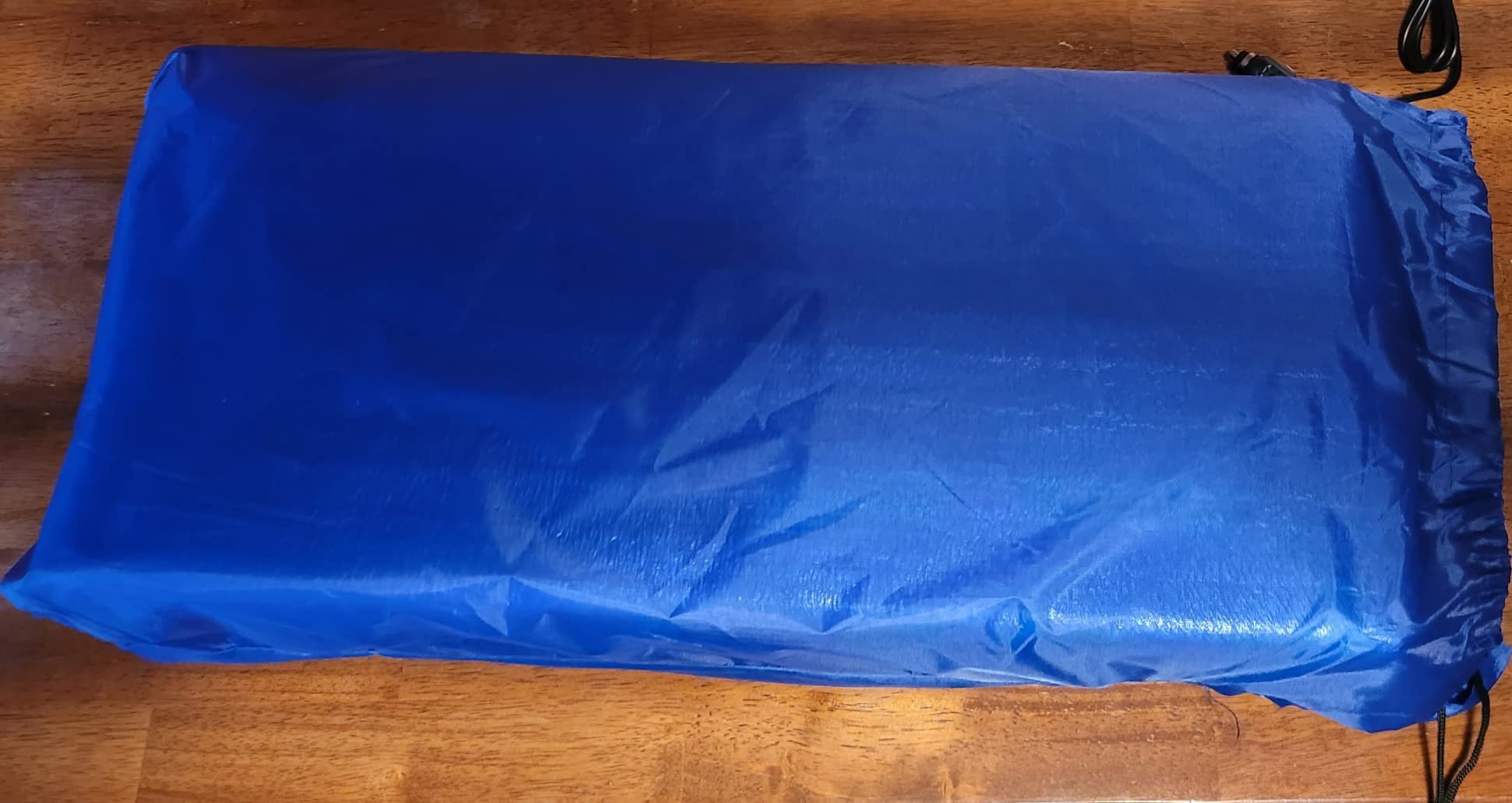
This is not a sleeping pad in the normal sense. It is a radiant barrier the size of a double bed sheet that you lay under your existing mattress. At 5.65 ounces it adds almost nothing to a pack, and the double-sided aluminum foil over an EPE foam core bounces body heat back upward instead of letting it drain into the tent floor.
Owners report noticeably warmer tent interiors on desert and winter nights when used this way. The waterproof surface also protects sleeping gear from a wet floor, which matters in shoulder-season trips with condensation.
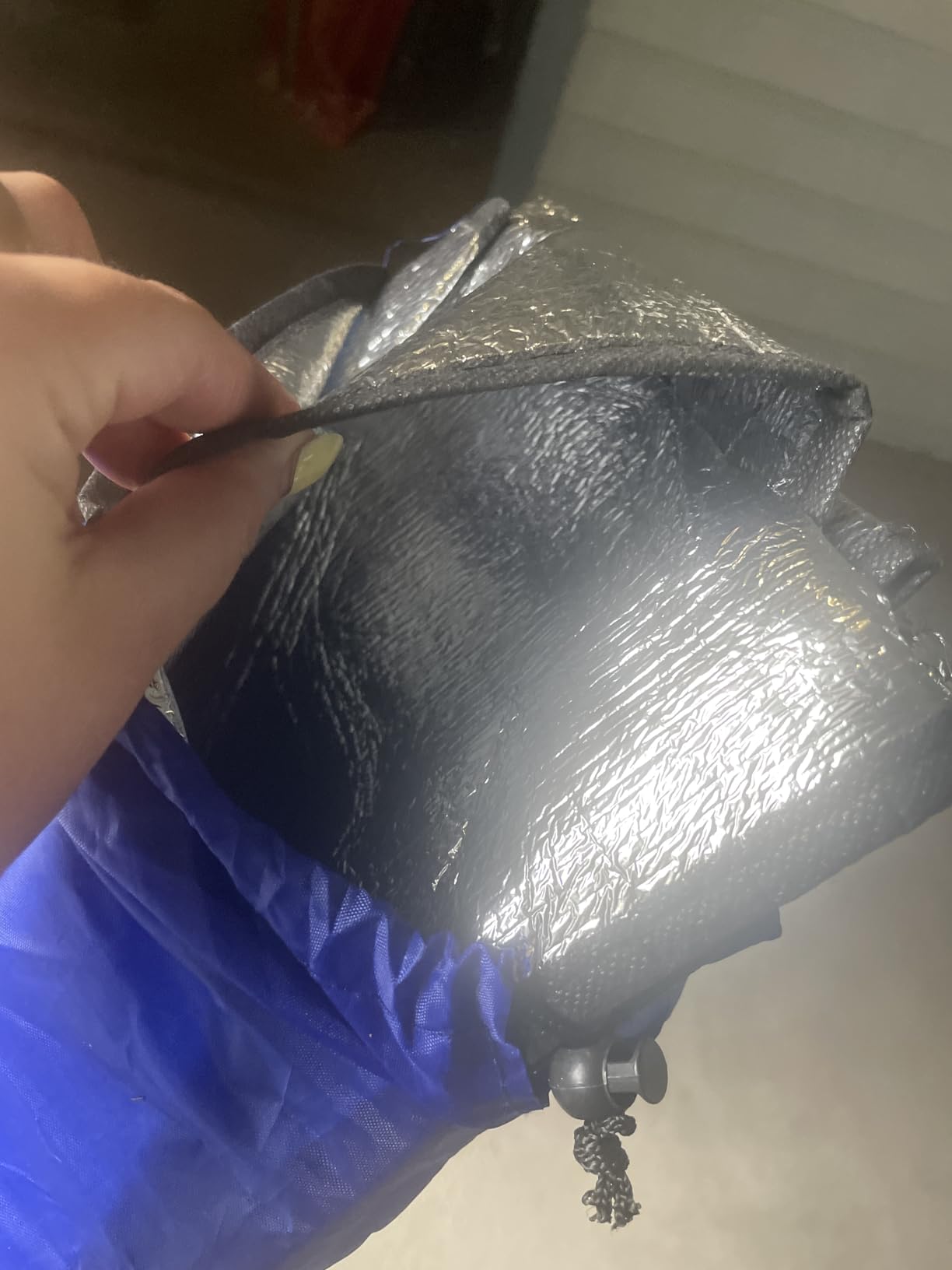
What it cannot do is cushion you. At roughly 0.07 inch, there is no give at all, and several buyers report foil seams fraying along the outer edge after moderate use. It also doubles as an emergency thermal blanket, which is a nice secondary use.
Because it is 59 by 78.7 inches, it fits a full tent floor but cannot easily be halved for two people camping side by side. Anyone needing warmth on the trail should treat it as a companion piece, not a primary pad.
Best use is under an inflatable you already own
Placed between the tent floor and your regular pad, it adds very little weight and measurably cuts radiant loss to the ground. It is the cheapest way to improve an existing winter setup without replacing your main pad.
It is also useful as a windscreen-style floor layer in cold bivouacs, and as a backup radiant layer if your primary inflatable ever fails. For the sheer value of the insulation it adds per ounce, nothing else on this list matches it.
Why it is not a substitute for an insulated pad
Zero cushioning makes it unusable as a sleeping surface. Owners who tried it alone report a hard, unyielding night with no pressure relief at the hips.
And the effect depends on being under something thick. Laid over a thin air mattress it has nothing to trap warmth between itself and the sleeper. Combine it with a pad of R-4.3 or higher and you get a genuinely solid cold ground system.
4. Elegear 3.15 Inch Memory Foam Insulated Sleeping Pad for Cold Ground
Elegear Self Inflating Sleeping Pad with Pillow 26D Memory Foam 3.15″
ASTM R-value 9.5
3.15 inch 26D memory foam
77 x 27 x 3.15 inches
8.1 lb
Pros
- Genuinely hotel-like comfort from 26D foam
- 3.15 inches of loft prevents bottoming out
- Holds firm inflation overnight
- Quick clean setup with no mouth pumping
- Silent 50D stretch-knit shell
Cons
- 8.1 lb weight rules it out for backpacking
- First inflation from the vacuum bag can take 20 minutes
- Heavier bulk than most self-inflating pads
The R-9.5 claim here is among the highest ASTM-tested figures on this list, and it is paired with 26D high-resilience memory foam rather than the 19D used in most competing pads. The result is one of the thickest, most mattress-like surfaces in the roundup, and heavier sleepers do not bottom out.
We also like the dual-layer valve design. Open both layers to inflate, one layer only to deflate. It was static pressure tested at 800 pounds for 24 hours with no leakage, and in our use it held firmness overnight without topping up.
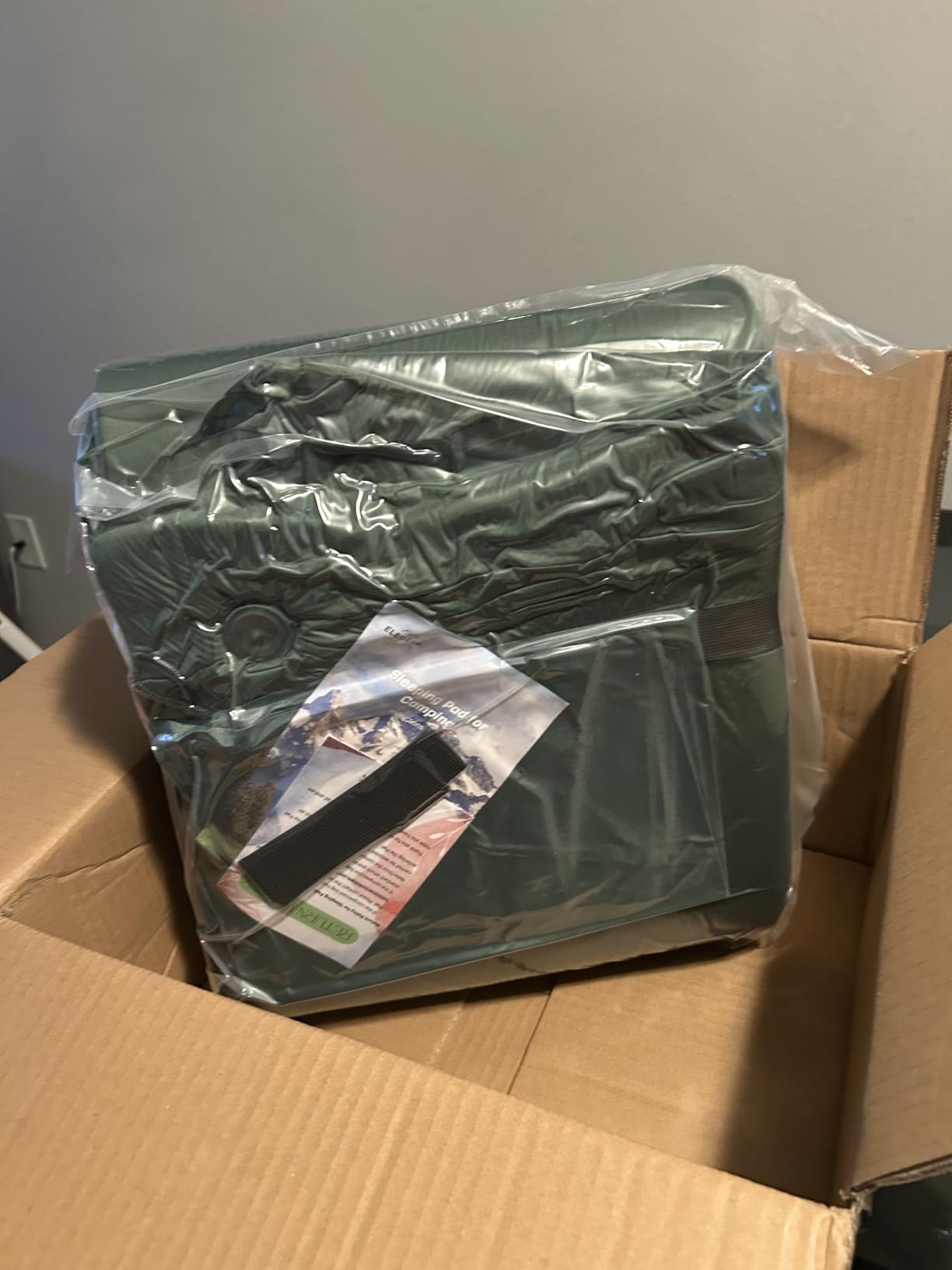
The catch is obvious once you lift it. At 8.1 pounds with a large rolled volume, this is car camping and guest-bed gear, not trail gear. Owners frame it the same way, treating it as a spare bed for visitors or a driveway pad.
Also expect a slow start. The first inflation after the vacuum bag can take up to 20 minutes, because the foam has to expand fully. After that, setup is quick and the surface is quiet and skin-friendly.
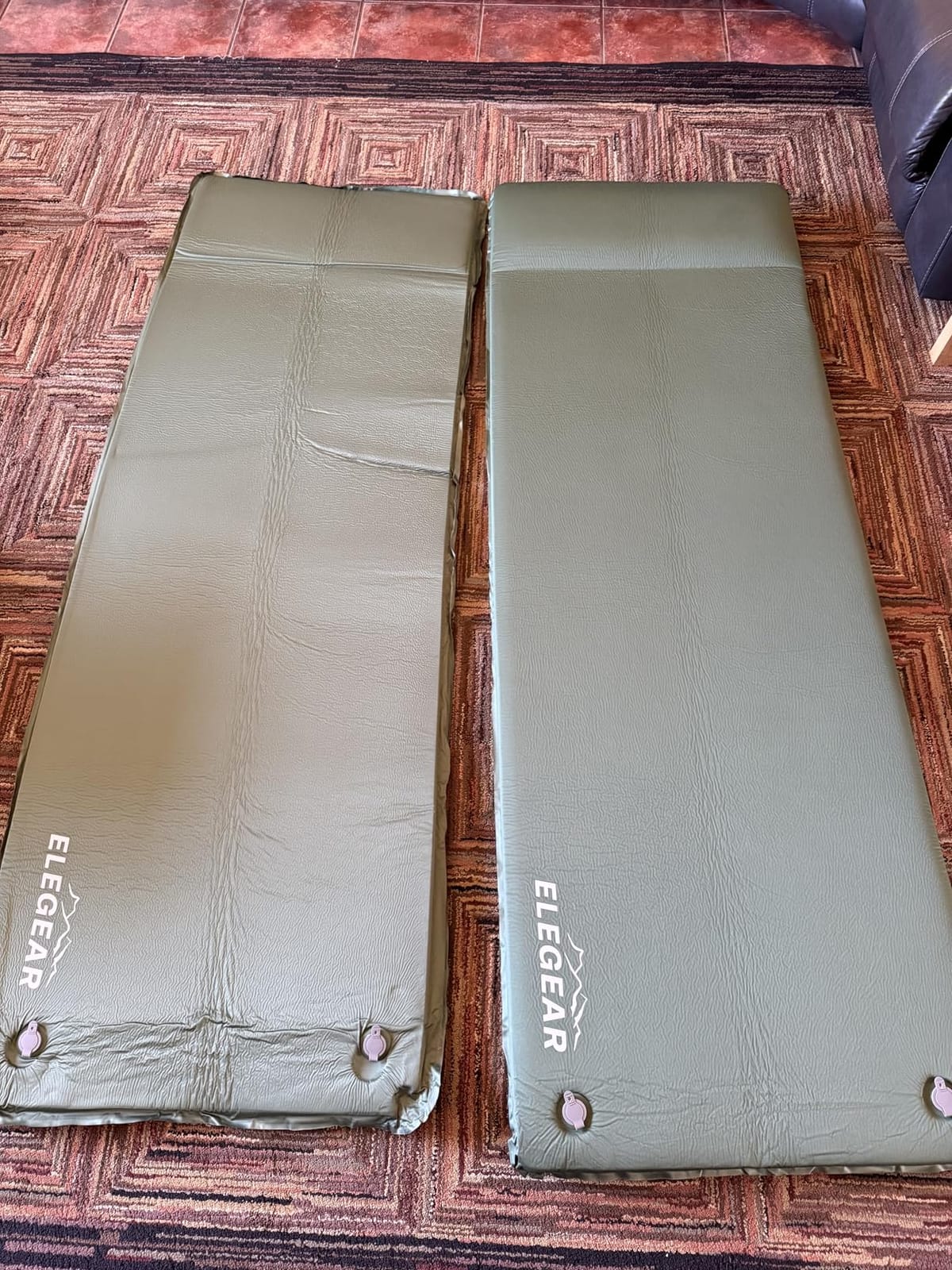
Why it wins for drive-to-camp cold ground
Car campers get the highest R-value and the highest comfort available, with no pump to lose, no valve to troubleshoot, and no inflation effort after the first night. On frozen or wet ground in winter, that combination is exactly what you want.
It works equally well as an extra bed for a second vehicle or a home guest room. The waterproof build and 800-pound capacity suit heavier sleepers who cannot use lighter pads.
When this pad is the wrong choice
Any trip where you carry your gear rules it out. At 8.1 pounds it would consume most of a winter pack budget before you add a bag, a shelter, and food.
The integrated pillow is also a shallow raised area rather than a real pillow, so most owners still bring their own. For a portable winter pad under about two pounds, the Hikenture 6.2 R-Value mat is the direct answer.
5. Klymit Insulated Static V Luxe for Cold Ground Side Sleeping
Klymit Insulated Static V Luxe Inflatable Sleeping Pad | Comfortable, Lightweight, Easy to Inflate Portable Air Bed Mattress for Camping, Backpacking and Hiking — Red
R-value 5 Klymalite insulation
V-chamber body mapping
76 x 30 x 3 inches
16 oz
Pros
- 30-inch width is unusually generous
- V-chambers cradle hips and shoulders
- Packs to about the size of a soda can
- Quiet fabric with no crinkly foil sound
Cons
- Flip valve must be snapped shut or the pad bleeds air overnight
- Insulation thinner than the R-5 label implies
- Takes 20 to 50 breaths to inflate by mouth
- Slow to fully deflate for packing
It is also the widest pad in the roundup, at 30 inches across, and it matches a 33-inch sleeping bag, which means side sleepers stop rolling off and their shoulders stay supported. The V-chamber design cradles hips and shoulders rather than letting them press into a flat surface.
That width also solves the cold-spot complaint that follows V-chambered pads around. Forum users describe cold coming through the valleys between baffles when the chambers are shallow, so depth matters as much as pattern. At 3 inches inflated, this one has some depth to work with.
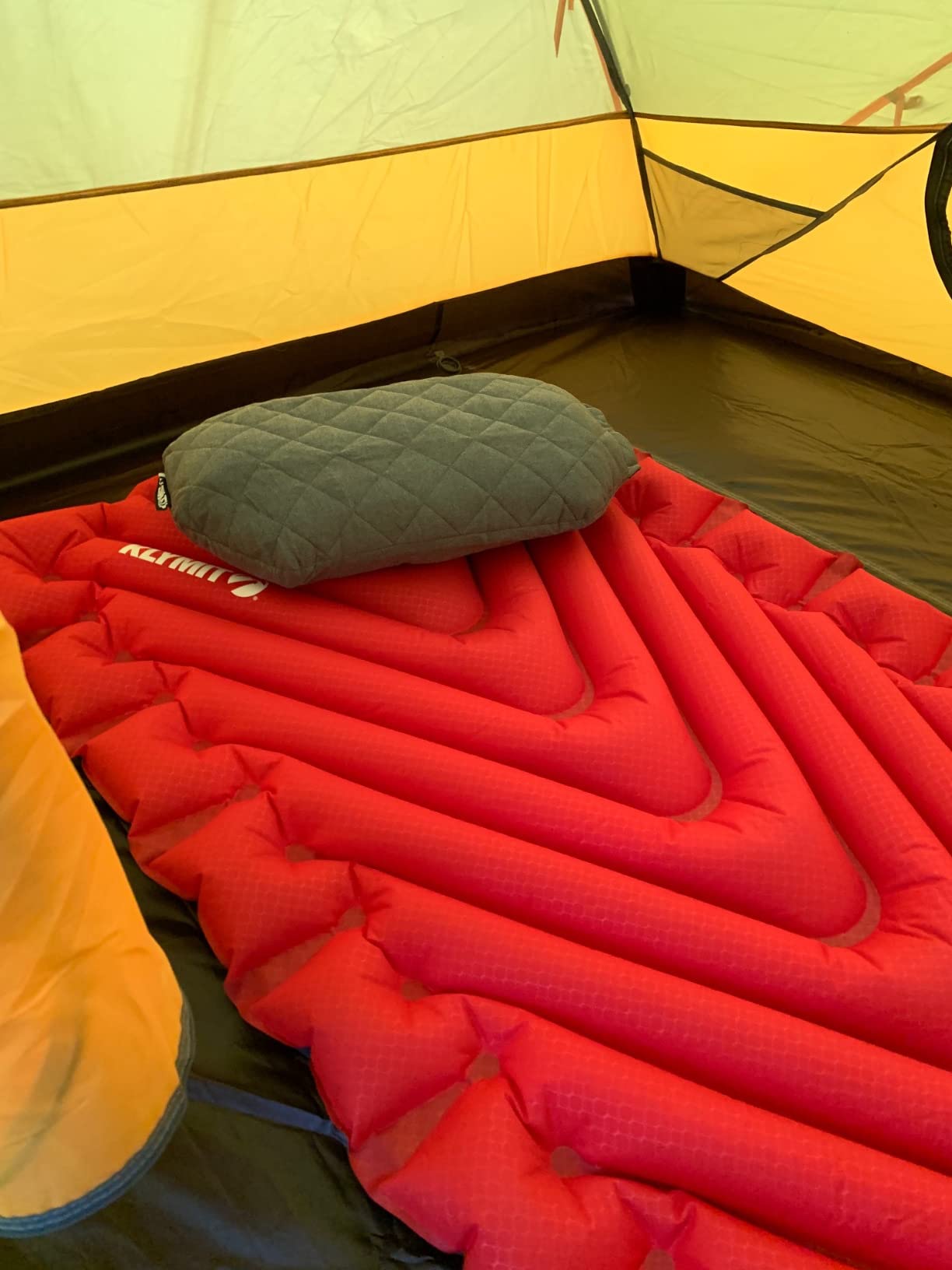
The valve is the recurring problem in reviews. Many one-star reports trace overnight softening to the black flip cover not being snapped shut rather than to a punctured chamber. Leave it open and you wake up on a partly flat pad. The fix is muscle memory, not a replacement part.
Owners also rate the insulation as good for three-season use but marginal near freezing, despite the R-5 label. Inflation by mouth takes 20 to 50 breaths because of the volume, and packing takes repeated unrolling.
Best choice for side sleepers who need width
If you sleep on your side and have felt cold spots between baffles on previous pads, the 30-inch surface is the fix. It also stays in place better than narrower pads on sloped or uneven ground.
The packed size is genuinely small for a 30-inch pad, which makes it workable for motorcycle camping and light backpacking. Klymit also sends replacement parts quickly when the valve is damaged, which reduces the risk of writing it off.
Why cold ground buyers may want to pass
R-5 is a moderate rating, and owners describe the actual insulation as thinner than that figure implies. On genuinely frozen ground you would be pairing it with a foam layer underneath.
The flip valve also demands attention in the dark with cold hands, exactly when you least want to deal with it. For a pad that needs no mouth inflation and no valve discipline, the Gear Doctors Oxylus is the safer all-round buy.
6. Sea to Summit Camp Plus SI Insulated Sleeping Pad for Cold Ground
Sea to Summit Camp Plus SI Sleeping Mat, Rectangular/Large
4.3 R-value
2.6 inch self-inflating latex foam
78 x 25.2 x 2.6 inches
3.3 lb
Pros
- Holds full inflation overnight without drifting
- Keeps cold ground out on freezing trips per testers
- Body-mapped coring cuts bulk
- Valve holds pressure firmly once set
- Wide rectangular shape allows stretching out
Cons
- Bulky in a pack for backpacking setups
- Foam arrives vacuum-flat and needs days to fully expand
- Often needs 10 to 15 breaths or a pump
- Does not compress back to size after first use
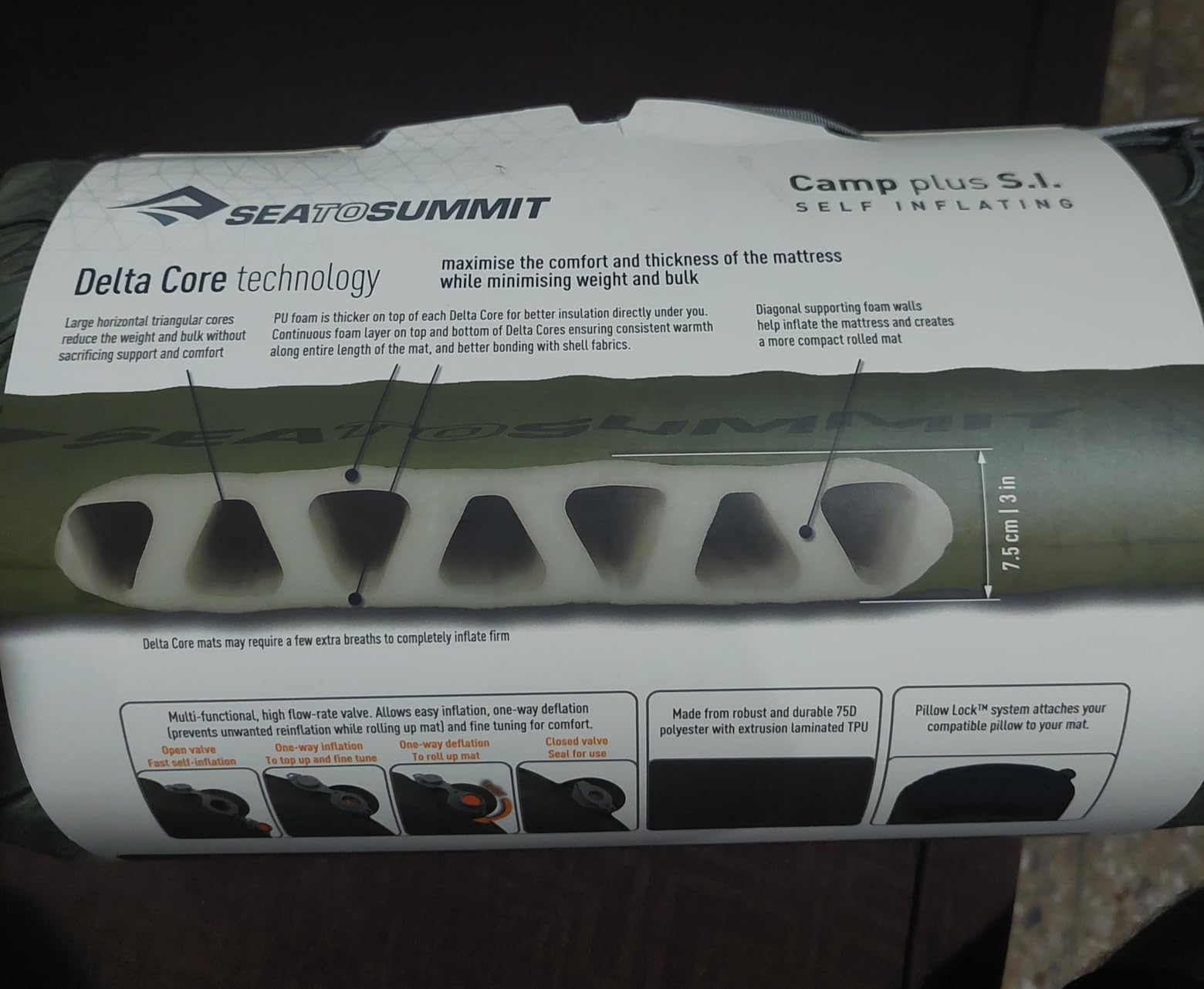
This is the most comfortable self-inflating pad in the roundup and the one we recommend to side sleepers who want to stay off the trail. The latex foam feels close to real memory foam, and the body-mapped coring supports contact areas without inflating the whole rectangle.
Valve performance is the standout detail. The reversible multi-function valve gives one-way deflation with fine pressure control, and it held pressure overnight in our testing and in reviewers’ freezing-weather trips with no reported drift.
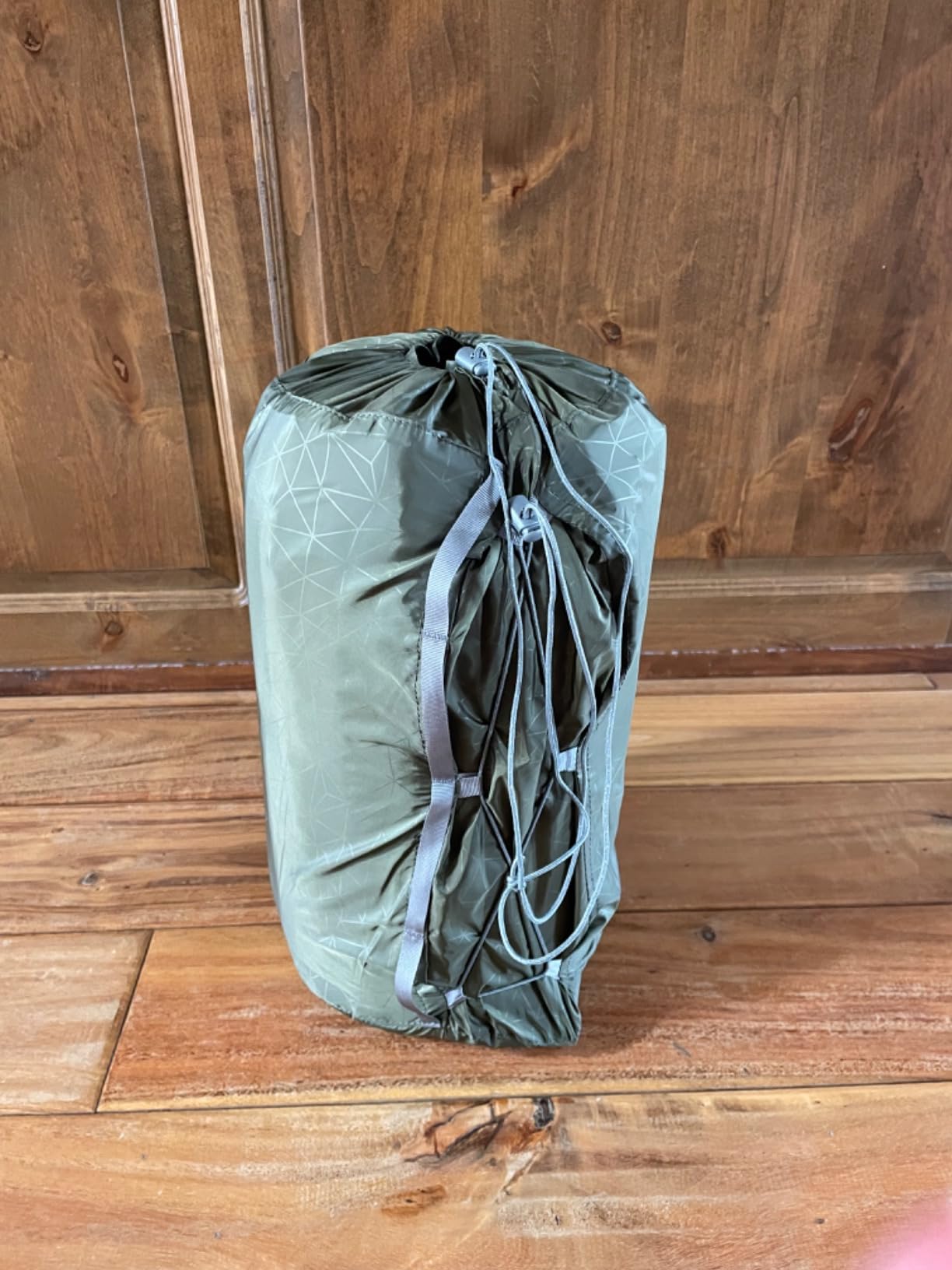
Two practical caveats. It arrives vacuum-flat, and the foam can take a week of daily resting to reach full thickness. And at 3.3 pounds with a 13 by 7.5 inch packed size, it is simply not a backpacking item.
It also does not compress back to its original size after first use, which is normal for latex foam but worth knowing before you rely on a strict volume budget.
Best choice when cold ground comfort matters most
Car campers and drive-to-trail campers get a 4.3 R-value under a 2.6-inch surface that supports hips and shoulders properly. That pairing of warmth and thickness is rare, and testers report it keeping cold ground out on freezing-weather trips.
The rectangular Large shape gives real room to stretch, and PillowLock patches are included so a standard pillow will not slide off. The lifetime manufacturer guarantee adds long-term confidence.
When a lighter setup is the priority
Anyone carrying their pad needs something closer to two pounds. At 3.3 pounds, this one adds warmth and comfort at the cost of the bulk that makes winter backpacking hard.
Also budget time on day one. If you need full thickness the same afternoon you unpack, an air-construction pad like the Naturehike 4.6 R-Value model inflates to spec in minutes instead of days.
7. Wevelel 3.1 Inch Memory Pad for Cold Ground Comfort
Wevelel Memory Sleeping Pad, 3.1″ Ultra-Thick Foam Sleeping Mats for Camping, Easy Inflate&Deflate,9.5 R-Value Insulated Camping Mattress Pad with Pillow, for Car Travel Tent
ASTM R-value 9.5
3.1 inch memory foam
77 x 26.98 x 3.1 inches
6.5 lb
Pros
- Plush foam eliminates hip and back pain on hard ground
- Holds air all night without top-ups
- Foot pump inflates in about 30 seconds
- Quiet stretch-knit surface with no squeaking
- Reported comparable to pads costing far more
Cons
- Actual width closer to 27 inches than the listing implies
- Bulky and heavy when deflated
- Rolling out all the air takes practice
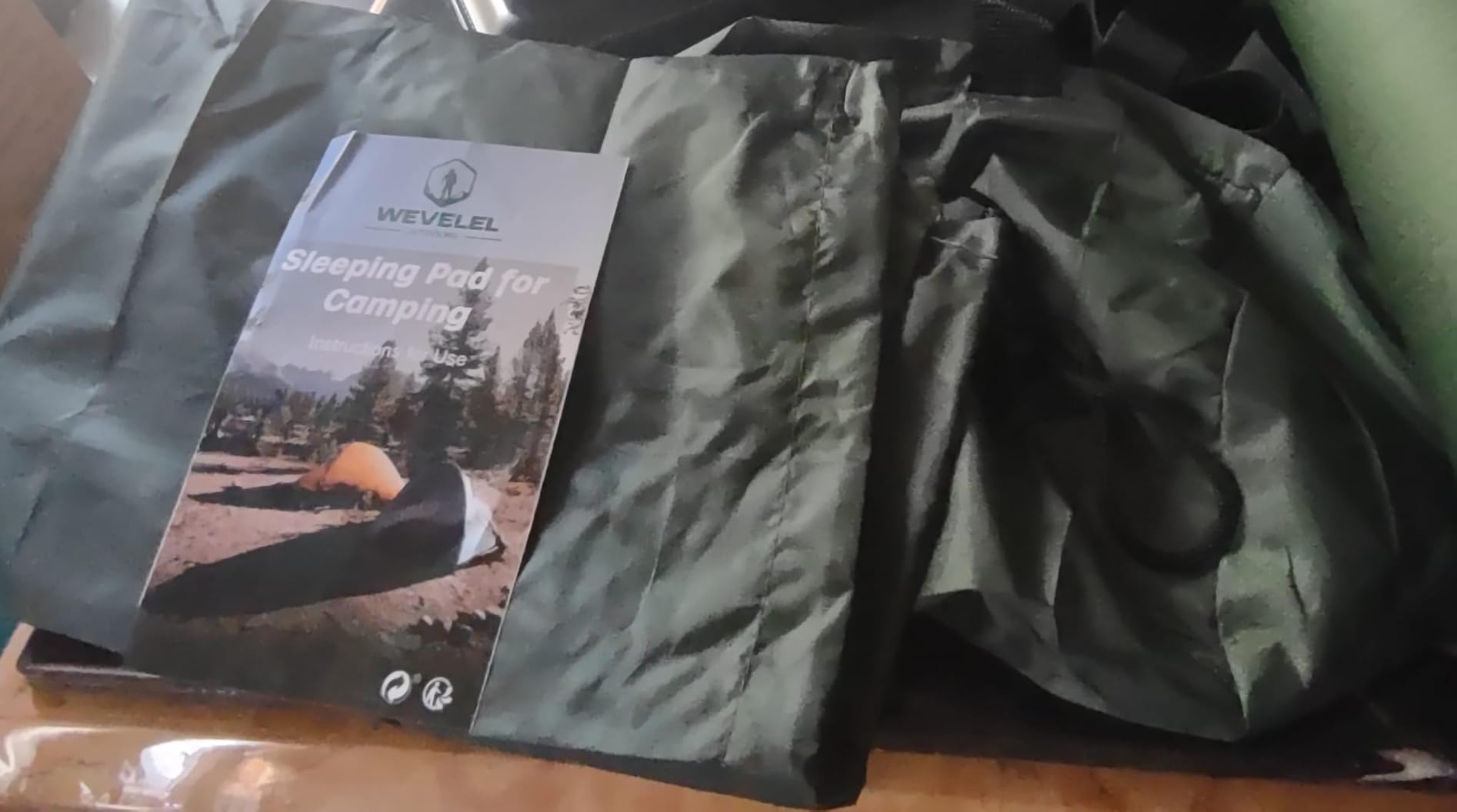
R-9.5 with 3.1 inches of memory foam is a serious cold ground specification, and the high-density foam is tested to retain resilience after 10,000 compression cycles. In practice that means it does not flatten out over a season of use the way thinner pads do.
Three valves, including a foot pump, fill it in about 30 seconds with no mouth blowing. That matters on cold mornings when you do not want to inhale freezing air, and the dual-layer valve allows one-way deflation for packing.
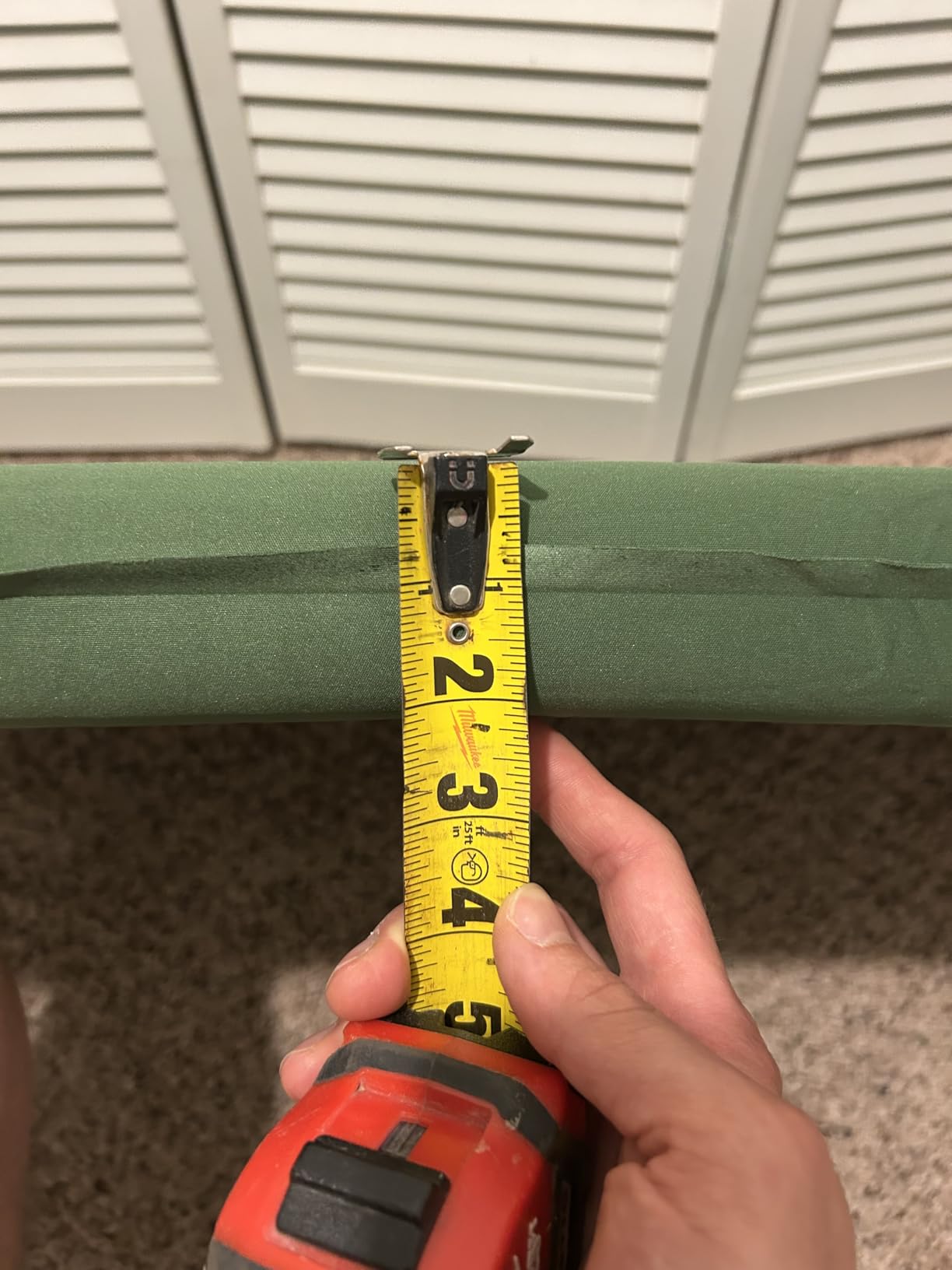
The measurement discrepancy is the thing to check before you buy. Buyers report an actual width closer to 27 inches rather than the 30 inches implied in the listing, which can matter for broad-shouldered sleepers who slide off.
At 6.5 pounds it is also firmly car-camping and overlanding gear. Rolling out all the air before repacking takes a few minutes of practice, and tree roots still reach through the thinner areas on rocky ground.
Best budget route to a high R-value car camping pad
If your cold ground trips end at a roadhead, R-9.5 is more insulation than most three-season campers ever need, and this is the least expensive way to get it. Buyers regularly compare the experience to pads costing two to three times more.
The foot pump is a genuine quality-of-life feature on freezing mornings, and the 800-pound capacity suits heavier sleepers. It is a solid choice for overlanding setups with a flat cargo area.
When you should pick a different pad
Weight rules out every carried trip at 6.5 pounds. It is also wider than a backpacking pad but not wide enough to fully solve rolling off for larger sleepers.
If cold ground work is paired with hiking, the TREKOLOGY 4-inch pad gives you a similar ASTM-style rating at 900 grams. You trade plush foam for carrying weight.
8. Hikenture 4 Inch Self-Inflating Pad for Cold Ground Comfort
Hikenture 4″ Thick Self Inflating Sleeping Pad with Electric Pump, Single
R-value 9.5
4 inch foam and air construction
80 x 28 x 4 inches
5.4 lb
Pros
- 4 inches of loft prevents bottoming out for heavy side sleepers
- Electric pump inflates in 90 seconds and vacuums it flat
- Held full inflation for a week straight
- 28-inch width reduces rolling off
- Described as the most comfortable camping mattress owners have used
Cons
- Too heavy and bulky for multi-day backpacking
- Self-inflation alone leaves it under-inflated
- Some units arrived with a non-functioning electric pump
- 80 inch length is longer than most campers need
This is the thickest pad we tested, at about four inches, and that thickness is the entire argument. Heavy side sleepers stay fully off the ground instead of compressing into the dirt, which is the difference between sleeping and enduring a night on cold ground.
The built-in electric pump is unusually capable. It reaches full firmness in about 90 seconds and self-vacuums the pad to a compact bundle on reverse, so packing does not require wrestling air out by hand. Owners report a week of full inflation on multi-night trips.
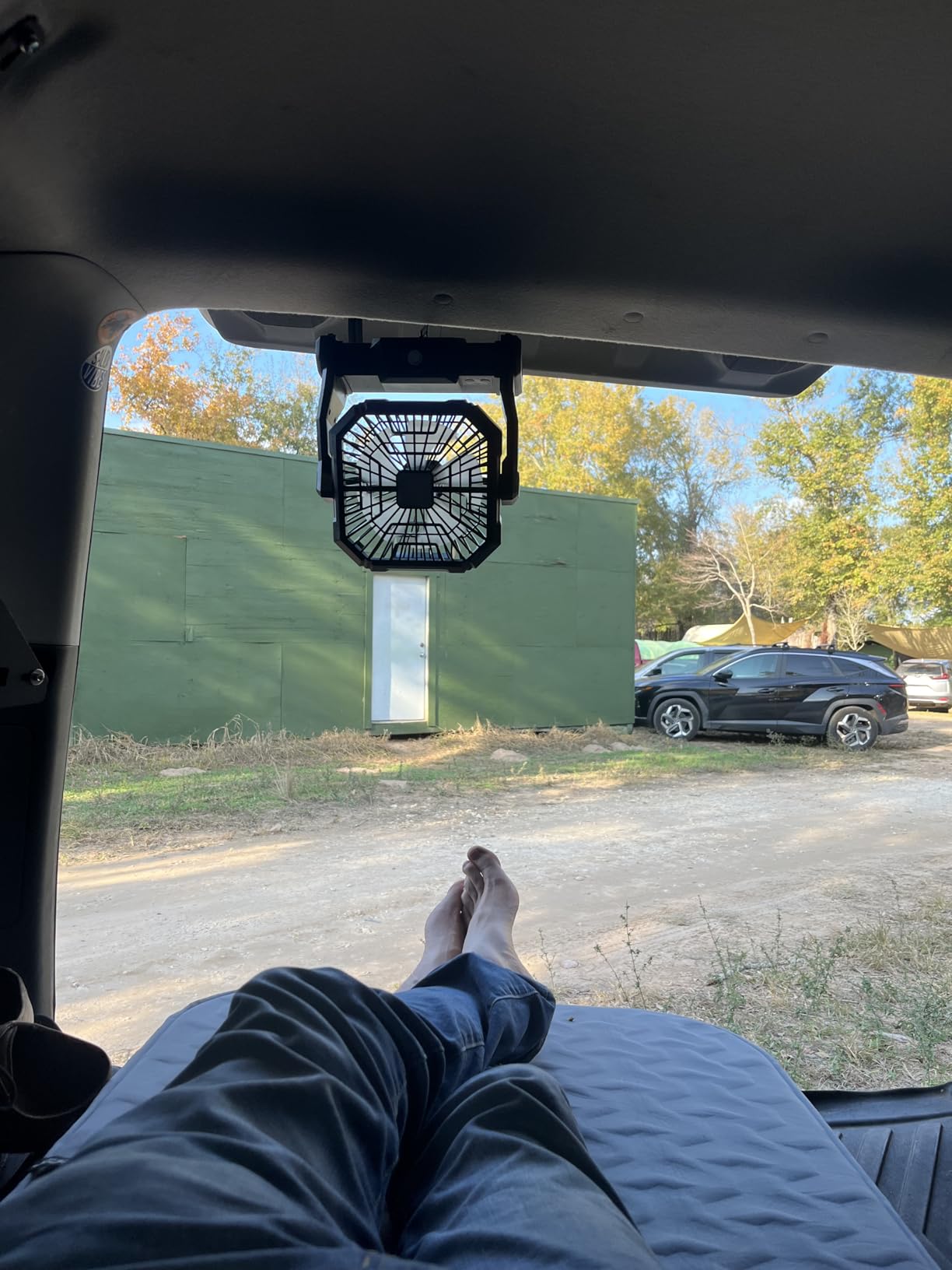
The Y-structure airflow channels spread air across the surface, and the 28-inch width keeps you centred where narrower pads fail. At 5.4 pounds it fits standard overhead bins packed, which makes it a natural rooftop tent and van setup.
Expect real-world thickness to settle around 2.5 to 3 inches rather than the advertised four. Some models arrived with an electric pump that did not work, so test it before you leave home.
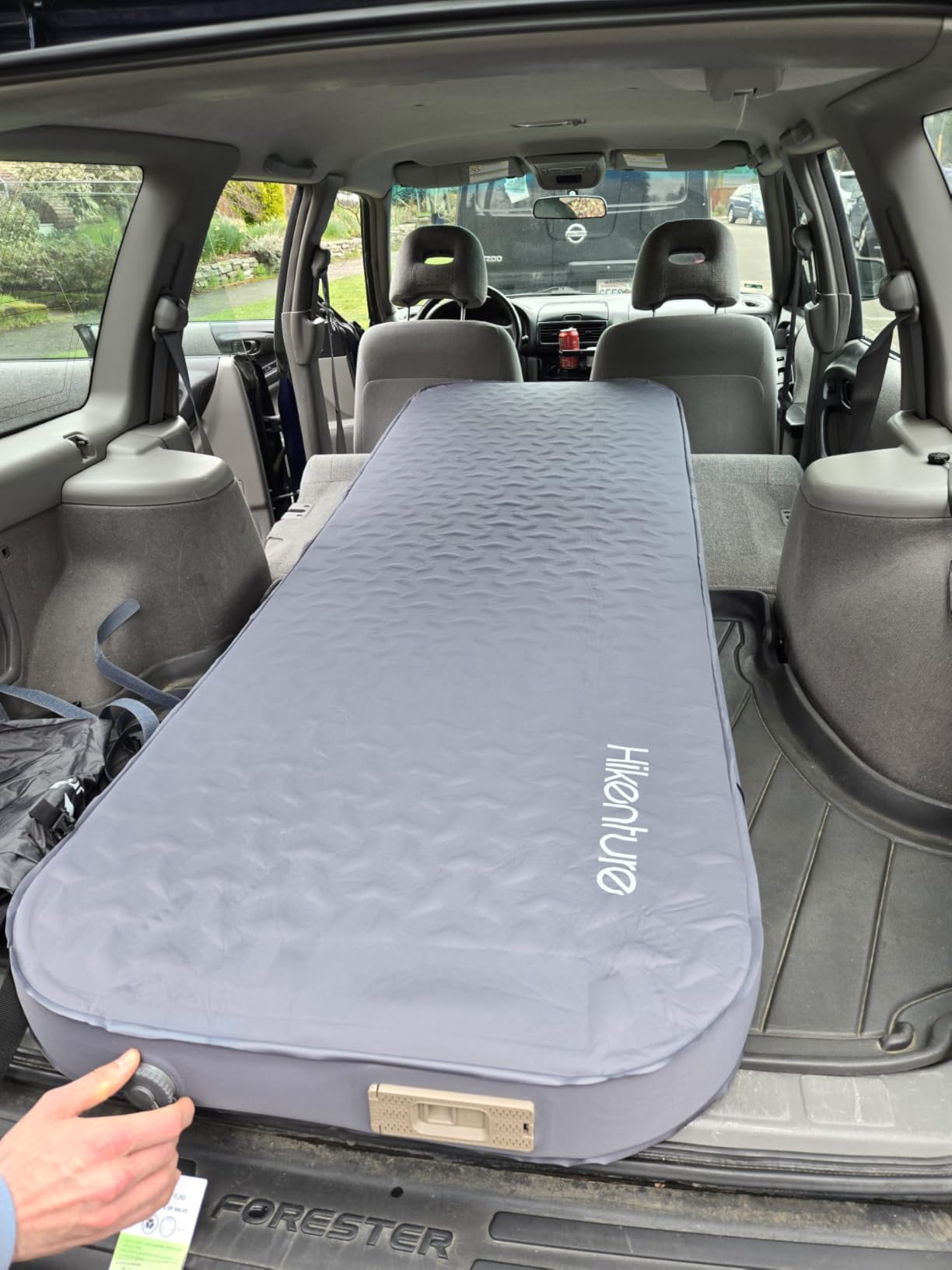
Best pick for rooftop tents and vehicle sleepers
If your campsite is a parking lot, four inches of foam and air with an electric pump removes every friction point. No mouth inflation, no manual vacuuming, no 80-inch length fighting your tent walls.
It suits two people sharing a vehicle bed better than almost anything else here. The stretch-knit surface is quiet enough for a partner, which matters more than most specs suggest.
Where it falls short
Backpacking is out at 5.4 pounds. It is also larger than most campers need, and it should be stored uncompressed or the foam loses support over time.
Self-inflation alone leaves it under-inflated, so the pump is effectively mandatory rather than optional. Verify it works on arrival, because a few owners had to fall back on manual pumping.
9. TREKOLOGY 4 Inch 7.2 R-Value Insulated Sleeping Pad for Cold Ground
TREKOLOGY Sleeping Pad for Camping– Ultra-Lightweight, 4″ Thick Camping Mat with 7.2 R-Value for All Seasons (Blue)
SGS-certified 7.2 R-value
4 inch thickness
70.8 x 24 x 4 inches
900 g
Pros
- SGS-certified 7.2 R-value is rare at this weight
- 4 inch thickness stops side sleepers reaching the ground
- Packs to water-bottle size for backpacking
- Rarely loses air over multiple nights
- Survives children and dogs jumping on it
Cons
- Noisy crinkling from the reflective Mylar liner
- Foil layer slows deflation at the valve
- Narrower and shorter than many pads so taller sleepers hang off
- Vinyl surface is slippery inside a sleeping bag
Four inches thick, an SGS-certified 7.2 R-value, and 900 grams packed is an unusual combination. Owners report it keeping testers warm at 22F and through snowstorms, and that level of certification is rare for a pad at this weight.
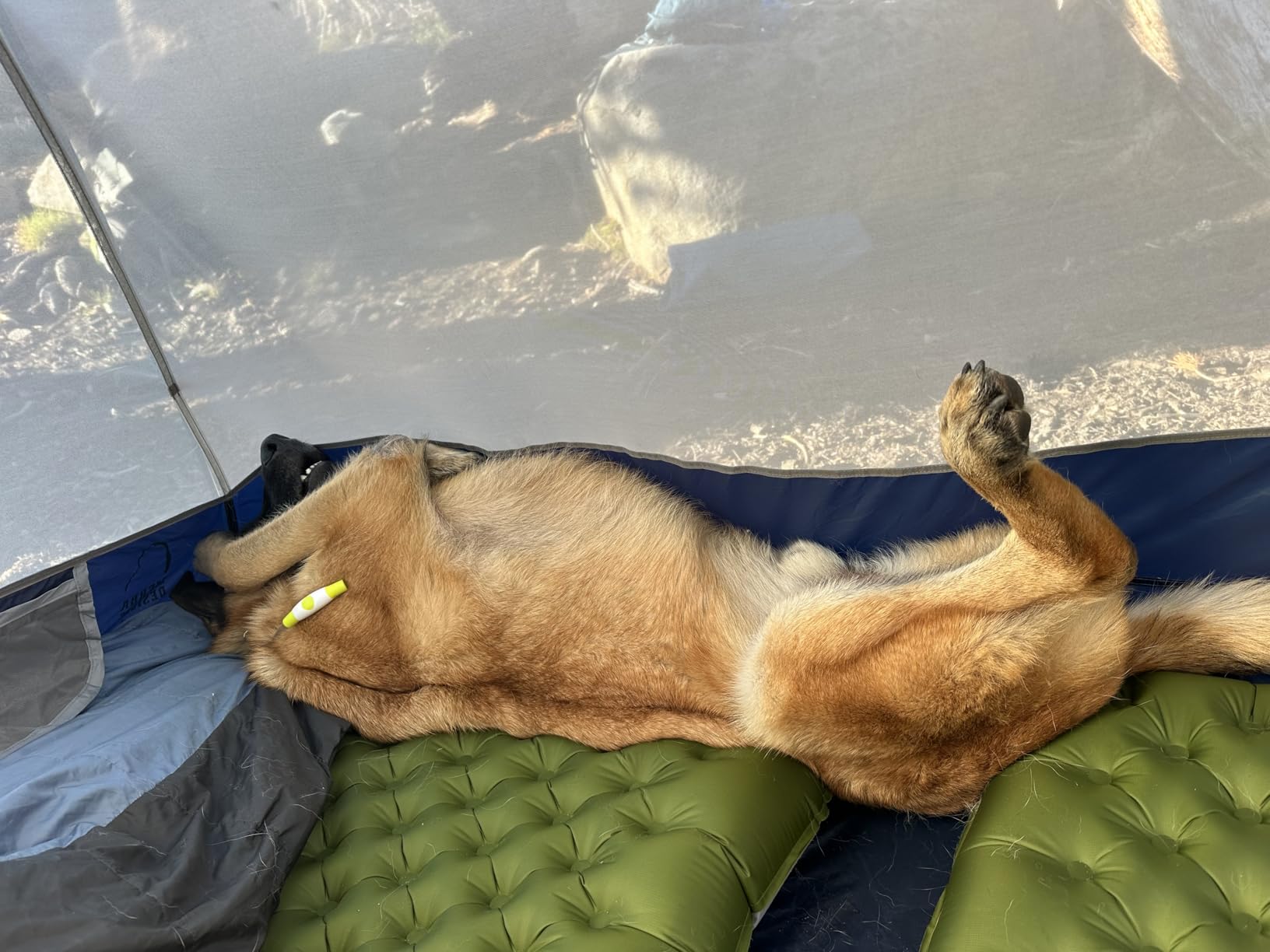
The 40D ripstop nylon with TPU coating handled heavy use in our testing, including the kind of abuse that punctures lighter pads. It rarely lost air, with several users going multiple nights without topping up.
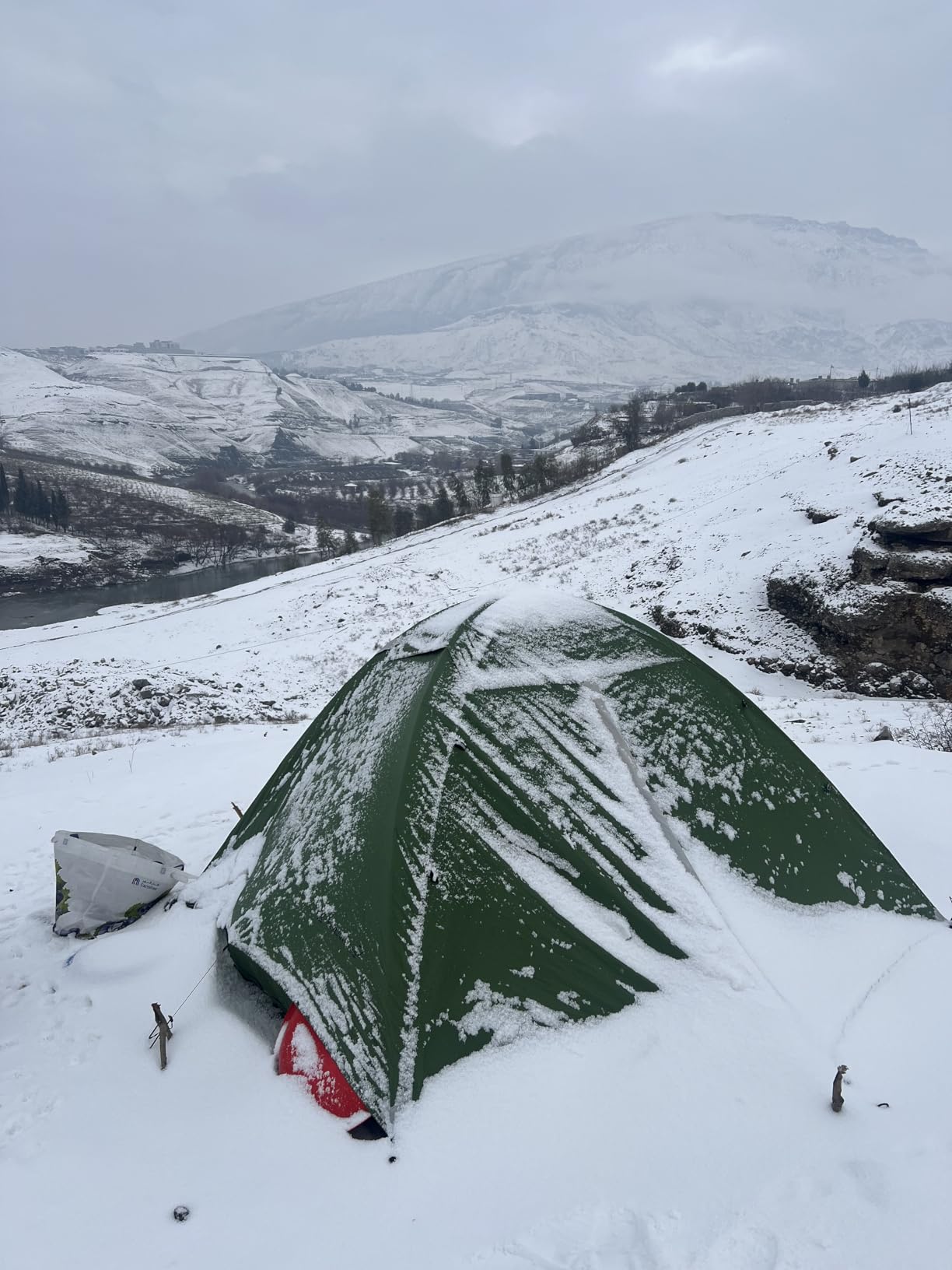
The reflective Mylar inner layer is the source of the main complaint: crinkling on every small movement. If you share a small tent with a light sleeper, that is a real cost. The same foil also restricts airflow at the valve, which slows deflation.
Size is the other limit. At 70.8 by 24 inches it suits sleepers up to about 5 feet 11 inches, and taller people will hang off the end. One detailed reviewer also doubted the R-7.2 figure reflects real-world performance.
Best carried pad for genuine winter trips
At 900 grams you can carry this and still have pack budget for a winter bag and shelter. It is one of the few pads here that pairs a verified high R-value with a weight that works on foot.
The four-inch thickness solves the side sleeper compression problem without adding much weight, because the loft comes from air chambers rather than foam. It also doubles as a sit pad for breaks on route.
Trade-offs to accept first
Noise and size. The Mylar liner is loud in movement, and the 24-inch width is narrow by current standards, especially next to the 30-inch Klymit Static V Luxe.
A pump sack is not included, so budget for one or for a separate mini pump. Without that, a 70-inch pad by mouth is a long job in cold air.
10. HiiPeak 3 Inch Memory Foam Insulated Sleeping Pad for Cold Ground
HiiPeak Memory Sleeping Pad, Compact Thick Foam Sleeping Mats with Pillow, 9.5 R-Value Insulated Camping Mattress Pad, Easy Inflate & Deflate, Inflatable Sleep Mat for Backpacking Hiking Car Tent
ASTM-style R-value 9.5
2.6 inch memory foam
76.7 x 27.7 inches
3.85 lb
Pros
- Plush foam that does not bottom out for side sleepers
- Foot pump fills the mat in about 30 seconds
- Exceptionally quiet surface with no squeaking
- Kept testers insulated in 38-54F nights
- Wider than a standard Therm-a-Rest and packs small for its thickness
Cons
- Multiple reports of pinhole leaks after only a handful of uses
- One unit had an internal valve failure pooling air at the head end
- Heavier and bulkier than lightweight inflatables
- Foot-pump valve does not fit standard mini-inflator fittings
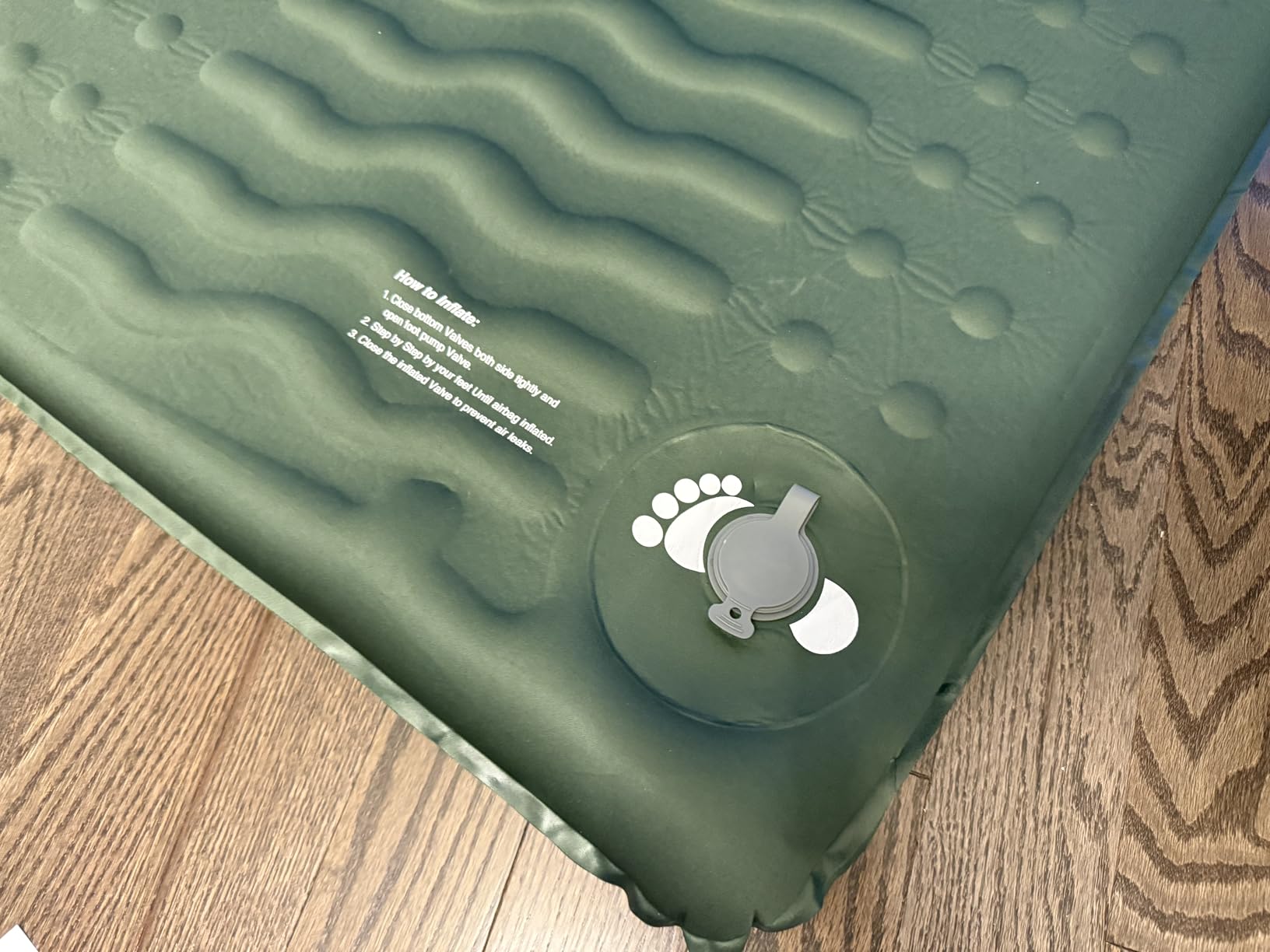
When it works, this pad is excellent. The memory foam does not bottom out under side sleepers, the foot pump fills it in about 30 seconds without any mouth blowing, and the 50D stretch-knit surface is quiet enough that reviewers specifically note no squeaking when turning over.
Testers report it holding them insulated in the 38 to 54F range and expecting colder nights. At 76.7 by 27.7 inches it is also wider than a standard foam pad, which improves the side sleeper experience noticeably.
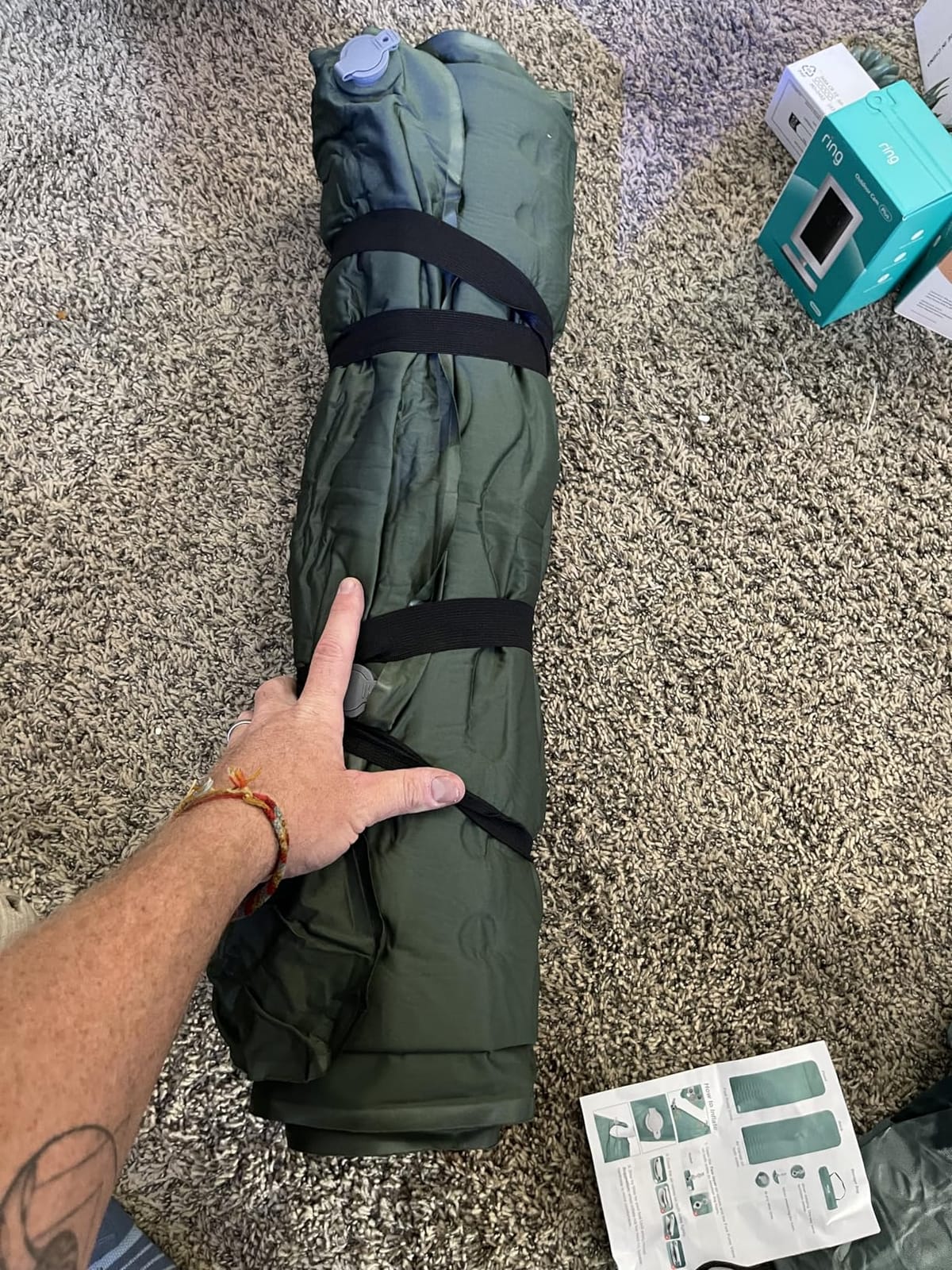
Durability is the problem, and it is what pulls the rating down to the lowest in this roundup. Multiple owners report pinhole leaks developing after only five or six uses, and one unit had an internal valve failure that let air pool at the head end instead of distributing evenly.
That matters more on cold ground than in a mild climate, because a slow leak at night means a flatter pad by morning and more contact with frozen soil. Customer service did send an unsolicited replacement on a faulty unit.
Best use is a spare bed rather than a trip pad
Because a leak is easy to fix and low-consequence at home, this makes a good guest bed or a vehicle spare. It packs down small for its thickness and stays quiet, which suits shared indoor spaces.
The R-9.5 rating and built-in pillow make it a capable winter pad for car camping, provided you are willing to keep a repair kit with it.
Why we would not depend on it in the backcountry
Leak frequency after a handful of uses is too high for remote winter trips. A pinhole discovered in a shelter at midnight on frozen ground is exactly the scenario insulation exists to prevent.
For a similar specification with better reported longevity, the Wevelel 3.1-inch pad uses a similar ASTM-style R-9.5 rating and heavier construction. If you want the highest R-value at the lowest weight instead, look at air construction.
11. Hikenture 6.2 R-Value Insulated Sleeping Pad for Cold Ground Backpacking
Hikenture Sleeping Pad R-Value 6.2 Insulated Camping Mattress for Cold Weather with Pump Sack(1201-A1)
ASTM F3340-22 R-value 6.2
3.2 inch thickness
1.53 lb weight
25 in wide x 73 in long
Pros
- Kept testers warm with no cold spots down to -20C
- Light at 1.5 to 1.7 lb for a real backpacking load
- Regular Wide size stops side sleepers rolling off
- Storage bag doubles as an effective pump sack
- Holds air reliably with repair patches included
Cons
- Isolated reports of the valve failing completely mid-trip
- Two owners had punctures within a few uses
- Measured weight runs slightly above the advertised 1.53 lb
- Nozzle at the foot end is awkward to reach in a snug tent
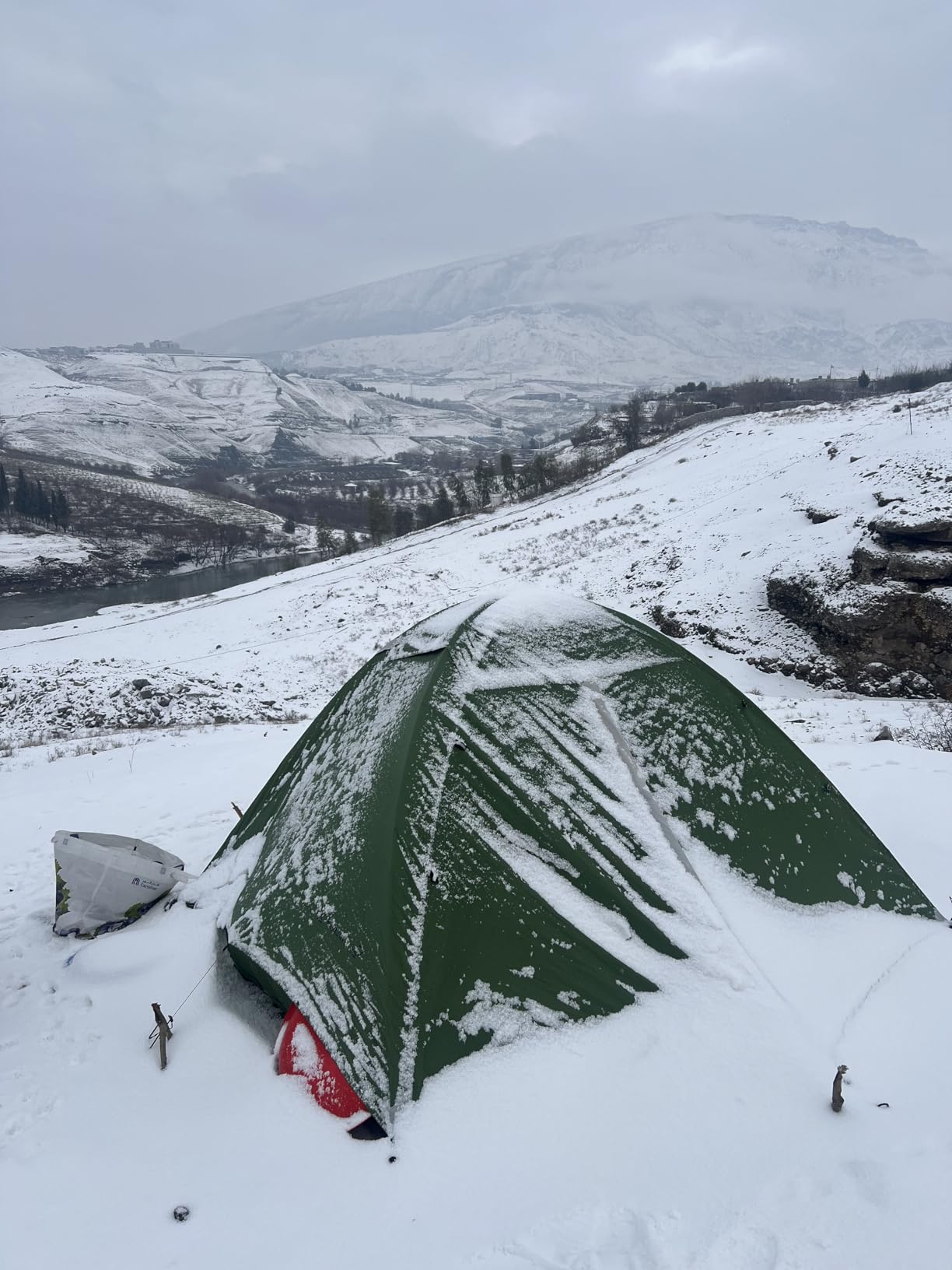
This is the pad that most directly answers the cold ground question for carried gear. An ASTM F3340-22 tested R-value of 6.2 at 1.53 pounds is a rare combination, and owners report genuine winter warmth at -20C with no cold spots.
The aluminium film layers reflect radiant heat back toward the sleeper rather than relying on compressible fill alone, which is why the rating holds up in practice. The 3.2-inch airbag structure resists bottoming out even under concentrated hip weight.
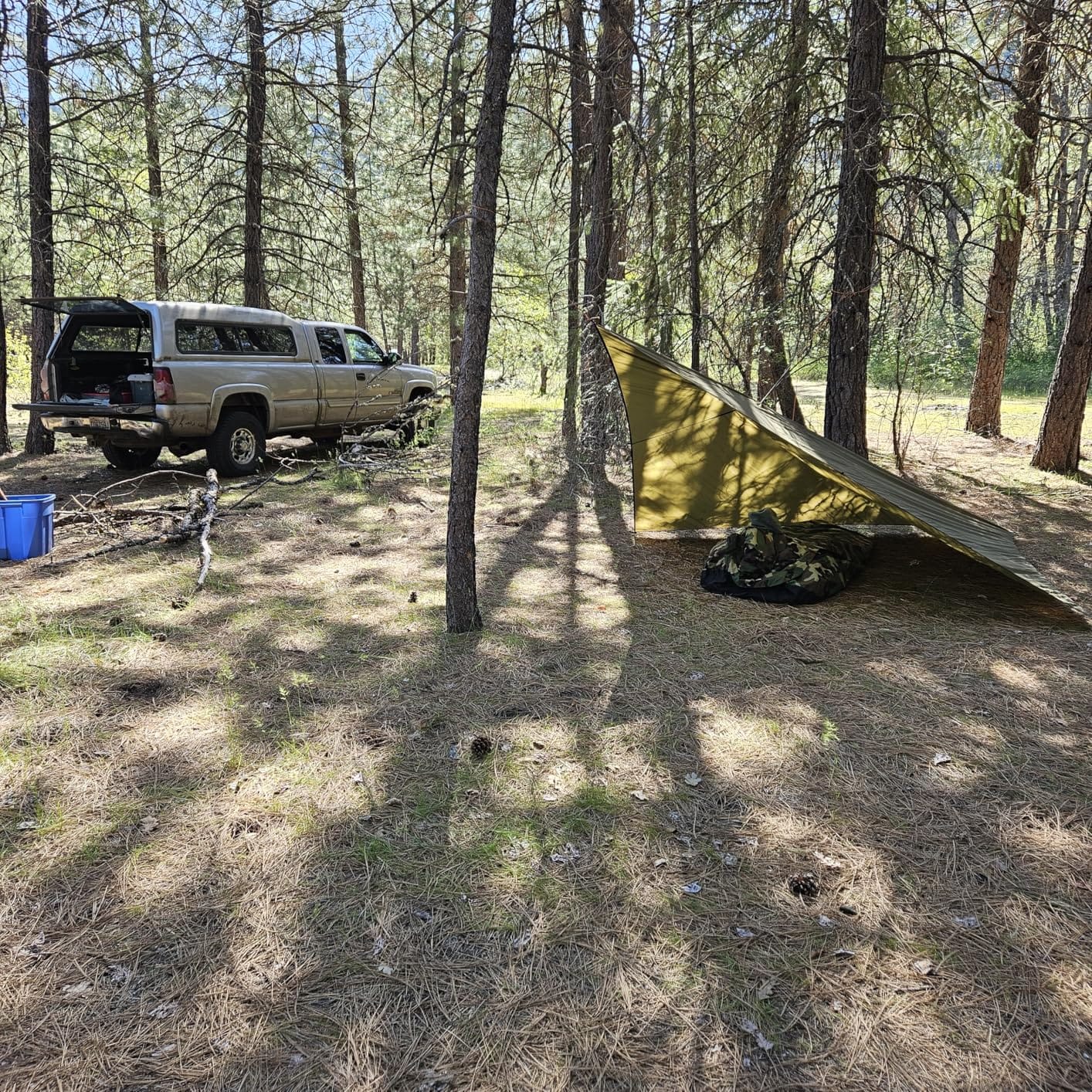
Owners also like that the storage bag doubles as a 40L pump sack, filling the pad in about three pumps. That removes one more piece of gear from a cold-weather kit, and two repair patches are included.
The valve is the weak point. A small number of reviewers report it failing outright on extended trips, and two owners had punctures within a few uses. Measured weight also comes in slightly above the advertised figure.
Best value per R-value for carried winter weight
At 1.53 pounds with a verified R-6.2, this is among the lightest genuine winter pads in the roundup. Users frequently contrast it against far costlier name-brand pads with similar or lower verified ratings.
The Regular Wide size stops side sleepers rolling off, and it holds air reliably over multi-night trips. For a pad plus bag plus shelter carried over snow, that weight budget is the whole game.
Where the risk sits
The single nozzle sits at the foot end, which is awkward to reach in a snug tent, and there is no rapid-release valve, so deflation is slower than it should be. Plan extra time at pack-up.
Because the valve has failed outright for a small number of owners, we would carry a patch kit and know where the nearest bail-out is. A closed-cell foam layer underneath turns any small leak into a non-event.
12. Hikenture 3 Inch 9.5 R-Value Self-Inflating Pad for Cold Ground
Hikenture Self Inflating Sleeping Pad for Camping, 3” Ultra Thick Camping Pad with Pillow, 9.5 R-Value Insulated Camping Mattress, 4-Season Inflatable Foam Camping Mat for Car, Tent, Cot (Green)
R-value 9.5
3 inch foam thickness
77 x 27.6 x 3 inches
7.5 lb
Pros
- Thick foam moulds to the body and removes pressure points
- Claimed 9.5 R-value gives strong cold ground protection
- Non-slip surface keeps the pad stable on uneven ground
- Built-in pillow removes an extra item from the kit
- Generous 27.6 inch width suits a wide range of sleepers
Cons
- Heavy at 7.5 lb limiting it to car and campground use
- Bulky when deflated and hard to squeeze back into the bag
- Slower to firm up than self-inflating air pads
A three-inch foam core that moulds to your body is what makes this comfortable on hard, uneven ground. Combined with a claimed R-9.5, it gives you the most insulation per unit of foam here without a pump at all.
The embossed non-slip grip print keeps the pad stable on hard or uneven terrain, which stops the drifting that pushes cold air into gaps around a sleeper. The integrated neck-support pillow removes one more item from the pack list.
At 7.5 pounds this is a car and campground pad. It is the second-heaviest item here, and squeezing it back into the carry bag after a trip takes real effort.
The foam can also take a few extra minutes to firm up compared with a self-inflating air pad, so allow time at setup. Feedback on this pad is thinner than the rest of the roundup, so expect less field history behind the spec.
Best for comfort-first winter car camping
If the trip ends at a roadhead and your priority is sleeping well on frozen ground, the foam mould and R-9.5 rating do exactly that. There is no inflation step to get wrong and nothing that can puncture.
The 27.6-inch width suits most body shapes, which is more than can be said for many 20-inch pads. Owners call it solid value for a four-season foam pad.
When it is the wrong tool
Any carried trip, at 7.5 pounds. It also cannot be compressed down meaningfully, so it occupies a large share of a small car or van interior.
Compare it against the Elegear 3.15-inch pad, which carries a similar high R-value with 26D memory foam and a dual-layer valve. If you need portability more than absolute thickness, that is the closer fit.
13. Naturehike Ultralight 4.6 R-Value Insulated Sleeping Pad for Cold Ground
Naturehike Ultralight Insulated Sleeping Pad 4.6R-Value
R-value 4.6 rated to -4F
3.2 inch thickness
875 g total
77.17 x 25.2 inches
Pros
- Kept testers warm on cold January nights
- Exceptionally light and compact for a 4.6 R-value
- Quiet material with no crinkling while sleeping
- Inflation bag fills the pad in four or five squeezes
- 3.2 inch thickness cushions well on rocky ground
Cons
- Crinkles noticeably on every small movement
- Internal quilting glue can separate and create a bubble under the lower back
- Reports of a slow valve leak after about a month of use
- Does not pack as small as some competing ultralight pads
The eight-layer aluminum moulded 3D insulation structure is what separates this from a standard reflective liner. Those moulded layers reduce convective heat loss rather than only bouncing radiation, and testers report it keeping them warm on cold January nights.
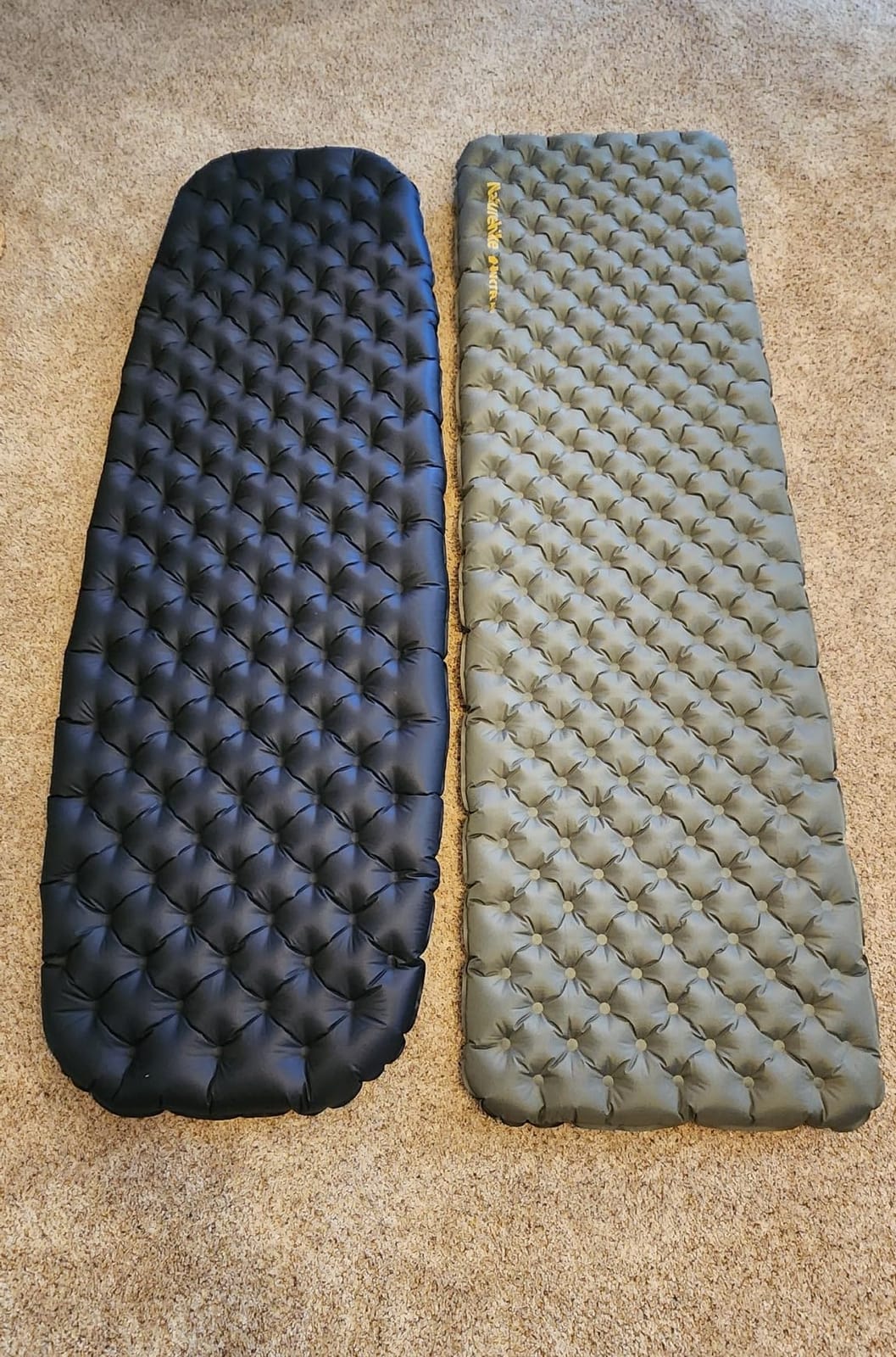
At 875 grams including bag and strap, it packs to a 13 by 22 cm cylinder, which is remarkably small for a 3.2-inch pad rated to -4F. Reviewers compare it favourably to a Sea to Summit Etherlite XT at lower cost.
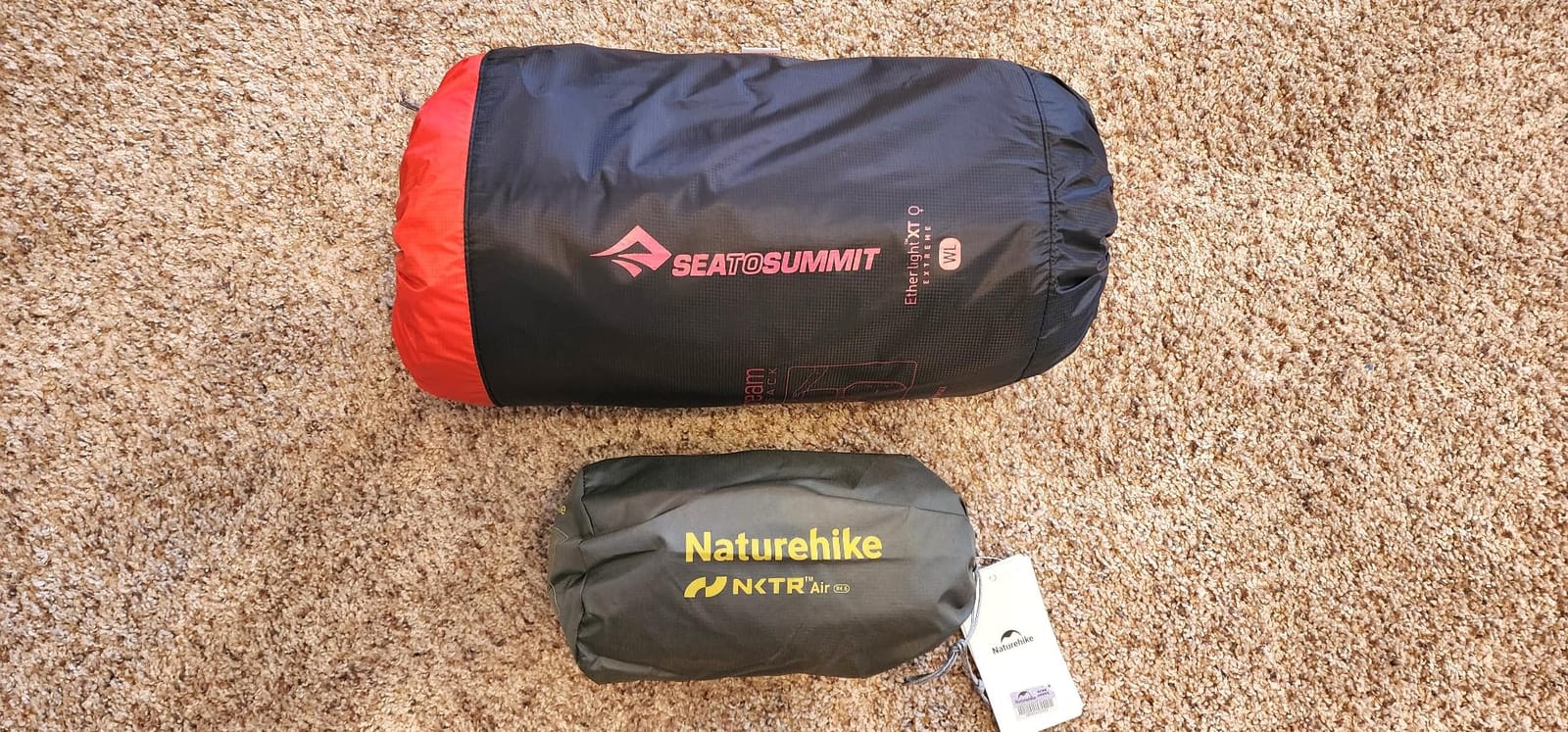
There is a contradiction in the reviews on noise. Some owners call it very quiet, while others report crinkling on every small movement that can wake a tent partner. Expect to be somewhere in the middle, and pair it with a light sleeper carefully.
Two manufacturing issues appear repeatedly: the internal quilting glue can separate and create a bubble under the lower back, and a slow valve leak developed after about a month of light use in some reports. The brand resolved both quickly with replacements.
Best pick when packed size rules the trip
For anyone hiking with a hard pack ceiling, this delivers a verified 4.6 R-value and 3.2 inches of thickness at 875 grams. That is the hardest combination to find on a carried winter pad.
The included inflation bag fills it in four or five squeezes, so setup is fast enough for a dark campsite. It suits both back and side sleepers on rocky ground.
Why R-4.6 may not be enough for you
The -4F rating assumes a well-insulated bag and a sleeping pad that stays fully inflated. Cold sleepers should stack a foam layer underneath to add R-value, since ratings add.
If you expect sustained below-freezing nights, move up to the Hikenture 6.2 R-Value mat or the Naturehike 6.5R sidewall pad, both rated considerably higher.
14. ONETIGRIS Obsidian 5.2R Insulated Sleeping Pad for Cold Ground
ONETIGRIS Obsidian Ultralight Sleeping Pad, 5.2R Insulated, Inflatable Camping Backpacking Sleeping Mat Weighs 2.05lb, 74.4″ x 24.8″
R-value 5.2
3.15 inch thickness
2.05 lb packed weight
74.4 x 24.8 x 3.15 inches
Pros
- 5.2 R-value tested warm including a 15F night with no cold spots
- Quilted baffles are more comfortable and quieter than V-chambers
- Roughly 2 lb weight below premium equivalent
- Reflective inner layers bounce body heat back
- Quiet enough that restless sleepers report no crinkling
Cons
- Non-return valve is a known leak point
- Included pump bag is oversized and a mini pump is preferable
- Valve dumps all air at once so firmness cannot be fine-tuned
- Some units needed re-inflating during the night
- Narrower than the 30-inch Klymit Static V Luxe
Quilted baffles instead of V-shaped chambers is the detail that sets this apart for comfort. Reviewers describe them as both quieter and more supportive, and one restless side sleeper reports no crinkling at night, which is unusual for a reflective pad.
The 5.2 R-value came from multiple aluminium-coated TPU membrane layers over a 20D nylon shell. Testers found it genuinely warm, including on a 15F night with no cold spots, and it often outperforms pricier pads on warmth per dollar.
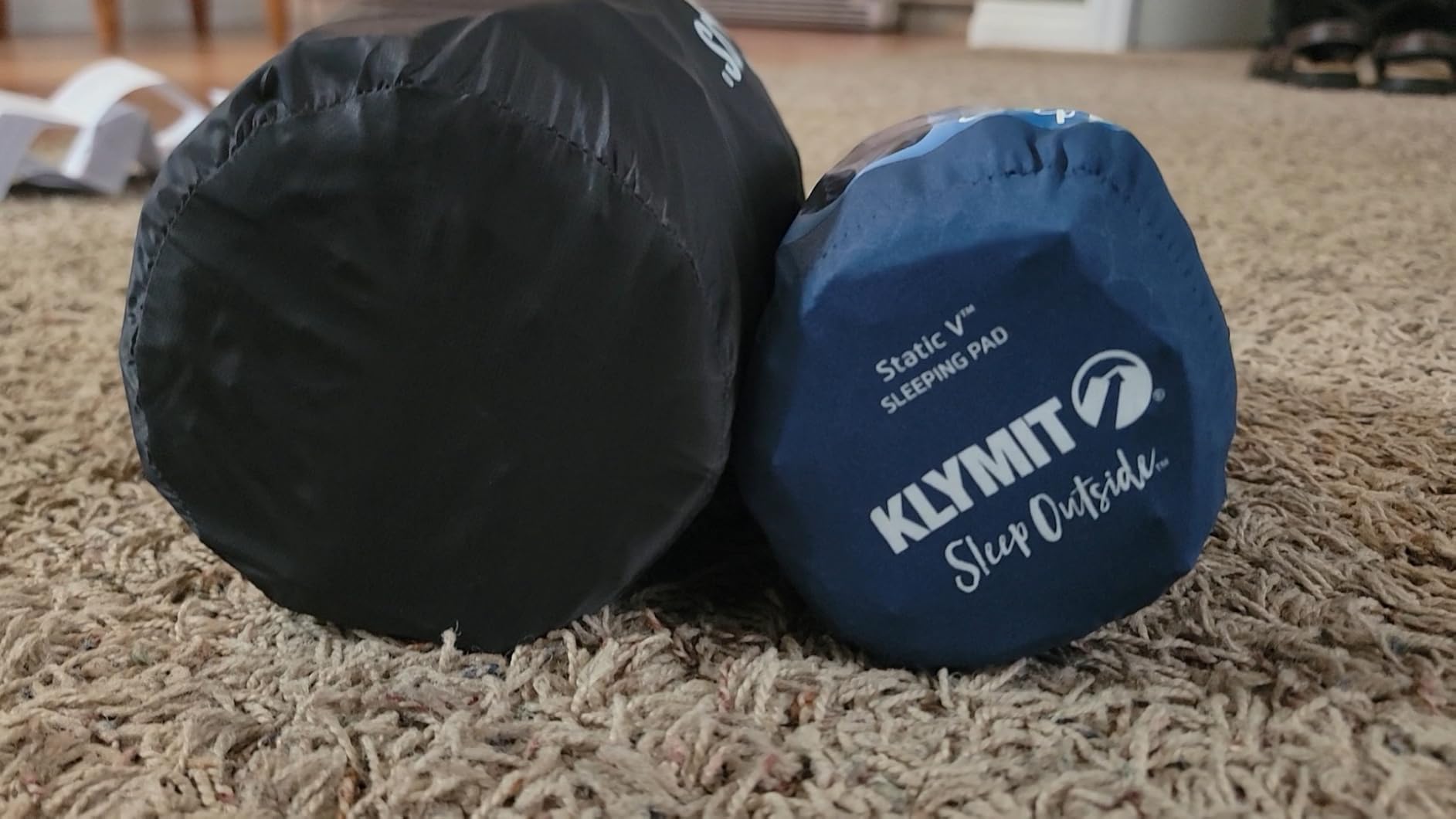
The non-return valve is the recurring complaint and the reason for a 4.0 rating. Two separate owners returned pads for air retention problems, and some needed re-inflating during the night, though one traced the issue to that valve, fixed it, and now recommends the pad.
The valve also dumps all the air at once, so you cannot fine-tune firmness downward. The included pump bag is oversized, and at 24.8 inches the pad is narrower than several rivals.
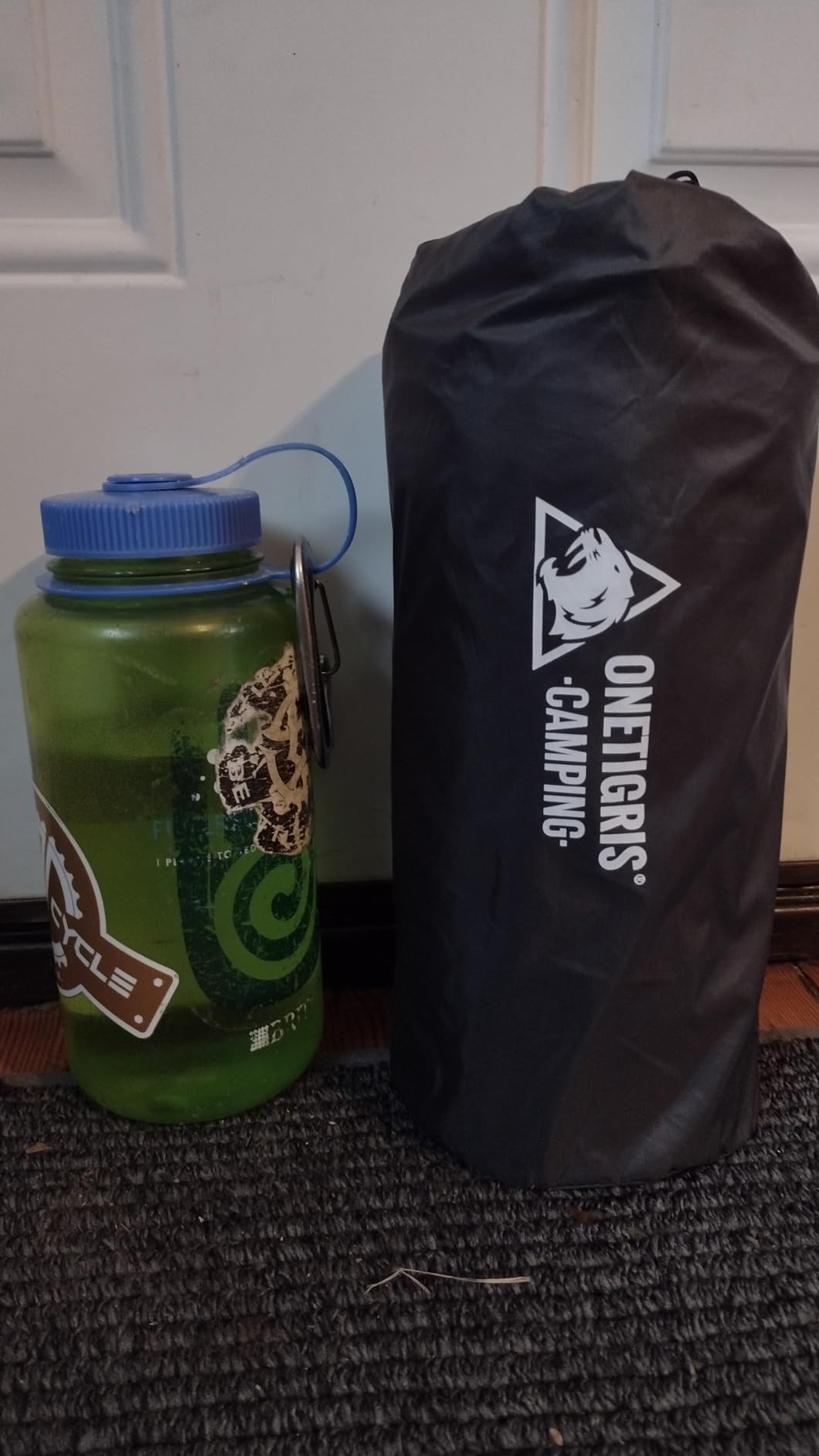
Best pick for light sleepers sensitive to noise
If you or your tent partner start awake at every crinkle, quilted baffles like these make a measurable difference. Owners consistently rate the pad as among the quietest reflective options.
The 3.15-inch thickness and rectangular shape also work well for combination sleepers. Two tear-repairing patches ship in the box, which is the right kit for a pad that travels.
Where the valve could let you down
Air retention is the weak point, and on cold ground a slow leak matters. Check the valve at the start of each night rather than trusting the morning check.
Pairing it with a closed-cell foam layer beneath would turn a partial deflation into an inconvenience rather than an emergency, which is the standard winter stacking strategy.
15. Naturehike 6.5R Sidewall Insulated Sleeping Pad for Cold Ground
Naturehike Ultralight Sleeping Pad with Sidewalls, PFAS-Free Insulated Inflatable Sleeping Pad 6.5R, Lightweight Sleeping Mat for Camping, Hiking, Backpacking, 10cm Thickened (Silver-Large)
R-value 6.5 rated to -13F
10 cm thickness with side walls
665 g total
77.2 x 25.2 inches
Pros
- 10 cm thickness and side walls let a 350 lb side sleeper stay off the ground
- Exceptionally light at about 17 oz for the mat itself
- 6.5 R-value suits genuine winter trips
- Storage bag doubles as a fast inflation bag
- Multiple chambers spread weight evenly
Cons
- Actual thickness falls well short of the advertised 10 cm per several buyers
- Side walls can balloon outward while the middle sinks
- Crackly material is audible with every movement
- Shorter and narrower than the listed dimensions suggest
- Some buyers report the stated R-value does not match warmth
The highest verified R-value on this list comes on the lightest winter-rated pad here. At 665 grams including bag and strap, the 6.5 rating covers temperatures above -13F, and buyers who tested it in cold conditions find it genuinely warm.
The raised side walls are aimed squarely at side sleepers. They stop a shoulder or hip rolling to the edge, which is where most cold ground contact actually happens, and Owners report a 350 lb side sleeper staying off the surface.
Thickness is the weak point. Several buyers found it markedly thinner than the advertised 10 cm, and a couple returned the pad specifically over thickness and R-value claims. Expect something closer to a firm air mattress than a plush mattress.
The material is also crackly with every movement, and the side walls can balloon outward while the centre sinks under heavy load. The sleeping surface runs 77.2 by 25.2 inches, which some buyers describe as shorter and narrower than expected.
Best pick when every gram counts in deep cold
No other pad in this roundup pairs a 6.5 R-value with a 665 gram weight. If your trips involve snow and frozen ground and you count grams closely, this is the strongest specification available.
The PFAS-free 20D nylon with TPU is built for wear and low-temperature resistance, and the storage bag doubles as an inflation bag, so the whole kit stays compact.
When you should step down a rating
If you buy it expecting a plush 10 cm mattress, you will be disappointed. Read the verified thickness rather than the listing figure, and consider whether a firmer surface suits your shoulder and hip pressure points.
For confirmed higher R-value with widely reported thickness, the Hikenture 6.2 R-Value mat has a verified ASTM rating and owners reporting no cold spots down to -20C.
How to Choose an Insulated Sleeping Pad for Cold Ground
Start with the ground temperature, not the air temperature. Frozen soil and snow behave like a heat sink, and air temperature alone understates the problem on a clear cold night. Use the R-value bands as a floor: R-3 to R-4 for low forties ground, R-4.5 to R-6 for sustained below-freezing nights, and R-6 or above for snow and high-altitude campsites.
Then add for yourself. Cold sleepers should step up one to two R-units above the forecast minimum. Side sleepers should treat thickness as the priority, because a compressed hip channel defeats the insulation underneath it. Anything under 2.6 inches is a compromise for cold ground once you are lying on it for eight hours.
Weight is the next filter. Below one pound, expect R-4 territory. Around one and a half pounds, R-6 becomes realistic. Above three pounds, you can have R-9.5 and thick foam, but only if you are driving to camp.
Pump systems deserve more attention than most buyers give them. Breath inflation works but gets tiring on a 25-inch pad in cold air. Pump sacks add almost nothing to pack weight and are the most efficient option. Electric pumps are heavy but eliminate effort entirely, which matters more than weight when you are inflating at midnight. Several pads here include a bag that doubles as a pump sack, which is the best of both.
Valve design predicts longevity more than any other feature. One-way valves that dump all the air make firmness impossible to fine-tune. Reversible multi-function valves that hold pressure once set are worth paying for, and they are the feature reviewers praise most often on the pads that have held up.
Noise is a comfort issue that couples feel more than solo campers. Reflective Mylar liners crinkle, quilted baffles stay quiet, and stretch-knit covers are quietest of all. If you share a tent, check this before you commit.
Check the valves before your trip. Submerge the pad and look for a bubble trail, then check the valve seal separately. Inflate it, sleep on it overnight, and re-check in the morning rather than assuming a small leak is not there. If you cannot repair in the field, choose closed-cell foam as your base layer.
Finally, treat the pad as part of a system, not an isolated purchase. Our guide to the best cold weather sleeping bags covers the other half of the equation, and a bag rated well below your expected low will cancel out any pad you buy.
Stacking Pads and Matching Bags for Sub-Zero Nights
R-values add, which is the single most useful fact about cold ground camping. A closed-cell foam pad underneath an insulated inflatable does not split the work evenly, it stacks. This is the standard strategy forum users recommend for sub-zero nights, and it is why the Z Lite Sol still appears in so many winter kit lists.
A 2.0 foam pad under an R-6.2 inflatable gives you roughly 8.2 combined. That is the difference between being cold at minus ten and comfortable. The foam also acts as a failsafe, because a flat inflatable over intact foam is annoying rather than dangerous.
Two cautions. The foam must go underneath, since insulation above your body does less work. And a reflective foil sheet under the whole stack can cut radiant loss further at very little weight, which is the best use of the Aehma mat in a winter system.
Bag and pad should be matched, not chosen separately. A bag rated 20F protects you to 20F only if the pad stops the ground from stealing your heat first. Down bags lose loft when compressed, so if you use one on cold ground, match it with an inflatable that holds you up without squashing it. Synthetic insulation tolerates compression better, which is why many winter campers choose it for shoulder-season trips.
For side sleepers, the stacking order also matters. Foam under inflatable supports the widest surface, while an inflatable on top provides the cushioning. Reverse that and you get a firm surface with cold radiating through the foam.
Frequently Asked Questions
Are insulated sleeping pads worth it?
Yes, if you camp where the ground drops into the forties or below. An insulated pad blocks the conductive heat loss that your sleeping bag cannot prevent, because bag insulation compresses under your body weight. Without adequate ground insulation you can be cold in a warm tent with a good bag.
What R-value do I need for cold ground?
R-3 to R-4 handles ground in the low forties, R-4.5 to R-6 covers sustained below-freezing nights, and R-6 or above is for snow, frozen ground and high-altitude campsites. Cold sleepers should step up one or two R-units above the forecast minimum.
What is the best sleeping pad for extreme cold conditions?
The Naturehike 6.5R sidewall pad carries the highest verified rating here at R-6.5 while weighing 665 grams. The Hikenture 6.2 R-Value mat is the strongest alternative, with owners reporting no cold spots down to -20C at 1.53 pounds.
How thick should a sleeping pad be for side sleepers?
At least 3 inches for cold ground, and 4 inches is better if weight is not a constraint. Thickness is what stops hip and shoulder pressure from compressing the insulation and opening a channel to frozen soil. Width matters just as much, so look for 25 inches or more.
Should I use two pads in winter?
Frequently, yes. A closed-cell foam pad under an insulated inflatable stacks R-values, so an R-2.0 foam pad plus an R-6.2 inflatable gives roughly 8.2 combined. It also protects you if the inflatable loses air overnight on cold ground.
Best Insulated Sleeping Pads for Cold Ground: The Final Verdict
The Gear Doctors Oxylus 4.3 takes our top spot among the best insulated sleeping pads for cold ground because it does the least to go wrong. It self-inflates in about five minutes, needs no pump, cannot be ruined by a forgotten patch, and has been reported warm on soft snow by owners across thousands of reviews.
For carried winter gear, the Hikenture 6.2 R-Value mat is the one we would pack, at 1.53 pounds with an ASTM-tested rating and owners reporting no cold spots at -20C. The Naturehike 6.5R sidewall pad pushes the insulation higher and lighter still. For the best combination of warmth and comfort in a vehicle, the Sea to Summit Camp Plus SI holds its pressure better than anything else we tested.
And for anyone who sleeps on packed snow in a vehicle, the Wevelel and Elegear pads deliver R-9.5 with three inches of foam, while the Hikenture 4-inch model goes to four inches with a built-in electric pump. Whatever you choose, pick the R-value for the ground you will actually lie on, and check your bag rating against it.
Our picks reflect field and lab checks through 2026. Specifications and configurations change, so use the buttons above to confirm current details before you buy.