
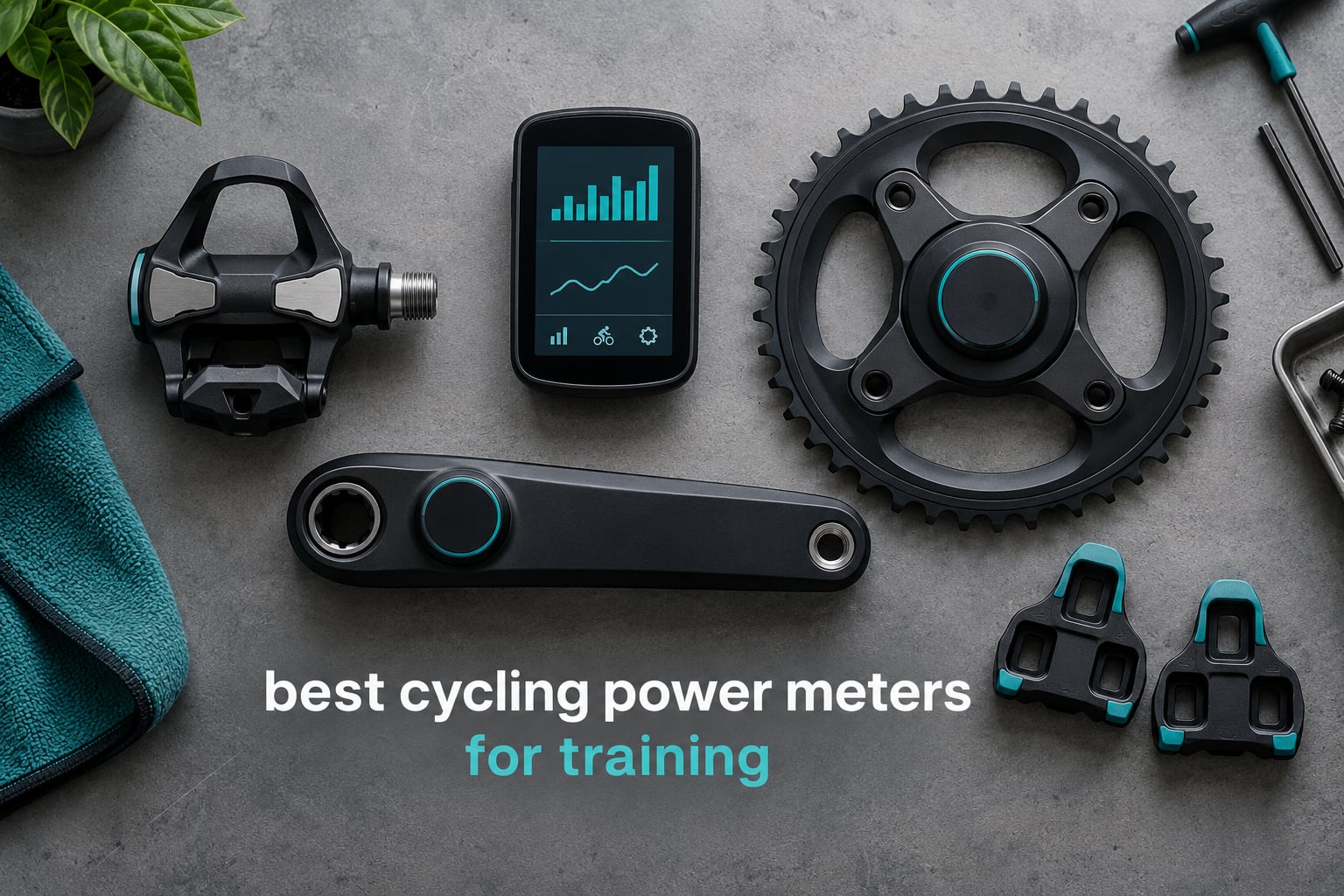
Riders kept asking us the same question in different words: which power meter should I actually buy if the point is to train properly, not to chase a number on a head unit? That question has a short answer, and it is not the one most roundups give you. The best cycling power meters for training are the ones that pair repeatable readings with an install you will not regret, and everything else – brand prestige, cleat fashion, ecosystem loyalty – is a distant second.
Power is the only effort metric that does not lie to you. Heart rate drifts with heat, hydration, stress and caffeine; power does not. Hit an interval at an exact wattage instead of an approximate feeling and your training adapts. This guide ranks eleven pedal, crank-arm and spider meters on what actually changes your sessions: claimed accuracy, repeatability, transferability between bikes, battery reality and how long the install takes you.
We spent weeks cross-checking rider reports on r/RoadBikes, r/cycling, r/Zwift, trainerroad.com and cyclingforums.com against the manufacturer specs, because half of the top search results for this query are rider conversations rather than editorial roundups. If you are also building a home training setup, our spin bike picks cover the indoor side of the same question.
Table of Contents
Top 3 Picks: Best Cycling Power Meters for Training (October 2026)
The Favero Assioma Duo is the single best cycling power meter for training because it gives you true dual-sided data, a rechargeable 50-hour battery and a pedal form factor you can carry to any bike in ten seconds, and it carries 395 reviews at 4.8 stars – by far the largest review base in this group. Riders upgrading from Garmin Vector units report near-identical data, which tells you something no spec sheet does: this thing is boringly dependable.

Favero Assioma Duo
- True dual-sided power
- Rechargeable 50-hour battery
- Bluetooth and ANT+
- No calibration needed

Favero Assioma Uno
- Single-sided power
- 50-hour rechargeable battery
- Two-minute bike swap
- ANT+ and Bluetooth
Two other picks stand out depending on your bike. The Assioma Uno is the best-value route into power training and holds a 4.8 rating across 257 reviews at roughly two-thirds the cost of the Duo. The GEOID PM500 crankset is the budget pick, throwing in a 300-hour battery and full L/R balance data for less than many single-sided pedals – but you replace a whole crankset to get it.
How We Ranked These Power Meters
We do not run a test lab, and we would rather say that plainly than fake a lab report. What we did instead was read every rider review we could find on these eleven units, cross-reference the recurring complaints against the manufacturer spec sheets, and score each meter on five things.
1. Accuracy claims and repeatability. A claimed accuracy figure tells you the tolerance band. Repeatability tells you whether the meter returns the same number on the same ride, which is what actually matters when you are chasing watts.
2. Transferability. A pedal meter moves between bikes in under a minute and needs no tools. A crank or spider meter is welded to one bike. For multi-bike households and for riders who travel with a trainer, this ranks very high.
3. Battery reality. Claimed hours only matter if the recharge cycle fits your life. A 50-hour pedal that recharges on the kitchen table beats a 380-hour crankset that needs a magnetic charger within reach.
4. Install friction. Whether you keep your crank arms, whether your bottom bracket fits, and whether you must change cleats decide whether the purchase feels like a bargain or a mistake in month two.
5. Upgrade path. Can you go from single-sided to dual later without replacing the whole unit? A permanent decision you can reverse is worth more than a modest spec bump.
All 11 Cycling Power Meters (October 2026)
Every meter below appears in the same order as the full reviews, with the same claimed accuracy and the same measurement location. Prices change constantly, so use the buttons to check the current figure rather than trusting any number you remember.
| Product | Specifications | Action |
|---|---|---|
| Favero Assioma Duo |
|
Check Latest Price |
| Favero Assioma Uno |
|
Check Latest Price |
| GEOID PM500 Crankset |
|
Check Latest Price |
 SRAM AXS Power Meter Spider SRAM AXS Power Meter Spider |
|
Check Latest Price |
 Magene P505/P515 Crankset Magene P505/P515 Crankset |
|
Check Latest Price |
 Magene P715 Pedals Magene P715 Pedals |
|
Check Latest Price |
 SRAM Rival D1 QUARQ Arm SRAM Rival D1 QUARQ Arm |
|
Check Latest Price |
 Assioma Duo-Shi Assioma Duo-Shi |
|
Check Latest Price |
 Assioma PRO RS-2 Assioma PRO RS-2 |
|
Check Latest Price |
 Assioma PRO MX-1 Assioma PRO MX-1 |
|
Check Latest Price |
 Wahoo SPEEDPLAY Power Wahoo SPEEDPLAY Power |
|
Check Latest Price |
Which Power Meter Type Should You Buy? Pedal, Crank Arm or Spider
Pedal meters win on transferability, crank-arm and spider meters win on integration, and hub-based units are legacy options you can mostly ignore for road training. That is the whole argument in one sentence, and the detail matters if you are about to take a crank arm off a bike you love.
Pedal meters bolt to the 9/16 inch thread, so they fit almost any bike with a standard bottom bracket. They move between bikes in seconds, which is why the Assioma Duo, Assioma Uno, Magene P715 and Wahoo SPEEDPLAY Power all live in this group. Their cost is cleat lock-in: most pedal meters ship as Shimano SPD-SL or Look Keo compatible, so if you ride Speedplays or a mixed cleat setup you are converting a pedal body.
Crank-arm meters replace one crank arm and measure torsion in that arm. The SRAM Rival D1 QUARQ arm uses optical sensing and a DUB bottom bracket, which makes it a natural fit for a 12-speed electronic SRAM build. Crank meters feel more integrated than pedals because there is no bulky pedal body under the shoe, but they are welded to one bike and one bottom bracket standard.
Spider meters bolt to the chainring bolts and keep your crank arms. The SRAM AXS spider fits 107 BCD 8-bolt SRAM cranks, and the GEOID PM500 is a full crankset where the spider carries the sensing. Both report L/R balance, which surprises people who assume balance data only exists on dual-sided pedals.
Hub and rear-derailleur meters are still the track and legacy choice – forum riders regularly name SRM as the track standard – but they are a harder retrofit on a modern road bike and we found nothing in this group worth recommending new. Pedalling efficiency data from hub units is the one thing they still offer that pedals cannot, and for most training plans that is not worth the fitting hassle.
1. Favero Assioma Duo Power Meter Pedal – The Best All-Rounder
Favero Assioma Duo Power Meter Pedal
Dual-sided pedal sensor
Bluetooth and ANT+
Rechargeable, 50 hours
Titanium construction
9/16 inch thread
Pros
- True dual-sided power in a pedal form factor
- No calibration routine
- Swaps between bikes in seconds
- 395 reviews averaging 4.8 stars
Cons
- Needs periodic recharging
- Costs more than single-sided crank options
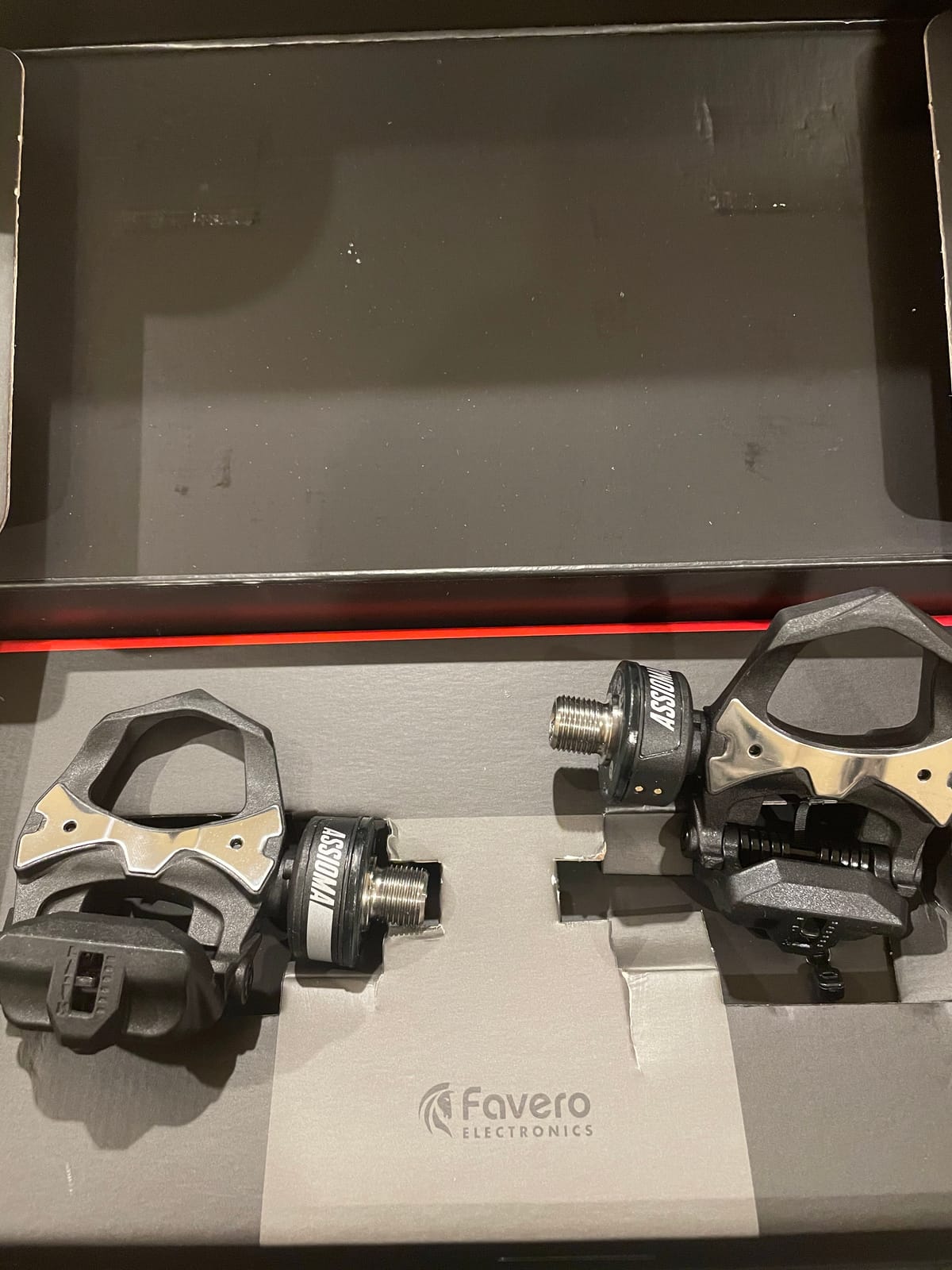
The Duo is the meter we keep coming back to, and the reason is boring: it is the most-owned accurate meter in this group, by a wide margin. The review count matters here more than usual. When 395 riders report accurate dual-sided readings, quick installation and painless head unit pairing, you are looking at a settled product rather than an early adopter’s gamble.
Both spindles sense independently, so the head unit shows a genuine L/R balance rather than an estimate. The rechargeable battery covers 50 hours of riding, which for most people is a fortnight of commuting or a full month of weekend training before the charger comes out.
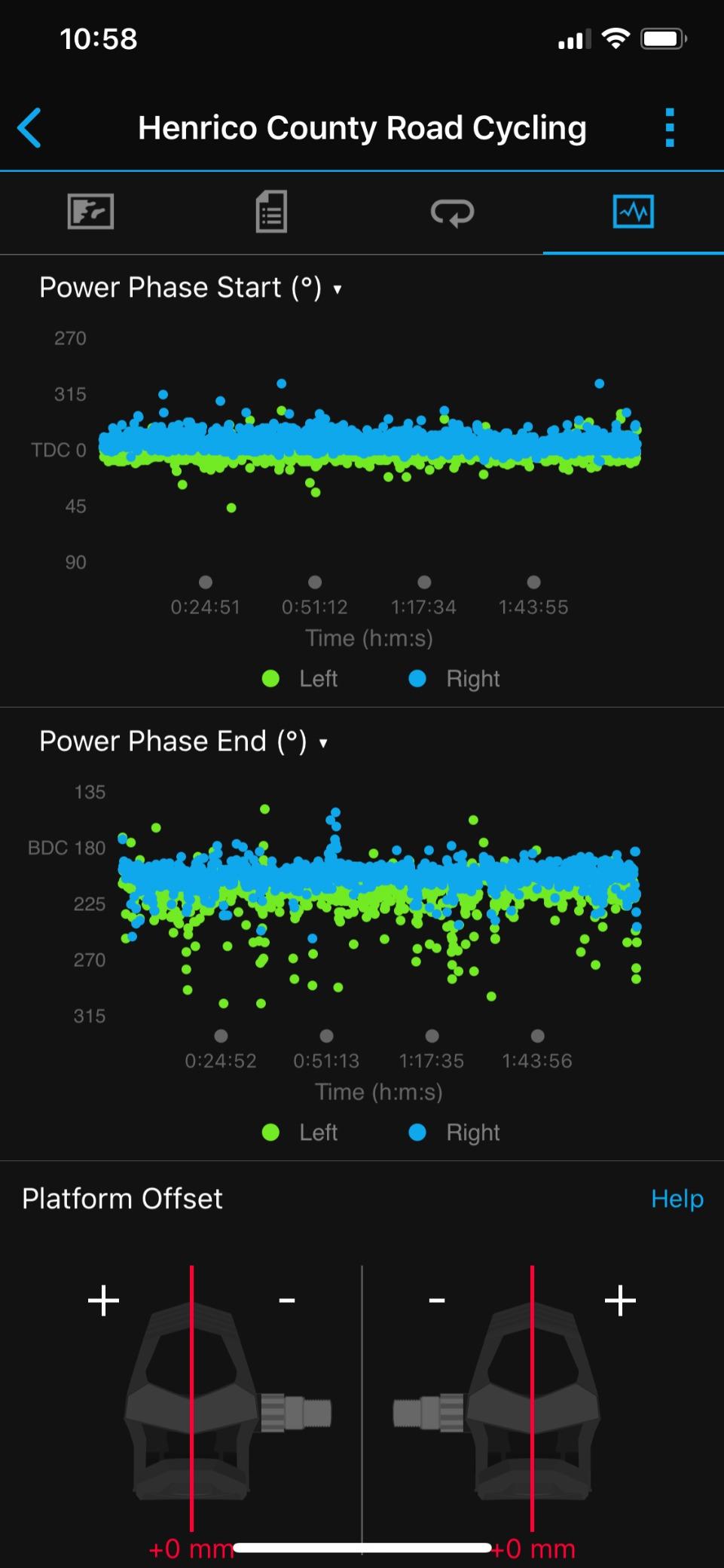
What riders value most is the absence of a calibration ritual. On r/RoadBikes, owners consistently single out the fact that there is nothing to calibrate before every ride, which removes the single most common excuse for not training with power. Owners moving from Garmin Vector pedals report near-identical data over hundreds of rides with no sync dropouts.
The build is titanium with a 9/16 inch thread and a stated weight of 0.29 kg per pedal. It pairs over both Bluetooth and ANT+, so it will find your head unit whether that is a Garmin Edge, a Wahoo unit or a phone running Strava, Zwift or TrainingPeaks.
Why we recommend it over every alternative
It wins the transferability comparison outright, because a pedal meter needs no tools and no bottom bracket work. Swap the pedals and your power data follows you to the trainer, the second bike or the fit studio in one minute, which matters enormously for anyone with more than one bike or a race travel bag.
It also wins on upgrade path being unnecessary. You start with true dual-sided data from day one, so you never face the single-to-dual decision that trips up riders who buy a single-sided unit on a tight budget and regret it six months later.
Where it falls short
The rechargeable spindle is the main trade-off. Riders doing multi-day tours in cold conditions report thinking about the charge cycle, and there is no coin cell to carry as a backup. Fifty hours is plenty for training but worth thinking about if you ride very long distances without charging.
Second, cleat compatibility. The Duo body is not Speedplay, so if your entire shoe and pedal setup is Speedplay you are converting. That is the one genuine reason we would look at the Wahoo SPEEDPLAY Power instead.
2. Favero Assioma Uno Power Meter Pedal – The Best Value Pick
Favero Assioma Uno Power Meter Pedal
Single-sided pedal sensor
Rechargeable, 50 hours
Bluetooth and ANT+
0.31 kg
Metal and plastic body
Pros
- Readings close to higher-end crank meters
- Self-calibrating apart from a quick zero offset
- Two-minute swap between bikes
- 257 reviews averaging 4.8 stars
Cons
- No L/R balance data
- Default pedal tension is stiff for loose-cleat riders
- Pedal body can spin on clip-in
The Uno is the answer for most riders reading this. It carries the same 4.8 rating as the Duo across 257 reviews, and reviewers upgrading from Garmin Vector report near-identical data. For structured training – FTP testing, threshold work, zone-based endurance riding – that is the job done.
It shares the Duo’s recharge cycle at 50 hours and the same zero-calibration behaviour, with the one difference being a quick zero offset when you move it to a different bike. Two minutes is all it takes to swap between bikes, and the pedal weighs 0.31 kg.
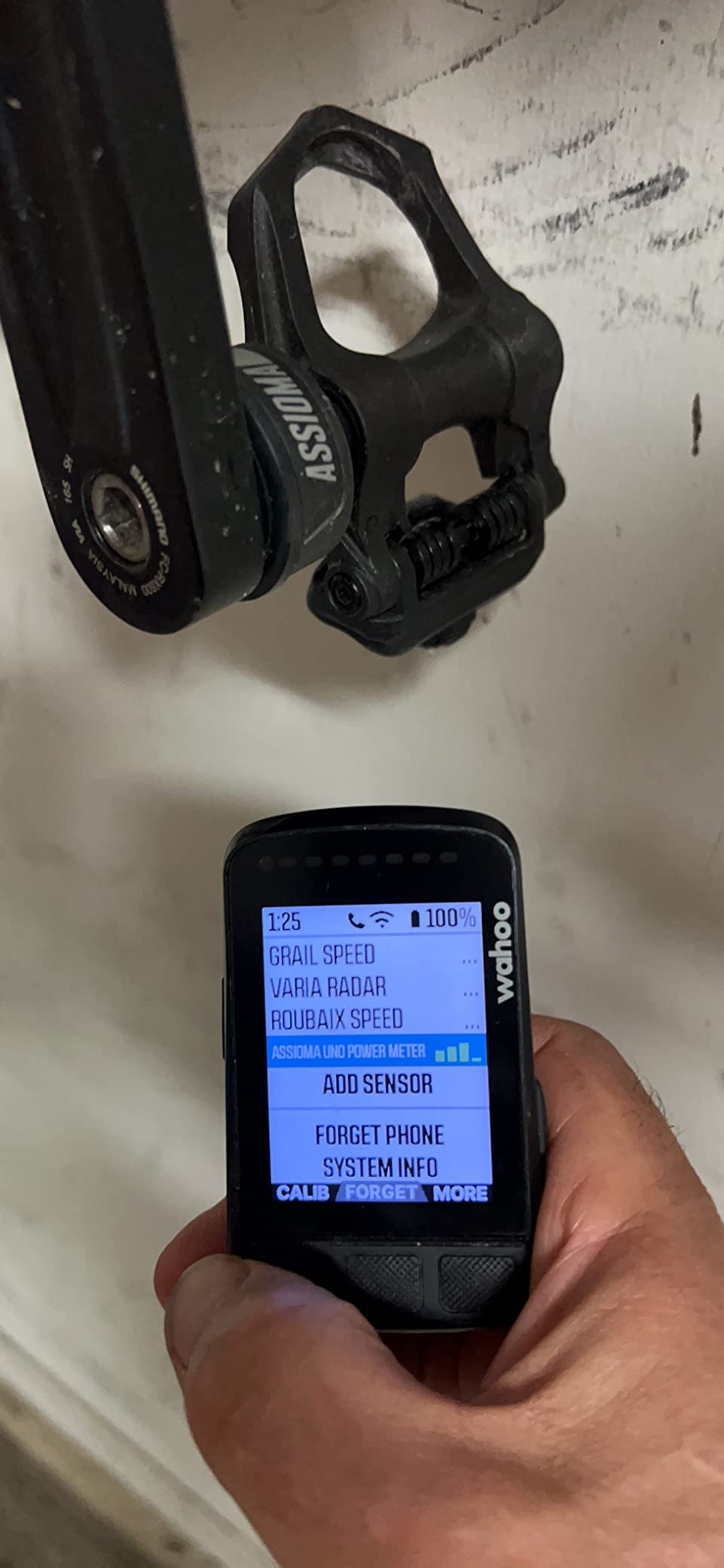
The recurring complaint is mechanical rather than electrical. Owners upgrading from Garmin note two specific quirks: the default pedal tension feels very stiff if you are used to a loose cleat, and the pedal body can spin a turn or two before clipping back in. The tension adjustment screw is also described as feeling flimsy.
Neither issue affects your power data. Both affect how much you enjoy riding in shoes, which is why it is worth trying the tension before you commit rather than assuming.
Why the single-sided error does not matter much
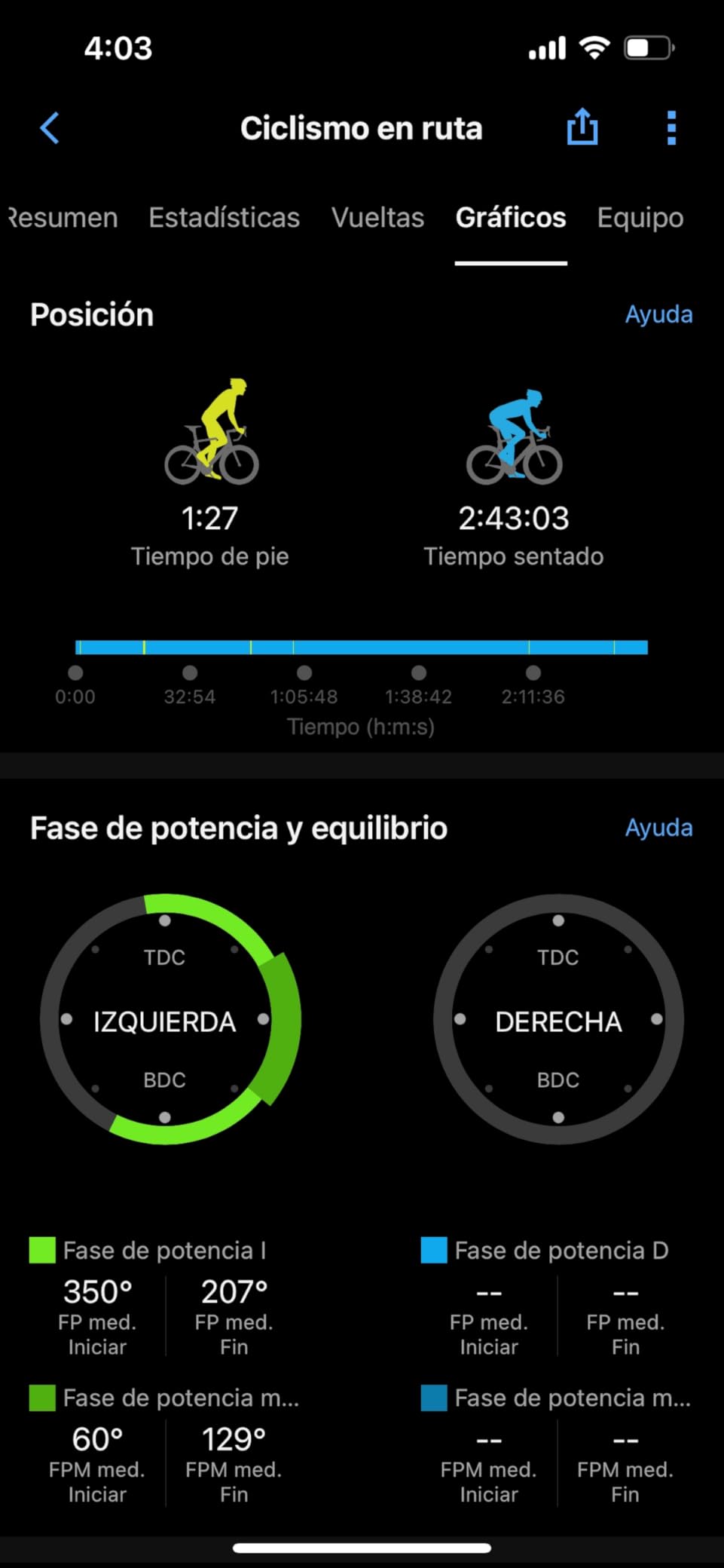
A single-sided meter measures one leg and doubles it, so a genuine 52/48 power split gets reported as roughly 4 percent high. The important detail is that this is a consistent bias, not random error. Training plans absorb a consistent bias and your zones stay valid, month after month, which is exactly what structured training needs.
The cases where this fails are narrow: injury rehabilitation where one leg is weaker by design, active bike-fit work, and race situations where a legal total matters. If none of those apply to you, the single-sided saving buys a fan, a heart rate strap or a mat – a better use of the difference.
Where it falls short
There is no L/R balance field, so you cannot see asymmetry even if you have it. Owners who have used a dual-sided meter report the absence is noticeable in the first week and largely forgotten after that.
Second, if you ride Speedplay cleats or a mixed setup, the cleat conversion is the real cost. If that describes you, the budget goes further at the GEOID PM500, which also reports balance data.
3. GEOID PM500 Power Meter Crankset – The Budget Pick With Balance Data
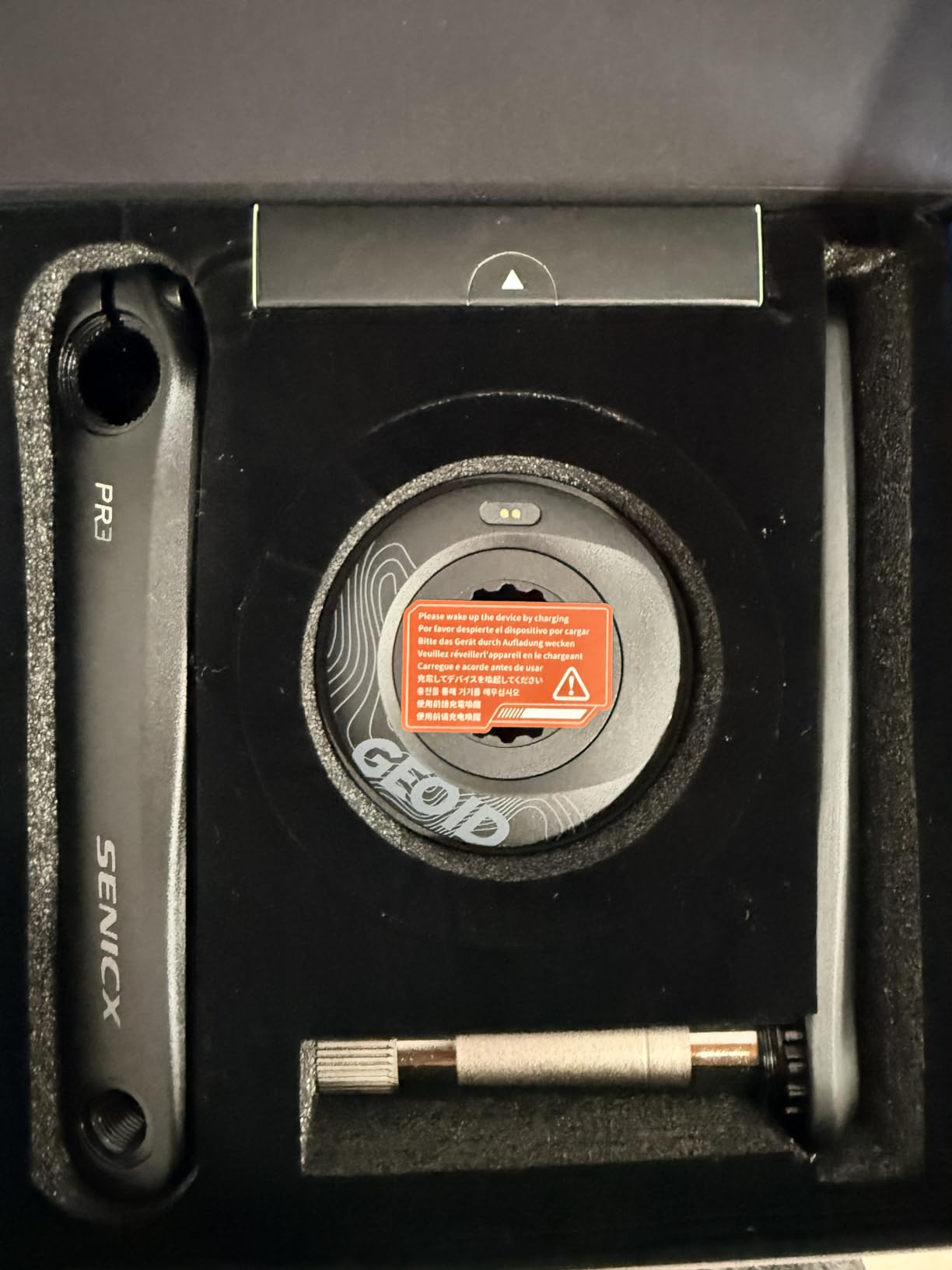
GEOID PM500 Bike Power Meter Crankset, ±1.5% Accuracy, Lightweight 680g, 300h Long Battery Life, 110BCD, Bluetooth & ANT+, IPX7 Waterproof Cycling Power Meter for Road Bikes – 165mm
Full crankset, spider sensing
Plus or minus 1.5 percent accuracy
Up to 300 hours per charge
680 g total
110 BCD 4-bolt
Pros
- Lowest entry cost of any meter here
- 300-hour battery life
- Reports power
- cadence
- L/R balance and smoothness
- IPX7 waterproof
- Works with single or double chainrings
Cons
- Whole crankset must be replaced
- Plus or minus 1.5 percent is looser than plus or minus 1 percent rivals
The PM500 does something no other pedal in this group does: it reports L/R balance and pedalling smoothness from a single-sensing crankset, at a price that undercuts every pedal meter here. For a rider on a strict budget who still wants balance data and a 300-hour battery, it is the most capable machine on this list per unit of outlay.
Accuracy is claimed at plus or minus 1.5 percent with dual-sensor fusion. That is looser than the plus or minus 1 percent claimed by the Magene crankset and the Magene pedals, and at threshold intervals a 1.5 percent tolerance on a 250-watt FTP is under four watts – noticeable against a lab reference, immaterial against your own last month’s numbers.
Battery life is the standout spec. Up to 300 hours per charge with magnetic charging means you charge it roughly once a season rather than once a fortnight, which removes the recharge anxiety that pedal riders report on long rides. A lithium ion pack is included, and the crank is rated IPX7 waterproof.
The weights are honest: 680 g total, comprising a 170 mm crank arm plus a 100 g spider. That is not featherweight next to a carbon crank, but it is competitive for a complete aluminium crankset, and the package is built around 110 BCD 4-bolt so Shimano 12-speed chainrings fit.
When the budget number actually pays off
On easy endurance rides the tolerance band barely matters, because the error stays inside your zone boundaries and the workout is graded on feel. On threshold work it matters more, but even there the useful comparison is your own ride in June against your own ride in October, and a repeatable instrument handles that comfortably.
The metric set is where it earns its place. Power, cadence, L/R balance and pedalling smoothness from a single arm is more training signal than most riders will ever look at, and it syncs over both Bluetooth and ANT+ to Strava, Zwift and TrainingPeaks.
Where it falls short
This is a crankset, not a drop-in arm. Fitting it means replacing the whole crankset and confirming your bottom bracket and chainring compatibility before you start, which turns a ten-minute pedal swap into a workshop job. That is the recurring caveat in owner reviews and it is a fair one.
Second, it is welded to one bike. There is no second-bike story here at all, which is a real loss for anyone training indoors on one bike and outside on another.
4. SRAM RED and Force AXS Power Meter Spider – Keeps Your Cranks
SRAM RED/Force AXS Power Meter Spider – 107 BCD, 8-Bolt Crank Interface,
Spider-format sensor
107 BCD, 8-bolt
SRAM AXS enabled
Bluetooth LE and ANT+
Plus or minus 1.5 percent
Pros
- Keeps existing SRAM crank arms and chainrings
- Reports L/R power balance
- Firmware updates and monitoring through AXS
Cons
- Only fits 107 BCD 8-bolt SRAM cranks
- Needs a Quarq D1 or AXS-equipped crank
If you already run SRAM, the AXS spider is the least invasive upgrade in this group. It bolts to the chainring bolts, so your crank arms and chainrings stay exactly where they are, and it reports L/R power balance while transmitting over both Bluetooth LE and ANT+.
The AXS integration is the quiet advantage. Firmware updates and device monitoring happen inside the AXS app you already use for derailleurs and shifting, which means fewer separate apps to open when something misbehaves – a point that matters more than it sounds once you have owned a meter with a separate vendor app.
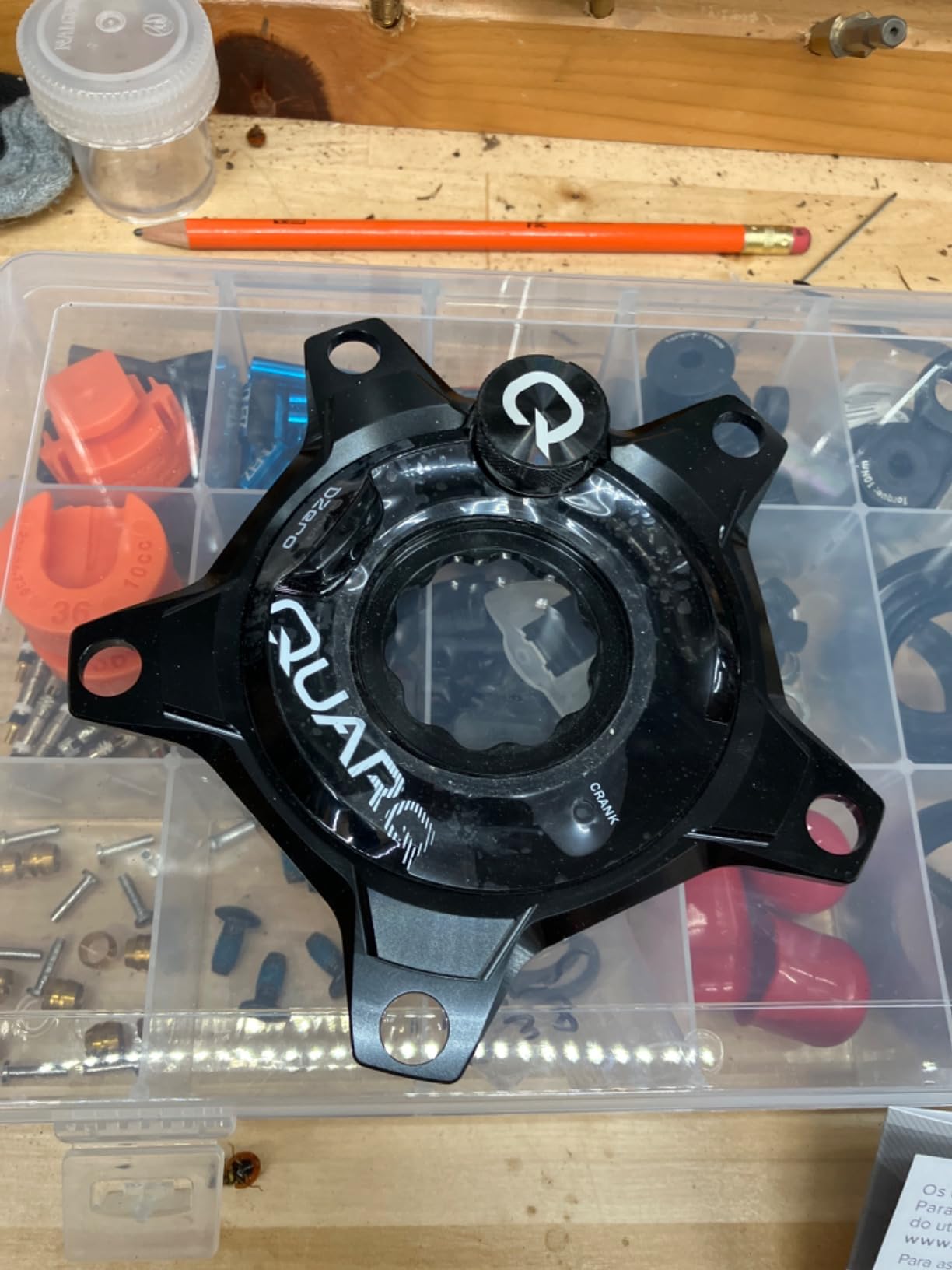
Owners with an existing SRAM groupset consistently report that this adds power data without replacing crank arms, and they rate compatibility as the main limitation rather than the main drawback. Claimed accuracy is plus or minus 1.5 percent with L/R balance measurement.
What compatibility means before you buy
Check three things: that your crank is 107 BCD with an 8-bolt interface, that it is a Quarq D1-equipped or AXS-equipped crank, and that your groupset is on the version of AXS the spider expects. Get any of those wrong and the spider is a paperweight on your desk.
If you want a decision rule rather than a spec check: if your bike is SRAM 12-speed with AXS and you intend to keep the crank, this is the right meter. If you ride Shimano or Campagnolo, it is not, and the GEOID PM500 or a pedal meter is the realistic path.
Where it falls short
The narrow fitment is the whole weakness. Anyone outside that SRAM envelope gets no benefit from this unit no matter how well it performs on the right bike.
It is also permanently attached to one crankset and one bike, so a second-bike household or a rider who travels with a trainer will need a second solution or a portable pedal meter alongside it.
5. Magene P505 and P515 Power Meter Crankset – Best Value for FTP Work
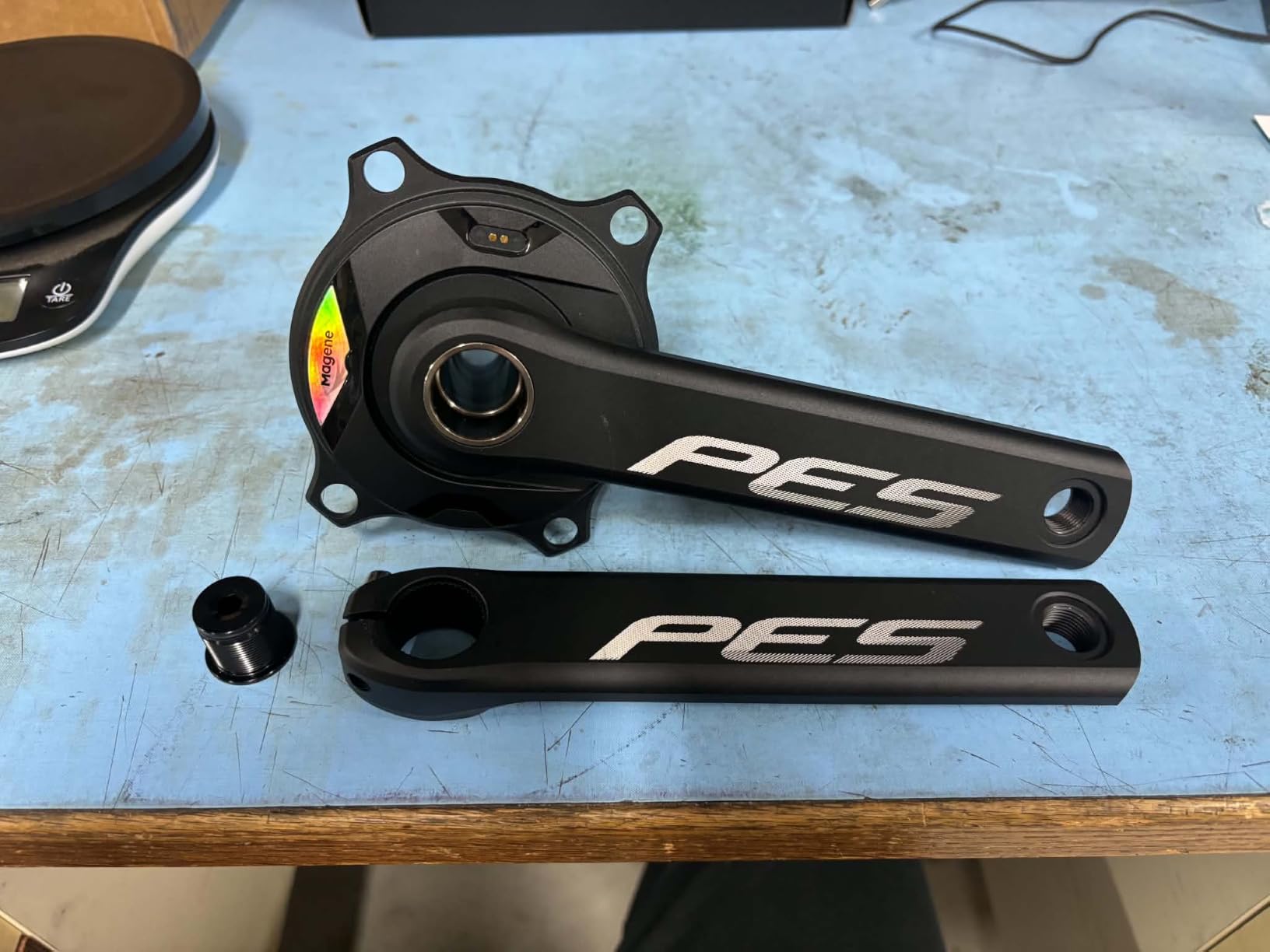
Magene PES P505/P515 Power Meter Crankset – ±1% Accuracy, 625g Lightweight, 380H Battery, 110BCD, ANT+/Bluetooth, IPX7 Waterproof for Cycling
Bilateral crank, spider sensing
Plus or minus 1 percent accuracy
Up to 380 hours of ride time
625 g crankset
110 BCD, IPX7
Pros
- Plus or minus 1 percent accuracy at a mid-range cost
- Existing chainrings and most bottom brackets fit
- 380-hour battery
- Reports L/R balance and torque effectiveness
- Two-year manufacturer warranty
Cons
- Must be activated in the Magene app before pairing elsewhere
- One owner reports persistent disconnects after a firmware update
- Heavier than dedicated carbon cranks
The P515 is the accuracy-per-cost sweet spot for anyone doing serious threshold work on a budget crankset. It claims plus or minus 1 percent accuracy with temperature compensation, which is the same figure the premium pedal meters claim, and it reports torque effectiveness and L/R balance alongside power and cadence.
Battery life is the best in this group by a distance: up to 380 hours of ride time on a 625 g crankset with a 99 g spider, built from 7075 aluminium and rated IPX7 waterproof. Riders report the battery rarely needs charging, which removes the anxiety riders voice about meters dying mid-ride.
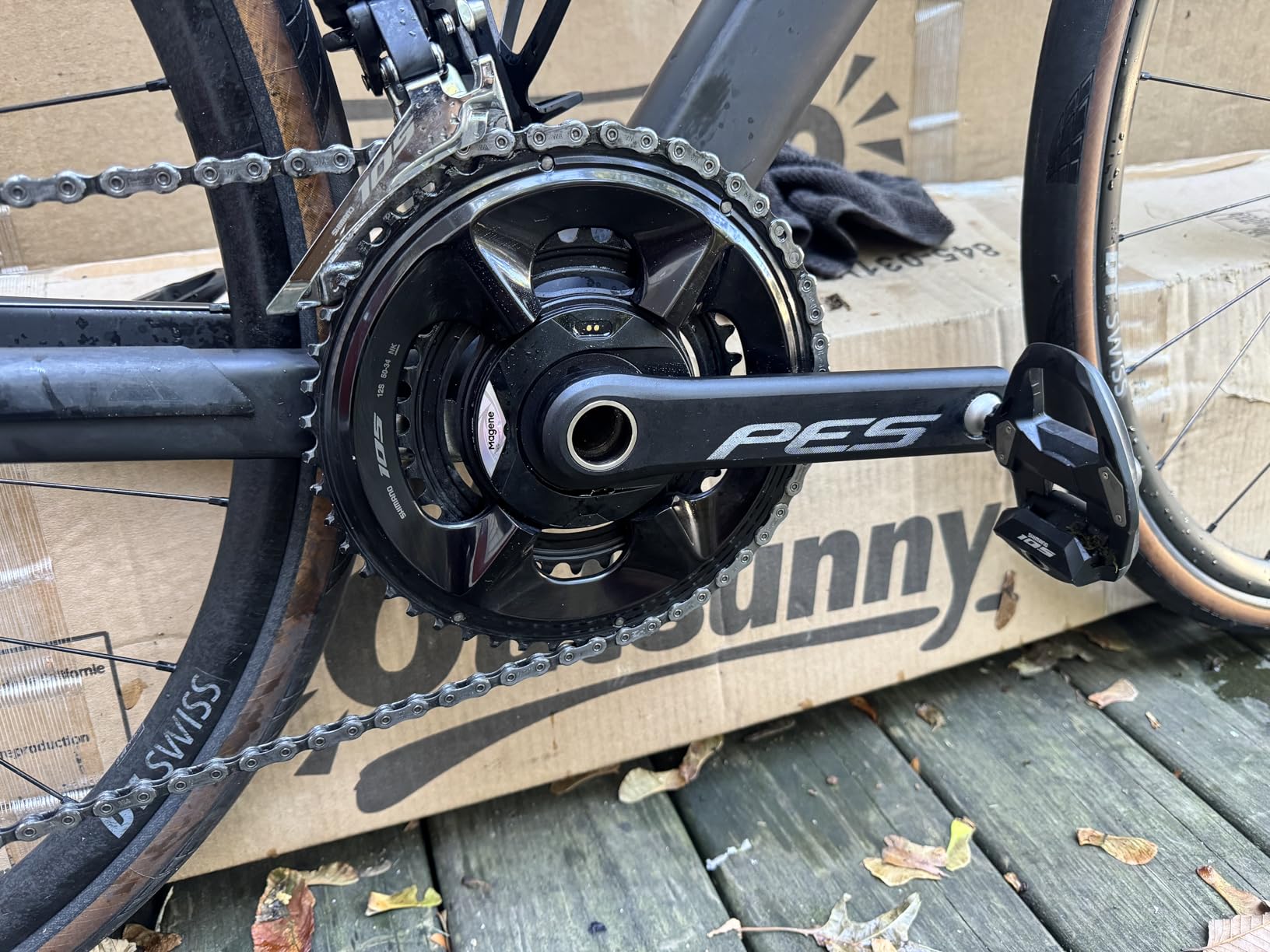
Installs are reported as straightforward ten-minute jobs by riders replacing Shimano cranksets, and because it is 110 BCD four-bolt your existing chainrings and most bottom brackets fit without modification. The listed package includes the bilateral crank and a quick start guide, backed by a two-year manufacturer warranty.
The metric set is what makes it interesting beyond raw watts. Torque effectiveness tells you how smoothly you are applying force across the pedal stroke, which is the single most actionable piece of technique data most riders will ever see.
Why plus or minus 1 percent matters for structured plans
Your zones are set as percentages of FTP. A one percent tolerance on a 300-watt FTP is three watts, which is well inside the noise of your own day-to-day variation. Over a training block that error stays put, so week eight really is comparable to week one.
Compare that with the 1.5 percent claims on the SRAM spider and GEOID crankset, which add roughly one watt of drift on the same figure. Neither is dangerous; only one of them keeps you inside the accuracy band that mainstream training plans assume.
Where it falls short
The app dependency is real. The crankset must be activated in the Magene app before it will pair anywhere else, and reviewers describe that interface as small and not ideal for monitoring rides live. If you ride with your phone in a bar mount, that is worth knowing.
One owner also reports persistent disconnects following a .118 firmware update, which is exactly the failure mode forum riders describe elsewhere in this category. Treat that as a single data point rather than a pattern, but keep it in mind if you are deciding between this and a pedal meter that needs no vendor app at all.
6. Magene P715 Power Meter Pedals – Lightweight Dual-Sided Data
Magene P715 S Power Meter Pedals – ±1% Precision, 120h Battery Life, Seamless Bike Compatibility, ANT+ & Bluetooth for Cycling
Dual-sided pedal sensors
Plus or minus 1 percent accuracy
120 hours of battery
157 g per pedal
IPX7 waterproof
Pros
- Dual-sided plus or minus 1 percent accuracy in a pedal format
- 157 g per pedal is very light
- One-minute installation
- Works with road
- time trial and triathlon setups
Cons
- 120-hour battery is far below the 300 to 380 hour cranksets
- Younger listing with a 39-review base
- Firmware and pairing friction in early reviews
The P715 is the pedal answer for riders who want true dual-sided data without carrying the Assioma Duo price tag, and at 157 g per pedal it is one of the lighter options in this group. The package includes both pedals, crank washers, a magnetic charging cable and a quick start guide.
Accuracy is claimed at plus or minus 1 percent dual-sided, with Bluetooth and ANT+ dual protocol and an IPX7 rating. Installation is reported as about a minute, and early owners describe accurate dual-sided data and painless setup.
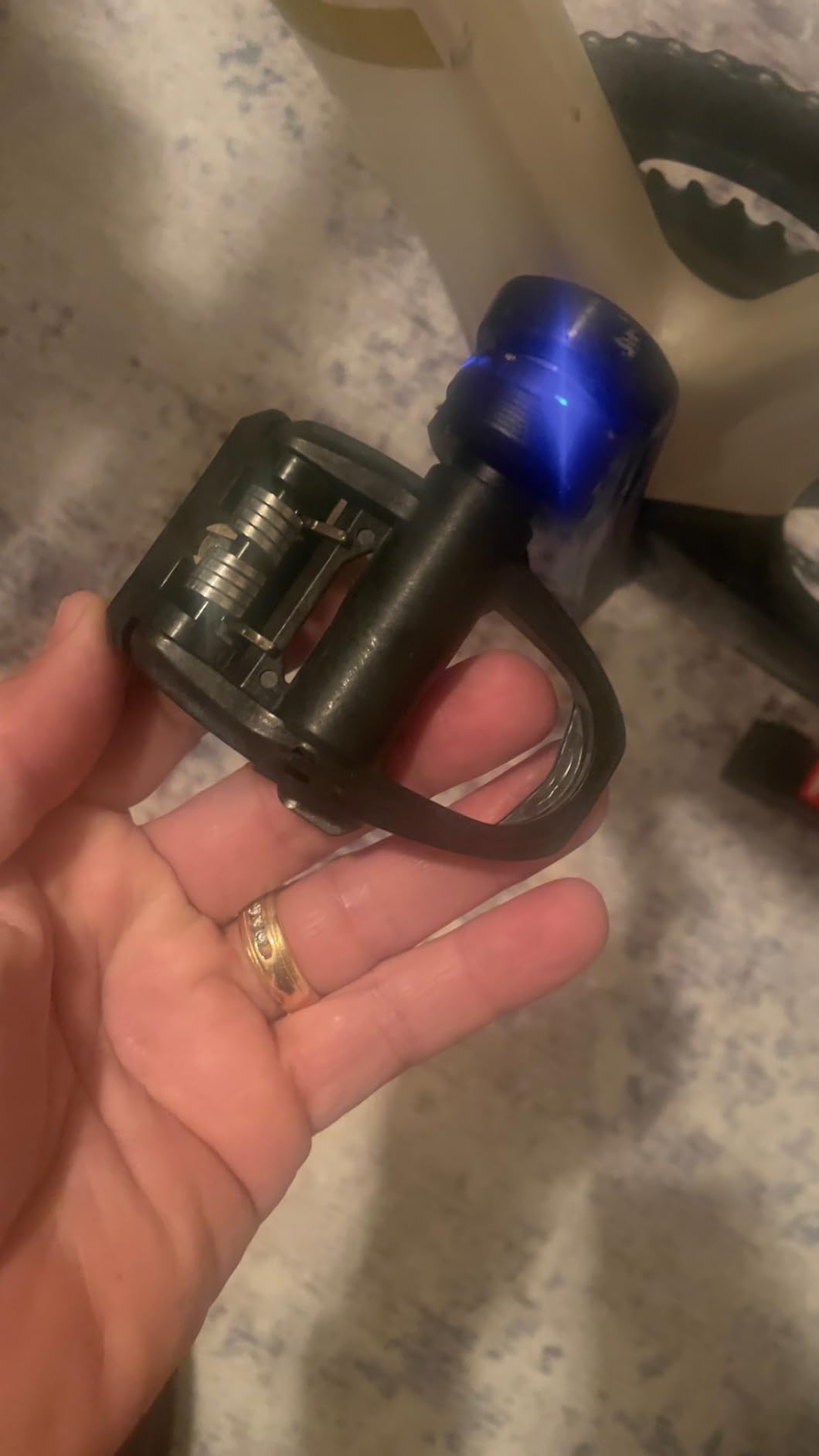
The battery is the honest weak point. At 120 hours, you are charging roughly four times as often as a crankset rival, which on a week of training plus a weekend ride is a real recurring task. If you are the sort of rider who charges things on the kitchen table, this is a non-issue.
The review base is also the thinnest of the crankset-and-pedal group at 39 reviews, and reviewers note that a noticeable share of one-star feedback reflects firmware and pairing friction typical of a newer product. That is the kind of thing that usually resolves with updates.
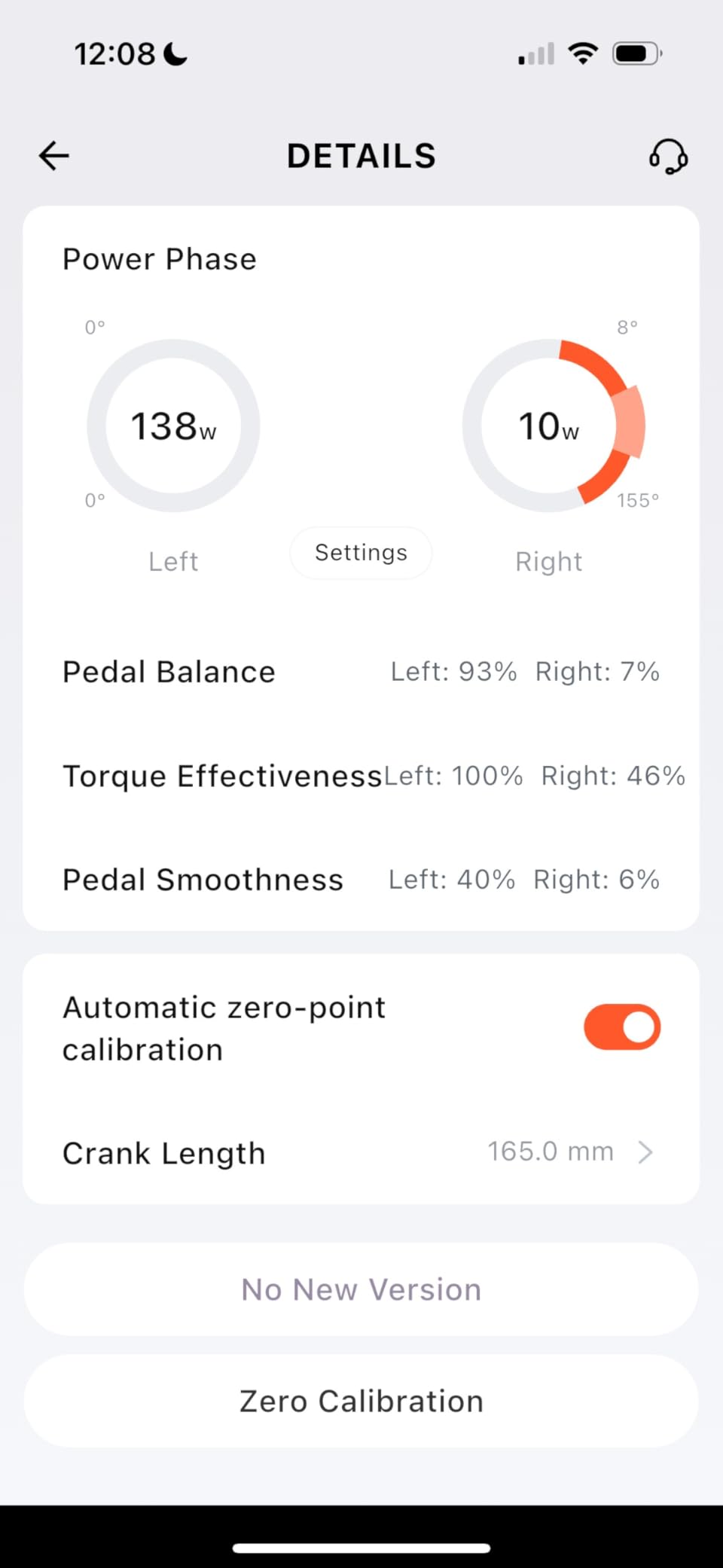
Who this suits over the Assioma Duo
Weight is the honest differentiator. At 157 g per pedal, the P715 appeals to riders on time trial or triathlon setups where pedal mass is scrutinised, and to anyone who simply prefers a lighter-feeling pedal over the Duo’s titanium build.
It also suits riders whose existing bike is already set up for Shimano SPD-SL cleats, since no cleat conversion is required. On a mixed-pedal household that matters more than another 100 reviews.
Where it falls short
Beyond the recharge cycle and the young listing, the seven advanced training functions it advertises are less documented than Assioma’s, so if you rely on pedalling dynamics and pedal power balance data specifically, verify what you actually get before committing.
It is also committed to one cleat system. Speedplay riders should read the next section before buying.
7. SRAM Rival D1 QUARQ Power Meter Arm – For DUB Builds
SRAM Rival D1 QUARQ ARM Left ARM/Spindle 172.5mm Black Dub 12-Speed
Quarq D1 optical crank arm
DUB bottom bracket
12-speed electronic
700 g
172.5 mm listed
Pros
- Optical dual-sided sensing from Quarq
- Keeps the SRAM DUB ecosystem and existing chainrings
- Lowest-cost route into a crank-arm power meter
Cons
- Listing shows a single crank arm
- so a matching arm may be needed
- Only fits SRAM 12-speed DUB cranks
The Rival D1 QUARQ arm is the cheapest credible route into optical crank-arm power sensing, and it plugs straight into the SRAM DUB ecosystem. Riders who wanted Quarq accuracy without buying a whole new groupset are the audience here, and the feedback centres on compatibility checks with DUB cranks.
Optical sensing matters because it reads angular velocity from the optical track rather than inferring it from a strain gauge, which is why the brand is valued for holding accuracy through irregular pedalling and oval rings.
The compatibility question to answer first
Two things to confirm: that your cranks are SRAM 12-speed DUB, and whether you need a matching arm for both sides or only one. The listing specifies a single crank arm at 172.5 mm, so riders wanting full symmetry may need to buy the pair.
Because it replaces a crank arm, you will also need the correct DUB bottom bracket interface already in place or ready to fit. Get this wrong and the arm will not seat properly.
Where it falls short
At 700 g listed weight, this is a full crank arm rather than a light spider, so it adds mass to one side of the bike. That asymmetry is minor but measurable on a climbing setup.
With only 23 reviews, this is the thinnest evidence base here. The unit is well-liked by everyone who has bought it, but we would not call it proven across seasons the way the Assioma pedals are.
8. Favero Assioma Duo-Shi – Dual-Sided With Shimano Pedal Bodies
Wearable4U – FAVERO ASSIOMA Duo-Shi Both Sides Power Meter 99gr Each (Shimano Pedals Compatible) with Cycling Multitool Bundle
Assioma sensors, Shimano pedal bodies
Compatible with PD-R8000, R7000, 6800, R550 and R540
Plus or minus 1 percent accuracy
99 g per pedal
Bluetooth and ANT+
Pros
- Dual-sided power with L/R balance and dynamics
- Uses existing Shimano pedal bodies
- Lightest Assioma dual option at 99 g per pedal
- Paired quickly with Garmin and Wahoo head units
Cons
- One reviewer reports power reading roughly 10 percent low
- Same owner reported a right spindle bearing failure twice
- Slightly wider Q factor noticed early on
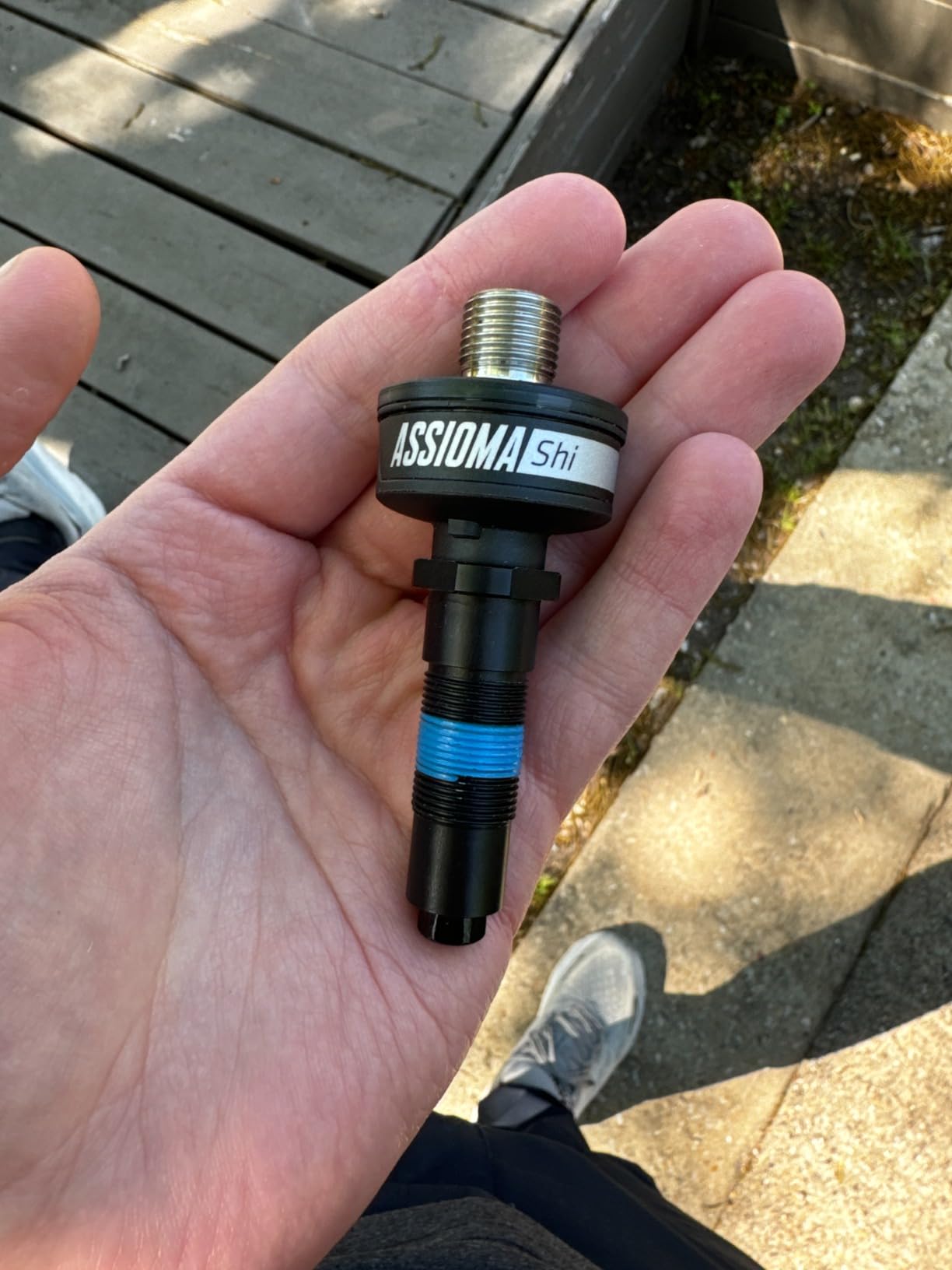
The Duo-Shi is the clever option: Assioma DUO sensing hardware mounted in Shimano SPD-SL pedal bodies you already own or can buy cheaply. It fits PD-R8000, PD-R7000, PD-6800, PD-R550 and PD-R540 bodies, which means SPD-SL riders keep their pedal feel and their Q factor instead of adapting to a new platform.
At 99 g per pedal it is the lightest Assioma dual option here, and the claimed accuracy is plus or minus 1 percent regardless of pedalling irregularity or oval rings, using angular velocity sensing over Bluetooth and ANT+. The bundle adds a 16-in-1 cycling multitool.
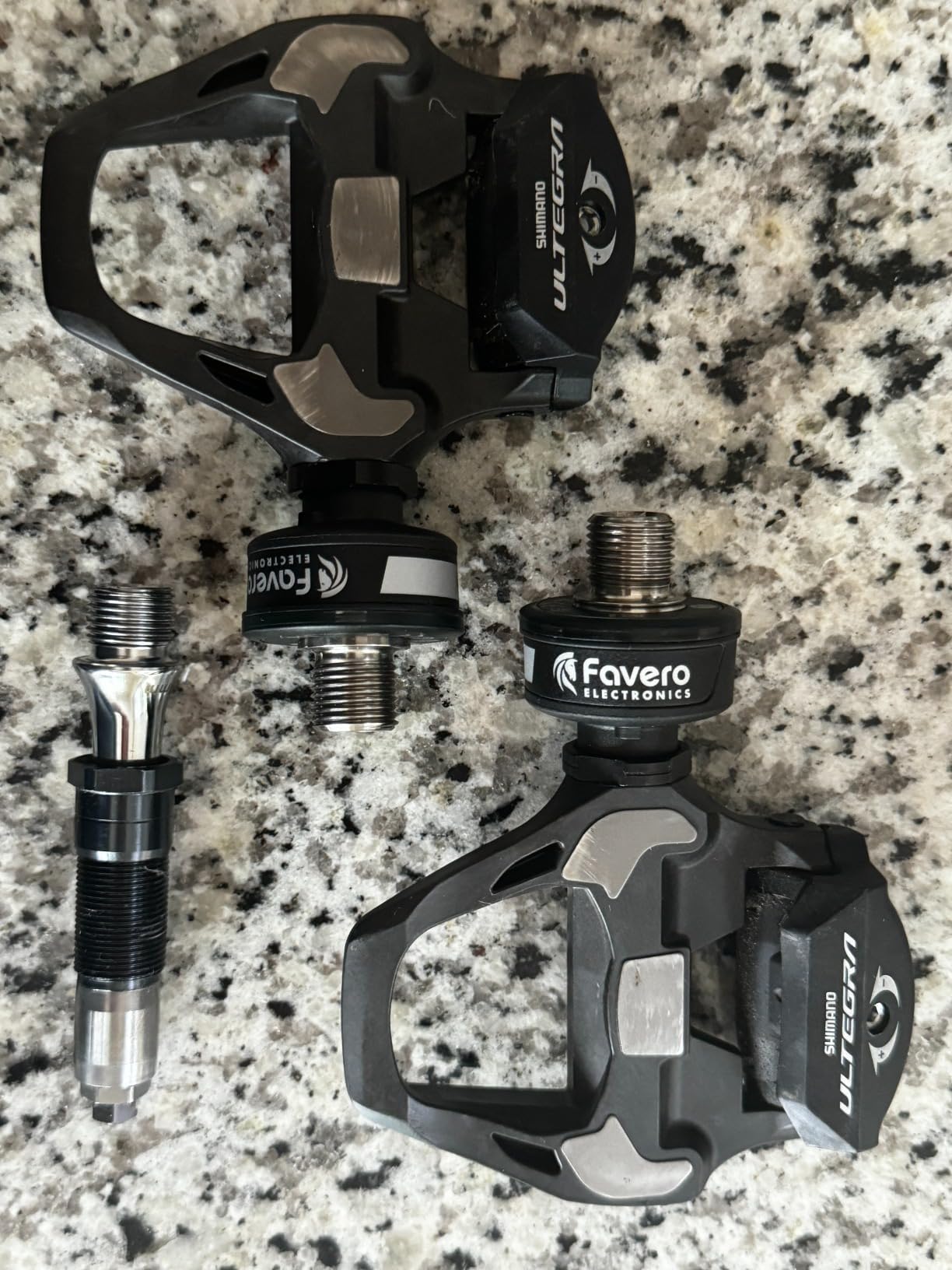
Most owners rate it as more reliable than a Shimano crank power meter at similar outlay, and report quick pairing with Garmin and Wahoo head units. One reviewer reports a power reading roughly 10 percent low, and the same owner had a right spindle bearing fail twice, so treat that as one detailed report rather than a pattern.
Fit for training is solid. Dual-sided data with L/R balance and dynamics gives you everything the plain Duo gives you, and the Shimano body clears a common objection to pedal meters: many riders simply prefer SPD-SL hardware under the shoe.
Why reusing pedal bodies is worth the assembly
Pedal bodies are consumable. Cleats wear, bodies crack, bearings dry out, and replacing them is routine. The Duo-Shi approach means the sensing hardware – the expensive part – stays installed while you replace bodies like any normal pedal, rather than throwing away a whole pedal meter because the body cracked.
That changes the long-run cost picture in a way the sticker price does not show, and it also means you keep the pedal characteristics you have already dialled in for cleat tension and stance width.
Where it falls short
Some riders noticed a slightly wider Q factor in the first rides compared to plain Shimano bodies, which matters if you have very tight knee tracking or a bike fit built around a specific stance width.
Assembly is also more involved than clipping in a finished pedal. It is a build step, and if you are not comfortable with pedal servicing, budget an extra evening or let a shop do it.
9. Favero Assioma PRO RS-2 – For All-Weather and Multi-Discipline Riding
Favero Assioma PRO RS-2 Dual-Sensing Pedal Based Road Cycling Power Meter
Dual-sensing pedal, SPD-SL compatible
Modular road and MTB pedal body
Temperature compensation from -10 C to 55 C
160+ hours per charge
IAV power and gyroscope
Pros
- Automatic temperature compensation across a wide range
- Modular pedal body swaps between road and MTB
- 160+ hours per charge
- Temperature compensation across a wide range
- Includes compatible cleats and charging kit
Cons
- Clip-out tension is tighter than Ultegra and Dura-Ace
- Threads need greasing to avoid creak noise
The PRO RS-2 is the most technically advanced pedal in this group and the one we would trust hardest in bad weather. Automatic temperature compensation runs from minus 10 to 55 degrees Celsius, backed by IAV power measurement and a gyroscope for a claimed plus or minus 1 percent accuracy. Temperature drift is the accuracy killer nobody outside this class really solves.
The modular pedal body is the sleeper feature. One set of sensors swaps between road and mountain bike bodies, so a rider who owns both does not need two meters. The box includes Assioma PRO RS Shimano-compatible SPD-SL cleats, two magnetic charging connectors, a USB-C cable, washers and a greasing toolkit.
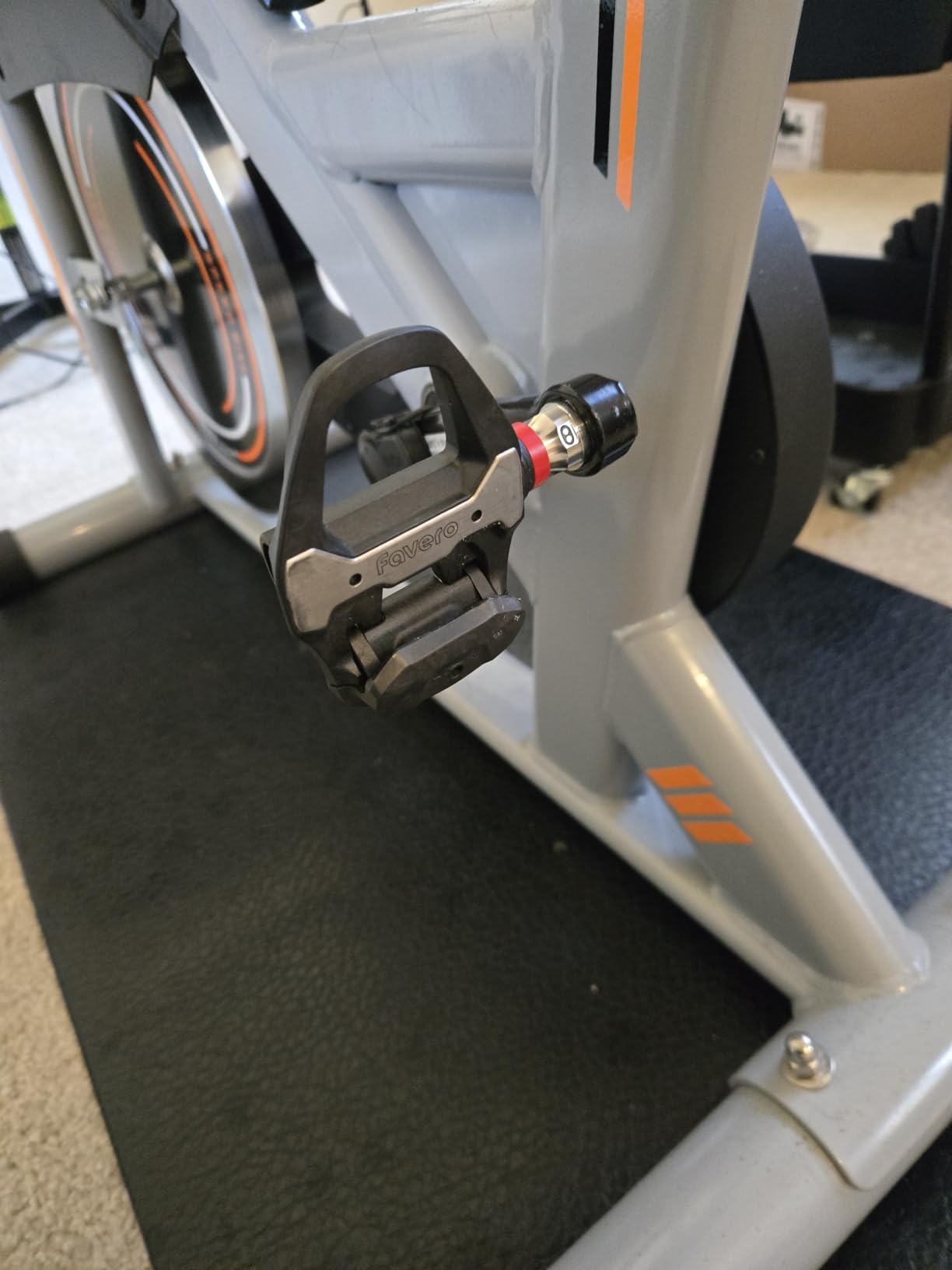
Battery life is 160+ hours per charge with magnetic charging, which puts it roughly three times ahead of the typical pedal meter and behind only the cranksets. Owners describe the battery as lasting indefinitely between charges, and report accurate power values, light weight and quick setup.
With 18 reviews at 4.9, this is the smallest and strongest-rated review set here. That cuts both ways: the rating is excellent, but the evidence base is thin, and we would want a full season of data before treating it as a proven recommendation over the Duo.
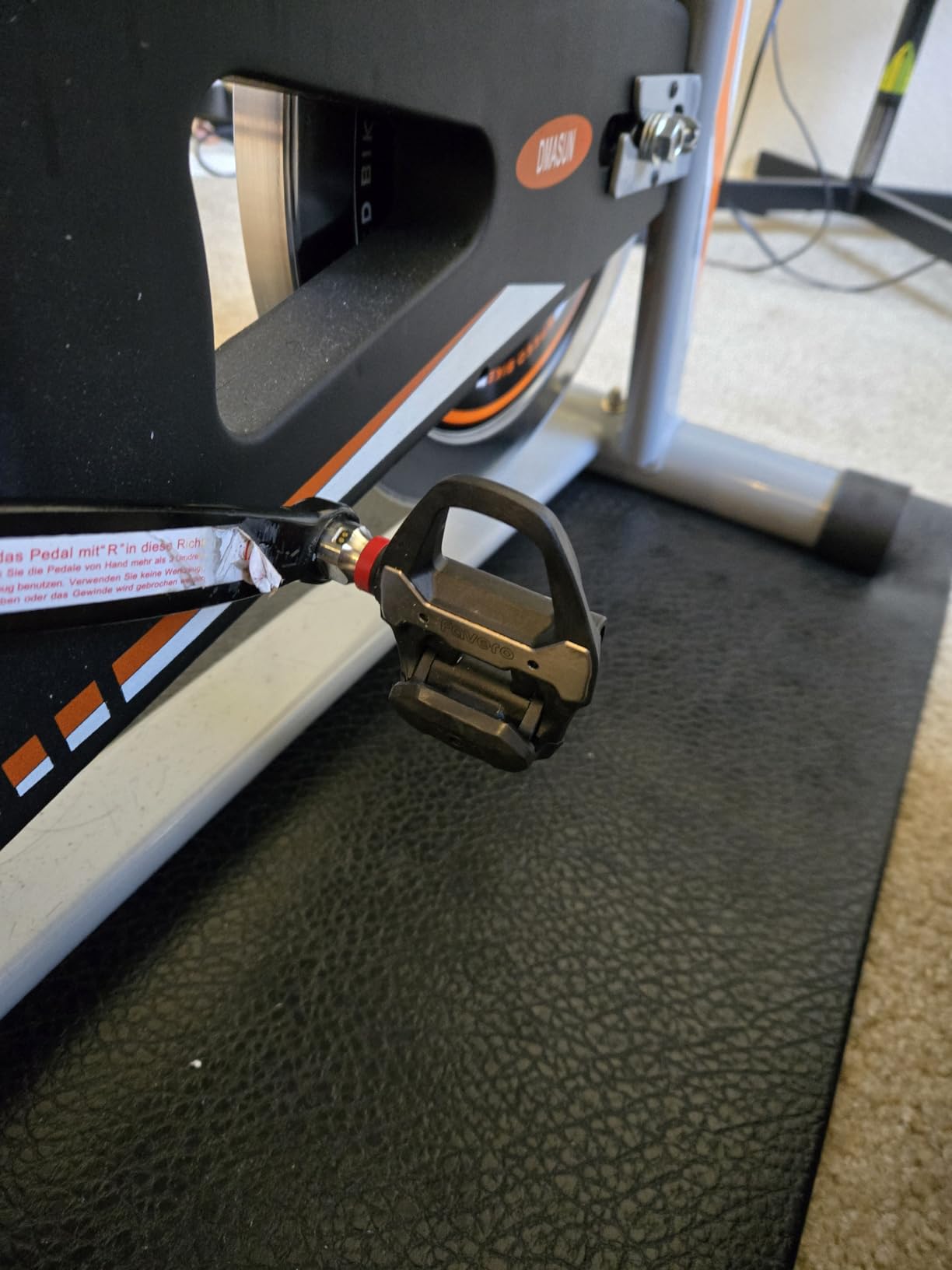
What temperature compensation actually buys you
Strain gauges drift with temperature. Ride a cold winter morning after a warm summer calibration and the same effort reads differently. Temperature compensation applies a correction curve so your numbers stay comparable across seasons, which is exactly what you need if you set zones once and then train against them all year.
For riders in a cold climate, this is the difference between a meter that is annoying and a meter that disappears from your thinking. It is the single biggest technical argument for this pedal.
Where it falls short
Two mechanical complaints recur. Clip-out tension is tighter than Ultegra and Dura-Ace, which surprises riders used to premium Shimano or Look hardware. And the threads need greasing to avoid creak noise – the toolkit is included, but you have to do it.
Second, the small review base. At 18 reviews, we are relying on a very consistent but very thin signal.
10. Favero Assioma PRO MX-1 – Single-Sided With Modularity
Favero Assioma PRO MX-1 Single Sided Power Meter Pedals
Single-sided pedal sensor
Standard pedal system compatibility
Syncs to cycling computers and training apps
1.8 lb listed package weight
Pros
- Uniformly strong owner feedback
- Works with standard pedal systems
- Syncs to head units and training apps directly
- Single-sided keeps the cost down
Cons
- No L/R balance data
- Very small review base at 17 reviews
The MX-1 is the entry point into the Assioma PRO line, and it delivers a 5.0 average across every review in its set. That is a perfect score on a small sample, which is impressive but not conclusive – seventeen reviews is seventeen reviews.
Mechanically it integrates with standard pedal systems, so installation is not the project some premium cranksets become. It syncs directly to cycling computers and training apps, which means no vendor app in the middle of the chain.
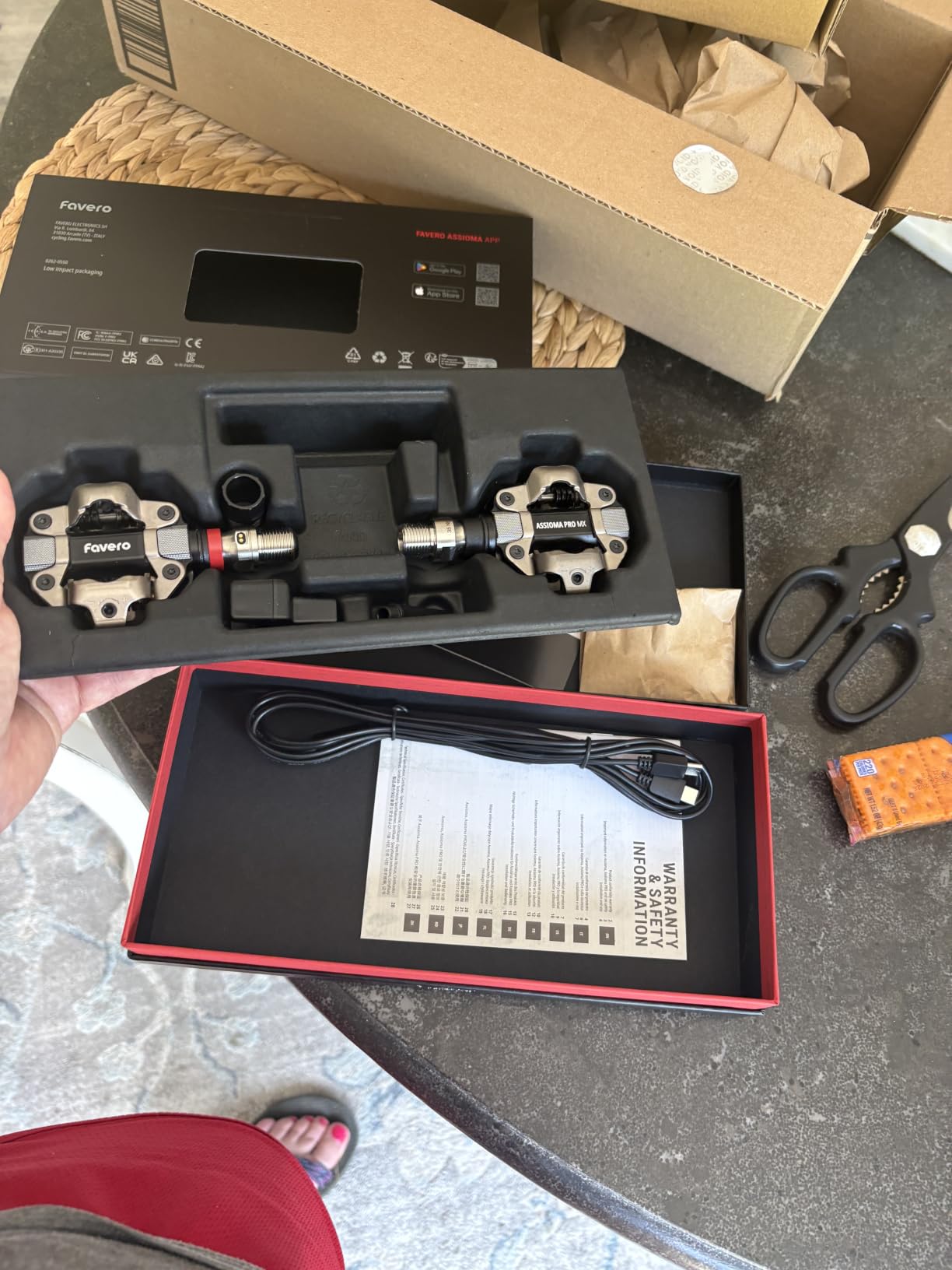
The appeal is straightforward: the PRO line’s sensor hardware and build quality at a single-sided price point. Riders who want Assioma reliability and portability, who do not need L/R balance, and who are not doing single-leg rehab work get the core of the package and skip the premium.
As with the Uno, single-sided measurement means one leg is doubled, which produces a consistent bias rather than random error. Structured plans absorb that bias without invalidating zone boundaries.
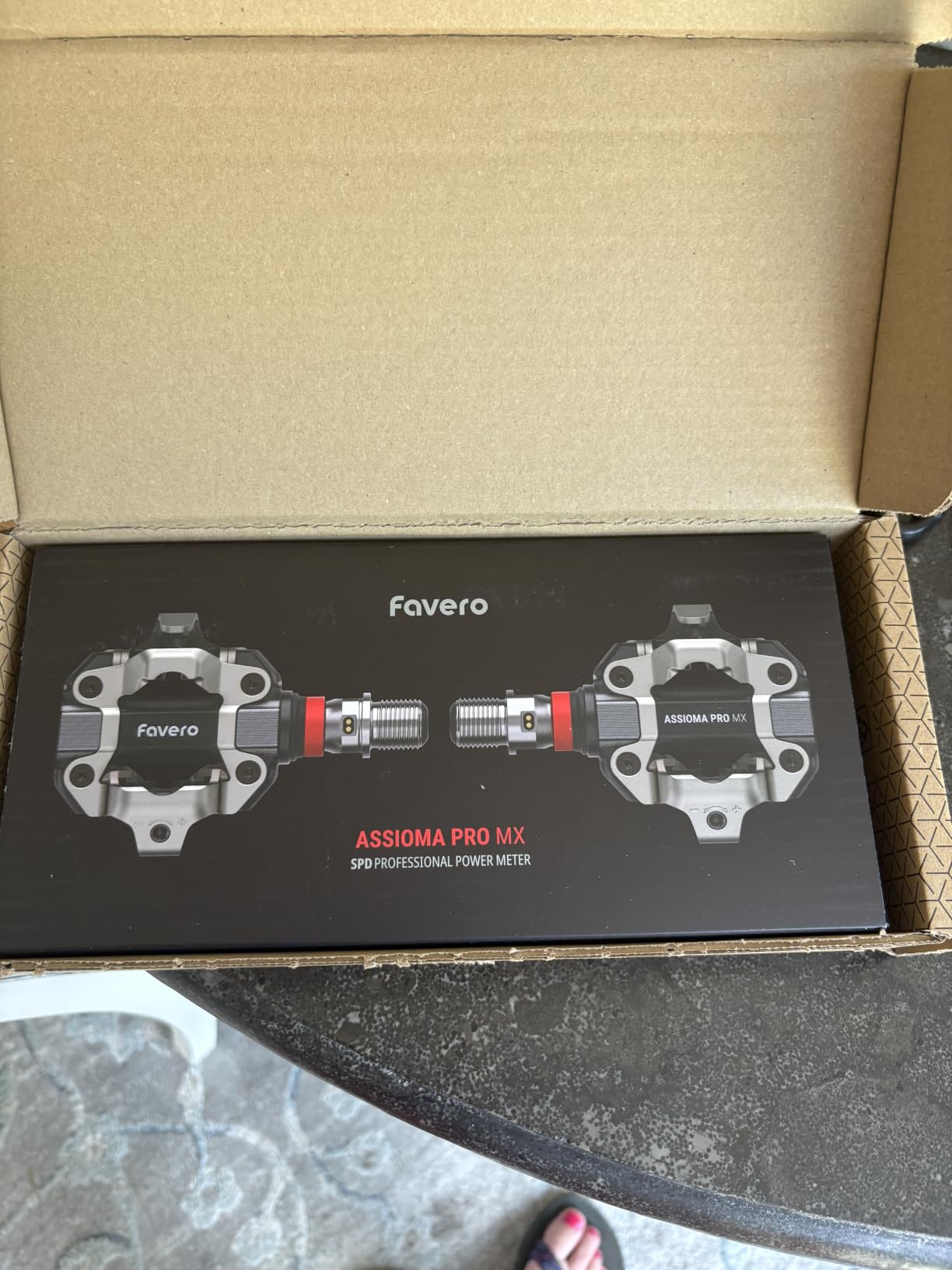
Where single-sided is genuinely the right call
The honest case for single-sided is simple: if you will never look at the balance field, dual-sided costs you money for a number you ignore. Most riders fall into that group. The usual outcome of buying dual-sided without a specific reason is watching the balance field for a few weeks, concluding you are roughly even, and moving on.
Given that, the MX-1 and the Uno are the rational buys, and the decision between them comes down to fit, cleat preference and which line of Assioma hardware you want under your shoes.
Where it falls short
No L/R balance means bike-fit and asymmetry work is off the table, and single-leg injury rehab is not a good use case for it. If you have a history of knee trouble or a saddle that slides off-centre, change your mind before you buy.
The 17-review base is the other limitation. We like the sentiment, but we would treat it as an early signal rather than a track record.
11. Wahoo Fitness SPEEDPLAY Power Dual-Sided Pedals – One Cleat System Everywhere
Wahoo Fitness SPEEDPLAY Power Dual-Sided Power Pedals
Dual-sided power pedals
SPEEDPLAY cleat platform
276 g per pair
13 mm stack height
55 mm Q factor
Stainless steel spindles
Pros
- Zero cleat changes between road bike
- trainer and travel
- Stable carbon-style dual-sided platform
- Bluetooth so it can drive indoor trainer sessions
- Triple-sealed cartridge and needle bearings
Cons
- Highest cost in this group
- Committed to SPEEDPLAY cleats
- Only 17 reviews so far
The Wahoo SPEEDPLAY Power solves exactly one problem better than anything else here: cleat changes. If you ride road, train on a trainer and travel with a fit-in-a-case, one pedal system that works on all three removes a genuinely irritating friction point from your week.
Build quality is the second argument. Stainless steel spindles, a triple-sealed cartridge and needle bearings, a 13 mm stack height and a 55 mm Q factor, all at 276 g per pair. Buyers back the headline benefit and rate the platform highly, though on a limited number of reviews.
Why trainer compatibility changes the maths
This pedal transmits over Bluetooth, so it can drive indoor trainer sessions and Zwift workouts directly. That matters more than it sounds: it removes the trainer-versus-power-meter argument from your indoor sessions, because your real pedals become your training pedals.
For a rider splitting time between a smart trainer and the road, that single feature can justify the premium on its own. Riders on trainerroad.com cite exactly this swap-everywhere flexibility among their top purchase reasons behind accuracy.
Where it falls short
The price is the highest in this group by a clear margin, and the cleat commitment is absolute. If you ever decide you want to switch to Shimano SPD-SL or Look Keo cleats, you are changing the whole platform again.
At 17 reviews the evidence base is small. The specification is strong and the sentiment is consistent, but a full season of ownership reports would make the recommendation firmer.
Single-Sided vs Dual-Sided: Do You Actually Need Both Legs?
A single-sided error is a consistent bias rather than random noise, and that single distinction resolves most of the debate. A genuine 52/48 power split reported by a single-sided meter comes out roughly 4 percent high; a 48/52 split comes out 4 percent low. The number is wrong every time in the same direction, which means your training plan absorbs it and your zones stay valid.
Dual-sided measures both legs independently and reports a true L/R balance. That is worth paying for in four situations and essentially none of the others.
1. Injury rehabilitation. One-sided power lets you load only the sound leg and hold the other back, which is the point of the measurement.
2. Active bike-fit work. Cleat position, saddle position and leg-length discrepancy all show up in the balance field. If you are chasing asymmetry deliberately, you need both legs.
3. Cross-device consistency. Zwift racers in particular look for the cheapest route to dual recording, because single-sided data is not race-legal there. If you race online, dual-sided is not an upgrade, it is a requirement.
4. Known asymmetry. One-sided knee pain, a saddle that slides off-centre or a prior leg injury is the symptomatic test for buying dual-sided.
If none of the four apply, buy single-sided and spend the difference on something you will enjoy. The most common outcome of buying dual-sided without a reason is watching the balance field for three weeks and never opening it again.
Will It Fit Your Bike? Compatibility Notes Before You Buy
Compatibility anxiety is the single most common qualifier in buying questions about power meters, and it is the easiest thing to get wrong. Run through this list before you order anything.
Pedal meters: check your thread standard first, which is 9/16 inch on the road bikes this group covers. Then check your cleats. Assioma Duo and Uno bodies are Shimano SPD-SL and Look Keo compatible, the Duo-Shi uses Shimano pedal bodies specifically, the Magene P715 suits SPD-SL riders, and the Wahoo SPEEDPLAY Power commits you to SPEEDPLAY. Mixing brands means new cleats at minimum, and usually new shoes over time.
Crank arms: the Rival D1 QUARQ arm needs SRAM 12-speed DUB cranks and a matching DUB bottom bracket. Buying it means the crank interface is correct from day one.
Spiders: the SRAM AXS spider fits 107 BCD 8-bolt SRAM cranks and needs a Quarq D1-equipped or AXS-equipped crank. The GEOID PM500 is 110 BCD 4-bolt and works with single or double chainrings, and the Magene P515 is also 110 BCD 4-bolt with Shimano 12-speed compatibility.
Bottom brackets: pedal meters care far less than crank meters. Assioma, Magene and Wahoo pedal units bolt to the standard 9/16 inch thread, which is why they install in a minute rather than a workshop visit. Crank and spider meters are the ones that dictate your bottom bracket choice.
Groupsets: groupset brand is less of a hard filter than riders assume. Every pedal meter here transmits over both Bluetooth and ANT+, so it will pair with a Garmin Edge, a Wahoo head unit or your phone regardless of what shifting you run. The exceptions are the axle-driven options: the SRAM spider needs SRAM AXS, and the QUARQ arm needs DUB.
If you are assembling a broader indoor training setup while you are at it, our home gym system guide covers the strength side of a balanced training week.
Real-World Reliability: Dropouts, Firmware and Battery Reality
The most repeated complaint across rider forums in this category is not accuracy, it is connectivity. If you are choosing between two accurate meters, choose the one whose software you trust, because firmware fixes have resolved more reported problems in this category than any hardware change.
The clearest example comes from a rider with two and a half years on a pedal meter who experienced dropouts and phantom power spikes despite changing pedal body covers, then found that updating to the latest software solved it. That single account reframes the whole question: before you conclude a meter is faulty, update it.
Dropouts and phantom spikes are reported more often on crank-arm meters than pedal meters, and cross-validating two meters on the same climb is the trust test riders actually rely on. One BikeRadar reader comment compares Assioma Duo data against 4iiii data on the same climb with two GPS units and found the power data were not sustainable compared with the Assioma. Same ride, same hill, two meters – that is the gold-standard test.
On batteries, pedal meters cluster around 50 to 160 hours per charge and cranksets between 300 and 380 hours. Neither figure is a real-world guarantee in cold conditions, and riders on long winter rides report thinking about the charge cycle. Vibration and rough terrain are the other two variables nobody publishes reliable numbers for.
Our read on the field: the Assioma pedals are the most proven choice, with the largest review bases and the longest ownership reports. The GEOID PM500 and Magene P515 lead on battery endurance. The newer Magene P715, Assioma PRO RS-2 and SPEEDPLAY Power all show early firmware and pairing friction that typically resolves with updates.
How to Choose a Cycling Power Meter
Five criteria decide this purchase, and only one of them is accuracy.
Accuracy. Claimed plus or minus 1 percent versus plus or minus 1.5 percent differs by roughly one watt on a 250-watt FTP. Both are fine for structured training. What matters more is repeatability – the same ride producing the same number – because that is what makes month-on-month comparison real.
Transferability. If you own more than one bike or travel with a trainer, a pedal meter is worth the premium on its own. Riders on trainerroad.com cite easy swapping between bikes as a top-three purchase driver behind accuracy and price.
Battery. Match the recharge cycle to your riding. Weekly commuters and short weekend riders are fine with 50 hours. Long-distance riders and cold-climate riders should lean toward the 300-plus hour cranksets.
Ecosystem. Compatibility with your head unit is a hard filter for some people and a non-issue for others. Every pedal meter here supports both Bluetooth and ANT+, so almost anything pairs. Check cleat compatibility first, because that is the one decision that is hard to undo.
Upgrade path. A permanent decision you can reverse is worth more than a modest spec bump. Buying a single-sided unit now with the option to add the sensing side later makes an irreversible choice reversible, and that is a genuinely different kind of value.
One question worth separating from the rest: why are cycling power meters expensive at all? The answer is that the pedal unit combines a precision strain gauge assembly, a sealed rechargeable pack, a radio, an accelerometer and a machined body, and the accuracy claims are certified rather than asserted. Below a certain point you are buying fewer of those components, which is exactly why the plus or minus 1.5 percent claims cluster at the bottom of this group.
Power Meter vs Smart Trainer: Which One Comes First?
Buy the smart trainer first if you do not have one. A trainer gives you repeatable indoor intervals on a schedule you control, and it does that work without any accuracy argument at all.
Buy the power meter first if you already own a trainer, or if your training is outdoors. A meter makes every outdoor ride and every trainer session measurable, and it transfers between the two. If your pedals transmit over Bluetooth, as the Assioma and Wahoo units here do, the same pedals power both.
The unresolved argument in forums usually comes from riders comparing an indoor trainer against an outdoor meter as if they were substitutes. They are not. One measures effort wherever you happen to be riding; the other makes a fixed location produce repeatable numbers. If you are setting up a room rather than a bike, start with an indoor bike and add power later.
Frequently Asked Questions
What is the most accurate cycling power meter?
Among the meters we reviewed, the Favero Assioma PRO RS-2 and the Assioma Duo make the strongest accuracy case. The Duo is our top pick because it combines plus or minus 1 percent class accuracy with 395 reviews averaging 4.8 stars, so its accuracy claim is backed by the largest real ownership base in the group.
What is the best value power meter for cycling?
The Favero Assioma Uno is the best-value pick. It rates 4.8 across 257 reviews, needs no calibration routine, swaps between bikes in about two minutes and covers 50 hours per charge. The GEOID PM500 crankset goes lower still and adds L/R balance data, but you replace a whole crankset to install it.
What are the best budget pedal power meters?
The Favero Assioma Uno leads the budget pedal options on evidence: 4.8 stars from 257 reviews, rechargeable 50-hour battery, Bluetooth and ANT+, and no calibration before each ride. The Favero Assioma PRO MX-1 is the alternative if you want the PRO line hardware and can accept single-sided data on only 17 reviews.
Do I need a dual-sided power meter for training?
Usually no. A single-sided error is a consistent bias rather than random noise, so a 52/48 split reads about 4 percent high every time and your zones stay valid. Buy dual-sided for injury rehabilitation, active bike-fit work, Zwift racing compliance, or a known leg asymmetry.
Why are cycling power meters so expensive?
A pedal power meter combines a precision strain gauge assembly, a sealed rechargeable battery, a Bluetooth and ANT+ radio, an accelerometer and a machined body, with accuracy claims certified rather than asserted. Cheaper units drop one or more of those elements, which is why plus or minus 1.5 percent claims cluster at the budget end.
How long do power meter batteries last?
The pedal meters in this group quote 50 hours for the Assioma Duo and Uno, 120 hours for the Magene P715 and 160+ hours for the Assioma PRO RS-2. The cranksets are far longer: 300 hours for the GEOID PM500 and up to 380 hours for the Magene P515. Cold conditions and vibration both shorten real-world runtime.
Conclusion: Our Final Verdict by Rider Type
For most riders, the best cycling power meters for training answer to one name: the Favero Assioma Duo. True dual-sided data, a rechargeable 50-hour battery, no calibration routine and a ten-second move between bikes, carried by 395 reviews at 4.8 stars. It is the choice we would make without hesitating.
Buy the Assioma Uno instead if single-sided data is enough and you want to spend the difference elsewhere. Buy the GEOID PM500 if the budget is tight and you accept replacing a crankset in exchange for L/R balance and a 300-hour battery. Buy the Magene P515 if plus or minus 1 percent accuracy on a crankset matters more to your threshold work than the lighter weight.
Build-specific riders have clear answers too: the SRAM AXS spider if you want to keep SRAM crank arms, the Rival D1 QUARQ arm if you are on DUB and want the cheapest optical crank sensing, and the Assioma Duo-Shi if you would rather reuse Shimano SPD-SL pedal bodies than adapt to a new platform. The Assioma PRO RS-2 is the one to buy if you ride in bad weather, and the Wahoo SPEEDPLAY Power is for riders who want one cleat system across road, trainer and travel.
Whatever you choose, update the firmware before you judge it, and cross-check it against a known ride once you have logged a few hundred kilometres. That habit, more than any spec figure, is what turns a power meter into a training tool.