
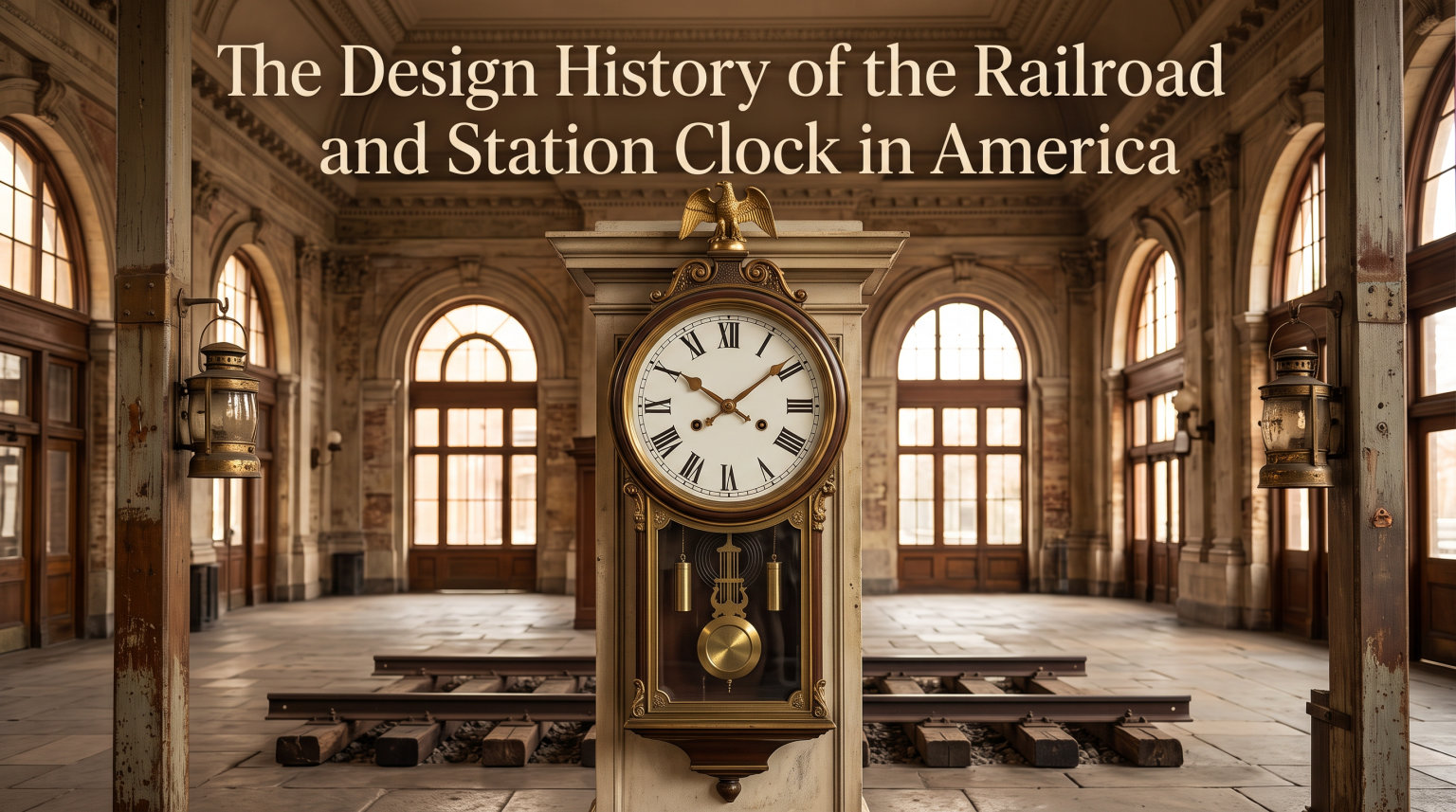
When you walk into a grand American train station and look up at that oversized dial face with its bold black hands and crisp Roman numerals, you are staring at more than a timekeeping device. You are looking at the mechanical solution to one of the most dangerous problems in nineteenth-century transportation. The design history of the railroad and station clock in America is the story of how a young nation learned to coordinate millions of lives across thousands of miles using nothing but brass, pendulums, and telegraph wire.
Station clocks served as the official time reference for entire communities. They told passengers when to board, told conductors when to depart, and told yardmasters when to clear the tracks. Every detail of their design, from the width of the minute hand to the thickness of the oak case, answered a single question: how do you make time visible and trustworthy to hundreds of people at once?
In this guide, I walk through the full arc of American railroad timekeeping, from the chaos of pre-1883 local time to the precision master clock systems that still influence clock design today. Along the way, we cover the manufacturers who built these iconic timepieces, the technology that kept them synchronized, and the design language that made station clocks instantly recognizable.
Table of Contents
Before Standard Time: The Chaos of Local Railroad Time
To understand why the railroad station clock became so important, you have to picture American timekeeping before 1883. Every city and town set its clocks by the sun, which meant noon in Boston happened about 45 minutes before noon in Washington, D.C. Local solar time worked fine when the fastest way to travel was a horse.
Railroads shattered that system. A single rail trip from Maine to California could cross dozens of local time zones, each different from the last. To cope, individual railroad companies simply invented their own time standards. The Pennsylvania Railroad ran on Philadelphia time, while the New York Central used New York City time.
By the early 1880s, American railroads collectively operated on more than 50 different local times. A station master might need three or four clocks on the wall, each labeled with a different railroad line, just to know when trains would actually arrive. Passengers regularly missed connections, freight schedules collided, and the risk of two trains sharing a single track at the same moment grew with every new mile of track laid.
This patchwork of conflicting times was not just inconvenient. It was deadly. Train collisions caused by schedule confusion pushed railroad officials to demand a solution, and that solution required a new kind of clock infrastructure.
November 18, 1883: The Day of Two Noons
The turning point in railroad station clock history America arrived on November 18, 1883. On that Sunday, railroad companies across the United States and Canada adopted a system of four standard continental time zones: Eastern, Central, Mountain, and Pacific. The change was organized by William F. Allen, secretary of the General Time Convention, who spent years negotiating with railroad officials to reach agreement.
The transition was dramatic. At precisely the agreed moment, station clocks across the country were reset to the new standard zone times. In some cities, the clock jumped forward by several minutes; in others, it jumped back. People called it the Day of Two Noons because many locations experienced noon, then reset their clocks, and reached noon again.
The federal government did not mandate standard time. It was the railroad industry that imposed it, using the sheer scale of their operations and the station clocks in their depots to make it reality. Within months, most towns and cities had quietly adopted railroad time for everyday life because the station clock on the depot wall was the most reliable, most public time source available.
Standard time zones did not become federal law in the United States until 1918, a full 35 years after the railroads put them into practice. For more than three decades, the railroad station clock was effectively the national time standard.
How Telegraph Time Signals Synchronized Railroad Clocks
Setting a time zone is one thing. Keeping hundreds of station clocks perfectly in step across a continent is something else entirely. The railroad industry solved this problem with a technology that was already transforming communication: the telegraph.
The U.S. Naval Observatory in Washington, D.C., maintained the reference master clock. Each day, it transmitted a precise time signal over telegraph wires operated by Western Union. At agreed moments, the signal traveled to railroad offices and depots across the country, where operators used it to correct their station clocks to the exact second.
The Self-Winding Clock Company of New York pioneered a particularly clever system. Their clocks contained an electromechanical mechanism connected to the telegraph line. Every hour, a signal from the master clock would trigger a tiny correction, advancing or retarding the clock hands as needed. This meant that a station clock in a remote Nebraska depot could stay synchronized to within a second of the clock in a New York City terminal.
This hourly telegraph synchronization changed everything. For the first time, every clock on a railroad network displayed identical time, eliminating the guesswork that had plagued train operations. The telegraph time signal became the invisible backbone of American railroad timekeeping, and the station clock was its visible face.
The Great American Station Clock Manufacturers
A handful of American clockmakers dominated railroad clock production, and each brought distinctive design and engineering philosophies to the work. These manufacturers did not just build clocks. They built the visual identity of American railroading.
Seth Thomas Clock Company
The Seth Thomas Clock Company, based in Thomaston, Connecticut, was perhaps the most important American railroad clock manufacturer. Founded in 1813, Seth Thomas produced the regulators and depot clocks that hung in thousands of stations across the country. Their railroad-grade movements featured high-count jeweled escapements and precision pendulum assemblies designed to hold accuracy within seconds per week.
Seth Thomas regulator clocks became so trusted that many small towns used the station’s Seth Thomas as the community’s official time reference. The company’s No. 18 regulator, with its handsome oak case and large white dial, remains one of the most recognizable American station clock designs. Collectors and museums prize surviving examples for their craftsmanship and provenance.
Chelsea Clock Company
The Chelsea Clock Company, founded in Boston in 1897, took a different path. Chelsea specialized in marine-grade precision clocks, and their Ship’s Bell clocks earned a reputation for extraordinary reliability in harsh conditions. Railroads valued Chelsea timepieces for the same reason the Navy did: they kept perfect time in environments where lesser clocks failed.
Chelsea’s contribution to railroad timekeeping extended beyond station clocks. Their precision movements influenced the standards for railroad-grade watches and master clock systems. Many Chelsea clocks still in service today run on their original mechanical movements, a reflection of the quality of their manufacture.
E. Ingraham Company
The E. Ingraham Company of Bristol, Connecticut, produced the distinctive banjo clocks that appeared in numerous railroad offices and smaller depots. Ingraham was known for creative case designs and reliable spring-driven movements that required less maintenance than heavier pendulum regulators.
While less famous than Seth Thomas in railroad circles, E. Ingraham clocks played a quiet but important role in secondary stations and administrative offices. Their banjo-style cases, with rounded lower bodies and slender necks, offered a more compact timekeeping solution for spaces where a full regulator clock would not fit.
Self-Winding Clock Company
The Self-Winding Clock Company deserves special attention because their technology directly addressed the synchronization problem. Based in New York, the company developed the electromechanical clocks that connected to Western Union telegraph lines for automatic hourly correction.
The Union Pacific Railroad used Self-Winding Clock Company timepieces as their official standard clocks. These clocks combined a traditional pendulum movement with an electromagnetic winding and correction mechanism, creating a system that was both mechanically sound and electronically precise. The Self-Winding Clock Company’s developments represent the bridge between old-world clockmaking and the age of synchronized electrical timekeeping.
Station Clock Design Characteristics
American railroad station clocks shared a consistent visual language that made them instantly readable, even from across a crowded platform. The design priorities were always the same: legibility, durability, and accuracy.
The dial face was almost always white enamel or painted metal, providing maximum contrast against the black hour marks and hands. Roman numerals were the standard choice for station clocks, though Arabic numerals appeared on some later models. The hands were broad and bar-shaped, thick enough to be read from a distance but balanced enough to move cleanly.
Most station regulators used an eight-day movement, meaning they needed winding only once a week. The cases were typically built from solid oak, chosen for its strength and resistance to the temperature swings and vibration common in active railroad depots. Glass doors protected the dial, and many cases featured decorative moldings that gave the clocks a dignified, institutional presence.
Inside, the better station clocks used gravity escapement mechanisms, a design originally developed for precision astronomical clocks. The gravity escapement isolated the pendulum from variations in the driving force, allowing the clock to maintain accuracy even as the mainspring wound down. This level of mechanical sophistication was what separated a true railroad-grade clock from an ordinary wall clock.
Railroad Watch Requirements: Precision on the Wrist
Station clocks were only half the equation. Every railroad employee involved in train operations, from engineers to conductors to switchmen, was required to carry an approved railroad-grade pocket watch. These watches had to meet strict standards for accuracy, jewel count, and adjustment.
A typical railroad watch requirement specified at least 17 jewels, adjustment to five positions, temperature compensation, and an open-face design with the winding stem at 12 o’clock. The watch had to keep time within 30 seconds per week, and it had to be inspected regularly by a certified railroad watch inspector.
The watch inspector was a real position at every major railroad. Inspectors compared employee watches against the station clock, which was in turn synchronized to the telegraph time signal from the Naval Observatory. If a watch drifted beyond the allowed tolerance, the employee could not work until it was corrected or replaced. This chain of precision, from the observatory master clock to the telegraph to the station clock to the conductor’s pocket watch, was what kept American trains running safely on single-track lines.
American vs European Station Clock Design
American and European station clocks developed distinctly different design philosophies, and understanding the contrast helps explain why American railroad clocks look the way they do.
The iconic Swiss railway clock, designed by engineer Hans Hilfiker in 1944 for the Swiss Federal Railways, represents the European approach. It features a stark white face with bold black bar-shaped marks instead of numerals, and a distinctive red second hand shaped like a signaling disc. The Swiss design is minimalist, functional, and iconic, so much so that it still dominates international perceptions of what a station clock should look like.
American station clocks, by contrast, embraced a warmer, more substantial aesthetic. The oak cases, Roman numerals, and regulator-style dials reflected a design tradition rooted in nineteenth-century American clockmaking rather than twentieth-century European industrial design. American clocks were built to be furniture as much as instruments, commanding presence in the depots and stations they occupied.
Both traditions shared the same core principle: the clock face had to be read instantly and accurately by people in motion. But the American design language prioritized craftsmanship and institutional gravitas, while the European approach pursued maximum visual simplicity.
Notable Surviving Station Clocks and Preservation
The preservation of historic railroad clocks has become a serious endeavor for railroads, museums, and private collectors. BNSF Railway alone maintains a collection of more than 200 historic clocks from its predecessor rail lines, including Seth Thomas regulators, Chelsea Ship’s Bell clocks, and E. Ingraham banjo clocks. Many of these are displayed at the BNSF headquarters and at exhibits like the one at White Lakes Mall in Kansas.
For collectors, provenance is everything. A clock with documented history connecting it to a specific railroad line, station, or even a named station master commands far more interest than an unattributed piece. Original boxes, service records, and documentation significantly increase value. Collectors and preservationists prefer clocks in working condition with their original movements, though finding replacement parts for antique mechanisms remains a real challenge.
Restoration requires careful judgment. Over-restoring an oak case or refinishing an original dial can actually reduce collector value by erasing the clock’s authentic patina and history. The most respected preservation work focuses on stabilizing the clock, repairing the movement to working order, and preserving the original finish rather than making the clock look new.
Museums across the country continue to display railroad clocks as artifacts of American industrial history. These surviving timepieces are physical records of the era when the station clock was the most important public timekeeper in the nation, and they remind us how much we take standardized time for granted today.
FAQs
What is the history of the station clock?
Station clocks originated in the nineteenth century as railroads needed a reliable, public time reference for scheduling trains and informing passengers. In America, the adoption of standard time zones on November 18, 1883 made station clocks the official time standard for entire communities. Manufacturers like Seth Thomas, Chelsea Clock Company, and the Self-Winding Clock Company produced the precision regulators and depot clocks that synchronized train operations across the country.
When were time zones created by railroads?
Railroads in the United States and Canada adopted standard continental time zones on November 18, 1883, an event known as the Day of Two Noons. The system divided the continent into Eastern, Central, Mountain, and Pacific zones. Standard time did not become federal law in the United States until 1918, meaning railroad station clocks effectively served as the national time standard for 35 years.
Who built the first clock in America?
The first clockmakers in colonial America included individuals like William Davis of Boston in the late 1600s, but large-scale American clock manufacturing began in the early 1800s. Eli Terry of Connecticut is widely credited with pioneering mass-produced wooden clock movements starting around 1807. Seth Thomas, who worked with Terry before founding his own company in 1813, became one of the most influential American clock manufacturers, producing many of the railroad station clocks used across the country.
Where is the oldest train station in the USA?
Several stations claim the title of oldest surviving train station in the United States. The Mount Clare Station in Baltimore, Maryland, dating to 1829 and associated with the Baltimore and Ohio Railroad, is among the earliest. Other contenders include stations from the 1830s in Pennsylvania and Massachusetts. Many of these early stations would have displayed regulator clocks from manufacturers like Seth Thomas as their primary public time reference.
How do you know if an old clock is valuable?
Value depends on manufacturer, age, condition, provenance, and originality. Clocks from recognized railroad suppliers like Seth Thomas, Chelsea Clock Company, and the Self-Winding Clock Company command premium prices, especially with documented railroad history. Original movements, original finishes, and accompanying documentation such as service records or original boxes significantly increase value. Working condition is preferred, and collectors generally advise against aggressive restoration that erases authentic patina.
Can you use WD-40 on clock movements?
No, you should never use WD-40 on clock movements. WD-40 is a solvent and water-displacing spray, not a proper clock lubricant, and it will attract dust, gum up delicate components, and eventually damage the mechanism. Clock movements require specialized clock oil applied sparingly to specific pivot points. For antique or railroad-grade clocks, professional cleaning and lubrication by a qualified horologist is strongly recommended to preserve both function and value.
Conclusion
The design history of the railroad and station clock in America is really the story of how a nation learned to keep time together. Before 1883, America ran on a patchwork of local solar times that made train travel confusing and dangerous. The adoption of standard time zones on that single November day transformed the station clock from a local convenience into the public face of a national time standard.
The clockmakers who built these timepieces, Seth Thomas, Chelsea, E. Ingraham, and the Self-Winding Clock Company, created designs that balanced precision engineering with institutional beauty. Their white dials, bold black hands, oak cases, and gravity escapement mechanisms set a standard for legibility and reliability that still influences clock design today.
The telegraph time signal network that synchronized these clocks was the invisible infrastructure of American railroading. Every hour, signals from the Naval Observatory corrected clocks from New York to Nebraska, so that every conductor, engineer, and passenger saw the same time.
If you want to explore this history further, visit a railroad museum with a clock collection, or look for surviving station clocks in historic depots. The BNSF historic clock collection and various preservation exhibits offer a chance to see these remarkable machines up close. And if you are lucky enough to encounter a working Seth Thomas regulator or a Chelsea Ship’s Bell clock in its original station setting, take a moment to appreciate that you are looking at the device that taught America what time it really was.