
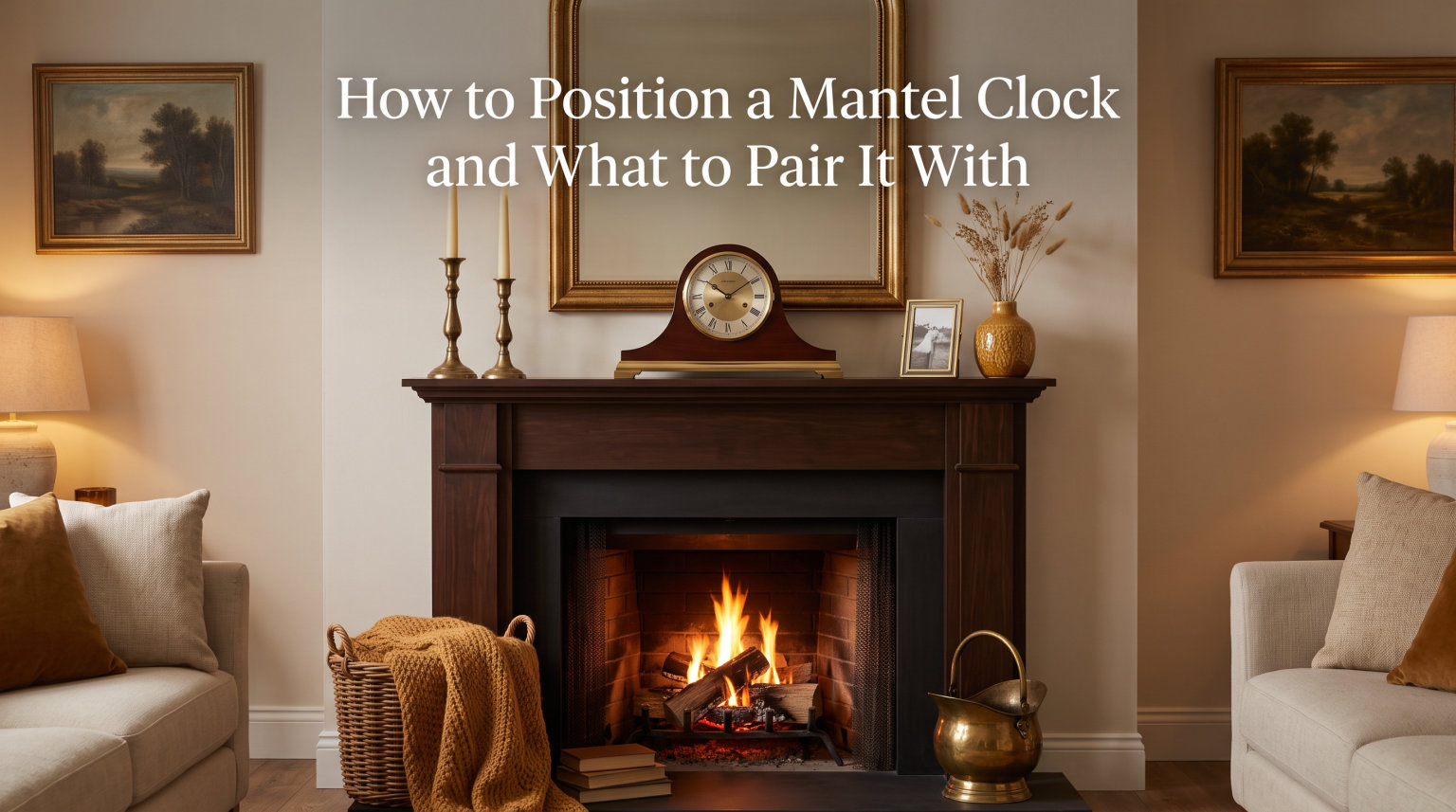
A mantel clock does more than tell time. It anchors a room, draws the eye, and gives your fireplace a clear focal point that feels intentional rather than random. But getting the placement right is what separates a styled mantel from a cluttered shelf.
Whether you inherited a 1920s heirloom or picked up a new piece for your living room, where you set it and what you surround it with will make or break the look. I have spent years styling mantels in homes ranging from tiny apartments to sprawling century homes, and the same principles apply everywhere.
In this guide, I will walk you through exactly how to position a mantel clock and what to pair it with so your display looks balanced, polished, and full of character.
Table of Contents
Fireplace Mantel Placement Guidelines
The fireplace mantel is the natural home for a mantel clock, and proper fireplace mantel clock positioning starts with one rule: center it. Place the clock in the middle of the mantel shelf, aligned with the center of the fireplace opening below. This creates instant symmetry and makes the clock the star of the wall.
If your room layout makes dead-center placement awkward, shift the clock slightly but keep it within the central third of the mantel. A clock pushed to one edge throws off the balance of the entire wall and makes the space feel lopsided.
Check your alignment from across the room. Stand back about eight to ten feet and look at how the clock lines up with the fireplace surround, the wall above, and any artwork hanging behind it. Small misalignments become obvious from a distance.
Make sure the clock sits flat and stable on the mantel surface. Use a small felt pad under each corner if the shelf is uneven. A wobbling clock not only looks sloppy but can also throw off the pendulum movement and chime mechanism inside.
Proportion Guide: Clock Size vs Mantel Width
No competitor I found online gives you actual numbers for matching clock size to mantel width. That stops here. Getting the proportion right is the single biggest factor in whether your mantel clock looks like it belongs or looks lost on the shelf.
Here is the ratio I recommend based on styling dozens of mantels: your clock should take up roughly one-quarter to one-third of the total mantel width. This leaves enough space on each side for complementary accessories without crowding.
For a standard 48-inch mantel, aim for a clock between 12 and 16 inches wide. A 60-inch mantel calls for a clock in the 15 to 20 inch range. If your mantel is on the narrow side at 36 inches, keep the clock between 9 and 12 inches so it does not overwhelm the shelf.
Height matters too. The clock should be tall enough to stand out above surrounding objects but not so tall that it dwarfs everything else. A clock that is roughly one-half to two-thirds the height of the items flanking it creates the most pleasing visual proportion.
Height Considerations and Visual Layering
Professional stylists use a technique called visual layering to make mantels look full and dynamic. The idea is simple: arrange objects at three different heights so the eye travels up and down rather than scanning a flat line.
Think of your mantel in three layers. The tall layer includes items like candlesticks, branching stems, or a piece of leaning artwork that reaches 18 to 30 inches above the shelf. The medium layer is your clock and medium-height vases, typically 8 to 15 inches tall. The low layer includes small objects like books, trays, or low sculptures that sit at 2 to 6 inches.
Your mantel clock usually anchors the medium layer right in the center. From there, build outward with tall items on one side and shorter groupings on the other. This asymmetrical approach feels more modern and collected than rigid symmetry.
Avoid lining up everything at the same height. Five objects all standing 10 inches tall looks like soldiers in a row. Varying heights create rhythm and make the arrangement feel designed rather than placed.
What to Pair With Your Mantel Clock
Once your clock is centered and proportioned, the accessories you choose to flank it will define the mood of your mantel. Here are the best pairings I have used and seen work across thousands of styled homes.
Candlesticks and taper candles are the classic companion. Use a pair of brass or wood candlesticks on one side of the clock, with heights that differ by at least three inches. The vertical lines complement the clock’s solid form beautifully.
Vases with fresh or dried stems add organic texture. A tall vase with eucalyptus or dried pampas grass on the opposite side of the candlesticks creates natural asymmetry. Keep the vase diameter smaller than the clock base so the clock remains the focal point.
Stacked hardcover books are a styling staple. Stack two or three books on the low layer and top them with a small object like a finial, a small sculpture, or a decorative box. Books add warmth and a sense of collected personality.
Framed family photos or small artwork leaning against the wall behind the clock adds depth. Use one large frame or a cluster of two smaller ones, positioned slightly off-center so the clock remains visually dominant.
A small tray or shallow bowl collects smaller items like matches, a remote, or seasonal touches. This keeps the mantel functional and prevents loose objects from looking scattered.
Styling Tips by Decor Theme
Your mantel clock styling should match the room around it. Here is how I approach the three most common decor themes.
For traditional decor, go symmetrical. Place matching candlesticks or matching vases on either side of the clock. Choose a clock with warm wood finishes, brass elements, and classic Roman numerals. Add a pair of porcelain pieces or silver candleholders to complete the formal look.
For modern and minimalist spaces, keep it spare. Use the clock as nearly the only object on the mantel with one sculptural piece offset to one side. Choose a clock with clean lines, a simple dial, and minimal ornamentation. Less is more here.
For rustic farmhouse styling, lean into texture and warmth. Pair a wood-cased clock with galvanized metal accents, a small bundle of dried cotton stems, and a weathered picture frame. Mismatched heights and vintage pieces give that collected-over-time feel.
Feng Shui Principles for Mantel Clock Placement
Feng shui offers guidance on clock placement that no competing article I found addresses. In feng shui philosophy, clocks represent the steady flow of time and energy, making their placement meaningful beyond pure aesthetics.
Place your mantel clock so the face is visible from the main seating area but not directly facing the front door. Feng shui practitioners believe a clock facing the entrance can feel like time rushing out of the home. Instead, position the clock where it is easily seen from where you actually sit and relax.
Avoid placing a chiming clock in the bedroom. The sound is thought to disrupt restful energy. Living rooms, dining rooms, and entryways are all considered ideal locations for a mantel clock in feng shui practice.
Alternative Placement Locations
No fireplace? No problem. Mantel clocks work beautifully in plenty of other spots around the home. I have styled them on bookshelves, console tables, dressers, and side tables with great results.
A console table in the entryway makes an excellent stage for a mantel clock. It greets guests immediately and sets a welcoming, classic tone for the home. Pair it with a lamp on one side and a small floral arrangement on the other.
A bookshelf or built-in shelving unit works well too. Place the clock on the center shelf at eye level and surround it with books and small collectibles. A bedroom dresser is another strong option, especially for smaller clocks that do not need a full mantel-width stage.
Common Mistakes to Avoid
Knowing where not to place a clock is just as important as knowing where to put one. Here are the mistakes I see most often.
Do not place a mantel clock near a heat source like a radiator or directly above a wood-burning fireplace that gets heavy use. Extreme temperature swings can damage the internal movement and dry out wooden cases, causing cracks.
Avoid placing the clock in direct sunlight. UV rays fade wood finishes and dial faces over time. If your mantel gets strong afternoon sun, consider sheer curtains or rotating the clock’s position seasonally.
Do not crowd the clock with too many accessories. If you cannot see the clock face clearly from across the room, the mantel is too busy. Edit down to three to five objects total, including the clock itself.
Finally, never place a pendulum clock on an unstable surface. The pendulum needs a level, vibration-free base to keep accurate time. A wobbly shelf or a table near a slamming door will throw off the mechanism.
FAQs
How to style a mantel with a clock?
Center the clock on the mantel, then flank it with accessories at three different heights: tall items like candlesticks or stems, medium items like vases, and low items like stacked books. Keep the total number of objects between three and five so the clock remains the focal point.
Where not to place a clock?
Avoid placing a clock near direct heat sources like radiators or heavily used wood-burning fireplaces, in direct sunlight that fades the finish, on unstable surfaces that disrupt pendulum movement, or in bedrooms if it has an audible chime.
Where to place a mantel clock?
The best place for a mantel clock is centered on a fireplace mantel, aligned with the center of the fireplace opening. If you do not have a fireplace, a console table in the entryway, a bookshelf at eye level, or a bedroom dresser are excellent alternatives.
What to pair with a mantel clock?
Pair a mantel clock with candlesticks of varying heights, vases with fresh or dried stems, stacked hardcover books topped with small objects, leaning framed artwork behind the clock, and a small tray for functional items. Keep the clock as the tallest or most prominent piece.
Conclusion
Learning how to position a mantel clock and what to pair it with comes down to three things: center your clock, match its size to your mantel, and build layers of varying heights around it. Follow the proportion guidelines, choose accessories that match your decor theme, and avoid heat and sunlight, and your mantel will look styled and intentional in no time.