
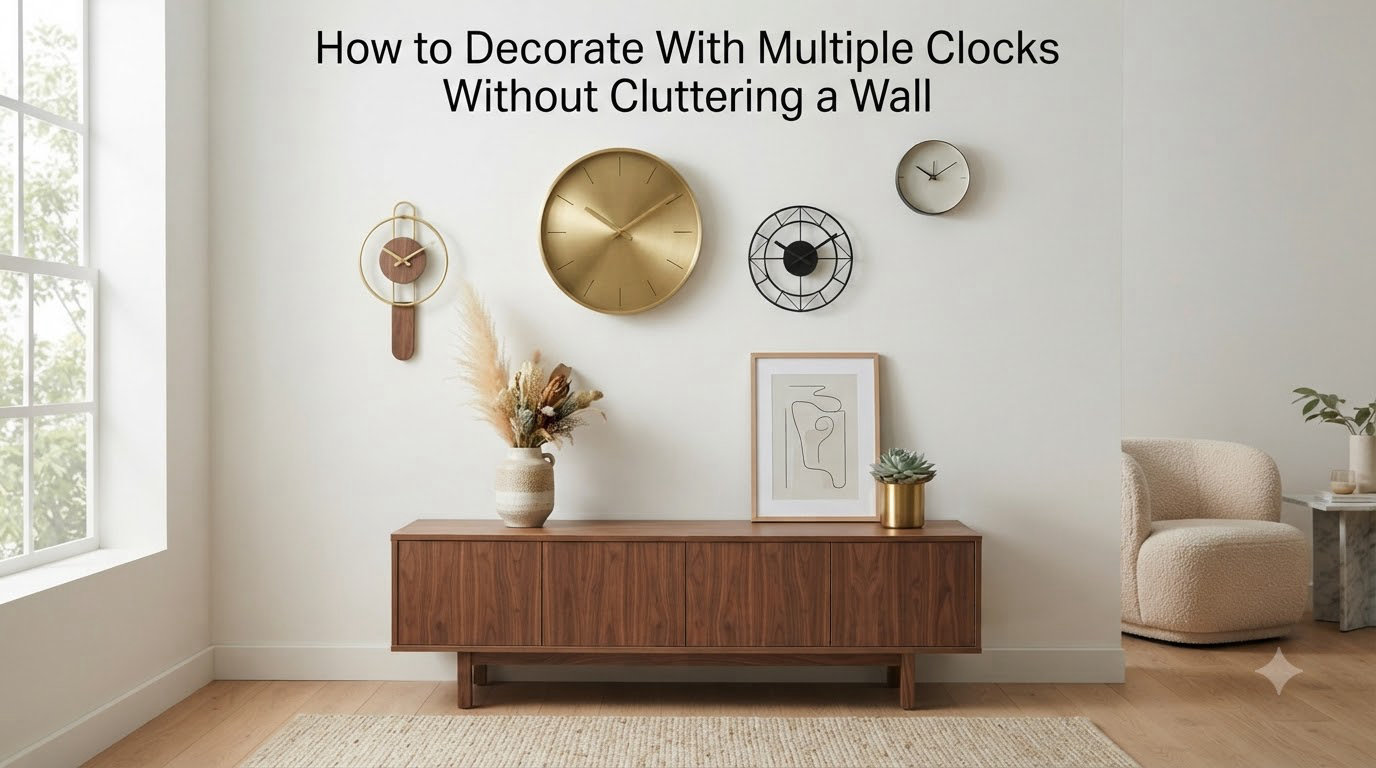
Decorating with multiple clocks on a single wall can look stunning when done with intention, or it can look like a chaotic jumble that overwhelms the space. The fear of clutter is the number one reason people hesitate to hang more than one clock, even when they have a beautiful collection waiting in storage. I have helped homeowners and renters alike transform bare walls into striking clock displays, and the process always comes down to a few simple principles anyone can follow.
In this guide, you will learn how to decorate with multiple clocks without cluttering a wall using proven arrangement patterns, specific spacing measurements, and style coordination techniques. Whether you have three clocks or ten, these strategies will help you create a display that looks deliberate, balanced, and visually appealing.
Table of Contents
The Difference Between a Clock Collection and Clock Clutter
Clutter happens when items feel random, unconnected, and thrown together without thought. A collection, on the other hand, reads as intentional because every element shares some visual thread, whether that is size, color, material, theme, or alignment.
The moment a viewer can sense a pattern or purpose behind your clock arrangement, the display stops feeling cluttered and starts feeling curated. This single shift in mindset is the foundation of everything that follows. Before you hang a single clock, decide what ties your group together, because that common thread is what separates design from mess.
A good test is to step back ten feet from your wall and squint. If the clocks blend into a muddy visual blob with no clear organization, you have clutter. If your eye can trace a line, a shape, or a deliberate grouping, you have a display.
The confusion often comes from maximalist interiors that successfully display dozens of objects on a single wall. Those walls work because every item is placed with precision, not because more stuff automatically looks good. The same logic applies to clocks: quantity is not the enemy, but careless placement always is.
How to Decorate With Multiple Clocks Without Cluttering a Wall
The process of creating a clutter-free clock wall comes down to five repeatable steps. Follow them in order and you will avoid nearly every common mistake.
Step 1: Choose Your Anchor Clock First
Every successful multi-clock wall starts with one dominant piece. This is your anchor clock, the largest or most visually striking timepiece in the group, and it sets the tone for everything around it.
Pick the clock you want people to notice first and plan the rest of the arrangement around it. The anchor should be roughly 1.5 to 2 times larger than the surrounding clocks so it stands as the clear focal point.
Step 2: Lay Out Your Arrangement on the Floor
Never start hammering nails without testing your layout first. Clear a space on the floor that matches your wall dimensions and arrange the clocks there, moving pieces around until the grouping feels balanced.
This step saves your wall from unnecessary holes and lets you experiment freely. Take a photo of the arrangement you like best so you have a reference when it is time to hang everything.
Use painter’s tape on the wall to outline the edges of your arrangement before committing to nails. Seeing the footprint on the wall helps you confirm the grouping fits the space without overwhelming it.
Step 3: Establish a Consistent Spacing Rule
Random spacing is the fastest path to a cluttered look. Pick a distance between clocks and stick with it throughout the entire arrangement.
For most walls, a gap of 3 to 6 inches between clock edges creates breathing room without disconnecting the grouping. Larger clocks need wider gaps, while smaller clocks can sit closer together.
Step 4: Use Odd Numbers for Natural Balance
Interior designers and collectors on forums like Reddit consistently report that odd-numbered groupings of 3, 5, or 7 clocks look more natural and balanced than even-numbered sets. Odd numbers force asymmetry in a way that feels organic, while even numbers can feel stiff or symmetrical to a fault.
If you have an even number of clocks, consider adding one more or removing one to hit that odd count. The difference is immediately noticeable.
Step 5: Hang From the Center Outward
Start by hanging your anchor clock at the visual center of your arrangement, then work outward adding supporting clocks one at a time. Step back after each piece to check the balance before adding the next.
This method prevents the drift that happens when you hang left to right and end up with a lopsided result. Working from the center keeps the arrangement grounded and symmetrical within its own footprint.
Arrangement Patterns That Keep Clocks Organized
Three arrangement styles cover nearly every multi-clock wall scenario. Each one creates a different mood and works best in specific situations.
Grid Arrangement: Symmetry Made Simple
A grid layout places clocks in neat rows and columns, like a two-by-two or three-by-three matrix. This pattern works beautifully when all your clocks are the same size or very close to it, creating a clean, orderly look that reads as deliberate.
Grids are ideal for modern and minimalist interiors where structure and precision are valued. They also work well in home offices where a sense of organization reinforces the room’s purpose.
Keep every gap between clocks identical in a grid, both horizontally and vertically. Even small inconsistencies become obvious in a grid layout because the pattern is so structured.
Linear Alignment: Clean and Orderly
A linear arrangement places all clocks in a single horizontal or vertical row. Horizontal lines work well above sofas, console tables, and kitchen counters, while vertical lines suit narrow wall spaces like those beside a doorway.
One decorator I studied lined up all the city name tags above a row of time zone clocks in one straight line, which added instant order to clocks of varying sizes. That simple alignment trick works even when the clocks themselves differ in height or width.
For a horizontal line, align the centers of all clocks at the same height rather than their tops or bottoms. This creates a more pleasing visual flow than lining up edges.
Cluster Technique: Intentional Grouping
Clustering is the most artistic arrangement style and the one no competitor guide explains well. In a cluster, clocks are grouped tightly together in an organic shape that resembles a constellation or cloud formation.
The secret to a clutter-free cluster is varying clock sizes dramatically while keeping the spacing consistent. Place your largest anchor clock slightly off-center, then surround it with progressively smaller clocks, maintaining even gaps between each piece.
Clusters work best on large, empty walls where the grouping can serve as a statement piece. They are the go-to choice for maximalist decorators who want to showcase a genuine clock collection without it looking accidental.
Spacing Guidelines With Specific Measurements
Getting spacing right is the single biggest factor in avoiding a cluttered appearance. Here are measurements that work across most rooms and clock sizes.
For clocks under 12 inches in diameter, leave 3 to 4 inches between edges. For clocks between 12 and 24 inches, leave 5 to 7 inches. For oversized clocks over 24 inches, leave 8 to 12 inches so each piece can be appreciated individually.
The outer edge of your entire arrangement should sit at least 6 inches from adjacent furniture, door frames, or ceiling moldings. Crowding the boundaries of your wall makes even a well-planned grouping feel cramped.
Hang your anchor clock so its center sits between 57 and 60 inches from the floor, which is standard gallery height and roughly at eye level for most people. Build the rest of your arrangement outward from that starting point.
Always use a level and a measuring tape when marking hanging positions. Eyeballing distances leads to uneven results that become painfully obvious once all the clocks are in place. A stud finder helps you locate solid mounting points for heavier pieces.
Matching Clock Sizes and Styles for Visual Balance
Size variation is what gives a clock wall depth and interest, but the variation needs to follow a rule. Include one dominant clock, one or two mid-sized pieces, and several smaller clocks to create a hierarchy that guides the eye.
If every clock is the same size, the wall can feel flat or repetitive. If sizes vary too wildly with no middle ground, the arrangement loses cohesion and starts to look random.
Style cohesion matters just as much as size. You do not need identical clocks, but they should share at least one element, whether that is a consistent frame material like wood or metal, a shared color family, or a common design era.
Mixing a sleek modern clock with a rustic farmhouse piece and an industrial metal clock can work if they all share warm tones. Mixing without any shared thread is where clutter creeps in.
Face color is another easy unifying element. Clocks with white faces, regardless of their frame style, will read as a cohesive set from across the room.
Consider the wall color behind your clocks as well. Dark clock frames pop against light walls, while light or metallic frames stand out against darker paint. If your wall is already a bold color, choose clocks with neutral faces to avoid visual competition.
Room-by-Room Clock Wall Ideas
Different rooms call for different approaches to multi-clock displays. Here is how to adapt the principles above to specific spaces in your home.
Living Room Clock Displays
The living room is where most people want their clock wall to shine, and it usually offers the largest blank canvas. Above the sofa is the classic spot, where a linear row of three clocks or a centered cluster of five creates an instant focal point.
Leave at least 6 to 8 inches between the bottom of your lowest clock and the top of the sofa back. This gap prevents the clocks from feeling crowded by furniture and gives the arrangement room to breathe.
If your living room has a fireplace, consider flanking the mantel with a vertical pair of clocks on either side rather than crowding them all above it. This distributes visual weight and draws attention to the architectural feature.
Kitchen and Dining Areas
Kitchens are a natural home for multiple clocks, especially time zone displays that let you track family members in different cities. A linear arrangement above a counter or between cabinets keeps the look clean in a space that already has a lot of visual elements.
Choose clocks with simpler faces for the kitchen, since ornate details compete with cabinetry and appliances. Small to medium clocks in the 8 to 14 inch range work best in this tighter space.
Avoid hanging clocks directly above the stove or sink where heat and moisture can damage mechanisms over time. An open wall between upper cabinets is usually the safest and most visually balanced spot.
Home Office and Entryway
In a home office, a grid of identical or similar clocks reinforces the room’s organized feel and can even serve a practical purpose if you track multiple time zones for work. Two rows of two clocks create a tidy, professional look.
Entryways benefit from a single bold cluster of three clocks that welcomes guests without overwhelming a typically narrow wall. Keep the arrangement compact since entryway walls are often small and shared with hooks, mirrors, or light fixtures.
Time Zone Clock Walls: A Sentimental Approach
One of the most popular reasons people hang multiple clocks is to stay connected with family or friends living in different time zones. This approach gives your clock wall real meaning beyond decoration, which automatically elevates it from clutter to collection.
The trick that experienced decorators use is adding city name labels above or below each clock. Lining up all the labels in one straight horizontal row, even when the clocks vary in size, creates instant visual order that ties the whole display together.
Print city names on sticker paper, mount them on foam board for durability, and attach them with double-sided tape. Set each clock to its correct time zone before hanging, because adjusting hands after installation risks knocking pieces out of alignment.
Choose cities that have personal meaning, such as where your children live, places you have traveled, or destinations on your bucket list. This transforms a decorative choice into a conversation piece that tells your family story.
Common Mistakes That Make Clock Walls Look Cluttered
Avoid these frequent errors and your clock wall will stay looking intentional rather than messy.
Do not hang clocks at random heights. Mixed vertical positions without a pattern is the fastest way to make a grouping look accidental. Stick to your arrangement plan and measure twice before drilling.
Do not place clocks on walls that are already busy with art, photos, or patterned wallpaper. Multiple clocks compete with existing decor and create visual overload. Give clocks their own dedicated wall space whenever possible.
Do not forget about ticking sounds. Several clocks ticking in unison can become surprisingly loud in quiet rooms. If the ticking bothers you or your guests, remove the batteries from decorative clocks and set them to different times as a static display.
Do not mix battery-operated clocks with non-functioning ones without a plan. A wall where some clocks show the correct time and others are stuck at random hours looks unintentional. Either keep them all running or commit to a static display with hands set to deliberate positions.
Do not skip the hardware. Lightweight clocks may survive on a single nail, but heavier pieces need wall anchors or stud-mounted screws. A clock that shifts or sags over time throws off your entire spacing and ruins the clean look you worked to create.
FAQs
How many clocks is too many on one wall?
There is no fixed number, but most designers recommend staying between 3 and 7 clocks on a single wall. Beyond that, the display becomes difficult to organize and risks looking cluttered unless you have a very large wall space and a clear unifying theme like time zones.
How to decorate without adding clutter?
The key is intentionality. Choose items that share a visual thread such as color, material, or theme, maintain consistent spacing between pieces, and limit yourself to odd-numbered groupings. Step back and view the wall from ten feet away to confirm the arrangement reads as deliberate rather than random.
Where should you avoid placing clocks?
Avoid placing clocks on walls already crowded with artwork, above beds where they could fall, directly opposite televisions where they compete for attention, and in spots with heavy sun exposure that can fade clock faces over time.
What to pair with a clock on the wall?
Floating shelves work well above or below clocks and can hold small plants, books, or framed photos. Mirrors, framed art, and sconces placed on either side of a clock also create a balanced composition. Keep complementary pieces smaller than the clock so it remains the focal point.
Can you have more than one clock in a room?
Yes, multiple clocks in a room work well when each serves a different wall or purpose. Many decorators disperse a collection across different walls rather than grouping everything together, aiming for 2 to 3 clocks per wall. The key is giving each clock enough surrounding space so it does not compete with nearby pieces.
Conclusion
Learning how to decorate with multiple clocks without cluttering a wall comes down to intention, consistency, and a clear plan. Choose an anchor clock, pick an arrangement pattern, maintain even spacing, and give your clocks a shared visual thread. With these principles, your clock collection becomes a statement of style rather than a source of clutter.