
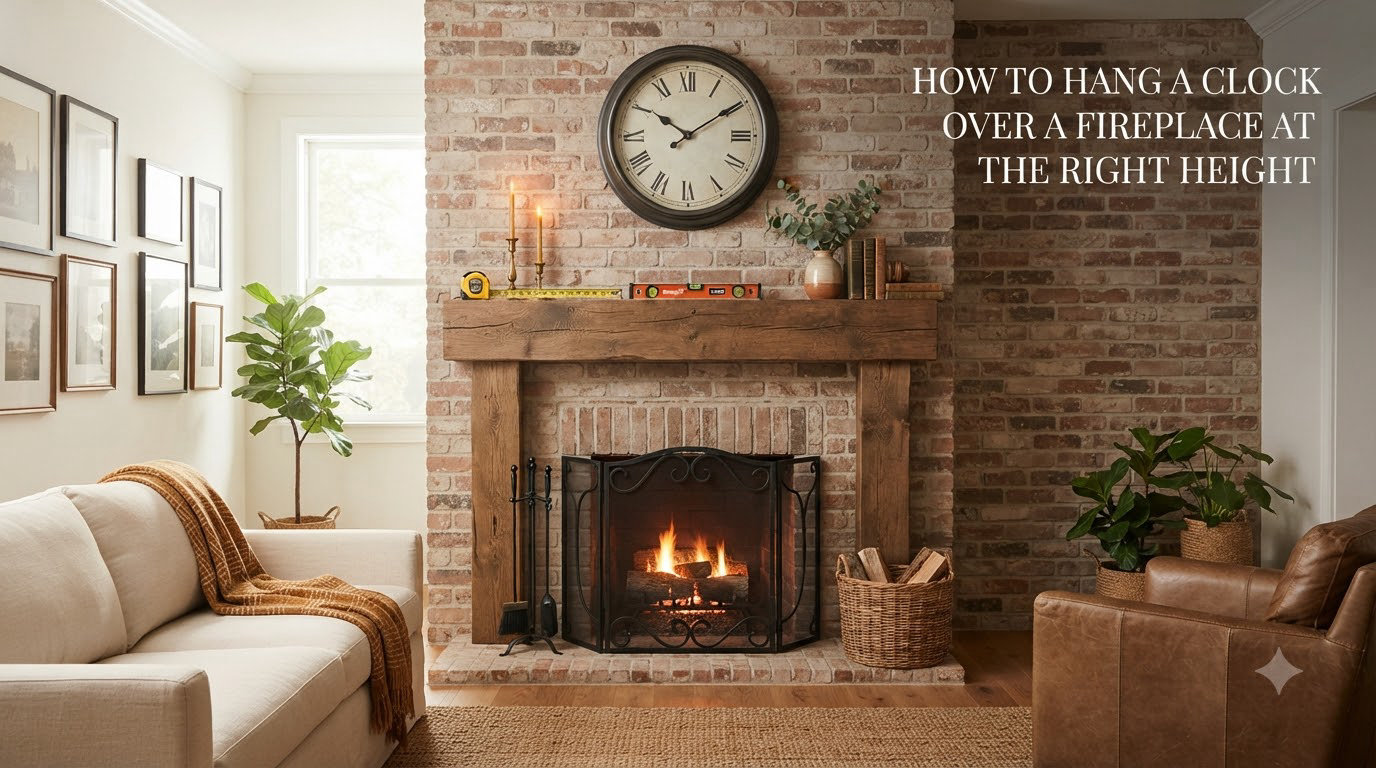
A clock above a fireplace does more than tell time. It anchors the room, draws the eye, and turns a blank stretch of wall into a proper focal point. But getting the placement wrong can throw off the entire look or, worse, send your clock crashing to the mantel.
If you have been staring at that empty space above your mantel wondering where exactly the clock should go, you are in the right place. This guide walks through exactly how to hang a clock over a fireplace at the right height, with specific measurements, the correct hardware for every wall type, and the heat warnings that most guides skip entirely.
I have pulled together the standard interior design rules along with real-world advice from homeowners who have done this themselves. By the end, you will know the exact height, the exact tools, and the exact steps to get it right the first time.
Table of Contents
The Right Height to Hang a Clock Over a Fireplace: 57 to 60 Inches
The standard rule for hanging a clock over a fireplace is to place the center of the clock between 57 and 60 inches from the floor. This range lines up with average eye level and keeps the clock comfortable to read without tilting your head up or down.
When you are hanging the clock above a mantel specifically, there is a second measurement to keep in mind. The bottom edge of the clock should sit about 3 to 6 inches above the top of the mantel. This gap creates breathing room and prevents the clock from looking crowded against the shelf.
Most mantels sit between 52 and 58 inches off the floor. If your mantel already falls in that range, you simply measure 3 to 6 inches above it and hang. If your mantel is unusually low or high, prioritize the 57-to-60-inch center-of-clock rule over the mantel gap.
Tools and Hardware You Will Need
Gather your tools before you start so you do not end up halfway through with a missing drill bit. Here is what you need:
Stud finder (for drywall installations)
Tape measure and a pencil for marking
Level (a small torpedo level works fine)
Drill with the correct bit for your wall type
Wall anchors rated for at least double your clock’s weight
Screws that fit your clock’s hanging hardware
Hammer and possibly a masonry bit (for brick or stone)
The golden rule on weight is simple. If your clock weighs 5 pounds, use hardware rated for at least 10 pounds. Doubling the capacity gives you a safety margin that prevents disasters.
Step-by-Step: How to Hang a Clock Over a Fireplace
Learning how to hang a clock over a fireplace comes down to five clear steps. Follow them in order and you will have a secure, level, centered installation.
Step 1: Measure and Mark the Height
Start by measuring from the floor to find your target height. For most installations, you want the center of the clock at 57 to 60 inches. Mark that height lightly with a pencil.
If your mantel is in the standard range, measure 3 to 6 inches above the mantel top and mark that spot instead. Then verify it falls within the 57-to-60-inch window. Adjust if the two numbers conflict.
Step 2: Find the Center Above the Mantel
The clock must sit centered over the mantel, not centered to the ceiling or the wall. Measure the width of your mantel, divide it in half, and use a level to draw a vertical plumb line up from the center point.
This is where many people go wrong. They center the clock on the wall itself, but the wall may be wider than the mantel. Always center to the mantel for visual balance.
Where your horizontal height mark crosses your vertical center line is your hanging point. Mark it clearly.
Step 3: Check for a Wall Stud
Run your stud finder across the marked area. If a stud sits behind your hanging point, you can screw directly into the wood framing. This is the strongest possible mounting method.
If there is no stud at the center, do not panic. This is extremely common above fireplaces. You will use a wall anchor instead. Pick an anchor rated for at least double your clock’s weight and follow the anchor manufacturer’s installation instructions.
Step 4: Drill and Install the Anchor
For drywall, drill a pilot hole sized to your anchor and tap the anchor in flush. For brick or stone, switch to a masonry bit and drill into a mortar joint whenever possible. Mortar is softer and easier to repair if you ever remove the clock.
Insert a masonry anchor or plastic sleeve into the drilled hole. Then drive your screw in, leaving enough of the screw head exposed to catch the clock’s hanging bracket.
Step 5: Mount, Level, and Check
Lift the clock onto the screw or bracket. Step back and check it with a level. Small adjustments are easier if you leave a bit of play in the screw rather than driving it flush.
Give the clock a gentle downward tug to confirm it is seated securely. If it holds firm, you are done.
Hanging on Different Wall Types
Every fireplace surround is different, and your hardware needs to match the material. Here is what works for each common wall type.
Drywall Above the Fireplace
Drywall is the easiest surface to work with. Use a stud finder first. If you catch a stud, a single 2-inch wood screw will hold most clocks without any anchor at all.
If no stud is present, use a toggle bolt or a heavy-duty plastic anchor. Toggle bolts are the better choice for clocks over 10 pounds because they spread the load behind the drywall.
Brick Fireplace Surrounds
Brick requires a carbide-tipped masonry bit and some patience. Drill slowly to avoid cracking the brick face. Aim for the mortar joints between bricks whenever you can, since mortar drills faster and holds anchors well.
Use a lead sleeve or plastic masonry anchor sized to your screw. Insert it into the drilled hole, then drive the screw in to hang the clock. Homeowners on home improvement forums consistently report this method as reliable for heavy clocks.
Stone and Natural Stone Surfaces
Stone is the toughest surface to drill. You need a hammer drill with a carbide or diamond-tipped masonry bit. Mark your spot with a piece of painter’s tape to keep the bit from wandering on the uneven surface.
Drill into mortar joints if your stone is laid with them. For stacked stone without mortar, drill directly into a stone face using steady pressure and a slow speed. Use a masonry anchor designed for concrete and stone.
Fireplace Heat: Will It Damage Your Clock?
This is the warning most guides gloss over, and it comes straight from real homeowner experiences. Heat rising from a gas or wood fireplace can damage a clock sitting directly above it.
One homeowner reported that warmth from their gas fireplace warped the backing of their clock and caused the hands to stick when rotating. Others have described battery compartments warping and adhesives softening over time.
If you use your fireplace regularly, consider these precautions. Keep at least 12 inches of clearance between the top of the fireplace opening and the bottom of the clock. Choose a clock with a metal or solid wood backing rather than thin composite materials. Check the clock periodically for warping if the fireplace runs often during winter.
If heat is a serious concern, a battery-operated quartz clock handles temperature swings better than a mechanical pendulum clock. Fewer moving parts means fewer things to warp and stick.
Clock Size and Proportion Tips
The right height only looks right if the clock is properly sized for the space. A clock that is too small gets swallowed, and one that is too large overpowers the mantel.
A good rule is to choose a clock that is roughly one-half to two-thirds the width of your mantel. If your mantel is 60 inches wide, look for a clock between 30 and 40 inches in diameter. This keeps the proportions balanced.
For two-story rooms, the standard 57-to-60-inch rule still applies for reading height. But visually, you may need a larger clock or a clock with a visible frame to hold its own against the tall wall. Some designers hang a larger clock slightly higher and pair it with smaller decorative pieces below to fill the vertical space.
The Picture Rail Alternative
If you are nervous about drilling into brick or stone, or if you rent and cannot modify the wall, a picture rail is a clever workaround. A picture rail is a thin molding installed horizontally above the mantel. You hang the clock from the rail using picture wire and hooks.
Homeowners love this method because it lets you swap decorations without putting new holes in the wall. You can move the clock, adjust its height, or replace it entirely without any patching or repainting. It is one of the most underused solutions for fireplace wall decorating.
Where Not to Place a Wall Clock
A few spots above a fireplace are asking for trouble. Avoid placing a clock directly over the fireplace opening where heat is most intense. Skip spots with no wall stud and no room for a proper anchor if your clock is heavy. And never hang a clock on wallpaper or plaster that is already cracking, since the vibration of the clock movement can worsen the damage over time.
FAQs
What is the correct height to hang a clock?
The correct height to hang a clock is 57 to 60 inches from the floor to the center of the clock. This range aligns with average eye level and keeps the clock easy to read. When hanging above a mantel, leave a 3-to-6-inch gap between the top of the mantel and the bottom of the clock.
Can you put a clock above a fireplace?
Yes, you can put a clock above a fireplace. It is a popular placement that creates a strong focal point. Just make sure to use anchors rated for your clock’s weight and keep at least 12 inches of clearance between the fireplace opening and the clock to avoid heat damage.
How to hang a clock on a stone fireplace?
To hang a clock on a stone fireplace, use a hammer drill with a carbide or diamond-tipped masonry bit. Mark the spot with painter’s tape, drill slowly into a mortar joint if possible, then insert a masonry anchor and drive in a screw. Leave enough screw exposed to catch the clock’s hanging bracket.
How high to mount a mantel above a fireplace?
A standard mantel mounts between 52 and 58 inches from the floor. Most building codes require at least 12 inches of clearance between the fireplace opening and the bottom of a combustible mantel. Check your local fire code for exact requirements before installing.
Where not to place a wall clock?
Avoid placing a wall clock directly over a heat source, on cracking plaster, or in spots without proper anchoring for heavy clocks. Also avoid hanging clocks in direct sunlight, which can fade clock faces and damage battery compartments over time.
Wrapping Up
Knowing how to hang a clock over a fireplace at the right height comes down to three things: the 57-to-60-inch measurement, centering to the mantel, and matching your hardware to the wall material. Add in the heat precautions and proportion guidelines from this guide, and your clock will look intentional, stay secure, and keep running for years. Grab your tape measure, pick your spot, and get hanging.