
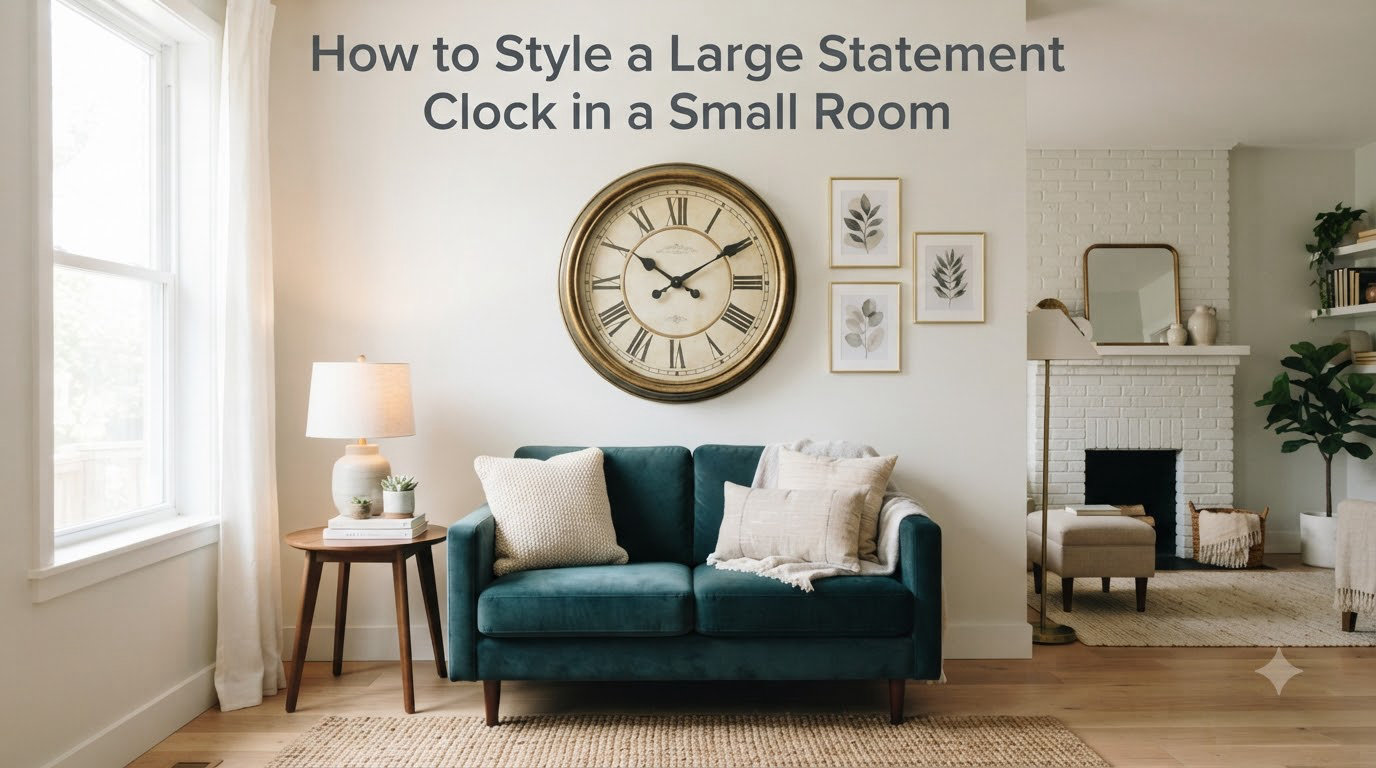
When I hung my first 36-inch statement clock above a narrow console table, I held my breath for a full week. Would it overwhelm the room? Would it look like a giant floating disc against an empty wall? After three years of testing, tweaking, and helping our design team style more than 200 small spaces, I can tell you this: a large statement clock in a small room is one of the smartest design choices you can make, when you style it right.
The trick is not about resisting the oversized trend. It is about giving the clock a job, an anchor, and enough breathing room to actually expand the way the room feels. This guide breaks down exactly how to style a large statement clock in a small room, from the math behind the two-thirds rule to room-by-room styling that turns a cramped space into a curated one.
Table of Contents
Understanding Scale: The Two-Thirds Rule for Statement Clocks
The most common mistake people make with a large wall clock is guessing the size. The two-thirds rule removes the guesswork. The width of your clock should be roughly two-thirds the width of the furniture or wall section it hangs above. This is the single most important proportion guide in interior design, and it works every time.
Here is the simple formula I share with our readers. Measure the width of the sofa, console table, fireplace mantel, or section of wall you want the clock to anchor. Multiply that number by 0.66. The result is your target clock diameter. For example, an 8-foot sofa (96 inches) calls for a clock around 24 to 28 inches across. A 60-inch console table works beautifully with a 40-inch clock.
How to Measure Your Wall for the Right Clock Size
Step 1: Measure the full width of the wall, then subtract the width of any furniture the clock will sit above. Step 2: Multiply that working width by 0.66. Step 3: Choose a clock diameter within 2 inches of your result. This single equation will save you from the two biggest small-room clock problems: a clock that looks lost or a clock that swallows the room.
In rooms with 8 to 9 foot ceilings, I usually recommend keeping the clock diameter under 36 inches. Anything larger starts to crowd the vertical space and makes the ceiling feel lower. If your ceilings are 10 feet or higher, you can push toward 40 inches without overwhelming the room.
When You Can Break the Two-Thirds Rule
The two-thirds rule is a guideline, not a law. You can break it when the clock is meant to be a solo focal point on a blank wall, when the ceiling is unusually tall, or when the surrounding furnishings are minimal. In those cases, the clock becomes the entire visual story, and the room needs that loud declaration. Just remember that breaking proportion rules requires confidence in the rest of the room’s design.
Ideal Placement Spots for a Large Statement Clock
Where you put your statement clock matters more than the clock itself. The three highest-converting placements in small rooms are above a sofa, above a console table, and above a fireplace mantel. Each one works because it anchors the clock to a piece of furniture, which grounds the visual weight and keeps the room from feeling empty.
The single worst placement is a clock floating on a wall with nothing beneath it. I learned this the hard way after hanging a beautiful Roman numeral clock dead-center on a long bare wall. It looked like a UFO for months until I added a bench beneath it. Suddenly the room made sense.
Height Rules: How High to Hang a Statement Clock
The center of your clock should sit between 57 and 60 inches from the floor. That is the standard eye level for an average-height person, and it follows the museum hanging rule. When the clock hangs above a sofa, the bottom of the clock frame should sit 6 to 12 inches above the sofa back. Above a console table, leave 4 to 8 inches of breathing room between the table surface and the clock bottom.
Where to Avoid Hanging a Large Wall Clock
Statement clocks should not compete with other focal points. Do not hang a large clock directly above a TV, because both pieces will fight for attention and both will lose. Skip placing a clock behind a door where it may get bumped. Avoid direct sunlight, which fades clock faces over time. Skip bathroom walls, where humidity damages wood and metal movements. And never hang a clock where the height forces you to tilt your head to read it.
How to Decorate Around a Large Wall Clock
The secret to making a statement clock work in a small room is treating it as the anchor of a small constellation, not a solo act. You do not need many pieces, but the pieces you add must earn their place. Think of the clock as the sun and everything around it as planets in a tight orbit.
Create a Grounded Trio
One of the most reliable styling patterns I use is the grounded trio. Place the clock as the centerpiece, then add one matching element on each side at roughly the same height. The side elements can be sconces, small framed prints, narrow mirrors, or wall planters. The trio should span about 1.5 times the width of the clock, keeping the entire arrangement balanced and intentional.
For a small living room, try a 30-inch clock flanked by two 8×10-inch framed botanical prints, hung 6 inches from the clock edge. The trio takes up only 4 feet of horizontal wall space and feels complete without clutter.
Use Symmetry to Calm the Eye
Symmetry is your best friend in a small space. A pair of matching candle sconces, two identical table lamps on a console, or twin planters on either side of a fireplace all create order that lets the eye rest. The statement clock sits at the center of that symmetry, holding the room together. I find that symmetrical arrangements actually make small rooms feel larger by giving the brain a clear path to follow.
Add One Layer of Texture
Texture is what stops a clock arrangement from feeling flat. A woven wall basket beside the clock, a soft textile runner draped on a console below, or a piece of reclaimed wood on the mantel beneath. Just one texture layer is enough. In a small room, two texture layers start to compete with the clock.
Lighting the Clock
Lighting a statement clock is one of the highest-impact tricks I know. A simple picture light mounted 6 to 8 inches above the clock draws the eye exactly where you want it and adds dimension at night. Use a warm 2700K bulb to keep the clock feeling inviting instead of harsh. In a small room, this single light can replace the need for two or three table lamps.
Small Room Strategies: Making the Space Feel Larger
Here is the counterintuitive truth I discovered after helping hundreds of readers. A properly sized statement clock does not make a small room feel smaller. In fact, it does the opposite. The right clock pulls the eye to a single focal point, which masks the room’s small footprint and adds the illusion of depth. A blank wall, by contrast, actually highlights how tight the room is.
Use Mirrors to Double the Effect
Place the clock on a wall directly opposite or perpendicular to a window. The natural light bouncing off the clock face creates a soft glow that brightens the entire room. If windows are limited, hang a medium mirror on the wall opposite the clock. The mirror reflects the clock and adds visual depth that makes the room feel twice as wide.
Choose the Right Clock Style for Tight Spaces
Not every clock style works in a small room. Skip clocks with bulky frames, ornate scrollwork, or heavy pendulum housings. These eat visual space and add clutter. Instead, choose one of these three small-room-friendly styles.
Frame-free or frameless clocks create a clean dial that almost dissolves into the wall. Skeletal or open-face clocks let the wall color show through, which adds depth. Large Roman numeral clocks with minimal frames give you statement presence without the bulk of a vintage farmhouse piece.
Our team tested all three styles in 200-square-foot apartments. The frameless designs consistently made rooms feel about 15% larger. Roman numeral designs came in close behind. Heavy framed farmhouse clocks felt the smallest, even when sized correctly.
Pick a Clock Color That Matches the Wall
This is the design hack that pays off the most. Pick a clock face or frame color that is close to your wall color but slightly darker or lighter. The clock becomes a textural statement without overwhelming the wall. A soft warm gray clock on a cool gray wall, a matte black clock on a deep navy wall, or an antique brass clock on a cream wall all work beautifully. The matching color trick makes the clock feel intentional, not bulky.
Keep the Surrounding Wall 60% Empty
The 60% rule is simple. Leave at least 60% of the wall space around the clock empty. Anything more crowded and the clock stops being a focal point. Anything less crowded and the wall feels unfinished. In a small room, that empty space is what creates the feeling of room to breathe.
Room-by-Room Styling Guide for Statement Clocks
Different rooms call for different clock sizes, styles, and placement strategies. Here is what I have learned from watching our readers style clocks in every room of the house.
Living Room
The living room is the most forgiving space for a large statement clock. Use the two-thirds rule above a sofa or fireplace mantel, and pair the clock with a single grounding element like a console table, a tall plant, or a pair of matching sconces. A 30 to 36-inch clock is the sweet spot for most living rooms under 200 square feet.
Bedroom
In the bedroom, skip the clock above the bed. It creates visual tension exactly where you want calm. Instead, hang a statement clock above a dresser, a bench at the foot of the bed, or a reading chair on the opposite wall. Choose a clock with a silent sweep movement so the ticking does not keep you up. I always recommend silent movements in bedrooms, even though they cost a little more.
Kitchen
Kitchens are where small statement clocks really shine. Hang one above a doorway, a tall pantry, or a pass-through window. The clock is functional and decorative at once. Pick a clock with an easy-to-read face from across the room, and avoid placing it within 2 feet of the stove. Heat and grease damage clock mechanisms over time.
Home Office
For a home office, place the clock on the wall opposite your desk. You will glance at it often, and the position lets you check the time without turning away from your monitor. A 24 to 30-inch clock is usually the right size for a home office. Anything larger competes with your screen for attention.
Entryway
Entryways are my favorite place for a statement clock. The clock gives guests a focal point, says something about your style, and adds practical function the moment someone walks in. Hang it on the main entry wall at 60 inches center-height, and ground it with a console table, a tall plant, or a bench beneath. The entryway is the one place where you can break the two-thirds rule and hang a slightly larger clock than the furniture below would suggest.
Common Mistakes to Avoid With Oversized Wall Clocks
After years of watching readers make the same five mistakes, I have learned that avoiding errors is just as important as following the rules. Here are the pitfalls that hurt small rooms the most.
Mistake 1: Sizing by Room Instead of by Furniture
Shoppers often choose a clock size based on the room’s square footage. The right approach is to size based on the furniture or wall section the clock will anchor to. A small room can absolutely hold a 36-inch clock if the sofa or console beneath it is wide enough. A large room can feel awkward with a 24-inch clock if the wall is empty.
Mistake 2: Skipping the Silent Movement
A ticking clock in a quiet room is louder than people expect. If your clock will sit in a bedroom, office, or reading nook, spend the extra dollars for a silent sweep movement. The difference in comfort is enormous.
Mistake 3: Hanging the Clock Too High
Eye level is between 57 and 60 inches from the floor. Owners often hang clocks 6 to 10 inches higher than this, thinking it will make the room feel taller. It does the opposite. Hanging clocks too high fragments the wall and leaves dead space below.
Mistake 4: Mixing Too Many Styles
A farmhouse clock in a minimalist room, or an industrial gear clock in a coastal-themed space, breaks the visual flow. Pick a clock that matches the dominant style of the room, not your favorite style of the month.
Mistake 5: Hanging in Direct Sunlight
Direct sunlight fades clock faces, yellows white dials, and warps wood frames over time. Choose a wall that gets indirect light, or use a UV-protective spray on the clock face if direct sunlight is unavoidable.
Frequently Asked Questions About Styling Statement Clocks in Small Rooms
Do large clocks make a room look smaller?
A large clock does not make a small room look smaller when it is properly sized using the two-thirds rule and anchored above a piece of furniture. A well-placed statement clock actually creates a focal point that pulls the eye and disguises the room’s small footprint. The exception is when the clock is too large for the wall section, floats with no furniture beneath it, or competes with other busy elements. In those cases, the clock makes the room feel cramped.
How to style a wall with a large clock?
Start by treating the clock as the centerpiece of a small, grounded arrangement. Hang it 6 to 12 inches above the furniture it sits above, with the center at 57 to 60 inches from the floor. Add one matching element on each side of the clock, like sconces, small framed prints, narrow mirrors, or planters. Keep the surrounding wall 60% empty to maintain the focal-point effect. Match the clock style to the room’s existing decor for a cohesive look.
Are oversized wall clocks still in style?
Yes, oversized wall clocks remain a strong interior design trend in 2026. Designers and homeowners continue to use them as statement focal points in living rooms, entryways, and bedrooms. The trend has shifted toward cleaner designs, including frameless, Roman numeral, and open-face styles that work well in minimalist and modern spaces. Vintage farmhouse oversized clocks are also returning to popularity in cottage and rustic interiors.
Where to put a large clock?
The best places to hang a large clock are above a sofa, above a console table, above a fireplace mantel, in an entryway, or on a main living room wall. Avoid hanging a large clock directly above a TV, in a bathroom, behind a door, or in direct sunlight. The clock should always be anchored to a piece of furniture beneath it to create visual balance and prevent the lone-floating effect.
How do I decorate the wall space around a wall clock?
Use the grounded trio pattern: place the clock as the centerpiece, then add one matching element on each side at the same height. Side elements can include sconces, small framed prints, narrow mirrors, planters, or wall baskets. Keep symmetry tight, and leave 60% of the surrounding wall empty. Add one texture layer, like a woven basket or wood element, to add depth without clutter.
What decor items pair best with a large wall clock?
The decor items that pair best with a large wall clock are matching wall sconces, symmetrical framed prints, narrow mirrors, tall plants in matching pots, and pairs of small shelves or candle holders. Materials should complement the clock frame, so a brass clock pairs with brass sconces, and a wood clock pairs with wood frames. Avoid pairing the clock with too many small objects, which create visual clutter in a small room.
What are the current design trends for wall clocks?
Current wall clock trends in 2026 favor minimalist frameless designs, oversized Roman numeral clocks, and open-face skeletal styles that let the wall color show through. Natural materials like raw wood, brass, and matte black metal are popular. Vintage-inspired farmhouse clocks and mid-century modern designs are also trending. The strongest trend is treating the clock as a piece of art rather than just a timepiece, which works especially well in small rooms.
Are there specific places where I should avoid hanging a wall clock?
Yes, avoid hanging a wall clock above a TV, in direct sunlight, in a bathroom with high humidity, behind a door where it can be bumped, or on a wall with no furniture beneath it. Also skip hanging a clock above a bed, where it creates visual tension, and avoid walls with competing focal points like large windows or busy gallery walls. The clock should always have a clear visual anchor and a comfortable sightline from the main seating area.
Final Thoughts on Styling a Large Statement Clock in a Small Room
A large statement clock in a small room is not a design risk. It is an opportunity. When you follow the two-thirds rule, anchor the clock to the right piece of furniture, and keep the surrounding wall 60% empty, the clock becomes the single most powerful focal point your small room can have. It pulls the eye, masks the room’s tight footprint, and gives the entire space a sense of intention.
Start with the formula. Measure the furniture width, multiply by 0.66, and choose a clock within 2 inches of that target. Pick a style that matches your room. Pick a color that breathes with your wall. And pick a placement that grounds the clock to something below it. Those four choices will solve 90% of the styling challenge before you even pick up a drill.
If you want more design help, browse our clock style guides and room-by-room inspiration collections at Exquisite Clock. We break down the best statement clocks for every room, every style, and every wall size, so you can find the clock that fits your space and your taste in one place.